
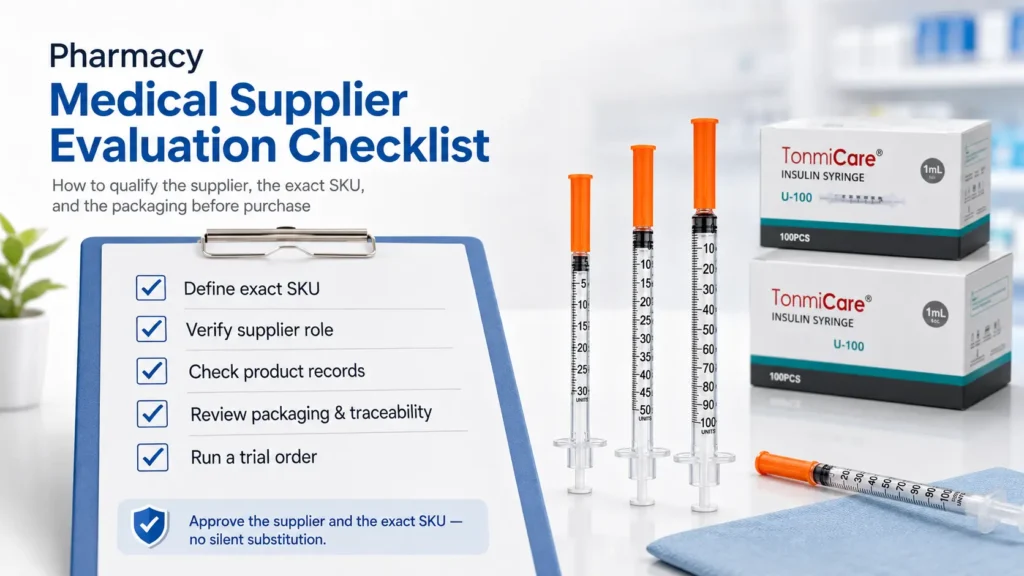
U.S. Pharmacy Supplier Qualification Guide
A practical framework for evaluating suppliers of finished medical devices and disposable consumables—moving from non-negotiable qualification gates to exact-SKU approval, controlled trial orders, weighted comparison and ongoing performance review.
Reviewed by
Scope: This guide is a risk-based procurement framework for U.S. organizations purchasing finished medical devices and disposable medical consumables. It is not a universal legal checklist and does not replace state pharmacy law, accreditation, reimbursement, contract, regulatory or quality advice. Requirements must be adapted to the buyer's role, exact product, intended market, supplier relationship and internal procedures.
Direct answer
How Should a Pharmacy Evaluate a Medical Supplier?
Start by defining the exact product, packaging, destination market and service requirement. Identify the supplier's legal and commercial role, then apply non-negotiable gates for product identity, applicable market records, traceability, change control and written commercial terms. Only suppliers that pass those gates should enter weighted scoring. Validate the winning candidate with a controlled trial order, approve named SKUs rather than an unlimited catalog, and monitor delivery, accuracy, shelf life, documentation and issue response over time.
A low price or high score cannot compensate for an unidentified legal manufacturer, mismatched product records or an unauthorized substitution. Conversely, a large certificate folder does not prove that the quoted SKU fits the pharmacy's needs. The objective of a medical supply vendor evaluation is an evidence-based purchasing decision with recorded limits.
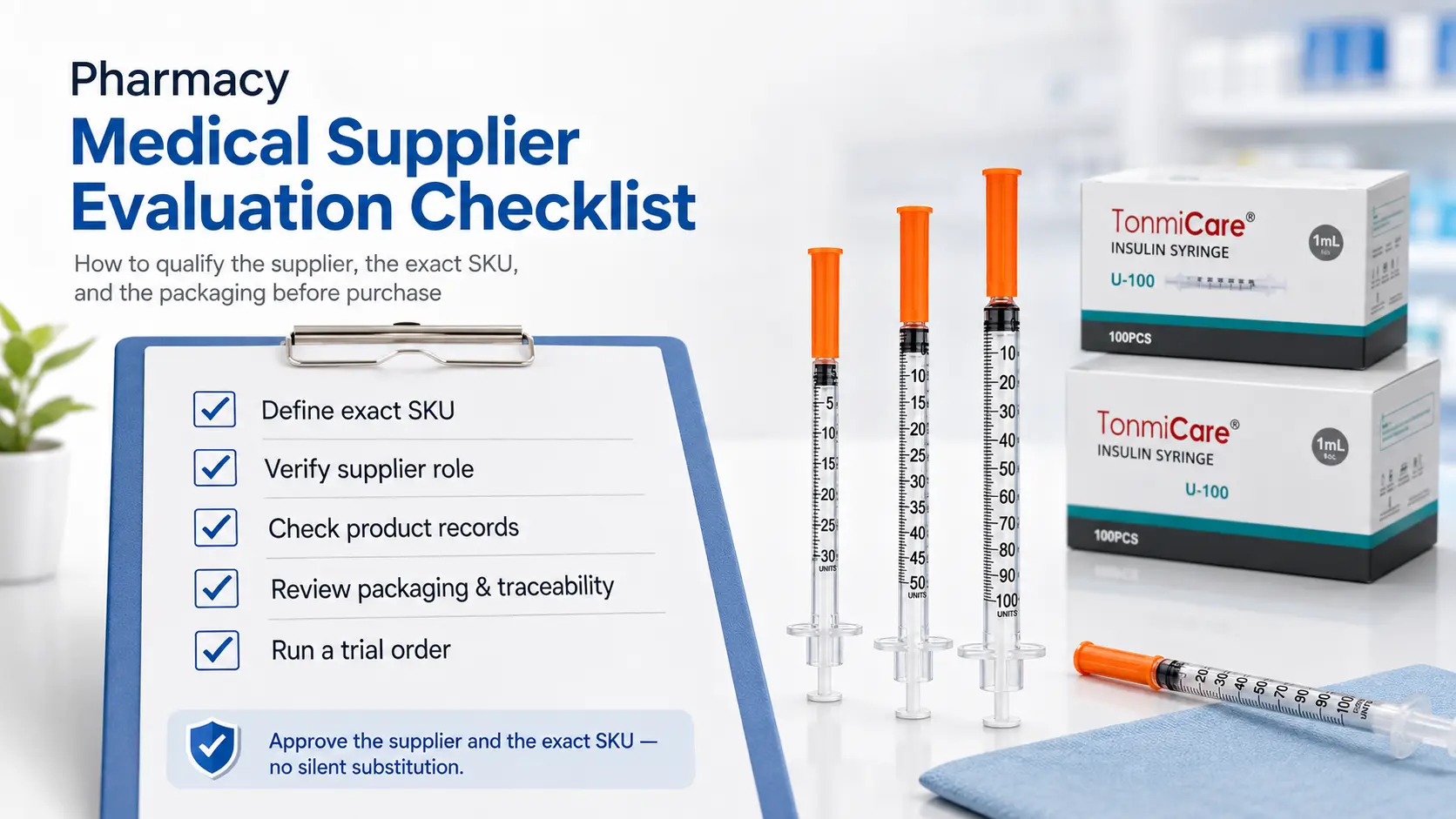
1. Define the Scope Before Using a Supplier Evaluation Checklist
“Healthcare supplier evaluation” can refer to several different processes. This article addresses finished products such as insulin syringes, pen needles, lancets, alcohol prep pads, sharps containers and similar medical consumables. Buyers evaluating these categories can also review wholesale diabetes care supplies by product family and specification.
Prescription-drug wholesaler qualification, Medicare DMEPOS participation, sales-representative credentialing and manufacturer control of component or sterilization suppliers are different systems. The last of these is governed by the device manufacturer's quality system; it should not be presented as a pharmacy's automatic ISO 13485 supplier-control duty. FDA's QMSR, which became effective February 2, 2026, applies to finished-device manufacturers that intend to commercially distribute medical devices.[6]
| Purchase or activity | Primary framework | Use this checklist? |
|---|---|---|
| Finished medical devices and consumables | Supplier role, exact product, applicable records, quality, logistics and performance | Yes—main scope |
| Certain prescription drugs | DSCSA authorized trading-partner and tracing requirements | Use a separate drug process[8] |
| DMEPOS billed to Medicare | CMS enrollment, supplier standards and applicable accreditation | Add the CMS process[9] |
| Capital or connected equipment | Installation, maintenance, cybersecurity, uptime, training and service contracts | Expand substantially |
| Components, contract manufacturing or sterilization | Manufacturer QMS purchasing and outsourced-process controls | Use the manufacturer's QMS |
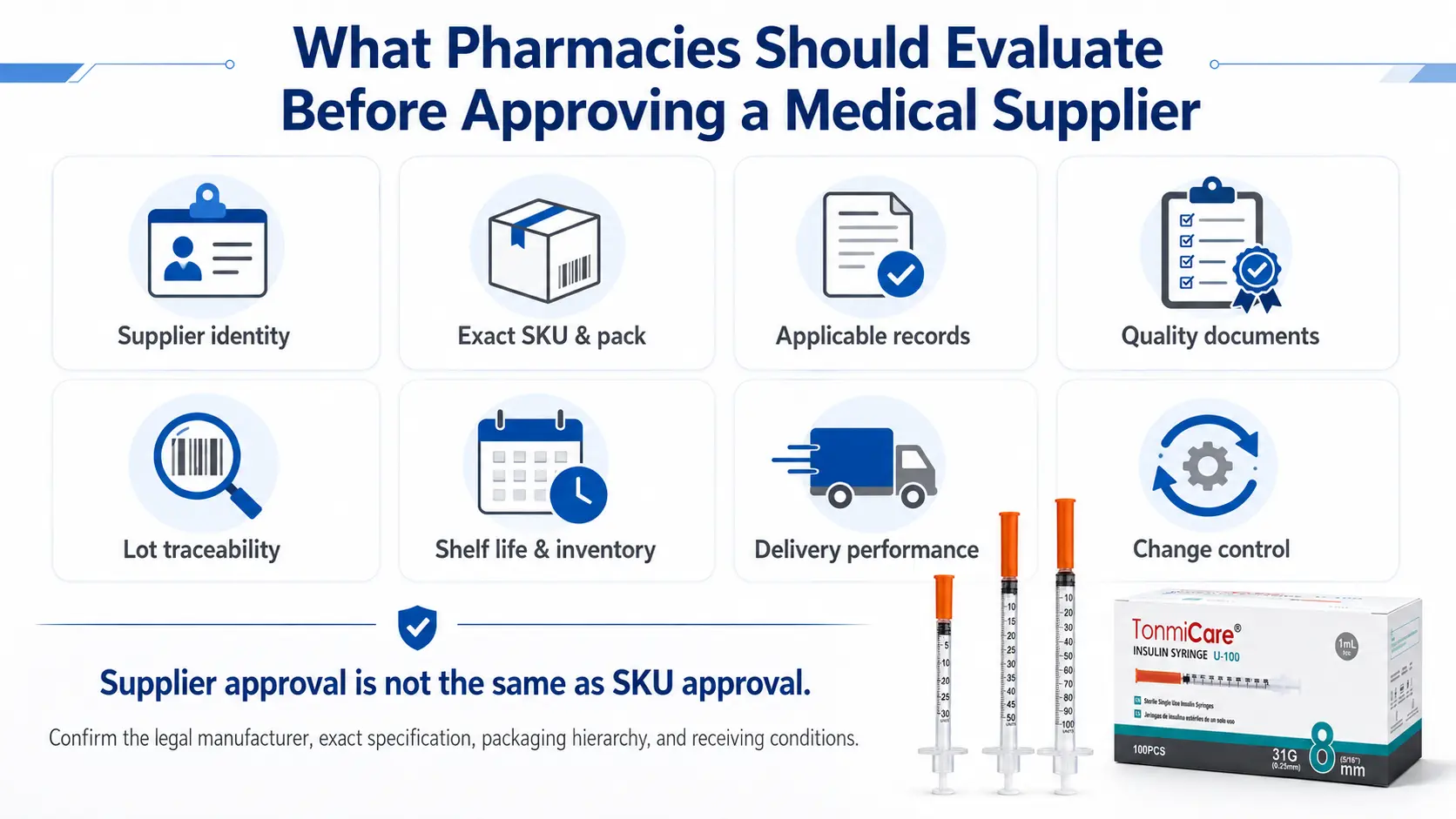
2. Supplier Approval Is Not the Same as SKU Approval
A supplier may be competent for one product family and unsuitable for another. It may distribute several brands, use more than one manufacturer or quote different package quantities under similar descriptions. Therefore, the approved-supplier record and the approved-product record should be linked but separate.
The operating rule
Supplier approval defines who may supply. SKU approval defines exactly what may be purchased. A new gauge, length, capacity, brand, legal manufacturer, REF, unit count, case pack or private-label version requires review before it is added to the approved product list.
| Supplier status | SKU status | Permitted purchasing action |
|---|---|---|
| Approved | Approved | Purchase within the recorded SKU, pack, market and terms |
| Approved | Not reviewed | Do not purchase until the new SKU is evaluated |
| Conditional | Trial approved | Limit quantity, duration and receiving conditions |
| Suspended | Previously approved | Pause new orders while the defined issue is investigated |
| Rejected | Any | Do not add to the purchasing system |
3. Define the Product and Purchasing Requirement First
A supplier cannot be evaluated against an undefined need. “Insulin syringes, good quality, fast delivery” is not a comparison baseline. The pharmacy procurement checklist should first state the exact product and receiving conditions so every candidate quotes the same requirement.
- Product identity: generic device type, intended use, brand requirement and legal manufacturer where known.
- Specification: model or REF, capacity, gauge, length, scale, material, sterile status and relevant design features.
- Packaging: units per pouch or bag, units per box, boxes per case, labeling language, barcode and shipping-carton needs.
- Commercial need: forecast, order frequency, MOQ, target delivery window, destination and acceptable payment terms.
- Inventory policy: minimum remaining shelf life, lot restrictions, single- or mixed-lot acceptance and backup-supply needs.
- Documentation: public records, controlled product files, lot-specific records and shipment documents required at each stage.
- Change control: which changes require advance written notice and reapproval.
Record “must-have” criteria separately from preferences. A must-have is a requirement whose failure makes the product unusable, nonconforming or outside the approved procurement scope. Preferences may be scored only after all must-have requirements are satisfied.
4. Identify the Supplier's Legal and Commercial Role
The same company name can appear as seller, distributor, importer, labeler, brand owner or manufacturer. These roles are not interchangeable. Ask the candidate to identify the legal entity signing the quotation and invoice, the legal manufacturer of the product, the source of inventory and the party responsible for labeling, complaints, recalls and change notifications.
| Supplier role | Primary evaluation focus | Evidence to request |
|---|---|---|
| Manufacturer | Legal entity, site, product scope, manufacturing controls and applicable device records | Site identity, quality-system evidence, product specification and applicable records |
| Brand owner or labeler | Brand, label responsibility, UDI/DI where applicable and relationship to the maker | Labeler identity, approved labeling, identifier mapping and responsibility matrix |
| Distributor or wholesaler | Authorized sourcing chain, storage, exact-SKU accuracy, traceability, returns and recall execution | Source confirmation, lot/expiry fields, warehouse controls and escalation contacts |
| Importer | Manufacturer identity, import role, labeling and transaction continuity | Responsible parties, product records and shipment/import information as applicable |
| Broker or trading company | Transparency of actual manufacturer, title/source of goods and control over records | Written supply-chain map and product-specific supporting evidence |
| Private-label supplier | Manufacturer, labeler, artwork, UDI, complaints, recalls and change responsibilities | Signed responsibility matrix, approved specification and artwork/version records |
Role ambiguity is a gate failure
If the candidate will not identify the actual manufacturer or cannot explain how the offered product, labels and records connect to the invoicing entity, do not treat the issue as a minor score deduction. Resolve the identity gap before commercial comparison.
5. Apply Non-Negotiable Qualification Gates
Gates prevent a high service score or attractive unit price from masking a basic qualification failure. Each gate should have a result—pass, fail, not applicable or open—and a named piece of evidence. “Pending” should not be silently converted into “pass.”
Identity
Quoting entity, supplier role, legal manufacturer, brand and relevant site are identified.
Exact product
SKU or REF, specification, labeling and unit/box/case configuration agree.
Applicable status
Required market records are verified for the device—not assumed from a certificate.
Traceability
Lot, expiry, order and source fields can be retained and retrieved where applicable.
Issue control
Complaint, quality and recall contacts plus escalation routes are defined.
Change control
No product or packaging substitution occurs without written buyer approval.
Commercial clarity
Price basis, MOQ, case pack, shelf life, delivery and return terms are written.
Evidence integrity
Critical records are current, authentic, in scope and matched to the quoted SKU.
The pharmacy should define in advance which open items allow conditional approval and which require rejection. For example, a standard commercial reference may be supplied after the initial screen, while an unresolved legal manufacturer or contradictory label should stop the evaluation.
6. Verify the Exact Product and Applicable FDA Records
For U.S. medical-device sourcing, begin with classification and product identity—not marketing phrases such as “FDA certified.” FDA states that establishment registration and device listing do not denote approval, clearance or authorization, and FDA does not issue device registration certificates.[1]
Determine the product code, regulation number, class and applicable premarket pathway. Most Class I and some Class II devices are exempt from 510(k), subject to limitations; other devices may require 510(k), De Novo, PMA or another applicable pathway.[2] A blanket demand for a 510(k) from every supplier is therefore as unreliable as accepting any 510(k) number without checking its coverage.
- Classify: identify the device type, regulation and product code in FDA sources.
- Determine pathway: confirm whether the device is exempt or whether a specific premarket record applies.
- Match parties: compare applicant, legal manufacturer, listing entity and labeler roles.
- Match product: compare device name, model/family, intended use, specification and actual labeling.
- Check identifiers: review UDI/DI and GUDID data where applicable, including brand, model and package quantity.[5]
- Record the result: save database date, search terms, record numbers and the reason the evidence covers the approved SKU.
FDA's public databases support verification, but a database hit does not by itself establish supplier reliability, commercial authorization, correct current inventory or conformity of the received lot. Product status is one gate within the broader medical device supplier qualification process.
7. Review Supplier and SKU-Specific Documentation
The document review should answer a decision question, not reward page count. Separate company-level evidence from product-, lot- and shipment-level records. State whether each file is public, controlled, confidential, lot-specific, unavailable or not applicable. Tonmit buyers can request SKU-specific documentation support for an active sourcing project.
| Evidence level | Examples | What it can support |
|---|---|---|
| Company and site | Legal entity, address, role, quality certificate and certificate scope | Who is involved and which operations/sites are covered |
| Exact SKU | Specification, label, IFU where applicable, REF, pack hierarchy and product records | What product is being reviewed and whether records match it |
| Lot or release | Lot, expiry, CoC, CoA or release/sterilization record where used | Whether the specific production lot meets defined release evidence |
| Order and shipment | Purchase-order confirmation, invoice, packing list, carton and shipping records | Whether the approved item and quantity entered the transaction |
ISO 13485 certification can be relevant quality-system evidence, but it is not a general product authorization and should be checked for organization, site, scope, certification body and validity. FDA's incorporation of ISO 13485:2016 into QMSR does not mean FDA requires or issues an ISO 13485 certificate; FDA states that it will not require certificates of conformance to ISO 13485 for QMSR inspections.[7]
For the broader boundaries of Tonmit's support and buyer responsibility, review Tonmit's compliance-support scope. Availability and applicability must still be confirmed for the selected product and commercial arrangement.
8. Evaluate Product Quality, Packaging and Traceability
“High quality” is not a measurable answer. Convert it into controls that can be checked against documents, samples and receipts. For disposable medical consumables, this usually includes specification consistency, sterile barrier and package condition where applicable, label accuracy, pack counts, lot and expiry visibility, complaint handling and the supplier's ability to trace affected stock.
- Specification, label and physical product use the same brand, model/REF and declared features.
- Individual, box and case quantities match the approved packaging hierarchy.
- Sterile products use the correct sterilization claim and intact sterile-barrier configuration.
- Lot and expiration fields are legible, consistent across relevant packaging levels and captured at receiving.
- Barcodes and UDI/DI data are checked where applicable; package quantity and hierarchy are not assumed.
- The supplier can link a simulated or actual lot to available inventory, shipment records and the proper escalation contact.
- Product changes are controlled through a documented notification and approval process.
Traceability should be tested, not merely promised. Give the supplier a sample scenario—such as a complaint involving a named lot—and ask which records it can retrieve, who makes decisions, how affected inventory is controlled and how downstream customers are contacted. The expected response should reflect the supplier's actual role rather than responsibilities it does not own.
9. Test Complaint, Recall and Change-Notification Processes
Before approval, identify separate commercial and quality contacts. Ask how a suspected defect, damaged sterile barrier, labeling conflict, shortage, incorrect lot or customer complaint will be acknowledged, investigated and resolved. The agreement should also state how urgent safety or field-action notices will reach the pharmacy.
Control
Identify and quarantine or otherwise control affected inventory under the buyer's procedure.
Notify
Send the SKU, lot, quantity, evidence and issue description to the named contact.
Investigate
Determine scope, source, affected transactions and the parties responsible for action.
Resolve
Record disposition, corrective action, customer communication and supplier-status impact.
Search FDA's Medical Device Recalls database for the product and relevant firms as part of due diligence.[4] A recall record is not an automatic rejection: evaluate the cause, scope, timeliness, communication and corrective response. Likewise, absence from a public recall search does not prove that a supplier has no quality risk.
Change notification should cover the fields that define approval, including legal manufacturer, manufacturing site, material, key specification, sterilization method, shelf life, labeling, packaging, brand/labeler, UDI, case quantity and source relationship as applicable. The buyer should decide which changes require reapproval before further shipment.
10. Verify Inventory and Supply-Continuity Claims
“In stock in the USA” is not enough for a recurring supply decision. Inventory may be allocated to another customer, pending quality release, short-dated, held by a third party or available only in a different pack. Verify the claim at the exact SKU and lot level.
| Claim | Evidence-based question | Decision field |
|---|---|---|
| U.S. inventory available | Which exact REF and pack are physically held, in what quantity and at which fulfillment location? | Available-to-promise quantity by SKU |
| Ready to ship | Is stock released, unallocated and orderable before the stated cut-off? | Release and allocation status |
| Acceptable shelf life | What are the lot, expiration date and remaining shelf life at expected delivery? | Buyer-policy pass/fail |
| Recurring supply | What replenishment lead time, reorder point, capacity and backup route support the forecast? | Continuity plan and trigger |
| Fast delivery | Which carrier, service level, order cut-off and destination assumption support the promise? | Written delivery basis |
Buyers can evaluate U.S.-warehouse fulfillment by exact SKU and should still confirm current lot, quantity, allocation and shipping terms at order placement. A warehouse capability page does not guarantee perpetual stock for every catalog item.
11. Evaluate Delivery, Shelf Life, Returns and Receiving Controls
Supplier performance becomes visible at receiving. Before a trial order, agree on the requested ship date, delivery window, partial-shipment rules, carton labeling, documents, acceptable remaining shelf life, damaged-goods process, returns, credits and the handling of shipping discrepancies.
- Purchase order, confirmation, packing list and invoice use the approved SKU and case quantity.
- Delivered quantity, lot and expiry agree with shipment records and receiving policy.
- Cartons are intact, identifiable and appropriate for the product and transport route.
- Shortages, overages, damage and substitutions are reported before acceptance.
- Return authorization, credit timing, restocking fees and nonreturnable conditions are written.
- Expedited freight promises state the service level and exclusions rather than only “fast delivery.”
A pharmacy should define whether remaining shelf life is measured at shipment or receipt and whether mixed lots are allowed. There is no universal shelf-life threshold for every consumable; the minimum should reflect forecast, turnover, safety stock, customer commitments and internal policy.
12. Compare Total Cost Instead of Unit Price
Normalize every proposal to the same approved SKU, package quantity, case quantity, shelf-life basis, destination and delivery terms. Then evaluate the cost that reaches the receiving dock—not the visually lowest number in a quotation.
Relevant items can include minimum-order effects, inner and case quantities, domestic or international freight, duties where applicable, payment fees, labeling or setup charges, inspection, short-dated inventory risk, damage, returns, documentation effort and shortage exposure. Expected-risk costs should use the buyer's evidence and assumptions; they should not become an invented surcharge used to force a preferred vendor result.
Pharmacies comparing recurring or bulk programs can review wholesale medical supply programs and request a quote based on the same specification and receiving terms used in the scorecard.
13. Conduct a Controlled Sample and Trial Order
A sample helps verify basic configuration, labeling and packaging, but it may not test inventory allocation, picking accuracy, commercial documentation, shipping condition or issue response. A controlled trial order tests the actual transaction. Define its limits and acceptance criteria before ordering.
| Trial check | Compare against | Record |
|---|---|---|
| Product identity | Approved SKU/REF, specification, brand and labeling | Pass, discrepancy or unauthorized substitution |
| Pack accuracy | Unit, box and case quantities in quotation and purchase order | Count and variance |
| Lot and shelf life | Receiving policy and promised minimum remaining shelf life | Lot, expiry and policy result |
| Delivery | Confirmed date, quantity and destination | On-time/in-full result |
| Condition | Packaging and product acceptance criteria | Damage, shortage and inspection result |
| Documents | Agreed pre-shipment and shipment document list | Complete, late, incorrect or missing |
| Response | Agreed acknowledgement and resolution process | Time and adequacy of action |
Do not confuse a sample with commercial approval
A sample may come from a different lot, packaging version or production arrangement. Record what was sampled, retain the evidence needed by the buyer's procedure and confirm that the commercial shipment matches the approved configuration. Evaluation samples should not enter usable inventory unless all applicable acceptance and receiving requirements are satisfied.
14. Use a Weighted Medical Supplier Scorecard
Score only candidates that pass the mandatory gates. Use the same questions, evidence period and scoring rules for every candidate. The weights below are an adjustable procurement example—not a legal, FDA, ISO or accreditation requirement.
| Evaluation dimension | Example weight | Evidence to score |
|---|---|---|
| Exact product and packaging fit | 20% | Specification, sample, labeling, pack and approved-use match |
| Quality evidence and traceability | 20% | Applicable records, lot control, complaint response and change controls |
| Inventory and supply continuity | 20% | Available stock, replenishment, forecast support and backup plan |
| Logistics and receiving performance | 15% | OTIF, order accuracy, condition, shelf-life compliance and returns |
| Total cost and commercial terms | 15% | Normalized received cost, MOQ, payment, freight and risk assumptions |
| Service, change and issue response | 10% | Response quality, escalation, documentation SLA and corrective action |
| Total | 100% | Thresholds are set by the buyer's risk policy |
A five-point scale can be defined as 1 = unacceptable evidence, 2 = major gaps, 3 = minimum acceptable, 4 = strong and 5 = verified best fit. These labels must be supported by written examples. “Good service” should not earn a four unless the evaluator records response times, completeness and outcomes.
Do not let averaging erase critical risk. Gate results remain separate from the score, and evaluators should record major assumptions, missing data, conflicts of interest and why one candidate was selected over another.
15. Assign Approved, Conditional, Suspended or Rejected Status
The final record should be more precise than “vendor accepted.” State the legal supplier entity, approved site or source where relevant, approved SKUs, package quantities, destination market, documentation conditions, commercial limits, approval owner and next review trigger.
| Status | When to use it | Required control |
|---|---|---|
| Approved | All gates passed, trial/experience acceptable and score meets internal threshold | Limit approval to named products, packs, sources and terms |
| Conditional | Defined noncritical items remain open or only a trial is authorized | Set quantity/time limits, owner, due date and conversion criteria |
| Suspended | A material performance, quality, identity or change-control issue is under review | Pause new orders and define investigation/reinstatement conditions |
| Rejected | A mandatory gate failed or residual risk is unacceptable | Record the reason and prevent unapproved purchasing |
Private-label programs need additional role and version controls. Buyers should plan private-label medical supply responsibilities and coordinate controlled packaging and labeling before artwork or production is approved.
16. Monitor Performance and Use Risk-Based Requalification Triggers
Approval is not permanent. Track the few measures that reveal whether the supplier continues to deliver the approved product and service. Define the data source, calculation period, owner and action trigger so metrics are comparable.
| Metric | Calculation | What to investigate |
|---|---|---|
| Fill rate | Quantity shipped on the agreed initial shipment ÷ quantity ordered | Allocation, shortages, partial shipments and backorders |
| OTIF | Orders delivered on time and in full ÷ orders due | Promised dates, carrier exceptions and supplier-controlled delays |
| Order accuracy | Correct order lines ÷ total received order lines | Wrong SKU, pack, quantity, label or substitution |
| Shelf-life compliance | Accepted quantity meeting policy ÷ quantity received | Short-dated lots and promised-vs-received shelf life |
| Documentation SLA | Complete responses within agreed time ÷ document requests due | Late, mismatched, expired or incomplete records |
| Issue response | Time to acknowledgement, containment and agreed resolution | Severity, repeated delay and effectiveness of action |
There is no universal performance threshold or requalification interval for every medical consumable. Set them according to product risk, availability of substitutes, purchase volume, history and internal policy. In addition to a scheduled review, initiate event-based requalification when relevant.
- Legal manufacturer, manufacturing site, labeler, brand owner or critical supply relationship changes.
- Material, sterilization, specification, shelf life, packaging, labeling or UDI changes.
- A new SKU, pack quantity, destination market or private-label version is proposed.
- A quality certificate expires, changes scope or cannot be verified.
- Unauthorized substitution, repeated order errors or shelf-life failures occur.
- Complaint trends, recall activity, warning letters or import issues create relevant risk.
- Ownership, warehouse model, delivery route or business-continuity assumptions materially change.
17. Medical Supplier Evaluation Red Flags
Red flags are signals for investigation, not always proof of misconduct. The response should be proportional: clarify, request objective evidence, limit a trial, suspend approval or reject the candidate based on severity and whether the issue can be resolved.
| Red flag | Why it matters | Buyer response |
|---|---|---|
| “FDA certified” or generic registration certificate | Registration is not product approval and FDA does not issue device registration certificates | Verify official records and require accurate terminology |
| 510(k) number with no SKU mapping | The record may cover another applicant, device, model or intended use | Compare public record, labeling and marketed configuration |
| Manufacturer will not be disclosed | Product identity, accountability and evidence chain cannot be established | Treat as a failed identity gate unless resolved |
| Catalog, label, sample and quote conflict | The buyer may approve a different product from the one shipped | Stop and reconcile a single controlled specification |
| “Equivalent product may be substituted” | Uncontrolled changes can alter manufacturer, spec, pack or records | Prohibit substitution without prior written approval |
| U.S. stock without lot, expiry or allocation detail | Stock may not be usable or available for the order | Verify exact-SKU available-to-promise inventory |
| Unusually low price after normalization | Case pack, shelf life, freight, source or specification may differ | Recheck comparison basis and source before scoring |
| No quality or recall escalation contact | Urgent problems may be routed only through sales | Require named contacts and an escalation pathway |
18. Copyable Medical Supplier Due-Diligence Questions
Send the same core questions to shortlisted suppliers and require answers for the exact product and packaging configuration quoted. Add product-specific or contract requirements where needed.
Medical Supplier Evaluation Request
Please answer the following questions for the exact product, SKU/REF and packaging configuration in your quotation. Identify any item that is not applicable, confidential, unavailable or pending.
- What legal entity will quote, invoice and supply the order, and what is its supply-chain role?
- Who is the legal manufacturer, and what manufacturing site is relevant to this product?
- What are the exact brand, model/SKU/REF, specification and intended use?
- What are the unit, box, inner-carton and case quantities?
- Which current labels, IFU, product specifications and packaging images apply?
- Which FDA establishment, listing, product-code, classification and premarket records apply, if any?
- What UDI/DI and GUDID information applies, if required for the product and package?
- What quality-system evidence is available, and which legal entity, site and scope does it cover?
- What lot, expiration, release, sterility and traceability records are available for this product?
- Can you trace a lot to available stock, shipment records and the appropriate complaint or recall contact?
- Which product, manufacturing, labeling, packaging or source changes require notice, and how much notice is provided?
- Will you confirm that no product substitution will occur without our prior written approval?
- Which exact SKUs are currently available, in what quantity, lot and expiration, and are they released and unallocated?
- What replenishment lead time, capacity and backup-supply plan support our forecast?
- What are the MOQ, case price, freight basis, payment terms, delivery window and quote validity?
- What minimum remaining shelf life will be guaranteed at receipt?
- What are the damaged-goods, discrepancy, return, credit and recall procedures?
- What trial-order quantity and acceptance process do you recommend?
- Who are the sales, documentation, quality and urgent-escalation contacts?
Please explain any difference among the quoting company, legal manufacturer, labeler, brand owner, importer, warehouse operator and record holder.
Supplier evaluation worksheet & RFQ tools
Copy or download the blank templates, then enter the real SKU, evidence references, buyer-defined acceptance thresholds, supplier responses and receiving observations. Do not treat placeholders as verified supplier data.
Use the buttons above to prepare a supplier evaluation record.
Preview the editable templates
Gate,Result (Pass/Fail/Open/N/A),Evidence reference,Owner,Date,Follow-up
Legal entity and role,,,,,
Exact SKU/REF and pack,,,,,
Applicable regulatory status,,,,,
Lot and expiry traceability,,,,,
Complaint and recall escalation,,,,,
Change and substitution controls,,,,,
Written commercial terms,,,,,
Evidence validity and scope,,,,,

Scored criterion,Example weight,Score (1-5),Weighted points (0-100),Evidence reference,Notes
Exact product and packaging fit,20%,,,,
Quality evidence and traceability,20%,,,,
Inventory and supply continuity,20%,,,,
Logistics and receiving performance,15%,,,,
Total cost and commercial terms,15%,,,,
Service and issue response,10%,,,,

Receiving check,Expected evidence,Actual result,Pass/Fail/Review,Corrective action,Owner
SKU REF/label,Approved exact SKU,,,,
Unit box case quantities,Approved pack hierarchy,,,,
Lot and expiry,Receiving policy,,,,
Outer/sterile packaging,Approved condition criteria,,,,
Documents,PO/packing list/required files,,,,
Delivery,Confirmed window/quantity,,,,
Medical Supplier Evaluation - SKU-Level RFQ

Buyer / organization: [ ]
Destination market & delivery ZIP: [ ]
Product category and intended use: [ ]
Exact brand / REF / model: [ ]
Gauge / capacity / dimensions / required features: [ ]
Units per box and boxes per case: [ ]
Est. order quantity / replenishment forecast: [ ]
Required minimum shelf life at receipt: [ ]
Lot / label / UDI / documents required: [ ]
Please identify the selling entity, legal manufacturer, labeler and importer (where applicable).
Please specify applicable FDA records / exemptions matched to this SKU; no generic FDA certificate claims.
Please identify available inventory, allocation/release status and estimated lead time.
Please confirm samples or controlled trial terms, shipping terms, MOQ and validity.
Please state quality escalation and recall contacts and confirm no substitutions without prior written approval.
Please distinguish documents currently available from items requiring confirmation.
Method and limits: Assign pass/fail/open/N/A to mandatory gates; do not score a supplier with an unresolved critical gate. For eligible suppliers, score each criterion from 1 to 5, calculate the weighted result, then record a controlled trial receiving check. Weights are illustrative and should be approved by the buyer. No tests, case histories, sample receipts, or compliance outcomes are claimed.
Medical Supplier Evaluation FAQ
Does approving a supplier automatically approve every SKU?
No. Supplier approval confirms who may supply within defined limits; SKU approval confirms the exact product, manufacturer, specification, packaging and market configuration that may be purchased. A new SKU or material configuration requires review.
Is FDA registration proof that a supplier or product is approved?
No. FDA establishment registration and device listing do not denote approval, clearance or authorization. FDA also does not issue device registration certificates. Verify the exact establishment, device and applicable premarket status in official sources.
Does every medical device supplier need ISO 13485 certification?
No universal pharmacy-purchasing rule makes every seller or distributor ISO 13485-certified. The relevance depends on role, product, market and buyer policy. For a certificate that is requested, verify its entity, site, scope, issuer and validity. FDA states that QMSR inspections do not require an ISO 13485 certificate of conformance.
Does every medical device require a 510(k)?
No. Most Class I and some Class II devices are 510(k)-exempt subject to limitations. Determine the exact classification and pathway. When a 510(k) applies, match the applicant, device, models, product code, intended use and labeling to the offered SKU.
Should a pharmacy require a sample or trial order?
Risk and internal policy determine the requirement. A sample can verify basic configuration, while a controlled trial order tests commercial accuracy, lot and expiry, documents, delivery, condition and issue handling. Neither replaces applicable product and supplier evidence.
How often should a medical supplier be re-evaluated?
Use a risk-based interval set by the pharmacy; there is no single schedule for all consumables. Also trigger re-evaluation after material product, manufacturer, site, labeler, quality, supply, performance, ownership or regulatory changes.
How can a pharmacy verify a U.S.-warehouse inventory claim?
Ask for the exact SKU and pack, physical location, available-to-promise quantity, lot, expiration, release/allocation status, shipping cut-off and replenishment plan. Reconfirm at purchase-order placement because inventory changes over time.
Should a pharmacy maintain primary and backup suppliers?
For important or difficult-to-substitute products, a qualified backup may reduce disruption risk. The backup must be approved independently for exact SKUs; a contingency plan should not authorize an unreviewed substitute during a shortage.
What should happen when a supplier substitutes a product?
Do not accept the substitute automatically. Compare its manufacturer, SKU, specification, labeling, pack, UDI and applicable records, then approve or reject it through the defined change process. Control any already-received stock while the discrepancy is investigated.
What additional checks apply to private-label medical supplies?
Define the legal manufacturer, brand owner, labeler, importer and distributor roles; approve product specifications and artwork versions; confirm UDI and market responsibilities where applicable; and allocate complaint, recall, change, record-retention and traceability duties in writing.
Does DSCSA apply to syringes, pen needles and other medical devices?
DSCSA establishes tracing requirements for certain prescription drugs. Medical devices follow a different FDA framework. Pharmacies purchasing both should maintain correctly scoped procedures rather than applying drug transaction records as a substitute for device qualification.
What should happen if the received lot differs from approved records?
Quarantine or otherwise control the affected stock under the buyer's procedure, preserve the product and records, notify the supplier and quality contact, investigate scope and cause, and document disposition. Do not revise the approved product record merely to match what arrived.
19. Conclusion: Approve the Relationship and the Exact Product
A useful medical supplier evaluation checklist does more than ask whether a vendor has competitive prices, fast delivery or certificates. It establishes who is supplying, what exact product may be purchased, which evidence supports it, how the real order performs and what will happen when products or conditions change.
The strongest decision sequence is simple: fail unresolved mandatory gates, score only qualified candidates, verify promises through a controlled trial, approve named SKUs with recorded limits and monitor evidence that matters. That approach helps pharmacies compare medical consumables suppliers without turning voluntary internal weights into supposed legal requirements or allowing a high total score to conceal a fundamental product-identity gap.
SKU-level procurement support
Request a SKU-Level Medical Supply Review
Use our wholesale medical supplies hub to describe the exact SKU, intended market, pack configuration, estimated quantity, delivery destination, document requirements and proposed trial order. Quote and document availability are confirmed for the specific request; the inquiry topic is included in the link for tracking.
Official References
- U.S. Food and Drug Administration. Important Reminders About Registration and Listing.
- U.S. Food and Drug Administration. Class I and Class II Device Exemptions.
- U.S. Food and Drug Administration. Product Code Classification Database and 510(k) Premarket Notification Database.
- U.S. Food and Drug Administration. Medical Device Recalls Database.
- U.S. Food and Drug Administration. AccessGUDID for the Public.
- U.S. Food and Drug Administration. Quality Management System Regulation (QMSR).
- U.S. Food and Drug Administration. QMSR Frequently Asked Questions.
- U.S. Food and Drug Administration. Drug Supply Chain Security Act (DSCSA).
- Centers for Medicare & Medicaid Services. Enroll as a DMEPOS Supplier.
Editorial method: The source list describes the regulatory and procurement framework reviewed for this guide. Buyer-facing forms are illustrative blank worksheets developed for this article, not summaries of actual received lots or performed inspections. Official references and applicable device records should be rechecked at the time of each transaction; first published August 11, 2026.