
2026 Supplier Qualification & Procurement Guide
An evidence-informed framework for evaluating insulin syringe suppliers through regulatory identity, exact-SKU control, quality evidence, traceability, fulfillment performance and total operational cost.
Executive summary
Key Takeaways
- Do not qualify a supplier using an “FDA certificate.” FDA does not issue registration certificates to medical-device facilities, and registration or listing does not by itself mean that a device is approved or cleared.[1]
- Compare quotations only after fixing the exact insulin scale, capacity, graduation, needle gauge, needle length, catalog number, package hierarchy, labeling and allowed substitutions.
- Treat traceability as a working process. A buyer should be able to connect the received lot and expiration date to inventory locations and outbound orders.
- A U.S. warehouse can shorten replenishment time, but location alone does not prove stock accuracy, shelf-life control, recall readiness or upstream resilience.
- Evaluate total operational cost—not only cost per syringe—and apply regulatory and identity requirements before using a weighted supplier score.
Abstract
For a U.S. pharmacy or medical distributor, selecting an insulin syringe supplier is not simply a unit-price comparison. Supplier qualification depends on whether the exact product being quoted can be connected to the appropriate manufacturer identity, regulatory records, controlled specifications, labeling, quality evidence, lot traceability, fulfillment process and commercial terms.
This guide presents an evidence-informed framework for evaluating insulin syringe suppliers in 2026. It begins with non-negotiable product-identity and regulatory gates, then examines specification control, quality and traceability, supply continuity, total operational cost and supplier service.
Core procurement principle: approve a documented and traceable SKU and supply program—not a generic “box of insulin syringes.”
1. The Procurement Problem Is Larger Than the Product
Insulin syringes appear commercially simple: select a capacity, needle gauge, needle length, package quantity and price. In practice, each of those attributes forms part of the product identity that the buyer must control.
FDA’s product-classification database identifies the piston syringe under product code FMF as a Class II device, with a 510(k) submission type and no good-manufacturing-practice exemption.[2] An establishment registration number, an image labeled “FDA certificate,” or an unspecific product description is therefore not a sufficient basis for qualifying the offered configuration.
The postmarket consequences are equally important. FDA’s unique device identification system is designed to identify medical devices from manufacturing through distribution and use. A UDI may include a device identifier and production information such as lot, batch or expiration data.[3] For a pharmacy or distributor, this creates a practical requirement: the organization must know exactly which device it received, where it is stored and which downstream orders received an affected lot.
- Can the buyer verify the device and the organizations responsible for it?
- Does the offered SKU exactly match the pharmacy’s approved purchasing specification?
- Can the product be traced and managed through complaints, field actions and recalls?
- Can the supplier replenish the SKU at an acceptable risk-adjusted total cost?
2. Method and Scope
This article is an evidence-informed B2B procurement review. It is not a clinical study, systematic medical review, legal opinion or substitute for an organization’s regulatory or quality procedures.
The framework draws on four evidence categories:
- current U.S. FDA resources covering device classification, establishment registration and listing, 510(k), UDI and quality-system requirements;
- public manufacturer, regulatory and certification records relevant to the insulin syringe product family discussed;
- professional procurement and distributor practices used to define exact medical-device SKUs, packaging hierarchies, traceability and supplier controls; and
- Tonmit first-party commercial information relating to selected product configurations, packaging, U.S. warehouse-supported fulfillment and buyer-documentation workflows.
Public database information can change, and product-family records do not automatically establish the status of every catalog number, packaging revision or private-label version. Supplier claims and public records should therefore be reconciled against the exact SKU being purchased.
Tonmit-specific examples are used only where the underlying product, packaging, warehouse or supply information can be identified. A single SKU, shipment, certificate or regulatory record is not generalized automatically to other products or future transactions.
The framework is intended for institutional purchasing and supplier onboarding. It does not recommend a syringe size, needle specification or treatment approach for an individual patient. Product selection and clinical use must follow applicable labeling, prescriptions, organizational policy, law and qualified professional judgment.
3. Start With Regulatory Identity—Not Marketing Language
3.1 “FDA registered,” “FDA listed,” and “FDA cleared” are not interchangeable
FDA states that it does not certify medical devices or issue registration certificates to medical-device facilities. It also states that registration and listing do not denote approval, clearance or authorization of a facility or its devices.[1]
| Evidence | What it may help establish | What it does not establish by itself |
|---|---|---|
| Establishment registration | The establishment appears in FDA’s registration system for the relevant period | FDA approval of the facility or every product it handles |
| Device listing | A device is listed under an establishment’s activities | That every quoted catalog number, label or private-label version is covered |
| 510(k) clearance | FDA found the submitted device substantially equivalent for its cleared use and configuration | That unrelated or materially changed products are covered |
| UDI / GUDID information | Device-identifier and catalog information submitted by the applicable labeler | A substitute for clearance, labeling, listing or quality review |
| ISO 13485 certificate | A defined quality-management-system scope certified by a certification body | FDA clearance or proof that every shipped SKU is within scope |
The correct question is not “Do you have FDA?” It is: Which legal manufacturer, labeler, manufacturing site, product code, 510(k), listing, UDI, label revision and catalog number apply to the exact SKU being quoted?
3.2 Build a SKU-specific regulatory identity sheet
Before onboarding, request a controlled document that identifies, as applicable:
- legal manufacturer and manufacturing site;
- labeler or private-label entity;
- sterilization site;
- U.S. agent or initial importer role;
- FDA product code and device class;
- applicable 510(k) number;
- device-listing information;
- UDI-DI or GUDID record;
- exact catalog numbers covered; and
- current U.S. labeling and instructions for use.
The buyer should independently search FDA’s public databases and record the date of verification.[4] If the manufacturer, brand, catalog number, UDI, capacity, needle configuration, package and label cannot be reconciled, the evaluation should pause until the discrepancy is documented and resolved.
3.3 Account for the 2026 QMSR environment
FDA’s Quality Management System Regulation became effective on February 2, 2026. The amended 21 CFR Part 820 incorporates ISO 13485:2016 by reference while retaining applicable U.S. statutory and regulatory requirements.[5]
For a buyer, a current ISO 13485 certificate is useful but not the end of the assessment. The purchasing review should also consider whether the manufacturer can support:
- controlled specifications and product release;
- supplier and sterilization controls where applicable;
- complaint handling and escalation;
- nonconformance and corrective-action processes;
- change notification; and
- traceable records for the supplied device and site.
4. Freeze the Exact SKU Before Comparing Price
4.1 A product family is not a purchase specification
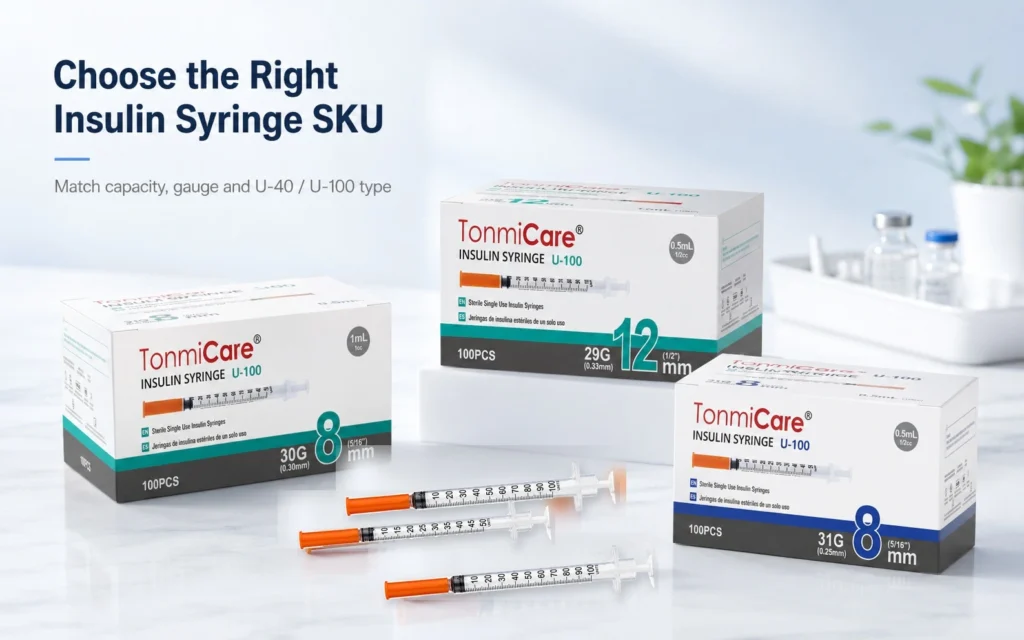
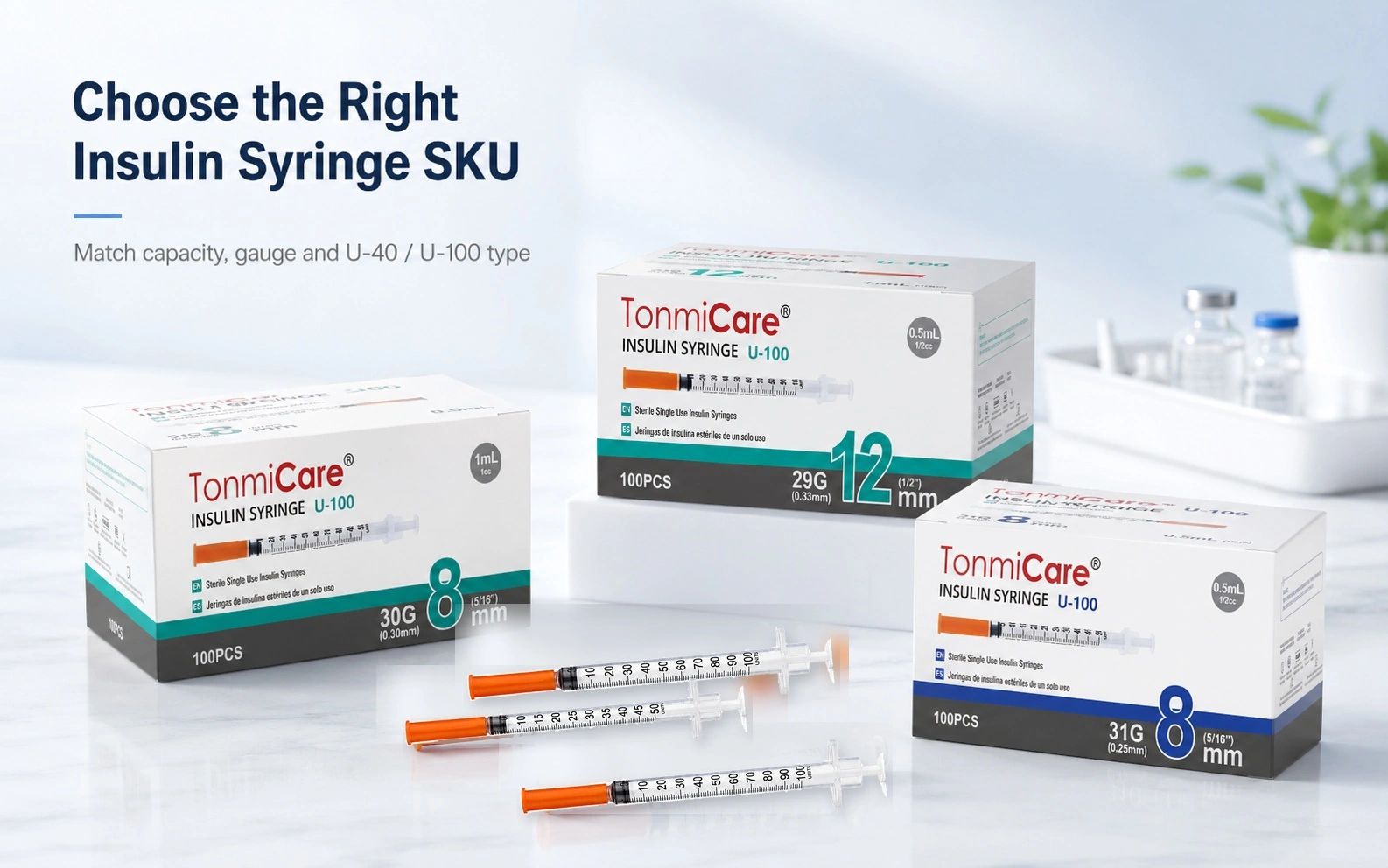
“U-100 insulin syringe, 31G” is incomplete. A professional purchase specification should control at least:
- insulin scale and concentration marking;
- nominal volume and maximum unit capacity;
- graduation increment;
- needle gauge and length in millimeters and inches;
- fixed needle or other connection type;
- sterile and single-use labeling;
- material or latex declarations where applicable;
- primary package format;
- syringes per box, boxes per case and cases per pallet;
- catalog number and GTIN/UDI where applicable;
- lot and expiration format;
- remaining shelf life at shipment; and
- country of origin and label revision.
U-100 denotes 100 units of insulin per milliliter. Because insulin concentration and syringe markings must correspond, the pharmacy should source only configurations approved through its clinical, formulary, dispensing and legal processes. This article does not provide patient-specific selection advice.
Buyers who have already defined the required capacity, gauge, needle length and packaging format can review current wholesale insulin syringe specifications and supply options before requesting SKU-level availability or pricing.
4.2 Use a signed master specification
The quotation, approved sample, purchase order and receiving record should all point to the same controlled specification.
| Required field | Purchasing control |
|---|---|
| Supplier SKU and manufacturer REF | Exact identifier; no “or equivalent” unless preapproved |
| Insulin scale | U-100 or another specifically authorized requirement |
| Capacity and graduation | Exact volume, maximum units and unit increment |
| Needle | Exact gauge, length and fixed/other format |
| Sterility and single-use status | Exact label statement and package configuration |
| Commercial package | Each/box/case/pallet hierarchy |
| Product identity | Catalog number, UDI/GTIN, lot and expiration format |
| Regulatory mapping | Applicable product code, 510(k), listing and label references |
| Label version | Approved U.S. artwork or IFU revision |
The purchase agreement should prohibit unapproved substitution. Material changes to the needle, barrel, graduation, lubricant, adhesive, sterilization, packaging, labeler, country of origin or manufacturing site should enter the agreed change-notification and requalification process.
5. Evaluate the Evidence Chain and Traceability Process
5.1 Ask for a coherent evidence package
A folder containing unrelated certificates is not a qualification package. The evidence chain should be:
SKU → controlled specification → current label/IFU → manufacturing and release controls → lot/UDI → shipment and customer record
Depending on the product and transaction, the buyer may request:
- current specification and product data sheet;
- applicable U.S. label and IFU;
- SKU-level FDA references;
- current quality-system certificate and scope;
- sterilization method and supporting controls at an appropriate level of confidentiality;
- biocompatibility, material, performance or shelf-life evidence relevant to the device and claims;
- certificate-of-conformance or lot-release process;
- complaint, field-action and recall procedures;
- change-notification policy; and
- product-liability or commercial insurance evidence required by the buyer.
The buyer does not necessarily need the manufacturer’s full confidential design history. It does need enough controlled evidence to determine whether the supplied SKU and its commercial claims are supported.
5.2 Test traceability before an actual event
A traceability code printed on a box is valuable only if the process behind it works. Before approving a strategic supplier, conduct a desktop mock recall using a hypothetical lot:
- identify the received lot and expiration date;
- locate remaining stock;
- identify outbound orders or customers that received the lot;
- demonstrate quarantine controls;
- identify who communicates with affected customers and within what timeframe; and
- document returns, reconciliation and effectiveness checks.
FDA explains that a UDI’s production identifier may carry lot, batch, expiration or manufacturing information, while the device identifier identifies the labeler and specific device version or model.[3] Pharmacies should capture the data needed for their receiving, inventory, complaint and recall responsibilities rather than relying on package visibility alone.
6. Measure Supply Continuity—Not Merely Warehouse Location
6.1 What a U.S. warehouse can improve
Domestic inventory can offer meaningful operational advantages:
- shorter order-to-delivery time for stocked SKUs;
- smaller, more frequent replenishment orders;
- reduced dependence on international transit for routine purchases;
- faster response to demand changes;
- simpler domestic returns or stock transfers; and
- reduced need for the pharmacy to hold excessive on-site inventory.
However, a U.S. address does not establish available-to-promise inventory, stock reservation, shelf-life control, fill rate, recall readiness or upstream recovery capacity.
Convert “U.S. stock” into measurable questions:
- Which REF numbers are available today?
- Is the inventory owned, allocated, reserved or shared?
- What are the order cutoff, warehouse processing time and carrier handoff time?
- What is the minimum remaining shelf life at shipment?
- How are expiration and inventory records reconciled?
- What happens during a backorder or demand spike?
- What is the upstream manufacturing and replenishment lead time?
- How quickly will the supplier communicate a shortage, quality hold or change?
6.2 Use an order-specific service commitment
A delivery estimate should name the selected REF, confirmed stock, destination ZIP code, warehouse processing window, carrier service and expected delivery range. This is more useful than a nationwide claim that omits exceptions.
The formula is simple; the inputs are not. Lead time should include order review, warehouse processing, transit, weekends, allocation risk and likely upstream delay. Safety stock should reflect demand variation, desired service level, shelf life, storage capacity and the consequence of a stockout.
7. Compare Total Operational Cost, Not Only Unit Price
Normalize all quotations to the same approved SKU and unit of measure. Then account for:
- inbound freight and accessorial charges;
- customs, duty, brokerage and international transport if applicable;
- MOQ and case-rounding effects;
- receiving, inspection, relabeling, repacking and data-entry labor;
- inventory carrying cost and expiration risk;
- rush orders, backorders and substitution cost;
- damage, shortage, return and complaint administration;
- quality-event and recall cost; and
- OEM artwork, printing plates, packaging inventory, testing and regulatory review.
The strongest comparison is an annualized scenario model under normal demand, demand surge, upstream delay and quality hold. A slightly higher unit price may be economically preferable if it reduces emergency freight, excess stock, documentation labor and interruption risk.
Standard stock versus private label
Private label can increase brand control, packaging differentiation and potential margin. It can also create higher MOQ, longer lead time, obsolete artwork risk, labeling responsibilities, UDI and listing questions, complaint exchange obligations and additional recall coordination.
Before approving an OEM or private-label program, define:
- the legal manufacturer, labeler, importer and distributor roles;
- permitted use of regulatory and technical documentation;
- labeling, UDI, GUDID and listing responsibilities where applicable;
- quality agreement, complaint exchange, adverse-event escalation and recall roles;
- artwork approval and change control;
- product MOQ, packaging MOQ, tooling or plate charges and lead time;
- ownership of unused or obsolete packaging; and
- transition and post-termination responsibilities.
Standard U.S.-warehouse stock is often the more practical starting point for market testing, variable demand or buyers that do not yet have a mature private-label quality and regulatory process.
Tonmit supply example
8. Applying the Framework: A Tonmit Supply Example
The following example shows how this supplier-evaluation framework can be applied to selected Tonmit insulin syringe configurations. The two 1 mL configurations below are used as controlled reference SKUs and do not represent the complete Tonmit insulin syringe range.
Buyers comparing other capacities, gauges or needle lengths can review Tonmit’s current wholesale insulin syringe supply options before confirming the applicable REF, labeling, documentation, inventory and commercial terms.
| Insulin scale | Capacity | Needle | Type 7 REF | Type 8 REF | Box | Case |
|---|---|---|---|---|---|---|
| U-100 | 1 mL | 30G × 5/16 in (8 mm) | ISY-7103008-100 |
ISY-8103008-100 |
100 | 2,000 |
| U-100 | 1 mL | 31G × 5/16 in (8 mm) | ISY-7103108-100 |
ISY-8103108-100 |
100 | 2,000 |
8.1 Manufacturer and regulatory documentation
The applicable products are manufactured by Promisemed Hangzhou Meditech Co., Ltd. For procurement review, Tonmit maintains supplier-provided regulatory and quality documentation for applicable products. The certificate holder and 510(k) applicant remain Promisemed; Tonmit does not describe those manufacturer records as certificates issued to Tonmit.
FDA’s public database shows Promisemed insulin syringe 510(k) records K193273 and K223453.[6][7] The K223453 decision identifies an insulin syringe under 21 CFR 880.5860, product code FMF and Class II.[7]
The public K223453 summary describes a sterile, single-use syringe with a non-retractable integrated needle. The submitted family includes 0.3 mL, 0.5 mL and 1.0 mL volumes; 28G through 32G needles; and 6 mm, 8 mm and 12 mm lengths. It also reports ethylene oxide sterilization at a sterility assurance level of 10−6 and shelf-life testing supporting five years after sterilization.[7]
Health Canada’s active medical-device licence 106461 lists Promisemed’s insulin syringe device family and device identifiers.[8] This supports product-identifier verification in the Canadian database; it should not be presented as U.S. market authorization. For U.S. procurement, the selected REF, current U.S. label/UDI, FDA listing and applicable 510(k) mapping should be reviewed together.
A current EN ISO 13485 certificate published in a public device filing identifies Promisemed Hangzhou Meditech Co., Ltd. as certificate holder and includes insulin syringes within the stated QMS scope.[9] Buyers should request the current controlled certificate and applicable SKU documentation during onboarding.
8.2 U.S. warehouse and fulfillment
Tonmit supports applicable domestic orders through its warehouse in Hudson, Ohio. Current U.S.-warehouse orders are generally processed and delivered in approximately one week.
This is a planning estimate rather than an unconditional nationwide delivery guarantee. Final timing depends on the confirmed SKU, available inventory, destination, order cutoff, carrier service and transaction-specific terms.
Buyers can review current product configurations and procurement options on Tonmit’s wholesale insulin syringe supply page before requesting order-specific availability and delivery confirmation.
8.3 Traceability and complaint access
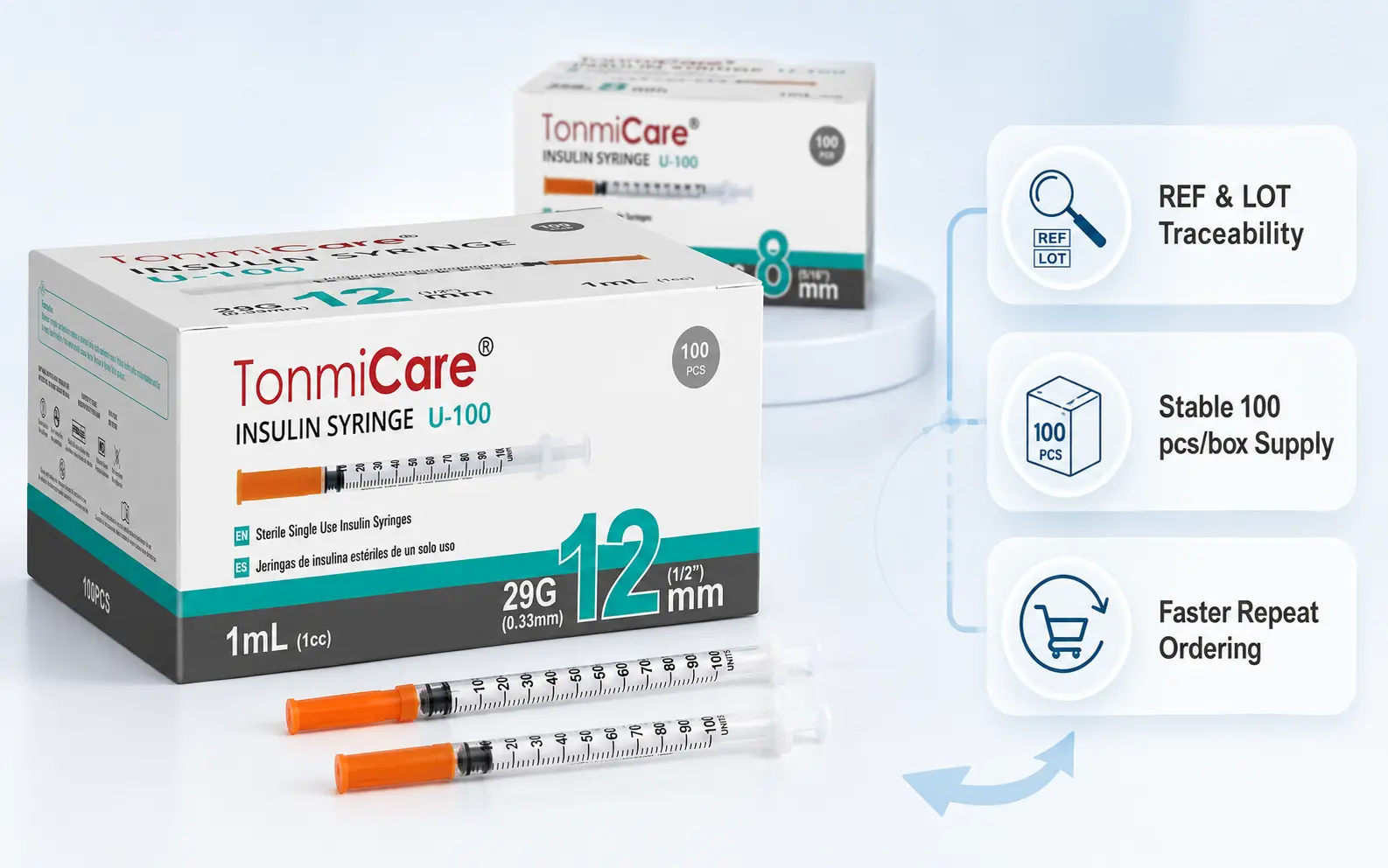
Current commercial boxes include a traceability code that can be checked together with printed contact information and a complaint channel. During supplier onboarding, buyers should test the code, record the information returned and confirm how lots are connected to outbound orders, complaint escalation, quarantine and recall cooperation.
8.4 Receiving Review Checklist for Buyers
Supplier qualification should continue after the purchase order is issued. The first received shipment provides an opportunity to verify whether the physical product, packaging and shipment records match the approved purchasing specification.
| Receiving check | What should be verified | Example record source |
|---|---|---|
| Manufacturer & REF | Legal manufacturer and commercial REF match the approved purchase specification | Product box / PO / specification |
| Product configuration | Capacity, insulin scale, gauge and needle length | Product label / approved specification |
| Package quantity | Units per box and boxes per shipping case | Packing list / physical count |
| LOT / batch | Lot or batch identifier is readable and captured | Product and case labeling |
| Expiration | Expiration date and remaining shelf life | Product labeling / receiving record |
| UDI / barcode | Identifier is readable and reconciled where applicable | Label / barcode scan |
| Package condition | Visible carton and sterile-package condition | Receiving inspection |
| Quantity | Received quantity matches the purchase and shipping records | PO / packing list / physical count |
| Traceability | Received lot can be connected to the receiving and inventory record | Warehouse / inventory record |
8.5 What buyers should submit for a reliable quotation
To avoid an incomplete or non-comparable quotation, provide:
- selected Type 7 or Type 8 REF;
- required monthly and annual quantity;
- delivery destination and target schedule;
- standard packaging or private-label request;
- required product, regulatory and quality documents;
- minimum remaining shelf life; and
- recurring replenishment or reserved-stock expectations.
9. A Two-Stage Supplier Decision Model
Stage A: Non-negotiable gates
Suspend qualification if any of the following remains unresolved:
- the legal manufacturer or labeler cannot be identified;
- the quoted SKU cannot be reconciled with applicable regulatory records and current U.S. labeling;
- the seller presents registration as FDA approval or an FDA-issued registration certificate;
- the quote permits uncontrolled substitution;
- catalog, lot, expiration or package identity cannot be captured;
- complaint and recall communication responsibilities cannot be demonstrated;
- material product or site changes can occur without agreed notification; or
- advertised U.S. inventory cannot be confirmed by REF.
Stage B: Weighted score after all gates pass
| Evaluation dimension | Suggested weight | Minimum evidence |
|---|---|---|
| Regulatory identity and documentation | 25% | Manufacturer/labeler, classification, applicable clearance/listing path, current labeling |
| Exact product and packaging fit | 20% | Signed specification, approved sample, pack hierarchy, substitution control |
| Quality, traceability and change control | 20% | QMS scope, controlled evidence, lot/UDI process, complaint/recall controls |
| Supply continuity and U.S. fulfillment | 15% | REF-level inventory, processing terms, shelf-life policy, upstream lead time |
| Total cost and commercial terms | 10% | Annualized cost, MOQ, freight, returns, price-change rules |
| Service and lifecycle performance | 10% | Response times, corrective-action support, performance reporting |
Score each dimension from 0 to 5 and multiply it by the assigned weight. A high score cannot cure a failed regulatory or product-identity gate.
10. Recommended Procurement Workflow
- Define the approved requirement. Document the exact SKUs, demand profile, shelf-life requirement, storage limits and intended commercial channel.
- Issue a controlled RFQ. Give every supplier the same specification and unit-of-measure template; require written disclosure of exceptions.
- Verify records independently. Search the applicable FDA databases and save the date and outcome of the review.[4]
- Review samples and commercial packaging. Confirm manufacturer, catalog number, UDI/GTIN, lot and expiration format, label claims, package integrity, count and barcode readability.
- Complete quality and logistics review. Examine QMS evidence, complaint and recall controls, inventory process, shipping terms, shelf-life policy, returns and upstream contingency planning.
- Contract the controls. Attach the specification, change notification, traceability, service level, shortage notice, recall cooperation and return responsibilities to the appropriate agreement.
- Start with a controlled order. Use the first receipt to test count, labels, lot capture, shelf life, damage, order accuracy, traceability code and transit time.
- Monitor performance. Track fill rate, on-time shipment, order accuracy, shelf-life compliance, documentation response, complaints, corrective actions, backorders and unapproved changes.
11. Which Sourcing Model Fits Which Buyer?
| Buyer situation | Practical starting model | Main benefit | Principal trade-off |
|---|---|---|---|
| Independent pharmacy testing demand | Standard, documented U.S.-stock SKU | Lower commitment and shorter replenishment cycle | Less packaging differentiation |
| Multi-location pharmacy with predictable use | Reserved domestic inventory and scheduled replenishment | Better service planning and lower local stock burden | Requires forecast and allocation discipline |
| Distributor building a house brand | Private label after regulatory and quality review | Brand control and possible margin improvement | Higher MOQ, lead time and lifecycle responsibility |
| High-volume buyer prioritizing ex-factory cost | Direct-import program after full qualification | Potential unit-cost benefit at scale | Greater freight, inventory and interruption exposure |
| Program requiring demand-spike resilience | Hybrid domestic stock plus upstream visibility | Balances speed and recovery capacity | More complex inventory governance |
No sourcing model is universally superior. The best choice depends on demand stability, organizational capability, working capital, shelf life, service requirement and the buyer’s ability to manage private-label responsibilities.
Questions from pharmacy buyers
12. Frequently Asked Questions
Does FDA registration mean an insulin syringe is FDA approved?
No. FDA states that registration and listing do not denote approval, clearance or authorization, and it does not issue registration certificates to medical-device facilities.[1] Buyers should verify the applicable classification, marketing pathway, device and responsible organizations.
What should a pharmacy provide before requesting a final bulk price?
Provide the exact REF or required insulin scale, capacity, graduation, gauge, needle length, package quantity, annual volume, delivery destination, labeling requirement, documentation requirement and allowed substitutions. A price quoted before the specification is frozen cannot be reliably compared.
What is the difference between Tonmit’s Type 7 and Type 8 insulin syringes?
FDA’s K223453 public summary identifies one documented structural difference: the protective end cap is included only on Type 8.[7] The quotation should still identify the exact REF, current packaging revision, U.S. label/UDI, available inventory and documents for the selected product.
Is U.S. warehouse inventory enough to qualify a supplier?
No. Domestic inventory may shorten fulfillment time, but the buyer must still verify product identity, documentation, lot traceability, inventory accuracy, remaining shelf life, recall cooperation and upstream replenishment.
How quickly can Tonmit’s U.S. warehouse deliver?
Tonmit currently describes applicable U.S.-warehouse orders as generally processed and delivered in approximately one week. Final timing depends on confirmed REF-level stock, destination, order cutoff, carrier service and order terms. Request a destination-specific estimate with the final quotation.
How can a buyer trace a Tonmit syringe box or submit a complaint?
Current boxes include a traceability code and printed contact and complaint information. Buyers should test both during onboarding and confirm the data returned, responsible party, response time, escalation route and recall cooperation.
Which capacity, needle gauge or needle length should a pharmacy stock?
That is a formulary, prescribing, clinical, demand and legal decision—not a generic supplier recommendation. Procurement should ensure that the purchased SKU exactly matches the organization’s approved requirement and applicable labeling.
What changes when a buyer requests private-label packaging?
Private label can affect the labeler, artwork, UDI/GUDID responsibilities, listing analysis, complaint exchange, recall roles, package MOQ and change control. Those responsibilities should be assigned before artwork or production approval.
13. Limitations
This framework does not replace legal, regulatory, clinical, procurement or quality-system review.
Public regulatory databases, certification records and product information can change. A product-family record does not automatically establish that every catalog number, label revision, package configuration or private-label version is covered.
Tonmit-specific examples in this article describe selected products, documentation and supply processes available for review at the time of publication or revision. They should not be interpreted as a live inventory feed, universal delivery commitment or guarantee that the same documentation applies to every SKU or transaction.
Any receiving, packaging or traceability example represents the specific product or shipment examined. Buyers should independently verify current records, physical product identity, controlled documents, inventory, shelf life and commercial terms for the exact SKU before approval or purchase.
14. Conclusion
For a U.S. pharmacy, the correct object of procurement is not merely a box of insulin syringes. It is a verified and controlled SKU supported by the appropriate regulatory identity, current label, specification, quality evidence, lot traceability, inventory data, logistics terms and lifecycle responsibilities.
Three conclusions follow:
- Regulatory wording must be precise. Registration, listing, 510(k) clearance, UDI and ISO 13485 are related but non-interchangeable forms of evidence.
- Domestic inventory should be measured as a service system. Warehouse location becomes valuable when connected to REF-level availability, shelf-life controls, processing terms, traceability and replenishment planning.
- Cost should be risk-adjusted. A low unit price is not an advantage if it depends on specification ambiguity, excess inventory, weak change control, incomplete documentation or slow disruption recovery.
A gate-and-score process makes supplier selection more defensible, reduces preventable SKU and documentation errors and supports a more resilient replenishment program.
References
- U.S. Food and Drug Administration. Important Reminders about Registration and Listing .
- U.S. Food and Drug Administration. Product Classification: Piston Syringe, Product Code FMF .
- U.S. Food and Drug Administration. UDI Basics .
- U.S. Food and Drug Administration. Medical Device Databases .
- U.S. Food and Drug Administration. Quality Management System Regulation (QMSR) .
- U.S. Food and Drug Administration. 510(k) Premarket Notification K193273 .
- U.S. Food and Drug Administration. K223453 — Insulin Syringe, Promisemed Hangzhou Meditech Co., Ltd. .
- Health Canada. Active Medical Device Licence No. 106461 — Insulin Syringe .
- Public copy of the TÜV Rheinland EN ISO 13485 certificate for Promisemed Hangzhou Meditech Co., Ltd., Registration No. SX 2091024-1 (effective January 24, 2025; expiry October 22, 2027). View certificate copy .