
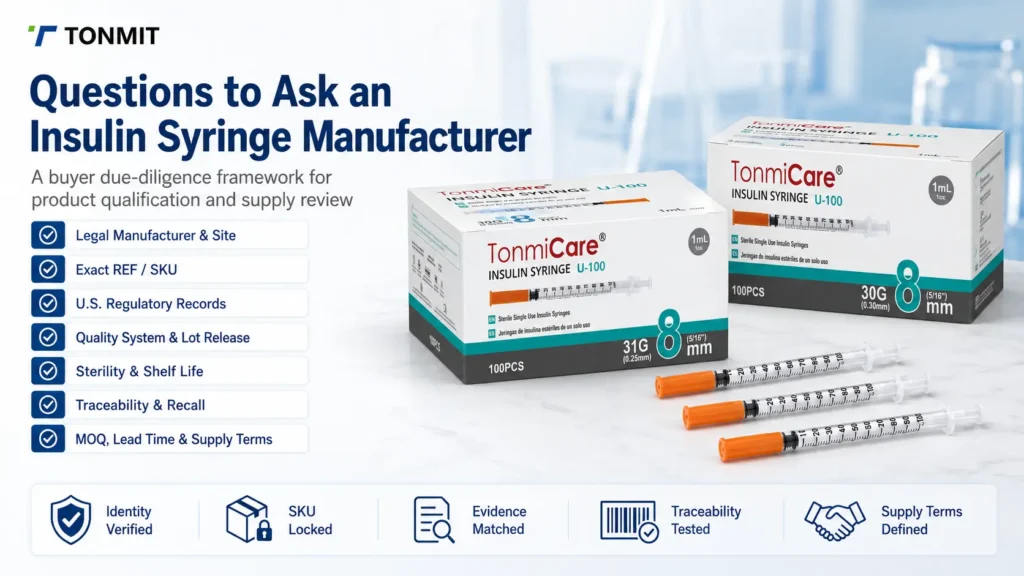
Insulin Syringe Manufacturer Due-Diligence Checklist
A practical qualification guide for pharmacies, distributors and procurement teams that need to verify the legal manufacturer, exact SKU, U.S. regulatory records, quality controls, lot-release evidence, sterility, traceability, MOQ and total supply terms before approving an insulin syringe program.
Scope: This guide supports institutional and commercial supplier qualification. It is not legal, regulatory, clinical, prescribing or patient-specific advice. Requirements depend on the actual device, market, labeling, organizations and transaction. Verify current records and approve the exact product through the buyer’s applicable quality, regulatory, legal and procurement processes.
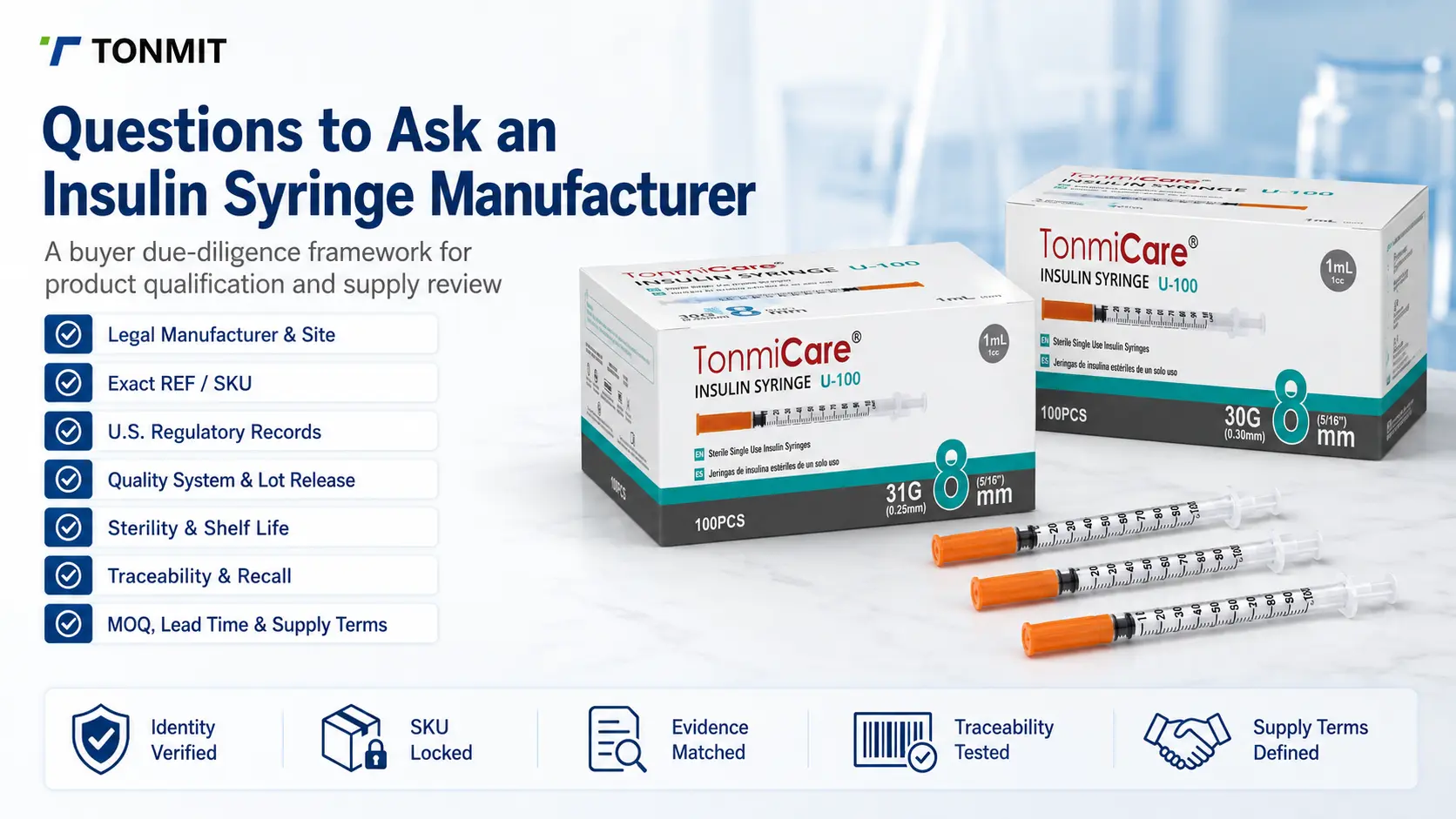
Quick answer
What Should Buyers Ask an Insulin Syringe Manufacturer First?
Before choosing an insulin syringe manufacturer, ask whether the supplier can connect the exact quoted REF to the legal manufacturer, manufacturing site, current U.S. regulatory records, controlled specification, quality system, lot-release tests, sterility and shelf-life evidence, traceability process, change-notification rules and measurable commercial terms.
Do not accept a folder of general certificates as proof. Every answer should identify the product and site it covers, the current record or document that supports it, and the person responsible when the product, shipment or evidence fails. Buyers ready to compare available configurations can review wholesale insulin syringe options after fixing the required specification.
Executive summary
Key Takeaways for Procurement Teams
- Verify identity before capability. “Factory direct” does not establish the legal manufacturer, actual production site, labeler or seller of record.
- Qualify a specific SKU. Capacity, concentration scale, graduation, gauge, length, design, sterile presentation, REF and packaging revision belong in the approval record.
- Ask for evidence, not assurances. A useful answer states what record applies, who owns it, its scope, version and relationship to the quoted product.
- Separate gates from scoring. Price, MOQ and lead time cannot compensate for unresolved manufacturer identity, market status, quality or traceability.
- Test execution. A controlled sample, first-order acceptance and desktop mock recall reveal gaps that a questionnaire may not.
- Control the lifecycle. Change notification, complaints, corrective action, shortage communication and recovery terms matter after approval.
How to Use These 10 Manufacturer Questions
Send the same questions and the same SKU brief to every candidate. For each response, record the evidence received, its version or date, the reviewer and any unresolved exception. Use the broader supplier qualification framework when the review also covers distributors, importers, warehouse operators and replenishment performance.
Identity, records and controlled documents
Product, label, pack and barcode match
Receipt, lot, expiry and document check
Gates passed and terms contracted
Quality, service, changes and continuity
Use one rule for all ten questions
A statement such as “yes, we comply” is not an answer. Require a product-specific record, a verifiable database entry, a controlled procedure summary or a measurable commercial commitment. Confidential technical detail may be managed through appropriate review access, but the buyer still needs enough evidence to make a documented decision.
1. Are You the Legal Manufacturer of the Exact Insulin Syringe Being Quoted?
A seller may be a manufacturer, brand owner, labeler, exporter, importer, warehouse operator or distributor—and one organization may perform several roles. Ask the candidate to map the actual organizations involved rather than relying on “manufacturer” in a profile or email signature. When channel choice is still open, compare manufacturer and distributor sourcing before deciding which organizations require qualification.
The response should name the legal manufacturer and manufacturing address, the brand or labeler, the quotation and invoice entity, the exporter, the U.S. initial importer where applicable, the inventory owner and the organization responsible for complaints and recalls. Compare those names with the product label, specification, quality certificate and relevant public records.
Buyer question to copy: Please identify the legal manufacturer, physical manufacturing site, labeler, seller of record, exporter, U.S. initial importer where applicable, inventory owner and complaint/recall contact for each quoted REF.
2. Can You Lock the Exact Insulin Syringe SKU Before Quoting?
“1 mL 31G insulin syringe” is not a complete purchase specification. The quote, sample, product data sheet, label, purchase order and received product should identify the same controlled configuration. Buyers should compare insulin syringe sizes and specifications before asking manufacturers to compete on price.
| Control field | What to state | What to verify |
|---|---|---|
| Scale and capacity | Required concentration scale, 0.3/0.5/1 mL or other approved capacity | Barrel artwork, maximum marking and nominal volume match |
| Graduation | Exact increment and any approved special marking requirement | Drawing, sample and production scale are identical |
| Needle | Gauge × length and fixed or other verified design | Specification, label and sample use the same dimensions |
| Identity | Manufacturer REF, brand SKU and UDI/GTIN where applicable | Identifiers reconcile across unit, box, case and records |
| Packaging | Sterile barrier, units per box, boxes per case and revision | Artwork, count, lot and expiration formats are controlled |
| Substitution | Written approval required for any change | Quote and PO contain no uncontrolled “or equivalent” language |
Copy-ready PO control:
No substitution of concentration scale, capacity, graduation, needle gauge, needle length, product configuration, legal manufacturer, manufacturing site, REF, label, sterile presentation or packaging revision without the buyer’s prior written approval.
3. Which U.S. Regulatory Records Apply to This Exact SKU?
Do not ask only, “Are you FDA certified?” FDA states that it does not issue registration certificates to medical-device facilities and that registration and listing do not by themselves denote approval, clearance or authorization.[1] Ask the manufacturer to explain the applicable pathway and connect the quoted product to the relevant legal entities, model information and current labeling.
Depending on the device and transaction, the review may include product classification, applicable premarket submission or exemption rationale, establishment registration and device listing activities, labeler information, UDI/GUDID records, current U.S. label, warning letters, recalls and import alerts. The purpose is not to collect the largest number of screenshots; it is to reconcile the exact quoted product. Use Tonmit’s guide to review FDA requirements for insulin syringe suppliers, then independently check current public records.
Country of origin is not a complete qualification decision
FDA has published safety communications and enforcement actions concerning certain plastic syringes made in China. Buyers should review the specific manufacturer, device, site and current import status rather than treating every syringe from a country as equivalent—or ignoring current enforcement information.[2]
4. What Quality System Covers the Manufacturing Site and Product?
Ask for the current quality-management-system certificate and scope, including the certificate holder, covered address, product scope, issue and expiry dates and certification body. Then ask how the system controls specifications, suppliers, nonconforming product, corrective action, complaints, traceability and product changes for the quoted syringe.
FDA’s Quality Management System Regulation became effective on February 2, 2026. The amended 21 CFR Part 820 incorporates ISO 13485:2016 by reference while retaining applicable U.S. requirements.[3] An ISO 13485 certificate can support a site-level review, but it is not an FDA marketing authorization, does not prove that every factory is covered, and is not a product certificate. There is also no FDA-issued “QMSR certificate.”
Qualified buyers can request SKU-specific documentation for selected products instead of relying on undifferentiated certificate folders.
5. What Tests and Acceptance Criteria Release Each Lot?
“100% QC” is not meaningful unless the manufacturer names the inspection or test, method, sampling approach, acceptance criteria, record and disposition of a failed lot. Ask for a test matrix applicable to the exact design and claims. FDA’s standards database lists ISO 8537:2016 as a partially recognized standard for sterile single-use insulin syringes with or without needles, but its applicability and extent of recognition must be assessed for the actual device.[4]
| Review area | Manufacturer should explain | Buyer should confirm |
|---|---|---|
| Scale and volume | Applicable dimensional, graduation and capacity controls | Criteria match the approved scale and REF |
| Functional performance | Leakage, plunger movement or operating-force methods as applicable | Method, sample size and acceptance limit are identified |
| Needle assembly | Needle dimensions, attachment or fixed-needle controls | Actual gauge, length and design are covered |
| Sterile package | Seal, package integrity and visual-release controls | Released packaging is the approved configuration |
| Label and count | REF, lot, expiry, artwork, barcode and pack-quantity checks | Unit, box and case identities reconcile |
| Claims | Tests supporting any special performance claim | No unsupported low-dead-space, safety or comfort claim |
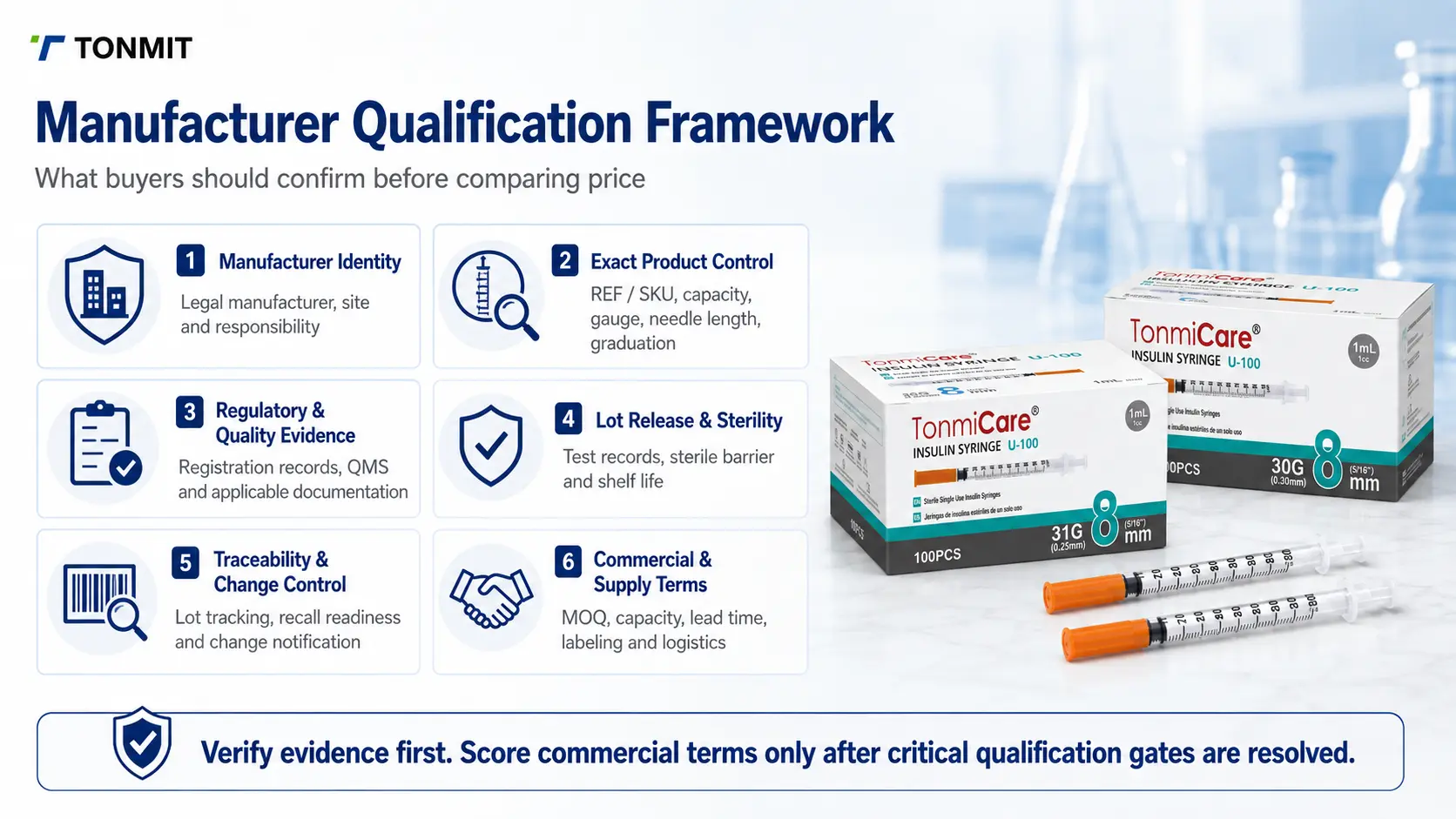
6. How Are Sterility, Packaging Integrity and Shelf Life Supported?
Ask the manufacturer to identify the sterilization method, sterilization site or contractor, validation framework, routine processing controls and lot-release responsibility. The response should also explain sterile-barrier packaging validation, seal or integrity controls, transportation testing, shelf-life basis, accelerated and real-time aging status and how lot, manufacture and expiration information are assigned.
Do not assume that every shipment automatically includes the same certificate. A certificate of conformance, certificate of analysis, sterilization record or certificate and lot-release record answer different questions. The buyer should state which document is required, what information it must contain, whether it is available at shipment and who reviews it.
7. Can You Trace and Recall an Affected Lot?
A printed lot number is only the visible part of traceability. Ask the manufacturer to demonstrate backward traceability from finished lot to relevant components, processing and records, and forward traceability to shipped customers or inventory locations. The process should identify complaint intake, investigation, quarantine, corrective action, field-action decision support and recall communication responsibilities.
FDA explains that the production identifier portion of a UDI may include data such as lot or batch number, expiration date and manufacture date when those appear on the label.[5] Buyers should still determine which data their receiving, inventory and outbound systems capture. Public recall databases can support history checks, but an absence of search results does not replace a functioning recall process.[6]
- Select a hypothetical finished lot.
- Identify related production and release records.
- Locate remaining manufacturer, warehouse and buyer inventory.
- Identify customers or orders that received the lot.
- Demonstrate quarantine, notification, return and reconciliation steps.
- Record elapsed time, missing data and the responsible contacts.
8. Which Changes Require Advance Buyer Notification?
A sample may pass while later orders drift because a material, component, supplier, production line, site, sterilization provider, test method, label or package changes. Ask for the manufacturer’s change-control and customer-notification policy before approval. Define which changes require notice, how far in advance, what evidence accompanies the notice and whether the buyer may reject, requalify or use a last-time buy.
- Critical raw material, needle tubing, lubricant, adhesive or component supplier;
- mold, production line, manufacturing site or significant process;
- sterilization provider, location, cycle or sterile-barrier packaging;
- specification, acceptance method or product performance claim;
- legal manufacturer, labeler, REF, UDI/GTIN, artwork or instructions;
- pack quantity, packaging material, country of origin or shipping configuration;
- quality certificate status or relevant U.S. regulatory status.
9. What Are the Real MOQ, Capacity, Lead-Time and Private-Label Conditions?
“Flexible MOQ,” “large capacity” and “fast delivery” are marketing descriptions, not planning inputs. Ask for numbers and the conditions behind them: standard-stock MOQ, production MOQ by SKU, mixed-SKU rules, printed-packaging MOQ, private-label MOQ, monthly available capacity, current allocation and the quotation validity period.
Lead time should be separated into artwork approval, material procurement, production, sterilization, release, international transit, customs, warehouse receipt and domestic delivery. If the program requires custom packaging, review private-label insulin syringe requirements, including legal roles, artwork, UDI, packaging inventory, complaint exchange and obsolete-material responsibility.
10. What Does the Total Supply Program Include—and What Happens When Something Goes Wrong?
The last question connects qualification to commercial execution. Ask what is included in price, which Incoterms apply, who manages freight, insurance, import and customs responsibilities, whether U.S. stock is confirmed for the exact REF, and how lot, expiration, minimum remaining shelf life, order processing and destination timing are controlled.
Then define remedies for delay, shortage, damage, incorrect SKU, rejected product, documentation failure and quality events. The agreement should identify investigation and corrective-action responsibilities, return authorization, replacement, credit, recall cooperation, escalation contacts and shortage notification. Buyers comparing full cases can calculate case quantities and landed cost; buyers relying on domestic releases should review U.S.-warehouse-supported fulfillment.
Landed cost per 100 accepted syringes
= (product + packaging + freight + insurance + import + handling + inspection + expected shortage/damage/expiry cost − credits) ÷ accepted syringes × 100
Use the same exact SKU, pack basis, delivery point, shelf-life requirement and acceptance rules for every manufacturer quotation.
How Should Buyers Approve, Condition or Reject a Manufacturer?
Use non-negotiable gates first. If identity, exact-product mapping, applicable regulatory status, core quality evidence, sterility, lot release or traceability remains materially unresolved, commercial scoring should stop. A low price must not compensate for a failed gate.
| Status | Decision rule | Permitted next step |
|---|---|---|
| Pass | All gates resolved with current, coherent evidence | Commercial scoring, controlled first order and monitoring |
| Conditional approval | Minor, bounded gaps have owners and deadlines; no critical gate is failed | Limited scope, documented condition and closure review |
| Additional evidence required | Decision cannot be made because material evidence is incomplete | Pause quote approval and request specified records |
| Reject | Identity, status, product control or quality evidence is contradictory or unacceptable | Close qualification or restart only after substantive remediation |
After the gates pass, score commercial fit: price, MOQ, capacity, lead time, service, private-label capability, inventory strategy and fulfillment performance. Record the reviewer, evidence version, review date and renewal or requalification date.
Copyable Insulin Syringe Manufacturer Document Request
Use this short request after sending the exact product brief. It tells the manufacturer that general marketing files will not complete the review.
Subject: Document Request for Insulin Syringe Manufacturer Qualification
Please provide current records applicable to the quoted legal manufacturer, physical manufacturing site and exact product REF:
1. Controlled product specification, current label and complete pack hierarchy
2. Legal manufacturer, manufacturing site, labeler and supply-chain role map
3. Applicable U.S. classification, premarket, registration/listing and UDI references
4. Current quality-management-system certificate and relevant scope
5. Product-specific test matrix and representative lot-release record
6. Sterilization, packaging-integrity and shelf-life information
7. Lot traceability, complaint, corrective-action and recall contacts
8. Customer change-notification policy
9. Standard, production and private-label MOQ; capacity; and milestone lead time
10. Itemized supply terms, U.S. inventory or import roles, shelf-life commitment and claim process
Please identify any document that is unavailable, confidential or pending; state the alternative evidence or controlled review method; and do not substitute another product, site or organization without written disclosure.
Frequently Asked Questions From Insulin Syringe Buyers
How can I tell whether a supplier is the actual insulin syringe manufacturer?
Compare the claimed legal manufacturer and production address with the product label, controlled specification, relevant quality certificate, public regulatory records and commercial documents. Ask the supplier to map the brand owner, labeler, exporter, importer, warehouse and seller separately. Unexplained name or address differences require resolution.
Does FDA registration mean an insulin syringe is FDA approved?
No. FDA states that establishment registration and device listing do not by themselves denote approval, clearance or authorization, and FDA does not issue registration certificates to medical-device facilities.[1] Verify the applicable device pathway and exact product records.
Does one 510(k) automatically cover every syringe sold by a manufacturer?
No automatic assumption should be made. Compare the quoted model and REF, design, dimensions, intended use, labeling, applicant or manufacturer relationship and current listing information with the applicable public record. Ask the responsible organization to document the mapping and resolve material differences.
Does an ISO 13485 certificate prove that every factory and product is covered?
No. Review the certificate holder, address, scope, validity and relationship to the actual manufacturing site and product. The certificate supports quality-system review within its stated scope; it is not product clearance or an FDA-issued certificate.
Should every insulin syringe shipment include a CoA?
Not necessarily. CoA, CoC, sterilization documentation and lot-release records have different contents and may not all be standard shipment documents. Define the record needed, required fields, review timing and availability in the RFQ and quality or supply agreement.
How should buyers evaluate insulin syringe samples?
Reconcile the sample with the controlled specification, manufacturer REF, concentration scale, capacity, graduation, gauge, length, design, sterile package, label, UDI/GTIN where applicable, lot, expiration and pack quantity. Record approval against a named revision; a sample alone does not approve later production.
What is the MOQ for wholesale or private-label insulin syringes?
MOQ is manufacturer-, SKU- and packaging-specific. Request separate figures for standard stock, production by REF, mixed-SKU orders, printed packaging and private label. Also evaluate how the commitment fits forecast, remaining shelf life, storage, cash and product-change risk.
Can U.S. warehouse stock replace manufacturer qualification?
No. Domestic stock can shorten replenishment for confirmed inventory, but it does not establish the product’s legal manufacturer, current records, quality controls or recall process. Confirm the exact REF, quantity, lot, expiration, minimum remaining shelf life, ownership and upstream replenishment path.
What should happen after a manufacturer passes the questionnaire?
Review a controlled sample, place a limited first order, verify received product and documents, test traceability and monitor fill rate, order accuracy, shelf life, complaints, corrective actions and changes. Written answers are the beginning of qualification, not its completion.
Conclusion: Choose the Evidence Chain, Not the Best Sales Claim
The best questions to ask an insulin syringe manufacturer are those that convert claims into verifiable decisions. Identify the responsible organizations, lock the exact SKU, reconcile current U.S. records, verify the manufacturing site’s quality system, understand lot release and sterile-package controls, test traceability, contract change notification and make every MOQ, lead-time, landed-cost and recovery assumption measurable.
A manufacturer should be approved only for the product, site, role and supply arrangement actually reviewed. That qualification should continue through sample approval, the first commercial receipt and ongoing monitoring. When evidence is incomplete, the correct outcome is not automatic rejection or optimistic approval—it is a clearly assigned request, deadline and decision status.
Manufacturer qualification support
Request an Insulin Syringe Manufacturer Qualification Review
Send Tonmit your target concentration scale, capacity, graduation, gauge × length, annual volume, packaging format, delivery ZIP code and document checklist. We can organize applicable product paths, available evidence, supply roles and unresolved items for a structured B2B review.
Product availability, documentation, regulatory applicability, MOQ, packaging, inventory, shelf life, pricing and delivery must be confirmed for the selected REF and transaction.References and Verification Resources
- U.S. Food and Drug Administration. Important Reminders about Registration and Listing. FDA states that registration/listing does not denote approval, clearance or authorization and that it does not issue registration certificates to medical-device facilities.
- U.S. Food and Drug Administration. Update: Evaluating Plastic Syringes Made in China for Potential Device Failures. Review the current communication and linked updates for scope and status.
- U.S. Food and Drug Administration. Quality Management System Regulation (QMSR). Current Part 820 framework and February 2, 2026 effective date.
- U.S. Food and Drug Administration. Recognized Consensus Standard: ISO 8537:2016. FDA recognition record for sterile single-use insulin syringes; review the stated extent of recognition.
- U.S. Food and Drug Administration. UDI Basics. Overview of device identifier and conditional production-identifier information.
- U.S. Food and Drug Administration. Medical Device Recalls Database. Public search resource for classified recalls and certain correction or removal actions.
- U.S. Food and Drug Administration. Establishment Registration & Device Listing Database. Verify current establishment and device-listing information without treating the record as approval.
- U.S. Food and Drug Administration. Search for Import Alerts and Warning Letters. Search by the relevant company, site and product; record the date and interpret results in context.