
Pharmacy Procurement & Replenishment Guide
A practical workflow for pharmacies, clinics and medical distributors buying wholesale insulin syringes by the case—covering exact SKU selection, case-pack conversion, 90-day demand, landed cost, shelf life, U.S. inventory and first-order acceptance.
Scope: This guide supports institutional and commercial purchasing. It is not patient purchasing, dosing or product-substitution guidance. Match every syringe to the medication labeling, approved product master and applicable pharmacy or clinical workflow. Specifications, regulatory records, case quantities, inventory, shelf life, price and delivery are controlled by the exact REF and transaction. Tonmit is the company and website operator; TonmiCare is the product brand used for selected supply programs.
Quick answer
What Must a Pharmacy Confirm Before Buying Insulin Syringes by the Case?
Approve the exact insulin syringe SKU first: concentration scale, capacity, graduation, gauge, needle length, design, manufacturer and REF. Then confirm syringes per box, boxes per case, total syringes per case, assigned lot, expiration date, minimum remaining shelf life, available quantity, fulfillment route and delivery basis. Compare every quote using landed cost per 100 accepted syringes—not case price alone.
Executive summary
Key Takeaways
- Demand must be planned by exact REF. Combining 0.3, 0.5 and 1 mL demand can hide shortages and expiry risk.
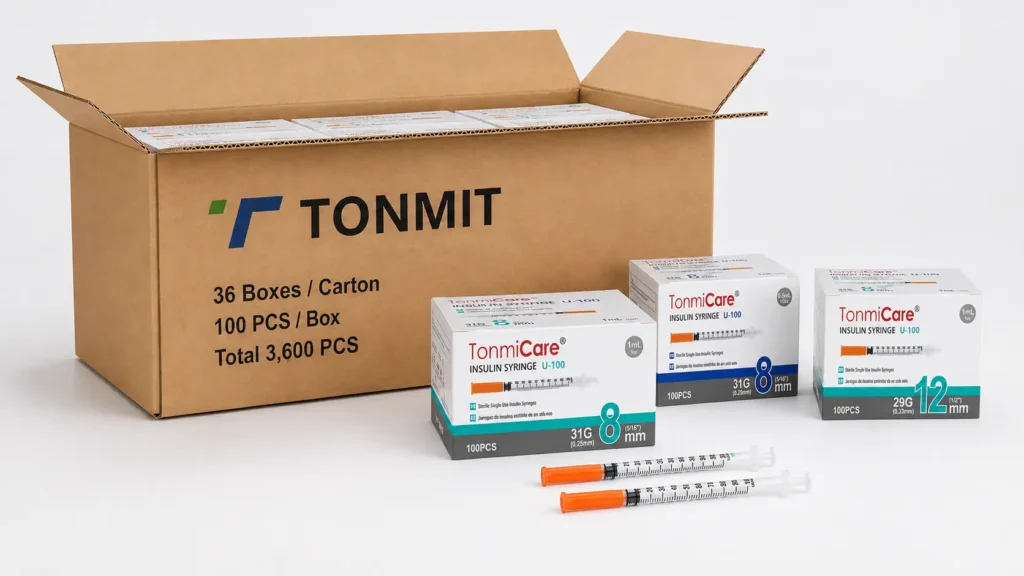
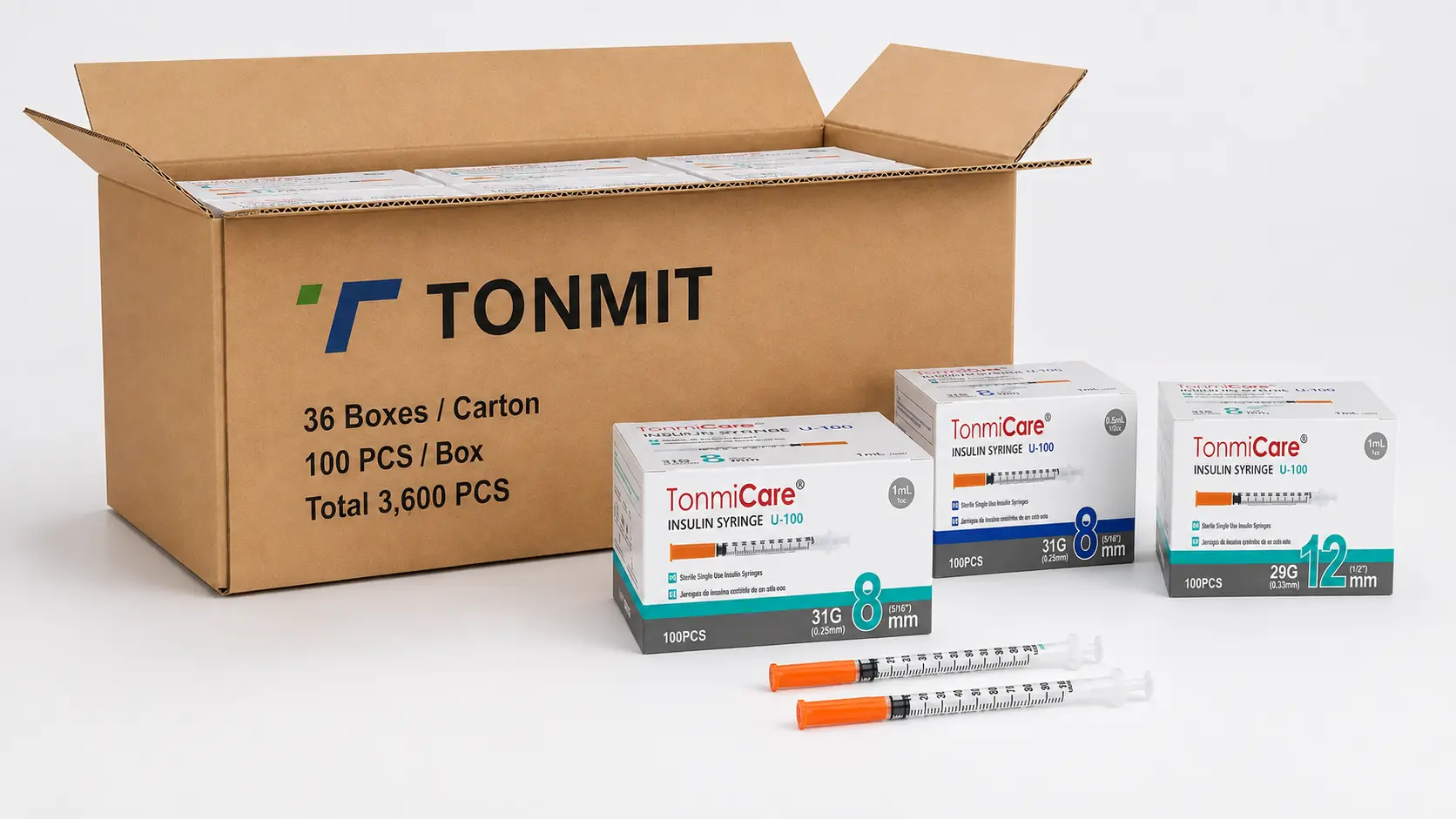
- A case is not a standardized quantity. TonmiCare’s default factory planning basis is 100 syringes per box and 36 boxes per case, while selected published or warehouse-stocked REFs may use 20 boxes per case.
- Specification comes before price. U-100 or U-40 scale, capacity, graduation, gauge, length and product configuration are separate controlled fields.
- Normalize wholesale quotations. Compare the same approved SKU using landed cost per 100 accepted syringes, remaining shelf life and delivery terms.
- Warehouse presence is not inventory confirmation. Verify the exact REF, available-to-promise quantity, lot, expiration date and destination-specific window in writing.
- The first shipment is part of supplier approval. Check identity, quantity, sterile-package condition, traceability and unapproved substitutions before inventory release.
1. Build an Exact-SKU Demand Map
A pharmacy should not start a wholesale insulin syringe order by asking which size is most popular. Start with the buyer’s approved item master and actual movement by location. A broad annual total is not enough: calculate usage for each concentration scale, capacity, graduation and needle configuration separately.
| Demand field | What to record | Why it matters |
|---|---|---|
| Approved identity | Manufacturer, brand/labeler and exact REF | Prevents look-alike SKU substitution |
| Clinical specification | U-100/U-40, capacity, graduation, gauge × length and design | Keeps concentration and scale controls intact |
| 90-day movement | Units dispensed, sold or issued by exact REF and location | Creates an evidence-based monthly average |
| Usable on-hand | Exclude damaged, quarantined, recalled and short-dated stock | Avoids overstating available inventory |
| Confirmed inbound | Include only accepted purchase orders with credible dates | Separates supply from unconfirmed forecasts |
| Safety stock | Set by demand variability and verified replenishment time | Supports continuity without uncontrolled overstock |
For capacity and graduation comparisons, use the 0.3, 0.5 and 1 mL insulin syringe size guide. Once the requirement is fixed, review available wholesale insulin syringe configurations. This article focuses on converting an approved requirement into a controlled case order.
2. Confirm U-100 Scale, Capacity, Gauge and Needle Length
FDA classifies a piston syringe as a Class II device under 21 CFR 880.5860.[1] FDA’s recognition record for ISO 8537:2016 describes sterile, single-use syringes, with or without needles, intended solely for insulin injection.[2] For purchasing purposes, this means “1 mL insulin syringe” or “31G syringe” is not a complete product identity.
Tonmit’s priority wholesale 1 mL U-100 specifications include selected 30G × 5/16 in (8 mm) and 31G × 5/16 in (8 mm) configurations. The quotation must identify the exact REF and confirm all attributes rather than treating these descriptions as universal equivalents.
Keep U-40 and U-100 products as separate controlled SKUs; the U-40 and U-100 concentration-scale guide explains why the printed scales are not interchangeable. Do not approve a capacity, scale, gauge, length or design change solely because another case is cheaper or available sooner.
Purchase-order rule: No substitution of concentration scale, capacity, graduation, gauge, length, device design, manufacturer or REF without documented buyer approval.
3. Compare Box, Case and Pallet Quantities
Case normally means a master shipping carton, but it does not identify a universal quantity. TonmiCare’s standard factory planning configuration uses 100 syringes per box and 36 boxes per case, or 3,600 syringes per case. Selected current product or U.S.-warehouse configurations may use 20 boxes per case, or 2,000 syringes per case. These configurations must remain separate in the quote, purchase order and receiving record.
| Supply configuration | Planning basis | Buyer control |
|---|---|---|
| TonmiCare standard factory case | 100/box × 36 boxes = 3,600 syringes; approximately 21 kg gross carton weight when confirmed for this configuration | Reconfirm REF, dimensions, gross weight and final production pack before freight booking |
| Selected published or warehouse-stocked case | Some 1 mL configurations may use 100/box × 20 boxes = 2,000 syringes | Use the existing manufacturer case hierarchy; do not infer 36 boxes from the brand alone |
| Mixed-SKU shipment | Multiple full cases or approved case packs in one shipment | Keep separate REF, lot, expiry, quantity and receiving records for every SKU |
| Private-label production | Pack depends on approved artwork, carton design, MOQ and production configuration | Complete a separate packaging and regulatory feasibility review |
Do not let the word “case” replace packaging data
Write syringes per box, boxes per case and total syringes per case on the PO. If case dimensions, weight, box count or barcode level changes, require review before shipment even when the total ordered quantity appears unchanged.
4. Calculate 30-Day, 90-Day and Reorder Quantities
Calculate demand and reorder points by exact REF and location. Use a rolling 90-day average when demand is reasonably stable, then adjust for seasonality, new contracts, backorders and known program changes.
Average monthly usage by SKU = units used during the last 90 days ÷ 3
Average weekly usage = units used during the last 90 days ÷ 13
Reorder point = average weekly usage × verified replenishment lead time + approved safety stock
Cases to order = round up [(reorder requirement − usable on-hand − confirmed inbound) ÷ confirmed syringes per case]
Illustrative example: One REF moved 32,400 syringes in 90 days, or approximately 2,492 per week. With a verified two-week replenishment time and one 3,600-unit case of safety stock, the reorder point is approximately 8,584 syringes. If usable stock has fallen to 3,000 with no confirmed inbound quantity, the buyer needs 5,584 additional syringes and should round up to two 3,600-unit cases. Recalculate if the quoted case contains 2,000 rather than 3,600 units.
5. Normalize Bulk Pricing and Landed Cost
Case price is not a useful comparison until the specification, units per case and commercial basis are normalized. A 3,600-unit case will naturally have a different headline price from a 2,000-unit case. Remaining shelf life, freight, handling, shortage and damage also affect the usable cost.
Product price per 100 syringes = quoted product price ÷ total quoted syringes × 100
Landed cost per accepted syringe = (product + freight + handling + duties/taxes where applicable + expected write-off) ÷ accepted syringes
| Normalized quote field | Supplier A | Supplier B |
|---|---|---|
| Exact approved specification | U-100, 1 mL, 31G × 5/16 in, exact REF confirmed | Same specification; REF still pending |
| Pack hierarchy | 100/box × 36 boxes = 3,600/case | 100/box × 20 boxes = 2,000/case |
| Remaining shelf life | Defined minimum at shipment | “Fresh stock”—not measurable |
| Freight basis | Destination freight included | Freight and handling excluded |
| Comparable result | Calculate landed cost per 100 accepted syringes | Do not rank until REF, shelf life and freight are complete |
The purpose of this comparison is not to favor a larger case. It is to make the two quotes economically and technically comparable. Buyers with slower movement may prefer a smaller case if it reduces expiry exposure, even when its normalized unit cost is higher.
6. Confirm MOQ, Mixed-SKU and Exception Terms
Many order problems occur after price approval because the quotation does not define what happens during a shortage, packaging change or partial shipment. Add the following terms before issuing the PO.
| Commercial term | Question to settle | Recommended control |
|---|---|---|
| MOQ and price tier | Is the threshold measured by SKU, case, pallet or annual volume? | State the applicable tier and period in the quote |
| Mixed-SKU ordering | Can different full cases share one shipment or pallet? | Keep each REF and lot separately identified |
| Backorder | When will the buyer be notified and what quantity is allocated? | Define notification timing and revised delivery options |
| Substitution | May the supplier change REF, pack or specification? | Prohibit unapproved substitution in writing |
| Split shipment | Can quantity ship across lots or dates? | Require approval when it affects freight, shelf life or receiving |
| Short-dated stock | What minimum remaining shelf life applies? | Use a number of months at shipment, not “fresh stock” |
| Damage or shortage | How quickly must discrepancies be reported? | Align inspection window, evidence and credit/replacement process |
| Reserved inventory | Is a forecast binding and is a purchase commitment required? | Separate forecasts, allocations and firm orders |
7. Verify U.S. Inventory, Shelf Life and Delivery
“U.S. warehouse,” “in stock” and “ready to ship” are not interchangeable. A product may be physically present but allocated, quarantined, short-dated or held under another REF. Ask for transaction-specific confirmation:
- manufacturer, brand/labeler, exact REF and packaging revision;
- available-to-promise case quantity and confirmation date;
- assigned or eligible lot and expiration date;
- minimum remaining shelf life at shipment;
- warehouse processing and carrier-handoff estimates;
- ship-from location, destination ZIP code and freight service;
- estimated delivery window and the assumptions behind it;
- upstream replenishment plan if the U.S. stock is depleted.
Tonmit’s U.S. warehouse-supported medical supply fulfillment can support selected domestic inventory and replenishment programs. Availability and timing remain REF-, lot-, order- and destination-specific. A warehouse address is not a same-day or next-day delivery promise.
8. Separate Supplier-Qualification and Shipment Documents
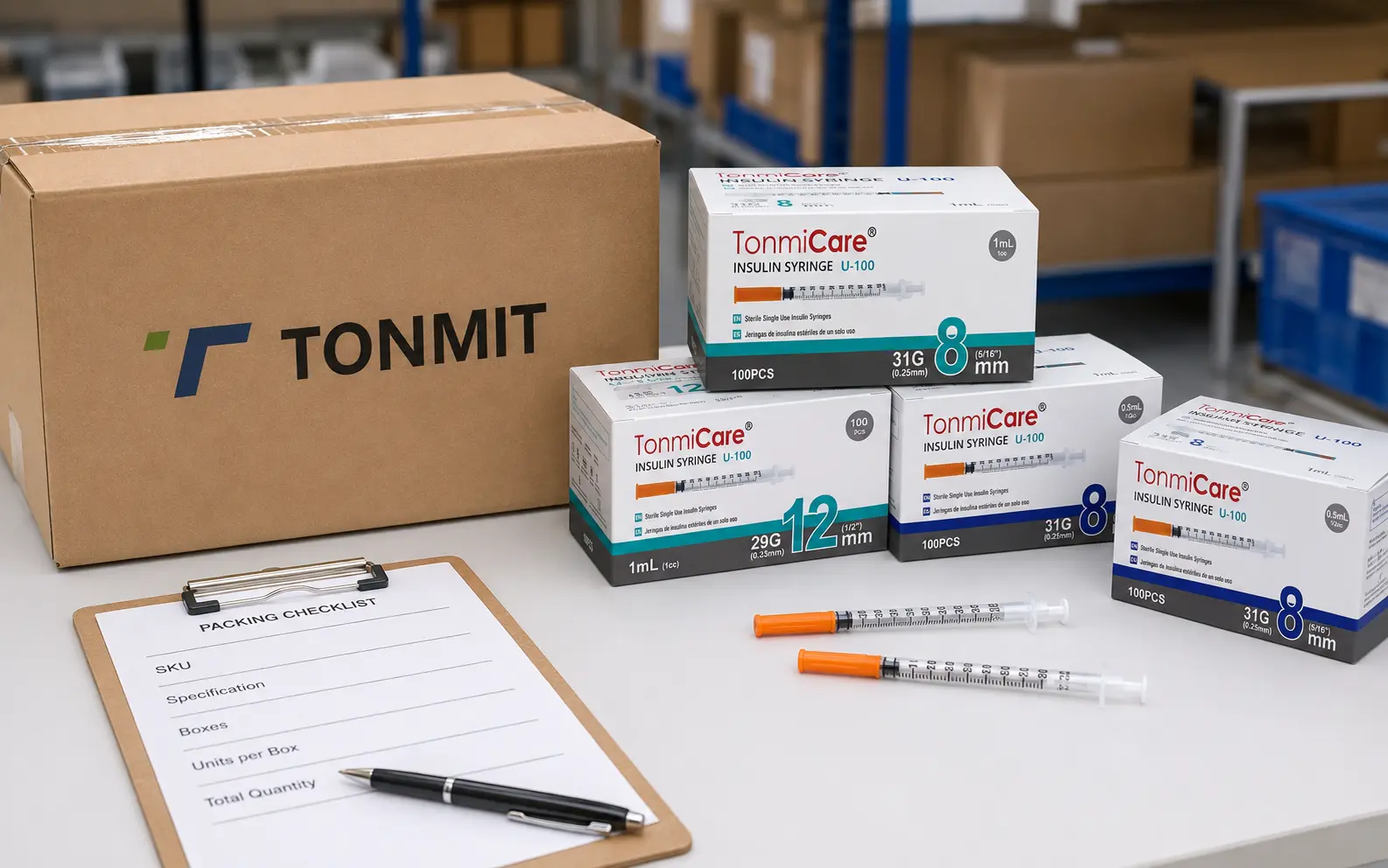
Do not request the same file set for every order, and do not treat generic company certificates as proof of the exact shipment. Separate the supplier-onboarding file from the documents that identify the actual lot and transaction.
| Supplier-qualification file | SKU/order master file | Shipment or lot file |
|---|---|---|
| Legal manufacturer, site and labeler identities | Exact REF, specification, label and IFU | Packing list and shipped case count |
| Applicable establishment and device records | UDI/GTIN mapping where applicable | Actual lot and expiration date |
| ISO 13485 certificate, scope and validity | Case hierarchy, shelf life and storage conditions | CoC or lot-release record when agreed |
| Complaint, recall and change-control processes | Approved sample and artwork revision | Freight and receiving records |
FDA states that establishment registration and device listing do not denote approval, clearance or authorization, and FDA does not issue registration certificates to medical-device facilities.[3] FDA’s Quality Management System Regulation became effective February 2, 2026 and incorporates ISO 13485:2016 by reference for covered manufacturers.[4] An ISO certificate supports quality-system review; it does not authorize every SKU or replace product-specific evidence.
Use the wholesale insulin syringe supplier evaluation checklist for legal-entity, regulatory, quality-system, audit and change-control review. Use medical-device documentation support to organize public records, controlled qualification files and transaction documents.
9. Validate the First Case Order Before Full Approval
The first shipment is a controlled test of the product, packaging and supplier’s execution. Hold it in receiving status until the buyer completes the agreed checks.
- Match commercial records: PO, packing list, invoice, carton count and shipping labels.
- Confirm identity: manufacturer, brand, REF, scale, capacity, graduation, gauge and length.
- Recalculate quantity: units per box × boxes per case × cases received.
- Inspect condition: quarantine wet, crushed, punctured, opened or compromised packages.
- Verify traceability: capture lot, expiration date and applicable UDI/GTIN.
- Scan barcodes: confirm the expected identifier at the required packaging level.
- Check shelf life: compare actual expiration with the contractual minimum.
- Check substitutions: quarantine any unapproved REF, label, pack or specification.
- Record delivery: compare actual processing and transit against the agreed window.
- Release or escalate: document acceptance, discrepancy, complaint and supplier response.
If higher injection volume changes disposal needs, separately review the sharps container sizing and type guide. Sharps planning complements but does not replace case-order receiving controls.
10. Turn the First Order into a Replenishment Program
After the first order is accepted, measure supply performance by exact REF. At minimum, track on-time shipment, order accuracy, fill rate, remaining-shelf-life compliance, documentation response time, complaint response and unapproved substitutions. Review backorder notifications and corrective actions separately from routine service metrics.
A scheduled case-release program can reduce emergency freight and storage pressure. Forecasts should remain clearly identified as forecasts unless the commercial agreement makes them binding; reserved stock, ownership and expiry responsibility should be documented.
11. Choose Case, Scheduled Release, Pallet or Private Label
| Buyer situation | Recommended starting model | Main control |
|---|---|---|
| Independent pharmacy or uncertain demand | Standard U.S.-stock case order | Limit expiry exposure and reconfirm exact REF inventory |
| Multi-location pharmacy with stable use | Monthly or quarterly scheduled case release | Demand by location, allocation and release dates |
| Distributor or large program | Pallet or factory-direct supply | Production lead time, freight cube and continuity plan |
| Brand owner with predictable volume | Private-label feasibility project | Regulatory roles, artwork, packaging MOQ and lifecycle ownership |
Private label is not a routine logo change. It may affect labeler identity, UDI, artwork control, MOQ, complaints and recall communication. Review private-label insulin syringe programs separately from standard wholesale case ordering.
12. Copyable Pharmacy RFQ Template
A complete RFQ makes supplier quotations comparable and reduces follow-up. Replace the bracketed fields and require the supplier to identify every exception.
Required product: [U-100/U-40] insulin syringe; [0.3/0.5/1] mL; [graduation interval]; [gauge × length]; [fixed/removable design]; exact manufacturer/REF [required or supplier to identify].
Commercial pack: [100] syringes per box; [20/36/to be confirmed] boxes per case; [number] cases; annual demand [quantity]; mixed-SKU requirement [yes/no].
Supply: destination ZIP code [ZIP]; requested delivery window [date/range]; U.S. stock/factory-direct preference [selection]; minimum remaining shelf life [months]; split-lot or split-shipment approval [required/not permitted].
Documents: current specification and label/IFU; manufacturer and labeler identities; applicable FDA and quality-system mapping; packaging hierarchy; available lot and expiration date; agreed shipment/lot documents.
No substitution of concentration scale, capacity, graduation, gauge, length, design, manufacturer, REF or packaging without written approval.
Pharmacy Buyer FAQ
How many insulin syringes are in a case?
There is no universal case quantity. TonmiCare’s default factory planning configuration is 100 syringes per box and 36 boxes, or 3,600 syringes, per case. Selected published or U.S.-warehouse REFs may use 20 boxes, or 2,000 syringes, per case. Confirm the exact REF and packaging revision in the quote and PO.
What information is required for an accurate wholesale quote?
Provide the concentration scale, capacity, graduation, gauge × length, design, preferred REF or approval process, case quantity, recurring demand, destination, shelf-life requirement, required documents and delivery target.
What is the MOQ for wholesale insulin syringes?
MOQ is supply-program specific. Confirm whether it applies by exact SKU, full case, mixed shipment, pallet, annual volume or private-label production. The quotation should identify the applicable price tier and period.
Can different syringe sizes be mixed in one order?
Mixed-SKU shipments may be possible, but each SKU must retain a separate REF, lot, expiration date, box/case quantity and receiving record. Different capacities or concentration scales must not be treated as interchangeable units.
How should pharmacies compare insulin syringe case prices?
First confirm the same approved specification. Then normalize syringes per box, boxes per case, shelf life, freight and handling, and compare landed cost per 100 accepted syringes.
Are samples available before a case order?
Sample availability depends on the exact SKU and program. When samples are used for approval, record the manufacturer, REF, scale, graduation, gauge, length, sterile presentation and packaging revision so the production order can be compared with the approved sample.
Does U.S. warehouse support mean the exact SKU is in stock?
No. Obtain written confirmation of the exact REF, available-to-promise quantity, lot, expiration date, processing time, destination and expected delivery window.
How much remaining shelf life should a pharmacy require?
Set a measurable number of months remaining at shipment based on demand, inventory policy and replenishment model. Avoid subjective wording such as “fresh stock.”
What happens if the requested SKU is backordered?
The agreement should define notification timing, available allocation, revised dates and cancellation or split-shipment options. No alternate REF, scale, capacity, gauge, length or pack should ship without written approval.
Are prescriptions or buyer credentials required?
Account eligibility, resale documentation, prescription controls and patient-sale requirements can depend on the buyer, destination jurisdiction, supplier policy and sales channel. Confirm the transaction-specific requirements rather than relying on one nationwide statement.
Can a standard case order use customer-brand packaging?
Private labeling requires a separate feasibility review because it can affect artwork, labeler and UDI responsibilities, packaging MOQ, production time, complaint handling and recall communication.
Conclusion: Buy a Controlled SKU, Not an Ambiguous Case
The reliable way to buy insulin syringes by the case is to approve an exact product and make every packaging and supply assumption measurable. Build demand by REF; lock the U-100 or U-40 scale, capacity, graduation and needle specification; state the complete box and case hierarchy; normalize wholesale price by accepted units; confirm inventory, lot, shelf life and delivery; then validate the same data at receiving.
For a SKU-specific review, request procurement support with the completed RFQ, destination and required delivery window.
References
- 21 CFR 880.5860 — Piston syringe. Electronic Code of Federal Regulations. Accessed August 4, 2026.
- FDA Recognized Consensus Standard: ISO 8537:2016. U.S. Food and Drug Administration. Accessed August 4, 2026.
- Important Reminders about Registration and Listing. U.S. Food and Drug Administration. Accessed August 4, 2026.
- Quality Management System Regulation (QMSR). U.S. Food and Drug Administration. Accessed August 4, 2026.
Exact-SKU case pricing and replenishment
Request a SKU-Specific Insulin Syringe Case Quote
Share the concentration scale, capacity, graduation, gauge × length, preferred REF, case quantity, recurring demand, destination, shelf-life requirement and document checklist. Tonmit will review applicable TonmiCare or selected supply configurations, case pack, U.S. inventory and fulfillment options.
Final specifications, regulatory mapping, case quantity, weight, availability, shelf life, price and delivery are confirmed for the exact REF and transaction.