
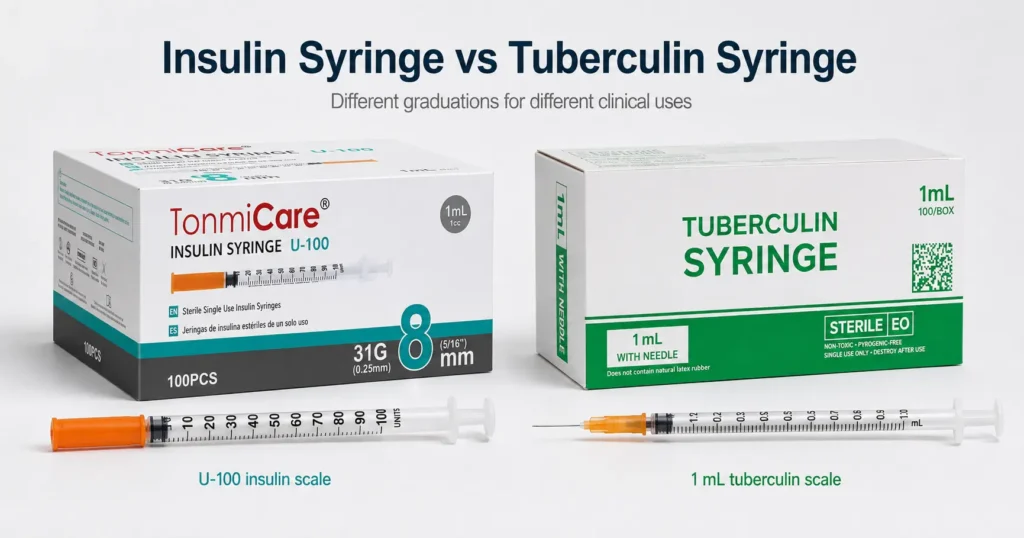
2026 Syringe Identification & Procurement Guide
A scale-first comparison for pharmacies, clinics and distributors—covering units versus milliliters, intended use, needle configuration, substitution risk and exact-SKU receiving controls.
Editorial and medication-safety disclosure: This article explains device identity and procurement controls; it is not a dosing guide or authorization to substitute syringes. Use the syringe type specified by the current medication label, prescription, pharmacist or clinician instructions, and organizational policy. Do not convert among units, milliliters, milligrams or concentrations using an online chart. Quoted device attributes must be verified for the exact manufacturer REF and market configuration.
Direct answer
Quick Answer: Are Insulin and Tuberculin Syringes Interchangeable?
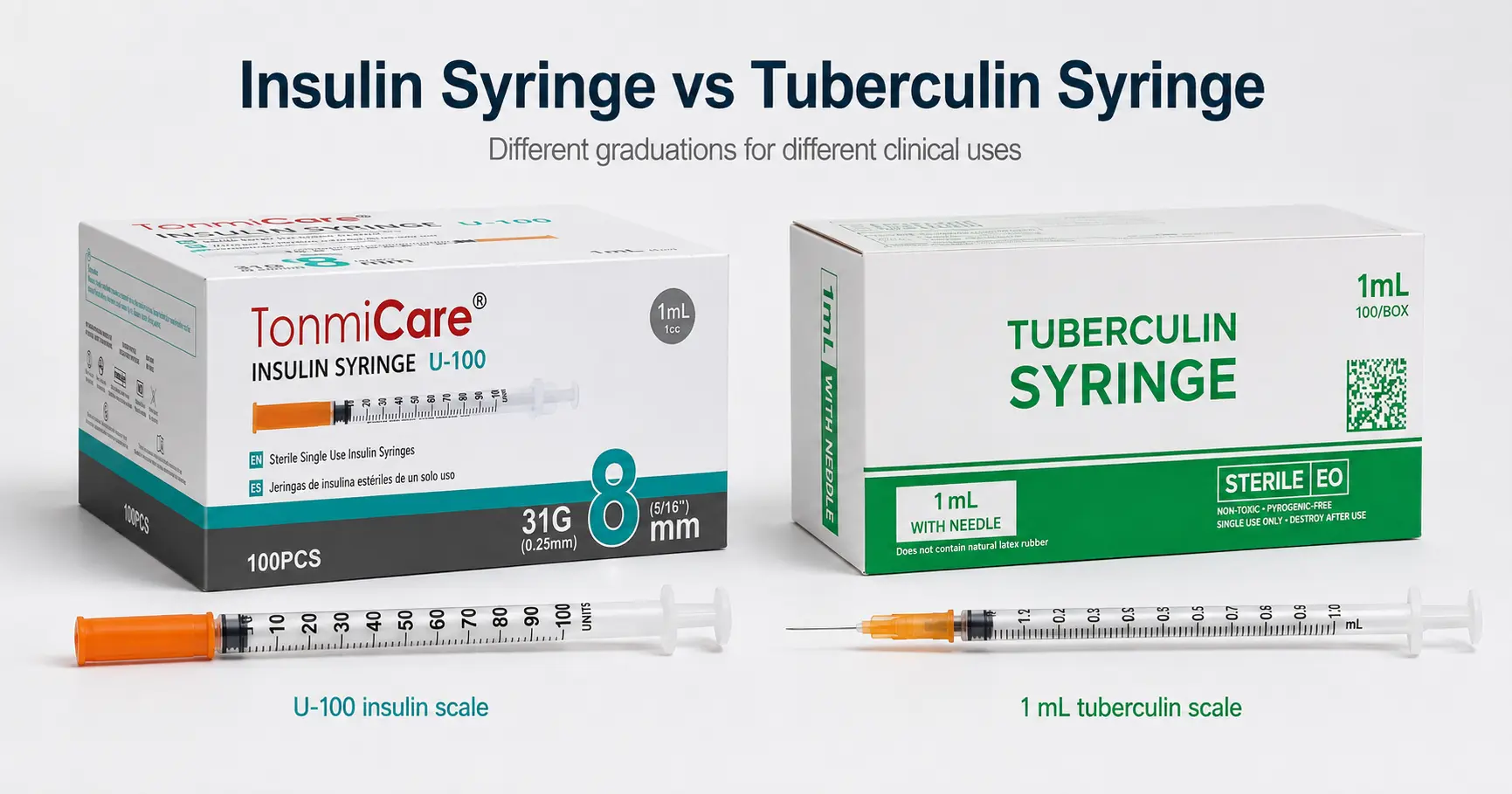
No—not simply because both may hold 1 mL. An insulin syringe uses a concentration-specific unit scale and is intended for the insulin named by its labeling; a tuberculin or general-purpose 1 mL syringe is typically graduated in milliliters. Needle and connector designs also vary. Use only the syringe specified by the medication label and approved workflow, and never authorize substitution from capacity alone.[1][2]
Executive summary
Key Takeaways
- 1 mL describes capacity, not device identity. A 1 mL insulin syringe and a 1 mL tuberculin syringe can have the same nominal volume while using different scales and intended-use statements.
- Units and milliliters answer different questions. Insulin units are linked to the labeled concentration; mL is a volume measurement. A scale must not be treated as a universal conversion tool.
- Do not generalize needle design. Many retail insulin syringes use a fixed needle, but Luer-lock insulin syringes exist. Tuberculin syringes may be supplied without a needle, with a removable needle or in other SKU-specific configurations.
- Current drug labeling takes priority. A U-100 vial label can require a U-100 syringe, while U-500 vial labeling requires a dedicated U-500 syringe and says not to use another syringe type.[5][6]
- Recent evidence shows the identification risk is operational, not theoretical. In 2026, a Class II recall involved packages labeled as 1 mL tuberculin syringes that contained U-100 insulin syringes.[3]
- Buyers should approve a complete SKU. Control intended use, scale, graduation, capacity, needle/connector, manufacturer REF, label, UDI/GTIN, sterile package, case hierarchy and regulatory mapping.
1. Why “1 mL Syringe” Is Not a Complete Product Identity
Searchers often compare an insulin syringe vs tuberculin syringe because both can appear as slim, transparent, single-use 1 mL devices. That visual similarity is real, but it does not make them interchangeable. Capacity is only one attribute in a device specification.
FDA 510(k) summary K162081 provides a particularly clear example. It describes a 1 mL Luer-lock hypodermic syringe and a 1 mL Luer-lock insulin syringe whose assemblies were physically similar. The decisive difference was the barrel scale: the general-purpose syringe was graduated in milliliters, while the insulin syringe was graduated in insulin units. Their intended uses also differed—general aspiration/injection for the hypodermic syringe versus subcutaneous injection of U-100 insulin for the insulin syringe.[1]
This example corrects two oversimplifications at once:
- the difference is not always visible from barrel size or connector alone; and
- an insulin syringe is not always a fixed-needle device, because a cleared 1 mL Luer-lock insulin syringe also exists.
Procurement rule: “1 mL syringe” is a search term, not an approvable purchase specification. The PO must identify the scale, intended use, exact REF and configuration.
For buyers who need to compare 0.3 mL, 0.5 mL and 1 mL U-100 products within the insulin category, the insulin syringe sizes guide separates capacity, graduation, gauge and needle length. This article addresses a different decision: whether a general 1 mL or tuberculin-labeled syringe can be treated as the same device as a concentration-specific insulin syringe.
2. Insulin Syringe vs Tuberculin Syringe Comparison Chart
The table below is designed as a direct-answer block for users and AI search systems. It shows the typical distinction while preserving an important condition: exact features vary by manufacturer and REF.
| Comparison field | Insulin syringe | Tuberculin / general 1 mL syringe | Buyer decision |
|---|---|---|---|
| Primary scale | Insulin units tied to the labeled concentration, such as U-100, U-40 or a dedicated U-500 product | Usually milliliters; graduation interval is SKU-specific | Never approve from capacity or a stock photo alone. |
| Nominal capacity | Common examples include 0.3, 0.5 and 1 mL | Commonly 1 mL, but product families and naming vary | Capacity does not establish the scale or intended use. |
| Intended use | Injection of the insulin concentration stated in the device labeling | Small-volume aspiration/injection or another use defined by the exact labeling | Match the device to the medication label and institutional policy. |
| Needle design | Many products have a permanently attached needle; Luer insulin syringes also exist | May be syringe-only or supplied with a fixed/removable needle, depending on the REF | Specify the actual needle and connector configuration. |
| Typical unit of ordering | Concentration scale + capacity + graduation + gauge × length + package count | Capacity + mL graduation + connector + needle configuration + package count | Keep separate item masters and barcodes. |
| Substitution rule | No automatic substitution. Use only the device authorized for the exact medication and workflow. | Require clinical/pharmacy approval and a controlled item-master change. | |
| Primary error mode | Wrong concentration scale, graduation or insulin family | mL-to-unit conversion, wrong small-volume scale or wrong device selection | Control by full identity, not color or silhouette. |
Bottom line: the safest answer to “is a tuberculin syringe the same as an insulin syringe?” is no. They can share capacity and even some physical components, but their scale and labeled use create different devices and different medication-error risks.
3. Insulin Syringe Units vs mL: Why the Scale Matters
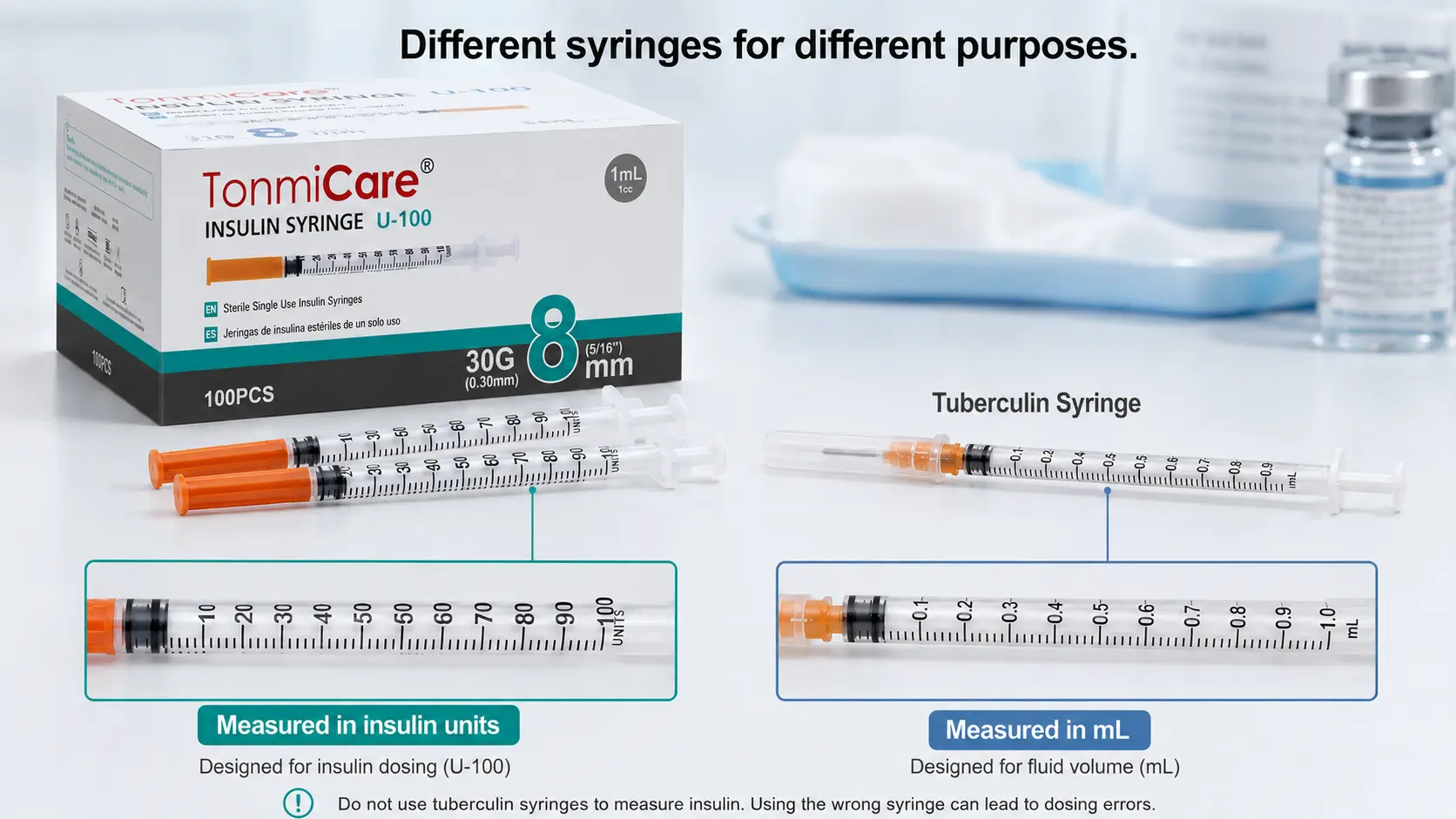
A milliliter is a unit of liquid volume. An insulin unit is a biological dosing unit expressed in relation to the labeled drug concentration. The barrel of a concentration-specific insulin syringe translates a known insulin concentration into unit markings so the user can read the prescribed number of units directly when the correct syringe and insulin are paired.
For example, the current HUMULIN R U-100 carton identifies the solution as 100 units/mL and instructs users to use only a U-100 syringe.[5] That label-specific relationship explains why a 1 mL U-100 syringe can be marked to 100 units. It does not mean:
- every 1 mL syringe is an insulin syringe;
- every drug measured in a 1 mL barrel can be expressed in “syringe units”;
- an mL scale and a U-100 scale can be substituted without an approved process;
- 100 units is the correct dose for any individual; or
- a U-100 syringe is suitable for U-40, U-500 or another concentration.
The current HUMULIN R U-500 label makes this concentration dependence even clearer. It requires a dedicated U-500 insulin syringe for the vial presentation, says no dose conversion is needed with that syringe and instructs users not to use any other syringe type.[6] Modern dedicated devices replaced older workarounds in which concentrated insulin was sometimes described through U-100 “syringe units” or tuberculin-syringe milliliters—terminology that ISMP associated with serious underdose and overdose risk.[7]
For that reason, this article intentionally does not publish a tuberculin-to-insulin conversion chart. A chart might rank for a conversion query while creating the exact ambiguity the current labels are designed to remove. The safer GEO-ready answer is conditional and explicit:
Scale rule: Read the medication concentration and use the matching syringe named by the current label. Do not translate a prescription into a different syringe scale through generic web arithmetic.
4. Intended Use and Standards: Separate Device Categories
Intended use is not marketing wording; it defines what the device is designed and labeled to do. Two devices may share barrel volume and materials while remaining distinct because the scale, use environment and performance evidence are different.
FDA’s recognized-consensus-standards database reinforces this separation:
- ISO 8537:2016 addresses sterile single-use syringes, with or without needles, intended solely for injection of insulin filled by the end user. FDA partially recognizes this standard and specifically notes that it covers insulin syringes for various concentrations.[2]
- ISO 7886-1:2017 addresses sterile hypodermic syringes for manual aspiration and injection of fluids. Its scope explicitly excludes insulin syringes and points to ISO 8537 for that category.[4]
This does not mean that every product claiming one of these standards is automatically acceptable. A buyer still needs exact-SKU evidence showing which standard edition, clauses, tests and product configuration are covered. Nor should a distributor copy performance or shelf-life claims from one cleared device into another manufacturer’s product description.
A useful documentation map should connect:
Device label → intended use → scale → manufacturer REF → applicable FDA record → model coverage → current IFU → packaging identity → quality evidence
When the documentation chain breaks at any point, the product should remain unapproved for substitution or private-label release until the gap is resolved.
5. Fixed Needle vs Luer Lock: Do Not Use Design Shortcuts
Many consumer insulin syringes combine the barrel and a permanently attached fine needle. That configuration can reduce residual space and simplifies the product identity for a specific subcutaneous insulin workflow. It is also common enough that buyers sometimes assume “fixed needle” defines every insulin syringe.
That assumption is incorrect. FDA-cleared 1 mL Luer-lock insulin syringes exist. K162081 describes one with an insulin-unit scale and a Luer connector, while the same submission describes a physically similar general-purpose 1 mL hypodermic syringe with an mL scale.[1] In this case, connector style alone would not distinguish the two devices.
Tuberculin syringes also should not be reduced to one connector or needle format. Depending on the manufacturer and catalog number, a 1 mL product may be:
- a syringe-only Luer-slip or Luer-lock configuration;
- packaged with a removable hypodermic needle;
- supplied with a safety-engineered needle;
- described for general small-volume aspiration/injection; or
- labeled for a more specific professional use.
The buyer therefore needs separate controlled fields for barrel scale, connector, needle attachment, gauge, length and safety mechanism. A single “1 mL syringe with needle” field collapses too many decision variables and increases substitution risk.
Fields that must remain independent
Capacity is not graduation. Graduation is not concentration scale. Gauge is not needle length. Luer lock is not intended use. Safety feature is not compatibility. Record every field separately.
6. Can You Use a Tuberculin Syringe for Insulin?
Do not substitute a tuberculin syringe for an insulin syringe based on 1 mL capacity. The correct device is the one named by the current insulin label, prescription and approved care process. For current U-100 and U-500 examples, the labels explicitly require concentration-matched insulin syringes.[5][6]
A healthcare professional may encounter legacy documentation describing concentrated insulin measured in milliliters with a tuberculin syringe. That historical practice does not create a general modern substitution rule. ISMP documented how communication in “syringe units” or mL contributed to confusion with U-500 insulin before dedicated delivery systems were available.[7] Current labeling should replace legacy workarounds, and clinicians must manage any exceptional process through formal medication-use controls.
For pharmacies and distributors, the operational response is:
- Do not display a tuberculin syringe as an automatic alternative when an insulin syringe is out of stock.
- Do not map both products to one item master because they share 1 mL capacity.
- Do not create generic directions that convert insulin units to an mL syringe scale.
- Escalate a shortage or substitution request to the responsible pharmacist, prescriber or clinical governance process.
- Document the concentration, presentation, exact syringe and patient education requirements before dispensing.
For a deeper explanation of concentration-matched systems, use the U-40 vs U-100 insulin syringe guide. Neither concentration should be inferred from barrel capacity or package color.
7. Can You Use an Insulin Syringe for Other Medications?
An insulin syringe should not be treated as a general-purpose measuring device merely because it has a fine needle and small barrel. Its scale may represent insulin units rather than milliliters, and its labeled intended use may be limited to a specific insulin concentration. Using it for another medication can create ambiguity among the prescribed amount, the drug concentration and the printed scale.
FDA’s ISO 8537 recognition describes insulin syringes as intended solely for insulin injection, while the recognized ISO 7886-1 scope covers general manual hypodermic syringes and excludes insulin syringes.[2][4] This standards distinction supports a simple content rule: do not market an insulin syringe as a universal device for compounded medicines, GLP-1 vials, allergy injections or other small-volume products without exact labeling and regulatory evidence.
Searches such as “how many units is 0.5 mL in a syringe” become dangerous when they omit the medication and concentration. “Units” printed on an insulin syringe do not create a universal volume unit for other drugs. Milligrams, milliliters and insulin units cannot be interchanged without the complete medication-specific concentration and authorized instructions.
For procurement teams, create separate categories at minimum:
- concentration-specific insulin syringes;
- general 1 mL hypodermic or tuberculin-labeled syringes;
- syringe-and-needle combinations for defined non-insulin applications;
- oral/enteral syringes that must not connect to parenteral systems; and
- specialty or medication-dedicated delivery devices.
Each category should have a distinct item name, barcode, bin, substitute group and approval route.
8. 2026 FDA Recall: When the Package and Syringe Did Not Match
On July 30, 2026, FDA’s recall database showed an open Class II recall for Monoject 1 mL Luer Lock Tuberculin Syringes. The outer packaging and blister labels identified a tuberculin syringe, but the packages contained U-100 insulin syringes. The listed action covered 198,900 units distributed across the United States and Canada.[3]
This event is unusually relevant because it demonstrates that:
- the wrong syringe can be difficult to detect when only the outside package is checked;
- both devices may share 1 mL capacity and a similar Luer-lock form;
- scale identity is a safety-critical feature, not a minor printing difference;
- lot-level traceability is necessary for quarantine and downstream notification; and
- distributors must be able to identify customers who received affected lots.
The recall notice instructed recipients to review inventory, communicate with personnel, segregate and quarantine affected product, and notify downstream customers where applicable. Those steps can be converted into a reusable receiving and recall-control plan:
| Failure point | Preventive control | Evidence to retain |
|---|---|---|
| Outer box matches PO, inner device does not | Open a validated sample quantity and compare barrel scale and configuration | Receiving photos, inspection record and approved sample |
| Similar 1 mL items share storage | Separate bins, unique barcodes and non-substitutable item masters | Location map and inventory-system rules |
| Scale discrepancy treated as cosmetic | Classify scale and intended-use mismatch as a release-blocking nonconformance | Quarantine record and escalation decision |
| Lot distribution cannot be reconstructed | Capture lot and customer shipment records at the required package level | Lot-to-receipt and lot-to-customer trace |
| Recall notice stops at the first consignee | Maintain downstream notification responsibilities and acknowledgment tracking | Customer notices, responses and reconciliation |
The lesson is broader than one brand or lot: a distributor should verify what is inside the sterile package, not only what is printed on the shipping case.
9. Medication-Safety Controls for Pharmacies and Clinics
Education is necessary, but it is weak when the item master, storage layout and purchasing rules allow the wrong syringe to reach the point of use. ISMP has reported harmful insulin errors involving doses measured in mL rather than units, misread syringe graduations and failure to use an insulin syringe in hospital hyperkalemia workflows.[8]
A stronger system uses several controls at the same time:
- Name the scale in the item description. Use “U-100 insulin syringe” or “1 mL syringe, mL scale” instead of a generic “1 cc syringe.”
- Store unlike scales separately. Physical separation should be reinforced by unique barcodes and location labels.
- Prohibit automatic substitution. Do not place U-40, U-100, U-500 and mL-scale devices in one equivalent-item group.
- Link the medication to the device. EHR, dispensing and order-set logic should identify the correct concentration and device presentation.
- Require independent verification for high-risk workflows. Follow organizational policy for insulin preparation and administration.
- Use pharmacy-prepared or dedicated products where policy requires. Avoid ad hoc bedside conversion between scales.
- Train through the actual device. Show the approved syringe and barrel markings rather than relying on verbal descriptions.
- Monitor near misses. Wrong-bin picks, barcode overrides and label discrepancies should feed into corrective action before harm occurs.
When healthcare workers administer injections to other people, sharps exposure is a separate selection factor. OSHA identifies engineering controls, safer needle devices and accessible sharps containers as parts of exposure reduction under the Bloodborne Pathogens Standard.[9] A safety-engineered syringe must still use the correct scale and intended use; “safety” does not make unlike devices interchangeable.
After use, place the complete syringe or removable sharp in the appropriate disposal container under facility policy and applicable law. Buyers can compare container volume, openings, fill lines and placement using the sharps container selection guide.
10. Exact-SKU Procurement Specification
For a B2B buyer, the key outcome of the insulin syringe vs tuberculin syringe comparison is a better item specification. The approved record should make it impossible to confuse two products that happen to share 1 mL capacity.
| Control group | Required fields | Common incomplete wording | Approval test |
|---|---|---|---|
| Device identity | Device name, intended use, brand, legal manufacturer, labeler and exact REF | “1 mL syringe” | Every package level maps to the same REF and label revision. |
| Scale | U-100, U-40, U-500 or mL; graduation interval and maximum marking | “100-unit/1 cc” without concentration | Controlled specification and physical sample agree. |
| Physical configuration | Capacity, barrel design, connector, fixed/removable needle, gauge, length and safety feature | “Fine needle included” | Exact configuration matches the clinical requirement. |
| Sterile barrier | Sterilization method, individual package type, opening method and seal-integrity criteria | “Sterile pack” | Evidence belongs to the quoted SKU and current package. |
| Commercial hierarchy | Units/box, boxes/case, units/case, cases/pallet, dimensions, weight and barcode level | “100 per box” only | Case price can be normalized to confirmed usable units. |
| Traceability | UDI/GTIN where applicable, lot, manufacture/expiration format and complaint contact | “Lot traceable” | Sample records support lot-to-customer reconstruction. |
| Regulatory mapping | Applicable 510(k) or other pathway, model coverage, product code, listing and current U.S. label | “FDA registered” | Exact REF is within the cited record and target-market configuration. |
| Supply | MOQ, current inventory by REF, lot/expiration, lead time, allocation, freight and change notification | “In stock USA” | Availability is confirmed for the transaction and destination. |
FDA states that establishment registration and device listing do not denote approval, clearance or authorization and that FDA does not issue medical-device registration certificates.[10] A quotation should therefore avoid “FDA certified syringe” and instead identify the exact device record and responsible organizations.
For a broader onboarding process, use Tonmit’s wholesale insulin syringe supplier evaluation checklist. It extends the product specification into complaint handling, change control, supply continuity and total operating cost.
11. Receiving, UDI and Lot Traceability
Receiving is the last controlled point before stock becomes available for dispensing or distribution. The 2026 recall shows why inspection should reach beyond the shipping label.
Incoming inspection sequence
- Match supplier item, manufacturer REF and PO description.
- Confirm the device name and intended-use wording on the current label.
- Verify scale type, maximum marking and graduation interval on the actual syringe.
- Confirm capacity, connector, needle attachment, gauge, length and safety feature.
- Compare sterile package, dispenser box and case labels for consistent REF, UDI/GTIN, lot and expiration data.
- Inspect package integrity and shipping damage under the sampling plan.
- Quarantine any wrong scale, mixed configuration, artwork discrepancy or unapproved substitution.
- Release inventory only after inspection results are documented and reconciled.
FDA’s UDI system is designed to identify devices through distribution and use. A device identifier identifies the labeler and specific model/version; production identifiers can include lot, serial number, expiration date or manufacture date when those data appear on the label.[11] Buyers should decide which package levels and production fields must be scanned, stored and passed downstream.
A practical recall-ready record links:
Supplier shipment → receiving lot → internal location → order/customer → complaint or field action → quantity reconciled
For private-label insulin syringes, the same chain must also identify who controls artwork, who is the labeler, who maintains UDI/GUDID data where applicable, and who sends customer notifications. A logo change cannot obscure the concentration scale, REF or legal-manufacturer relationship.
12. Applying the Comparison to Tonmit and TonmiCare
Tonmit is the company and website entity supporting product selection, documentation, packaging, U.S.-warehouse coordination and B2B fulfillment. TonmiCare is the applicable product brand. The two names should not be substituted for the legal manufacturer, labeler or exact device identity shown in the approved documentation.
Tonmit’s wholesale insulin syringe range focuses on concentration-specific insulin syringe configurations for pharmacies, clinics and distributors. Selected priority U-100 1 mL configurations include 30G × 8 mm and 31G × 8 mm options, subject to exact REF, graduation, labeling, documentation and inventory confirmation. These products must not be described as generic tuberculin syringes merely because the barrel holds 1 mL.
When a buyer requests both insulin syringes and general 1 mL syringes, the quotation should keep them as separate lines and require independent approval. At minimum, Tonmit’s review should confirm:
- the medication or program use case;
- insulin concentration scale or mL scale;
- capacity and graduation interval;
- fixed-needle or Luer configuration;
- gauge and length where a needle is included;
- standard or safety-engineered design;
- manufacturer, labeler, REF and current artwork;
- applicable FDA and quality documentation;
- box, case and pallet hierarchy;
- lot, expiration and minimum remaining shelf life; and
- current U.S. warehouse availability for the exact SKU.
Use Tonmit’s medical device documentation support to request the SKU-level evidence. Warehouse claims remain transaction-specific: inventory, lot, expiration date, processing time, carrier service and destination must be reconfirmed when the order is placed.
13. Copy-Ready RFQ Checklist
A strong RFQ prevents “same 1 mL size” from becoming an uncontrolled substitution. Copy the fields below and require the supplier to state every exception.
| RFQ field | Required detail | Status |
|---|---|---|
| Device category | Insulin syringe or general 1 mL/tuberculin syringe; exact intended use | Required / no substitution |
| Scale | U-100, U-40, U-500 or mL; graduation and maximum marking | Verified on sample |
| Physical specification | Capacity, connector, fixed/removable needle, gauge × length, safety feature | Exact REF only |
| Identity | Legal manufacturer, brand/labeler, REF, UDI/GTIN and current label revision | Reconciled |
| Packaging | Individual sterile pack, units/box, boxes/case, units/case, pallet and dimensions | Confirmed |
| Documentation | Applicable FDA record, model coverage, IFU/label, standards, QMS and requested quality files | Accepted / gap |
| Traceability | Lot/expiration format, minimum remaining shelf life, complaint and recall contacts | Tested |
| Commercial supply | MOQ, case price, annual volume, current inventory, lead time, destination ZIP and freight | Transaction-specific |
| Private label | Roles, artwork control, mandatory scale/intended-use labeling, UDI analysis and packaging validation | Standard / OEM |
Copy-ready request
Required device: [concentration-specific insulin syringe / general 1 mL syringe]; intended use [state]; scale [U-100/U-40/U-500/mL]; capacity [mL]; graduation [interval]; connector and needle [fixed/Luer, gauge × length, safety requirement]; exact manufacturer and REF; [units] per box; [boxes] per case; annual volume [quantity]; destination ZIP [ZIP]; minimum remaining shelf life [requirement]; standard or TonmiCare private-label packaging [status]; required FDA, labeling, quality and logistics documents [list]. No scale, intended-use, needle or REF substitution without written approval.
Search questions answered
14. Frequently Asked Questions
What is the difference between an insulin syringe and a tuberculin syringe?
The central difference is the scale and intended use. An insulin syringe is marked in concentration-specific insulin units, while a tuberculin or general 1 mL syringe is typically marked in milliliters. Needle and connector designs vary by SKU, so physical appearance alone is not a reliable identifier.
Are insulin and tuberculin syringes interchangeable?
No automatic interchangeability should be assumed. Use the syringe named by the current medication label and approved clinical or pharmacy process. Sharing 1 mL capacity does not make the scales or intended uses equivalent.
Can you use a tuberculin syringe for U-100 insulin?
Do not substitute based on volume. Current U-100 insulin labeling can instruct users to use only a U-100 syringe. Any exceptional clinical process must be directed and controlled by qualified healthcare professionals, not by a generic web conversion.
Can you use a tuberculin syringe for U-500 insulin?
Current HUMULIN R U-500 vial labeling requires a dedicated U-500 insulin syringe and says not to use any other syringe type. Legacy practices involving tuberculin-syringe mL measurements should not override the current label.
Is a 1 mL insulin syringe the same as a 1 mL syringe?
No. “1 mL” states nominal capacity only. The second device may have an mL scale and general-purpose intended use, while the insulin syringe has a concentration-specific unit scale and insulin-specific labeling.
Does 1 mL equal 100 units?
Only in the defined context of U-100 insulin, which contains 100 units per mL. It is not a universal relationship for U-40, U-500 or non-insulin medications, and it does not authorize using an mL syringe instead of the labeled insulin syringe.
Why are insulin syringes marked in units instead of mL?
The unit scale is designed to let the user read the prescribed insulin units directly when the syringe is paired with the matching labeled concentration. The printed scale is therefore part of the device identity.
Can an insulin syringe be used for another medication?
It should not be treated as a general-purpose syringe without exact medication instructions and device labeling. An insulin-unit scale can create confusion when a different drug is prescribed in mg or mL.
Do all insulin syringes have fixed needles?
No. Many retail insulin syringes use permanently attached needles, but FDA-cleared Luer-lock insulin syringes also exist. Confirm the exact connector and needle configuration rather than relying on category assumptions.
Do all tuberculin syringes have removable needles?
No. They may be supplied syringe-only, with a removable needle, with a safety needle or in another configuration. The exact manufacturer REF and label determine the design.
What happened in the 2026 tuberculin syringe recall?
FDA reported that packages labeled as 1 mL Luer-lock tuberculin syringes contained U-100 insulin syringes. The listed Class II recall covered 198,900 units and illustrates why buyers should inspect the barrel scale inside the package.
How can a pharmacy prevent insulin and tuberculin syringe mix-ups?
Use distinct item names and barcodes, separate storage, concentration-specific order logic, no automatic substitution, physical receiving inspection and escalation of every scale or labeling discrepancy.
What should a distributor verify before buying bulk U-100 insulin syringes?
Verify intended use, U-100 scale, capacity, graduation, connector/needle, gauge × length, exact REF, manufacturer and labeler, applicable FDA record, sterile packaging, case quantity, UDI/GTIN, lot, shelf life and confirmed inventory.
Does FDA registration mean the syringe is FDA cleared?
No. FDA states that registration and listing do not denote approval, clearance or authorization. Verify the exact device pathway and whether the quoted REF is within the cited record.
Can TonmiCare private-label packaging use only “1 mL syringe” on the front?
The final artwork must preserve all mandatory and safety-critical identity required for the target market, including the correct scale and intended-use information. Private labeling requires role, UDI, regulatory and artwork review; a generic front-panel description is not enough.
15. Limitations and Conclusion
This guide reflects U.S. public records, labels and recognized standards reviewed on July 31, 2026. Product labeling, recall status, device configurations, regulatory records and commercial packaging can change. The examples cited establish useful principles but do not transfer every feature, test result or clearance claim to another manufacturer or private-label SKU.
The answer to “insulin syringe vs tuberculin syringe” is not that one is universally better. They are different tools whose apparent similarity can hide a critical scale and intended-use difference. A 1 mL insulin syringe may be marked in U-100 units for a specific insulin workflow; a 1 mL tuberculin or hypodermic syringe may be marked in milliliters for small-volume use. Connector and needle design must be verified separately.
For patients and care teams, follow the medication label and professional instructions. For pharmacies, clinics and distributors, prevent substitution through separate item masters, exact-SKU documentation, physical scale inspection, lot traceability and recall-ready customer records. The procurement goal is not merely to buy a 1 mL barrel—it is to buy the correct, fully identified device and preserve that identity through delivery and use.
Exact-SKU supply support
Request an Insulin Syringe Specification Review
Tonmit supports pharmacies, clinics and medical distributors reviewing TonmiCare insulin syringe specifications, scale and graduation, needle configuration, packaging, documentation, private-label requirements and U.S.-warehouse-supported fulfillment.
Share the intended use, concentration scale, capacity, graduation, connector or fixed-needle design, gauge × length, case quantity, annual volume, destination and document list. Final regulatory mapping, labeling, inventory, remaining shelf life, lead time and commercial terms are confirmed for the selected SKU and transaction.
References
- U.S. Food and Drug Administration. 510(k) Summary K162081: 1 mL Luer-Lock Hypodermic and Insulin Syringes. The public summary distinguishes the mL scale and general-purpose use from the insulin-unit scale and U-100 use.
- U.S. Food and Drug Administration. Recognized Consensus Standard ISO 8537:2016—Sterile Single-Use Syringes for Insulin. FDA partially recognizes the standard and describes its insulin-specific scope.
- U.S. Food and Drug Administration. Class II Device Recall: Monoject 1 mL Luer Lock Tuberculin Syringe. FDA’s record states that labeled tuberculin-syringe packages contained U-100 insulin syringes; page updated July 30, 2026.
- U.S. Food and Drug Administration. Recognized Consensus Standard ISO 7886-1:2017—Sterile Hypodermic Syringes for Manual Use. The scope covers general manual hypodermic syringes and excludes insulin syringes.
- U.S. National Library of Medicine, DailyMed. HUMULIN R U-100 U.S. Label. The carton identifies 100 units/mL and directs use only with a U-100 syringe.
- U.S. National Library of Medicine, DailyMed. HUMULIN R U-500 U.S. Prescribing Information. The vial presentation requires a U-500 insulin syringe and prohibits using another syringe type.
- Institute for Safe Medication Practices. Hardwiring Safety into the Computer System: Technology Support for U-500 Insulin. ISMP describes historical confusion involving U-100 syringe markings, tuberculin-syringe mL and actual insulin units.
- Institute for Safe Medication Practices. ISMP Medication Safety Alert! Action Agenda, January–March 2018. The agenda summarizes harmful insulin errors involving mL measurement, syringe markings and incorrect devices in hospital hyperkalemia treatment.
- Occupational Safety and Health Administration. Hospitals eTool: Needlestick and Sharps Injuries. OSHA summarizes engineering controls, safer needle devices and sharps-container practices under the Bloodborne Pathogens Standard.
- U.S. Food and Drug Administration. Important Reminders about Registration and Listing. FDA states that registration and listing do not denote approval, clearance or authorization and that FDA does not issue device registration certificates.
- U.S. Food and Drug Administration. UDI Basics. FDA explains device identifiers, production identifiers and identification through distribution and use.