
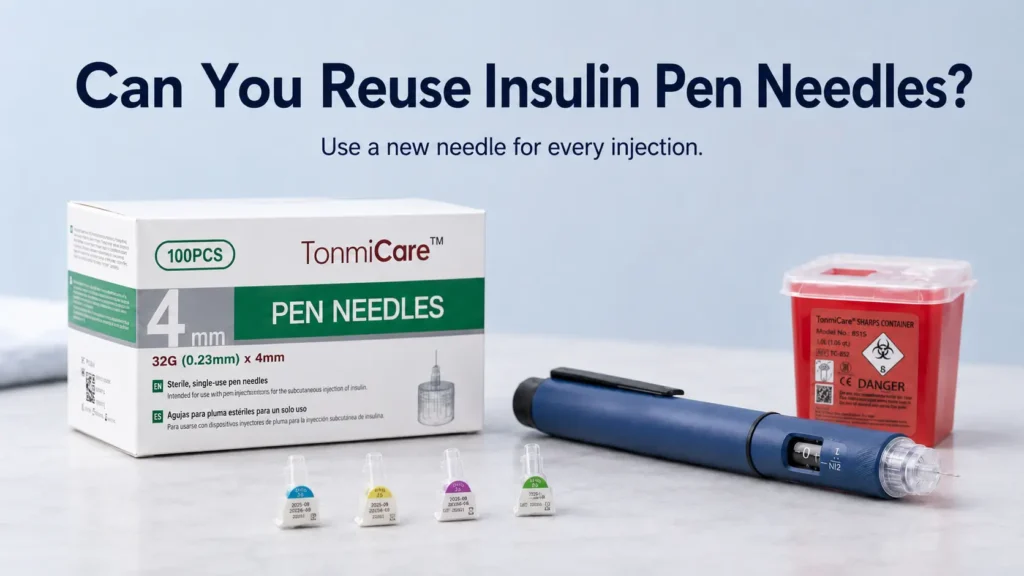
Pen Needle Safety & Supply Planning
A focused guide for pharmacies, clinics, care programs and medical distributors—connecting single-use instructions with realistic demand forecasting, refill controls and sharps planning.
Scope: This article is an educational and procurement resource, not patient-specific medical advice. Follow the current instructions for the exact medication pen and needle supplied. Do not change a treatment routine, injection device or prescribed quantity based only on an online article. If cost, access or shortages are contributing to reuse, consult the dispensing pharmacist or prescribing healthcare professional.
Direct answer
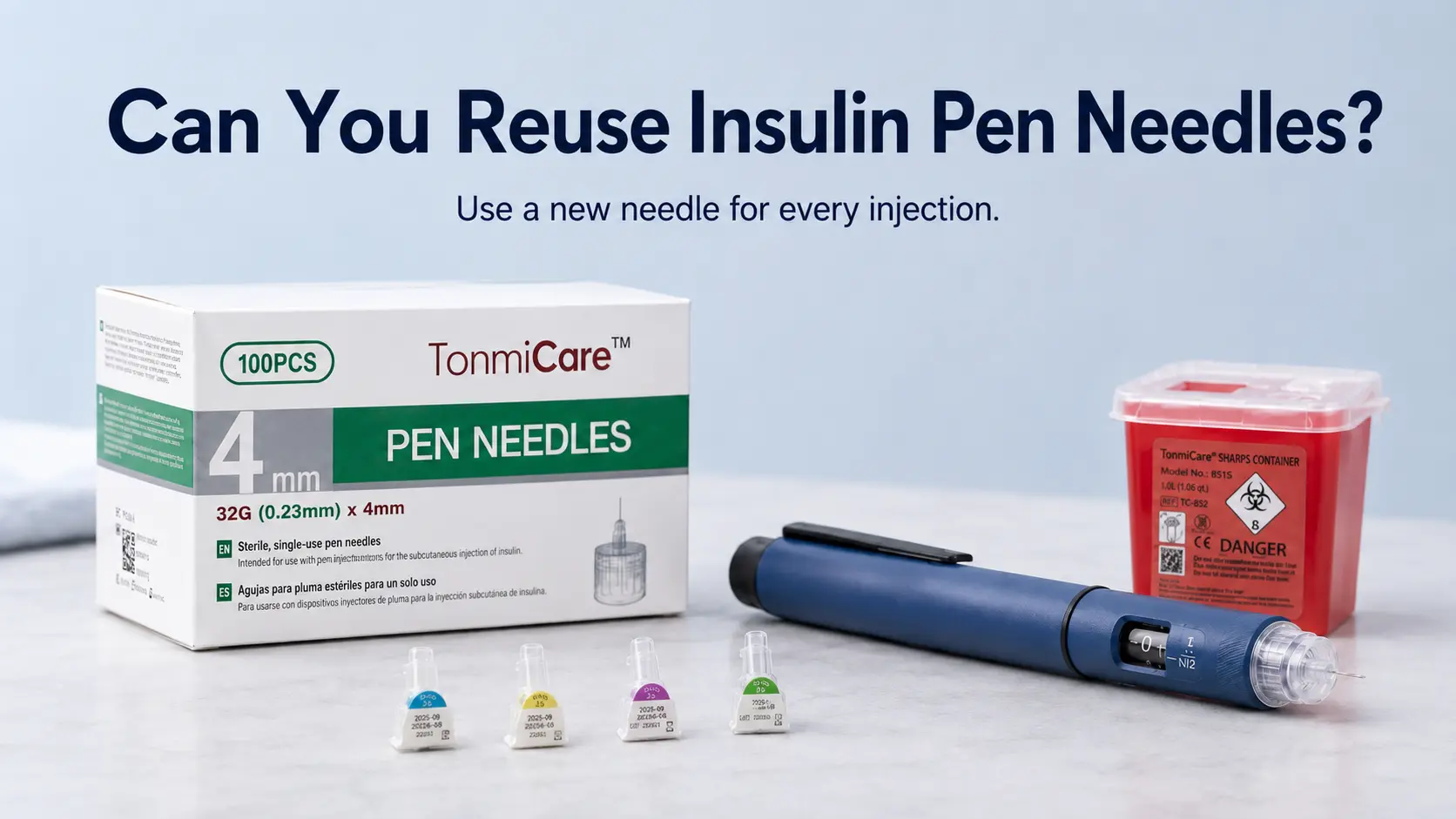
Can You Reuse Insulin Pen Needles?
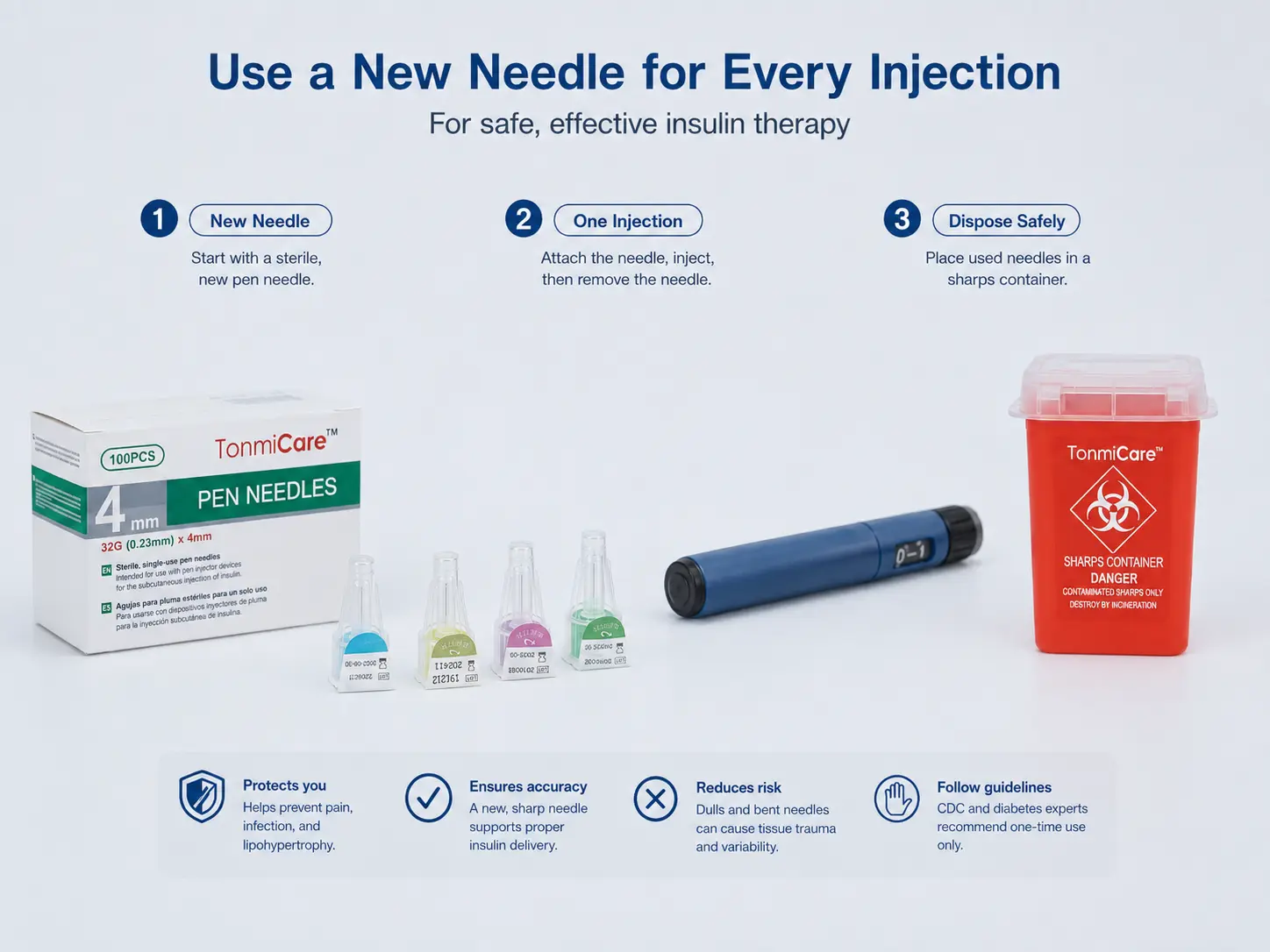
No. Use a new, compatible pen needle for each injection and remove it from the pen immediately afterward. Current instructions for multi-dose insulin pens direct users to select a new needle for every injection and warn against reuse or storage with a needle attached.[1] Pharmacies, clinics and care programs should therefore forecast one new needle for every expected injection. Reuse should not be built into purchasing quantities or used as a shortage-management strategy.
Executive summary
Key Takeaways
- One injection requires one new needle. The multi-dose pen body may be reused by one patient; its detachable needle remains single-use.
- Reuse, pen sharing and attached-needle storage are different controls. Each needs a separate policy and counseling message.
- Use precise evidence language. Reuse is associated with lipohypertrophy and pain, but available research does not prove that every reuse causes infection, visible deformation or a dosing error.[2][3]
- Forecast from injection events. Do not reduce demand by assuming that users will reuse needles.
- Confirm the exact pen presentation. Some devices require a detachable needle; others use an integrated needle and accept no separate accessory.
- Match the setting. Self-use programs and employee-administered clinic injections may require different needle designs, controls and disposal procedures.
1. Why Pen Needles Are Treated as Single-Use
A detachable pen needle and a multi-dose pen have different intended-use boundaries. A pen may hold several labeled doses for one patient, while the needle connected for each injection is opened, attached, used and discarded. “Reusable pen” does not mean “reusable needle.”
The current HUMULIN N KwikPen instructions tell users to use a new needle for each injection, select a new needle during preparation and remove the capped needle after administration. They also explain that storing the pen with the needle attached can contribute to leakage, blockage and air entry.[1] These product-specific instructions—not appearance, convenience or informal reuse habits—provide the operational basis for pharmacy counseling and inventory planning.
Once a needle has been opened and passed through skin, it is no longer in its original sterile condition. Visual inspection cannot verify sterility, internal blockage, lubricant condition, hub integrity or microscopic tip changes. Cleaning or wiping a used needle does not restore the validated sterile barrier.
2. What Reuse Evidence Does—and Does Not—Establish
A reliable policy separates product instructions from observational research. Single-use instructions provide the purchasing rule. Research helps explain possible outcomes and why counseling matters, but it should not be converted into claims that the evidence does not support.
| Question | Supported conclusion | Important limitation | Operational decision |
|---|---|---|---|
| Is reuse within labeled use? | Current pen instructions specify a new needle for each injection. | This does not mean every second use produces immediate harm. | Plan one new needle per injection. |
| Is reuse linked to lipohypertrophy? | Reviews and meta-analysis report an association.[2][3] | Much of the evidence is observational; site rotation and other behaviors also matter. | Combine fresh-needle access with injection-site education. |
| Does reuse cause infection? | A used needle is no longer in its original sterile state, and labeling identifies contamination or infection as concerns. | Direct clinical evidence that personal reuse commonly causes infection is not robust. | Maintain single use without claiming infection is inevitable. |
| Does every needle visibly bend? | Tip and coating changes may occur and may not be visible. | Dramatic microscopy images do not prove identical damage after every injection. | Do not inspect and reuse; follow labeled use. |
A 2026 narrative review concluded that reuse is commonly associated with lipohypertrophy and pain, while also noting limitations in the evidence for infection, bleeding and bruising. The review was commissioned and funded by Embecta, so its conclusions should be considered together with its declared sponsorship and the underlying studies.[2] A 2025 systematic meta-analysis likewise identified reuse among the reported risk factors for lipohypertrophy, but did not turn observational association into proof that reuse alone caused every lesion.[3]
Communication standard: “Pen needles are intended for single use, and reuse is associated with avoidable risks” is defensible. “A second use will always cause infection or a bent needle” is not.
3. Separate Needle Reuse, Pen Sharing and Attached-Needle Storage
These behaviors are often grouped together, but they are not interchangeable:
| Situation | What it means | Required control |
|---|---|---|
| Same patient reuses a needle | A single-use accessory is used for more than one injection. | Provide and counsel for one new needle per injection. |
| A pen is used for more than one patient | A single-patient-use medication device crosses between people. | Never share the pen, even when the external needle is changed.[4] |
| A used needle remains attached | The pen is stored with an open needle pathway. | Remove after use according to the product instructions. |
Changing an external needle does not make a shared multi-dose pen safe for another person. FDA-required labeling warns against sharing because blood can enter the cartridge during use.[4] Clinics should assign, identify and store single-patient-use pens so they cannot move between patients.
Leaving a needle attached also creates a different control failure. Depending on the exact pen, instructions may identify leakage, air entry, blockage, contamination or accidental sharps exposure as concerns. Policies should therefore specify both replacement and removal—not merely “do not share needles.”
4. How to Calculate Pen Needle Demand
The most reliable forecast begins with documented injection events, not historical purchasing distorted by reuse or shortages.
Base needle demand = active users × injections per user per day × covered days
Order quantity = base demand + approved reserve − usable on-hand stock − confirmed inbound stock
Boxes required = order quantity ÷ verified pieces per box, rounded up to a full orderable box
| Setting | Documented demand | Base quantity | Buyer action |
|---|---|---|---|
| Community pharmacy | 200 users × 2 injections/day × 30 days | 12,000 needles | Convert using the verified pack size, then apply refill and substitution rules. |
| Clinic program | 45 administered injections/day × 22 operating days | 990 needles | Add an approved operational reserve and evaluate standard versus safety design. |
| Medical distributor | Approved customer demand by exact REF | Sum by SKU, not as one generic pen-needle total | Subtract usable inventory and confirmed inbound supply before converting to cases. |
Do not apply a “reuse factor”
A forecast such as “two injections per needle” converts an off-label behavior into a purchasing assumption. If supply access is inadequate, document the shortage, expedite replenishment, review covered quantities and escalate through the appropriate pharmacy or clinical pathway.
5. Pharmacy Refill and Shortage Controls
For pharmacies, the issue is not only which needle fits. The dispensing process must connect the documented injection frequency with the days supplied, pack size, refill timing and permitted substitution pathway.
- Confirm whether the exact medication presentation requires a detachable pen needle.
- Calculate the number of injection events during the covered period.
- Verify whether any needles are included with the exact device package.
- Convert demand using the approved product’s actual pack size.
- Flag mismatches between prescribed frequency and covered quantity before dispensing.
- Do not substitute gauge, length or interface outside the approved workflow.
- Record shortage-related changes and communicate them to affected staff or patients.
- Provide a disposal pathway appropriate to the buyer’s setting.
If a different needle is proposed, verify the exact pen, attachment interface, supported compatibility evidence and local substitution rules. The detailed review belongs in the insulin pen needle sizes and compatibility guide; it should not be improvised during a stockout.
6. Clinic, Care-Program and Home-Health Controls
When employees administer injections to other people, the purchasing decision must also address occupational exposure. OSHA identifies safer needle devices and proper sharps containers as examples of engineering controls and requires contaminated sharps to be discarded immediately or as soon as feasible into appropriate containers.[6]
The facility’s exposure-control process should determine whether a standard pen needle or a safety-engineered design is required. A safety feature does not replace compatibility review: the selected device must still attach correctly, support the intended medication pen and be used according to its instructions.
- Assign multi-dose pens to one patient and prevent cross-patient movement.
- Standardize attachment, removal and disposal steps in staff training.
- Place appropriate sharps containers close to the point of use.
- Track needle demand separately for patient self-use and staff-administered procedures.
- Review needlestick incidents, product complaints and recurring shortages for corrective action.
For home use, FDA advises placing used needles and other sharps in a sharps disposal container immediately after use and following community disposal rules.[5] Institutional programs should follow their applicable regulated-medical-waste procedures.
7. Minimum Purchasing Fields for Single-Use Pen Needles
This article does not repeat the full technical and regulatory qualification covered in the compatibility guide. For a reuse-prevention and replenishment program, the minimum RFQ and item-master fields are:
| Field | Why it matters | Required evidence or confirmation |
|---|---|---|
| Exact pen presentation | Determines whether a separate needle is required. | Current product name, model and instructions |
| Needle REF and supported fit | Prevents generic “universal” assumptions. | Manufacturer documentation or approved compatibility record |
| Standard or safety design | Aligns the product with self-use or employee-administered workflow. | Facility risk assessment and approved specification |
| Pieces per box and boxes per case | Converts injection demand into orderable quantities. | Current packaging specification and quotation |
| Lot and remaining shelf life | Supports traceability and prevents avoidable expiry. | SKU-level order or allocation confirmation |
| Replenishment lead time | Determines reorder point and reserve. | Written inventory location and delivery terms |
| Approved substitution rule | Prevents uncontrolled changes during shortages. | Buyer policy and qualified alternative list |
For full gauge, length, interface, sterile-barrier and regulatory review, use the compatibility guide and the medical device documentation support page. Current wholesale insulin pen needle options should be confirmed by exact SKU before a purchase order is released.
8. Replenishment Checklist
Complete the following review for every replenishment cycle:
- Reconfirm the demand basis: active users or procedures, injection frequency and covered days.
- Separate exact SKUs: do not combine standard and safety designs or different approved fits into one total.
- Reconcile inventory: count only usable on-hand stock and confirmed inbound quantities.
- Apply the approved reserve: document its purpose instead of hiding it inside an inflated forecast.
- Verify pack conversion: use current pieces-per-box and boxes-per-case information.
- Confirm lot, shelf life and delivery: warehouse presence alone is not SKU-level availability.
- Review shortage substitutions: require compatibility and workflow approval before use.
- Monitor results: record shortages, reuse reports, complaints, expiry and delivery performance.
The resulting forecast should be traceable from planned injection events to the final number of boxes or cases ordered. This makes reuse prevention a measurable supply control rather than a counseling message disconnected from inventory.
Frequently Asked Questions
Can you reuse insulin pen needles?
No. Use a new compatible needle for every injection and remove it afterward according to the pen instructions. Reuse should not be included in pharmacy, clinic or distributor demand assumptions.
How often should an insulin pen needle be changed?
Change it after every injection. A multi-dose pen can contain several doses for one patient, but the detachable needle remains a single-use accessory.
Can the same needle be used twice by the same person?
That is still reuse of a single-use device. Real-world reuse studies do not establish a universally safe number of uses for current pen needles.
Can a multi-dose insulin pen be shared if the needle is changed?
No. Single-patient-use pens must never be shared. Changing the external needle does not eliminate the risk that blood has entered the cartridge.
Can a needle remain attached between injections?
Current pen instructions generally direct users to remove it. Leaving a needle attached can contribute to leakage, air entry, blockage, contamination or accidental sharps exposure.
How many pen needles are needed for 30 or 90 days?
Multiply the documented injections per day by the covered days. For example, two injections daily require a base quantity of 60 needles for 30 days or 180 for 90 days, before any approved reserve and pack-size rounding.
When should a clinic consider safety pen needles?
When employees administer injections to others, the facility should evaluate safety-engineered devices under its exposure-control process and applicable OSHA requirements. Compatibility with the intended pen must still be confirmed.
How should used pen needles be disposed of?
Place used needles in an appropriate sharps container immediately after use. Consumers should follow FDA and community guidance; healthcare facilities should follow applicable occupational-safety and medical-waste procedures.
Conclusion
Insulin pen needles are intended for single use. The defensible operational rule is one new, compatible needle for every injection, followed by removal and appropriate sharps disposal. That conclusion does not require overstating uncertain evidence or claiming that every reused needle immediately causes infection, visible damage or dosing failure.
For pharmacies, clinics, care programs and distributors, the B2B implication is concrete: calculate demand from documented injection events, keep pen sharing and attached-needle storage under separate controls, select standard or safety designs for the actual setting, and replenish by exact approved SKU. Adequate access is part of the reuse-prevention strategy.
Exact-SKU supply support
Request an Insulin Pen Needle Supply Review
Share the pen presentation, expected injection frequency, required needle design, monthly demand and delivery location. Tonmit can help review suitable TonmiCare supply configurations, packaging quantities, documentation and replenishment options.
Compatibility, regulatory mapping, packaging, U.S. inventory, shelf life, lead time and commercial terms are confirmed for the selected SKU and transaction. Tonmit is the company and website operator; TonmiCare is the product brand used for selected supply programs.
References
- U.S. National Library of Medicine, DailyMed. HUMULIN N (insulin human) U.S. Label and Instructions for Use. Updated December 19, 2025. The KwikPen instructions require a new needle for each injection, removal after use and disposal in a sharps container.
- Isaacs D, Kruger D, Cornell S, et al. Pen Needle Reuse in People with Diabetes Who Inject Insulin: A Narrative Review. Diabetes Therapy. Published July 16, 2026. The review evaluates reuse prevalence, reported associations, evidence limitations and education strategies; its declared funding relationship should be considered.
- Mader JK, Fornengo R, Hassoun A, et al. Risk Factors for Lipohypertrophy in People With Insulin-Treated Diabetes: A Systematic Meta-Analysis. Journal of Diabetes Science and Technology. 2025.
- U.S. Food and Drug Administration. FDA Requires Label Warnings to Prohibit Sharing of Multi-Dose Diabetes Pen Devices Among Patients. FDA explains that single-patient-use pens must not be shared even if the needle is changed.
- U.S. Food and Drug Administration. Best Way to Get Rid of Used Needles and Other Sharps. FDA advises immediate placement in a sharps disposal container and compliance with community rules.
- Occupational Safety and Health Administration. Hospitals eTool: Needlestick and Sharps Injuries. OSHA summarizes safer-device, work-practice and sharps-container controls.