
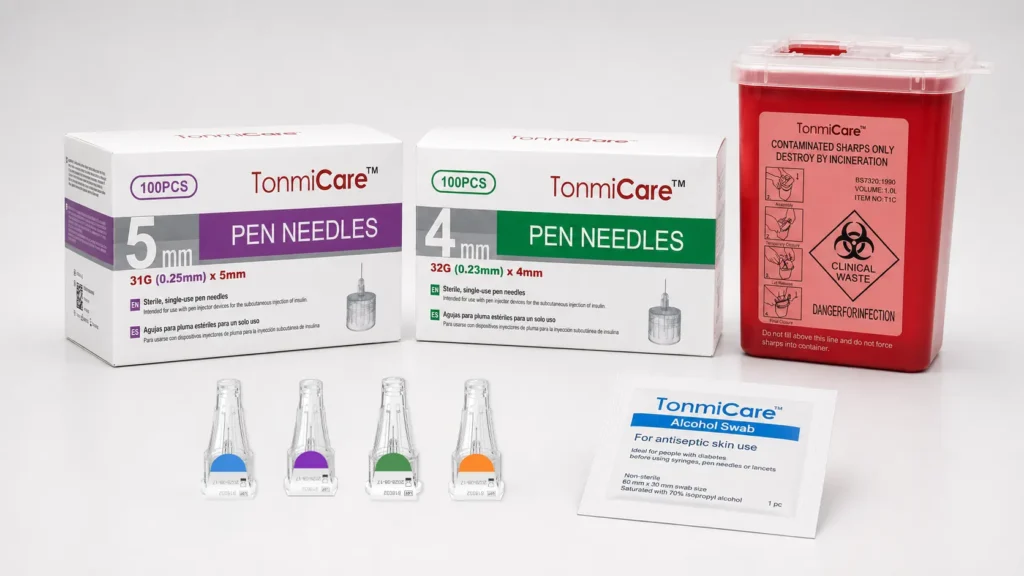
2026 U.S. GLP-1 Device & Supply Guide
A presentation-first framework for distinguishing attachable pen needles, integrated-needle single-dose pens and vial-based syringe requirements across current U.S. GLP-1 injection programs.
Editorial and safety disclosure: This article is an educational procurement resource, not patient-specific medical advice, a prescribing guide or a dose-conversion tool. Device presentations, package configurations and instructions can change. Always use the current FDA-approved labeling, prescription and healthcare-professional instructions for the exact product dispensed. Never transfer medicine out of a prefilled pen, attach an unapproved needle, or convert milligrams, milliliters and “units” using an online chart.
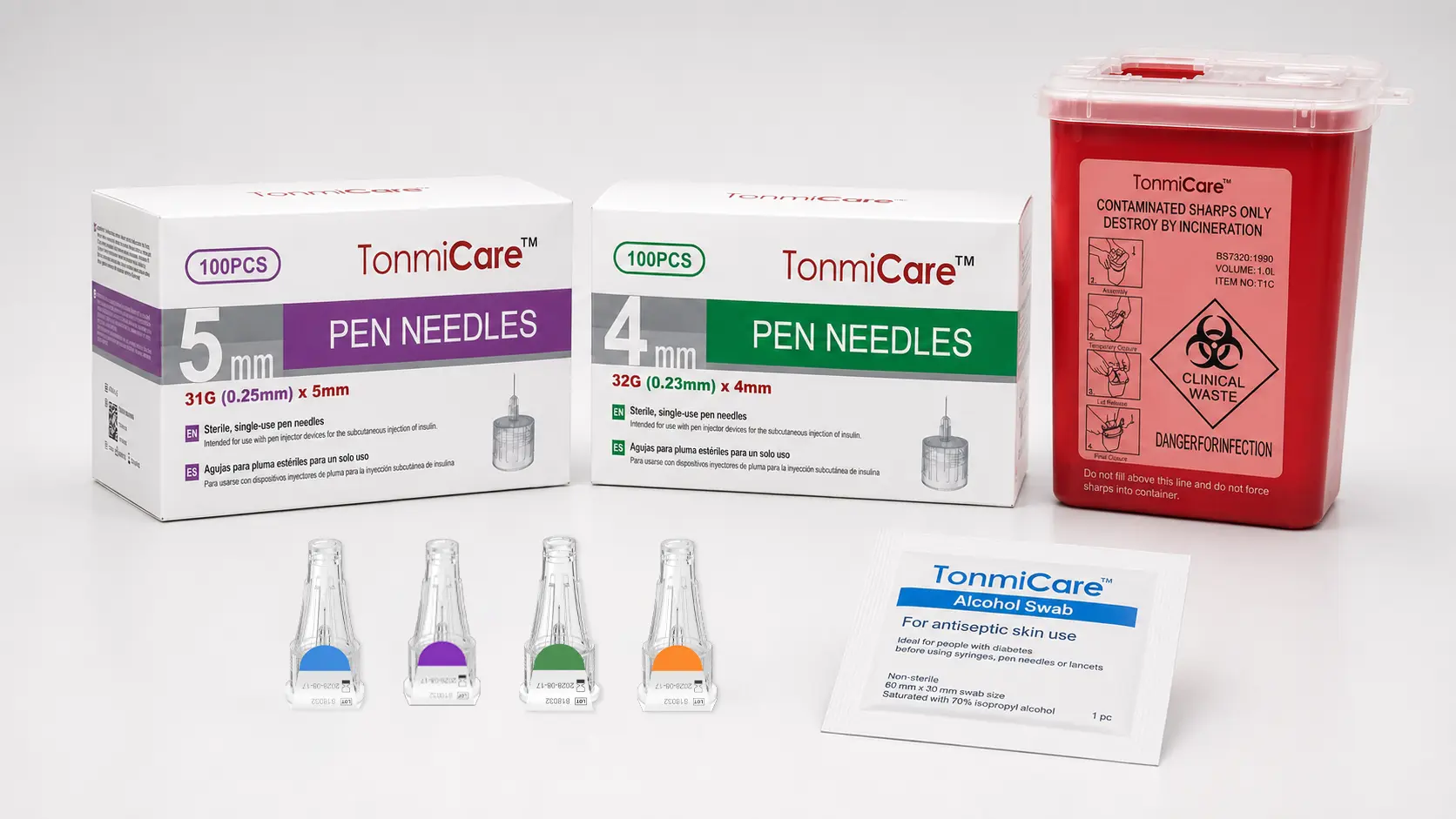
Direct answer
Quick Answer: Do GLP-1 Pens Need Needles?
Some do, and some do not. In the current U.S. market, the Ozempic multi-dose pen uses a new attachable pen needle for each injection. Wegovy injection pens use an integrated needle. Mounjaro and Zepbound single-dose pens do not accept a separate pen needle, while their vial presentations require a separate syringe and needle selected according to the current instructions and prescribed volume. The active ingredient alone does not determine the required supply.
Executive summary
Key Takeaways
- Start with the exact presentation. “Semaglutide” or “tirzepatide” is not enough. Record the brand, strength, NDC or presentation, pen or vial format, dose volume and current instructions.
- Not every GLP-1 pen uses an attachable pen needle. Ozempic does; U.S. Wegovy, Mounjaro and Zepbound single-dose pens use built-in or concealed needle systems and should not be paired with a screw-on pen needle.
- Vials create a different supply path. Current Mounjaro and Zepbound vial labeling gives 1 mL as an example of an appropriate syringe capacity and requires measurement of a specified 0.5 mL or 0.6 mL volume, depending on the presentation.
- “Universal GLP-1 pen needle” is an unsafe blanket claim. A pen needle must be supported for the exact attachable-needle device; an integrated-needle autoinjector has no pen-needle interface to approve.
- Do not convert medication doses into insulin-syringe units. Milligrams, milliliters and insulin units are different measurement systems. Follow the labeled volume and healthcare-professional instructions for the exact vial and syringe.
- Procurement follows the device pathway. Pen needles, syringes, alcohol prep pads, gauze and sharps containers should be forecast by presentation-specific utilization—not bundled identically for every GLP-1 prescription.
1. Start With the Drug Presentation, Not the GLP-1 Name
Searches such as “GLP-1 pen needles,” “Ozempic needles” and “syringe for GLP-1 vial” often treat medication name and injection hardware as if they were interchangeable. They are not. A GLP-1 receptor agonist can be supplied in a multi-dose pen with a removable needle, a disposable single-dose autoinjector with an integrated needle, a single-dose vial, a multi-dose vial or a non-injectable presentation. Each path creates a different supply list and different handling risks.
The most reliable control point is the exact marketed presentation. For a pharmacy or clinic, the intake record should capture:
- drug trade name and active ingredient;
- strength and concentration as printed on the label;
- dose volume where the instructions identify one;
- pen, single-dose vial or multi-dose vial format;
- NDC, package configuration and current label revision;
- whether the needle is attachable, integrated or supplied separately;
- which accessories are included in the commercial carton;
- which additional supplies must be dispensed or made available;
- storage, preparation, administration and disposal instructions.
This presentation-first method also prevents a common inventory error: assigning a box of pen needles to every GLP-1 pen prescription. A screw-on pen needle is relevant only when the injector is designed for an attachable needle. It is unnecessary for a single-dose pen with an integrated needle and cannot replace the syringe-and-needle system required for a vial.
Procurement rule: Medication family → exact product → exact presentation → current instructions → required supplies. Do not reverse the sequence by choosing a popular needle or syringe first.
2. Do GLP-1 Pens Need Pen Needles? Current U.S. Comparison
The table below summarizes current U.S. FDA-approved labeling reviewed on July 28, 2026. It is a procurement orientation, not a substitute for the label accompanying the dispensed product.
| Product and current U.S. presentation | Separate pen needle? | Separate syringe and needle? | Buyer control |
|---|---|---|---|
| Ozempic multi-dose, single-patient-use pen | Yes. Use a new attachable needle for each injection; current cartons include NovoFine Plus needles in quantities tied to the pen configuration. | No for normal labeled pen use. | Match the exact pen, approved needle evidence and carton needle count; never extract residual medicine with a syringe. |
| Wegovy prefilled single-dose injection pen | No. The U.S. injection pen has an integrated needle. | No for normal labeled pen use. | Do not add a standard pen needle SKU to the dispensing bundle. |
| Mounjaro prefilled single-dose pen | No. The pen is a one-time autoinjector and does not use an attachable pen needle. | No for normal labeled pen use. | Dispense the pen as a complete device; follow the current pen instructions. |
| Mounjaro single-dose vial | No. | Yes. Current labeling instructs use of an appropriate syringe, giving a 1 mL syringe capable of measuring a 0.5 mL dose as an example. | Control mL graduations, needle/syringe configuration and the exact prescribed vial presentation. |
| Zepbound prefilled single-dose pen | No. The one-time pen does not use an attachable pen needle. | No for normal labeled pen use. | Do not confuse the pen with the vial presentations sold under the same brand. |
| Zepbound single-dose vial | No. | Yes. Current instructions identify a separately supplied syringe and needle and a 0.5 mL dose volume. | Verify the syringe can measure 0.5 mL and follow the healthcare professional’s device recommendation. |
| Zepbound multi-dose vial | No. | Yes. Current instructions identify a separately supplied syringe and needle and a 0.6 mL dose volume. | Verify the 0.6 mL line, multi-dose vial workflow, beyond-use instructions and a new syringe and needle for every injection. |
Presentation changes matter. A brand that previously appeared only as a pen may later add vial configurations, and package contents can change by strength or NDC. Pharmacy systems should therefore map accessory logic to a controlled presentation identifier, not merely to a trade name.
3. Do Ozempic Pens Need Needles?
Yes. The current U.S. Ozempic product is a prefilled, disposable, single-patient-use multi-dose pen that requires a new attachable needle for each injection. FDA-approved labeling states that the needle should be removed and safely discarded after each injection and that the pen should be stored without a needle attached.[1]
The current carton configuration is also relevant to dispensing. The 2 mg/3 mL pen that delivers 0.25 mg or 0.5 mg doses is packaged with six NovoFine Plus needles. The 4 mg/3 mL and 8 mg/3 mL pens are packaged with four needles.[1] A pharmacy should check the actual NDC and carton rather than assuming that every pen contains the same number of needles.
Does this mean any 32G × 4 mm pen needle fits?
No blanket conclusion should be made from gauge and length alone. “32G × 4 mm” describes two physical dimensions; it does not establish that a specific third-party needle REF is labeled or validated for a particular pen. The buyer should retain the current pen instructions, pen-needle label or compatibility statement, exact needle catalog number and any applicable regulatory mapping.
Tonmit’s insulin pen needle sizes and compatibility guide provides the full specification framework for 4 mm, 5 mm, 6 mm and 8 mm options. For an Ozempic-related program, the key point is not to select a needle because it is marketed as “universal,” but to approve a documented pen-and-needle combination.
Can a syringe be used to pull medicine out of an Ozempic pen?
The labeled pen pathway should be followed. Do not puncture the cartridge, remove “leftover” medicine, improvise an extra dose or transfer the product into another syringe. Those practices bypass the metered-dose system, create sterility and dosing risks, and are outside the instructions reviewed for the prefilled pen.
4. Does Wegovy Come With a Needle?
The current U.S. Wegovy injection presentation is a prefilled, disposable, single-dose pen-injector with an integrated needle.[2] It does not require—and is not designed to accept—a separate screw-on pen needle. The entire pen is discarded after the single injection according to the instructions and applicable sharps-disposal rules.
This directly answers two common searches:
- Does Wegovy come with a needle? The injection pen contains an integrated needle.
- Can an Ozempic pen needle be used on Wegovy? No attachable pen needle is used on the current U.S. Wegovy single-dose injection pen.
For pharmacies, an automated accessory rule that adds pen needles to every semaglutide prescription would therefore produce inconsistent results: it may be appropriate to review a needle requirement for Ozempic, while a Wegovy injection pen already contains its needle. The decision must be keyed to presentation, not active ingredient.
Wegovy now also has a U.S. tablet presentation in current labeling. This article addresses injection supplies only; no injection accessory should be inferred for an oral product.[2]
5. Does the Mounjaro Pen Need a Needle?
The current U.S. Mounjaro single-dose prefilled pen does not require an attachable pen needle. Its instructions describe removing the base cap, positioning the device, unlocking it and pressing the injection button; the concealed needle is part of the one-time device pathway.[3]
Mounjaro is also available in single-dose vials. That presentation creates a separate supply requirement. The current prescribing information instructs patients using the vial to use a syringe appropriate for dose administration, giving “a 1 mL syringe capable of measuring a 0.5 mL dose” as an example. The instructions show that the needle and syringe are supplied separately and may be provided as a pre-attached needle-and-syringe unit or as compatible separate components, according to the healthcare professional’s recommendation.[3]
| Mounjaro presentation | External pen needle | Separate syringe | Supply implication |
|---|---|---|---|
| Single-dose pen | No | No | Complete one-time injector; plan sharps disposal capacity |
| Single-dose vial | No | Yes | 1 mL-class syringe example, 0.5 mL measurement capability, needle, alcohol swab, gauze and sharps container |
A pharmacy stocking both formats needs two distinct accessory rules. Assigning pen needles to the vial is wrong; assigning no syringe to the vial is incomplete. The same brand name cannot safely serve as the only stock-system trigger.
6. Does the Zepbound Pen Need a Needle?
The current U.S. Zepbound single-dose pen is a complete one-time injection device and does not use a separate pen needle. Zepbound is also supplied in single-dose and multi-dose vial presentations, which require a separately supplied syringe and needle.[4]
The July 2026 procurement distinction is especially important because the current label covers multiple vial workflows:
- Single-dose vial: the instructions identify a 0.5 mL dose and give a 1 mL syringe and needle recommended by the healthcare provider as an example.
- Multi-dose vial: the instructions identify a 0.6 mL dose and similarly give a 1 mL syringe and needle as an example; a new syringe and needle are required for every injection.
The difference between 0.5 mL and 0.6 mL is operationally significant. The approved supply record should state the exact vial type and volume that the syringe must measure. “1 mL syringe” alone is incomplete because capacity does not establish graduation spacing, label system, needle configuration or suitability for the intended use.
Current Zepbound instructions list a vial, separately supplied syringe and needle, alcohol swab, gauze and sharps container in the injection setup.[4] This provides a defensible starting point for a presentation-specific kit, but a distributor should still verify the exact commercial SKU, device labeling and responsibilities before assembling or marketing a combined package.
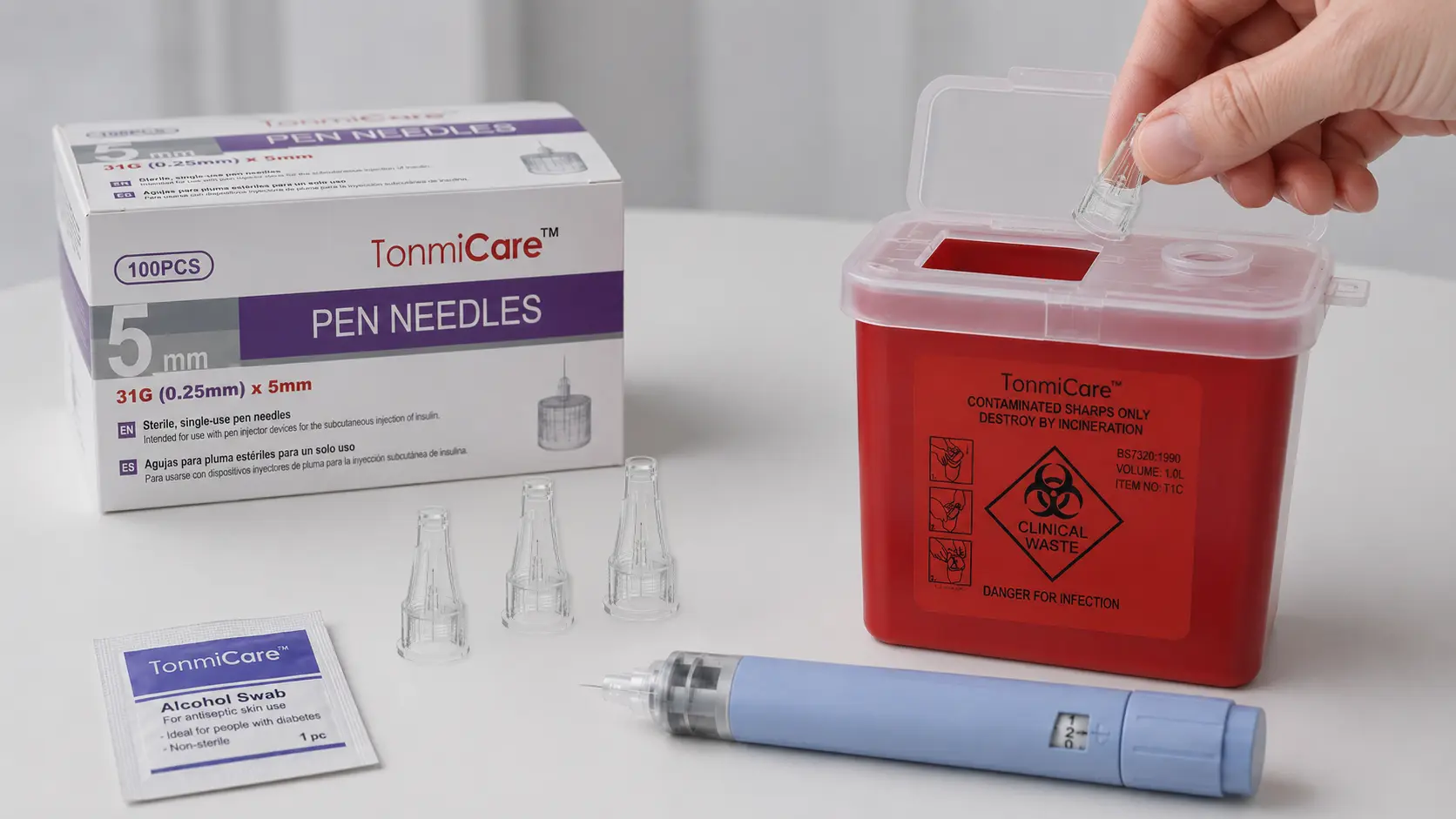
7. Are GLP-1 Pen Needles Universal?
“Universal GLP-1 pen needle” is too broad to serve as a procurement specification. The phrase collapses two different questions:
- Does the drug presentation have an attachable-needle interface at all?
- If it does, is the exact needle SKU supported for that exact pen?
For Wegovy, Mounjaro and Zepbound single-dose pens, the first answer is no: those devices do not use an external pen needle. For a multi-dose pen designed for a removable needle, such as the current Ozempic pen, the second question still requires evidence.
| Compatibility field | Evidence to retain | Approval question |
|---|---|---|
| Medication presentation | Trade name, strength, NDC, pen type and current instructions | Does this device accept an attachable needle? |
| Needle identity | Manufacturer, brand, REF, gauge × length and UDI/GTIN where applicable | Is this the same commercial SKU being quoted? |
| Compatibility support | Current needle label/IFU, controlled compatibility list or other accepted evidence | Does the evidence cover the intended pen model or defined interface? |
| Included accessories | Carton contents by NDC and strength | Are supplemental needles needed, and in what quantity? |
| Change control | Revision date and supplier notification agreement | Will a pen, hub, label or package change trigger re-review? |
For buyers comparing wholesale insulin pen needle options, gauge and length remain important, but they come after device-pathway screening. Tonmit is the company and website operator; TonmiCare is the product brand. Any TonmiCare compatibility statement should be confirmed for the exact needle REF and intended pen before use in a GLP-1 program.
8. Selecting a Syringe and Needle for a GLP-1 Vial
A vial-based GLP-1 program should not select syringes through a generic “insulin syringe” keyword. Current Mounjaro and Zepbound labeling uses milliliters to describe the dose volume and gives a 1 mL syringe as an example of appropriate capacity. The supplied syringe must be able to measure the required volume clearly and must be appropriate for the exact labeled workflow.
Capacity, scale and needle are separate fields
A procurement record should specify at least:
- nominal syringe capacity;
- graduation unit and interval, including the required 0.5 mL or 0.6 mL line;
- fixed needle or detachable needle configuration;
- needle gauge and length as directed or approved for the program;
- hub connection if the needle is supplied separately;
- sterile, single-use labeling and sterile-barrier format;
- dead-space or residual-volume considerations where the organization evaluates them;
- REF, lot, expiration, UDI/GTIN where applicable and pack hierarchy;
- instructions, regulatory mapping and quality documentation for the exact device.
Why “units” can be dangerous in vial discussions
An insulin syringe scale expresses insulin units for a defined insulin concentration system. A GLP-1 medication label may state dose strength in milligrams and withdrawal volume in milliliters. Those systems are not interchangeable. A social-media direction such as “draw to 50 units” can be misunderstood when the actual prescription, concentration, vial and syringe scale are not all fixed.
This article therefore does not provide a milligram-to-unit or milliliter-to-unit conversion table. A pharmacy should use the exact labeled or prescribed volume, confirm the syringe graduation system and provide patient-specific instructions through the authorized clinical process. A product’s 1 mL capacity alone does not make every 1 mL insulin syringe an appropriate substitute.
Safety rule: Never infer syringe selection from capacity alone. Verify volume markings, needle configuration, intended use, current medication instructions and the healthcare professional’s directions as one controlled combination.
9. GLP-1 Injection Supplies Checklist by Presentation
A useful complete GLP-1 injection support supplies guide should separate presentation-specific items from general support items. The matrix below can be adapted for formulary, dispensing or purchasing review.
| Supply item | Attachable-needle multi-dose pen | Integrated-needle single-dose pen | Single- or multi-dose vial |
|---|---|---|---|
| External pen needle | Required when identified by current pen instructions; one new needle per injection | Not used | Not used |
| Syringe | Not used for labeled pen administration | Not used for labeled pen administration | Required; capacity and mL graduations must match the instructions |
| Separate hypodermic needle | Not used in place of the pen needle | Not used | Required when not pre-attached; verify connection and specification |
| Alcohol prep pad | Follow current instructions and organizational policy | Follow current instructions and organizational policy | Current Mounjaro and Zepbound vial instructions list an alcohol swab, including vial-stopper preparation |
| Gauze or cotton | Program-specific support item | Program-specific support item | Listed in current Mounjaro and Zepbound vial setup instructions |
| Sharps container | For used pen needles | For used single-dose pen devices as directed | For used needles and syringes |
| Patient instructions | Pen use, new needle, removal, storage and disposal | Single-dose device operation and disposal | Vial verification, withdrawal volume, injection and disposal |
For alcohol swab specifications, sterile-barrier and package review, see the alcohol prep pad buying guide. For disposal capacity, opening design and placement, use the sharps container selection guide. These support items should be sized to the actual device and utilization pattern rather than added as generic one-size-fits-all accessories.
10. Pharmacy and Clinic Workflow Controls
Pharmacy dispensing workflow
- Resolve the exact prescription and presentation. Confirm the product, strength, pen or vial, NDC and quantity.
- Open the current accessory rule. External pen needle, integrated needle or separate syringe-and-needle pathway.
- Check carton contents. Do not assume the included needle count from another strength or prior package.
- Reconcile additional supplies. Confirm whether pen needles, syringes, needles, prep pads, gauze and disposal containers are separately required.
- Provide presentation-specific education. Do not reuse instructions written for a different pen or vial.
- Block automatic substitution. Needle and syringe substitutions should follow applicable prescribing, dispensing, labeling, formulary and legal controls.
- Record lot and complaint paths. Preserve enough identity to investigate device or packaging issues.
Clinic administration workflow
Clinics need the same presentation controls plus occupational-exposure and multi-patient safeguards. Injection pens must remain single-patient devices and should never be shared, even when the needle is changed. The current Ozempic label explicitly states that its pen must never be shared between patients because of blood-borne pathogen risk.[1] CDC applies the same core principle to pen-shaped injection equipment used in healthcare settings.[5]
For staff-administered programs, the organization should evaluate sharps-injury protections, point-of-use disposal, training, exposure-control procedures and the selected device’s instructions. A standard self-use pen needle and a safety pen needle should not be treated as operationally identical. Any safety feature must be assessed for the exact device and workflow.
11. Forecasting, Packaging and Replenishment
Forecast accessories from injections and presentations, not from patient count alone. A weekly multi-dose pen requiring external needles creates roughly one needle-use event per injection, plus any contingency quantity allowed by policy. A single-dose integrated-needle pen creates no separate pen-needle demand but consumes more sharps-container volume per injection because the entire injector is discarded. A vial consumes a new syringe and needle per injection.
| Forecast driver | Why it matters | Buyer action |
|---|---|---|
| Prescription volume by presentation | Pen and vial formats drive different accessory demand | Report by NDC/presentation, not brand total |
| Injections per package | Determines needle, syringe and disposal events | Map current carton contents and labeled dose count |
| Included accessory count | May reduce or defer separately dispensed needle demand | Verify by strength and NDC at every label revision |
| Box and case quantity | Affects reorder points, picking and partial-case handling | Set min/max by site and SKU |
| Remaining shelf life | Demand shifts can strand presentation-specific supplies | Define minimum remaining shelf life at receipt |
| Sharps volume | Autoinjectors occupy more container space than detached needles | Size container and exchange frequency by actual waste stream |
| Presentation change | New vial or pen configurations can invalidate accessory rules | Require label surveillance and change notification |
For U.S. warehouse-supported programs, “in stock” should be confirmed by exact REF, lot, remaining shelf life, order quantity and destination. A long-term article should not promise same-day shipping or a fixed transit time. Tonmit’s established public position is U.S.-based warehouse fulfillment support for confirmed transactions, with final availability and delivery timing reviewed by order.
12. FDA, Compounding and Product-Claim Boundaries
Do not extend one label to another product
The four FDA labels cited in this guide apply to specific approved products and presentations. They do not establish the syringe, needle, concentration or instructions for a different compounded, imported, private-label or future presentation. If a pharmacy supplies a lawful patient-specific compounded preparation, its prescription, pharmacy label, concentration, instructions and device selection require a separate controlled review.
Compounded GLP-1 products are not FDA approved
FDA states that compounded drugs are not FDA approved and do not undergo the agency’s premarket review for safety, effectiveness and quality. In its April 1, 2026 policy clarification, FDA also stated that semaglutide and tirzepatide were not on the drug shortage list or the 503B bulks list at that time and reiterated restrictions on products that are essentially copies of commercially available drugs.[6] This article does not promote compounded semaglutide or tirzepatide or provide a dosing pathway for them.
Use precise device language
For pen needles, syringes and other medical devices, establishment registration and device listing do not mean that FDA has approved or cleared every product sold by a company. Buyers should map the exact device REF to the responsible manufacturer, applicable product code, 510(k) where required, current listing, UDI/GUDID information where applicable, label and instructions.[7]
Appropriate marketing language includes “FDA documentation available for applicable product models” or “FDA-cleared [exact device family/REF]” only when the cited clearance actually covers the item. Avoid “FDA-certified supplier,” “FDA-approved warehouse” and other phrasing that implies agency endorsement.
13. RFQ Checklist for GLP-1 Injection Support Supplies
A pharmacy, clinic or distributor requesting GLP-1 injection supplies should issue a presentation-specific RFQ. One line reading “GLP-1 kit” is not sufficient.
| RFQ field | Required detail | Status control |
|---|---|---|
| Medication pathway | Pen or vial presentation, intended market and accessory logic | Defined before quotation |
| Pen needle | Exact pen model, needle REF, gauge × length, standard/safety design and compatibility evidence | Required only for attachable-needle pens |
| Syringe | Capacity, mL graduations, required measurement line, fixed/detachable needle and sterile barrier | Required for the approved vial pathway |
| Separate needle | Gauge, length, hub connection, packaging and intended use | Match syringe and program instructions |
| Support items | Alcohol prep pads, gauze, sharps container and any approved packaging components | Quantity per injection or kit |
| Product identity | Manufacturer, labeler, brand, REF, UDI/GTIN where applicable, country of origin and label revision | Reconciled before approval |
| Documentation | Specification, label/IFU, FDA mapping, QMS scope, sterilization and shelf-life records as applicable | Accepted / gap / not applicable |
| Packaging | Units/box, boxes/case, dimensions, barcode levels, lot and expiration format | No inferred pack counts |
| Supply | MOQ, annual volume, order frequency, stock location, lead time, remaining shelf life and destination | Confirmed per transaction |
| Lifecycle | Complaints, traceability, recall support, substitutions, returns and change notification | Responsibilities assigned |
Tonmit can support pharmacies, clinics and distributors reviewing GLP-1 injection-support configurations, while TonmiCare identifies the product brand for applicable consumables. Request medical device documentation support for the exact quoted REF rather than relying on a company-level certificate or a generic product description.
14. Frequently Asked Questions
Do all GLP-1 pens need separate pen needles?
No. The current U.S. Ozempic multi-dose pen uses an attachable needle. Wegovy, Mounjaro and Zepbound single-dose pens use integrated or concealed needles and do not accept a separate pen needle. Always verify the exact current presentation.
Do Ozempic pens come with needles?
Current U.S. Ozempic cartons include NovoFine Plus needles. The number varies by pen configuration: the 0.25/0.5 mg dose pen carton includes six, while current 1 mg and 2 mg dose pen cartons include four. Check the actual NDC and carton contents.
Does Wegovy come with a needle?
The current U.S. Wegovy injection pen has an integrated needle. It is a disposable single-dose pen and does not use a separately attached pen needle.
Does the Mounjaro pen need a separate needle?
No. The U.S. Mounjaro single-dose pen is a complete one-time device. Mounjaro single-dose vials are different and require a separately supplied syringe and needle.
Does the Zepbound pen need a separate needle?
No. The U.S. Zepbound single-dose pen does not use an attachable pen needle. Zepbound single-dose and multi-dose vials require a separate syringe and needle.
Are Ozempic, Wegovy, Mounjaro and Zepbound pen needles interchangeable?
This question begins from a false assumption: three of the current U.S. single-dose pen systems do not use attachable pen needles. For an attachable-needle pen, approve compatibility for the exact pen and needle REF; do not rely on a blanket “universal” claim.
What syringe is used for a Mounjaro vial?
Current U.S. labeling gives a 1 mL syringe capable of measuring a 0.5 mL dose as an example. The actual syringe and needle should follow the healthcare professional’s recommendation and the current instructions for the dispensed vial.
What syringe is used for a Zepbound vial?
Current labeling gives a 1 mL syringe as an example and requires measurement of 0.5 mL for the single-dose vial or 0.6 mL for the multi-dose vial. Confirm the exact presentation, graduations and professional directions.
Can an insulin syringe be used for GLP-1 medication?
Do not decide from the words “1 mL” alone. Insulin syringes use concentration-specific unit scales, while approved GLP-1 vial instructions identify volumes in milliliters. Use only the syringe type and measurement system directed for the exact medication and presentation; do not create an online unit conversion.
Can a pen needle be reused for a weekly GLP-1 injection?
No. For an attachable-needle pen, current instructions require a new needle for each injection. Remove and dispose of the used needle as directed; store a multi-dose pen without a needle attached when its labeling requires this.
Can a GLP-1 pen be shared if the needle is changed?
No. A single-patient-use pen must not be shared. Changing the needle does not remove the risk of blood-borne pathogen transmission associated with pen sharing.
What supplies are needed for a GLP-1 vial injection?
Current Mounjaro and Zepbound vial instructions identify the vial, an appropriate syringe and needle supplied separately, an alcohol swab, gauze and a sharps container. Exact items and specifications must follow the current label and healthcare-professional directions.
How should used GLP-1 needles, syringes and pens be discarded?
FDA recommends placing used needles and other sharps in a sharps-disposal container immediately after use and following local community or facility requirements for final disposal.[8] The exact waste stream can differ for detached needles, syringes and integrated-needle pens.
What should a pharmacy verify before buying GLP-1 injection supplies in bulk?
Verify the medication presentation, device pathway, exact accessory REF, compatibility evidence, capacity and graduations, needle specification, sterile barrier, pack hierarchy, remaining shelf life, FDA and quality documentation, inventory location, substitution rules, traceability and change control.
15. Limitations and Conclusion
This guide reflects public U.S. labeling and FDA information available on July 28, 2026. Drug presentations, NDCs, instructions, package contents, regulatory records and commercial availability can change. It does not establish compatibility for every third-party needle or syringe, and it does not replace the product label, prescription, clinical judgment or a facility’s policies.
So, do GLP-1 pens need needles? The accurate answer is presentation-specific:
- an attachable-needle multi-dose pen requires a new, verified pen needle for each injection;
- an integrated-needle single-dose pen requires no external pen needle;
- a vial requires an appropriate syringe and needle capable of measuring the labeled or prescribed volume.
For procurement, the correct buying unit is not “a GLP-1 needle.” It is a controlled combination of the exact medication presentation, current instructions, verified device accessory, packaging identity, documentation, supply terms and disposal workflow. That distinction allows pharmacies and clinics to support patients without over-dispensing incompatible supplies or leaving vial-based programs incomplete.
Presentation-specific supply support
Request a GLP-1 Supply Configuration Review
Tonmit supports pharmacies, clinics and medical distributors reviewing pen needles, syringes, injection needles, alcohol prep pads, sharps containers, packaging and documentation for defined GLP-1 device pathways.
Share the exact medication presentation, intended market, required device type, annual volume, package format, destination and document list. Final compatibility, regulatory mapping, availability, labeling, lead time and commercial terms are confirmed for the selected SKU and transaction.
References
- U.S. Food and Drug Administration. Ozempic (semaglutide) Prescribing Information and Medication Guide. Current label reviewed July 28, 2026. The label identifies multi-dose, single-patient-use pens, carton needle quantities, use of a new needle for each injection and the prohibition on pen sharing.
- U.S. Food and Drug Administration. Wegovy (semaglutide) Prescribing Information. Current label reviewed July 28, 2026. Section 16 describes the injection presentation as a disposable single-dose pen-injector with an integrated needle.
- U.S. Food and Drug Administration. Mounjaro (tirzepatide) Prescribing Information and Instructions for Use. Revised December 2025. The label distinguishes single-dose pen and single-dose vial pathways and identifies an appropriate 1 mL syringe capable of measuring 0.5 mL as an example for vial use.
- U.S. Food and Drug Administration. Zepbound (tirzepatide) Prescribing Information and Instructions for Use. Current label reviewed July 28, 2026. The label distinguishes single-dose pen, single-dose vial and multi-dose vial presentations and identifies 0.5 mL and 0.6 mL vial workflows.
- Centers for Disease Control and Prevention. Be Aware, Don’t Share: Insulin Pens and Other Injection Equipment. CDC states that pen-shaped injection equipment is intended for one person and should not be shared even when the needle is changed.
- U.S. Food and Drug Administration. FDA Clarifies Policies for Compounders as National GLP-1 Supply Begins to Stabilize. Updated April 1, 2026.
- U.S. Food and Drug Administration. Important Reminders about Registration and Listing. FDA explains that registration and listing do not denote approval, clearance or authorization.
- U.S. Food and Drug Administration. Best Way to Get Rid of Used Needles and Other Sharps. FDA recommends immediate placement in a sharps-disposal container and disposal according to applicable local requirements.