
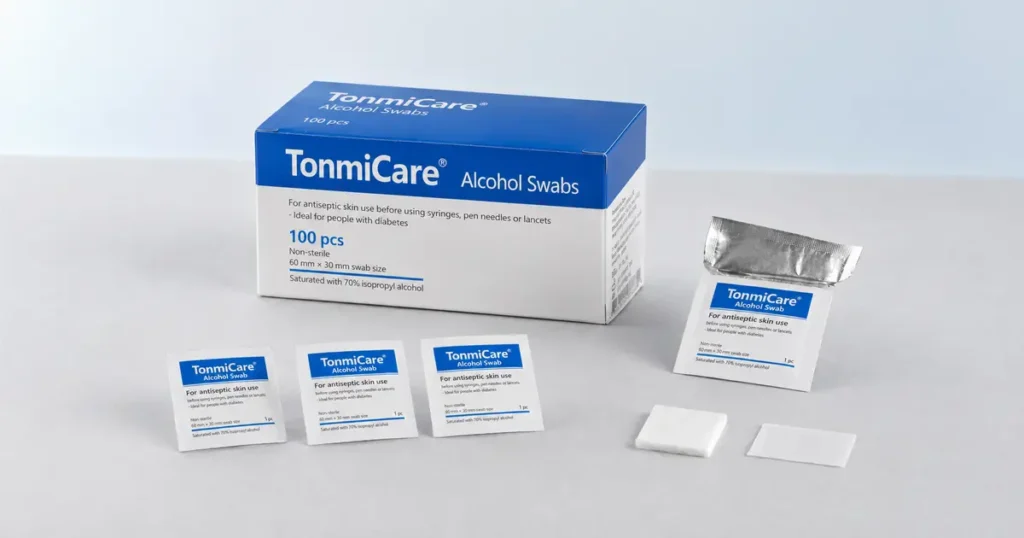
2026 Pharmacy Procurement Guide
A specification-led framework for comparing intended use, 70% isopropyl alcohol, pad construction, pouch integrity, labeling, microbiological controls, traceability and bulk supply requirements.
Editorial disclosure: This article is published by Tonmit as an educational procurement resource. It is not patient-specific medical advice, a legal opinion or a substitute for the current product label, applicable OTC drug monograph, regulatory review, facility policy or infection-control procedure. Regulatory status, claims, sterility, documentation and commercial terms must be verified for the exact SKU and target market.
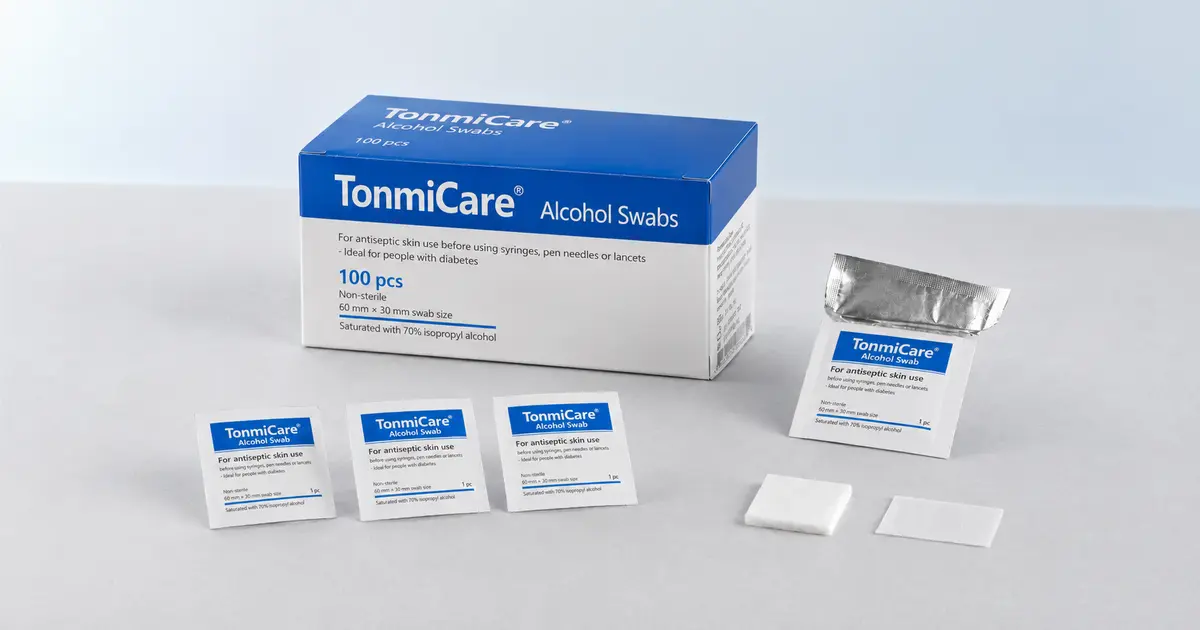
Executive summary
Key Takeaways
- Start with intended use. A pad for skin preparation and a pad promoted to disinfect a medical-device surface are not automatically the same regulated product.
- “70% IPA” is not a complete specification. The RFQ should state the concentration basis, assay or release requirement, solution load, pad construction and approved label claim.
- Individually wrapped does not mean sterile. Sterile and nonsterile products require different claims, controls, evidence and batch-release expectations.
- The pouch is part of product performance. Seal quality, material barrier, evaporation control and shelf-life evidence determine whether a pad remains adequately wetted through distribution and storage.
- An NDC is an identifier, not an approval badge. FDA states that NDC assignment and inclusion in the NDC Directory do not denote approval or verification of the submitted information.[2]
- Microbial and recall controls are practical buyer requirements. FDA’s March 2026 notice for selected Webcol alcohol prep pad lots illustrates why lot capture, quarantine and downstream notification must work before a problem occurs.[7]
Abstract
Alcohol prep pads are often quoted as a short commodity description: “medium, 2-ply, 70% IPA, 100 per box.” That description is useful for initial sorting but insufficient for a pharmacy, clinic, kit assembler or medical-supply distributor. The buyer must also know what the product is intended and labeled to do, whether its concentration is expressed and controlled on the same basis, how much solution is delivered by the pad, whether sterility is claimed, whether the pouch maintains integrity and liquid content throughout shelf life, and whether the legal manufacturer, labeler, NDC, batch records and recall process can be reconciled.
This alcohol prep pads procurement guide converts those questions into a controlled B2B specification. It focuses on pads containing 70% isopropyl alcohol used in healthcare supply programs, while recognizing that the regulatory pathway depends on the product’s claims and presentation. It also explains why individually wrapped, sterile, nonsterile, skin-preparation and device-disinfectant products should not be treated as interchangeable terms.
Keywords: alcohol prep pads procurement guide; wholesale alcohol prep pads; 70% isopropyl alcohol pads; alcohol swabs for pharmacies; alcohol pad packaging; alcohol prep pad supplier; private label alcohol prep pads; alcohol swab quality control
1. Scope and Method: Control the SKU Before Comparing Price
This article addresses institutional sourcing, product identity and supplier governance. It does not prescribe how an individual should prepare an injection site. Healthcare organizations should follow the current product label, clinician direction, infection-control policy and applicable law.
Product quality is only one part of safe injection practice. CDC guidance also emphasizes aseptic technique and a new sterile, single-use needle and syringe for each injection; purchasing an alcohol pad does not replace those controls.[8]
The analysis uses four evidence groups:
- FDA’s current OTC monograph and drug registration/listing resources;
- 21 CFR labeling and current good manufacturing practice requirements;
- FDA and CDC resources relevant to microbiological quality and injection safety;
- official ASTM scopes for flexible-package seal and integrity test methods.
FDA’s OTC Monograph M003 states conditions for first aid antiseptic drug products and identifies isopropyl alcohol at 50% to 91.3% by volume in an aqueous solution as an active-ingredient range under that monograph.[1] However, a purchaser should not conclude that every 70% alcohol pad automatically conforms to M003 or that every skin-preparation claim is established merely because a listing appears online. Formulation, intended use, labeling, manufacturing controls and other applicable requirements must be evaluated together.
Procurement rule: Approve a fully identified SKU—not a generic phrase. The controlled record should connect use claim, formula, pad, pouch, sterility status, label, NDC or device identity where applicable, pack hierarchy, shelf life and batch-release evidence.
2. Intended Use Determines the Regulatory Review
Two pads may contain the same nominal 70% IPA solution yet require different evidence because their promoted uses differ. FDA public records include alcohol prep pads presented as human OTC drug products for topical use, while FDA device records also identify alcohol pads intended as medical-device disinfectants under product code LKB.[5][9]
| Promoted use | Likely review focus | Buyer evidence |
|---|---|---|
| Topical skin preparation or antiseptic use | OTC drug pathway, active ingredient, label claims, Drug Facts, NDC/listing and drug CGMP | Current label, monograph or application basis, SPL/NDC record, facility roles and batch controls |
| Disinfection of a medical-device surface | Medical-device intended use, product classification, applicable premarket record and device labeling | Exact product code, 510(k) where applicable, device listing, IFU and performance evidence |
| Component supplied inside a kit | Component identity plus kit labeling, configuration and field-action propagation | Pad SKU/lot linkage, kit BOM, receiving control and recall-notification process |
| General wipe without a medical claim | Actual claims and applicable nonmedical product requirements | Approved claim set and confirmation that medical uses are not implied |
This table is a classification screen, not a legal determination. Final status depends on the complete product, intended use, formulation, label and marketing context. A supplier should not move a pad from one column to another by changing only the front-panel wording.
For procurement, the first RFQ field should therefore be a precise use statement. Terms such as “medical grade,” “hospital quality,” “for injection,” “antiseptic,” “disinfectant” and “sterile” are claims requiring support; they are not interchangeable sales adjectives.
3. What “70% Isopropyl Alcohol” Does—and Does Not—Specify
Seventy percent isopropyl alcohol is common in alcohol prep pad listings, but the number alone leaves several purchasing questions unanswered:
- Is concentration stated by volume, by weight or through another controlled expression?
- What is the release specification and analytical method?
- Is the inactive liquid simply purified water, or are other ingredients present?
- How much solution is loaded onto each pad?
- How is uniformity controlled across the batch?
- How is evaporation assessed through the claimed shelf life?
M003 specifies isopropyl alcohol concentration by volume for the monograph range.[1] A DailyMed label example for an individually wrapped alcohol prep pad states “isopropyl alcohol, 70% v/v,” topical route and a skin-preparation use; the same public entry also identifies the product as a human OTC drug and lists its pack configuration.[5] That record is useful as a label example, not evidence that FDA endorses the product or that another supplier may reuse its claims.
For comparable quotations, write the liquid specification as a complete set:
| Liquid field | What the RFQ should state | Why it matters |
|---|---|---|
| Active ingredient | Isopropyl alcohol | Prevents substitution with ethanol or another antiseptic |
| Nominal concentration | 70%, with the required basis stated | Makes labels, specifications and test results comparable |
| Release limits | Supplier’s controlled acceptance range and method | Shows how nominal concentration is maintained batch to batch |
| Solution load | Target per pad and acceptable range | Separates concentration from the amount actually delivered |
| Inactive ingredients | Complete formulation identity | Supports label, allergy and change-control review |
| Stability | Real-time/accelerated program in the marketed pouch | Supports concentration, wetness, seal and expiry claims |
A pad can meet a concentration assay yet still be unsuitable if it contains too little solution, dries prematurely after opening, varies excessively across units or loses alcohol through the pouch during storage. Concentration and liquid load are related but distinct controls.
4. Pad Construction: Size, Ply, Material and Solution Load
“Medium” and “large” are commercial descriptors, not universal dimensions. Buyers should request both folded and unfolded dimensions in millimeters, then define material, basis weight or other controlled construction parameters appropriate to the product.
At minimum, compare:
- folded pad length and width;
- unfolded pad length and width;
- number of plies and fold pattern;
- substrate material and supplier specification;
- basis weight, thickness or absorbency control where relevant;
- solution load per pad and allowable variability;
- lint, visible foreign matter and edge quality acceptance criteria;
- latex claim or material declaration if required by the buyer;
- primary-pouch opening behavior and pad presentation.
A larger unfolded pad is not automatically “more saturated.” A thicker substrate may hold more solution, but only the supplier’s controlled liquid-load specification and batch data establish how much solution is present. Likewise, “2-ply” does not describe fiber composition, basis weight or finished dimensions.
| Sample description | Still missing | Controlled purchase description |
|---|---|---|
| Medium alcohol pad | Dimensions, substrate, ply, solution and claim | Exact folded/unfolded dimensions, material, construction, liquid and label identity |
| 2-ply pad | Material, weight, fold, size and wetting | Approved drawing/specification plus liquid-load acceptance range |
| 70% IPA swab | Concentration basis, release limits and quantity | Controlled formula, assay method, solution load and marketed pouch |
| 100-count box | Pouch identity, carton dimensions and case pack | Units/box, boxes/case, lot/expiry display and barcode hierarchy |
5. Sterile vs Nonsterile: Individually Wrapped Is Not the Same as Sterile
An individual pouch can protect a pad from handling and evaporation without establishing a sterile claim. Buyers should record sterility status as a separate specification field and reject assumptions based on appearance, foil packaging or the word “single-use.”
FDA’s CGMP Q&A for topical antiseptics distinguishes the control expectations:
- for nonsterile topical antiseptic drug products, procedures should prevent objectionable microorganisms, and each batch should be appropriately tested before disposition;
- for products purporting to be sterile, written procedures must prevent microbiological contamination, sterilization or aseptic processes require validation, and batch sterility testing requirements apply.[4]
If sterile product is required, request the sterilization or aseptic-process identity, validation summary, routine controls, sterile-barrier evidence, batch-release status and confirmation that the labeled shelf life is supported in the final package. If nonsterile product is acceptable, request the microbiological specification, objectionable-organism control strategy, water and substrate controls, finished-batch testing and documented use claim.
Buyer checkpoint: The purchase order, approved artwork, specification, certificate and receiving inspection should all use the same sterility statement. “Individually wrapped” should never be used as a substitute.
6. Pouch Integrity, Evaporation Control and Shelf Life
The primary pouch functions as a container-closure system for a volatile, alcohol-containing product. It must protect the pad from leakage, contamination and unacceptable alcohol or moisture loss across filling, sealing, transport and storage.
A useful packaging review covers:
- film or foil structure and approved material specification;
- seal width, seal appearance and sealing-process controls;
- pouch dimensions and tear/opening performance;
- gross leak, channel leak or other integrity testing appropriate to the pouch;
- seal-strength method and acceptance criteria;
- solution retention or unit-weight change through shelf life;
- print rub resistance and legibility after transport and aging;
- carton protection against compression, puncture and edge damage;
- real-time and accelerated stability data in the marketed package.
ASTM F88/F88M covers measurement of seal strength in flexible barrier materials, while ASTM F2096 provides an internal-pressurization method for detecting gross leaks in packages.[10][11] These standards do not automatically prescribe the correct test plan for every alcohol pad pouch. The manufacturer should select, validate and justify methods appropriate to its materials, package design and product claims.
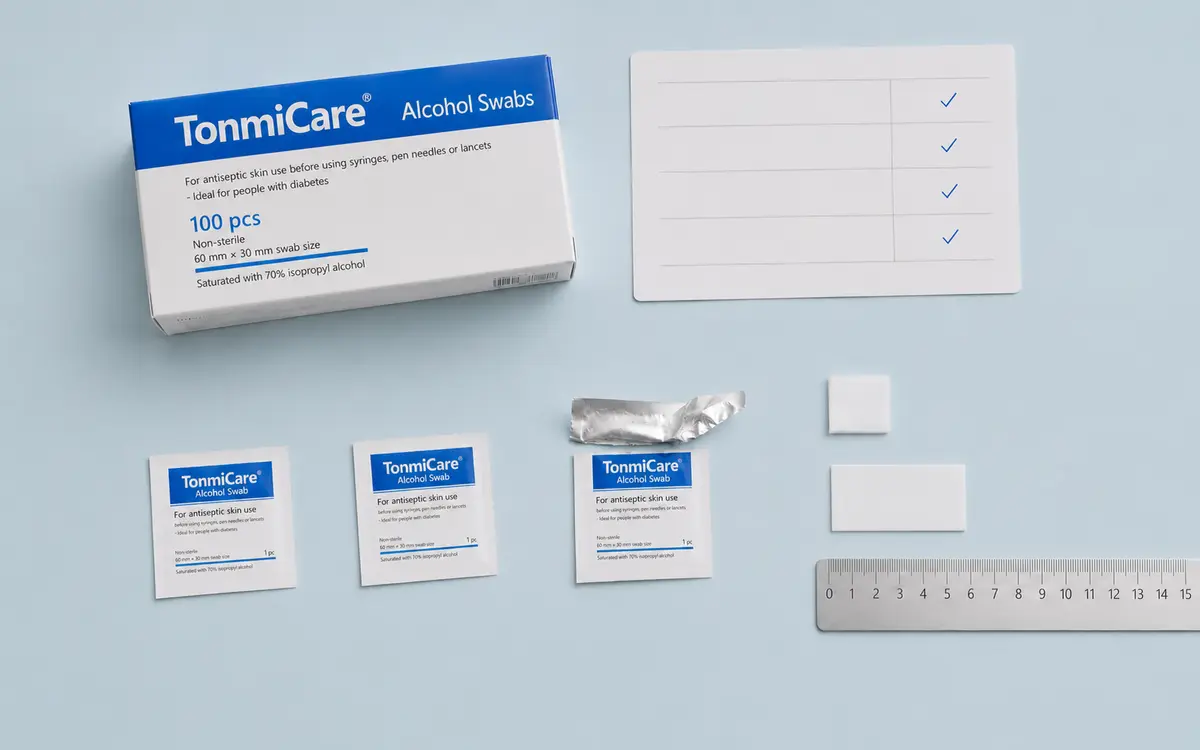
During sample approval, inspect more than the front of the carton. Open units from different carton positions, compare wetness and odor qualitatively, examine seals under consistent light, confirm that the pad is not caught in the seal, and reconcile pouch codes with carton and case labels. Any destructive test should follow an approved sampling plan rather than an improvised pass/fail judgment.
7. U.S. Label, Drug Facts and NDC Review
For an OTC drug product, 21 CFR 201.66 sets content and format requirements for Drug Facts labeling.[3] The buyer should compare the artwork, structured product listing and commercial product—not merely collect a screenshot of an NDC search result.
Review the following fields across the unit pouch, retail carton, case label and listing record:
- statement of identity and intended use;
- active ingredient, concentration and purpose;
- uses, warnings, directions and inactive ingredients;
- net quantity or count statement;
- manufacturer, packer, distributor or labeler identity as applicable;
- NDC and package code for the exact marketed configuration;
- lot number and expiration date;
- sterility statement, if any;
- storage, flammability and single-use statements;
- country-of-origin and customer-contact information where required;
- barcode and case-level item identity used by the buyer.
FDA explains that the NDC Directory contains listing data submitted by labelers for approved and unapproved prescription and OTC drugs, and that assignment of an NDC does not denote FDA approval.[2] FDA’s electronic registration and listing instructions also state that registration or an NDC number does not denote approval of a company or its products.[6]
Therefore, avoid procurement records and marketing phrases such as “FDA-approved because it has an NDC.” A more accurate statement is: “U.S. drug establishment and product listing information is available for review; regulatory status and monograph or application basis are verified for the exact SKU.”
8. Drug CGMP, Facility Identity and Batch Control
Alcohol prep pads marketed as topical antiseptic drugs are not governed by the medical-device QMSR merely because the pad is a healthcare consumable. FDA states that 21 CFR parts 210 and 211 apply equally to OTC and prescription finished drug products.[4]
A supplier-qualification file should identify every material operating role:
- legal manufacturer and physical manufacturing site;
- solution preparation, pad converting, filling and pouch-sealing sites;
- sterilization provider, if applicable;
- testing laboratory and quality-unit responsibilities;
- labeler, packer/repacker and distributor roles;
- U.S. establishment registration/listing status where applicable;
- importer, customs and domestic warehousing roles;
- complaint, adverse-event and recall contacts.
For each commercial batch, the evidence package should be proportionate to risk and contract requirements. Typical review fields include active-ingredient identity and assay, solution load, pad and pouch conformance, package count, microbiological results, sterility status where claimed, label reconciliation, lot and expiration coding, release authorization and certificate of analysis or conformance.
FDA’s CGMP resource for topical antiseptics specifically highlights water, applicator material such as cotton pads, containers/closures, in-process bioburden, objectionable microorganisms, written specifications, finished-product testing and quality-unit oversight.[4] A generic ISO certificate or a single certificate of analysis does not replace review of these controls.
Tonmit program review
Applying the Framework to a Tonmit Alcohol Prep Pad RFQ
Tonmit positions alcohol swabs within its diabetes-care and GLP-1 support supply scope for pharmacies, clinics and healthcare distributors, with documentation, packaging and U.S.-warehouse-supported coordination reviewed by project.[12]
Because alcohol prep pad regulatory and quality evidence is claim- and SKU-specific, the quotation should not begin with a blanket statement that every available configuration has the same status. Instead, Tonmit and the buyer should first lock the intended use, target market and brand arrangement, then reconcile the exact product identity and supporting file.
Recommended RFQ wording: “Please identify the exact product name, intended use, legal manufacturer, manufacturing site, labeler, NDC or applicable device record, active ingredient and concentration basis, pad dimensions/material/ply, solution load, sterility status, pouch specification, pack hierarchy, shelf life, batch-release documents and private-label responsibilities for the item quoted.”
The final quotation should separately state what is available from U.S. stock, what requires production, the remaining shelf life for warehouse inventory, minimum order quantity, case and pallet configuration, documentation lead time, artwork status and permitted substitutions.
9. Microbial Risk, Traceability and Recall Readiness
Alcohol content does not eliminate the need for microbiological control. FDA has stated that objectionable microbial contamination has occurred in topical antiseptic products, including pads or swabs used before injections, and points to manufacturing controls, water, applicator material, environment, packaging and finished-product testing as relevant risk areas.[4]
On March 20, 2026, FDA posted Cardinal Health’s voluntary recall notice for selected Webcol Large Alcohol Prep Pad lots due to Paenibacillus phoenicis microbial contamination. The notice instructed customers to review inventory, segregate and quarantine affected product, disseminate the notice internally and notify downstream customers.[7]
The lesson for a buyer is operational rather than brand-specific. Before approval, test whether the supply chain can answer:
- Which received lots remain in each warehouse or clinic location?
- Which purchase orders, kits or customer shipments contained each lot?
- Can inventory be blocked from allocation immediately?
- Who decides quarantine, return, destruction and replacement?
- How are departments and downstream customers notified?
- Can the supplier provide affected-lot data in a usable format?
- How are complaints and potential adverse events escalated?
- What evidence closes the recall or field action?
Run a mock trace using one received lot before scaling the program. Record the time needed to identify remaining stock and outbound recipients. A printed lot code is valuable only when purchasing, warehouse and customer records preserve it.
10. Pack Hierarchy, Shelf Life and Supply Planning
Low unit cost can hide operational cost when case packs do not match order patterns, unit pouches are difficult to scan, cases arrive with short remaining shelf life or a private-label MOQ exceeds realistic demand.
Define the entire pack hierarchy:
- one pad per pouch;
- pouches per dispenser box;
- boxes per shipping case;
- cases per pallet, pallet pattern and maximum height;
- unit, box and case dimensions and weights;
- barcode or item code at each required level;
- lot and expiration placement at pouch, box and case levels;
- minimum remaining shelf life at shipment and receipt.
| Commercial factor | Quoted unit price may omit | Buyer calculation |
|---|---|---|
| MOQ | Expiry exposure and storage space | Demand during usable remaining shelf life |
| Case quantity | Pick-face replenishment and split-case labor | Orders per case and touches per shipment |
| Lead time | Artwork, testing, release and customs time | Total replenishment lead time plus buffer |
| U.S. stock | Exact lot, remaining shelf life and replenishment source | Available-to-promise by approved SKU |
| Private label | Plate/artwork cost and obsolete packaging liability | Total program cost over forecast volume |
| Quality events | Quarantine, notification, replacement and investigation | Contracted response and cost allocation |
For a new item, a controlled first order is often more informative than an aggressive annual commitment. Measure order accuracy, remaining shelf life, pouch damage, count accuracy, wetness consistency, label scan performance, document response and lot capture before expanding.
11. Private Label and Custom Packaging Responsibilities
Private label is not simply replacing one logo with another. For an OTC drug, the labeler name, NDC structure, SPL submission, Drug Facts, manufacturing-establishment data and complaint/recall responsibilities must align. FDA’s listing instructions require current product data and labeling, including outer-packaging images and the establishments involved in manufacturing.[6]
Before artwork approval, assign responsibility for:
- legal manufacturer, labeler, packer and distributor statements;
- labeler code, product/package NDC and SPL maintenance where applicable;
- approved intended use, active ingredient, warnings and directions;
- sterility and material claims;
- lot, expiration, storage, flammability and country-of-origin statements;
- barcode ownership and case-level item data;
- artwork review, revision control and obsolete-material disposition;
- change notification for formula, pad, pouch, site, process or label;
- complaint exchange, regulatory reporting and recall communication;
- MOQ, setup fees, production lead time and unused packaging liability.
Do not copy another brand’s front panel or Drug Facts box and treat it as a template approval. The proposed artwork should be reviewed against the exact formula, claims, business roles and current regulatory basis of the private-label SKU.
12. Procurement Checklist and RFQ Workflow
- Define the intended use and target market. Separate topical skin-preparation, first-aid, device-disinfectant and kit-component requirements.
- Lock the liquid specification. State active ingredient, nominal concentration, basis, release limits, inactive ingredients and solution load.
- Lock the pad specification. State folded/unfolded size, substrate, ply, construction and relevant physical acceptance criteria.
- Define sterility status. Require consistent evidence and labeling for sterile or nonsterile product.
- Review the pouch. Obtain material, sealing-process, integrity, solution-retention and shelf-life evidence appropriate to the marketed package.
- Reconcile U.S. product identity. Compare label, NDC/SPL or applicable device record, manufacturer, labeler, site and package configuration.
- Review batch and microbiological controls. Confirm specifications, sampling, release testing, deviations, complaints and change control.
- Approve the pack hierarchy. Confirm counts, dimensions, barcodes, lot/expiry visibility and receiving requirements.
- Test traceability. Map a sample lot from receipt through inventory and downstream shipments.
- Place and monitor a controlled first order. Score documentation, quality, fill rate, delivery, damage, shelf life and corrective response.
| RFQ field | Required detail | Approval status |
|---|---|---|
| Use and identity | Intended use, product name, manufacturer, labeler and exact REF/SKU | Verified / gap |
| Liquid | IPA concentration basis, limits, formulation and solution load | Approved / pending |
| Pad | Folded/unfolded size, material, ply and construction | No substitution |
| Sterility | Sterile or nonsterile claim and supporting control package | Reconciled |
| Pouch | Material, seal/integrity controls and shelf-life support | Accepted / gap |
| U.S. label | Drug Facts, NDC/SPL or applicable device identity and business roles | Current / revise |
| Quality | CGMP/site evidence, release tests, microbiology, complaint and change controls | Qualified / pending |
| Supply | MOQ, case/pallet, shelf life, stock, lead time, freight and destination | Contracted |
| Lifecycle | Lot trace, recalls, returns, replacements and private-label obligations | Assigned |
Questions from pharmacy buyers
13. Frequently Asked Questions
What does 70% IPA mean on an alcohol prep pad?
It identifies a nominal isopropyl alcohol concentration, but the buyer should verify the concentration basis, controlled release range, analytical method and solution load per pad. The phrase does not define pad size, wetness, sterility, intended use, shelf life or regulatory status.
Are individually wrapped alcohol prep pads sterile?
Not necessarily. Individual wrapping may support hygiene, unit use and evaporation control, but sterility is a separate labeled claim. Verify the exact package statement and the supporting manufacturing, validation, microbiological and batch-release controls.
Does an NDC mean an alcohol prep pad is FDA approved?
No. FDA states that NDC assignment and inclusion in the NDC Directory do not denote FDA approval, and the directory includes listing data for approved and unapproved drugs.[2] Verify the exact regulatory basis, label and current commercial SKU.
Are skin-prep pads and device-disinfectant pads interchangeable?
No automatic interchangeability should be assumed. Their intended uses, claims, classifications and evidence may differ. FDA device records identify alcohol pads intended as device disinfectants under product code LKB, while many topical skin products are listed as human OTC drugs.[9]
What is the difference between medium and large alcohol prep pads?
There is no universal dimensional definition. Request folded and unfolded dimensions, material, ply, basis weight or thickness where relevant, solution load and pouch size. Commercial size names alone are not adequate purchase specifications.
What documents should a B2B buyer request?
Request a SKU identity sheet, current label/artwork, applicable NDC/SPL or device record, manufacturer and site roles, formula/specification, pad and pouch specification, sterility status, shelf-life support, microbiological and release controls, sample batch certificate, pack hierarchy, complaint/recall process and change-notification terms.
How should a buyer review alcohol pad pouch quality?
Review pouch material, seal-process control, seal appearance and strength, appropriate leak/integrity testing, solution retention, real-time stability and transport protection. The test method must fit the actual material and package design; one named ASTM method is not automatically sufficient for every pouch.
What information is needed for accurate bulk pricing?
Provide intended use, market, IPA specification, pad dimensions/material/ply, solution load, sterility status, units per box, boxes per case, annual volume, order frequency, shelf-life requirement, destination, document list and private-label status. Otherwise, competing quotations may describe materially different products.
14. Limitations and Conclusion
This guide is based on public U.S. records and webpages available on the review date. Regulations, monographs, database entries, labels, product portfolios and recall status can change. Public listing of one product does not establish the regulatory status, quality or claim support of another product. Buyers should obtain qualified regulatory and legal review for their exact market arrangement.
For B2B procurement, the correct buying unit is not simply “a 70% IPA alcohol swab.” It is a controlled SKU supported by:
- defined intended use—skin, first-aid, device or kit context;
- controlled product specification—liquid, pad, solution load, sterility and pouch;
- reconciled regulatory identity—manufacturer, labeler, current label and applicable U.S. record;
- batch-quality evidence—microbiology, release, stability and packaging controls;
- commercial control—pack hierarchy, shelf life, MOQ, stock and delivery;
- lifecycle control—traceability, complaints, changes and recall response.
When those elements are fixed before price comparison, pharmacies and distributors can reduce dry-pad complaints, artwork errors, unsupported claims, batch-trace gaps, uncontrolled substitutions and avoidable inventory risk.
Wholesale & documentation support
Request an Alcohol Prep Pad SKU Review
Tonmit supports pharmacies, clinics and medical distributors reviewing wholesale alcohol prep pads, case quantities, documentation, U.S.-warehouse-supported availability and private-label requirements.
Share the intended use, target market, IPA concentration basis, pad size/material/ply, solution load, sterility status, annual volume, packaging format, destination and document list. Tonmit can confirm available product paths and transaction-specific details by RFQ.
Final regulatory mapping, label, sterility, packaging, documentation, availability, remaining shelf life, lead time and private-label feasibility are confirmed for the selected SKU and target market.
References
- U.S. Food and Drug Administration. “OTC Monograph M003: First Aid Antiseptic Drug Products for Over-the-Counter Human Use.” Posted May 2, 2023. FDA.
- U.S. Food and Drug Administration. “National Drug Code Directory.” The page states that directory inclusion and NDC assignment do not indicate FDA verification or approval. FDA.
- Electronic Code of Federal Regulations. “21 CFR 201.66 — Format and content requirements for over-the-counter (OTC) drug product labeling.” eCFR.
- U.S. Food and Drug Administration. “Questions and Answers on Current Good Manufacturing Practice Regulations: Production and Process Controls,” including FDA’s topical-antiseptic CGMP questions. FDA.
- U.S. National Library of Medicine. “Alcohol Prep Pad — Isopropyl Alcohol Liquid.” DailyMed human OTC drug label example; updated October 2023. DailyMed.
- U.S. Food and Drug Administration. “Electronic Drug Registration and Listing Instructions.” FDA.
- U.S. Food and Drug Administration. “Cardinal Health Issues Voluntary Nationwide Recall of Webcol™ Large Alcohol Prep Pad.” FDA publish date March 20, 2026; notice updated April 15, 2026. FDA.
- Centers for Disease Control and Prevention. “Safe Injection Practices to Prevent Transmission of Infections to Patients.” CDC.
- U.S. Food and Drug Administration. “Class 2 Device Recall — PDI Alcohol Prep Pads packaged in the INRatio kit.” The record identifies product code LKB, pad, alcohol, device disinfectant. FDA.
- ASTM International. “ASTM F88/F88M-23 — Standard Test Method for Seal Strength of Flexible Barrier Materials.” ASTM.
- ASTM International. “ASTM F2096-11(2019) — Standard Test Method for Detecting Gross Leaks in Packaging by Internal Pressurization.” ASTM.
- Tonmit. “U.S. Pharmacy Wholesale Supplier — Medical Consumables & Diabetes Care Supply.” Alcohol swabs are included within current diabetes-care and GLP-1 support supply programs. Reviewed July 22, 2026. Tonmit.