
2026 Healthcare Procurement Guide
A workflow-led framework for comparing sharps container capacity, opening and closure design, mounting, fill visibility, regulatory evidence, case packing and disposal-path compatibility.
Editorial disclosure: This article is an educational procurement resource, not legal advice, a facility exposure-control plan or a medical-waste disposal instruction. Requirements vary by workplace, waste stream, transport method, state and locality. Verify the current regulation, product labeling, facility policy and disposal-vendor instructions for each program.
Executive summary
Key Takeaways
- Choose by workflow, not nominal volume alone. The correct container must accept the largest sharp generated at the station and fit the user’s reach, room, mounting system and changeout process.
- Keep regulatory statements precise. OSHA specifies workplace containment and use requirements; FDA regulates sharps containers as medical devices and recommends FDA-cleared containers in healthcare facilities; transport and disposal introduce additional rules.
- A fixed syringe count is not a reliable capacity specification. Actual capacity changes with syringe size, attached devices, safety features, orientation, inlet design and the manufacturer’s fill line.
- The opening and closure deserve their own approval. One-handed disposal, hand-entry restriction, snag resistance, temporary closure and irreversible final closure can matter as much as wall thickness.
- “Three-quarters full” is guidance tied to the marked fill line—not permission to estimate by eye. Follow the exact fill indicator and manufacturer instructions, and do not force contents down.
- Bulk procurement must include accessories and logistics. Brackets, cabinets, case pack, nesting, carton dimensions, label control, current FDA record, replacement stock and disposal compatibility belong in the RFQ.
Abstract
Sharps containers are often compared by a short description such as “1 quart red container,” “1 liter needle box” or “5 gallon wall-mount bin.” That is not enough for safe selection. Two containers with the same nominal capacity may have different openings, fill lines, closures, mounting footprints, usable internal volume and compatibility with insulin syringes, pen needles, lancets, auto-injectors, blood-collection sets or longer procedural devices.
This guide explains how healthcare facilities and medical-supply buyers can compare sharps container sizes and types without turning the decision into a volume-only purchase. It separates federal workplace requirements from FDA device status and downstream transport rules, applies the four NIOSH performance criteria—functionality, accessibility, visibility and accommodation—and converts them into a room-level selection matrix and B2B RFQ checklist.[4]
Keywords: sharps container sizes; sharps container types; how to choose a sharps container; sharps containers for clinics; wall-mounted sharps container; 1 liter sharps container; medical sharps disposal container; bulk sharps containers
1. Sharps Container Selection Starts with the Workflow
The first purchasing question should not be “What is your cheapest 1-liter box?” It should be “Which devices are generated, where are they generated, and what must happen from disposal through final removal?” The container is an engineering control within a larger exposure-control and waste-management system.
OSHA requires contaminated sharps to be discarded immediately or as soon as feasible into containers that are closable, puncture resistant, leakproof on the sides and bottom, and properly labeled or color-coded. During use, the containers must be easily accessible, located as close as feasible to the area where sharps are used, maintained upright, routinely replaced and not allowed to overfill.[1][2]
Those requirements make selection a point-of-use problem. Build a short workflow record for each location:
- procedure or task performed at the station;
- all disposable sharps generated per procedure;
- largest, longest and widest device after use;
- whether the device has a bulky safety shield, tubing or attached syringe;
- estimated procedures per day and peak-day volume;
- standing, seated, mobile-cart or tray-based use;
- patient, child, visitor or behavioral-health access risks;
- changeout responsibility, temporary storage and final disposal route.
Selection rule: Approve the container against the complete disposed device in the real work position. A lid that accepts a bare needle in a catalog photo may not accept a shielded lancet, auto-injector or attached syringe safely.
NIOSH developed its container guidance specifically for infection-control practitioners, purchasers and others responsible for selection. It organizes performance around functionality, accessibility, visibility and accommodation rather than price or nominal capacity alone.[4]
2. Separate OSHA, FDA, Transport and Local Requirements
High-ranking web pages often compress several regulatory layers into the phrase “OSHA-compliant sharps container.” The phrase is useful as shorthand, but a buyer should know what evidence belongs to which authority.
| Layer | What it addresses | What the buyer should verify |
|---|---|---|
| OSHA Bloodborne Pathogens Standard | Employer controls for contaminated sharps in covered workplaces, including container characteristics, access, upright use, replacement, closure and exposure-control practices | Container design and labeling support the standard; placement and changeout procedures are implemented by the employer |
| FDA medical-device framework | Sharps containers are generally Class II devices under product code MMK and subject to 510(k) premarket review | Exact manufacturer, proprietary name, product code, 510(k) number, device listing and labeling for the quoted SKU or family |
| DOT transport rules | Packaging used to transport regulated medical waste and sharps; requirements depend on packaging configuration and transport scenario | Whether the closed container is an inner packaging, part of a mail-back system or represented for transport; required outer packaging and instructions |
| State, local and facility rules | Medical-waste classification, storage, collection, disposal, licensing and potentially more stringent occupational requirements | Current jurisdictional rules, facility policy, hauler acceptance criteria and approved waste stream |
The current FDA classification database identifies “container, sharps” under product code MMK as a Class II device with 510(k) submission type and lists ASTM F2132 and ISO 23907-1 among recognized consensus standards relevant to the classification.[7] FDA also recommends that healthcare facilities use FDA-cleared sharps disposal containers.[6]
OSHA does not “approve” or “certify” a particular commercial product. It sets employer obligations and performance characteristics. A seller’s “OSHA compliant” statement should therefore be supported by the design, label and use instructions, while the healthcare employer remains responsible for placement, training, replacement and other workplace controls.
Similarly, a 510(k) record is not a blanket authorization for every size, lid, label or private-label configuration a factory can make. Procurement should map the quoted REF to the cleared device family and current labeling instead of relying on a logo printed in a sales brochure.
3. How to Compare Sharps Container Sizes and Capacity
Sharps container capacity may be stated in liters, quarts or gallons. Convert the units for planning, but do not assume that equal nominal volume means equal usable capacity. The inlet, internal baffles, fill line, lid depth and device orientation all reduce or reshape the usable space.
| Nominal format | Typical point-of-use role | Selection questions |
|---|---|---|
| Travel / pocket | Home health, mobile staff or travel support for limited small sharps | Does it accept the complete device? Is temporary closure secure during movement? What disposal route accepts it? |
| Approximately 1 quart / 1 liter | Phlebotomy trays, low-volume exam rooms, diabetes education or compact countertops | Is the base stable? Can it be mounted? Is the inlet suitable for syringes, lancets and pen needles? |
| Approximately 1–2 gallons | Exam rooms, medication rooms, nurse stations and moderate-volume treatment areas | Does the lid support one-handed disposal? Are cabinet and bracket SKUs compatible? Is fill status visible? |
| Approximately 3–5 gallons | Procedure rooms and areas generating larger devices or higher volume | Will longer devices fit without snagging? Can staff see the opening below eye level? How is the full container moved? |
| Approximately 8–18 gallons | Restricted-access, high-volume areas and centralized collection programs | Is the unit floor-standing, cart-mounted or foot operated? Which transport packaging and waste service accept the configuration? |
This table describes common commercial formats, not a universal rule. The correct size is the smallest format that safely accommodates the largest device and expected volume between planned changeouts without encouraging overfilling.
Why “how many syringes fit?” needs a controlled test
A fixed answer such as “225 syringes per gallon” can be misleading. A 1 mL insulin syringe occupies less space than a 3 mL syringe with an attached safety needle. Auto-injectors, pen devices, lancets, winged sets and tubing change packing behavior again. Shaking or compressing contents to achieve a catalog count is not an acceptable capacity method.
For a high-volume program, ask the supplier for a simulated-use capacity statement tied to defined devices, or conduct a supervised evaluation with representative unused devices. Record the device mix, container model, fill-line endpoint and observed usability. Use that result for forecasting—not a generic count taken from another lid or container.
A practical forecast
Forecast each work area separately:
- Estimate procedures per day and sharps generated per procedure.
- Use a validated or trial-based device count to the marked fill line.
- Calculate expected days to fill under normal and peak volume.
- Compare that interval with housekeeping rounds and disposal pickup.
- Add changeout and emergency safety stock by site, not only at a central warehouse.
If the selected container fills unpredictably, the problem may be SKU mismatch, opening design, seasonal procedure volume or poor distribution of replacement stock—not simply insufficient nominal liters.
4. Match the Largest Sharp to the Disposal Opening
NIOSH states that a container should be large enough to accommodate the largest sharp used at the workstation and shaped for the type of sharp requiring disposal. It also recommends an opening that facilitates one-handed disposal, minimizes catching or snagging and restricts hand entry where needed.[4]
| Device characteristic | Opening risk | Procurement check |
|---|---|---|
| Small loose lancet or pen needle | Device may rest near the inlet or be difficult to release cleanly | Confirm drop path, restricted-access feature and visibility into the inlet without reaching |
| Syringe with attached needle | Barrel may strike the lid; horizontal length may exceed the opening | Test complete assembly at normal disposal angle using one hand |
| Safety needle or shielded device | Activated shield increases width and may snag | Measure post-activation dimensions, not unused dimensions |
| Auto-injector or injection pen | Bulky body may not fit a needle-only port | Verify that the labeled waste stream and inlet accept the complete device |
| Winged set, tubing or longer sharp | Entanglement, rebound or protrusion risk | Evaluate inlet size, internal path and container depth with the actual configuration |
Do not select a needle-removal notch merely because it appears convenient. OSHA generally prohibits removal of contaminated needles unless the employer can demonstrate that no feasible alternative exists or removal is required by a specific procedure, and any permitted removal must use a mechanical device or one-handed technique.[1] The approved work practice, device labeling and exposure-control plan must govern whether a removal feature is used.
5. Lid, Opening and Closure Types
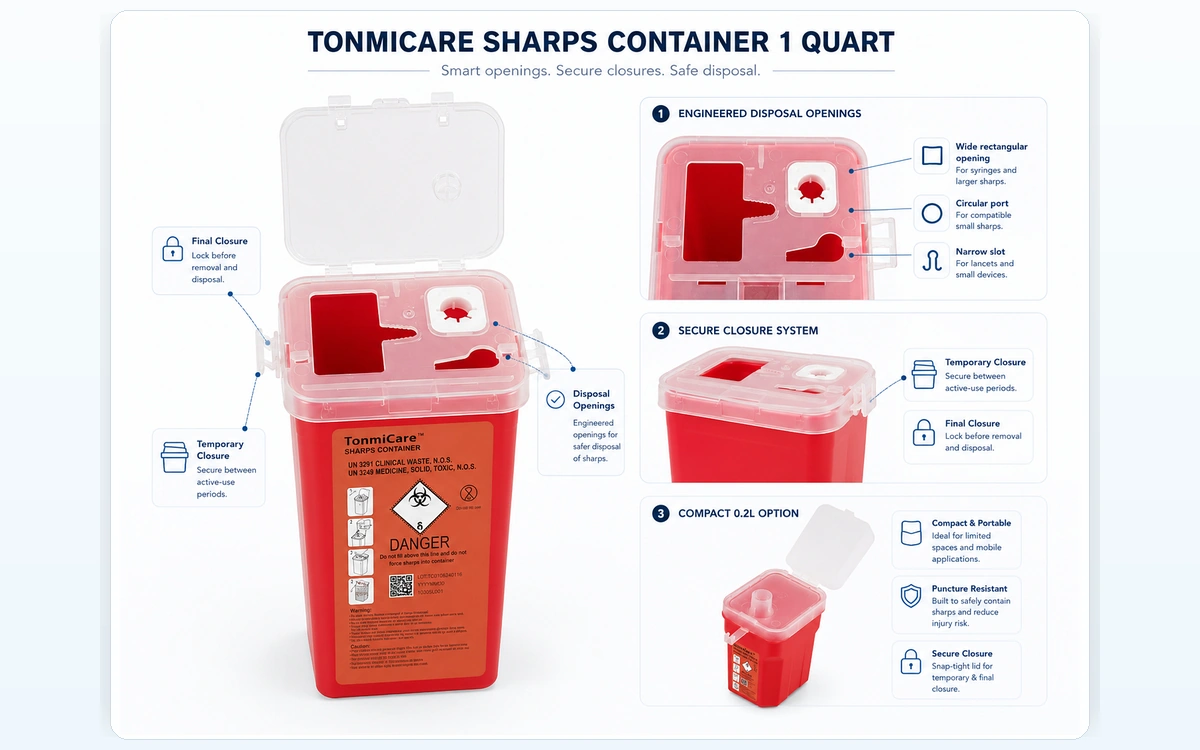
Commercial container names are not fully standardized, but buyers commonly encounter vertical-drop, horizontal-drop, counterbalanced, rotating, sliding, hinged and multi-port lids. The safest design depends on the waste stream and workstation.
| Design feature | Potential advantage | Questions before approval |
|---|---|---|
| Vertical drop | Simple top access and direct drop path | Can the user see the opening and release the complete device without pushing? |
| Horizontal or counterbalanced entry | May restrict hand access and hide contents after disposal | Does the mechanism accept the largest device without trapping or rebound? |
| Rotating or cylinder lid | May provide controlled access and temporary containment | Can it be operated one-handed? Is the fill level still visible? |
| Multiple ports | May support different small and larger sharps | Are staff likely to use the wrong port? Are removal features permitted by policy? |
| Temporary closure | Supports movement or periods when the unit is not actively used | Is the state obvious, secure and reversible without placing a hand near contents? |
| Permanent final lock | Reduces reopening and protrusion risk before removal | Is final closure intuitive, tamper evident and resistant to manual reopening? |
FDA describes healthcare-facility containers as rigid, puncture-resistant plastic or metal with leak-resistant sides and bottom, and a tight-fitting puncture-resistant lid with an opening that accepts a sharp but is not large enough for a hand to enter.[6] NIOSH further recommends safe, visible access and a final closure resistant to manual reopening.[4]
During sample review, test assembly, lid seating, temporary closure and final closure while wearing the gloves normally used for changeout. A lid that requires excessive force or ambiguous alignment can create a real handling problem even if the container body meets material requirements.
6. Placement, Mounting and Installation Height
Correct placement is not an accessory decision made after the purchase. OSHA requires easy access and location as close as feasible to the area where sharps are used. NIOSH recommends that the container be visible, within easy horizontal reach and positioned so the user can see the inlet.[1][4]
For fixed wall-mounted units, NIOSH’s ergonomic analysis describes an installation range of approximately 52–56 inches for a standing workstation and 38–42 inches for a seated workstation. The underlying principles matter more than copying a number: the user should see the entire inlet, reach it comfortably and keep it below eye level.[4]
Avoid predictable placement failures
- behind a swinging door or where carts and wheelchairs can strike the unit;
- under a sink, inside a cabinet or in a corner that requires awkward reach;
- above eye level, where the inlet and fill status cannot be seen;
- outside the room when sharps are generated inside;
- on an unstable counter without a tray or stabilizer;
- within unrestricted reach of children, visitors or vulnerable patients;
- in a bracket improvised for a different container model.
NIOSH cautions that mounting systems should be safe, stable, cleanable and, when appropriate, lockable; it also advises using mounting systems only with the containers for which they were designed.[4] Therefore, quote the bracket, cabinet or stabilizer as a controlled accessory SKU. Do not assume “wall mount compatible” means universal fit.
7. Fill Line, Changeout and the “90-Day Rule”
FDA explains that healthcare-facility containers are marked with a line indicating when they are about three-fourths full and advises following manufacturer instructions to close and seal them at that point. OSHA’s enforceable wording is that containers must be replaced routinely and not allowed to overfill.[6][1]
The practical endpoint is the marked fill line on the exact product—not a visual guess, a hand-compressed level or a generic percentage borrowed from another container. Staff should never reach in, shake the container or force contents downward to gain capacity.
Some online guides state that every sharps container has a universal 90-day service-life limit. OSHA’s Bloodborne Pathogens Standard does not establish one universal 90-day replacement interval for all sharps containers. A time-based limit may instead come from product instructions, facility policy, state or local rules, infection-control practice, waste-vendor requirements or a specific service agreement.
Build changeout around two triggers:
- fill trigger: the marked fill line is reached or safe access is compromised; and
- time or condition trigger: the applicable instruction, policy or local requirement is reached, or the container is damaged, unstable, contaminated externally or otherwise unsuitable.
Before removal, OSHA requires the container to be closed to prevent spillage or protrusion. If leakage is possible, a suitable secondary container is required. Reusable sharps containers must not be opened, emptied or cleaned manually in a way that exposes employees to percutaneous injury.[1]
8. Do Not Select the Waste Stream by Color Alone
Red is widely used for biohazardous sharps containers, while yellow, blue, white and black appear in various chemotherapy, pharmaceutical, hazardous or regional programs. These colors are not a universal substitute for reading the label and confirming the waste stream.
OSHA permits specified biohazard labeling or red color-coding for contaminated sharps within its standard.[1] That does not mean every red container is suitable for every regulated medical waste, or that every yellow container has the same meaning in every institution or jurisdiction.
The RFQ should state:
- intended waste stream and excluded materials;
- required body and lid color;
- biohazard symbol, warning language and label position;
- whether pharmaceutical or chemotherapy waste is involved;
- facility-specific color conventions;
- final disposal vendor’s acceptance requirements.
Never infer suitability for trace chemotherapy, hazardous pharmaceuticals, controlled substances, batteries or glass medication vials from color or container rigidity. Those streams may require different containers, labels and disposal methods.
9. Disposable, Reusable, Mail-Back or Service-Based Systems
The container cannot be separated from its downstream route. A low-volume pharmacy may need a mail-back kit, while a multi-site clinic network may use scheduled pickup and standardized wall-mounted units. A hospital may use a reusable service model with automated processing. These are different supply systems, not merely different containers.
| System | Potential fit | Procurement questions |
|---|---|---|
| Single-use container | Common point-of-use collection with facility-arranged removal | Who provides outer transport packaging? Is the model accepted by the hauler? How is replacement stock staged? |
| Reusable service container | Higher-volume programs with specialized automated collection and processing | Who owns, exchanges, processes and documents the unit? What happens during service interruption? |
| Mail-back kit | Lower-volume or geographically dispersed generators where an authorized program is available | Does the kit include the cleared container, required outer packaging, instructions, tracking and treatment documentation? |
| Mobile / home-health format | Staff traveling between care locations | Is temporary closure secure? How is the unit kept upright and protected from heat, impact and unauthorized access? |
DOT’s regulated-medical-waste rules address packaging used in transportation and require sharps transported in specified large packagings, carts or bulk outer packagings to be placed in puncture-resistant non-bulk inner packaging that is securely closed. The requirements vary by packaging configuration, and a point-of-use container should not automatically be represented as a complete transport package.[9]
For mail-back or pickup programs, qualify the service provider and packaging instructions separately from the container supplier. A container purchase alone does not establish a compliant transportation or disposal program.
10. Quality and Regulatory Evidence for the Exact SKU
For U.S. healthcare supply, “FDA registered,” “FDA certified” and “FDA approved” are often used imprecisely. The FDA classification database identifies sharps containers under product code MMK as Class II devices with 510(k) review.[7] Ask for the device-specific evidence rather than relying on a facility registration screenshot.
| Evidence item | What to reconcile | Common mismatch |
|---|---|---|
| 510(k) clearance record | Applicant, proprietary name, product code and cleared device family | Record belongs to another manufacturer or materially different design |
| Device listing and establishment roles | Current manufacturer, specification developer, relabeler or other applicable role | Registration is presented as product approval |
| Label and instructions | REF, capacity, waste stream, fill line, warnings, assembly, closure and disposal instructions | Sales sample and production label do not match |
| Performance evidence | Puncture, leak, stability, impact, closure, fill indication and applicable standards | Certificate names a material or standard but not the supplied model |
| Change control | Body resin, wall construction, lid geometry, closure, label and manufacturing site | Supplier treats color or lid changes as cosmetic despite performance impact |
| Complaint and field-action process | Lot traceability, escalation, investigation, quarantine and downstream notification | Carton lot is not linked to unit label or customer shipment |
FDA’s sharps-container 510(k) guidance addresses containers and secondary containers and provides the premarket framework for these devices.[8] The current MMK classification page also lists recognized standards, including ASTM F2132 for puncture resistance and ISO 23907-1 for sharps containers.[7] A buyer should confirm which standards and editions are actually claimed for the quoted SKU and obtain evidence within the permitted documentation scope.
Sample evaluation should include production-equivalent units. Check body rigidity, seams, label adhesion, fill-line visibility, lid seating, temporary closure, permanent lock, bracket fit and carton protection. Do not destroy the only retained sample; keep an approved reference unit or controlled image set for future receiving comparisons.
Tonmit program review
Applying the Framework to a Tonmit Sharps Container RFQ
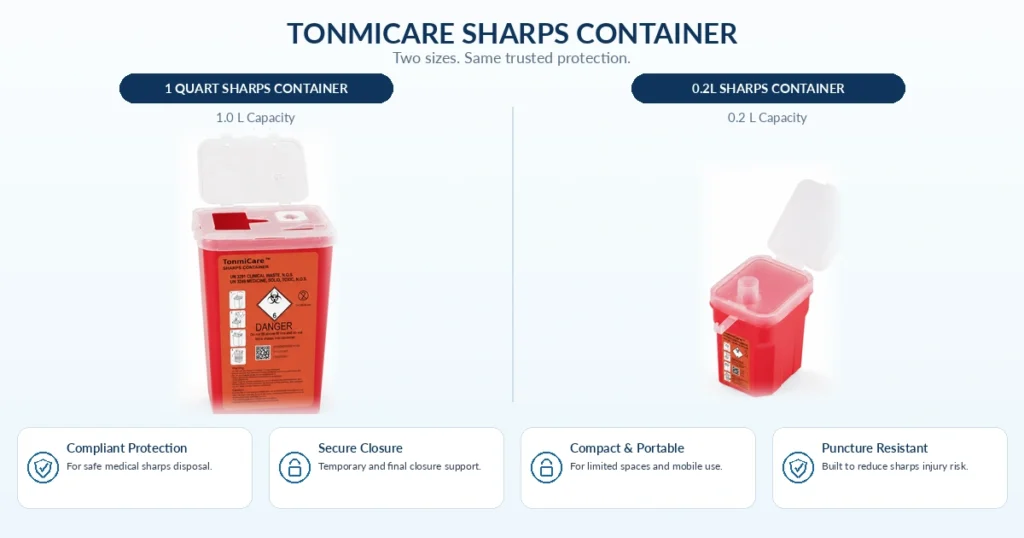
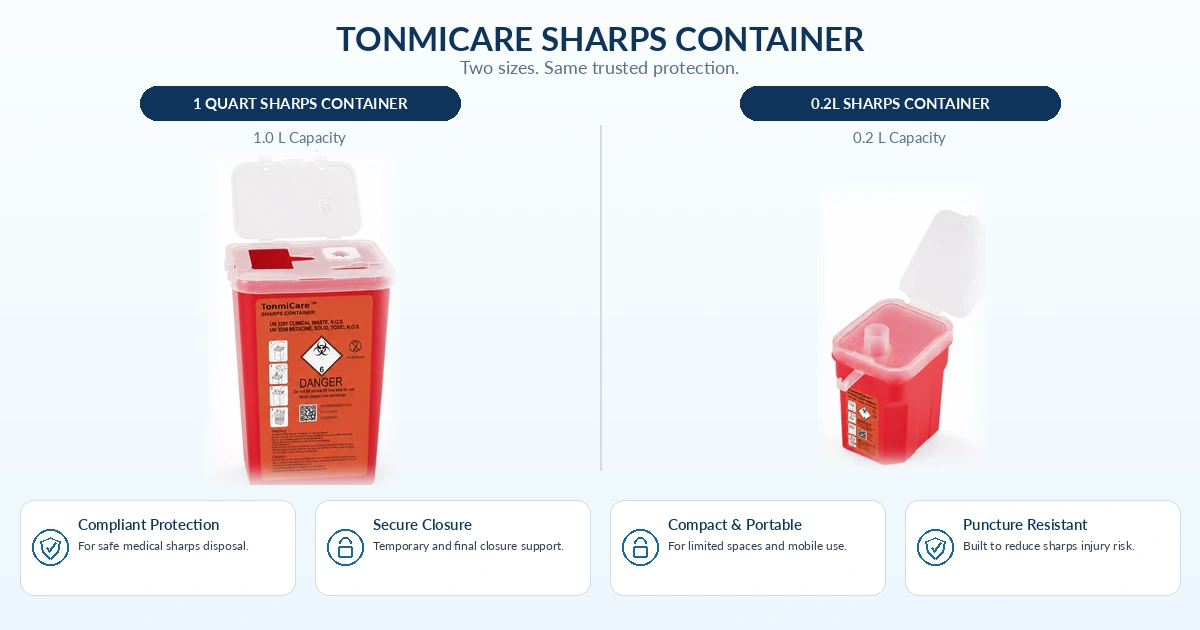
Tonmit’s current reference materials include compact 1-liter sharps-container configurations. Capacity, color, lid, label, certification, case pack and availability must still be verified against the exact quoted REF; an image should not be treated as a complete specification.
For a U.S. program, Tonmit can organize a SKU-level review covering:
- nominal and usable capacity, external dimensions and unit weight;
- body and lid material, opening geometry and closure states;
- compatible sharps and excluded waste streams;
- fill line, warning label, unit lot and carton traceability;
- applicable regulatory and performance documents;
- unit assembly state, case pack, carton dimensions and pallet information;
- private-label artwork control and preproduction approval;
- current Ohio warehouse stock, replenishment lead time and allocation for the exact SKU.
Scope boundary: Product supply and documentation review do not replace the buyer’s qualification of its medical-waste hauler, mail-back provider, facility procedure or state and local disposal route.
11. Bulk Supply Planning: Case Pack, Nesting and Replacement Stock
Sharps containers consume more warehouse volume than their unit price may suggest. Nestable bodies can reduce inbound cube, but lids, cabinets and brackets may ship separately. Some units require assembly before placement; others are delivered preassembled. These differences affect labor, storage, receiving and deployment.
Request the following commercial fields:
- units per inner pack and master carton;
- whether bodies nest and how lids are packed;
- carton dimensions, gross weight and pallet pattern;
- assembled versus unassembled delivery state;
- bracket, cabinet and stabilizer quantities per site;
- minimum order quantity by standard and private-label SKU;
- current stock, production lead time and label-artwork lead time;
- lot identification at unit, inner and master-carton levels;
- replacement parts or accessory availability;
- change-notification period for lid, resin, label or manufacturing-site changes.
Forecast replacement stock at the facility level. A central distribution center may show adequate inventory while one treatment room runs out. Set a minimum quantity for every container location, plus site safety stock based on peak usage and replenishment time.
Private label adds a regulatory and operational review. Confirm who is the legal manufacturer, how the cleared device relates to the private-label presentation, which party controls artwork, how biohazard and use instructions are preserved, and how complaints or recalls reach the downstream buyer.
12. Illustrative Facility Selection Matrix
The matrix below is a starting point for evaluation, not a substitute for a site assessment.
| Location | Likely container profile | Priority checks |
|---|---|---|
| Retail pharmacy vaccination room | Compact countertop or wall-mounted unit sized for syringes and safety needles | Point-of-use reach, visitor access, fill visibility, bracket security and replacement stock |
| Diabetes education / injection training | Small stable unit for pen needles, lancets, syringes and demonstration devices as applicable | Complete-device compatibility, clear opening, patient access control and disposal route |
| Phlebotomy station | Portable tray or mounted unit with opening sized for collection devices | One-handed drop, tubing or shield accommodation, stability and close proximity |
| Exam room | Wall-mounted or cabinet-secured point-of-use unit | Ergonomic height, largest sharp, cabinet fit, child access and room-level changeout |
| Medication room | Moderate-capacity secured unit | Procedure volume, waste-stream segregation, fill inspection and staff access |
| Procedure room | Larger opening and capacity for longer or bulkier devices | Post-use device dimensions, snag prevention, temporary closure and safe removal path |
| Mobile clinic / home health | Portable container with secure temporary closure | Upright transport within work process, temperature and impact exposure, vehicle security and return route |
| Restricted high-volume area | Large floor, cart or service-system container | Access control, hands-free features, internal transport, hauler interface and backup capacity |
OSHA also requires covered employers to review their exposure-control plan and solicit input from non-managerial employees responsible for direct patient care when identifying, evaluating and selecting effective engineering and work-practice controls.[3] Procurement should therefore include a structured user evaluation instead of relying only on management or purchasing preference.
13. A Seven-Step Sharps Container RFQ Workflow
- Map the waste-generating locations. Record procedure type, user position, largest post-use sharp, daily volume, patient access and disposal route.
- Define the regulatory and waste-stream scope. State target market, workplace use, required FDA device status, label language, facility color convention and excluded waste.
- Specify container and accessory fields. Include nominal capacity, external dimensions, opening type, closure states, fill-line visibility, base stability, bracket or cabinet and assembly state.
- Request SKU-level evidence. Reconcile REF, label, instructions, 510(k), device listing, performance records, quality-system documents and manufacturing roles.
- Evaluate samples at point of use. Use representative unused devices and normal PPE; assess one-handed disposal, reach, visibility, snagging, stability, closure and changeout.
- Validate logistics and disposal compatibility. Confirm case pack, carton cube, warehouse allocation, mail-back or hauler acceptance, outer packaging and replacement-stock triggers.
- Approve and monitor one controlled configuration. Lock artwork and component specifications, retain an approved sample, track complaints and require notification before material, lid, label or site changes.
Minimum RFQ fields
| Category | Required fields |
|---|---|
| Use environment | Facility type, room, standing/seated/mobile position, user and access risks |
| Sharps profile | Device names, post-use dimensions, attached components and quantity per procedure |
| Container | REF, capacity, dimensions, opening, temporary and final closure, fill line, color and label |
| Accessories | Exact compatible bracket, cabinet, stabilizer, cart or tray SKU |
| Evidence | FDA record, listing, labeling, applicable standards, performance reports and change control |
| Supply | MOQ, case pack, carton/pallet data, warehouse stock, lead time, lot traceability and complaint channel |
| Downstream route | Hauler or mail-back acceptance, closure instruction, outer packaging, local rule and documentation |
Questions from healthcare buyers
14. Frequently Asked Questions
What size sharps container does a clinic need?
There is no single clinic size. Select by room-level device mix, largest post-use sharp, procedure volume, available mounting space and planned changeout interval. A compact 1-liter or 1-quart format may suit some low-volume stations, while procedure areas may require a larger opening or capacity. Validate with representative devices before standardizing.
How many syringes fit in a 1-gallon sharps container?
A universal count is unreliable. Capacity changes with syringe volume, safety features, attached needles, auto-injectors, tubing, inlet geometry and the marked fill line. Use a supplier statement tied to defined devices or a controlled simulated-use evaluation; never shake or compress contents to reach a target count.
Are sharps containers “OSHA approved”?
OSHA does not approve individual commercial containers. Its Bloodborne Pathogens Standard requires characteristics and workplace practices such as closability, puncture resistance, leak resistance, labeling, accessibility, upright use and routine replacement without overfilling. The employer must select and use a product that supports those requirements.
Does a healthcare-facility sharps container need FDA clearance?
FDA states that sharps containers are generally Class II devices subject to 510(k) requirements and recommends FDA-cleared containers in healthcare facilities. Verify the exact quoted model or device family, manufacturer, product code, 510(k) and current labeling rather than relying on a general registration claim.
When should a sharps container be replaced?
Replace it at the marked fill line or earlier if required by its instructions, facility policy, local rule, disposal program or condition. OSHA requires routine replacement and prohibits overfilling. Damage, instability, external contamination, compromised closure or unsafe access can also require immediate changeout.
Is there a universal 90-day rule for sharps containers?
No universal 90-day interval appears in OSHA’s Bloodborne Pathogens Standard for every container and setting. A specific time limit may come from manufacturer labeling, a facility policy, state or local requirements, infection-control practice or a waste-service contract. Use the applicable rule for the exact program.
Should a sharps container be filled to 75%?
Follow the product’s marked fill line and instructions. FDA describes many containers as having a line at about three-fourths full, while OSHA requires that containers not be overfilled. Do not substitute an estimated percentage for the actual indicator on the selected SKU.
What is the correct height for a wall-mounted sharps container?
NIOSH describes approximately 52–56 inches for a standing workstation and 38–42 inches for a seated workstation in its ergonomic analysis. The governing principles are a clear view of the inlet, comfortable reach and positioning below eye level. Site conditions and users still require assessment.
What do red and yellow sharps containers mean?
Red commonly identifies biohazardous sharps, while yellow may be used in chemotherapy or other programs, but color meanings are not universal across all waste streams and jurisdictions. Read the exact label and confirm facility policy and disposal-vendor acceptance; never choose by color alone.
Can a detergent bottle replace a sharps container?
FDA discusses heavy-duty household containers only as an alternative for consumers when an FDA-cleared container is unavailable and directs users to community guidelines. That consumer contingency should not be treated as a general procurement substitute for a healthcare facility’s workplace, device and waste-management requirements.[5]
Is a mail-back container the same as a standard sharps container?
Not necessarily. A mail-back system may include the sharps container, authorized outer packaging, shipping instructions, tracking and treatment documentation. Confirm that the complete system is available and permitted for the generator, location, waste stream and package weight.
What should a distributor request before ordering bulk sharps containers?
Request exact REF and label, FDA and performance evidence, capacity and dimensions, opening and closure design, compatible accessories, case and pallet data, MOQ, production and warehouse lead time, lot traceability, private-label roles, change control, complaint handling and confirmation of the downstream disposal route.
15. Limitations and Conclusion
No web guide can determine a facility’s correct sharps container without the exact devices, work position, users, room design, waste stream and disposal route. The illustrative capacities and settings in this article are selection prompts, not mandatory assignments. Product availability, FDA status, labeling, standards and regulations can change, and state or local requirements may be more stringent than the federal baseline.
The most defensible purchase starts with point-of-use observation and ends with a controlled SKU. Match the largest post-use device to a safe opening; match capacity to a validated changeout interval; match the container to a compatible bracket and visible location; then reconcile the label, FDA record, performance evidence, case pack, warehouse plan and disposal route.
That approach answers the question “What size sharps container do we need?” more accurately than a generic capacity chart. The right size is the configuration that remains functional, accessible, visible and convenient throughout use—without forcing staff to improvise.
Wholesale & documentation support
Request a Sharps Container SKU Review
Send Tonmit your device mix, target capacity, opening type, color, label market, annual demand, delivery location and required documentation. We can organize a comparable quotation and identify the fields that still require confirmation before sample or bulk approval.
Include photos or model names of the largest sharps generated after use. This is usually more useful than sending only a desired container volume.
References
- Electronic Code of Federal Regulations. 29 CFR 1910.1030—Bloodborne Pathogens. Current electronic edition accessed July 22, 2026.
- Occupational Safety and Health Administration. Protecting Yourself When Handling Contaminated Sharps. OSHA Fact Sheet.
- Occupational Safety and Health Administration. Bloodborne Pathogens and Needlestick Prevention—Standards. Accessed July 22, 2026.
- National Institute for Occupational Safety and Health. Selecting, Evaluating, and Using Sharps Disposal Containers. DHHS (NIOSH) Publication No. 97-111.
- U.S. Food and Drug Administration. Sharps Disposal Containers. Consumer and home-use information.
- U.S. Food and Drug Administration. Sharps Disposal Containers in Health Care Facilities.
- U.S. Food and Drug Administration. Product Classification: Container, Sharps—Product Code MMK. Accessed July 22, 2026.
- U.S. Food and Drug Administration. Guidance on the Content and Format of Premarket Notification [510(k)] Submissions for Sharps Containers.
- Electronic Code of Federal Regulations. 49 CFR 173.197—Regulated Medical Waste. Current electronic edition accessed July 22, 2026.