
Insulin Syringe Comparison & Purchasing Guide
U-40 and U-100 identify different insulin-unit scales. A matching needle size or barrel capacity does not make the syringes interchangeable. Here is how to read the difference and keep the required scale on the quote, order and delivered product.
Match the syringe scale to the medication label and the prescribing professional’s directions. This guide covers product selection and purchasing checks; individual doses and treatment changes require a clinician, pharmacist or veterinarian.
Quick answer
What is the difference between U-40 and U-100 insulin syringes?
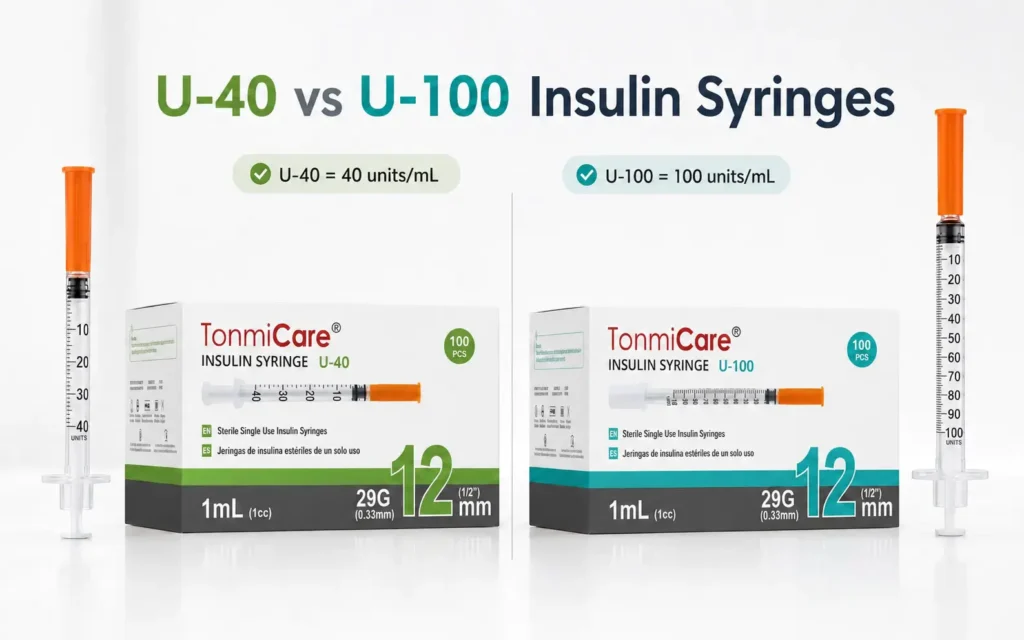
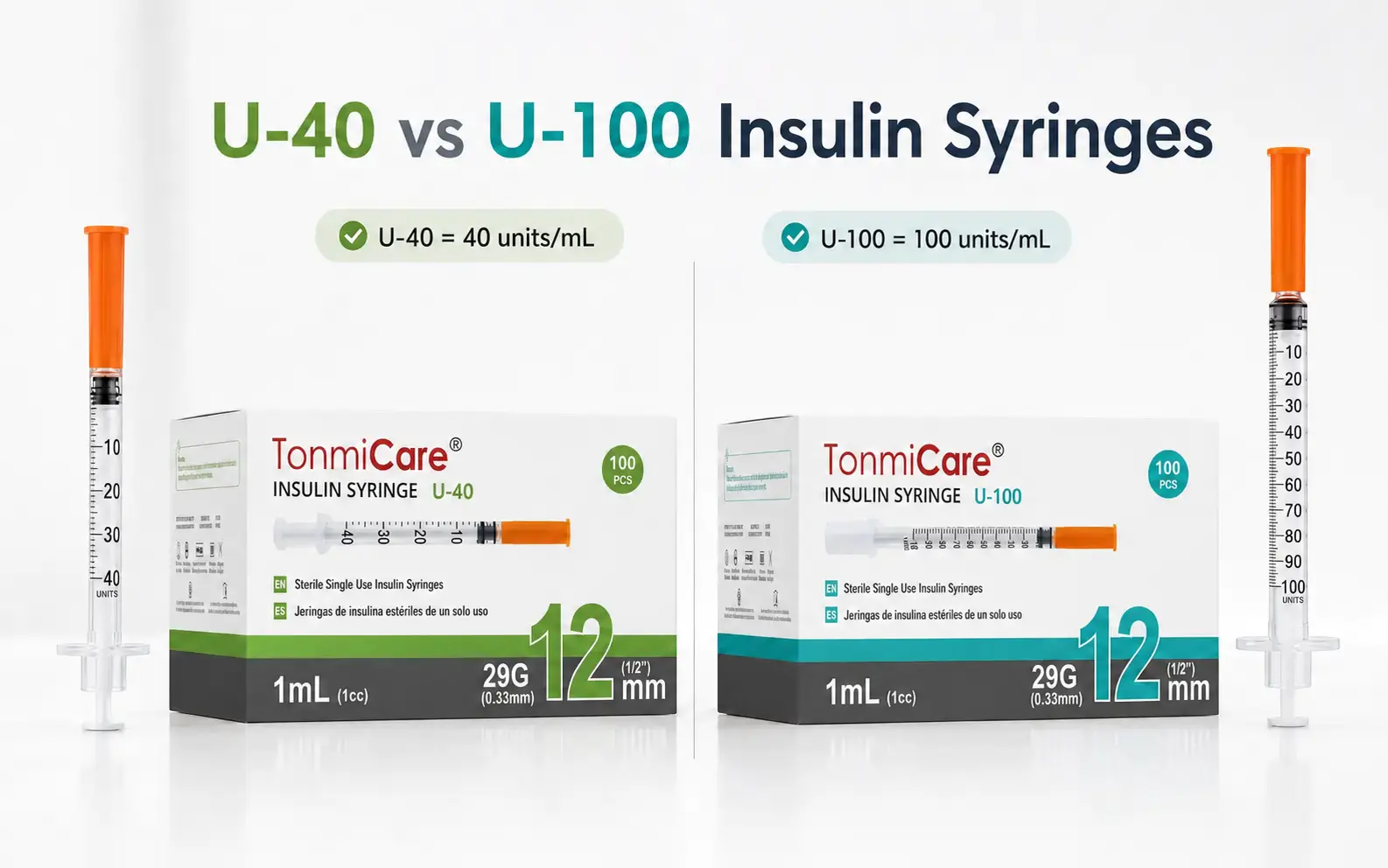
A U-40 syringe has a unit scale for insulin containing 40 units/mL. A U-100 syringe has a unit scale for insulin containing 100 units/mL. The same numbered mark represents a different liquid volume on each scale. Use the syringe specified for the actual insulin presentation.[1][2][3]
For an order, state U-40 or U-100 first, then capacity, graduation and needle size. See the comparison or copy the RFQ.
Before approving a quote
Three fields that cannot be guessed
- Concentration scale: read U-40 or U-100 on the approved requirement and supplied label.
- Delivery presentation: distinguish a vial from a cartridge or prefilled pen.
- Product identity: record the manufacturer’s catalog reference, shown here as REF.
1. Read the scale before the capacity
On the medication, U-40 and U-100 describe insulin concentration. On an empty syringe, they identify the concentration for which its numbered unit scale is calibrated. They do not describe the needle or mean the syringe contains insulin.
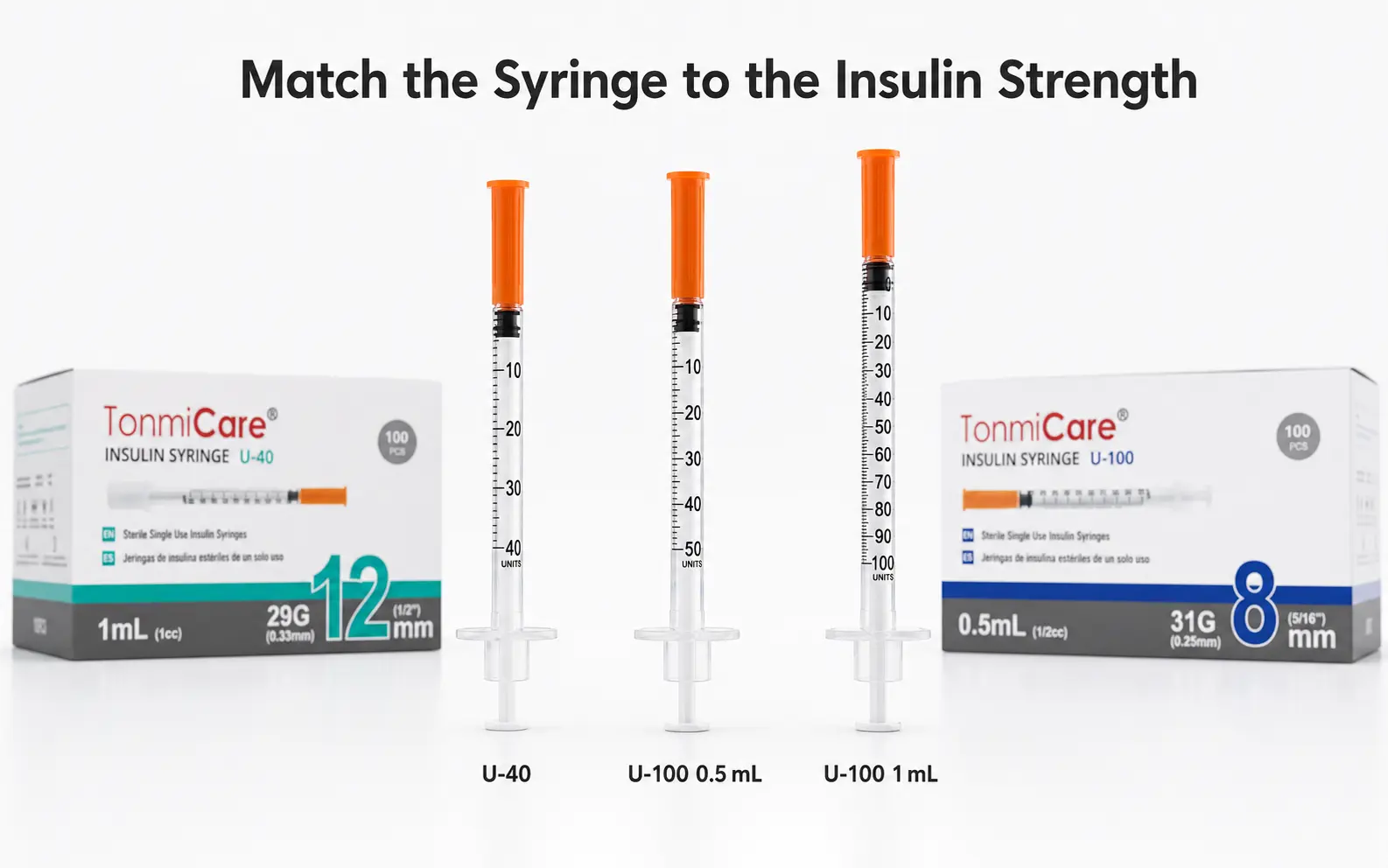
Two syringes labeled 0.5 mL can hold the same volume while showing different maximum unit numbers: 20 for a U-40 scale and 50 for a U-100 scale. A request for “a 20-unit syringe” still needs the concentration scale and capacity; the number alone is incomplete.
U-40 vs U-100 at a glance
| Field | U-40 | U-100 |
|---|---|---|
| Matching insulin concentration | 40 units/mL | 100 units/mL |
| Maximum units at 0.5 mL capacity | 20 | 50 |
| Maximum units at 1 mL capacity | 40 | 100 |
| Label examples in this guide | Vetsulin and ProZinc vials | HUMALOG U-100 vials |
| Fields the scale does not establish | Graduation interval, needle gauge and length, intended use, packaging and exact REF | |
A syringe does not become U-40 because it has a particular cap color, or U-100 because it is sold through a human pharmacy. Read its printed identification and the product label.
2. A scale mismatch can change the amount delivered
The concentration ratio is 100 ÷ 40 = 2.5. If someone follows the same numbered unit mark on the wrong syringe, the amount of insulin will be wrong. The direction of the mismatch matters:
| Insulin vial | Wrong syringe scale | At the same numbered unit mark |
|---|---|---|
| U-40 | U-100 | 40% of the intended insulin units |
| U-100 | U-40 | 2.5 times the intended insulin units |
The Vetsulin and ProZinc vial labels specify U-40 syringes and warn about incorrect dosing with other scales. HUMALOG U-100 vial instructions specify a U-100 syringe.[1][2][3] If a wrong-syringe injection may already have occurred, contact the treating clinician or veterinarian immediately.
Worked purchasing example
The needle matches; the scale does not
A request specifies U-40, 0.5 mL, 30G × 8 mm, fixed needle, 100/box. The replacement offer is U-100 with the same capacity, needle and box count.
Decision: do not approve it as the requested item. Ask for the correct U-40 REF and package label. Matching four fields does not compensate for a concentration-scale mismatch.
Illustrative example, not a customer case or a statement of current stock.
What to do during a backorder
Keep the requested scale on the order. Ask the supplier to identify every proposed change and obtain the appropriate written authorization before accepting a replacement. An online conversion chart does not make a U-100 syringe the routine replacement for a U-40 syringe. Resolve missing matching supplies with the pharmacist, clinician or veterinarian before use.
3. Check whether the medication is a vial, cartridge or pen
A brand name is not enough to choose accessories. The FDA-hosted Vetsulin labeling distinguishes U-40 vial use from its cartridges, which use VetPen and the pen needles specified in that labeling.[1] Changing presentation can change the supply category even when the medication’s brand remains the same.
| Presentation | Direction in the cited label | Order check |
|---|---|---|
| Vetsulin U-40 vial | U-40 syringe | Required capacity, graduation and needle |
| Vetsulin cartridge | VetPen and specified pen needles | Do not carry over the vial syringe order |
| ProZinc U-40 vial | U-40 syringe | Follow the veterinarian’s directions and supplied labeling |
| HUMALOG U-100 vial | U-100 syringe | Confirm this is the vial presentation |
Species does not select the scale
Veterinary orders can involve different insulin products. Record the prescribed medication, concentration and presentation rather than assuming that every animal prescription needs U-40. Equally, a U-100 marking does not establish that a particular device is labeled for human use.
4. Separate maximum capacity from the smallest graduation
Maximum capacity tells you how much the syringe holds. Graduation tells you the interval between its printed marks. A 30-unit maximum does not prove half-unit graduations, and a 100-unit maximum does not prove two-unit graduations.
| Nominal capacity | U-40 maximum | U-100 maximum | Still needed |
|---|---|---|---|
| 0.3 mL | 12 units if offered with this scale | 30 units | Actual REF and graduation artwork |
| 0.5 mL | 20 units | 50 units | Smallest printed interval |
| 1 mL | 40 units | 100 units | Maximum marking and unit label |
These relationships follow from capacity × concentration. They do not establish that a manufacturer supplies every combination. Use the syringe sizes guide for broader capacity planning.
Gauge and length are separate fields
A needle specification such as 30G × 8 mm does not identify the concentration scale. Retain both in the order description. If the package shows metric and inch lengths, compare the manufacturer’s stated dimensions; do not silently replace a nominal label value with a different physical length.
For a graduation check, request a readable photograph of the actual barrel and the specification for the quoted REF. Review half-unit or other fine markings from that evidence, rather than a resized marketing image. Patient-specific needle and graduation choices belong to the responsible professional.
5. Keep the scale on the quote, catalog and purchase order
Use separate item records for U-40 and U-100. A catalog title such as “0.5 mL insulin syringe” leaves the most important distinction out. The quoted manufacturer REF must resolve to the same scale on the sample, approved specification and delivered label.
Order-line format: U-40 or U-100 | capacity and maximum units | graduation | gauge × length | needle design | manufacturer REF | primary pack and box quantity.
For private-label supply, a new brand or carton does not remove the need to identify the scale. Keep the concentration marking prominent and reconcile the revised artwork with the approved product specification. Color is a secondary cue; it cannot resolve a missing or contradictory U-40/U-100 marking.
6. Receiving checks: when to hold an order
Compare the approved order, the actual unit or box label, and the delivered REF. The table below gives suggested purchasing decisions; your organization’s authorized release procedure controls the final decision.
| What you find | Suggested action | Evidence to request |
|---|---|---|
| U-40 ordered; U-100 received | Hold as a scale mismatch | Correct product and REF; no dose-conversion substitute |
| U-40 + 0.5 mL paired with a 50-unit maximum | Hold the inconsistent identification | Actual barrel, label and controlled specification |
| REF changed; capacity and needle look unchanged | Hold for change review | Written comparison of scale, graduation, design and labeling |
| Same approved REF; different lot | Record the lot and review normal release criteria | Expiry, package condition and required release records |
| Case count differs; inner product matches | Reconcile quantity and price before acceptance | Pieces/box × boxes/case, delivered quantity and agreed terms |
A carton-count difference is not the same failure as a concentration mismatch. Record it without overwriting the product identity. Likewise, a barcode scan supports receiving only if the catalog mapping is correct and the visible label agrees.
Blank receiving record
Concentration and product check
Use one record per delivered REF and lot. Keep patient names and individual doses out of this purchasing record.
Expand the template to select and copy the text manually.
View receiving record
U-40 / U-100 RECEIVING CHECK

Buyer / department:
Approved manufacturer and REF:
Required scale: U-40 / U-100
Required capacity, maximum units and graduation:
Required gauge x length and needle design:
Approved label / specification revision:

Delivered manufacturer and REF:
Scale on unit / box / case:
Actual capacity, maximum units and graduation:
Actual gauge x length and needle design:
Lot and expiration:
Pieces per box x boxes per case; quantity received:
Package condition and supporting records:

Differences from the approved order:
Decision: RELEASE / HOLD / RETURN / REVIEW REQUIRED
Responsible reviewer and date:
Resolution and evidence reference:

Blank purchasing record. Follow the authorized receiving procedure.
Do not enter patient identifiers or doses. Not a completed inspection
report, sterility test or device approval.
7. Human-use and animal-only devices need different document checks
U-40 and U-100 describe scales, not regulatory classifications. Establish the product’s labeled intended use and destination market before requesting regulatory evidence.
| Intended use | Relevant distinction | Buyer check |
|---|---|---|
| Human medical use | The FDA piston-syringe entry FMF identifies Class II, 21 CFR 880.5860 and a 510(k) submission type.[4] | Check the classification and applicable premarket record for the offered device. |
| Animal-only use | FDA does not require 510(k), PMA or other premarket approval for animal devices. It retains oversight of adulteration and misbranding.[7] | Verify animal-only labeling, manufacturer identity and supporting safety and quality information. |
FDA registration and listing are not approval or clearance, and FDA does not issue device-registration certificates.[5] For applicable human-device quality systems, the QMSR took effect on February 2, 2026 and incorporates ISO 13485:2016 by reference.[6]
An animal-only label cannot support a human-use claim. For either purchasing file, link the documents to the actual manufacturer, REF, scale and specification. Our documentation support page explains the broader file request.
8. Forecast U-40 and U-100 as separate stock items
Count demand and available stock by exact REF. If the U-40 item is out of stock, surplus U-100 stock does not fill that order. A forecast combining both under “insulin syringes” can conceal the shortage.
Keep the approved scale visible in the catalog, shelf location, picking record and reorder request. When a medication changes from a vial to a cartridge or pen, review the accessory list instead of carrying the previous syringe demand forward automatically.
For a Tonmit quotation, send the required scale, configuration, quantity and destination. We review the offered REF, packaging and shipment arrangement for that request. Do not assume a specific U-40 configuration is in U.S. stock from the presence of a U.S. warehouse alone. The U-100 buyer guide covers broader U-100 ordering details.
9. Copy an RFQ that keeps the concentration scale explicit
Give U-40 and U-100 separate order lines. Include the manufacturer REF when known; if it is not known, ask the supplier to identify it and provide a readable label and specification before approval.
Blank supplier request
U-40 / U-100 specification and supply RFQ
Copy the request and complete the purchasing fields. No patient information is needed.
Expand the template to select and copy the text manually.
View RFQ template
U-40 / U-100 INSULIN SYRINGE RFQ

Company and buyer contact:
Destination country and ZIP / postal code:
Intended use: HUMAN MEDICAL / ANIMAL ONLY / REVIEW REQUIRED
Medication and delivery presentation, if relevant:

SEPARATE ORDER LINE FOR EACH CONFIGURATION
Required scale: U-40 / U-100
Capacity and maximum unit marking:
Smallest graduation interval:
Needle gauge x exact length and needle design:
Required or proposed manufacturer REF:
Brand / manufacturer / labeler:
Primary pack, pieces per box and boxes per case:
Quantity, minimum remaining shelf life and delivery date:
Factory shipment or confirmed U.S. stock requested:

PLEASE PROVIDE
Actual barrel / unit / box label and specification:
Intended-use and destination-market documentation:
Product-appropriate sterility and shelf-life evidence:
Available quantity, shipping point and lot/expiry information:
MOQ, price by piece/box/case and freight basis:
Any differences from the requested configuration:

Do not offer a different concentration scale as an equivalent item.
Disclose other changes for written review before shipment.
Do not include patient identifiers or individual prescribed doses.
Buyer questions
Is a 20-unit syringe automatically U-40?
No. A 0.5 mL U-40 configuration has a 20-unit maximum, but “20 units” alone is not a complete product description. Check the printed scale, nominal volume and maximum marking together.
Can I use a U-100 syringe with U-40 insulin?
Does the cap color identify the correct syringe?
Color can help distinguish products within a defined supply system, but verify the printed U-40/U-100 marking and REF. A color match cannot override a conflicting scale or label.
Does a smaller capacity prove half-unit markings?
No. Capacity and graduation are separate specifications. Ask for the actual barrel image and controlled graduation drawing for the offered REF.
Does switching from a vial to a cartridge keep the same accessories?
Not necessarily. Check the new presentation’s instructions. For example, the cited Vetsulin labeling distinguishes U-40 syringes for vials from VetPen and specified pen needles for cartridges.[1]
Is an animal-only U-100 syringe interchangeable with a human-use product?
The U-100 scale does not establish intended use or regulatory status. Check the actual label and applicable product records; an animal-only designation does not support marketing the device for human use.
Approve the same scale from quote through receipt
Start with the medication presentation and required U-40 or U-100 scale. Record the remaining configuration and REF, then check that the delivered product agrees. If the scale is wrong or uncertain, hold the item and resolve the difference before dispensing or use.
Sources and editorial basis
- FDA Center for Veterinary Medicine. Vetsulin labeling, NADA 141-236. FDA-hosted vial and VetPen cartridge directions; cited file revised February 2019.
- FDA Center for Veterinary Medicine. ProZinc labeling, NADA 141-297. U-40 vial directions for cats and dogs in the cited file.
- Eli Lilly and Company. HUMALOG U-100 multiple-dose vial Instructions for Use. U-100 vial and syringe identification.
- FDA. Product Classification: Piston Syringe, FMF.
- FDA. Important Reminders About Registration and Listing.
- FDA. Quality Management System Regulation.
- FDA. How FDA Regulates Animal Devices.
Sources checked October 7, 2026. The medication sources apply to the named products and presentations. Check the labeling supplied with the actual medication. The quotation example and suggested receiving decisions are purchasing illustrations; the two downloadable worksheets are blank records, not completed inspections or evidence of device clearance.
Prepared by the Tonmit Medical Supply Editorial Team. Reviewer names and roles are listed above. Editorial team and review process.
Wholesale supply
Request a U-40 or U-100 syringe quote
Send the required scale, capacity, graduation, gauge × length, intended use, quantity and destination. We will review the proposed configuration, documents, packaging and shipment requirements before quotation.