
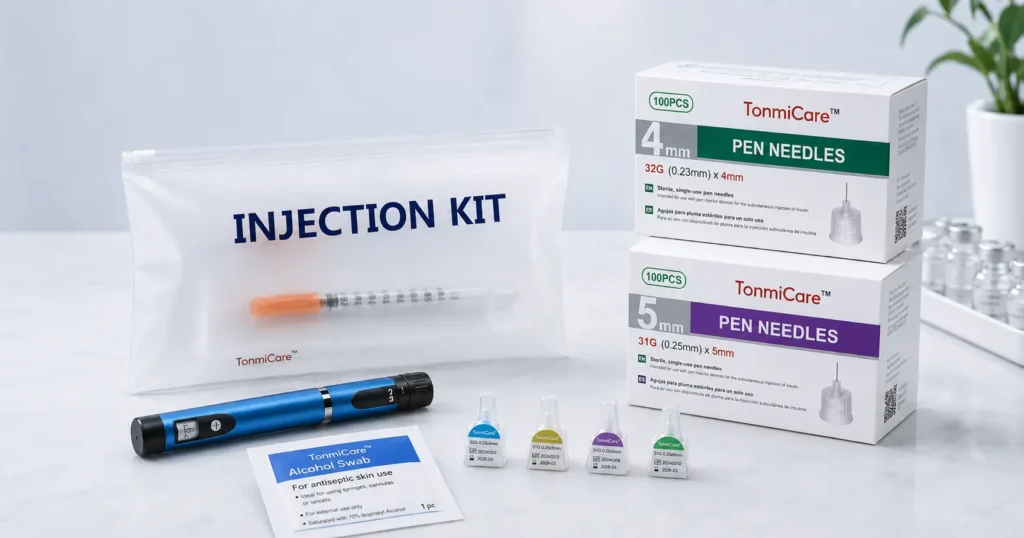
2026 Healthcare Procurement Guide
A presentation-led framework for configuring GLP-1 injection support supplies, controlling compatibility, documenting exact SKUs, planning kit replenishment and evaluating bulk supply programs for pharmacies, clinics and healthcare distributors.
Editorial disclosure: This article is an educational procurement resource for ancillary medical devices and consumables used with injectable GLP-1 receptor agonists and related dual GIP/GLP-1 therapies. It does not provide dosing, prescribing, compounding, patient-specific syringe selection or injection instructions, and it does not address oral GLP-1 products. Current FDA-approved medication labeling, Instructions for Use, prescriber directions, pharmacy policy and applicable disposal rules take precedence. Tonmit does not supply or compound GLP-1 medicines; TonmiCare is Tonmit’s medical consumables product brand.
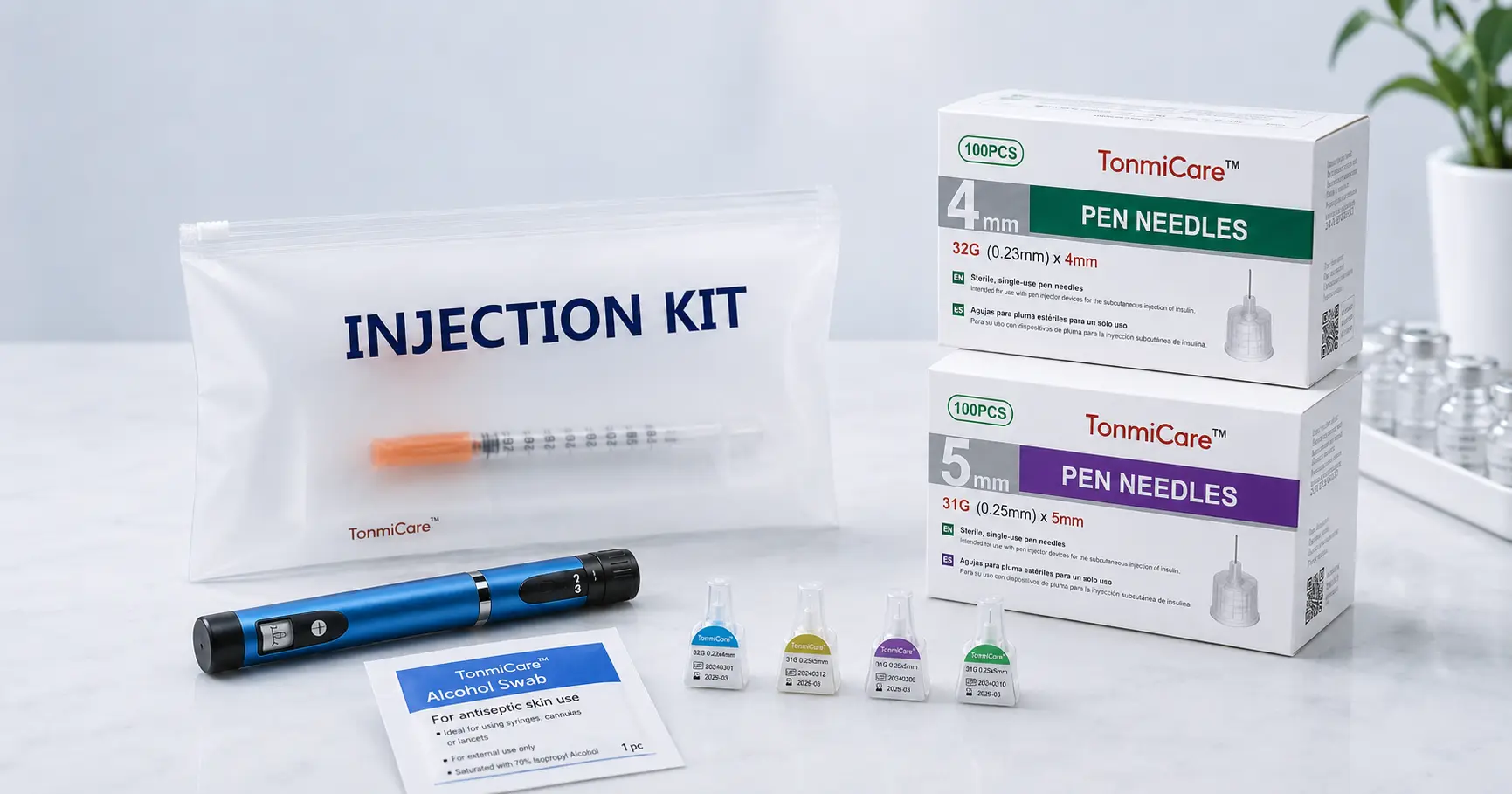
KEY TAKEAWAYS
GLP-1 support kits should be presentation-led, not product-list-led
- Start with the exact dispensed presentation and approved indication. A single-dose autoinjector, a multidose pen and a vial can require different ancillary supplies, even when the active ingredient is related.
- Do not standardize by drug or molecule name alone. Brand indication, market, strength, delivery system and packaging configuration can differ, and current labeling can change.
- Separate essential items from optional convenience items. This improves cost control and prevents unsupported clinical claims.
- Control compatibility at SKU level. The procurement record should connect each supply SKU to the applicable device Instructions for Use or an approved internal specification.
- Build disposal into the kit. Used needles and other sharps should enter an appropriate sharps container immediately after use; disposal requirements vary by jurisdiction.[7]
- Verify both component and finished-kit responsibilities. FDA establishment registration or device listing is not the same as clearance or approval, and a bundled kit may create separate labeling, UDI, quality-system and postmarket obligations.[10][15]
Abstract
GLP-1 support-supply procurement is often reduced to a generic starter-kit checklist. That approach can create unnecessary items, incompatible administration devices and weak traceability because current injectable therapies include integrated single-dose devices, multidose pens and vials with different ancillary-supply implications.
In this guide, “GLP-1 programs” is used as a procurement umbrella term for injectable GLP-1 receptor agonists and related dual GIP/GLP-1 therapies. It is not intended to imply that every product has the same mechanism, FDA-approved indication, presentation or administration requirement. The guide converts the exact dispensed presentation into a controlled B2B supply framework: it separates administration-critical devices from preparation, post-injection and disposal supplies; defines a modular kit architecture; sets SKU-level specification and evidence requirements; and connects component demand to packaging, lot control, U.S. inventory and refill planning.
Scope boundary: The framework applies to ancillary supplies for injectable presentations. It does not establish dosing, concentration conversion or syringe-selection protocols for compounded semaglutide, compounded tirzepatide or other non-FDA-approved formulations.[17]
Keywords: GLP-1 injection support supplies; GLP-1 injection support kits; pharmacy GLP-1 supplies; weight-management injection supplies; bulk pen needles; bulk syringes; alcohol prep pads; sharps containers; medical consumable procurement
Program growth turns small consumables into a repeatable supply-chain requirement
Injectable GLP-1 receptor agonists and related dual GIP/GLP-1 therapies are now used across diabetes care and chronic weight-management pathways. These pathways must remain indication-specific: for example, U.S. labeling identifies Zepbound for chronic weight management and other approved uses, while Mounjaro is indicated for glycemic control in patients with type 2 diabetes.[4][5] In a November 2025 KFF survey, 12% of U.S. adults reported that they were currently taking a GLP-1 medicine for weight loss, diabetes or another chronic condition.[1] CDC data based on the 2024 National Health Interview Survey also documented substantial injectable GLP-1 use among adults with diagnosed diabetes, with use varying by body-mass-index category and concurrent diabetes therapy.[2]
For procurement teams, the operational issue is not simply the volume of medication prescriptions. Each program may create recurring demand for pen needles, syringes, hypodermic needles, alcohol prep pads, gauze, adhesive bandages, sharps containers, travel or storage accessories, printed instructions and replacement supplies. A weekly injection schedule may appear low-volume at patient level, but the demand becomes material when multiplied across a pharmacy network, telehealth panel, employer program or regional distributor.
The most reliable approach is to treat these items as a controlled support-supply system. That system should have a defined scope, approved bill of materials, presentation-specific compatibility rules, replenishment logic and documented substitutes. This is more defensible than assembling a generic “weight loss injection kit” around whichever accessories are currently available.
Define what “complete injection support” means before requesting quotations
Search results for GLP-1 starter kits commonly combine a needle or syringe, alcohol prep pads, gauze or cotton, adhesive bandages and a sharps container. That checklist is useful as a consumer overview, but B2B buyers need a more disciplined classification. A procurement specification should distinguish four layers:
Administration-critical devices
Compatible pen needles or a syringe-and-needle configuration when the dispensed presentation requires them. These items require the strictest compatibility and regulatory review.
Site-preparation supplies
Alcohol prep pads or other site-preparation items specified by the healthcare program. Packaging integrity, solution composition, pad dimensions and shelf life should be controlled.
Post-injection and disposal supplies
Gauze, small adhesive dressings and an appropriate sharps container. Disposal instructions should reflect the user environment and applicable state or local requirements.
Program-support materials
Printed checklists, multilingual disposal guidance, tamper-evident outer packaging, lot traceability, refill identification and customer-support information.
Optional convenience items—such as travel organizers, refrigerator accessories or reminder cards—should be listed separately. They may improve the user experience, but they should not be represented as universally required for safe administration unless the applicable Instructions for Use or clinical protocol says so.
Match ancillary supplies to the actual GLP-1 presentation
The highest-risk content error in this topic is treating all injectable therapies commonly grouped under “GLP-1” as if they use a detachable pen needle or a vial-and-syringe workflow. Current U.S. labeling shows multiple presentation types. Wegovy labeling identifies presentation-specific administration requirements; Zepbound includes presentations that may require a new syringe and needle; Mounjaro is cited here only as a diabetes-program presentation example, not as a U.S. chronic-weight-management indication; and Saxenda is supplied as a dial-a-dose pen used with a separate needle.[3][4][5][6]
| Presentation type | Typical ancillary-supply implication | Procurement control |
|---|---|---|
| Single-dose pen or autoinjector with integrated needle | No separately purchased administration needle may be needed. Site-preparation, post-injection and disposal items may still be included according to protocol. | Confirm the current package and Instructions for Use; do not add a pen needle automatically. |
| Multidose, dial-a-dose pen | A new compatible disposable pen needle may be required for each injection. | Control interface compatibility, needle specification, market authorization and “single use” labeling. |
| Single-dose or multidose vial | A new syringe and needle are required when specified in the labeling. Exact volume, needle and syringe requirements must follow the product instructions and prescriber or pharmacy protocol. | Never infer dose from U-100 markings or publish conversion instructions without an authorized clinical protocol. |
| Prefilled syringe | The administration device may already be integrated; additional loose needles or syringes may be unnecessary. | Verify whether the presentation includes a needle and what disposal container opening is appropriate. |
Procurement teams should not treat a shared molecule or delivery format as evidence of an interchangeable indication. Tirzepatide is a dual GIP/GLP-1 receptor agonist. In the United States, Zepbound and Mounjaro have distinct approved labeling and program contexts; the bill of materials should therefore be approved against the exact brand, presentation, market and current Instructions for Use—not the molecule name alone.[4][5]
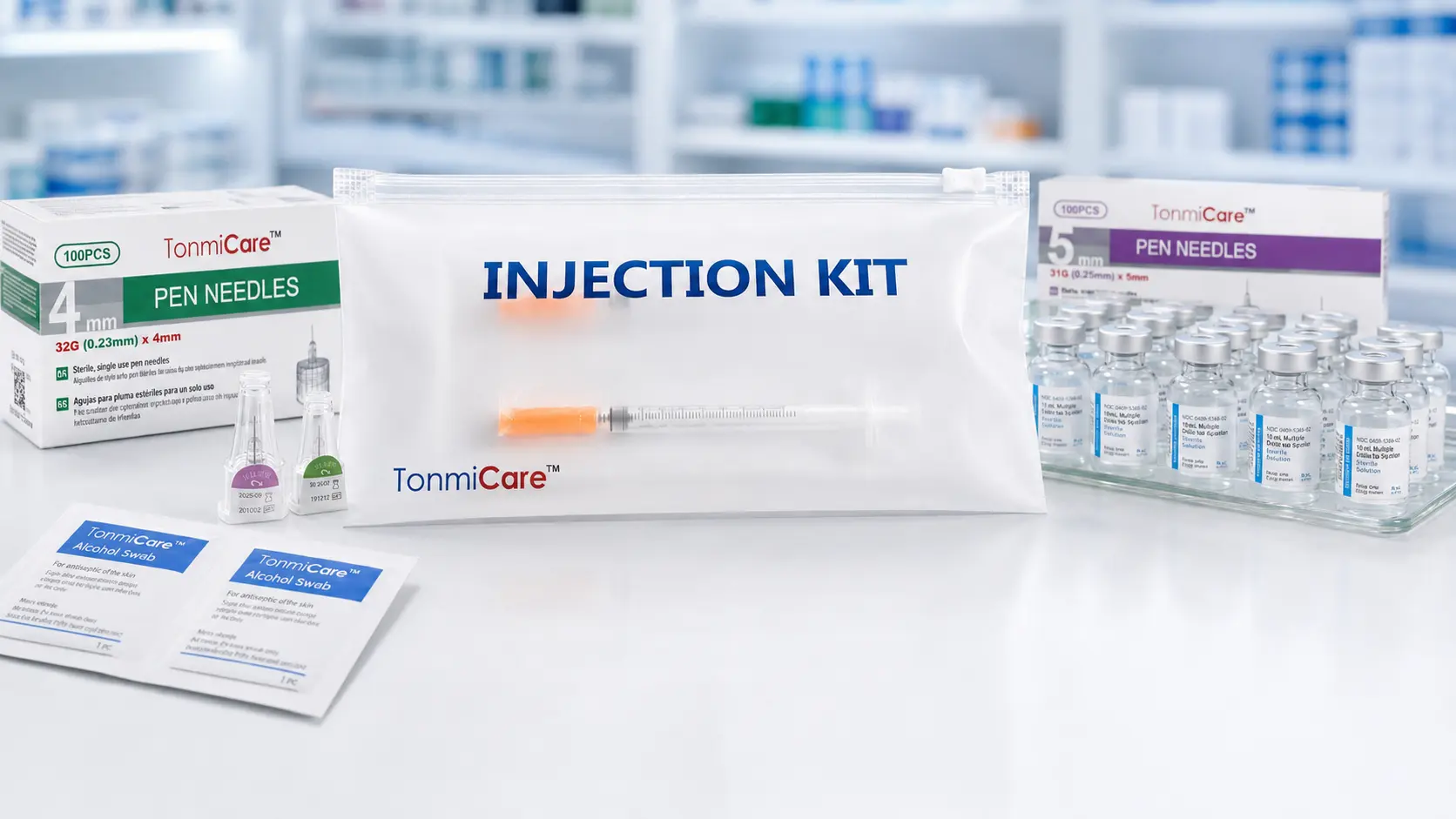
Use a modular kit architecture instead of one universal bundle
A modular architecture reduces errors, simplifies purchasing and supports more than one dispensing pathway. The base kit should contain only items that apply broadly to the selected program. Presentation-specific administration modules can then be added after the medication format is confirmed.
Base support module
Site-preparation items, small dressings if included by protocol, disposal guidance, support contacts and a sharps container sized for the planned replacement interval.
Pen-needle module
Compatible single-use pen needles in an approved quantity, with gauge, length, interface, packaging and regulatory status locked in the specification.
Vial administration module
Syringes and needles selected under the medication labeling and clinical protocol. The module should never substitute marketing language for dose-specific professional instructions.
Refill module
Consumables only, with no redundant container or organizer unless the replacement schedule requires it. Refill packs help reduce cost and packaging waste.
Buyers can further distinguish a patient starter pack, a monthly or quarterly refill pack, a clinic-use carton and a distributor master case. Each level should have its own item count, label hierarchy, lot-capture method and reorder point.
Control the exact SKU, not only the product category
“Pen needle,” “insulin syringe” and “alcohol swab” are procurement categories, not complete specifications. A qualified request for quotation should identify every attribute that can affect compatibility, usability, labeling or quality acceptance.
| Supply | Specification fields to freeze | Common failure mode |
|---|---|---|
| Pen needle | Gauge, length, hub/interface compatibility, sterility, single-use status, shield configuration, individual seal and box count. | Assuming every pen uses the same detachable needle or selecting by gauge alone. |
| Syringe | Nominal capacity, graduation system, dead-space design, tip type, needle attachment, sterility, intended use and unit labeling. | Confusing insulin-unit markings with a medication-specific dose or volume. |
| Hypodermic needle | Gauge, length, hub type, connector standard, bevel, sterility, packaging and sharps-protection features where required. | Changing length or connector without clinical and compatibility review. |
| Alcohol prep pad | Solution, pad material, folded and unfolded dimensions, saturation, package seal, sterility claim if applicable, shelf life and case quantity. | Quoting “70% alcohol” without verifying pad size, liquid load or seal integrity. |
| Sharps container | Nominal volume, opening geometry, closure mode, fill line, wall puncture resistance, leak resistance, labeling and mounting option. | Selecting only by capacity while ignoring the device opening and final-closure method. |
Needle gauge and length are frequent search questions, but a professional article should not present one specification as universally correct for all GLP-1 products. The buyer’s controlled matrix should cite the applicable Instructions for Use, internal clinical approval or device-compatibility evidence for each administration module.
Disposal is part of the supply system, not an afterthought
FDA recommends placing used needles and other sharps in a sharps disposal container immediately after use. The agency describes appropriate containers as puncture-resistant, leak-resistant, stable in use and fitted with a tight, puncture-resistant lid; it also advises following community disposal rules when the container reaches approximately three-quarters full.[7][8]
Healthcare facilities operate under additional occupational-safety and regulated-waste requirements. FDA recommends FDA-cleared sharps disposal containers in healthcare facilities, while OSHA requires covered workplaces to use appropriate closable, puncture-resistant, leak-resistant and properly labeled or color-coded containers that are accessible, maintained upright, routinely replaced and not overfilled.[9][14]
Define the user setting before selecting the container: home-use shipment, retail-pharmacy handoff, clinic room, mobile service or institutional facility. Container size, opening geometry, mounting, transport and final-disposal instructions may differ.
The kit label should not promise a universal disposal route. State and local rules vary, and users may need a community drop-off, household hazardous-waste program, mail-back service or other approved option. The kit can direct users to authoritative local resources without replacing those rules.
Request evidence that matches the exact device and market
A supplier presentation may list FDA registration, ISO 13485, CE marking or other certificates. Buyers should verify what each document actually demonstrates and whether it applies to the exact legal manufacturer, manufacturing site and SKU being purchased.
In the United States, establishment registration and device listing do not denote FDA approval, clearance or authorization.[10] Depending on classification and intended use, a syringe, needle, pen needle or sharps container may require specific premarket clearance or other regulatory controls. FDA’s piston-syringe guidance provides a useful device-category framework, but it should not be used as the sole evidence for a current product decision. Buyers should also verify the current FDA product classification, applicable special controls, exact 510(k) or exemption status, legal manufacturer and cleared device description for the quoted SKU.[11]
FDA’s Quality Management System Regulation became effective on February 2, 2026 and incorporates ISO 13485:2016 by reference into the updated device current good manufacturing practice framework.[12] For buyers, this reinforces the need to evaluate the manufacturer’s implemented quality system rather than treating a certificate image as sufficient evidence.
Core document set
- Legal manufacturer and manufacturing-site identification
- Applicable FDA establishment registration and device listing records
- Premarket clearance or authorization evidence where required
- ISO 13485 certificate and certified scope
- Product specification and controlled drawings
- Sterilization method and validation summary, when applicable
- Biocompatibility and performance evidence appropriate to the device
Lot-release and change-control set
- Certificate of conformity or agreed lot-release record
- Expiry and shelf-life support
- Packaging validation and seal-integrity controls
- Complaint, nonconformance and recall procedures
- Advance notification for material, tooling, site or labeling changes
- Retention-sample and traceability policy
- Approved-substitute matrix
Design the kit so every component remains identifiable
Combination packing can weaken traceability if inner labels are removed, mixed or covered. Each medical-device component should remain linked to its manufacturer, lot or batch, expiration date and applicable device identifier. FDA’s UDI system is intended to identify medical devices from manufacturing through distribution and use, subject to applicable requirements and exceptions.[13]
For private-label or co-branded programs, the artwork workflow should define who acts as labeler, which entity controls UDI obligations, how complaints are routed and how a field action can identify affected finished kits and individual components. A scannable kit code can supplement—but should not obscure—the original device identification.
Determine whether the finished bundle qualifies as a convenience kit
FDA provides a limited UDI exception for certain devices packaged within the immediate container of a qualifying convenience kit when the convenience-kit label bears a UDI. That exception is not automatic for every assortment marketed as a “kit.” The responsible company should document whether the finished configuration meets FDA’s interpretation, whether individual components remain separately distributed, and which entity is the kit labeler or manufacturer.[15]
The assessment should also address whether components are repackaged, relabeled, substituted, modified or reprocessed; whether the finished kit requires its own device listing or UDI record; and who owns quality-system controls, complaint evaluation, Medical Device Reporting where applicable, and corrections or removals. FDA states that convenience-kit manufacturers remain subject to general controls and may have reporting obligations when a kit or included finished device is corrected or removed.[16]
Do not accept “convenience kit” as a sales description. Require a written regulatory-role memo that identifies the legal manufacturer or kit assembler, labeler, UDI owner, listing responsibility, component status, complaint route and correction/removal decision owner for the exact finished configuration.
Plan demand by active patients, presentation mix and refill cycle
A simple patient count is not enough. Demand depends on how many active users receive each presentation, the injection frequency in the authorized regimen, the number of single-use accessories required per administration, pack size, expected wastage, onboarding growth, discontinuation and the replacement cycle of reusable or longer-life items such as sharps containers.
Required units = active users × administrations per period × units per administration + onboarding stock + approved safety stock − usable on-hand inventory
This is an inventory formula, not a dosing formula. Administration frequency and accessory quantity must come from approved program rules.Segment the forecast by module rather than forecasting only finished kits. If the medication mix changes from integrated single-dose devices to multidose pens or vials, the demand for loose needles or syringes can change even when total patient volume is stable. Modular forecasting also allows the buyer to replace one constrained component without rebuilding every kit.
For U.S. programs, domestic buffer inventory can reduce response time, but warehouse claims should be validated against actual SKU availability, lot status and order-processing capacity. Define the service level in measurable terms: available-to-promise quantity, order cutoff, case pack, lead time, fill rate and replenishment escalation process.
TONMICARE PROGRAM REVIEW
Applying the framework to a TonmiCare GLP-1 support-supply RFQ
TonmiCare is Tonmit’s medical consumables product brand. Tonmit can organize a presentation-specific RFQ covering pen needles, syringes, disposable injection needles, alcohol prep pads, sharps containers and controlled kit packaging. Every proposed item still requires confirmation against the exact medication brand, presentation, approved indication, program protocol and target-market requirements.
For a U.S. program, the review can document the exact component REF, specification, package hierarchy, applicable regulatory evidence, lot and expiry format, private-label artwork controls, finished-kit regulatory roles, current Ohio warehouse availability, replenishment lead time and complaint-routing process.
Scope boundary: Product supply and documentation review do not replace medication labeling, clinical approval, pharmacy verification, patient training or qualification of the final sharps-disposal route.
Evaluate the supplier as a controlled-program partner
Price per box is only one component of total procurement cost. A lower unit price can be offset by mixed specifications, packaging defects, incomplete documentation, delayed change notification, excessive minimum quantities or shortages that force emergency substitutions.
Where GLP-1 support-supply programs most often lose control
-
Using one kit for every presentation.
This creates redundant items for integrated devices and compatibility risk for pens or vials that require separate accessories.
-
Publishing syringe-unit conversions.
Insulin-syringe markings can be misunderstood as medication doses. Patient-facing conversion content should not be created outside an authorized clinical and pharmacy process.
-
Buying by product name instead of exact SKU.
Gauge, length, connector, pad size, container opening and packaging can change usability even when the category name is unchanged.
-
Calling registration “FDA approval.”
This is inaccurate and weakens buyer trust. Use the correct terms: registration, listing, clearance, authorization or approval, as applicable.
-
Removing original lot information during kitting.
The final kit must support complaint investigation, expiration control and targeted field action.
-
Ignoring the refill model.
Sending a full starter kit every cycle can increase cost and waste. Separate durable or slower-replacement items from single-use consumables.
-
Treating molecule names, brands and indications as interchangeable.
A shared active ingredient or related mechanism does not establish the same FDA-approved indication, presentation or supply workflow. Approve the kit against the exact brand and current labeling.
-
Assuming any bundled assortment is automatically a convenience kit.
UDI exceptions and regulatory roles depend on the finished configuration and how the components are packaged, labeled and distributed. Document the legal and quality responsibilities before launch.
Questions from healthcare buyers
Questions procurement teams ask most often
Do all GLP-1 injections require a separate pen needle?
No. Some presentations use an integrated single-dose device, while multidose pens may require a separate compatible pen needle. Vials can require a new syringe and needle. Verify the current presentation and its Instructions for Use before configuring the kit.
What needle size should be included in a GLP-1 kit?
There is no universal size for every GLP-1 presentation. The specification should follow the medication labeling, device compatibility evidence and the healthcare program’s approved protocol. Procurement should control gauge, length, interface and packaging at SKU level.
Can U-100 insulin syringes be included for vial presentations?
Only when the applicable medication instructions and authorized clinical or pharmacy protocol specify that exact syringe configuration. U-100 markings must not be treated as a general dosing system for all vial products, and a supplier should not provide patient-specific dose conversions.
How many supplies should a monthly kit contain?
The count depends on the authorized administration schedule, single-use requirement, program refill interval, expected wastage and presentation type. Build the quantity from approved program rules rather than a generic online checklist.
Should every starter kit include a sharps container?
A disposal solution should be planned whenever the presentation creates a used needle or other sharp. The container type and replacement interval depend on the device, user setting, fill capacity and local disposal route.
What documents should a U.S. pharmacy or distributor request?
At minimum, request legal-manufacturer and site information, applicable FDA registration/listing records, clearance evidence where required, ISO 13485 scope, product specifications, sterilization and packaging evidence, lot-release documentation, traceability controls and change-notification procedures.
Can the kit be private labeled?
Yes, subject to regulatory, labeling and quality responsibilities. The parties should define who is the legal manufacturer or kit assembler, who acts as labeler, who controls artwork and UDI obligations, how component lots are linked, how complaints are handled and how corrections, removals or field actions will be executed. Private labeling does not transfer or eliminate these responsibilities automatically.
Does every bundled supply set qualify as an FDA convenience kit?
No. “Convenience kit” has a specific regulatory meaning for UDI purposes, and the exception for devices inside the kit is conditional. The responsible company should assess the exact packaging configuration, component distribution status, labeler role, UDI, listing and postmarket responsibilities before applying the term.
Does this guide determine supplies for compounded semaglutide or tirzepatide?
No. Compounded injectable products may use different concentrations, containers and instructions, and FDA has reported dosing errors involving confusion between milligrams, milliliters and syringe units. The dispensing pharmacy and authorized clinical team must establish product-specific concentration, syringe and patient-instruction controls.[17]
How should procurement compare two kit suppliers?
Compare the exact bill of materials, regulatory status, quality-system evidence, component traceability, finished-kit regulatory roles, approved substitutes, change control, U.S. inventory, lead time, fill rate, complaint handling and total landed cost—not only the headline kit price.
A procurement checklist for GLP-1 injection support kits
The strongest GLP-1 support program begins with compatibility and control
A complete GLP-1 injection support solution is not defined by the number of items inside a box. It is defined by whether every item is necessary for the specific presentation, compatible with the approved workflow, supported by appropriate documentation, traceable through distribution and available when the program needs it.
Pharmacies, clinics, telehealth providers and distributors can reduce risk by using a modular kit architecture: a controlled base-support module, presentation-specific administration modules and a separate refill strategy. This approach improves specification accuracy, inventory flexibility, regulatory clarity and total operating cost.
Wholesale & documentation support
Request a GLP-1 Support-Supply Program Review
Send Tonmit the exact medication brand and presentation categories used by your program, target kit quantities, delivery market, preferred packaging, annual demand and documentation requirements. Using the TonmiCare medical consumables portfolio where appropriate, we can organize a comparable bill of materials and identify the fields that still require confirmation before sample or bulk approval.
Include the exact GLP-1 presentation or current Instructions for Use when possible. A drug name alone is not enough to determine whether a pen needle, syringe-and-needle configuration or no separate administration device is required.
References and source notes
- KFF Health Tracking Poll, November 2025: Current GLP-1 use in U.S. adults.
- CDC/NCHS Data Brief No. 537: GLP-1 injectable use among adults with diagnosed diabetes.
- DailyMed: Wegovy prescribing information and presentation-specific Instructions for Use.
- DailyMed: Zepbound prescribing information and Instructions for Use.
- DailyMed: Mounjaro prescribing information and Instructions for Use.
- DailyMed: Saxenda prescribing information and pen Instructions for Use.
- FDA: Best way to dispose of used needles and other sharps.
- FDA: Sharps disposal container characteristics and fill guidance.
- FDA: Sharps disposal containers in healthcare facilities.
- FDA: Establishment registration and device listing do not denote approval.
- FDA: 510(k) submissions for piston syringes.
- FDA: Quality Management System Regulation, effective February 2, 2026.
- FDA: Unique Device Identification system.
- Electronic Code of Federal Regulations: 29 CFR 1910.1030, Bloodborne Pathogens.
- FDA: Unique Device Identification—Convenience Kits.
- FDA: Convenience Kit Reporting Requirements for Corrections, Removals, and Medical Device Reporting.
- FDA: Dosing errors associated with compounded injectable semaglutide products.
References are provided for procurement and editorial verification. Drug labels and regulatory pages should be rechecked before publication because presentations and requirements can change.