
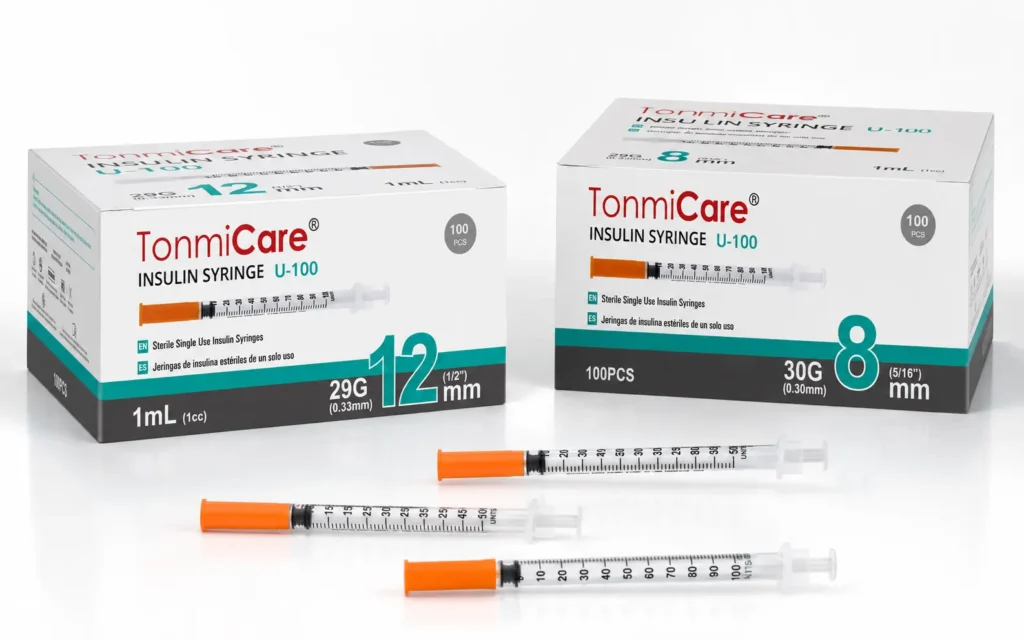
2026 U-100 Size & Procurement Guide
Compare 0.3 mL, 0.5 mL and 1 mL U-100 insulin syringe sizes by unit capacity, graduation markings, needle gauge and length, case packaging, FDA documentation and U.S. warehouse supply.
Editorial disclosure: This article is an educational resource for professional procurement. It does not prescribe insulin, select a syringe for an individual patient or provide medication-specific dose conversions. The prescribed insulin concentration, current product labeling, clinician or pharmacist instructions, organizational policy and applicable law take precedence. Capacity, graduations, needle specifications, regulatory status, inventory and commercial terms must be verified for the exact SKU.
Direct answer
Quick Answer: 30, 50 and 100 U-100 Units
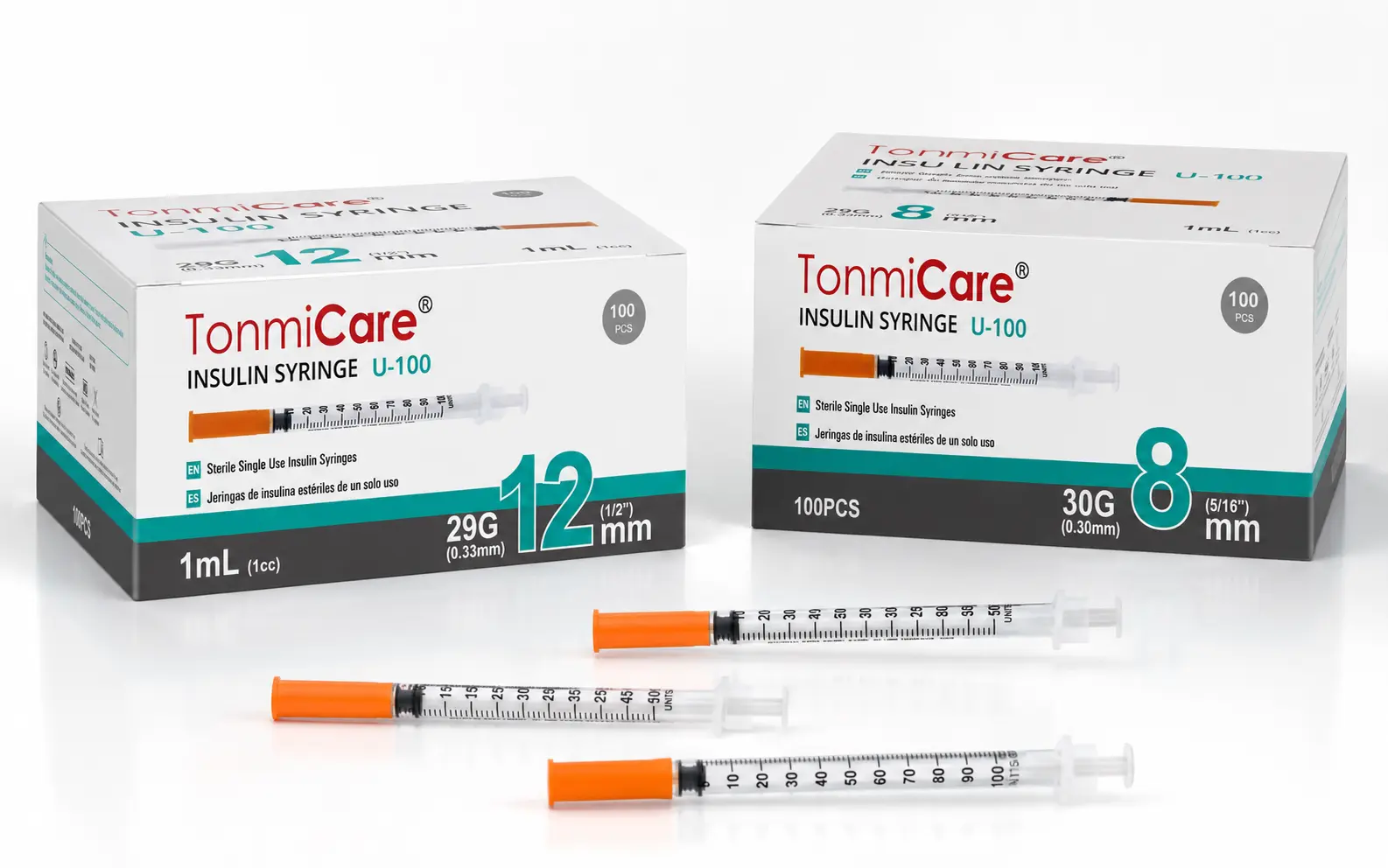
For U-100 insulin, a 0.3 mL syringe holds up to 30 units, a 0.5 mL syringe holds up to 50 units, and a 1 mL syringe holds up to 100 units. The American Diabetes Association identifies these as the most common insulin syringe sizes.[1]
Capacity is only the starting point. Buyers should also verify the concentration scale, graduation interval, needle gauge and length, exact manufacturer REF, sterile packaging, case quantity and current regulatory documentation.
Executive summary
Key Takeaways
- 0.3 mL, 0.5 mL and 1 mL are the common U-100 capacities, corresponding to maximum markings of 30, 50 and 100 units.[1]
- Capacity is not a complete purchase specification. Graduation, gauge, length, concentration scale, REF, packaging and permitted substitutions must also be controlled.
- mL and cc describe volume; units are tied to the labeled insulin concentration and syringe scale. There is no universal mg-to-units conversion.
- Case pricing should be normalized. Compare units per box, boxes per case, freight, remaining shelf life and the exact SKU before comparing quotations.
- FDA clearance, establishment registration and device listing are different concepts. Verify the exact quoted SKU and applicable record.[3]
- U.S. warehouse availability is transaction-specific. Confirm exact REF, quantity, lot, expiration date, processing time and destination before relying on a delivery estimate.
1. U-100 Insulin Syringe Size Chart: 0.3 mL vs 0.5 mL vs 1 mL
The common U-100 insulin syringe capacities are 0.3 mL, 0.5 mL and 1 mL. They may also be written as 0.3 cc or 3/10 cc, 0.5 cc or 1/2 cc, and 1 cc. Because one cubic centimeter equals one milliliter, cc and mL describe the same nominal volume.
| Nominal size | Equivalent notation | Maximum U-100 capacity | Buyer verification |
|---|---|---|---|
| 0.3 mL | 0.3 cc / 3/10 cc | 30 units | Confirm half-unit or one-unit graduation by exact REF, plus gauge, length and package identity |
| 0.5 mL | 0.5 cc / 1/2 cc | 50 units | Confirm concentration scale, graduation, gauge, length, sterile barrier and case pack |
| 1 mL | 1 cc | 100 units | Confirm concentration scale, graduation, exact REF, labeling, UDI/GTIN where applicable and documentation |
Procurement rule: “0.5 mL insulin syringe” describes a product category, not a complete purchase specification. Do not approve or substitute an item by capacity alone.
0.3 mL insulin syringes: up to 30 U-100 units
A 0.3 mL U-100 insulin syringe has a maximum capacity of 30 units. Selected products may use half-unit markings, but graduation is SKU-specific. Review Tonmit’s 0.3 mL insulin syringe options, then confirm the scale, gauge, length, package count and exact REF in the quotation.
0.5 mL insulin syringes: up to 50 U-100 units
A 0.5 mL U-100 syringe has a maximum capacity of 50 units. It is a distinct mid-capacity SKU and should not be treated as an automatic substitute for 0.3 mL or 1 mL inventory. See Tonmit’s 0.5 mL insulin syringe configurations.
1 mL insulin syringes: up to 100 U-100 units
A 1 mL U-100 syringe has a maximum capacity of 100 units. The larger barrel does not establish a particular graduation interval or needle specification. Review Tonmit’s 1 mL insulin syringe range or compare the complete wholesale insulin syringe portfolio.
2. What Does U-100 Mean on an Insulin Syringe?
U-100 means 100 units of insulin per milliliter. The scale on a U-100 syringe is designed so that the printed unit markings correspond to that concentration. The FDA-cleared Promisemed insulin syringe family described in K223453 includes syringes intended for subcutaneous injection of U-40 and U-100 insulin, demonstrating why concentration and the matching scale are part of product identity.[2]
The correct procurement question is not simply “Is this an insulin syringe?” It is:
Which concentration scale is printed on the exact syringe, and does it match the insulin product and approved dispensing or administration workflow?
A U-100 syringe should not be treated as a general-purpose conversion tool for U-40 insulin, U-500 insulin, compounded preparations or another injectable medication. Different concentrations can produce different relationships among milligrams, milliliters and syringe markings.
Why U-40 and U-100 must remain separate SKUs
U-40 contains 40 units per milliliter, while U-100 contains 100 units per milliliter. A barrel marking that is correct for one concentration does not represent the same liquid volume under the other scale. Procurement, storage, picking and dispensing systems should therefore keep concentration-specific products visibly separated and controlled by catalog number and barcode—not by package color alone.
3. mL, cc and Insulin Syringe Units: What Is the Difference?
These terms answer different questions:
- mL (milliliter) describes liquid volume.
- cc (cubic centimeter) is another way to describe the same volume; 1 cc equals 1 mL.
- unit is a potency or dosing measure tied to the labeled insulin concentration and syringe scale.
For a correctly marked U-100 syringe, 1 mL of U-100 insulin contains 100 units. That is why a 0.5 mL U-100 syringe has a 50-unit capacity and a 0.3 mL U-100 syringe has a 30-unit capacity. The arithmetic does not authorize use of that syringe for another concentration or medication.
Why “1 mg on an insulin syringe” has no universal answer
Milligrams measure mass, while syringe markings describe volume or a concentration-specific unit scale. Converting 1 mg to syringe units requires the exact concentration, such as mg/mL, plus the authorized product instructions. FDA has reported dosing errors with compounded injectable semaglutide involving confusion among milligrams, milliliters and “units,” as well as varying product concentrations.[6]
A supplier article should therefore not publish a universal “mg-to-units” chart. Pharmacies and healthcare programs should issue product-specific instructions through qualified clinical and dispensing processes.
4. How Do Insulin Syringe Graduation Markings Differ?
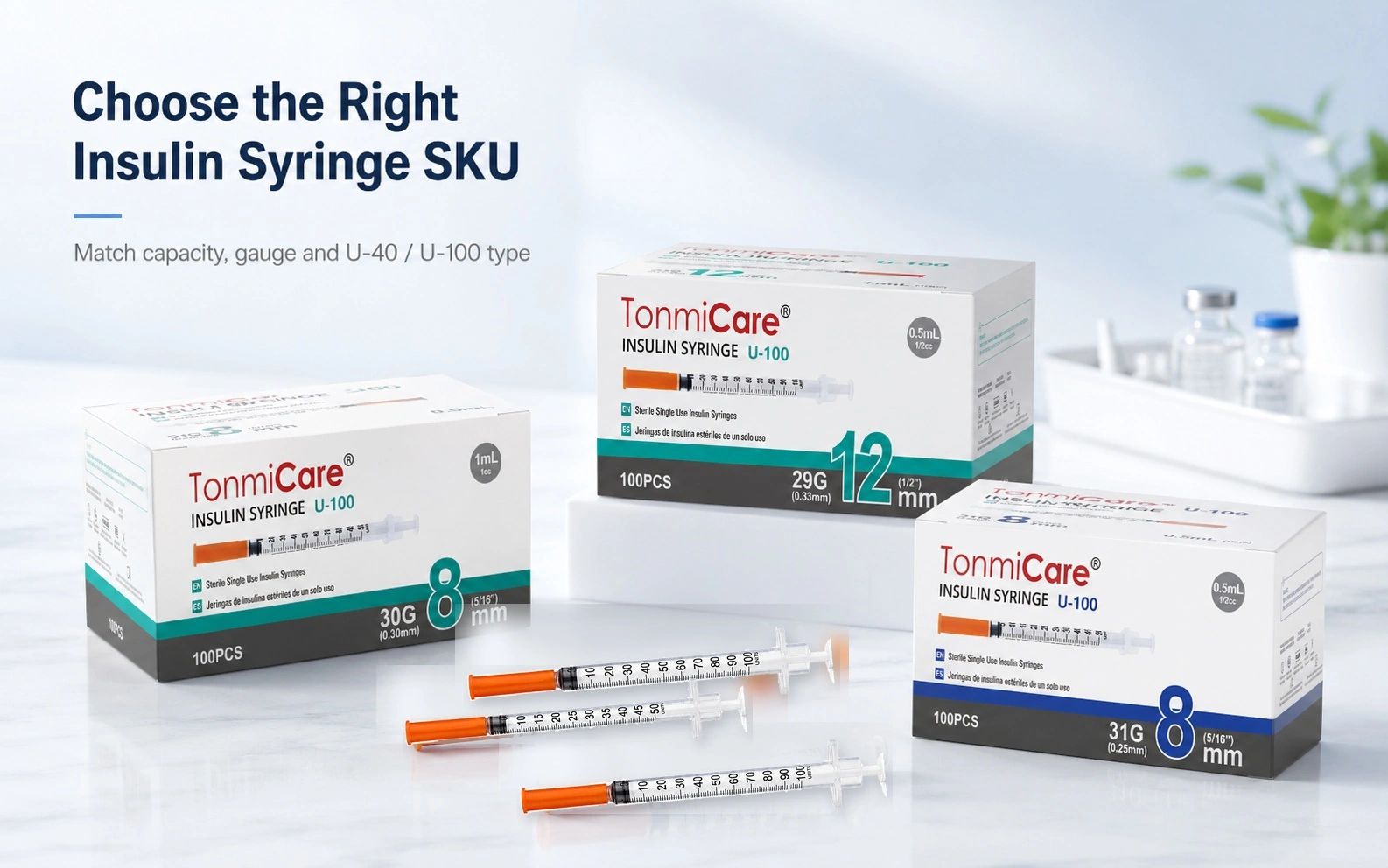
Graduation is the value represented by each scale interval. It determines how the barrel is read and forms part of the exact device specification. Capacity alone does not establish graduation.
Depending on the manufacturer and REF, a 0.3 mL syringe may be available with half-unit or one-unit increments. Other capacities may use one-unit, two-unit or another controlled scale. The buyer should not infer the increment from a stock photograph or a competing brand.
What to request before approving the scale
- a high-resolution, straight-on image of the complete barrel scale;
- the controlled specification stating scale type and graduation interval;
- the exact catalog number or REF;
- current label and instructions for use;
- an approved physical sample from the proposed production configuration;
- confirmation that the artwork, barrel printing and scale will not be substituted without notice.
During incoming inspection, the receiving team should compare the syringe and package against the approved sample and master specification. Scale legibility, missing print, inconsistent line length or a changed increment should enter the organization’s nonconformance process rather than being accepted as a cosmetic variation.
5. How Do Insulin Syringe Needle Gauge and Length Affect the SKU?
Gauge describes needle diameter using an inverse numbering convention: within comparable specifications, a higher gauge number generally indicates a smaller outside diameter. Length describes the needle length and is commonly stated in millimeters and inches. Neither value describes syringe capacity.
A description such as 31G × 8 mm, 0.5 mL, U-100 therefore communicates four separate attributes: gauge, length, capacity and concentration scale. It still does not identify the legal manufacturer, REF, graduation, package count or regulatory record.
| Field | What it describes | Buyer control |
|---|---|---|
| 0.3 / 0.5 / 1 mL | Nominal barrel capacity | Match the approved size and U-100 or other authorized scale |
| 29G / 30G / 31G | Needle gauge | Record gauge with length and REF; never identify by hub color alone |
| 6 / 8 / 12.7 mm | Needle length examples | Confirm the exact length and inch equivalent on label and PO |
| Half-, one- or two-unit scale | Graduation interval examples | Verify by controlled specification; do not generalize by capacity |
| Type / design | Integrated needle and other product-family details | Control the complete REF and approved labeling |
A buyer comparing detachable pen needles should use a separate compatibility framework. See Tonmit’s insulin pen needle sizes and compatibility guide; pen needles and fixed-needle insulin syringes are distinct product categories.
6. Match the Exact Insulin Syringe to the Exact Requirement
The strongest purchasing record connects one quoted item to one controlled specification:
Supplier item → manufacturer REF → concentration scale → capacity → graduation → gauge × length → sterile package → label/UDI → case pack → regulatory mapping
Descriptions such as “U-100 syringe,” “31G insulin syringe” or “0.5 cc syringe” leave important fields unresolved. Before comparing price, require every supplier to quote the same complete requirement and disclose exceptions.
Buyers comparing established brands with alternative wholesale insulin syringe SKUs should compare the exact capacity, graduation, gauge, needle length, sterile packaging, manufacturer REF and applicable regulatory record. A general “equivalent” description is not sufficient evidence of interchangeability.
Fields that should prohibit automatic substitution
- U-40, U-100 or other concentration-specific scale;
- nominal capacity and maximum unit marking;
- graduation interval;
- needle gauge and length;
- fixed-needle and product-family design;
- sterile-barrier format and single-use labeling;
- legal manufacturer, labeler, REF and UDI/GTIN where applicable;
- box, case and pallet hierarchy;
- approved label revision and target market.
Any change to the barrel, needle, scale, lubricant, adhesive, sterilization, package, labeler, manufacturing site or country of origin should enter the buyer’s agreed change-notification and requalification process.
7. Which Insulin Syringe Sizes Should a Pharmacy or Distributor Stock?
There is no universal stocking ratio. The appropriate mix is a formulary, prescribing, dispensing, demand, payer and legal decision. A distributor serving several customer types may require all three capacities, while an independent pharmacy may need a smaller controlled set.
Build the size mix from demand evidence
- historical dispensing or sales by exact size and REF;
- U-100, U-40 or other specifically authorized demand;
- graduation requirements, including approved half-unit demand;
- needle gauge and length by prescription or program;
- customer channel: retail pharmacy, clinic, long-term care or distributor;
- box and case movement by location;
- payer, formulary, contract and private-label requirements;
- substitution rules and nonreturnable special orders;
- remaining shelf-life policy and expiration exposure.
| Inventory role | Planning question | Recommended control |
|---|---|---|
| Core size SKU | Which approved size and needle specification has recurring demand? | Set reorder point, safety stock and supplier allocation by REF |
| Adjacent capacity | Is 0.3, 0.5 or 1 mL demand sufficient for a separate stocked item? | Maintain a unique barcode and block capacity substitution |
| Fine-graduation SKU | Is a specific half-unit or one-unit scale formally required? | Verify graduation on the syringe, label, catalog record and PO |
| Special-order SKU | Can low-volume demand be supplied without routine local inventory? | Define lead time, cancellation and return status before ordering |
| Private-label SKU | Does predictable volume justify artwork and packaging MOQ? | Complete regulatory, quality and labeler-role review first |
For a broader vendor-onboarding process, use Tonmit’s wholesale insulin syringe supplier evaluation checklist.
8. How to Compare Insulin Syringe Price per Case
Buyers comparing insulin syringe price per case should normalize the complete packaging hierarchy before comparing quotations. Two products with the same capacity and needle specification may still have different operating costs because of units per box, boxes per case, carton dimensions, freight, barcode level, sterile-barrier design and remaining shelf life.
A low headline case price is not necessarily the lowest usable cost if the quote covers a different graduation, shorter remaining shelf life, a smaller case pack or an unapproved substitute.
Commercial packaging fields
- syringes per dispenser box;
- boxes per shipping case and syringes per case;
- cases per pallet, pallet dimensions and total weight;
- individual sterile package format and opening method;
- box and case dimensions, gross weight and cube;
- catalog number, GTIN/UDI and barcode location where applicable;
- lot, manufacture and expiration-date format;
- labeled shelf life and minimum remaining shelf life at shipment;
- storage and transport conditions;
- country of origin and current artwork revision.
The K223453 public summary describes 0.3 mL, 0.5 mL and 1 mL products within the submitted family and reports ethylene oxide sterilization with a sterility assurance level of 10−6 and five-year shelf-life testing for that family.[2] Those attributes must not be transferred to an unrelated brand, REF or private-label configuration without matching controlled evidence.
Receiving checks for every shipment
- Match the manufacturer REF and supplier item to the purchase order.
- Confirm U-100 or other authorized scale, capacity, graduation, gauge and length.
- Verify box count, case count, lot and expiration date.
- Inspect labels, barcode, sterile packages and shipping damage.
- Quarantine any unapproved substitution, mixed specification or labeling discrepancy.
- Record the lot-to-inventory and lot-to-customer relationship required for complaints and field actions.
9. How to Verify FDA-Cleared Insulin Syringe SKUs
Regulatory language must match the underlying record. For products covered by a cleared 510(k), the appropriate term is generally FDA-cleared, while establishment registration and device listing are separate requirements. FDA states that registration and listing do not denote approval, clearance or authorization and that the agency does not issue registration certificates to medical-device facilities.[3]
Tonmit can support review of selected FDA-cleared insulin syringe options, but the manufacturer, exact REF, model coverage, current U.S. label and applicable record should be reconfirmed for each quotation. Avoid unsupported phrases such as “FDA-approved warehouse” or “510(k)-certified company.”
For an insulin syringe sold in the United States, request a SKU-specific identity sheet that identifies, as applicable:
- legal manufacturer and manufacturing site;
- brand owner, labeler, distributor and initial importer roles;
- FDA product code and device classification;
- applicable 510(k) and models or REFs covered;
- device listing and UDI/GUDID information where applicable;
- current U.S. label and instructions for use;
- concentration scale, capacity, graduation, gauge and length;
- ISO 13485 certificate and certified scope;
- sterilization, packaging, biocompatibility, performance and shelf-life evidence appropriate to the SKU;
- complaint, recall, nonconformance and change-notification processes.
FDA’s Quality Management System Regulation became effective February 2, 2026 and incorporates ISO 13485:2016 by reference into the amended 21 CFR Part 820 framework.[8] A current ISO 13485 certificate can support supplier review, but it does not replace device-level clearance, listing, labeling or product-identity verification.
FDA’s UDI system is intended to identify devices through distribution and use. Depending on the label, production information may include lot or batch, expiration date, manufacturing date or serial number.[7] Buyers should decide which fields must be captured at receiving and downstream distribution.
Tonmit program review
Applying the Size Framework to Tonmit’s Wholesale Program
Tonmit’s current wholesale page presents 0.3 mL, 0.5 mL and 1 mL insulin syringe paths with selected 29G, 30G and 31G needle configurations. Its primary 1 mL U-100 range includes selected 30G × 8 mm and 31G × 8 mm options, while additional capacities and needle combinations are reviewed by SKU and RFQ.[9]
Tonmit’s detailed supplier-evaluation guide maps current priority 1 mL configurations to Promisemed REFs and public FDA records, and describes applicable U.S. warehouse support in Hudson, Ohio. That mapping should still be reconfirmed for the exact item, label revision, inventory lot, target market and transaction.[10]
Recommended RFQ wording: “Please identify the legal manufacturer, REF, concentration scale, capacity, graduation interval, needle gauge and length, applicable FDA record, current U.S. label/UDI, box and case quantity, remaining shelf life and available U.S. inventory for the exact item quoted.”
Tonmit can review standard packaging, bulk quantities, case pricing, documentation, U.S.-warehouse-supported fulfillment and private-label requirements. Final claims should use the exact regulatory term supported by the applicable product record, with SKU-level documentation supplied during quotation and onboarding.
10. Bulk Insulin Syringes from a U.S. Warehouse
Selected bulk insulin syringe SKUs may be available from Tonmit’s U.S. warehouse for domestic order processing and fulfillment. Buyers looking for bulk syringes ready to ship from a U.S. warehouse should confirm availability by exact REF, capacity, graduation, gauge, needle length, requested quantity, lot and remaining shelf life.
Warehouse location alone does not prove that every size is currently available. Inventory, processing time, carrier service and delivery estimates are confirmed for the selected SKU, transaction and destination.
Convert “in stock USA” into measurable questions
- Which exact REFs and sizes are available today?
- What quantity is available to promise, allocated or reserved?
- Which lots and expiration dates will ship?
- What is the minimum remaining shelf life at shipment?
- What are the order cutoff, warehouse processing and carrier handoff times?
- Are box, case and pallet orders supported for the selected SKU?
- What happens if the ordered size becomes backordered?
- Is any alternate capacity, gauge, length or product family prohibited without written approval?
- What is the upstream production and replenishment lead time?
- How will the supplier communicate a shortage, quality hold or product change?
A useful delivery estimate should name the selected REF, confirmed quantity, destination ZIP code, processing window, carrier service and expected delivery range. “Fast shipping” and “next-day delivery” should not be used without inventory- and destination-specific support.
11. Private-Label Insulin Syringes: What Changes?
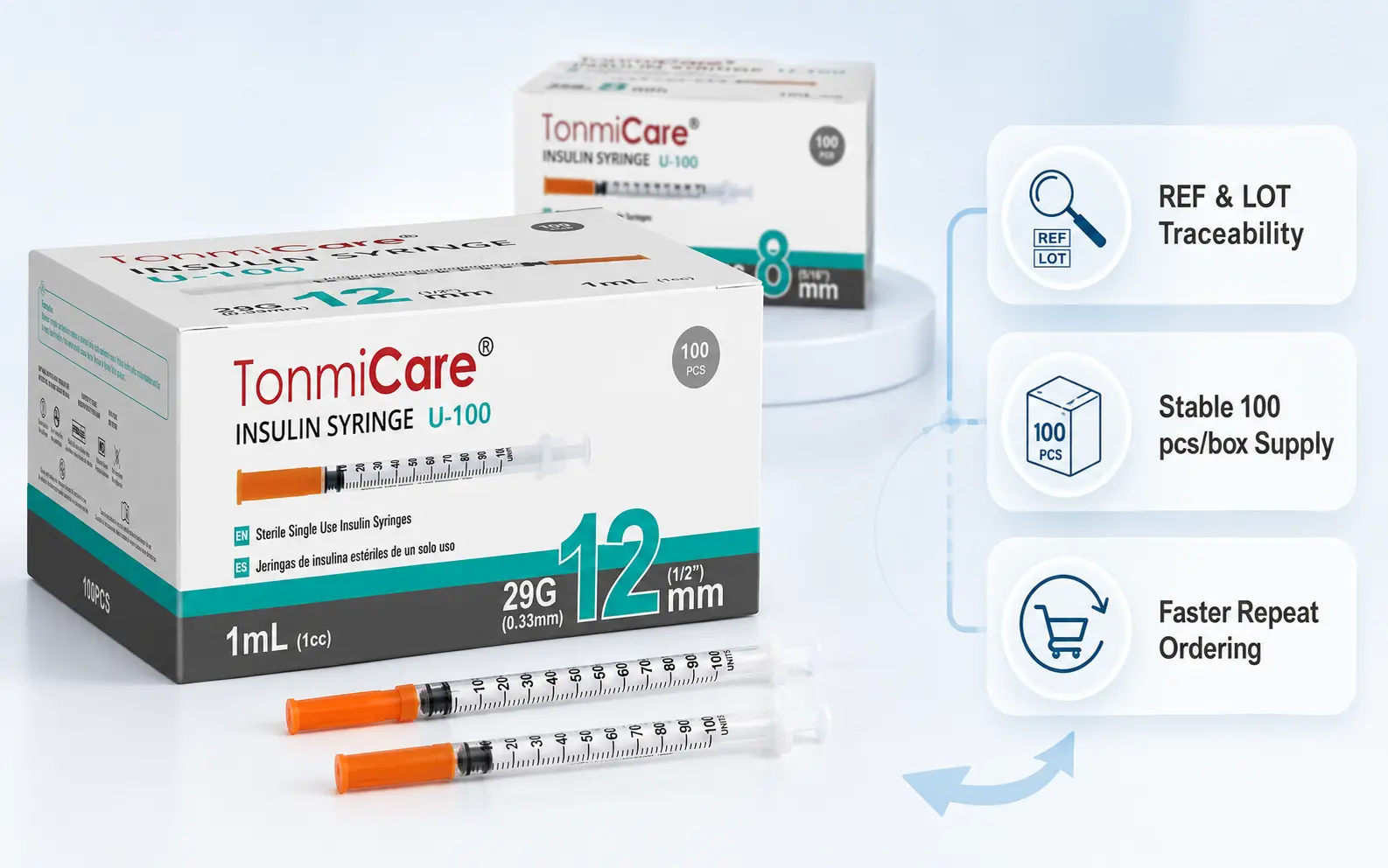
Private label is not only a logo or box-color change. Depending on the arrangement, target market and labeling structure, it can affect labeler identity, UDI/GUDID responsibilities, device listing analysis, artwork control, complaint exchange, regulatory reporting and recall communication.
Before approving private-label artwork, define:
- legal manufacturer, labeler, importer and distributor identities;
- exact device family and REFs covered;
- who owns and maintains UDI/GUDID records where applicable;
- authorized claims and concentration-scale statements;
- how capacity, graduation, gauge and length appear on every package level;
- lot, expiration, country-of-origin and contact information;
- artwork approval, revision control and obsolete-package disposition;
- complaint forwarding, Medical Device Reporting where applicable and escalation time;
- recall, correction and customer-notification responsibilities;
- product MOQ, packaging MOQ, setup cost, lead time and minimum remaining shelf life;
- ownership of unused or obsolete packaging inventory.
A standard, documented U.S.-stock SKU may be the more practical starting model for demand testing. A private-label program becomes more defensible when volume, regulatory roles, label control and lifecycle responsibilities are mature enough to support it.
12. Insulin Syringe RFQ Checklist
A complete request for quotation should make competing offers directly comparable. Copy the fields below into the RFQ and require suppliers to identify any exception.
| RFQ field | Required detail | Buyer status |
|---|---|---|
| Insulin scale | U-100, U-40 or another specifically authorized scale | Required / no substitution |
| Capacity | 0.3 mL, 0.5 mL or 1 mL and maximum unit marking | Required |
| Graduation | Half-unit, one-unit, two-unit or exact controlled interval | Verified by REF |
| Needle | Exact gauge × length, fixed-needle design and product family | No substitution |
| Commercial pack | Individual pack, units/box, boxes/case, cases/pallet and dimensions | Confirmed |
| Product identity | Manufacturer, labeler, REF, UDI/GTIN, lot and expiration format | Reconciled |
| Documentation | FDA mapping, label/IFU, QMS scope, sterilization, shelf life and requested quality files | Accepted / gap |
| Supply | MOQ, U.S. warehouse inventory, destination ZIP, processing time, freight, case price and replenishment | Transaction-specific |
| Private label | Roles, artwork, packaging MOQ, UDI/listing analysis, complaint and recall controls | Standard / OEM |
Copy-ready RFQ brief
Required product: [U-100/U-40] insulin syringe; [0.3/0.5/1] mL; [graduation] scale; [gauge × length]; [fixed-needle/design requirement]; [units per box]; [boxes per case]; annual volume [quantity]; requested case quantity [quantity]; delivery ZIP code [ZIP]; minimum remaining shelf life [requirement]; standard or private-label packaging [status]; required FDA, labeling, quality and logistics documents [list]. No substitution without written approval.
Questions buyers and searchers ask
Frequently Asked Questions About Insulin Syringe Sizes
What are the three common insulin syringe sizes?
The common sizes are 0.3 mL, 0.5 mL and 1 mL. For U-100 insulin, they hold up to 30, 50 and 100 units, respectively.[1] Graduation, gauge and needle length still vary by SKU.
How many units are in a 0.3 mL U-100 insulin syringe?
A correctly marked 0.3 mL U-100 insulin syringe holds up to 30 units. Confirm whether the exact REF uses half-unit, one-unit or another graduation.
How many units are in a 0.5 mL U-100 insulin syringe?
A correctly marked 0.5 mL U-100 syringe holds up to 50 units. Buyers must still verify the concentration scale, graduation, gauge, length and catalog number.
How many units are in a 1 mL U-100 insulin syringe?
A 1 mL U-100 insulin syringe holds up to 100 units. This relationship is specific to U-100 insulin and is not a universal conversion for every injectable product.
Can U-40 and U-100 insulin syringes be substituted?
They should not be treated as interchangeable. The printed scale is designed for a specific insulin concentration. Follow the prescription, labeling and authorized clinical or pharmacy instructions, and control each concentration as a separate SKU.
Does every 0.3 mL insulin syringe have half-unit markings?
No. Selected 0.3 mL products may have half-unit markings, while others may use one-unit or another controlled interval. Verify the exact syringe, specification, label and approved sample.
How many syringe units is 1 mg?
There is no universal conversion. Milligrams can be converted only when the exact medication concentration and authorized instructions are known. FDA has reported dosing errors involving confusion among milligrams, milliliters and syringe units for compounded injectable semaglutide.[6]
How should buyers compare insulin syringe price per case?
Confirm the exact SKU, syringes per box, boxes per case, freight, remaining shelf life and destination. Divide the landed case cost by the confirmed syringes per case, then account for any expiry, shortage or relabeling risk.
Are bulk insulin syringes available from a U.S. warehouse?
Selected SKUs may be available from Tonmit’s U.S. warehouse. Availability must be confirmed by exact REF, quantity, lot, expiration date and destination at the time of quotation.
Does FDA registration mean an insulin syringe is FDA cleared?
No. FDA states that establishment registration and device listing do not denote approval, clearance or authorization.[3] Verify the applicable 510(k), exact models, current labeling and responsible organizations.
13. Conclusion: Buy a Controlled SKU, Not Only a Syringe Size
The answer to the headline question is simple: for U-100 insulin, the common 0.3 mL, 0.5 mL and 1 mL syringes hold up to 30, 50 and 100 units. The correct B2B purchase decision is more detailed.
A pharmacy, clinic or distributor should approve a fully identified SKU supported by:
- the correct concentration scale and capacity—U-100, U-40 or another specifically authorized configuration;
- a controlled physical specification—graduation, gauge, length, fixed-needle design and sterile barrier;
- verified product identity—manufacturer, labeler, REF, current labeling and applicable FDA pathway;
- commercial control—box, case and pallet hierarchy, barcode, shelf life, MOQ and substitution rules;
- supply continuity—confirmed inventory, lot status, processing time, replenishment and shortage communication;
- lifecycle control—traceability, complaints, field actions, recalls and change notification.
When these fields are fixed before price comparison, the buyer can reduce scale mismatches, uncontrolled substitutions, receiving errors, documentation gaps and avoidable inventory cost. The result is a more reliable comparison of insulin syringe price per case and a clearer decision on U.S. warehouse replenishment.
U.S. inventory · case pricing · documentation
Request Current U.S. Inventory and Insulin Syringe Case Pricing
Tonmit supports pharmacies, clinics and medical distributors reviewing 0.3 mL, 0.5 mL and 1 mL insulin syringe options, selected FDA-cleared SKUs, packaging formats, documentation, private label and U.S.-warehouse-supported fulfillment.
Share the required concentration scale, capacity, graduation, gauge × length, case quantity, annual volume, destination ZIP code, package format and document list. Tonmit will confirm available product paths, exact REF, units per case, current inventory and transaction-specific terms.
Final capacity, scale, graduation, needle specification, FDA mapping, availability, case quantity, documentation, lead time and private-label feasibility are confirmed for the selected REF, transaction and target market.
References
- American Diabetes Association Professional Practice Committee. “7. Diabetes Technology: Standards of Care in Diabetes—2026.” The guideline identifies 1 mL, 0.5 mL and 0.3 mL as the most common syringe sizes, with maximum U-100 capacities of 100, 50 and 30 units. Diabetes Care.
- U.S. Food and Drug Administration. “K223453: Insulin Syringe, Promisemed Hangzhou Meditech Co., Ltd.” The public summary describes the intended U-40 and U-100 use, submitted capacities, needle ranges, sterilization and shelf-life testing for the identified family. FDA 510(k) Summary.
- U.S. Food and Drug Administration. “Important Reminders about Registration and Listing.” FDA.
- U.S. Food and Drug Administration. “FDA Alerts Health Care Providers, Compounders and Patients of Dosing Errors Associated with Compounded Injectable Semaglutide Products.” FDA.
- U.S. Food and Drug Administration. “UDI Basics.” FDA.
- U.S. Food and Drug Administration. “Quality Management System Regulation (QMSR).” Effective February 2, 2026. FDA.
- Tonmit. “Wholesale Insulin Syringes for Pharmacies, Clinics & Distributors.” Capacity, needle, package and RFQ information reviewed . Tonmit.
- Tonmit. “How U.S. Pharmacies Should Evaluate a Wholesale Insulin Syringe Supplier.” SKU mapping, public-record review and U.S.-warehouse-supported fulfillment information reviewed . Tonmit Buyer Guide.