
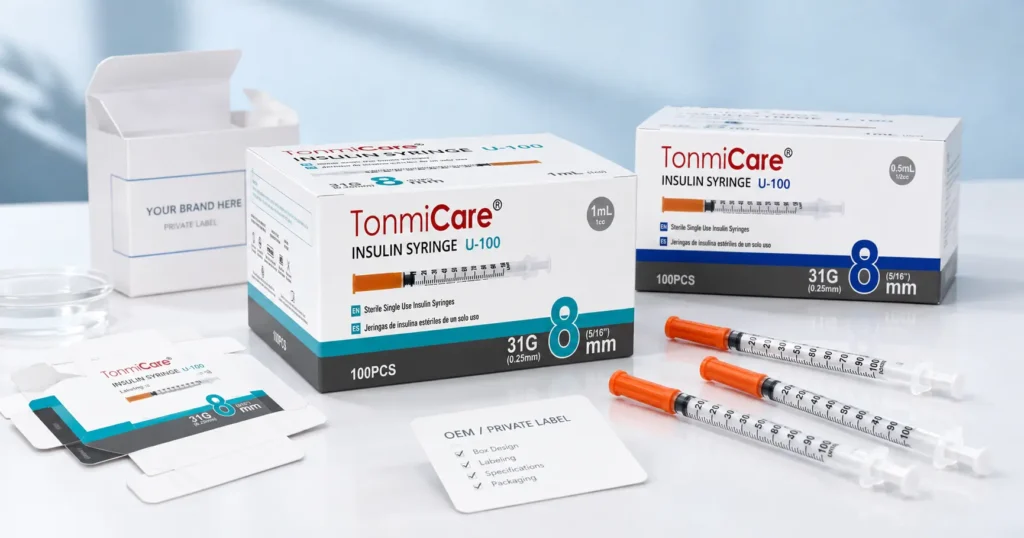
Private Label & OEM Guide for U.S. Distribution
A practical sourcing framework for medical distributors, importers and private-label program teams evaluating insulin syringe specifications, labeling roles, MOQ, quality controls and U.S. replenishment.
Scope: This is a B2B sourcing resource, not legal advice or clinical guidance. Obligations depend on the exact device, labeling, claims, parties, activities and target market. Obtain qualified regulatory review before commercial distribution. Tonmit is the company and website operator; TonmiCare is the product brand used for selected supply programs.
Direct answer
How Should Distributors Source Private Label Insulin Syringes?
Start with an exact, supportable insulin syringe SKU—not a logo file. Then document which organization is the manufacturer, labeler, relabeler, repackager, importer and distributor as applicable; approve controlled labeling and identifiers; separate product and print MOQs; qualify the technical and quality records; and connect the approved production lot to complaint handling, change control and replenishment. A customer-brand box is only one part of the program.
Executive summary
Key Takeaways
- Private label, OEM and custom specification are different scopes. A brand change and a device-design change should not share one approval path, MOQ or launch estimate.
- Use a documented production platform where possible. Changing the barrel, graduation, needle, sterile barrier or intended use creates additional technical and regulatory work.
- Assign U.S. roles before approving artwork. Actual activities—not contract labels alone—shape registration, listing, labeling, UDI, import and quality responsibilities.[1]
- Request a layered MOQ. Device production, printed components, identifiers and domestic releases can each have a different minimum.
- Registration is not product approval. FDA states that registration and listing do not denote approval, clearance or authorization.[2]
- U.S. stock must be planned. Customer-brand inventory becomes releasable only after the exact SKU is produced, accepted, imported where applicable, received and allocated.
1. Define the Private-Label Project Scope
A private-label insulin syringe program places a finished device into commercial distribution under a customer-selected brand or controlled labeling arrangement. The marketed identity can include the brand, legal-entity statement, concentration scale, capacity, graduation, gauge and length, reference number, lot and expiration presentation, sterile and single-use information, UDI, barcode, instructions and complaint contact.
Before requesting pricing, classify the project:
| Project scope | Typical request | Review required |
|---|---|---|
| Distribution identity | Add a distributor name and contact details without otherwise changing the labeling | Permitted wording, responsibility allocation and 21 CFR 801.1 presentation |
| Customer-brand label | Change the brand, label content, REF, artwork or package identity | Relabeler/labeler status, UDI/GUDID, listing and document-control impact |
| Custom packaging | Change the box, IFU, quantity, case or barcode hierarchy | Packaging, labeling, identifiers, shelf-life support and logistics controls |
| Custom device specification | Change capacity, graduation, needle, materials, claims or intended use | Formal design and regulatory assessment; additional verification, validation or premarket work may be required |
This distinction prevents a common commercial failure: a buyer requests “our logo” while the design brief also changes needle length, graduation or claims. Those changes affect far more than print setup and should be evaluated separately.
2. Select a Supportable Platform and Freeze the SKU
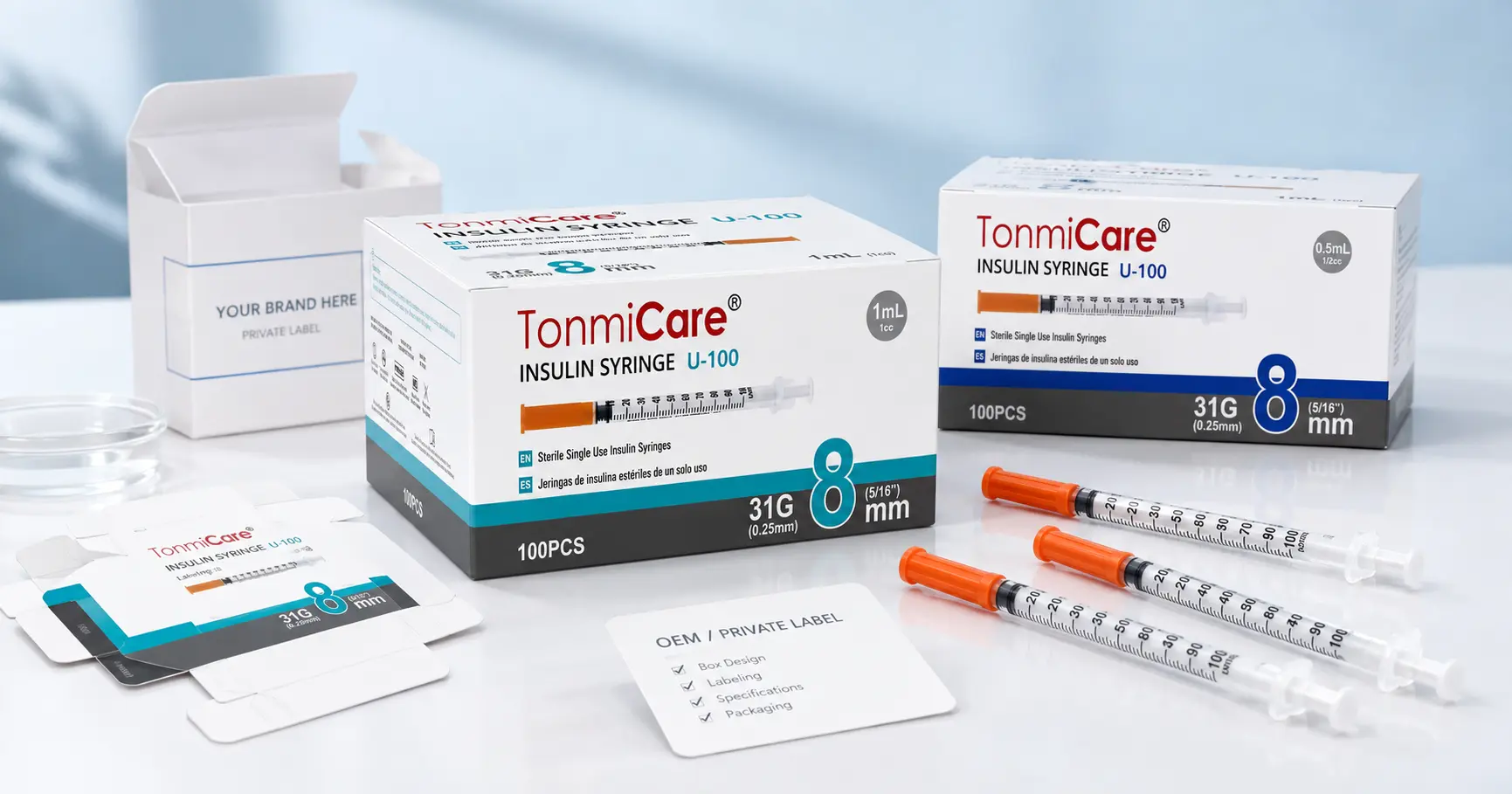
The most efficient starting point is usually a documented, market-appropriate platform. Review the current wholesale insulin syringe range and identify the closest supportable specification before commissioning customer-brand artwork. Public product examples are starting points only; private-label feasibility, market status, MOQ and availability remain specific to the final SKU.
Standard TonmiCare Supply
Use the existing brand and approved packaging to test demand with fewer project variables.
Customer-Brand Platform
Keep the core device within a qualified specification while reviewing the new label, package and commercial identity.
Custom Specification
Treat requested device or performance changes as a technical-development project, not a routine print job.
The controlled specification should state:
- concentration scale, such as U-100 or U-40;
- nominal capacity and graduation;
- needle gauge × length and attachment;
- materials and documented configuration;
- sterilization method and sterile barrier;
- shelf life and storage conditions;
- unit, box, case and pallet quantities;
- target market, claims and languages;
- legal manufacturer, REF and artwork revision;
- inspection and lot-release requirements.
Do not use U-40 or U-100 as a needle-size description. Concentration scale, capacity, graduation, gauge and length are separate controlled fields. FDA’s recognition record for ISO 8537 addresses sterile, single-use syringes intended for insulin injection.[9]
Decision rule
If the change affects the syringe, sterile barrier, labeling content, intended use, performance claim, pack quantity or identifier, record it as a controlled project change—not an informal artwork note.
3. Map U.S. Regulatory Roles Before Artwork
Terms such as “factory direct” and “full-service OEM” do not assign legal duties. FDA distinguishes manufacturers, contract manufacturers, relabelers, repackagers, specification developers, initial importers and domestic distributors according to their activities.[1] One organization may perform more than one role.
| Activity | Role to assess | Question to resolve |
|---|---|---|
| Manufactures the finished syringe | Manufacturer or contract manufacturer | Who controls production, release, QMSR processes, sterilization oversight and manufacturing changes? |
| Develops specifications and arranges manufacturing | Specification developer | Who owns design inputs, risk files, verification and regulatory decisions? |
| Changes labeling for own-name distribution | Relabeler and potentially UDI labeler | Who controls artwork, UDI, GUDID, listing, translations and revisions? |
| Changes immediate or retail packaging | Repackager | Does the activity affect the sterile barrier, shelf life, identifiers or release? |
| First furthers marketing after foreign manufacture | Initial importer | Who performs the applicable importer obligations? |
| Distributes an unchanged U.S.-market device | Domestic distributor | Who handles complaints, field actions and downstream traceability? |
Do not overstate the private-label 510(k) exemption
21 CFR 807.85(b) describes a limited premarket-notification exemption for a distributor placing a device into commercial distribution for the first time under its own name, and for a repackager that places its own name on a device without changing other labeling or otherwise affecting the device, when the device predates May 28, 1976 or another person filed the premarket notification.[3] This provision does not by itself decide registration, listing, labeling, UDI, import, quality-system or postmarket responsibilities. Apply it only after review of the exact product and activities.
4. Control Label Artwork, UDI and GUDID
FDA’s general device-labeling requirements state that the label must include the name and place of business of the manufacturer, packer or distributor. When the named firm is not the manufacturer, the relationship should be qualified with wording such as “Manufactured for” or “Distributed by.”[4]
For UDI purposes, FDA defines the labeler by who causes a label to be applied or modified for commercial distribution. Adding only a distributor’s name and contact information, without other label changes, is not a modification for determining whether that distributor is the UDI labeler. In other cases, the labeler may be the manufacturer, specification developer, repackager or relabeler.[5]
Approve controlled information at every applicable level: sterile package, dispenser box, IFU, case label, pallet label and electronic catalog. The checklist should cover legal entities, REF, scale, capacity, graduation, gauge × length, sterile and single-use information, lot/expiry format, quantity, complaint contact, country of origin, language, UDI/AIDC and barcode data. Compare the encoded data, human-readable text and GUDID record; a visual PDF approval alone is not enough.
5. Separate Every Layer of the MOQ
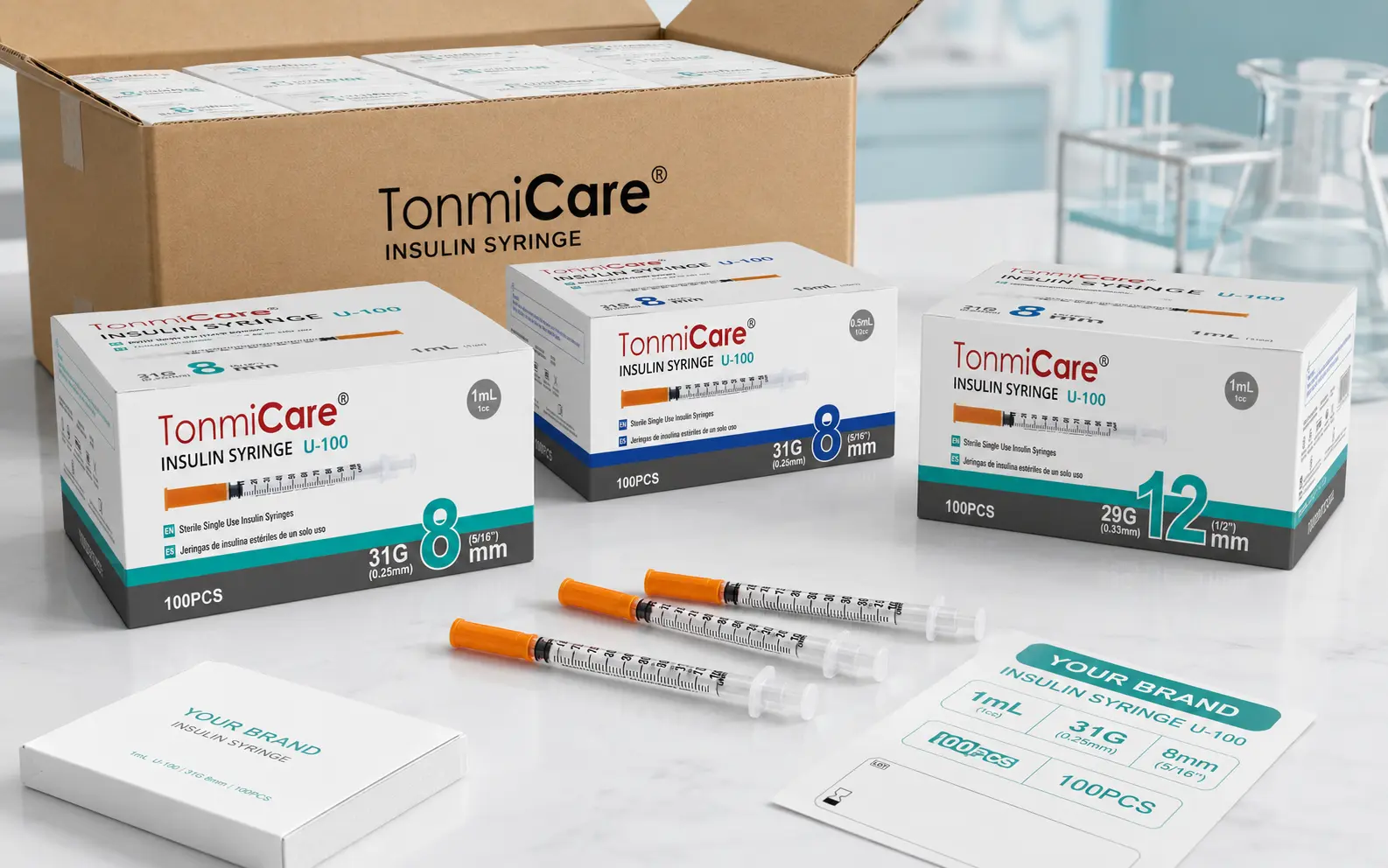
There is no universal MOQ for private label insulin syringes. The finished device, printed sterile package, box, IFU, master case, identifier setup and warehouse release can each have a different economical minimum. Request a breakdown instead of a single unexplained number.
| MOQ layer | Main driver | Buyer question |
|---|---|---|
| Device production | Line setup, material lot, assembly campaign and release testing | What is the minimum for the exact frozen specification? |
| Sterilization or validated batch | Validated load and release process | Can the project use a qualified campaign or require a dedicated lot? |
| Printed unit package | Printing plate and roll minimum | Does customer branding extend to the sterile package? |
| Box, IFU and case | Paperboard, die line, language and revision | Who owns unused or obsolete printed components? |
| UDI/GTIN and data | Issuing-agency account, identifiers and data maintenance | Who owns each identifier and maintains the record? |
| U.S. warehouse release | Case pack, pick rules and freight economics | What is the minimum domestic release after receipt? |
Request four quantities in every proposal: minimum first production, economical repeat production, minimum packaging reprint and minimum U.S. warehouse release. Also define overrun tolerance and who pays for unused printed materials after an artwork revision or program cancellation.
6. Use Staged Approvals and a Dependency-Based Timeline
A generic sample does not approve a private-label production configuration. Use staged controls:
- Reference sample: confirm the core SKU, scale, graduation, gauge, length and package format.
- Controlled artwork proof: compare text, symbols, legal entities, REF, quantity and barcode data with the specification.
- Physical packaging proof: check print, die cut, barcode scan and package hierarchy.
- First article: review the final device and printed components together.
- Golden sample: retain a signed reference linked to the approved specification and artwork revision.
- Production-lot release: compare the actual lot with the approved standard and agreed release records.
Project timing begins when the inputs are complete—not when a logo is first emailed. Ask for a milestone schedule covering feasibility, role review, specification freeze, artwork and identifier approval, samples, production, release, import and warehouse receiving. Each stage should show its dependency, approver and buyer-response deadline; avoid an unsupported universal day count.
7. Qualify the Exact Product, Sites and Records
A folder of unrelated certificates is not a private-label technical file. Documentation should match the legal entities, sites, device, REF, label version and target market. FDA’s Quality Management System Regulation became effective on February 2, 2026 and incorporates ISO 13485:2016 by reference for covered finished-device manufacturers.[6] An ISO 13485 certificate can support supplier qualification, but it does not authorize a specific product or customer-brand configuration.
Product and Market
- signed specification and approved packaging levels;
- classification, product code and applicable premarket evidence;
- registration, listing and UDI/GUDID records as applicable;
- sterilization, packaging and shelf-life support;
- inspection criteria and agreed lot-release records.
Entities and Quality
- legal manufacturer and relevant production, packaging and sterilization sites;
- current ISO 13485 certificate with holder, site, scope and validity;
- artwork, translation, barcode and identifier approvals;
- complaint, reporting, recall and change-notification procedures;
- signed quality agreement and responsibility matrix.
Claim control: FDA does not issue registration certificates for device facilities, and registration/listing does not denote approval, clearance or authorization.[2] Avoid “FDA certified,” FDA logos or certificate-style graphics in customer-brand artwork and sales materials.
8. Connect Complaints, Field Actions and Change Control
The quality agreement should connect the customer-facing complaint channel with the organization capable of investigating the device and lot. Define required complaint data, escalation time, sample return, investigation ownership, medical-device-reporting assessment where applicable, trend review, field-action authority, downstream traceability and record access.
FDA’s corrections and removals framework requires manufacturers and importers to report certain actions taken to reduce a risk to health or remedy a legal violation that may present a risk to health, while maintaining records for other corrections and removals.[7] The agreement should identify who performs the assessment and how the brand owner supplies customer and distribution data.
Advance notice and an impact assessment should apply to changes in:
- manufacturer, production, sterilization or packaging site;
- materials, dimensions, graduations, needle or lubricant;
- manufacturing, inspection, sterilization or release process;
- sterile barrier, IFU, symbols, claims or translations;
- REF, UDI-DI, GTIN, GUDID or listing information;
- shelf life, storage or transport configuration;
- regulatory status or certification scope;
- complaint, recall or field-action contacts.
FDA guidance explains that manufacturers must assess whether certain labeling, technology, engineering, performance or material changes could significantly affect safety or effectiveness or constitute a major intended-use change and therefore require a new 510(k).[8] The project agreement should name who documents that assessment and who has final release authority.
9. Treat U.S. Warehousing as a Replenishment Program
A qualified customer-brand program can use planned U.S. storage and domestic releases, but U.S. warehousing does not mean the private-label SKU is immediately available. The exact inventory must first complete production, release, import where applicable, receiving and customer allocation.
Launch inventory
The first approved lot requires additional time for artwork, identifiers, manufacturing, release and initial warehouse receiving.
Replenishment inventory
Repeat production feeds planned U.S. stock against agreed forecasts, safety stock, remaining shelf life and release quantities.
For each domestic release, confirm the customer-brand REF, unallocated cases, lot, expiry, remaining shelf life, ship-from location, processing estimate, freight method and destination. Tonmit’s U.S. warehouse-supported fulfillment is SKU- and order-specific; a warehouse location is not a same-day or next-day guarantee.
A staged launch may use standard TonmiCare inventory while the customer-brand program proceeds, but the two brands require separate item masters, purchase orders, lots and downstream traceability. Do not substitute one brand for another without documented buyer approval.
10. Compare Total Program Cost, Not Unit Price Alone
A low ex-factory unit price can create a higher program cost if it requires excessive printed-material inventory, produces short-dated stock or leaves identifier and regulatory work undefined.
Total program cost = device production + setup and printed components + validation and documentation + identifiers and data + release testing + freight/import + warehousing + obsolete stock risk + ongoing quality administration
Request separate pricing for setup and proofs, first and repeat device orders, printed-material MOQ and overrun, samples and validation, translation and data work, freight/import, receiving and storage, domestic releases, artwork changes, obsolete materials and cancellation terms.
11. Determine Whether the Project Fits Tonmit’s Program
Tonmit is the company and website operator. TonmiCare is the product brand used for selected medical-supply programs. Medical distributors, importers, private-label brands and qualified pharmacy groups developing recurring branded supply programs can use Tonmit’s Private Label & OEM support pathway. Standard supply and replenishment should use the wholesale program instead.
A public product page or marketing image does not confirm that a customer-brand version is available, market-appropriate or held in U.S. stock. A suitable inquiry begins with an existing platform and lists every requested change.
Private-label feasibility request
Include these fields in the RFQ
- buyer legal name, website, country and business role;
- target market and intended customer type;
- requested brand and required packaging levels;
- manufacturer REF or complete syringe specification;
- requested device, claim or packaging changes;
- proposed manufacturer, labeler, distributor and importer roles;
- UDI/GTIN ownership and GUDID responsibility;
- initial quantity and annual forecast by SKU;
- required qualification and lot-release records;
- remaining shelf-life requirement;
- quality-agreement and change-notification expectations;
- factory-direct, U.S.-warehouse or hybrid delivery preference;
- destination and target launch window.
12. Frequently Asked Questions
Who is this private-label insulin syringe guide for?
It is primarily for medical distributors, importers, private-label brands and qualified pharmacy groups planning recurring branded supply—not for ordinary pharmacy spot purchases of standard inventory.
Are private label and OEM insulin syringes the same?
Not always. Private label usually emphasizes brand and labeling, while OEM may also refer to contract manufacturing or custom development. Define the device, package, labeling and each party’s activities instead of relying on either term.
What is the MOQ for private label insulin syringes?
There is no universal MOQ. Confirm separate minimums for the finished device, validated batch, printed unit package, box/IFU, master case, identifier setup and U.S. warehouse release.
Can a distributor simply add its logo to an existing syringe box?
Not as an informal production instruction. The exact label change, legal-entity statement, UDI/GUDID impact, listing, controlled records and approvals must be reviewed before printing.
Does FDA registration authorize a private-label device?
No. FDA states that registration and listing do not denote product approval, clearance or authorization. Verify the exact device, relevant premarket status, legal entities, listing and labeling arrangement.
Can the needle gauge or length change during private labeling?
That is a device-specification change rather than branding alone. It requires technical, risk and regulatory assessment and may require additional verification, validation or premarket review.
Can customer-brand insulin syringes use Tonmit-supported U.S. warehousing?
Potentially, after the exact program is qualified and the inventory is produced, released, imported where applicable, received and allocated. Availability, lot, expiry, release quantity and lead time must be confirmed for the specific SKU and order.
What should a distributor send for a feasibility review?
Send the exact specification, target market, requested changes, packaging levels, proposed regulatory roles, initial and annual volume, document needs, delivery model, destination and target launch window.
Conclusion: Approve the Product Identity Before Launching the Brand
Successful private label insulin syringes for U.S. distribution begin with an approved device and responsibility model—not a logo. Freeze the specification, map the parties and activities, control labeling and identifiers, separate the MOQ layers, qualify the supporting records and connect the approved SKU to postmarket controls and replenishment.
References
- Who Must Register, List and Pay the Fee. U.S. Food and Drug Administration. Accessed August 1, 2026.
- Important Reminders about Registration and Listing. U.S. Food and Drug Administration. Accessed August 1, 2026.
- 21 CFR 807.85: Exemption from Premarket Notification. Electronic Code of Federal Regulations. Accessed August 1, 2026.
- General Device Labeling Requirements. U.S. Food and Drug Administration. Accessed August 1, 2026.
- UDI Basics. U.S. Food and Drug Administration. Accessed August 1, 2026.
- Quality Management System Regulation (QMSR). U.S. Food and Drug Administration. Updated February 2, 2026.
- 21 CFR Part 806: Medical Devices; Reports of Corrections and Removals. U.S. Food and Drug Administration.
- Deciding When to Submit a 510(k) for a Change to an Existing Device. Guidance for Industry and FDA Staff. U.S. Food and Drug Administration. Accessed August 1, 2026.
- FDA Recognized Consensus Standard: ISO 8537:2016. Sterile single-use syringes, with or without needle, for insulin. Accessed August 1, 2026.
Private label insulin syringe programs
Request a Private Label Feasibility Review
Share the exact syringe specification, target market, requested brand and packaging changes, proposed roles, initial and annual volume, document needs and delivery destination. Tonmit will review the suitable product and project path before confirming feasibility, MOQ, pricing or timing.
Request Procurement Support