
Needle Gauge & B2B SKU Comparison
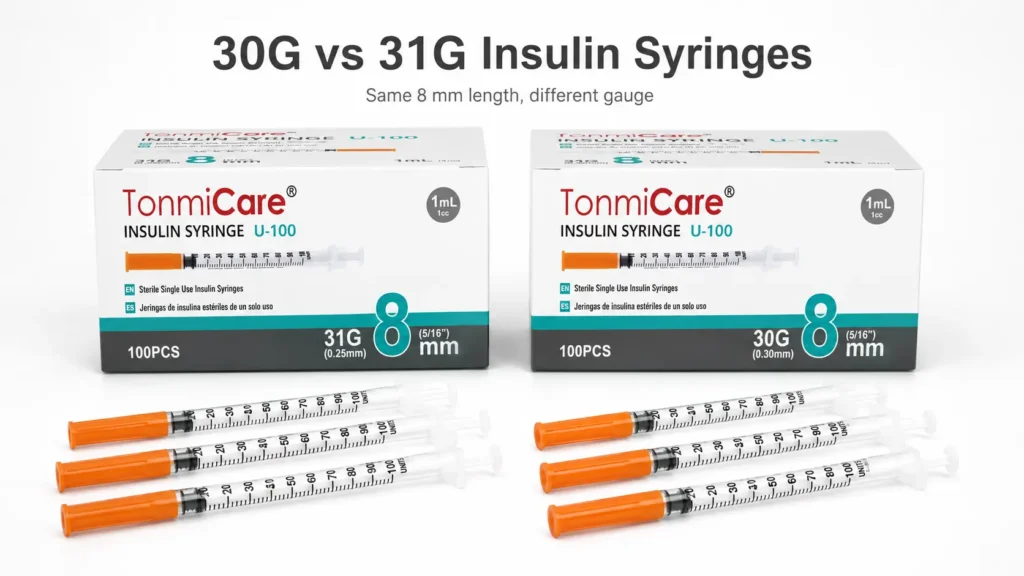
Compare 30 gauge vs 31 gauge insulin needles by thickness, needle length and complete syringe specifications. This guide answers common size and comfort questions, then helps pharmacies, clinics and distributors compare approved SKUs, receiving checks and wholesale quotations.
Scope: This article is an educational procurement resource for pharmacies, clinics and medical distributors. It does not select a syringe for an individual, provide injection technique, authorize product substitution or replace medication labeling, prescriptions, professional judgment, organizational policy or applicable law. Product performance, regulatory mapping, packaging, availability and price must be confirmed for the exact manufacturer REF and transaction.
Quick answer
Which Is Thinner: a 30G or 31G Insulin Syringe?
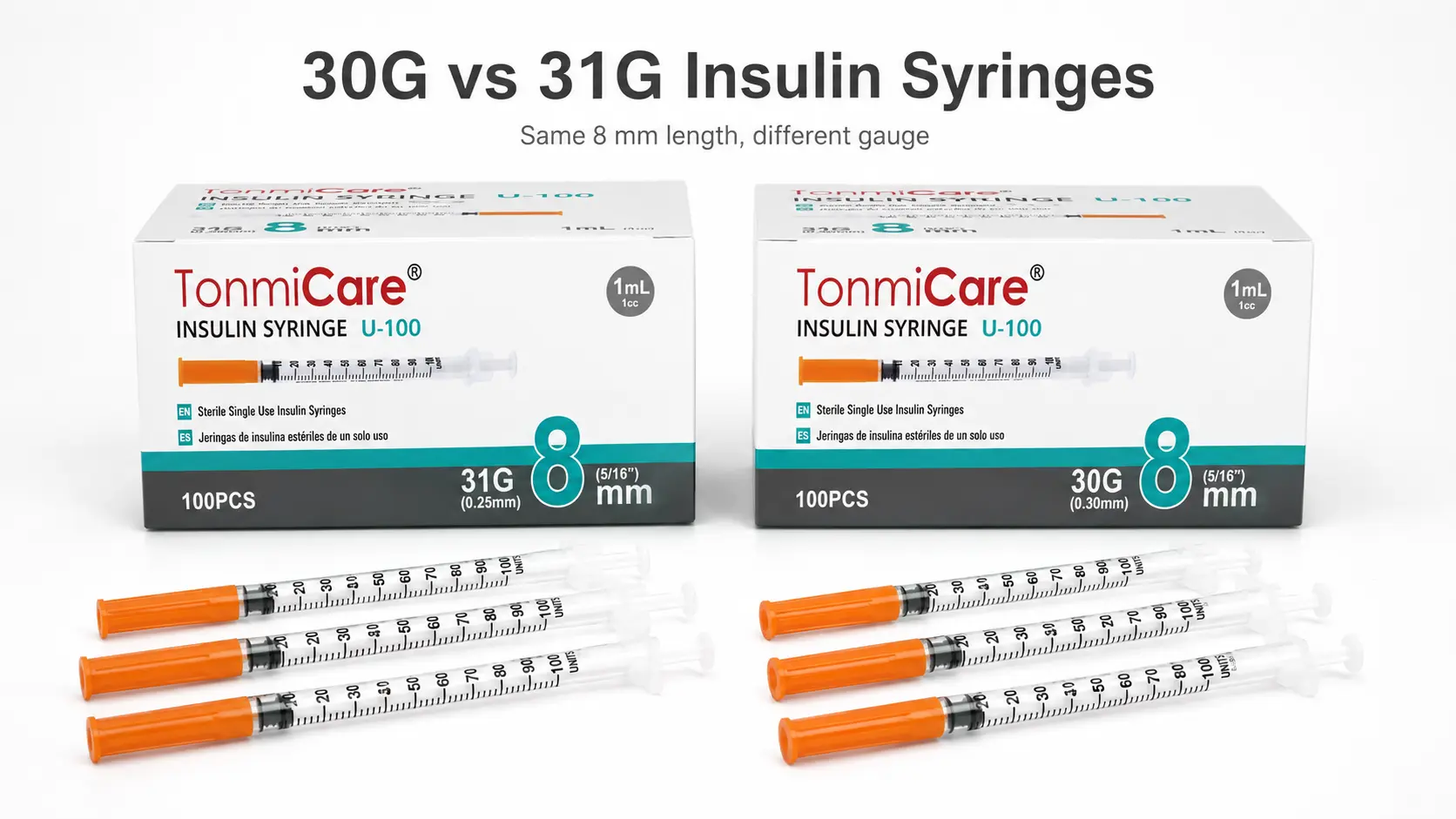
A 31G needle is thinner than a 30G needle. Under the ISO 9626 dimensional system, 30G needle tubing has an outside diameter of approximately 0.298–0.320 mm, while 31G is approximately 0.254–0.267 mm.[2], [8] These are reference tubing dimensions, not a measurement of a specific Tonmit syringe. They describe needle thickness, not needle length or syringe capacity.
Gauge does not establish needle length, internal lumen, flow, syringe capacity, concentration scale, graduation interval, clinical comfort, manufacturing quality or regulatory status. A pharmacy or distributor should therefore approve the complete syringe SKU—not replace 30G with 31G merely because the gauge number is higher.
Choosing between 30G and 31G
30G or 31G Insulin Syringe: Which Is Better for Your Order?
Start with the complete required syringe specification. If an approved requirement calls for a finer needle and the other controlled fields match, 31G is the thinner option. If the requirement specifies a 30G manufacturer REF, order that approved configuration or obtain authorization for an alternate. Gauge alone does not establish better comfort, faster delivery or higher product quality.
Comparing thickness
31G has a smaller outside diameter. Keep needle length, capacity and concentration scale separate.
Comparing products
Match the exact REF, graduation, packaging and required documentation before comparing quotations.
Choosing for an individual
Use the medication instructions and the syringe specification agreed with the healthcare team. The procurement comparison does not select an individual’s device.
Executive summary
Key Takeaways for Buyers
- 31G is thinner than 30G, but not necessarily shorter. Gauge and needle length are independent specification fields.
- Do not promise that 31G is painless. Perceived comfort can also depend on needle point, lubrication, penetration force, length, injection technique and individual response.
- Do not promise that every 30G syringe flows faster. Flow also depends on internal diameter, wall thickness, length, fluid properties and the finished device.
- Gauge does not determine dose accuracy. Concentration scale, barrel capacity, graduation, printing and tolerance controls must be reviewed separately.
- 30G and 31G are not automatic substitutes. The legal manufacturer, REF, U-40/U-100 scale, capacity, graduation, length, packaging and approved use pathway must still match.
- Stocking should follow actual demand. Keep separate SKU movement, substitution rules, case quantities, shelf life and replenishment data.
1. What Does Needle Gauge Actually Measure?
Needle gauge is a designation related to the outside diameter of the needle tube. In the common gauge convention, a higher gauge number indicates a smaller outside diameter within the same system. FDA recognizes ISO 9626:2016, which specifies dimensional and mechanical requirements for rigid stainless-steel needle tubing from 10G through 34G.[2]
A 30G needle size in mm or 31G needle size in mm can refer to thickness or length. The table below describes outside diameter; the printed needle length is a separate field.[8]
| Gauge | Approximate outside diameter | Relative description | Buyer note |
|---|---|---|---|
| 30G | 0.298–0.320 mm | Larger outside diameter | Confirm the finished-device specification and exact REF |
| 31G | 0.254–0.267 mm | Smaller outside diameter | Do not infer needle length, lumen or performance from gauge alone |
These ranges help explain the numbering system, but a procurement file should rely on the manufacturer’s controlled specification for the quoted product. The difference between outside diameter and inside diameter is important: tubing wall design affects the internal lumen, so two needles identified only by gauge may not produce identical flow behavior.
2. 30G vs 31G Insulin Syringes: Buyer Comparison Table
| Decision field | 30G insulin syringe | 31G insulin syringe | Correct procurement interpretation |
|---|---|---|---|
| Outside diameter | Larger | Smaller | 31G is the finer needle |
| Needle length | SKU-specific | SKU-specific | Gauge does not tell the buyer whether a needle is shorter |
| Perceived comfort | Product- and user-dependent | Product- and user-dependent | 31G may be selected as a finer option, but “painless” is not a gauge-level fact |
| Flow or injection force | Finished-device dependent | Finished-device dependent | Compare inner lumen, wall design, length and performance data |
| Dose accuracy | Not determined by gauge | Not determined by gauge | Review scale, capacity, graduation, legibility and tolerance |
| Product quality | Not determined by gauge | Not determined by gauge | Review needle point, penetration force, lubrication, bond, leakage and sterile barrier |
| Case quantity and price | REF-specific | REF-specific | Normalize the exact box and case hierarchy before comparing |
| Substitution status | Not automatic | Not automatic | Require buyer approval for every controlled field that changes |
Central buyer rule: 31G is thinner than 30G, but a purchasing team must approve the complete syringe SKU—not the gauge number alone.
3. Why Gauge and Needle Length Must Be Compared Separately
A designation such as 31G × 5/16 in contains two independent measurements. “31G” describes the needle-tubing size, while “5/16 in” describes length. A 30 gauge insulin syringe with a 5/16-inch needle can have the same nominal length as a 31 gauge insulin syringe with a 5/16-inch needle; the gauge changes thickness, not the meaning of the length marking.
Is a 5/16-inch insulin syringe needle the same length as 8 mm?
5/16 inch converts to 7.9375 mm and is commonly shown as approximately 8 mm in insulin syringe labeling. Treat 5/16 in / 8 mm as a nominal product-label convention, then confirm the exact quoted length and tolerance with the manufacturer. For a 30G vs 31G insulin syringe 8 mm comparison, hold length constant rather than comparing a shorter 31G product with a longer 30G product.
FDA’s public K223453 summary illustrates this separation. The submitted insulin-syringe family lists 30G and 31G among several gauges while separately listing 6, 8 and 12 mm needle lengths.[4] That product-family example does not mean every combination is offered under every REF; it demonstrates why gauge and length belong in separate database and purchase-order fields.
For a broader explanation of capacity, scale and graduation, use the 0.3, 0.5 and 1 mL U-100 insulin syringe guide. A detachable pen needle is a different product category and should not be used as the sole evidence base for a fixed-needle syringe comparison.
4. Does a 31G Insulin Syringe Hurt Less Than a 30G Syringe?
A 31G needle has a smaller outside diameter, so a buyer may reasonably evaluate it as a finer-needle option. That physical difference does not support an absolute statement that every 31G syringe hurts less for every user. Perceived discomfort can be influenced by the finished needle point, bevel consistency, surface finish, lubrication, penetration force, length, product handling, injection technique and individual sensitivity.
The K223453 public summary treats needle-tube diameter, needle points, lubrication and penetration force as separate performance characteristics, and it reports that no prospective clinical trials were conducted for that 510(k).[4] Buyers should therefore distinguish a controlled physical specification from a universal clinical-experience claim.
Marketing language to avoid
Do not describe a 31G insulin syringe as “painless,” “pain-free,” “guaranteed more comfortable” or clinically superior unless the exact claim, product and intended context are supported by appropriate evidence and permitted labeling. “Finer 31G needle option” is a narrower, specification-based statement.
5. Does a 30G Needle Deliver Insulin Faster?
A larger internal lumen can reduce resistance when other factors are held constant, but the gauge number describes outside diameter—not the entire flow path. Internal diameter can vary with wall thickness. Needle length, fluid properties, plunger and barrel design, lubrication, manufacturing tolerances and the force applied can also influence the user experience.
For that reason, “30G always flows faster than 31G” is too broad for a procurement specification or product claim. If injection force or delivery time is material to a program, request finished-device performance data under defined test conditions and compare matched configurations. Do not infer the result from a generic gauge chart.
6. What Needle Gauge Does Not Tell the Buyer
Gauge answers a narrow dimensional question. It does not answer the following purchasing questions:
- Is the barrel marked for U-40 or U-100 insulin?
- Is capacity 0.3, 0.5 or 1 mL?
- What value does each graduation interval represent?
- Is the needle 6 mm, 8 mm or another length?
- Is the needle integrated into the syringe?
- What are the legal manufacturer and exact REF?
- What sterile-barrier and single-use labeling apply?
- Which 510(k), listing and label cover the quoted model?
- How many syringes are in each box and case?
- What shelf life and minimum remaining shelf life apply?
FDA classifies piston syringes under 21 CFR 880.5860 as Class II devices.[1] FDA also recognizes ISO 8537:2016 for sterile, single-use syringes intended for insulin, with partial recognition as described in the agency’s database.[3] A gauge comparison should sit inside this broader device and SKU identity—not replace it.
7. Compare Complete 30G and 31G U-100 SKUs
The most useful B2B comparison controls all fields except gauge. Our current wholesale range includes selected 1 mL U-100 30G × 8 mm and 1 mL U-100 31G × 8 mm configurations. Buyers can review wholesale 30G and 31G insulin syringe configurations and the 1 mL U-100 insulin syringe range, then request the exact REF and controlled documents.
| Controlled field | Matched 30G comparison | Matched 31G comparison |
|---|---|---|
| Concentration scale | U-100 | U-100 |
| Nominal capacity | 1 mL / 100-unit maximum marking | 1 mL / 100-unit maximum marking |
| Graduation interval | Confirm by exact REF | Confirm by exact REF |
| Needle specification | 30G × 8 mm / 5/16 in | 31G × 8 mm / 5/16 in |
| Needle design | Confirm integrated fixed-needle configuration | Confirm integrated fixed-needle configuration |
| Manufacturer and REF | Required before approval | Required before approval |
| Regulatory and label mapping | Verify model coverage and current U.S. label | Verify model coverage and current U.S. label |
| Box and case hierarchy | Confirm transaction-specific pack | Confirm transaction-specific pack |
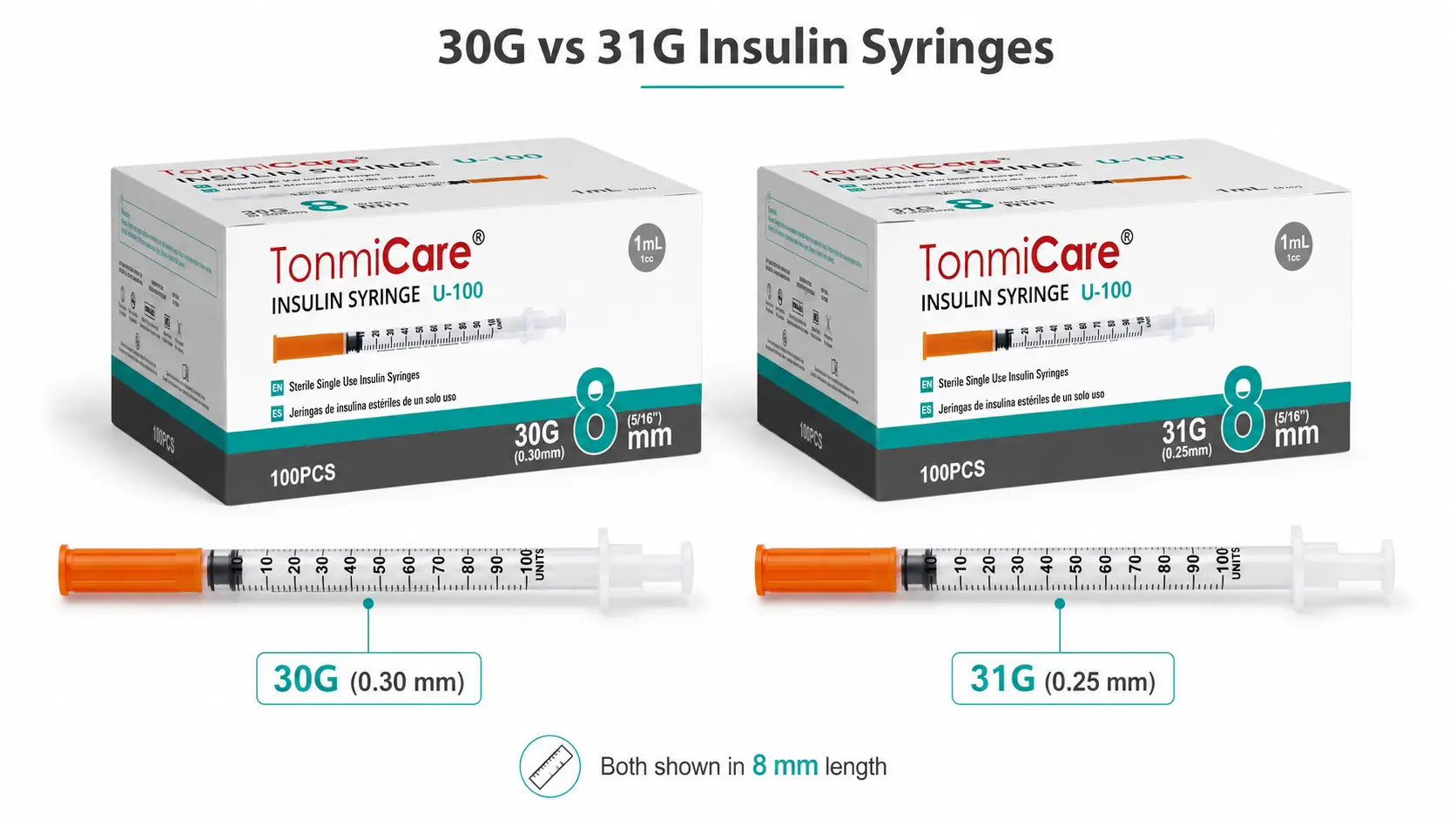
The table is a comparison worksheet, not a statement that two products are interchangeable. If graduation, labeler, REF, sterile package, case count or regulatory mapping differs, the buyer is comparing more than gauge.
8. Can a Pharmacy Substitute 31G for 30G?
Not automatically. Even when both products are 1 mL U-100 syringes with 8 mm needles, the manufacturer REF, graduation, package identity, labeling, prescription or formulary requirements, payer or contract terms, workflow and applicable state rules may differ. A supplier should disclose the proposed alternate and wait for documented buyer approval.
- Match U-40, U-100 or other concentration-specific scale.
- Match capacity and maximum unit marking.
- Match the graduation interval.
- Compare both gauge and needle length.
- Confirm the product design and sterile presentation.
- Reconcile legal manufacturer, labeler and exact REF.
- Verify current labeling, UDI/GTIN and regulatory mapping where applicable.
- Confirm organizational, prescription, contract and legal substitution controls.
- Approve box/case hierarchy, shelf life, inventory and commercial terms.
- Document who authorized the alternate and for which locations or orders.
Recommended PO wording: No substitution of concentration scale, capacity, graduation, gauge, needle length, device design, manufacturer, labeler, REF, sterile package or case hierarchy without written buyer approval.
9. Which Gauge Should a Pharmacy or Distributor Stock?
There is no universal stocking ratio. The correct choice depends on actual prescriptions or authorized demand, current customer preferences, approved formularies and product masters, supplier continuity, package quantity, shelf life and the organization’s substitution rules. “31G is finer” does not by itself prove that every location should replace its 30G inventory.
| Inventory role | Evidence to review | Recommended control |
|---|---|---|
| Core 30G SKU | Recurring 30G demand by exact REF, location and customer type | Set a REF-level reorder point and approved alternate status |
| Core 31G SKU | Recurring 31G demand by exact REF, location and customer type | Plan safety stock and case movement separately from 30G |
| Dual-gauge assortment | Both gauges have stable, non-interchangeable or preference-driven demand | Use unique barcodes and prevent uncontrolled pick substitution |
| Special-order gauge | Low or irregular demand does not justify routine inventory | Define lead time, cancellation, return and minimum-order terms |
| Shortage alternate | Named alternate has completed specification and policy review | Activate only under documented approval and communication rules |
As a starting planning window, review the last 90 days of clean movement data by exact REF, then adjust for new accounts, known program changes, backorders and seasonality. Keep damaged, quarantined, recalled and short-dated quantities out of usable on-hand inventory. Selected inventory may be supported through U.S. warehouse-supported medical supply fulfillment, but availability must be confirmed by REF, lot, quantity, expiration date and destination.
10. How Should Buyers Compare 30G and 31G Case Pricing?
Do not compare headline case prices until both quotations describe the same approved specification and package hierarchy. Gauge may affect the quoted SKU, but units per box, boxes per case, freight, remaining shelf life, MOQ and fulfillment route can create a larger commercial difference.
Product price per 100 syringes = quoted product price ÷ total quoted syringes × 100
Landed cost per accepted syringe = (product + freight + handling + duties/taxes where applicable + expected write-off) ÷ accepted syringes
Usable-case comparison = landed case cost ÷ syringes meeting the approved REF, shelf-life and receiving criteria
Our current public catalog lists 100 syringes per box and 20 boxes per case: 2,000 syringes for the listed range. A quotation for a different factory or shipping configuration may specify another hierarchy. Compare the pack stated for the exact quoted REF and supply route; do not assume that an older 36-box planning case and a current 20-box catalog case contain the same quantity. The insulin syringes by the case ordering guide explains the demand, cost and receiving workflow.
11. What Quality and Regulatory Documents Should Buyers Review?
Gauge is visible on a specification sheet, but supplier approval requires a connected evidence package. For each quoted 30G or 31G REF, request:
| Document group | Buyer question | Minimum linkage |
|---|---|---|
| Product identity | What exact product is being quoted? | Legal manufacturer, labeler, REF/model, UDI/GTIN where applicable and current artwork |
| U.S. market pathway | Which public record covers this model? | Product code, classification, applicable 510(k), model coverage, listing and current U.S. label |
| Physical specification | Are 30G/31G, length, scale and graduation controlled? | Signed specification, approved sample and change-notification agreement |
| Performance & quality | Which tests support the finished device? | Applicable dimensional, needle point, lubrication, penetration, leakage, graduation and bond controls |
| Sterility & shelf life | Does evidence apply to this package configuration? | Sterilization method, sterile-barrier validation, shelf-life basis and lot release records |
| Quality system | Is the manufacturer’s scope current and relevant? | Current ISO 13485 scope and evidence addressing applicable U.S. QMSR requirements |
| Postmarket control | Can affected lots and customers be identified? | Complaint, nonconformance, recall, field-action, traceability and change-control procedures |
FDA states that establishment registration and device listing do not by themselves denote approval, clearance or authorization, and the agency does not issue registration certificates to medical-device facilities.[5] Verify the exact quoted model against the applicable record rather than accepting “FDA registered” as a complete product qualification.
FDA’s Quality Management System Regulation became effective February 2, 2026 and incorporates ISO 13485:2016 by reference into the amended 21 CFR Part 820 framework.[6] An ISO 13485 certificate can support the review, but it does not replace device-level identity, labeling, market-pathway or finished-product evidence. Tonmit’s medical-device documentation support page explains the product-specific document review process; the broader wholesale insulin syringe supplier evaluation guide covers onboarding and traceability in greater depth.
Tonmit buyer worksheet
30G / 31G Insulin Syringe Receiving Checklist
Use this worksheet to record a receiving review against the approved purchase order and manufacturer documents. Inspect unopened packs and, where needed, an approved reference sample; do not open sterile sale stock merely to complete this worksheet. Record discrepancies for your organization’s receiving and quality process.
On smaller screens, scroll the table horizontally to complete status and notes.
| Check | Reference to compare | Status | Notes |
|---|---|---|---|
| Manufacturer and REF | Match the approved PO, label and product record; keep 30G and 31G REFs distinct. | ||
| Concentration scale and capacity | Confirm U-40 / U-100, nominal mL capacity and maximum unit marking. | ||
| Gauge and needle length | Check both fields on the package and specification; do not estimate gauge from a photograph. | ||
| Graduation and label revision | Compare visible artwork or an approved reference sample with the controlled specification. | ||
| Lot, expiry and package condition | Record lot and expiry, remaining shelf life, and visible damage to unopened sterile packs. | ||
| Box and case hierarchy | Reconcile syringes per box, boxes per case and total received quantity against the PO. |
Method and limits: This is a buyer-created visual and document review record, not published Tonmit test results or a lot-release certificate. A visual review cannot verify needle diameter, sterility, dose-delivery accuracy, penetration force or leakage performance. Those claims require the applicable controlled evidence and test method.
12. Copyable 30G/31G Insulin Syringe RFQ
Send the same complete requirement to each supplier and require exceptions to be disclosed. This keeps commercial comparisons focused on equivalent products.
Required product: sterile, single-use insulin syringe with integrated fixed needle.
Concentration scale: [U-100 / U-40 / other specifically authorized scale].
Capacity and graduation: [0.3 / 0.5 / 1] mL; maximum [units]; graduation interval [value].
Needle: [30G / 31G] × [6 / 8 / other] mm; disclose outside-diameter range and applicable tubing/wall specification.
Identity: legal manufacturer, manufacturing site, brand/labeler, exact REF/model, UDI/GTIN where applicable and current label revision.
U.S. documentation: product classification and code, applicable 510(k) and model mapping, current listing/label/IFU, QMS scope and requested quality files.
Packaging: individual sterile presentation, syringes/box, boxes/case, syringes/case, case dimensions and weight, cases/pallet, lot and expiration format.
Commercial requirement: requested quantity [cases/units], annual forecast [units], MOQ, unit and case price, freight basis, destination ZIP [ZIP], minimum remaining shelf life [months] and required delivery window [date].
Supply route: current U.S. inventory by REF/lot or production lead time, upstream replenishment time and shortage communication process.
Substitution: no change to scale, capacity, graduation, gauge, length, design, manufacturer, REF, package or label without written buyer approval.
Buyer FAQ: 30G vs 31G Insulin Syringes
Which is better: a 30G or 31G insulin syringe?
31G is thinner, but the appropriate product is the complete syringe specified for the user or purchasing program. Match concentration scale, capacity, graduation, needle length and approved REF. A higher gauge number alone does not establish better comfort, quality or interchangeability.
What does 31G × 5/16 inch mean on an insulin syringe?
31G is the needle’s gauge designation; 5/16 inch is its nominal length, commonly labeled as approximately 8 mm. The exact inch conversion is 7.9375 mm. Capacity, concentration scale and graduation must be read separately from the barrel and package.
Are 30G and 31G insulin syringes the same as insulin pen needles?
No. A fixed-needle insulin syringe includes a barrel and plunger; a pen needle is a separate component intended for a compatible injection pen. The same gauge number does not make the two device categories interchangeable.
Which is thinner, a 30G or 31G insulin syringe?
31G is thinner. Its outside-diameter range is smaller than the 30G range under the ISO 9626 gauge system. Gauge does not determine needle length or the rest of the syringe specification.
What is the diameter difference between 30G and 31G?
Reference tubing ranges are approximately 0.298–0.320 mm outside diameter for 30G and 0.254–0.267 mm for 31G.[8] Nominal package labels may show 0.30 mm and 0.25 mm. Obtain the controlled finished-device specification for the exact REF.
Does a 31G insulin syringe hurt less than a 30G syringe?
31G has a finer outside diameter, but gauge alone does not guarantee a less painful experience. Needle point, lubrication, penetration force, length, technique and individual sensitivity may also affect perceived comfort. Avoid absolute “painless” claims without product-specific evidence.
Does a 30G needle deliver insulin faster?
Not necessarily in every finished product. Flow and injection force can depend on internal lumen, tubing wall, needle length, fluid properties and syringe design. Request comparative performance data if this is a purchasing requirement.
Does needle gauge affect insulin dose accuracy?
Gauge does not determine the syringe’s concentration scale, barrel capacity, graduation interval or graduated-capacity tolerance. Those fields and scale legibility should be reviewed independently.
Is 31G × 5/16 in the same as 30G × 5/16 in?
No. Both may have the same nominal needle length—5/16 in or approximately 8 mm—but they have different gauges and outside diameters. They remain different specifications and may also have different REFs or package identities.
Can a pharmacy substitute 31G for 30G?
Not automatically. Confirm the complete SKU, prescription or formulary requirements, organizational policy, contract terms and applicable law. Require documented buyer approval before changing gauge or any other controlled field.
Are 30G and 31G available in 0.3, 0.5 and 1 mL syringes?
Availability is manufacturer- and REF-specific. Do not infer a gauge/capacity combination from a product-family range. Request the exact REF, graduation, length, label, packaging and regulatory mapping.
Which gauge should a pharmacy or distributor stock?
Base the mix on actual demand by approved REF, customer or prescription requirements, substitution rules, case movement, shelf life and supplier continuity. Some buyers may justify both gauges; others may designate one as special order.
Are 30G and 31G insulin syringes single-use?
Insulin syringes covered by ISO 8537 are single-use products, and CDC states that healthcare providers should use a syringe once and then discard it.[7] Follow the exact product label and safe-injection policy.
Conclusion: Choose the Complete SKU, Not Only the Gauge
The direct answer is simple: 31G is thinner than 30G. The correct B2B decision is more complete. Gauge must be evaluated together with needle length, internal lumen and finished-device performance; then connected to the required concentration scale, capacity, graduation, manufacturer REF, sterile package, regulatory mapping, case hierarchy and supply terms.
For pharmacies, clinics and medical distributors, the safest purchasing workflow is to compare matched SKUs, prohibit unapproved substitutions, base stocking on exact-REF demand and normalize quotations by landed cost per accepted syringe. This turns a superficial 30G-versus-31G question into a documented, traceable and commercially comparable sourcing decision.
Gauge · SKU · case pricing · documentation
Request a 30G or 31G SKU Comparison
Share the required insulin scale, capacity, graduation, gauge × length, annual volume, case quantity, destination ZIP code, package format and document list. We can review the exact 30G or 31G configuration, selected TonmiCare product paths, available documentation and wholesale terms. For a matched comparison, tell us which specifications must remain the same.
Final scale, capacity, graduation, gauge, length, manufacturer REF, FDA mapping, packaging, inventory, shelf life, delivery and private-label feasibility are confirmed for the selected product and transaction.
References
- Electronic Code of Federal Regulations. “21 CFR 880.5860—Piston syringe.” Defines the device and classifies it as Class II. eCFR.
- U.S. Food and Drug Administration. “Recognized Consensus Standard: ISO 9626:2016—Stainless steel needle tubing for the manufacture of medical devices.” The standard specifies dimensions and mechanical properties for designated needle tubing sizes. FDA Recognized Standards Database.
- U.S. Food and Drug Administration. “Recognized Consensus Standard: ISO 8537:2016—Sterile single-use syringes, with or without needle, for insulin.” FDA Recognized Standards Database.
- U.S. Food and Drug Administration. “K223453—Insulin Syringe, 510(k) Summary.” The public record separately lists gauge, needle length and performance characteristics and states that no prospective clinical trials supported that submission. FDA 510(k) Summary.
- U.S. Food and Drug Administration. “Important Reminders about Registration and Listing.” Registration and listing do not denote approval, clearance or authorization. FDA.
- U.S. Food and Drug Administration. “Quality Management System Regulation (QMSR).” The QMSR became effective February 2, 2026 and incorporates ISO 13485:2016 by reference. FDA.
- Centers for Disease Control and Prevention. “Safe Injection Practices and Your Health.” CDC states that healthcare providers should use a syringe once and then discard it. CDC.
- ISPG. “Tubing Chart.” Manufacturer-published metric needle-tubing ranges supporting the 30G and 31G outside-diameter comparison. The 2015 chart is a dimensional reference, not a Tonmit finished-device specification. Manufacturer tubing chart.