
U.S. Supplier Qualification & Documentation Guide
For finished medical devices, request evidence for the supplier, exact SKU, applicable FDA pathway, quality and sterility claims, and the shipped lot. Match each record to its owner, version and intended market.
Reviewed by
Review scope and backgrounds
Review scope: Quality, sterilization and traceability claims, including CoC/CoA and release-record limits.
Background: Quality-documentation review for medical consumables and related supply programs.
Review scope: Public classification, registration, listing, premarket and UDI information.
Background: Regulatory and compliance research relevant to medical-device sourcing and procurement.
Review scope: Supplier identity, document ownership, sourcing controls and buyer request fields.
Background: Medical-supply sourcing, supplier qualification and B2B procurement support.
Scope: This guide addresses U.S. B2B procurement of finished medical devices and disposable medical consumables. It is not a universal legal checklist and does not replace state pharmacy law, accreditation, reimbursement, contract, regulatory or quality advice. Prescription-drug tracing under DSCSA, Medicare DMEPOS participation and sales-representative credentialing are separate systems. Requirements must be set for the buyer’s role, exact product, destination market and transaction.
Direct answer
What Is the Minimum Medical Supplier Document Package for a Pharmacy?
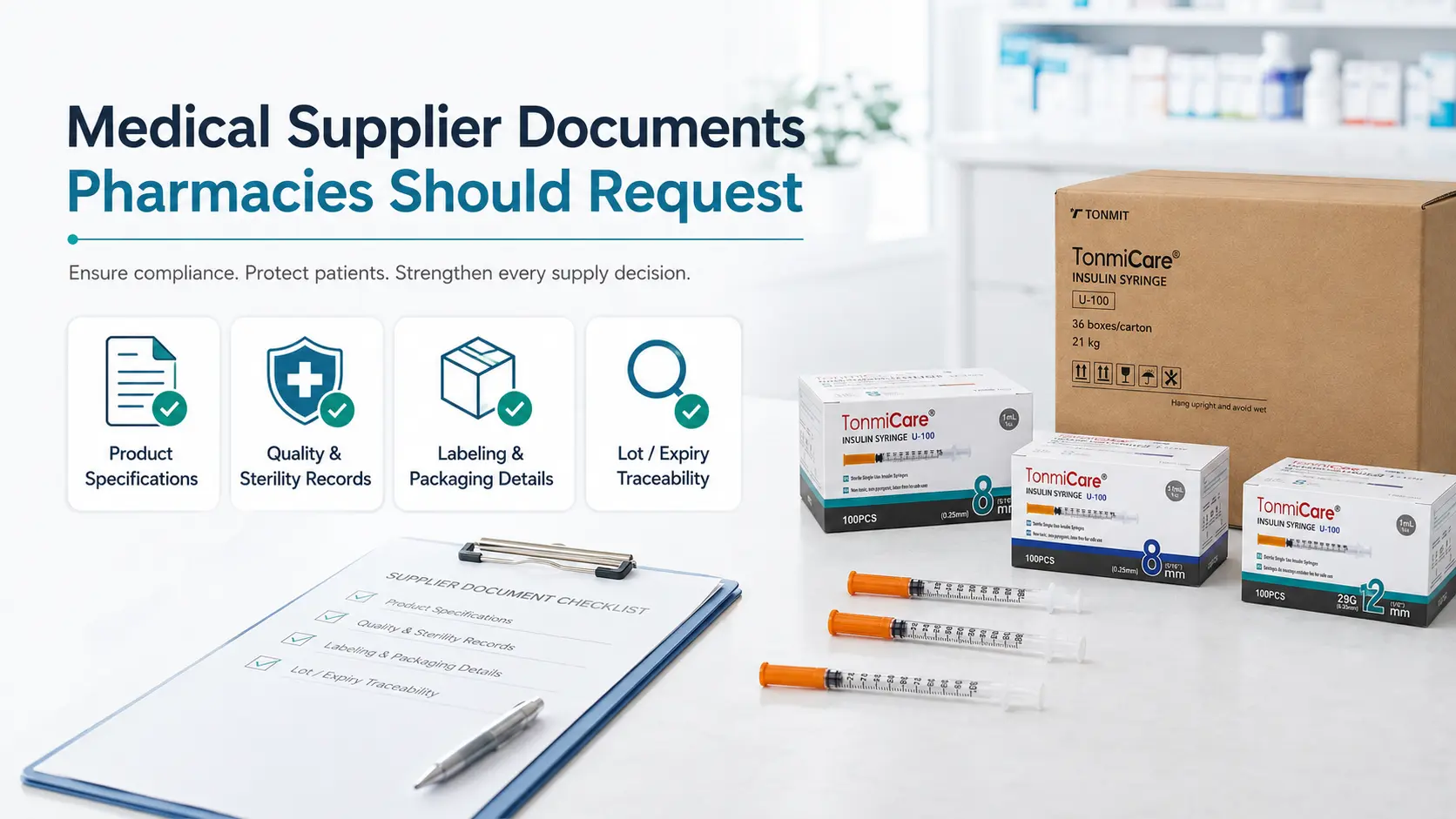
A pharmacy should build a product-specific file, not request the same certificates from every supplier. Confirm these five groups before approval:
- Legal seller, manufacturer, labeler and importer roles, where applicable.
- Exact REF/SKU, controlled specification, labeling, IFU and packaging hierarchy.
- Classification and the FDA registration, listing, premarket and UDI evidence that applies.
- Relevant quality, sterility, shelf-life and change-control evidence.
- Agreed lot/expiry, release, shipping and receiving records for the order.
Record each document’s owner, revision, coverage and review status. Separate unavailable, confidential, not-yet-created and nonapplicable evidence; a received PDF is not automatically verified. Use our document matrix and gap log, or request documentation for an exact product configuration.
1. Define the Procurement Scope Before Building the Checklist
This checklist covers finished medical devices such as insulin syringes, pen needles, lancets and sharps containers. Determine the classification of each offered item before choosing its document set. Skin-antiseptic alcohol prep pads can be marketed as OTC drugs; a device checklist alone is insufficient for those products.[10] Drugs, device/drug combinations and mixed kits need their own applicable review.
| Procurement object or activity | Primary document system | Covered by this guide? |
|---|---|---|
| Finished medical devices and consumables | Product identity, FDA records, labeling, quality, lot and shipment evidence | Yes—main scope |
| Skin-antiseptic alcohol prep pads and other OTC drugs | Drug classification, labeling, establishment/listing and applicable OTC requirements | Separate drug review; the DSCSA scope is not all OTC drugs |
| Certain prescription drugs | DSCSA trading-partner and product-tracing requirements | No—separate drug system[1] |
| DMEPOS billed to Medicare | Enrollment, accreditation, supplier standards and payer records | No—separate CMS system[2] |
| Sales representative site access | Vendor credentialing, training, insurance and facility-access records | No—person/site access |
Do not reuse one checklist across all four scopes
A pharmacy may participate in several systems at once. For example, a company can sell a device and also furnish DMEPOS, but FDA device evidence does not replace CMS enrollment or payer documentation. Build a separate checklist for each regulated activity.
2. Organize Medical Device Supplier Documentation Into Four Levels
The most practical structure separates records by what they prove. This prevents a business certificate from being treated as product evidence, or a product record from being treated as proof of the shipped lot.
Supplier identity
Who is quoting, invoicing, importing, distributing and handling complaints?
Exact product
Which manufacturer, SKU, specification, label and packaging version is offered?
Lot and order
Which lot, expiry, released quantity and shipping configuration will arrive?
Ongoing supply
How will changes, complaints, recalls, expirations and requalification be controlled?
3. Supplier Business and Legal-Identity Documents
Start by determining whether the quote comes from the legal manufacturer, specification developer, contract manufacturer, importer, relabeler, distributor or another commercial intermediary. These roles are not interchangeable. The pharmacy’s vendor master should match the entity that signs the contract and invoices the order, while the product file should identify the entity responsible for the marketed device.
- Legal business name and address: reconcile the quotation, tax form, contract, invoice and payment details.
- Supplier role and manufacturer relationship: document who manufactures, labels, imports, distributes and supports the product.
- Business or professional licenses: request only where applicable to the entity, state, product and activity.
- Tax-onboarding, banking and insurance records: request the forms appropriate to the contracting entity and buyer policy. Verify payment changes through a known contact; these records do not establish device authorization.
- Quality, complaint and recall contacts: identify named channels for escalation, returns, field actions and urgent traceability requests.
- Supplier questionnaire and declarations: cover conflicts, sanctions, subcontracting, change notification and data accuracy as appropriate.
- Approved-substitution rule: prohibit changes in maker, REF, specification, package count or labeling without written review.
A buyer should not infer a legal relationship from a shared brand name or sales brochure. If the seller is not the manufacturer, request a clear explanation of the authorized supply path and document ownership. For a broader commercial assessment, pharmacies can evaluate an insulin pen needle supplier using specification, documentation, traceability and replenishment controls.
4. Exact-SKU, Labeling and Packaging Documents
The exact product master is the center of a defensible pharmacy procurement checklist. Ask for the current controlled specification or data sheet and match it to a physical sample, label image or approved artwork. “Insulin syringe,” “32G pen needle” or a product family name is not precise enough.
| Document or field | Minimum comparison points | Why it matters |
|---|---|---|
| Product specification | Product name, intended use, model/REF, dimensions, gauge, length, capacity, materials and design features | Prevents family-level or “equivalent” substitutions |
| Current labeling | Legal manufacturer, labeler, brand, REF, warnings, symbols, lot/expiry fields and contact information | Connects the marketed product to responsible parties and claims |
| IFU or insert | Exact model scope, instructions, contraindications, warnings, storage and disposal, where applicable | Confirms labeled use and user information |
| Packaging hierarchy | Units per pouch, box and case; case dimensions; barcode level; shipping marks | Supports receiving, replenishment and price normalization |
| Shelf-life data | Labeled shelf life, storage conditions and minimum remaining shelf life at delivery | Controls waste and prevents unsupported expiry assumptions |
| Country and site information | Country of origin, legal manufacturer and applicable manufacturing/sterilization site | Supports regulatory, quality, import and sourcing review |
Control the version—not just the filename
Record the issue date, revision or artwork version used for approval. “Specification.pdf” without a model number or revision can become ambiguous when a manufacturer changes a box count, label, site or design. Buyers developing custom cartons should coordinate controlled packaging and labeling against the approved SKU.
5. FDA Registration, Listing, Classification and Premarket Records
For U.S. devices, verify official records instead of relying on a supplier’s “FDA certificate.” FDA states that it does not issue registration certificates to medical-device facilities, and registration or listing does not denote approval, clearance or authorization.[3] The correct record set depends on the device’s classification and pathway.
Check the role before expecting a registration
A domestic distributor that does not import devices generally does not register or list for that activity. An initial importer registers and identifies its manufacturers, but does not list devices in that role. Manufacturing, relabeling or repackaging can change the obligations. Match each entity to its actual activities using FDA’s role table.[11]
| FDA record | What it can establish | What the buyer should match |
|---|---|---|
| Establishment registration | Current registration information for an establishment and its role, where required | Legal name, address, role and current database entry |
| Device listing | A listed device associated with an establishment | Listing entity, device name, product code and applicable manufacturer |
| Classification record | Device type, product code, regulation and class | Offered product’s intended use and technical identity |
| 510(k) clearance | A cleared premarket notification for an applicable device | 510(k) holder, device name, product code, models, intended use and labeling |
| PMA or De Novo | Applicable approval or classification pathway for certain devices | Authorization holder, device/model scope, conditions and actual marketed product |
Not every medical device requires a 510(k). FDA notes that most Class I and some Class II devices are exempt from premarket notification, subject to limitations.[4] Therefore, “no 510(k)” is not automatically a defect, and “has a 510(k)” is not enough unless the offered SKU falls within the cleared device scope. Use the FDA Product Code Classification Database and the releasable 510(k) database to test the supplier’s claim.[5]
A PDF clearance letter is the start of the match
Compare the holder, device type, product code, intended use and supported model/family scope. A public record may not list every commercial REF. Where names or models differ, obtain a controlled manufacturer-to-SKU mapping and reconcile it with the specification and labeling. Similar appearance or a shared distributor cannot establish coverage. See our insulin syringe verification guide.
6. UDI and GUDID Verification
Where UDI requirements apply, compare the device identifier on the actual label with the corresponding GUDID record. FDA and the National Library of Medicine make device identification data publicly searchable through AccessGUDID.[6] Useful fields include the labeler/company name, brand, version or model, catalog number, package quantity, device description and higher packaging identifiers.
GUDID is not a lot-release database. It contains the device identifier (DI), not the actual production-identifier values for a lot, serial number or expiration date. It can indicate which PI attributes appear in a UDI. Verify the delivered lot and expiry against the physical labeling and transaction/release records.[12]
Do not assume every product or packaging level will present an identical UDI pattern. Exceptions, alternatives and compliance policies exist for certain devices and circumstances.[7] Ask the supplier to explain why a quoted SKU or package has no expected GUDID match, and escalate unresolved discrepancies before approval. A barcode that scans successfully is not, by itself, proof that all product data are correct.
7. ISO 13485, Certification Scope and the Current U.S. QMSR
An ISO 13485 certificate is quality-management-system evidence, not a general U.S. product authorization. Check the certificate holder’s legal name, certified site, scope, issue and expiry dates, certification body and any exclusions. Then confirm how the certified organization relates to the offered SKU.
The U.S. terminology also changed. FDA’s Quality Management System Regulation became effective February 2, 2026 and amended 21 CFR Part 820 by incorporating ISO 13485:2016 by reference, with additional FDA requirements.[8] That does not mean an ISO certificate alone proves compliance with every FDA obligation, nor that a pharmacy must obtain a manufacturer’s entire quality manual. Review available evidence in proportion to the product and supplier risk, and document gaps.
FDA does not require or issue certificates of conformance to ISO 13485, and such a certificate does not exempt a manufacturer from FDA inspection.[13] If a supplier has no ISO certificate, assess the applicable QMS obligations and decision-critical evidence instead of automatically treating the missing certificate as a legal failure.
Entity and site
Does the certificate identify the organization and location connected to the offered product?
Scope and status
Does the scope cover the relevant activity, and is the certificate current?
Product authorization
Certification does not automatically clear, approve or list every device.
8. Sterilization, Shelf-Life and Packaging Evidence
For a product labeled sterile, request the declared sterilization method and determine which controlled documents are available for qualification and routine release. Depending on the device and supplier arrangement, the package may include a sterilization statement, releasable validation summary, lot-release or sterilization record, packaging-integrity information and change-control commitments. Full validation protocols, raw data and production records may be proprietary and reviewed under NDA or audit rather than freely distributed.
| Claim or control | Reasonable buyer evidence | Important limit |
|---|---|---|
| Sterile status | Label/IFU statement, sterilization method and applicable release documentation | Only for the exact sterile product and configuration |
| Sterilization validation | Controlled summary or audit/NDA review appropriate to the project | Not normally re-created for every shipment |
| Shelf life | Labeled expiry, stated shelf life, storage conditions and available supporting summary | Must match the packaging system and product version |
| Package integrity | Packaging specification, seal/inspection controls and receiving criteria | A clean outer carton does not prove sterile-barrier integrity |
State the pharmacy’s minimum remaining shelf-life requirement in the purchase order. Do not estimate it from a catalog date or assume all lots will have the same remaining life. If inventory is fulfilled from a domestic location, confirm U.S.-warehouse inventory by exact SKU, assigned lot and expiration before release.
9. CoC vs CoA vs Lot-Release and Sterilization Records
CoC, CoA and lot-release records answer different questions. Their content and routine availability vary by device, manufacturer and quality agreement. Do not assume that every finished device ships with a CoA. Specify the product and lot linkage, acceptance information and release evidence needed for the purchasing decision.
| Record | Typical purpose | Useful fields to request | Always available? |
|---|---|---|---|
| Certificate of Conformity (CoC) | States that the identified product or lot conforms to defined specifications | SKU/REF, lot, PO, quantity, specification, date and authorized release | No universal format |
| Certificate of Analysis (CoA) | Reports selected tests, acceptance criteria, results and disposition | Test name, method/reference, limits, actual results, lot and approval | Not routine for every device |
| Lot-release record | Documents the manufacturer’s release decision for a production lot | Product, lot, date, disposition and authorization | Availability and format vary |
| Sterilization record/certificate | Supports processing or release for an applicable sterile lot | Product/lot link, method, cycle/load reference and release status | Only relevant to sterile products |
Ask one operational question
“Which routine release document exists for this exact product, and can it be linked to the lot assigned to our purchase order?” This produces a more useful answer than demanding a CoA regardless of the manufacturer’s release system.
10. Shipment, Lot-Traceability and Receiving Documents
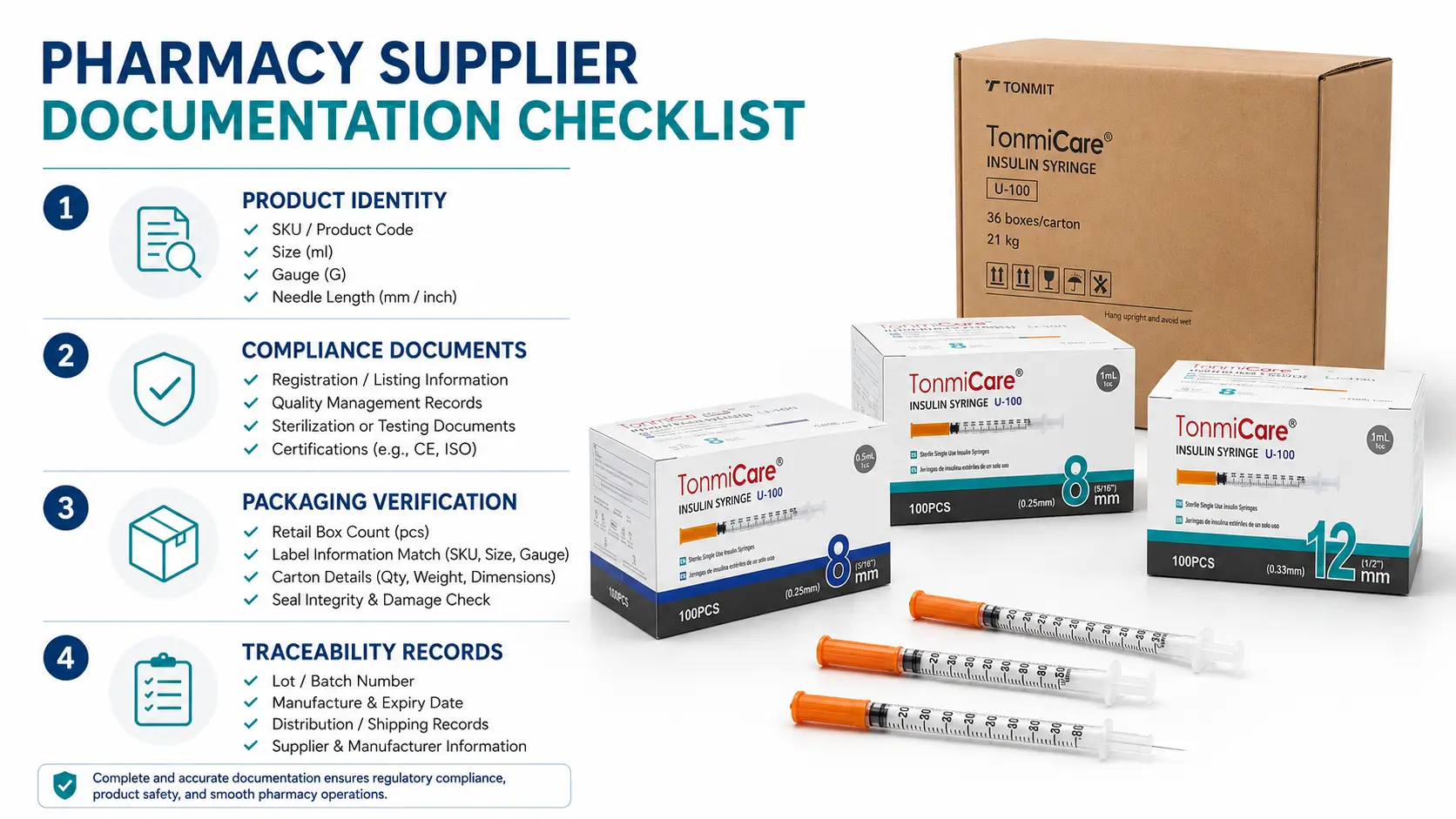
Product qualification and transaction release are separate controls. Public database records and a current product specification can support approval, but they do not identify the lot that will arrive. Agree on transaction records before issuing the purchase order.
- Purchase-order acknowledgement: exact SKU, quantity, unit/box/case hierarchy, price, delivery term and prohibited substitutions.
- Commercial invoice and packing list: supplier, consignee, item, quantity, carton or pallet detail and order reference.
- Assigned lot and expiry: product-to-lot mapping, manufacture/expiry dates where used and minimum remaining shelf life.
- Agreed quality-release record: CoC, CoA, lot release or sterilization-related record only as applicable and contracted.
- Origin and transport documents: country-of-origin statement, certificate of origin where applicable, bill of lading/air waybill and customs documents for the transaction.
- Receiving evidence: quantity, lot, expiry, package condition, label/REF match, temperature record where applicable and deviation disposition.
U.S. pharmacies and distributors planning repeat orders can review U.S. wholesale medical supply programs while keeping regulatory identity, inventory availability and transaction documentation as separate approval gates.
11. Additional Documents for Private-Label Medical Supplies
Private label is not merely a logo change. The final product identity may change the brand, labeler, distributor statements, packaging hierarchy, barcode data, artwork ownership and regulatory responsibilities. Before production, document who controls each element and which existing evidence can legitimately support the customer-branded configuration.
Approved master
Exact SKU, materials, dimensions, performance claims, sterilization and shelf life.
Controlled version
Brand, legal parties, symbols, warnings, IFU, barcode, lot and expiry fields.
Role map
Manufacturer, labeler, importer, distributor, complaint, recall and change owners.
Maintain signed sample and artwork approvals, packaging specifications, barcode assignments, production version, change-control agreement and lot-traceability records. Buyers can plan private-label medical supply documentation as part of the project—not after boxes have been printed.
12. When Should Pharmacies Request Each Document?
Requesting every record during the first sales conversation is inefficient, but waiting until shipment creates avoidable risk. Use staged access and identify unavailable, confidential, lot-specific and nonapplicable records.
| Procurement stage | Documents or evidence to review | Decision supported |
|---|---|---|
| Initial screening | Legal identity, role map, product scope, business records, quality-system summary and supplier questionnaire | Is the supplier eligible for detailed review? |
| Before sample approval | Exact specification, label, IFU, packaging, manufacturer, regulatory identity and UDI where applicable | Is this the product the pharmacy intends to approve? |
| Before PO | Final SKU/version, pack hierarchy, shelf-life rule, substitution restriction, quality-record requirement and change terms | Are requirements contractually measurable? |
| Before shipment | Assigned lot/expiry, available release record, invoice, packing list and shipping/origin documents | May the order be released? |
| At receiving | Physical SKU, quantity, lot, expiry, packaging and transaction-document match | Accept, quarantine or reject? |
| Periodic or event-driven review | Current certificates, registrations, changes, complaints, recalls and performance history | Does approval remain valid? |
13. How to Match Documents to the Exact Product
Treat verification as a connected evidence chain, not a folder of PDFs. The same brand name is insufficient when models, manufacturers or package quantities differ.
Identify the supplier role
Record who quotes, invoices, imports, distributes, manufactures and labels.
Lock the exact product master
Capture legal manufacturer, brand, REF/model, complete specification and packaging hierarchy.
Verify public records
Check classification, registration/listing, applicable premarket record, UDI/GUDID and recalls in official sources.
Review controlled evidence
Compare the specification, labeling, IFU, QMS certificate, sterility and shelf-life information.
Compare the physical sample
Reconcile product features, REF, label, barcode and pack quantity with the approved records.
Link the transaction
Match the PO, assigned lot, expiry, release record, invoice, packing list and shipment.
Record approval and gaps
Store version-controlled evidence, limitations, review owner, next review and escalation actions.
Worked document check: the REF matches, the records still do not
Illustrative exercise: DEMO-PN-A and DEMO-PN-B are fictional identifiers. This is not a customer case, inspection result or regulatory finding.
| Evidence | What the reviewer sees | Action before release |
|---|---|---|
| Approved quote and label | DEMO-PN-A; 100 units per box | Use as the controlled comparison baseline. |
| Packing list | DEMO-PN-A; 200 units per box | Clarify packaging level and revision; reconcile units and labels. |
| Proposed lot-release record | DEMO-PN-B; no mapping to the approved REF | Obtain traceable coverage or the correct record; log the gap. |
Decision: Hold the affected order while the discrepancies remain unresolved. Record the evidence reference, owner, due date and final disposition in the gap log. A matching brand, scanned barcode or valid registration does not resolve a product or lot mismatch.
Search FDA’s classified Medical Device Recalls database by product and firm as one part of the review.[9] An absence of a search result is not a complete quality conclusion; combine official data with complaint history, field-action communication and supplier performance. For Tonmit projects, buyers can also review Tonmit’s compliance-support scope and responsibility boundaries.
14. Medical Supplier Documentation Red Flags
| Red flag | Why it is insufficient or risky | Buyer response |
|---|---|---|
| Only an “FDA certificate” is supplied | FDA does not issue device-establishment registration certificates | Verify the official database and product-specific pathway |
| ISO 13485 is presented as product approval | A QMS certificate does not establish U.S. market authorization | Review site/scope, then separately verify product records |
| Documents identify only a product family | No clear link to the quoted REF, specification or packaging | Request an SKU coverage statement or exact record |
| 510(k) parties or models do not align | The clearance may not cover the offered device | Map applicant, model, product code, labeling and manufacturer |
| CoC/CoA lacks product or lot identity | The record cannot be linked to the shipment | Require traceable fields and authorized approval |
| Pack count differs across label and quote | May indicate an uncontrolled version or packaging level | Quarantine the discrepancy until resolved |
| CE evidence is used as U.S. authorization | EU conformity documentation does not replace applicable U.S. records | Review by destination market |
| Shortage allows an unapproved “equivalent” | Manufacturer, specification, label, UDI and records may change | Require written change and product reapproval |
15. Supplier Requalification and Change Notification
There is no single universal requalification interval that fits every U.S. pharmacy and every medical device. Set a risk-based cadence in the buyer’s supplier procedure and add event-driven reviews. Higher-risk devices, private-label programs, recurring quality issues or complex import roles may justify more frequent review than low-risk, stable products.
- Time-based review: monitor expiring certificates, registrations, contracts and approved specifications.
- Change-based review: re-evaluate manufacturer, site, material, design, sterilization, shelf life, labeler, UDI, packaging or intended-use changes.
- Performance-based review: analyze complaints, returns, receiving deviations, late delivery, fill rate and documentation responsiveness.
- Safety and regulatory review: monitor recalls, field actions and other relevant official updates.
- Approval outcome: renew, conditionally approve, suspend or remove the supplier/SKU with a recorded rationale.
16. Copyable Medical Supplier Document Request
Use our blank document matrix to assign evidence owners, access routes and review status. Record one entry for each document/version; use the gap log for unresolved items. The request template asks the supplier to distinguish unavailable, restricted, lot-specific and nonapplicable evidence.
Status key: Received—unverified; Verified for the recorded scope; Not applicable—with rationale; Restricted access; Awaiting lot/order record; Unavailable; Superseded. Record who accepted the evidence and why; the status is not a regulatory certification.
Document request matrix
14 starter rows covering owner, stage, applicability, access and review status.
View or manually copy the template
Review stage,Document or evidence,Typical owner,Applicability or trigger,Fields to reconcile,Access route,Status,Evidence reference / revision,Review owner,Next action / due date
Screening,Legal identity and role map,Seller and relevant supply-chain entities,Every proposed supplier,Legal names; addresses; contracting entity; actual activities,Direct request,,,,
Product approval,Controlled product specification,Manufacturer / specification owner,Exact offered configuration,REF; intended use; dimensions; materials; version,Direct request or controlled review,,,,
Product approval,Labeling / IFU / packaging master,Manufacturer / labeler,As applicable to the device and package level,REF; responsible parties; warnings; unit-box-case quantities,Approved artwork / label images,,,,
Product approval,Classification and premarket scope,Responsible manufacturer plus official source,Applicable classification and pathway,Product code; pathway; scope; link to offered REF,Official record plus controlled mapping,,,,
Supplier approval,Registration / listing role check,Each entity with a relevant activity,Only where required for that entity and activity,Name; address; role; status; search date,Official source,,,,
Product approval,UDI / GUDID match,Labeler plus official source,Where UDI / submission requirements apply,DI; labeler; model; package quantity; PI flags,Actual label and official record,,,,
Qualification,Quality-system evidence,Responsible manufacturer / certified organization,Risk-based; certificate if available or contractually required,Entity; site; scope; issuer; validity; known gaps,Certificate / controlled summary / audit,,,,
Qualification,Sterility / packaging / shelf-life evidence,Manufacturer / sterilization record owner,Sterile claim or labeled expiry,Configuration; method; package version; storage; support scope,Controlled summary / NDA / audit,,,,
Before PO,Quality / change / substitution terms,Buyer and seller,Contract-defined requirements,Allowed records; no silent substitution; change and recall contacts,Written agreement / PO,,,,
Before shipment,Assigned lot and remaining shelf life,Seller / inventory owner,When lot is assigned,REF; quantity; lot; expiry; minimum remaining life,Lot allocation record,,,,
Before shipment,Agreed release evidence,Manufacturer / record owner,Applicable and agreed for this product / order,REF coverage; lot; disposition; authorized release,CoC / CoA / lot-release or agreed alternative,,,,
Shipment / receiving,Invoice and packing list,Seller / shipper,Order-specific,PO; item; each-box-case quantities; lot references,Transaction documents,,,,
Receiving,Receiving check and deviation record,Buyer receiving / quality team,Delivered stock,Physical label; REF; lot; expiry; pack condition; quantity,Physical inspection record,,,,
Ongoing,Change / complaint / recall communication,Responsible parties and buyer,Periodic review or a relevant event,Affected SKU / lot; action; owners; approval status,Controlled correspondence and official sources,,,,
Document gap log
A blank record for discrepancies, actions, holds and closure evidence.
View or manually copy the template
Gap ID,Date opened,Supplier / manufacturer,Exact REF / package,Evidence reference / version,Gap or mismatch,Decision impact,Current status,Action owner,Required evidence or alternative,Due date,Order / stock hold,Resolution evidence,Disposition approver,Closed date
,,,,,,,,,,,,,,
Supplier document request
A copyable inquiry for the exact REF, packaging and destination market.
View or manually copy the template
Subject: Pharmacy supplier document request — [exact REF / packaging / U.S. market]

Buyer / organization:
Supplier legal name and role:
Legal manufacturer / labeler / importer, where applicable:
Product name / manufacturer REF / supplier SKU:
Specification and label revisions:
Each / box / case quantities:
Destination / estimated quantity / required delivery date:
Standard stock or private-label scope:

Please identify the available evidence for this exact configuration:
1. Controlled specification, current labeling and IFU, where applicable.
2. Relevant classification, registration/listing and premarket scope, with the basis for SKU coverage.
3. UDI/DI and GUDID information where applicable; lot/expiry will be checked separately.
4. Quality-system evidence and certificate entity/site/scope, if available or required by agreement.
5. Sterilization method, package / shelf-life support and available controlled summaries for sterile products.
6. Proposed routine release evidence (CoC, CoA, lot-release or agreed alternative) and product/lot linkage.
7. Assigned lot / expiry timing and minimum remaining shelf life at delivery.
8. Invoice, packing-list, origin and shipping documents applicable to the order.
9. Change, substitution, complaint and recall contacts and written responsibilities.

For each item, state: document owner; exact scope; revision/date; access route; and any limitation.
Distinguish: available / restricted access / not yet created for this lot / unavailable / not applicable with rationale.
If controlled records cannot be shared, propose an NDA review, audit or other decision-relevant evidence.
Please identify unresolved gaps and the date by which each can be resolved. Do not substitute a different REF or pack without written review.
How we built these tools
We organized this article’s document controls into supplier, product, order/lot and ongoing-supply levels, then added evidence ownership, access, version and disposition fields. These are original blank editorial tools, not completed supplier audits, customer records or test data. Adapt them to the actual product, applicable obligations and buyer procedures; they cannot establish compliance by themselves.
Include destination market, buyer type, expected annual volume, private-label status and required review date. Then submit your supplier document checklist with the product inquiry.
Frequently asked questions
Medical Supplier Documents for Pharmacies: Buyer FAQ
What documents should a pharmacy request before approving a medical supplier?
At minimum, identify the supplier and legal manufacturer; approve the exact SKU, label, IFU and packaging; verify applicable FDA and UDI records; review relevant QMS, sterility and shelf-life evidence; define lot/expiry, release, shipping, complaint, recall, substitution and change-notification controls. Add role-, state-, payer- and product-specific requirements to that baseline.
Does FDA issue a medical device registration certificate?
No. FDA states that it does not issue registration certificates to medical-device facilities. Verify establishment registration and device listing in FDA’s official database; neither record alone denotes product approval, clearance or authorization.
Is FDA registration the same as 510(k) clearance?
No. Establishment registration and device listing are separate from a 510(k) premarket notification. A 510(k), where required, must be matched to the applicant, device, product code, models, intended use and marketed labeling.
Does every medical device require a 510(k)?
No. Most Class I and some Class II devices are 510(k)-exempt, subject to statutory and regulatory limitations. Other devices may follow 510(k), De Novo, PMA or another applicable pathway. Determine the device’s exact classification and requirements rather than applying a blanket rule.
How can a pharmacy check whether a 510(k) covers the offered SKU?
Search FDA’s releasable 510(k) database, then compare the clearance holder, device name, product code, model or family scope, intended use, legal manufacturer and actual labeling. Ask the supplier to explain and document any name or relationship differences.
What is the difference between a CoC and a CoA?
A CoC usually states that an identified product or lot conforms to specified requirements. A CoA usually reports defined tests, acceptance criteria and results. Formats vary, and not every finished medical device is routinely supplied with a CoA.
Does every shipment need a Certificate of Analysis?
Do not assume that every finished device is routinely supplied with a CoA. Agree on the product-specific release evidence, whether CoC, CoA, lot-release, sterilization-related or another defined record, and verify its link to the order and lot. Check any additional product or contract requirements before issuing the PO.
What documents support a sterile product claim?
Start with the exact product label/IFU and declared sterilization method. Depending on the supplier and project, review available validation summaries, routine lot or sterilization release records, packaging information and shelf-life evidence. Full validation and production files may require NDA or controlled audit access.
Is an ISO 13485 certificate enough to approve a product?
No. Verify the certificate’s organization, site, scope, issuer and validity, then review the product-specific regulatory, specification, label, UDI, sterility and transaction evidence that applies. ISO 13485 is not a general product-market authorization.
Can one regulatory document cover several SKUs?
Sometimes, if the record explicitly covers a product family or listed models and the differences do not break its scope. Similar appearance, brand or distributor is not enough. Create a written SKU-to-document mapping and record the basis for coverage.
How often should a pharmacy requalify a medical supplier?
Use the cadence defined in the pharmacy’s risk-based supplier procedure; there is no single interval for all products. Also trigger review after material product, site, labeling, sterility, quality, regulatory, ownership or performance changes.
Does DSCSA apply to pen needles, syringes and other medical devices?
DSCSA establishes tracing requirements for certain prescription drugs. Medical devices follow a different FDA framework. A pharmacy that buys both drugs and devices should maintain separate, correctly scoped procedures rather than applying drug transaction records to device qualification.
Can a supplier refuse to send its complete technical file?
Yes, some technical, validation, audit and manufacturing records are proprietary or controlled by another entity. The buyer should identify the decision-critical evidence, request an appropriate summary, NDA, audit or third-party confirmation, document the limitation and decide whether residual risk is acceptable.
What should the pharmacy do if the received lot does not match the approved documents?
Quarantine or otherwise control the affected stock under the pharmacy’s procedure, preserve evidence, notify the supplier and quality contact, investigate the discrepancy and record disposition. Do not silently update the approved product master to fit what arrived.
17. Conclusion: Request the Right Evidence, Then Verify the Match
A useful supplier qualification checklist does not reward the largest folder of certificates. It identifies the parties, fixes the exact SKU and packaging, verifies the regulatory pathway in official sources, reviews relevant quality and sterile-product evidence, connects the order to a released lot and keeps changes under written control.
The final approval question is not “Did the supplier send documents?” It is “Do current, authentic and applicable records support the exact product, packaging, lot, market and commercial arrangement we intend to accept?” If the answer is incomplete, record the gap and resolve it before purchasing or distribution.
SKU-specific procurement support
Request a SKU-Specific Documentation Review
Share the product category, exact specification, packaging requirement, destination market, estimated order quantity and your supplier document checklist. Tonmit will review the applicable product configuration and available documentation for the sourcing project.
Official References
- U.S. Food and Drug Administration. Drug Supply Chain Security Act (DSCSA).
- Centers for Medicare & Medicaid Services. Enroll as a DMEPOS Supplier.
- U.S. Food and Drug Administration. Important Reminders About Registration and Listing.
- U.S. Food and Drug Administration. Class I and Class II Device Exemptions.
- U.S. Food and Drug Administration. Product Code Classification Database and 510(k) Premarket Notification Database.
- U.S. Food and Drug Administration. AccessGUDID for the Public.
- U.S. Food and Drug Administration. UDI Exceptions and Alternatives.
- U.S. Food and Drug Administration. Quality Management System Regulation (QMSR).
- U.S. Food and Drug Administration. Medical Device Recalls Database.
- National Library of Medicine, DailyMed. Example OTC alcohol prep pad labeling (not an approval determination).
- U.S. Food and Drug Administration. Who Must Register, List and Pay the Fee.
- U.S. Food and Drug Administration. Global Unique Device Identification Database (GUDID).
- U.S. Food and Drug Administration. Quality Management System Regulation — Frequently Asked Questions.
Editorial note: Key regulatory statements and reference destinations were checked on October 15, 2026. Public listings and labels do not establish authorization or the condition of a shipment. Recheck the exact device, entity and transaction before reliance.