
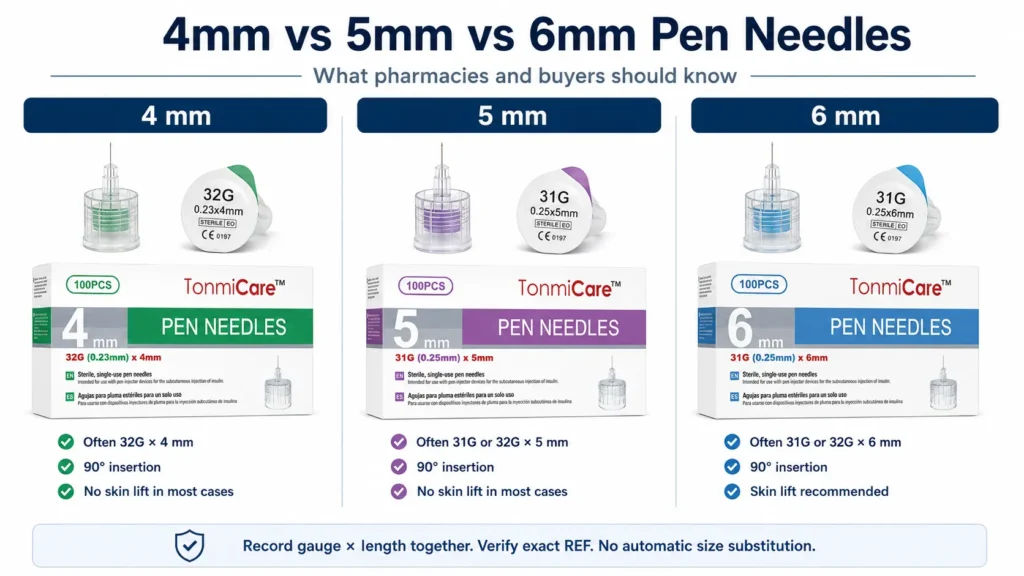
Pen Needle Size Comparison & Buyer Guide
An evidence-led comparison of 4 mm, 5 mm and 6 mm pen needles—covering length versus gauge, current injection-technique recommendations, compatibility, pharmacy substitution controls and wholesale SKU planning.
Reviewed by
Scope: This article supports education, dispensing and institutional purchasing. It does not select a needle for an individual, change a prescription or replace the instructions for the exact medication pen and needle. Product choice and injection technique should follow current labeling, professional guidance and patient-specific assessment. Commercial compatibility, documentation and availability must be confirmed by exact REF.
Direct answer
4mm vs 5mm vs 6mm Pen Needles: What Is the Practical Difference?
In a 4mm vs 5mm vs 6mm pen needles comparison, the numbers describe patient-end needle length—not thickness, medication dose or automatic compatibility. Current FITTER Forward recommendations call for a 90-degree insertion with all needle lengths. A skin lift is not needed in most cases with 4–5 mm pen needles, while a skin lift is recommended for 6 mm and longer needles. A skin lift may also be recommended with 4–5 mm for people with low BMI or lean body mass and children aged six years or younger.[1]
That population-level guidance does not make every 4 mm, 5 mm and 6 mm SKU interchangeable. A pharmacy or distributor must preserve the exact gauge, length, manufacturer, REF, hub design, compatible pen scope, labeling and package identity. The prescriber, pharmacist, diabetes-care team and applicable rules determine whether a different size may be used for an individual or substituted in dispensing.
1. Side-by-Side 4mm, 5mm and 6mm Pen Needle Comparison Chart
The useful comparison is not “shortest equals best.” It is how the length interacts with the exact gauge, injection technique, user assessment, compatible device and purchasing record. For the wider range of sizes and gauges, see the complete insulin pen needle sizes guide.
| Comparison point | 4 mm pen needle | 5 mm pen needle | 6 mm pen needle |
|---|---|---|---|
| What the number means | 4 mm patient-end length | 5 mm patient-end length | 6 mm patient-end length |
| Common market examples | Often 32G × 4 mm | 31G or 32G × 5 mm | 31G or 32G × 6 mm |
| Insertion angle | 90° under current FITTER guidance | 90° under current FITTER guidance | 90° under current FITTER guidance |
| Skin lift | Not needed in most cases; defined exceptions apply | Not needed in most cases; defined exceptions apply | Recommended under current FITTER guidance |
| Evidence position | Substantial short-needle evidence, with study limitations | Established adjacent short-length option | Valid option with a different technique boundary |
| Pharmacy substitution | Do not automatically substitute by length, appearance, shortage or price | ||
| Wholesale specification | Exact gauge × length + manufacturer + REF + compatible pen scope + package hierarchy | ||
How to read this chart
“Often” and “common” describe market configurations, not a fixed standard. A 4 mm needle is not automatically 32G, and a 6 mm needle is not automatically 31G. Verify the controlled specification and REF.
2. Pen Needle Length and Gauge Are Different Specifications
Length answers how long the patient-end needle is. Gauge describes the outside-diameter category using an inverse numbering convention: within a comparable system, a higher gauge number generally indicates a smaller outside diameter. Neither value proves the other.
This matters because a comparison of 32G × 4 mm with 31G × 5 mm changes two variables at once. If users report a difference in pain, flow, handling or preference, it cannot automatically be assigned to the 1 mm length difference. Tip geometry, wall design, lubricant, hub geometry, covers and manufacturing tolerances may also differ.
| Example | Length changed? | Gauge changed? | What the comparison can isolate |
|---|---|---|---|
| 32G × 4 mm vs 31G × 5 mm | Yes | Yes | Overall SKU experience, not length alone |
| 32G × 4 mm vs 32G × 6 mm | Yes | No | Closer length comparison, but tip and product design may still differ |
| 31G × 5 mm vs 32G × 5 mm | No | Yes | Closer gauge comparison, if other design features are controlled |
Buyer rule: write gauge × length together on every RFQ, sample-approval form, purchase order, barcode cross-reference and receiving record.
3. What Current Clinical Evidence Shows—and Does Not Show
The evidence supports short pen needles as effective options for subcutaneous insulin delivery, but it does not support a universal online prescription or automatic commercial substitution.
32G × 4 mm vs 31G × 5 mm or 8 mm
Adults using the 4 mm needle had equivalent glycemic control, no difference in reported leakage and lower pain ratings compared with the study comparators. The study was short, adult-only and changed gauge as well as length.[2]
32G × 4 mm vs 32G × 6 mm
The study reported comparable glycemic-control and safety outcomes, with the 4 mm product rated more favorably for pain and preference. Needle-tip shapes also differed, so length was not the only design variable.[3]
Technique differs at the 6 mm boundary
FITTER Forward recommends 90° insertion for all lengths, no skin lift in most cases for 4–5 mm, and a skin lift for 6 mm and longer, with additional exceptions for lean users and young children.[1]
A manufacturer’s current needle portfolio also states that its 4 mm product is associated with a lower intramuscular-injection risk than its 6 mm comparator and describes 4 mm use across BMI categories. Those are product-family claims supported by cited evidence; they should not be copied to every competing needle without confirming the exact product and evidence scope.[4]
Avoid an overbroad conclusion
“4 mm has strong supporting evidence” is defensible. “5 mm and 6 mm are obsolete,” “4 mm is best for everyone,” or “all short needles are interchangeable” is not supported by these studies.
4. Does a 1mm or 2mm Difference Matter?
Yes—but not in the simplistic sense that every 1 mm change produces a predictable clinical outcome. Moving from 4 mm to 5 mm changes the stated insertion length by 25%; moving from 4 mm to 6 mm changes it by 50%. Tissue depth, injection site, age, body composition, pressure, technique and device design still influence the real injection pathway.
| Usually not changed by length alone | May change or require review |
|---|---|
| Dose selected on the medication pen | Theoretical insertion depth and technique |
| Medication concentration | Skin-lift instruction at the 6 mm boundary |
| Need for a new needle at every injection | User perception, confidence and preference |
| Need to verify pen–needle compatibility | Prescription, formulary or dispensing status |
| Need for safe sharps disposal | REF, barcode, case pack and inventory record |
5. Injection Angle and Skin-Lift Requirements
The 2025 FITTER Forward recommendations provide a clear technique split: insert pen needles at 90°; a skin lift is not required in most cases with 4 mm and 5 mm needles; use a skin lift with 6 mm and longer needles. The recommendations also describe how a skin lift should be formed and advise keeping it until the needle is removed.[1]
| Needle length | Recommended angle | General skin-lift position | Important qualification |
|---|---|---|---|
| 4 mm | 90° | Not needed in most cases | Assess lean body mass, low BMI and young children |
| 5 mm | 90° | Not needed in most cases | Assess the same exceptions and current professional direction |
| 6 mm | 90° | Recommended | Follow the exact device instructions and training plan |
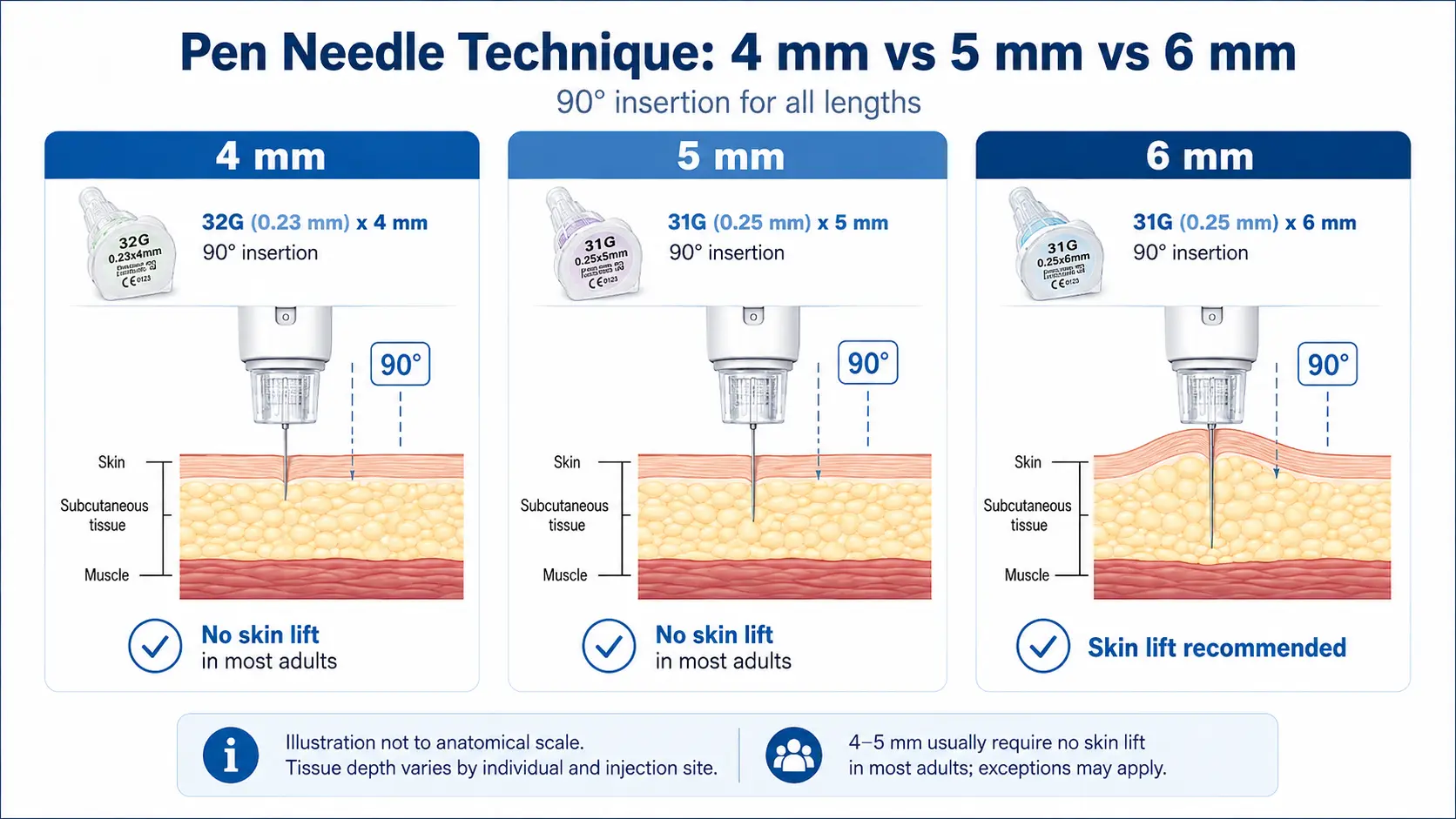
A blog should not turn this table into individualized technique training. The exact medication pen may require attachment, flow-check, dose-delivery, count-after-injection and removal steps that must come from its current instructions and the user’s healthcare professional.
6. BMI, Children and Lean-Body Considerations
Subcutaneous-tissue thickness varies by anatomical site and is influenced by age, BMI, sex, pregnancy status and individual body composition. FITTER Forward therefore recommends skin lifts for people with less subcutaneous tissue, including some older adults, children and people with low BMI or lean body mass. Its 4–5 mm exception specifically identifies BMI below 19 kg/m², lean body mass and children aged six or younger.[1]
Higher BMI does not, by itself, prove that a longer pen needle is required. Evidence and manufacturer materials support short-needle use across body sizes, but an individual’s medication, site, technique, dexterity and professional instruction still matter.[4] For pharmacy education, the correct message is “do not choose length from BMI alone,” not “BMI never matters.”
Useful counseling boundary
Pharmacy staff can identify the exact dispensed needle and direct the user to current instructions. Patient-specific changes to length, injection site or skin-lift technique should be routed to the prescribing or diabetes-care team under applicable practice rules.
7. Pain, Leakage and Glycemic-Control Evidence
Searchers often ask whether 4 mm hurts less or leaks more. The evidence needs careful wording. In the 2010 crossover trial, the 32G × 4 mm needle produced lower pain ratings than the 31G × 5 mm and 31G × 8 mm comparators, with similar reported leakage and equivalent glycemic control.[2] Because both gauge and length changed, the result does not isolate the effect of 1 mm.
The 2012 comparison held gauge at 32G while comparing 4 mm and 6 mm, and users rated the 4 mm needle more favorably for pain and preference. Yet the two needles also used different tip shapes, so product geometry still matters.[3] Neither study proves that every 4 mm product is painless or that every 5 mm or 6 mm product causes more pain.
| Evidence-aware statement | Claim to avoid |
|---|---|
| Selected trials found equivalent glycemic-control outcomes with the tested 4 mm products. | Every 4 mm needle delivers every drug identically. |
| Selected 4 mm products received lower pain ratings than their study comparators. | 4 mm pen needles are pain-free. |
| The 2010 trial found no difference in reported leakage. | A shorter needle can never leak. |
| Needle length is one factor among several. | Length alone determines comfort and performance. |
8. Pen and Device Compatibility Comes Before Size Preference
A 32G × 4 mm description does not prove that a needle is supported for a specific pen. Physical attachment is only one part of compatibility. The review should match the needle manufacturer and REF with the exact pen manufacturer, marketed name, model or presentation, target market and current labeling or controlled compatibility evidence.
ISO 11608-2:2022 specifies requirements and test methods for single-use, double-ended sterile needles intended for certain needle-based injection systems. Its scope is a useful technical baseline, but compliance with a general standard does not prove that every needle fits every pen; the exact device combination still needs controlled evidence.[7]
| Compatibility field | Evidence to capture | Buyer decision |
|---|---|---|
| Needle identity | Manufacturer, brand, REF, gauge, length and product family | Is this the exact item quoted and sampled? |
| Pen identity | Manufacturer, marketed name, model/presentation and country | Is this the device actually used by the program? |
| Evidence | Current IFU, controlled compatibility list or supported interface scope | Does it identify the quoted needle and intended pen? |
| Change status | Revision date, design/site change and notification process | Must the combination return to approval? |
For current standard product paths, buyers can review standard pen needle configurations. For purchasing, request exact-SKU evidence through SKU-specific product documentation support rather than relying on “universal,” “fits most” or a generic thread description.
9. GLP-1 Pens: Confirm the Device Presentation Before Choosing 4mm, 5mm or 6mm
“GLP-1 pen needle size” is not a complete question. Current U.S. products include multi-dose pens that use detachable needles, single-dose pens with integrated or concealed needles and vial presentations that use a separate syringe-and-needle pathway. A screw-on 4 mm, 5 mm or 6 mm needle is relevant only when the exact pen is designed to accept an external pen needle.
Use Tonmit’s current guide to check which GLP-1 pens require separate pen needles. Avoid phrases such as “4 mm needles fit all GLP-1 pens” or “all weekly pens need separate needles.” Device presentations and package contents can change.
10. Can Pharmacies Substitute 4mm, 5mm and 6mm Pen Needles?
Not automatically. A length change can affect the exact prescribed or dispensed product, technique instructions, barcode, formulary record, claim processing, patient education and inventory. A gauge change adds another product variable. Applicable prescribing, pharmacy, payer and jurisdictional requirements must be followed.
| Control field | Current SKU | Candidate SKU | Approval evidence |
|---|---|---|---|
| Exact identity | Manufacturer + REF | Manufacturer + REF | Both fully identified |
| Gauge × length | For example, 32G × 4 mm | For example, 31G × 5 mm | Each changed field visible |
| Pen scope | Approved models | Verified models | Current evidence reconciled |
| Technique | Current instruction | New instruction | Education impact assessed |
| Dispensing authority | Existing status | Required approval | Completed under applicable rules |
| Final status | Approved | Approved / restricted / rejected | No silent substitution |
Similar intended use does not create SKU equivalence. Shortage, lower price or a matching color does not authorize a 4→5 mm, 4→6 mm or gauge change.
11. Building a Controlled 4mm, 5mm and 6mm Pharmacy SKU Mix
The best assortment is the smallest controlled set that serves approved demand without forcing substitution. Start with dispensing history, prescribed specifications, compatible pen populations, customer requests, returns, backorders, case movement and remaining shelf-life requirements.
| SKU role | Planning question | Inventory control |
|---|---|---|
| Core stock | Which exact gauge × length drives repeat demand? | Set case quantity, reorder point and safety stock by REF |
| Adjacent stock | Does 5 mm or 6 mm demand justify a separate stocked position? | Use a unique barcode and block automatic replacement |
| Special order | Can lower-volume demand be supplied without local inventory? | Publish lead time and non-substitution status |
| Professional-use safety SKU | Does staff administration require evaluation of engineered protection? | Qualify design, training and disposal separately |
Facilities where employees administer injections should evaluate safer sharps devices and work-practice controls under their exposure-control process. OSHA requires applicable employers to consider appropriate, commercially available safer devices and involve relevant non-managerial healthcare workers in selection.[6] This workplace review is separate from a patient’s needle-length choice.
12. Packaging, Case Quantity and Replenishment
A “100-count” search term should not become an assumption. Verify units per box, boxes per inner carton, boxes per case, cases per pallet, barcode level, lot and expiration format, storage conditions and minimum remaining shelf life for the exact REF. Two 32G × 4 mm products can create different unit costs and warehouse work if their case quantities differ.
Base demand = users × injections requiring a detachable needle × planning days
Order need = base demand + approved operational reserve − usable on-hand inventory − confirmed inbound stock
Forecast from injection events, not simply the number of pens dispensed. Verify whether the exact medication presentation needs an external needle and whether any needles are included in the current carton. Do not reduce demand by assuming reuse; buyers can review why pen needles are labeled for single use.
When lead time or demand variability matters, confirm U.S.-warehouse inventory by exact SKU. Stock status should identify REF, available quantity, lot, expiration, allocation and replenishment source—not only “4 mm available.”
13. Buyer Checklist for 4mm, 5mm and 6mm Pen Needles
- Define the exact request. State gauge × length, standard or safety design, manufacturer/brand preference and target market.
- Identify every intended pen. Record manufacturer, marketed name, model/presentation and current instructions.
- Request the quoted REF. Do not approve a family-level brochure in place of SKU identity.
- Verify compatibility. Reconcile the exact needle and pen using current controlled evidence.
- Separate length from gauge. Make both changes visible during clinical, formulary and purchasing review.
- Review technique impact. Note the general 4–5 mm and 6 mm skin-lift boundary and route individual questions appropriately.
- Control substitution. Define approved, restricted and prohibited alternatives in writing.
- Normalize packaging. Compare units per box, boxes per case, total needles per case and barcode levels.
- Verify shelf life and supply. Set a remaining-life threshold and confirm lot, expiry, stock source and lead time.
- Plan disposal. Used pen needles belong in an appropriate sharps-disposal pathway; follow local and facility requirements.[5] For capacity planning, compare sharps container sizes by setting and waste volume.
Buyers comparing supply partners can evaluate an insulin pen needle supplier by exact-SKU evidence, packaging, traceability, shelf life, change control and replenishment support—not price alone. Available commercial paths are summarized on Tonmit’s wholesale insulin pen needle options page.
Buyer worksheet: SKU, compatibility and receiving QC
Use Tonmit’s blank review fields to compare exact 4 mm, 5 mm and 6 mm SKUs. Record the manufacturer/REF, gauge, pen model, controlled compatibility reference, box/case quantities, lot, expiry and receiving result. Separate documentary verification from actual shipment inspection.
Templates are blank; fill in verified supplier and shipment details.
Preview templates
Review date,Buyer,Needle manufacturer,Needle REF,Gauge,Length (mm),Intended pen model,Compatibility evidence/version,Units per box,Boxes per case,Lot,Expiry date,Seal condition,Label/UDI check,Shipment documents,Acceptance result,Follow-up/owner
,,,,4,,,,,,,,,,,,
,,,,5,,,,,,,,,,,,
,,,,6,,,,,,,,,,,,
Subject: 4 mm / 5 mm / 6 mm Pen Needle SKU Comparison RFQ
Buyer/company: [ ]
Market and destination ZIP/postal code: [ ]
Required configuration: 4 mm [ ]; 5 mm [ ]; 6 mm [ ]
Gauge by each length and standard/safety needle design: [ ]
Intended pen brand and exact model/presentation: [ ]
Manufacturer / brand / REF requested: [ ]
Current compatibility evidence / IFU revision: [ ]
Units per box / boxes per case / sample pack: [ ]
Order quantity / monthly forecast / MOQ: [ ]
Sterility and labeling / applicable records: [ ]
Shelf life remaining at receipt / lot details: [ ]
U.S. inventory or factory-direct route / freight basis: [ ]
Please quote each SKU separately, confirm compatibility and available documents for the exact REF, and do not substitute without written approval.
Method & limits: This is a buyer-prepared, empty QC/RFQ template illustrating what to capture at supplier qualification and receiving. It contains no Tonmit batch test result, clinical measurement, actual shipment inspection or customer case study. Apply each buyer’s documented acceptance policy.
Required product: [Standard / Safety] pen needle
Gauge × length: [32G × 4 mm / 31G × 5 mm / 31G × 6 mm / exact requirement]
Intended pen scope: [Manufacturer, marketed name, model/presentation and country]
Product identity: Disclose legal manufacturer, brand, product family and exact REF.
Compatibility evidence: Provide current evidence tied to the quoted needle and intended pen scope.
Packaging: [Needles/box] | [Boxes/case] | [Cases/pallet] | barcode level and dimensions.
Quantity: [Initial order] | [Monthly/annual forecast] | [Number of exact SKUs].
Shelf life: State labeled shelf life, lot/expiration before commitment and minimum remaining life at receipt.
Supply route: [U.S. stock / Factory direct] | Destination [ZIP/postal code].
Documents: Current label/IFU, product specification, applicable quality and traceability records.
Substitution: No change in gauge, length, manufacturer, REF, design, pack or compatibility scope without written approval.
Buyer FAQ: 4mm vs 5mm vs 6mm Pen Needles
What is the main difference between 4mm, 5mm and 6mm pen needles?
The numbers identify patient-end needle length. Current FITTER guidance recommends 90° insertion for all three; a skin lift is not needed in most cases for 4–5 mm, while it is recommended for 6 mm and longer. Gauge, design and compatibility remain separate specifications.
Does 1mm make a difference in a pen needle?
It changes the labeled length and the exact SKU. Its real effect depends on body site, tissue depth, technique and product design. One millimeter does not change the pen’s dose setting, but it can affect technique, prescription or formulary status and pharmacy substitution controls.
Is a 4mm pen needle thinner than a 5mm pen needle?
Not necessarily. Four and five millimeters describe length. Gauge describes diameter. A 32G × 4 mm needle is generally thinner than a 31G × 5 mm needle because its gauge is higher, not because it is shorter.
What is the difference between 32G × 4mm and 31G × 5mm?
Both length and gauge change: the first is 4 mm long at 32G, while the second is 5 mm long at 31G. Hub, tip, wall, lubricant, product family, REF and packaging may also differ, so compare the complete SKUs.
Are 4mm pen needles suitable for adults with a higher BMI?
Evidence and current product literature support short-needle use across body sizes, and higher BMI alone does not prove a longer needle is needed. Individual selection and technique should still follow current device instructions and professional assessment.
Do children or lean adults need a skin lift with a 4mm needle?
FITTER Forward recommends a skin lift for people with low BMI below 19 kg/m² or lean body mass and children aged six or younger, even in the 4–5 mm range. Individual instructions should come from the healthcare team familiar with the user and device.
Does a 6mm pen needle require a skin lift?
Current FITTER Forward recommendations call for a skin lift with 6 mm and longer needles and 90° insertion. Follow the exact pen and needle instructions and the user’s healthcare-professional guidance.
Is a 4mm pen needle always less painful than 5mm or 6mm?
No universal promise is justified. Selected trials reported lower pain ratings for tested 4 mm products, but gauge, tip design and other variables differed. Pain is also individual. Avoid “painless” claims.
Can a pharmacy substitute 4mm, 5mm and 6mm pen needles?
Do not automatically substitute them. Follow applicable prescription, dispensing, formulary, payer and jurisdictional requirements. Verify gauge, length, compatible pen scope, REF and education impact before an alternative is formally approved.
Do all insulin and GLP-1 pens use the same pen needles?
No blanket conclusion should be made. Verify the exact needle REF and pen. Some GLP-1 pens use an attachable needle, while others have an integrated needle or are supplied as vials requiring a different supply path.
Are 4mm, 5mm and 6mm pen needles always packed 100 per box?
No. One hundred per box is common, but packaging varies. Confirm needles per box, boxes per case, total needles per case, barcode level, lot format and shelf-life terms for the exact REF.
What information is needed for a wholesale pen needle quotation?
Provide exact gauge × length, standard or safety design, intended pen models, packaging, order and annual volume, destination, remaining shelf-life requirement, documentation needs, stock route and private-label status. Prohibit substitutions unless approved in writing.
14. Conclusion: Compare the Clinical Boundary and the Commercial SKU
The practical answer to 4mm vs 5mm vs 6mm pen needles is not a universal winner. Four and five millimeters share a current “no skin lift in most cases” technique position, while 6 mm crosses into a general skin-lift recommendation. Short-needle studies support the effectiveness and user acceptance of tested 4 mm products, but the results must be read with their gauge, design, population and study limitations.
For pharmacies and distributors, each gauge × length remains a distinct commercial SKU. Verify the needle REF, intended pen, current evidence, labeling, package hierarchy, shelf life, inventory source and authorized substitutions. That approach answers the user’s size question while preventing a comparison article from becoming an unsafe prescribing rule or an uncontrolled purchasing shortcut.
Exact-SKU pen needle support
Request a 4mm, 5mm or 6mm Pen Needle SKU Review
Send Tonmit your required gauge × length, intended pen models, product design, units per box, case quantity, annual volume, destination, remaining shelf-life threshold and required documents. We can organize the request around the exact quoted REF and supply route.
Final compatibility, product documentation, availability, packaging, remaining shelf life, price and delivery are confirmed by exact SKU and transaction. The link carries RFQ context; automatic form prefilling requires the commercial page to read these parameters.References
- Klonoff DC, et al. “Advance Insulin Injection Technique and Education With FITTER Forward Expert Recommendations.” Mayo Clinic Proceedings. 2025;100(4):682–699. Technique infographic reviewed August 10, 2026. View FITTER Forward technique recommendations.
- Hirsch LJ, et al. “Comparative glycemic control, safety and patient ratings for a new 4 mm × 32G insulin pen needle in adults with diabetes.” Current Medical Research and Opinion. 2010;26(6):1531–1541. PMID: 20429832. View PubMed record.
- Miwa T, et al. “Comparison of the effects of a new 32-gauge × 4-mm pen needle and a 32-gauge × 6-mm pen needle on glycemic control, safety, and patient ratings in Japanese adults with diabetes.” Diabetes Technology & Therapeutics. 2012. PMID: 23030357. View PubMed record.
- Novo Nordisk. “Needle Portfolio.” Current manufacturer information and cited evidence for selected NovoFine product claims; reviewed August 10, 2026. View manufacturer resource.
- U.S. Food and Drug Administration. “Best Way to Get Rid of Used Needles and Other Sharps.” Reviewed August 10, 2026. View FDA sharps guidance.
- Occupational Safety and Health Administration. “Bloodborne Pathogens and Needlestick Prevention—Quick Reference Guide.” Reviewed August 10, 2026. View OSHA guidance.
- International Organization for Standardization. “ISO 11608-2:2022— Needle-based injection systems for medical use—Part 2: Double-ended pen needles.” Published April 2022; reviewed August 10, 2026. View ISO scope.