
Wholesale Buying & Supply Planning Guide
A practical buying guide for pharmacies and distributors comparing bulk insulin pen needles, box and case quantities, MOQ, landed cost and replenishment.
Reviewed by
Supplier Evaluation Reviewer
Supply Chain & Fulfillment Reviewer
Scope: Institutional purchasing guidance. Confirm the exact product, pen instructions, target-market requirements and organizational policy. Final compatibility, stock, documentation and commercial terms require SKU-specific review.
Quick answer
What should you check before buying pen needles in bulk?
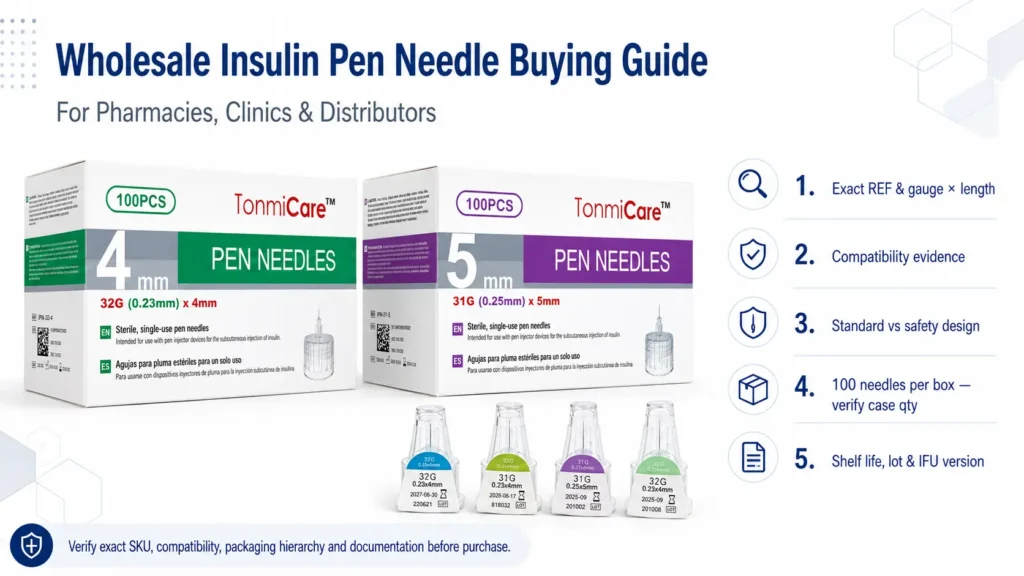
- Define the SKU: manufacturer, exact REF, standard or safety design, gauge × length.
- Verify compatibility: current evidence for the intended pen model and market.
- Confirm pack counts: needles per box, boxes per case and total needles per case.
- Compare landed cost: delivery and handling costs divided by saleable needles.
- Separate MOQs: available stock, factory pack, private-label print and custom packaging.
- Set acceptance terms: documents, lot/expiry, remaining shelf life and substitution approval.
Buying sequence: specify → verify → compare → qualify → receive → replenish.
1. Define specifications and verify compatibility
Record the complete commercial SKU
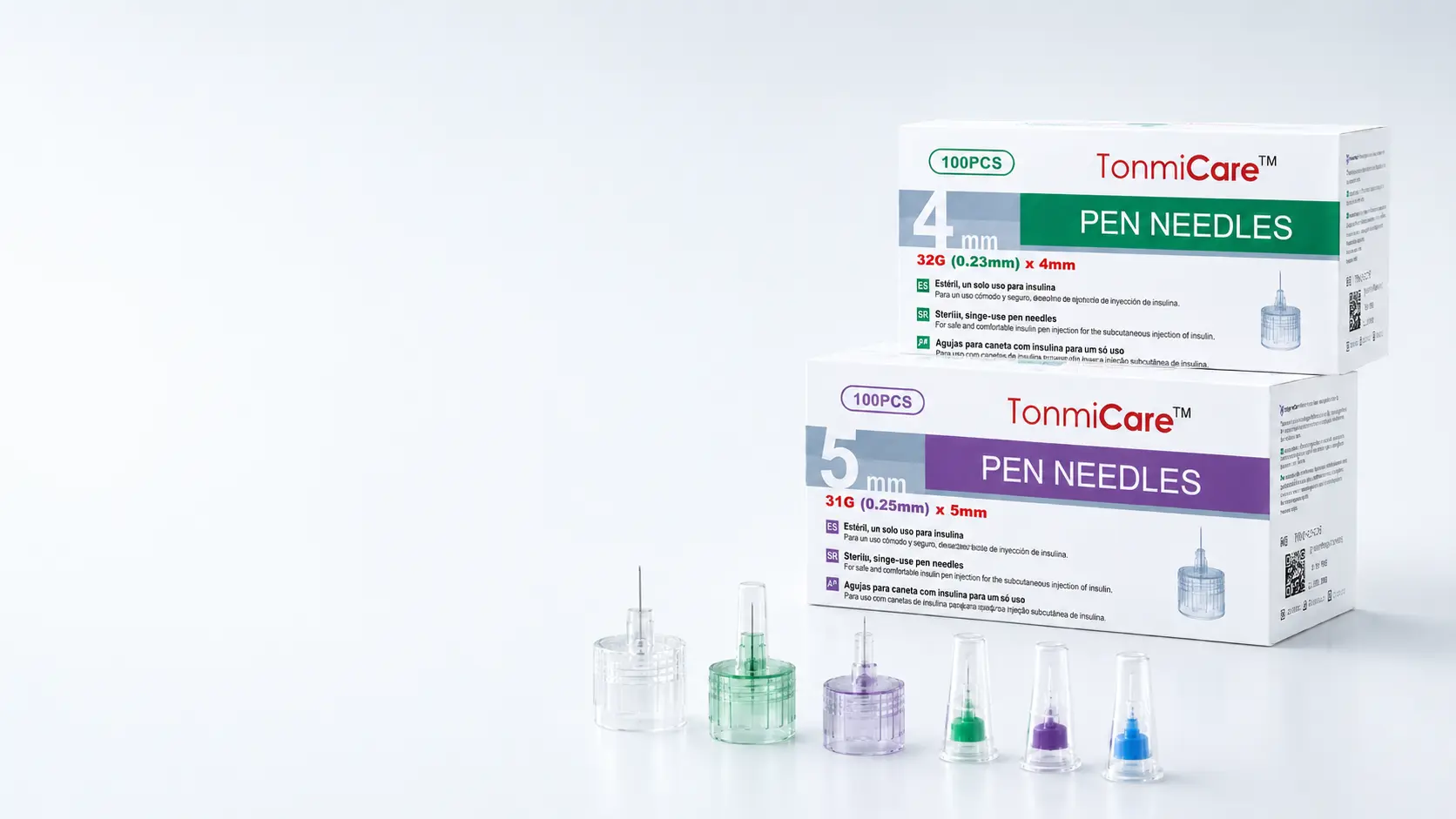
Start with the complete commercial SKU. “32G 4 mm” and “100 count” do not identify the hub, protective components, manufacturer, REF, pen scope or packaging revision.
| SKU field | What the buyer records | Why it matters |
|---|---|---|
| Product design | Standard or safety; commercial family where relevant | Separates use steps, shields, training and cost |
| Gauge × length | For example, 32G × 4 mm | Locks both diameter category and patient-end length |
| Manufacturer and REF | Legal manufacturer, brand/labeler and exact catalog number | Connects the quotation to labels, evidence and ordering data |
| Compatibility scope | Exact pens or defined interface supported by current evidence | Prevents approval from physical attachment alone |
| Sterile presentation | Single-use status, sterile barrier and opening method | Controls receipt, storage, damage and release criteria |
| Package hierarchy | Needles/box, boxes/case, cases/pallet, dimensions and weight | Enables case math, freight quotes and warehouse planning |
| Identifiers and revision | UDI/GTIN where applicable, label/IFU version, lot and expiry format | Supports item-master control, traceability and receiving |
Review wholesale insulin pen needle options for a shortlist, then approve the exact configuration and transaction using the fields above.
Separate standard, Plus and safety designs
Separate standard and safety designs before comparing price. FDA documentation describes common and safety configurations separately.[2] Tonmit’s “Plus” is a commercial family, not a separate regulatory classification or proof of a safety mechanism.
| Category | Procurement meaning | Minimum review | Substitution control |
|---|---|---|---|
| Standard pen needle | Conventional hub and removable cover/shield workflow | Both protective components, IFU, gauge × length, interface and pack | Approve only the exact REF and user instructions |
| Plus design family | Selected commercial handling or tip-design features within a product range | Verify each claimed feature, evidence, SKU and whether the device is standard or safety type | Do not infer equivalence from the word “Plus” |
| Safety pen needle | Engineered sharps-protection feature with its own activation and lockout behavior | Shield coverage, activation, dose visibility, training, disposal and workplace evaluation | Never auto-substitute with a standard needle |
FDA describes different cover and shield workflows that can cause confusion when products are switched.[3] OSHA requires employers to evaluate appropriate, effective and commercially available safer devices for their exposure situations.[4] The cited FDA device is an example, not clearance evidence for every Tonmit SKU.
Compare standard pen needles and Plus pen needle options by their actual instructions and features.
Buying 32G 4mm insulin pen needles in bulk
A request for 32G 4mm insulin pen needles in bulk needs the same identity and compatibility checks as any other specification. Higher gauge numbers generally indicate a smaller outside diameter; gauge alone does not establish length, pen fit or user suitability.
| Example RFQ specification | Typical procurement role | What it does not prove | Required follow-up |
|---|---|---|---|
| 32G × 4 mm | Short, fine-gauge RFQ example | Pen fit, product family, tip design or pack count | REF, compatibility, label, IFU, case pack and stock |
| 31G × 5 mm | Adjacent short-length option for defined assortments | Equivalence to 4 mm or 6 mm | Approved demand, substitution rule and exact case quantity |
| 31G × 6 mm | Mid-length configuration in selected product families | Standard versus safety design | Shield workflow, exact REF and intended setting |
| 31G × 8 mm | Longer option maintained for established demand | Permission to replace a shorter approved needle | Demand record, compatibility and formulary approval |
| Other gauge × length | Special-order, legacy or buyer-specific requirement | Current production, documentation or U.S. availability | MOQ, lead time, evidence and change-control review |
These are procurement examples, not sales rankings or patient recommendations. Check current product-family configurations and the pen needle sizes guide, then use actual customer demand to set the assortment.
Match evidence to the intended pen
ISO 11608-2:2022 covers single-use, double-ended, sterile needles for some non-integrated needle-based injection systems.[1] A standard does not establish universal compatibility; retain current evidence for the quoted needle and intended pen.
| Compatibility field | Evidence to retain | Approval question |
|---|---|---|
| Needle identity | Manufacturer, trade name, exact REF, gauge, length and current label | Does the evidence identify the same SKU being quoted? |
| Pen identity | Manufacturer, marketed name, device model/presentation and current instructions | Is this the pen actually used by the target program? |
| Needle evidence | Current IFU, controlled compatibility list or relevant test documentation | Does it name the intended pen or a clear interface scope? |
| Pen instructions | Current pen labeling and needle-attachment directions | Are named needle types, restrictions or setup steps consistent? |
| Revision control | Document date, version and change-notification process | Will a hub, claim, pen or labeling change trigger re-review? |
| Decision record | Approved, restricted, pending or rejected status | Can purchasing and receiving identify the approved combination? |
Better RFQ language: “Compatibility documentation available for review for the listed pen injector models; approval is limited to the exact quoted needle REF and current evidence.”
Do not accept “fits every pen” as evidence. For GLP-1 programs, first check the exact marketed device presentation; attachable-needle pens and integrated-needle devices have different supply needs.
2. Compare pack quantities, landed cost and MOQ
How many pen needles are in a box or case?
Insulin pen needles in 100-count boxes are one presentation, not a universal rule. A manufacturer guide lists 30-, 50- and 100-count products.[5] Confirm each packaging level for the exact REF.
| Packaging level | Fields to request | Operational use |
|---|---|---|
| Individual sterile unit | Barrier format, opening, product marking and damage criteria | Release, handling and end-user presentation |
| Dispenser/retail box | Needles per box, REF, UDI/GTIN where applicable, lot and expiry | Item master, dispensing, picking and reimbursement data |
| Inner carton | Boxes per inner carton, dimensions, weight and barcode | Warehouse break-pack and storage |
| Shipping case | Boxes per case, total needles, dimensions, gross weight and markings | Quote comparison, freight and receiving |
| Pallet | Cases per layer, layers, total cases, height, weight and pallet type | Container planning, warehouse capacity and damage control |
Needles per case = needles per box × boxes per case
Saleable needles received = received boxes × needles per box − rejected or damaged needles
Keep inner-pack, box, case and pallet counts as separate item-master fields. Do not derive one level from a supplier image or historical purchase order.
Do not confuse retail box, inner pack and shipping case. For different pack requirements, review custom packaging and labeling before fixing case quantities.
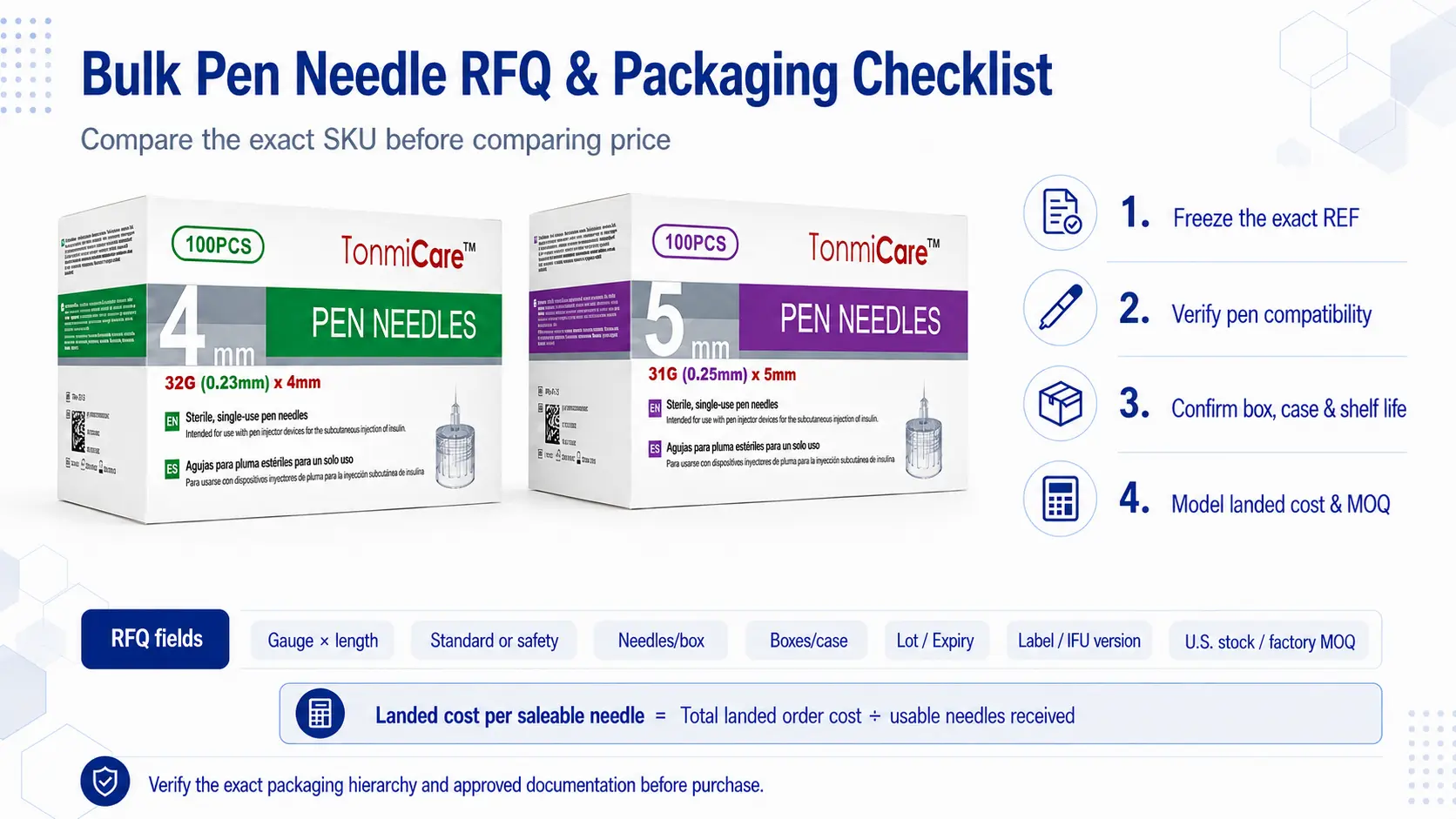
Calculate landed cost per saleable needle
Headline price per box is not comparable when pack counts, shipping terms, import responsibilities, remaining shelf life or rejected units differ. Convert every quotation to one common denominator and document all included and excluded costs.
Landed order cost = product + custom packaging + freight + insurance + duty/brokerage where applicable + domestic delivery + inspection and handling
Landed cost per saleable needle = landed order cost ÷ saleable needles received
Usable-life cost adjustment = account for units unlikely to sell before the buyer’s required expiry window
| Cost field | Quote A | Quote B | Buyer normalization |
|---|---|---|---|
| Exact REF and design | Record | Record | Stop if SKUs are not technically comparable |
| Needles/box and boxes/case | Record | Record | Convert to needles per case |
| Freight and delivery term | Included/excluded | Included/excluded | Model to the same destination and responsibility point |
| Remaining shelf life | Months/% | Months/% | Apply the same acceptance threshold |
| Damage/shortage allowance | Terms | Terms | Use saleable units, not invoiced units |
| Payment terms | Terms | Terms | Account for working-capital effect |
| Shortage exposure | Lead-time risk | Lead-time risk | Document emergency replenishment cost |
Ask for four separate MOQs
There is no single wholesale pen needle MOQ. Request separate minimums for stocked goods, production, private-label printing and custom packaging; each can be driven by different constraints.
| MOQ type | What it covers | Buyer question |
|---|---|---|
| U.S. stock order minimum | Available finished goods already held domestically | What exact REF, lot, quantity and remaining shelf life are available now? |
| Factory-standard MOQ | Normal production in an existing product and packaging format | Is the MOQ per SKU, gauge × length, box artwork or purchase order? |
| Private-label printing MOQ | Buyer brand applied to an approved standard configuration | Which packaging levels, plates, labels and inserts create separate minimums? |
| Custom configuration MOQ | New pack count, artwork, carton, barcode or technical variation | Which elements require validation, tooling, regulatory review or dedicated inventory? |
Confirm MOQ per REF and packaging revision. An order-wide minimum does not necessarily satisfy each size’s production or print minimum.
3. Choose a supply route and private-label scope
Compare U.S. stock, factory-direct and hybrid supply
Choose the supply route from delivery urgency, recurring volume, customization and working capital. Compare identical approved SKUs, or document the differences before comparing cost.
| Supply model | Best-fit need | Main advantage | Critical buyer checks |
|---|---|---|---|
| U.S. warehouse stock | Urgent or routine replenishment of selected finished SKUs | Shorter domestic fulfillment path | Exact on-hand REF, lot, expiry, quantity, allocation and replenishment source |
| Factory-direct standard pack | Predictable volume and planned case/pallet buys | Production-scale economics and upstream planning | MOQ, production lead time, shipping term, importer roles, customs and buffer stock |
| Private label / OEM | Recurring branded programs with sufficient volume | Controlled market presentation and pack design | Product identity, labeling roles, artwork, UDI, print MOQ, validation and change control |
| Hybrid replenishment | Domestic buffer plus planned factory supply | Balances speed, continuity and upstream cost | Whether both routes provide the same approved SKU, label and case configuration |
If sourcing an insulin pen needle supplier with U.S. inventory, confirm warehouse availability by REF, quantity, lot and expiry. Tonmit’s warehouse support is SKU-specific; a domestic route does not guarantee every configuration is stocked.
Set private-label product and packaging controls
Private label insulin pen needles require product, labeling, packaging and role control—not just a new logo. Define the target market and responsibilities before approving artwork.
| Project stage | Required decision | Common failure |
|---|---|---|
| Product lock | Exact REF, gauge × length, design and compatibility scope | Artwork begins before the product is frozen |
| Role mapping | Manufacturer, labeler, importer, distributor and complaint contacts | Commercial brand ownership is confused with manufacturing responsibility |
| Artwork control | Approved text, symbols, claims, barcode, lot/expiry fields and IFU | Design files contain unsupported compatibility or performance claims |
| Validation and approval | Pack integrity, print proof, production sample and controlled release | A visual proof is treated as full product approval |
| Lifecycle control | MOQ, inventory ownership, revision, obsolescence and change notice | Old and new packaging revisions mix in the same item master |
Tonmit is the company and supply partner; TonmiCare is a product brand for selected lines. Customer-branded or OEM projects depend on the exact product, feasibility, documentation, market and order volume.
4. Qualify documents, samples and receiving terms
Reconcile documentation and traceability
Match documents to the purchased product. FDA says registration and listing do not denote approval, clearance or authorization, and it does not issue registration certificates to device facilities.[6]
UDI identifies the labeler and device version or model; applicable production identifiers can include lot and expiry.[7] Cross-reference UDI/GTIN and distributor numbers to the manufacturer REF and packaging level.
FDA’s QMSR took effect February 2, 2026, incorporating ISO 13485:2016 for covered manufacturers.[8] Review records and change controls through SKU-specific documentation support; a certificate logo alone is insufficient.
Qualify the sample and first bulk order
Record whether samples come from current stock, production, a pilot run or an older lot. Capture REF, lot, expiry, label revision and the evidence reviewed; require bulk supply to match the approved version.
REF, gauge, length, design, label and lot
Compatibility, IFU and applicable documents
Barrier, hub, covers, markings and count
Attachment, removal, training and disposal
Same approved version, pack and acceptance criteria
Use the receiving checklist for document and visual checks. Attachment or functional evaluation requires a separate approved protocol and appropriate personnel. Sample approval does not authorize an unapproved substitute.
Set remaining shelf life and receiving rules
Specify minimum remaining shelf life at receipt, how it is measured and the remedy for short-dated delivery. Set the threshold from transit, storage and sell-through needs, rather than copying another buyer’s number.
Remaining shelf life at receipt = expiration date − actual receipt date
Remaining shelf-life percentage = remaining shelf life at receipt ÷ labeled shelf life × 100
Define whether the contract threshold is expressed in months, percentage, or both, and state who bears the risk of customs, carrier or warehouse delay.
Record identity, pack quantity, damage, lot/expiry and revision with the downloadable receiving checklist. Hold discrepancies under the buyer’s procedure; define concealed-damage, short-shipment, returns and replacement terms before ordering. Use first-expire, first-out (FEFO) handling for accepted lots.
5. Select the supplier and plan replenishment
Pass the gates before weighted scoring
Pass the identity, compatibility, documentation, traceability and change-control gates before weighted scoring. Price cannot compensate for an unresolved gate. Use the supplier qualification guide for a deeper review.
| Pass/fail gate | Pass requirement |
|---|---|
| Identity | Manufacturer, labeler, exact REF and current commercial version are disclosed and reconcilable |
| Compatibility | Current evidence covers the quoted needle and intended pen or controlled interface scope |
| Documentation | Applicable product, label, IFU and quality records map to the exact SKU |
| Traceability | Lot, expiration, packaging version and transaction records can be retained and retrieved |
| Substitution/change | No product, site, design, label, pack or compatibility change without agreed notification and approval |
View the suggested 100-point weighting
| Evaluation category | Suggested weight | Evidence to score |
|---|---|---|
| Exact SKU and compatibility evidence | 20 points | REF-specific records, pen/interface scope and revision control |
| Product and quality documentation | 15 points | Complete, current, reconcilable documentation package |
| Packaging and traceability | 10 points | Pack hierarchy, identifiers, lot and recall readiness |
| Landed cost | 15 points | Normalized cost per saleable needle on matched terms |
| Remaining shelf life | 10 points | Contract threshold, lot visibility and short-date remedy |
| Lead time and U.S. stock | 10 points | Actual inventory, replenishment source and fill-rate history |
| MOQ flexibility | 5 points | Separate stock, production, print and custom-pack minimums |
| Change-control process | 5 points | Advance notice, review triggers and transition inventory |
| Private-label capability | 5 points | Role mapping, artwork, validation and lifecycle process |
| Complaint and replenishment support | 5 points | Escalation contacts, response times and corrective action |
The downloadable scorecard uses illustrative weights totaling 100. Adjust them to the program, record evidence and keep the final approval with authorized personnel. A score is not a release certificate.
Resolve red flags before progressing
Pause and request evidence when:
- Manufacturer, REF or standard/safety design is undisclosed.
- “Universal fit” or an unofficial “FDA certificate” replaces product records.
- Box/case counts, lot, expiry or remaining shelf life are missing.
- One MOQ covers every route, or sample and bulk versions are not reconciled.
- Substitutions, changes, complaints or recalls lack agreed controls.
Document the resolution before progressing. A red flag calls for investigation; it does not by itself prove a supplier unacceptable.
Set the forecast and reorder point
Use actual exact-SKU movement, contracts and lead-time history to plan the mix. Search terms and portfolio examples do not establish a pharmacy’s best-selling sizes.
Average monthly demand = total exact-SKU demand during the analysis period ÷ months in the period
Lead-time demand = average demand per day or week × replenishment lead time in the same unit
Reorder point = lead-time demand + approved safety stock
Net requirement = forecast demand + target ending inventory − usable on-hand stock − confirmed inbound stock
Normalize demand to needles when box counts differ, and retain the conversion. Plan single-use demand from labeling and organizational practice; see the pen needle reuse guide.
Plan sharps capacity too. FDA recommends immediate placement of used sharps in appropriate containers.[9] Align forecasts with the facility’s disposal workflow and container requirements.
6. Download the RFQ and procurement worksheets
Send the same RFQ to each shortlisted supplier. Keep the receiving and supplier comparison records with the purchase order.
Wholesale RFQ
Complete the bracketed fields before sending.
View and manually copy the template
Subject: Wholesale insulin pen needle RFQ — [Organization / market]

Buyer / channel / destination: [ ]
Design / family: [Standard or Safety / family]
Gauge x length / manufacturer / exact REF: [ ]
Intended pen manufacturer, model, presentation and market: [ ]
Initial quantity / annual forecast / required delivery: [ ]
Needles per box / boxes per case / cases per pallet: [ ]
Supply route / private-label scope: [ ]
Minimum remaining shelf life at receipt: [ ]

Please provide current compatibility evidence, label and IFU, single-use sterile presentation, applicable product and quality records, UDI/GTIN where applicable, lot/expiry disclosure and packaging revision.
Quote stock, factory-pack, print and custom-pack MOQs separately per REF. State unit/box/case prices, delivery term, freight, payment, lead time, quote validity and damage/shortage remedies.
For U.S. stock, confirm exact REF, quantity, lot, expiry and allocation. For private label, define labeling roles, artwork, IFU/barcodes and approval steps.
Identify sample origin, lot and revision; confirm how bulk supply matches the approved sample. Agree change-notice and buyer-approval requirements. No substitution without written authorization.
Receiving checklist
One record per receipt and lot; all checks start unreviewed.
Preview the worksheet fields
| Receiving check | Initial status | Reference / evidence to retain |
|---|---|---|
| Manufacturer / labeler / exact REF | Not reviewed | Match approved product identity |
| Design / gauge x length / family | Not reviewed | No unauthorized standard/safety or family substitution |
| Approved label / IFU revision | Not reviewed | Record source and version |
| Intended pen / compatibility evidence reference | Not reviewed | Document check; no compatibility test performed by this sheet |
| Needles per box / boxes per case / case count | Not reviewed | Reconcile PO and actual quantity |
| Lot / expiration / UDI or GTIN where applicable | Not reviewed | Record each lot separately |
| Minimum remaining shelf life at receipt | Not reviewed | Compare actual receipt and expiry against contract |
| Carton / box / sterile-barrier visual condition | Not reviewed | Visual screening does not establish sterility |
| Sample-to-production match / approved changes | Not reviewed | Retain approval evidence |
"Field / check","Reference / value","Status","Evidence / notes"
"Worksheet","Tonmit pen needle receiving checklist","","Blank procurement record; not a product or lot-release certificate"
"Buyer / reviewer / receipt date","","",""
"PO / supplier / invoice","","",""
"Manufacturer / labeler / exact REF","","Not reviewed","Match approved product identity"
"Design / gauge x length / family","","Not reviewed","No unauthorized standard/safety or family substitution"
"Approved label / IFU revision","","Not reviewed","Record source and version"
"Intended pen / compatibility evidence reference","","Not reviewed","Document check; no compatibility test performed by this sheet"
"Needles per box / boxes per case / case count","","Not reviewed","Reconcile PO and actual quantity"
"Lot / expiration / UDI or GTIN where applicable","","Not reviewed","Record each lot separately"
"Minimum remaining shelf life at receipt","","Not reviewed","Compare actual receipt and expiry against contract"
"Carton / box / sterile-barrier visual condition","","Not reviewed","Visual screening does not establish sterility"
"Sample-to-production match / approved changes","","Not reviewed","Retain approval evidence"
"Discrepancies / hold reference / escalation contact","","",""
"Buyer disposition / authorization / date","","Pending","Complete under the buyer's approved procedure"
"Method limits","Document and visual screening only","","No verification of sterility, needle dimensions, penetration force, dose accuracy, flow, leakage or compatibility performance"
Supplier scorecard
Pass/fail gates first; suggested weights total 100.
Preview the worksheet fields
| Supplier review field | Weight / initial status | Evidence to retain |
|---|---|---|
| Identity | Not reviewed | Manufacturer and exact product identity reconcile |
| Compatibility | Not reviewed | Current evidence covers intended pen or controlled interface scope |
| Documentation | Not reviewed | Applicable records map to exact SKU |
| Traceability | Not reviewed | Lot, expiry, revision and transaction records retrievable |
| Substitution / change | Not reviewed | Agreed advance notice and written approval |
| Exact SKU and compatibility evidence | 20 points; unscored | REF-specific records, pen/interface scope and revision control |
| Product and quality documentation | 15 points; unscored | Complete, current, reconcilable documentation package |
| Packaging and traceability | 10 points; unscored | Pack hierarchy, identifiers, lot and recall readiness |
| Landed cost | 15 points; unscored | Normalized cost per saleable needle on matched terms |
| Remaining shelf life | 10 points; unscored | Contract threshold, lot visibility and short-date remedy |
| Lead time and U.S. stock | 10 points; unscored | Actual inventory, replenishment source and fill-rate history |
| MOQ flexibility | 5 points; unscored | Separate stock, production, print and custom-pack minimums |
| Change-control process | 5 points; unscored | Advance notice, review triggers and transition inventory |
| Private-label capability | 5 points; unscored | Role mapping, artwork, validation and lifecycle process |
| Complaint and replenishment support | 5 points; unscored | Escalation contacts, response times and corrective action |
"Record type","Criterion / field","Maximum points","Score / status","Evidence / notes"
"Worksheet","Tonmit pen needle supplier comparison","","","Illustrative procurement framework; not a validated rating or supplier certification"
"Record","Buyer / evaluator / date","","",""
"Record","Supplier / quoted manufacturer / REF / revision","","",""
"Gate","Identity","","Not reviewed","Manufacturer and exact product identity reconcile"
"Gate","Compatibility","","Not reviewed","Current evidence covers intended pen or controlled interface scope"
"Gate","Documentation","","Not reviewed","Applicable records map to exact SKU"
"Gate","Traceability","","Not reviewed","Lot, expiry, revision and transaction records retrievable"
"Gate","Substitution / change","","Not reviewed","Agreed advance notice and written approval"
"Weighted criterion","Exact SKU and compatibility evidence","20","","REF-specific records, pen/interface scope and revision control"
"Weighted criterion","Product and quality documentation","15","","Complete, current, reconcilable documentation package"
"Weighted criterion","Packaging and traceability","10","","Pack hierarchy, identifiers, lot and recall readiness"
"Weighted criterion","Landed cost","15","","Normalized cost per saleable needle on matched terms"
"Weighted criterion","Remaining shelf life","10","","Contract threshold, lot visibility and short-date remedy"
"Weighted criterion","Lead time and U.S. stock","10","","Actual inventory, replenishment source and fill-rate history"
"Weighted criterion","MOQ flexibility","5","","Separate stock, production, print and custom-pack minimums"
"Weighted criterion","Change-control process","5","","Advance notice, review triggers and transition inventory"
"Weighted criterion","Private-label capability","5","","Role mapping, artwork, validation and lifecycle process"
"Weighted criterion","Complaint and replenishment support","5","","Escalation contacts, response times and corrective action"
"Summary","Total available","100","","Score each category from 0 to its maximum; do not rank unresolved gates"
"Decision","Authorized buyer decision","","Pending","No automatic approval; retain rationale and authorization"
"Method limits","Illustrative weights only","","","Adapt to the program; document review is not laboratory testing or regulatory certification"
Blank buyer records. Document and visual checks do not establish sterility or functional performance; scoring weights are illustrative.
Template method and limits
Method and limits: Tonmit’s editorial procurement templates organize the controls in this guide. They contain no test results, inspected-lot data or customer case claims. The receiving sheet supports document and visual screening; the score weights are illustrative. Buyers must apply their own evaluation and approval procedures.
Buyer FAQ: Wholesale Insulin Pen Needles
Are all insulin pen needles universally compatible?
No. Match current needle evidence and pen instructions to the exact REF, model, market and revision. Physical attachment alone is insufficient.
How do I buy 32G 4mm insulin pen needles in bulk?
Specify the exact REF and product design, intended pens, box/case counts, volume and destination. Request compatibility evidence, MOQ, stock, shelf life and delivery terms; 32G 4 mm alone is incomplete.
How many pen needles are in a box or case?
Counts vary by REF. Confirm needles per box and boxes per case, then multiply them. A 100-count box does not establish the shipping-case quantity.
How should buyers compare wholesale pen needle pricing?
Compare equivalent SKUs and terms. Divide product, packaging, freight, applicable import costs, delivery and inspection costs by saleable needles; assess remaining shelf life separately.
Are standard and safety pen needles interchangeable?
Do not automatically substitute them. Protective mechanisms, instructions, training and workplace evaluation can differ even when gauge and length match.
What documentation belongs with a bulk order?
Retain identity, current label/IFU, compatibility and applicable quality/product records, pack counts and transaction lot/expiry. Check that each document covers the quoted SKU.
What shelf-life threshold should a buyer require?
Set a contract threshold at receipt using transit, storage and sell-through needs. Define measurement, lot disclosure and remedies; there is no universal remaining-life minimum.
What is the MOQ for wholesale or private-label pen needles?
Request separate minimums for available stock, production, print runs and custom packaging per REF and revision. The supplier must confirm current quantities; this guide does not promise one fixed MOQ.
Do all GLP-1 pens require separate pen needles?
No. Check the exact marketed presentation and current instructions. Attachable-needle pens, integrated-needle devices and vials have different supply requirements.
Can I request pen needles from a U.S. warehouse?
Request confirmation for the exact REF, quantity, lot, expiry, allocation and delivery destination. Domestic warehouse support does not mean all sizes or private-label configurations are stocked.
Wholesale pen needle support
Request a matched wholesale pen needle quote
Send us your specification, intended pens, volume, destination and preferred supply route. We will confirm the exact SKU, available packaging and quotation terms.
Compatibility, availability, documentation, packaging, remaining shelf life, inventory, price and delivery are confirmed for the exact SKU and transaction.References
- International Organization for Standardization. “ISO 11608-2:2022 — Needle-based injection systems for medical use — Part 2: Double-ended pen needles.” Published April 2022; reviewed August 10, 2026. View ISO scope.
- U.S. Food and Drug Administration. “510(k) Summary, K161950 — Common Type and Safety Type Insulin Pen Needle.” Reviewed August 10, 2026. View FDA 510(k) summary.
- U.S. Food and Drug Administration. “Pen Needles — Labeling Change Request Letter.” September 26, 2018; reviewed August 10, 2026. View FDA letter.
- Occupational Safety and Health Administration. “Bloodborne Pathogens and Needlestick Prevention — Quick Reference Guide.” Reviewed August 10, 2026. View OSHA guidance.
- UltiMed, Inc. “Pen Needles & Insulin Syringes Product Guide.” Manufacturer guide showing selected 30-, 50- and 100-count pen needle box presentations; reviewed August 10, 2026. View manufacturer guide.
- U.S. Food and Drug Administration. “Important Reminders About Registration and Listing.” Reviewed August 10, 2026. View FDA reminder.
- U.S. Food and Drug Administration. “UDI Basics.” Reviewed August 10, 2026. View FDA UDI resource.
- U.S. Food and Drug Administration. “Quality Management System Regulation (QMSR).” Effective February 2, 2026; reviewed August 10, 2026. View FDA QMSR resource.
- U.S. Food and Drug Administration. “Sharps Disposal Containers.” Reviewed August 10, 2026. View FDA sharps resource.