
U.S. Pharmacy SKU & Inventory Guide
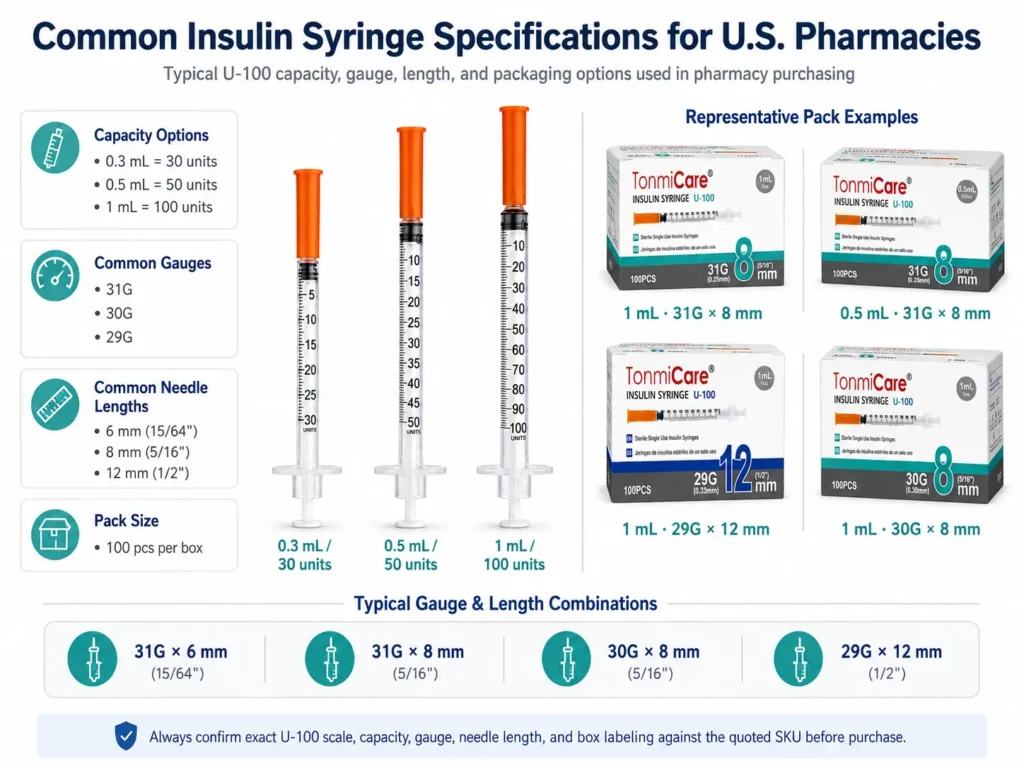
For U-100 pharmacy purchasing, start with 0.3 mL, 0.5 mL and 1 mL capacity categories, then verify the exact scale, graduation, gauge, needle length and package by manufacturer REF. Catalog listings identify candidates; local demand determines the stocking mix.
Reviewed by
Review scope and backgrounds
Review scope: Capacity, concentration scale, graduation, needle dimensions and exact-SKU comparisons.
Background: Medical-consumable specifications, product configurations and supplier product information.
Review scope: Sterility, traceability, receiving evidence and document limitations.
Background: Quality-documentation review for medical consumables and related supply programs.
Review scope: Label fields, primary presentation, package hierarchy and artwork controls.
Background: Medical-consumable packaging, label-content review and private-label project support.
Scope: This is an institutional purchasing resource, not patient-specific dosing or product-selection advice. Match the insulin concentration, syringe scale and exact configuration to current drug labeling, prescriptions, approved organizational policy and qualified professional directions. Public catalogs show available configurations; they do not establish national pharmacy sales rankings.
Quick answer
What Insulin Syringe Specifications Are Commonly Listed for U.S. Pharmacies?
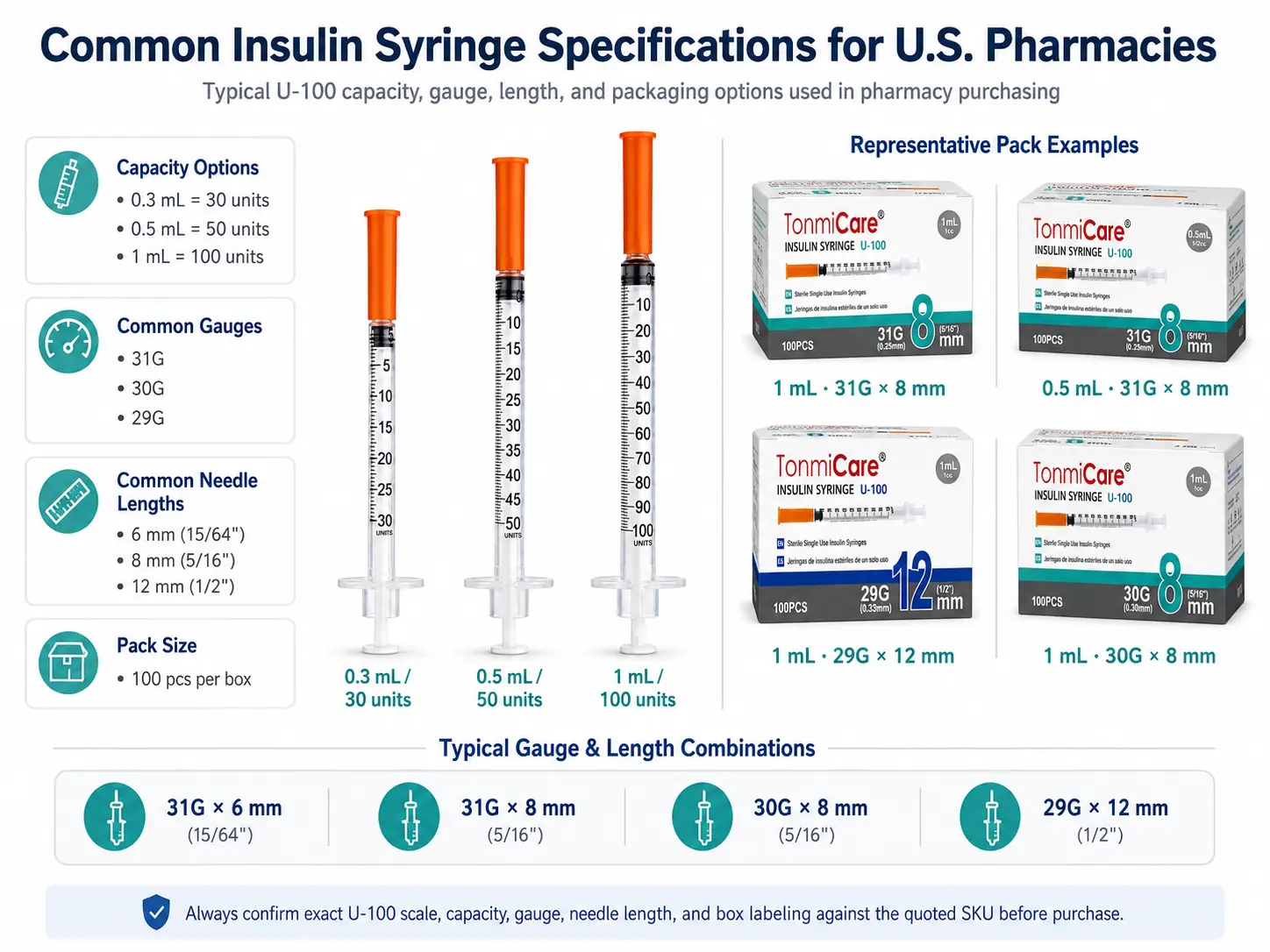
Commonly listed U-100 capacity categories are 0.3 mL, 0.5 mL and 1 mL. Manufacturer portfolios also include selected 29G, 30G and 31G fixed-needle products at 6 mm, 8 mm or a manufacturer-specific longer length. Exact combinations and graduations vary by REF. Check the manufacturer’s published configuration rather than treating the fields as a universal combination chart.[2][4]
Approve the complete identity: concentration scale; capacity and maximum marking; smallest marked increment; gauge × length; standard or safety design; manufacturer REF; sterile presentation; box/case quantities; and current labeling. Use our SKU approval worksheet, receiving checklist and RFQ template to record the evidence.
Executive summary
Key Takeaways for Pharmacy Buyers
- Use “commonly listed configurations,” not “national best sellers,” unless proprietary sales data supports a ranking.
- Separate capacity, concentration scale and graduation. A 0.3 mL syringe is not automatically a half-unit syringe, and a 1 mL syringe should not be assigned a graduation without REF-level proof.
- Higher gauge numbers generally indicate a smaller outside needle diameter, but gauge does not identify length, scale or suitability.
- Standard fixed-needle insulin syringes and safety insulin syringes require separate catalog records and workplace-use evaluation.
- Build the final stocking mix from the pharmacy’s own 90-day and 12-month exact-SKU movement, lead-time and substitution records.
- Compare bulk insulin syringe quotes only after normalizing the exact SKU, package hierarchy, remaining shelf life and landed cost.
1. What “Common” Means in This Insulin Syringe Specifications Guide
We use manufacturer-published configurations to build a candidate matrix for procurement. The main matrix covers U-100 syringes; other concentration scales require separate approved item records. This is not a national sales ranking, a recommendation to stock every combination or a patient-specific device-selection guide.
The FDA-published K223453 summary, cleared in 2023, describes one manufacturer’s family with 0.3 mL, 0.5 mL and 1 mL volumes, 28G–32G needles, and 6 mm, 8 mm and 12 mm lengths.[1] That family description does not establish current stock, a Tonmit SKU or every possible combination. We cross-check commercial examples against embecta’s U.S. page, an exact UltiMed product page and UltiMed’s product brochure.[2][3][4]
Evidence boundary
In this article, common means repeatedly listed in current U.S.-market portfolios. It does not mean every pharmacy should stock every configuration, or that the sequence below represents national market share.
2. U.S. Pharmacy Insulin Syringe Specification Matrix
The following insulin syringe size chart is a candidate-assortment tool. It helps a buyer decide which exact products need commercial and clinical review; it is not an instruction to substitute a product or select a device for an individual.
| Capacity category | Representative listed needle patterns | Graduation control | Pharmacy purchasing use |
|---|---|---|---|
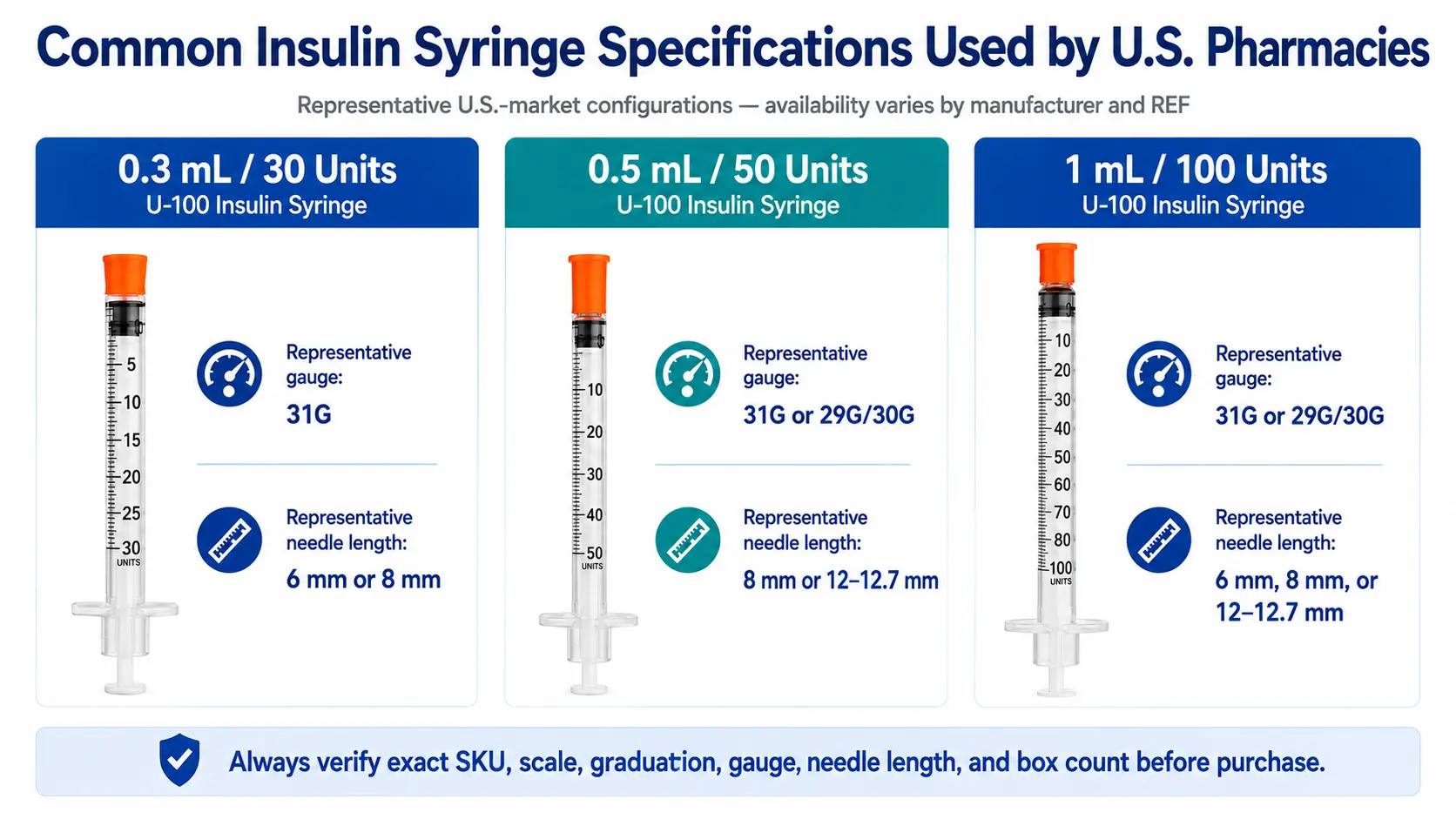
| 0.3 mL / 3/10 cc | Selected 31G × 6 mm and 31G × 8 mm configurations; other combinations vary by portfolio | Half-unit and one-unit patterns may exist; confirm the exact REF and barrel artwork | Separate fine-graduation requirements from general 0.3 mL stock |
| 0.5 mL / 1/2 cc | Selected 31G short-needle and 29G/30G traditional-length configurations | Do not infer the increment from 50-unit maximum capacity | Maintain an exact mid-capacity SKU rather than an open “equivalent” item |
| 1 mL / 1 cc | Selected 31G × 6/8 mm and 29G/30G × 12 mm or 12.7 mm, depending on the exact REF configurations | Verify the printed unit increment and maximum marking by REF | Consider separate controlled records for short- and traditional-length items |
| Safety insulin syringe | Capacity, gauge and length depend on the safety design and manufacturer | Verify both the measurement scale and activation mechanism | Evaluate separately for employee-use workflows and sharps exposure controls |
The matrix should be read row by row, not as a list of universal combinations. For current Tonmit options, buyers can review wholesale insulin syringe configurations and then request the exact REF, scale, graduation and package record for the item under consideration.
3. Common Barrel Capacities: 0.3 mL, 0.5 mL and 1 mL
Capacity describes nominal barrel volume. The common U.S. catalog categories are 0.3 mL, 0.5 mL and 1 mL; they may also appear as 3/10 cc, 1/2 cc and 1 cc. One cubic centimeter equals one milliliter, so the two notations describe the same nominal volume. Capacity does not establish the insulin concentration scale or the graduation interval.
| Nominal capacity | Equivalent notation | Maximum marking when correctly scaled for U-100 | Required buyer verification |
|---|---|---|---|
| 0.3 mL | 0.3 cc / 3/10 cc | 30 units | Scale, half- or one-unit graduation, gauge, length, REF and pack |
| 0.5 mL | 0.5 cc / 1/2 cc | 50 units | Scale, graduation, gauge, length, REF and sterile package |
| 1 mL | 1 cc | 100 units | Scale, graduation, needle, identifiers, box and case hierarchy |
Buyers who need the clinical and measurement distinctions can compare 0.3 mL, 0.5 mL and 1 mL insulin syringe sizes. For commercial review, use the dedicated 0.3 mL insulin syringe options, 0.5 mL insulin syringe options and 1 mL insulin syringe options as starting points, then confirm the final quoted SKU.
4. Insulin Syringe Gauge Sizes and Needle-Length Combinations
Needle gauge and needle length are independent fields. A higher gauge number generally describes a smaller outside needle diameter, so 31G is generally thinner than 30G, and 30G is generally thinner than 29G. Length is recorded separately in millimeters and, where used, inches. Neither field identifies the insulin scale, barrel capacity or graduation.
UltiMed’s exact product page identifies REF 09439 as a U-100, 0.3 mL, 31G × 8 mm item with a listed quantity of 100.[3] Its broader brochure also lists 1 mL × 31G × 8 mm and selected 29G/30G × 12.7 mm items.[4] The same needle description can therefore belong to different capacities, package presentations and product identities.
Keep nominal labels separate from exact conversions
1/2 inch equals 12.7 mm exactly; 12 mm is not an exact equivalent. Catalogs may use rounded nominal inch/mm descriptions. Preserve the manufacturer’s label and approved REF; resolve a 12 mm versus 12.7 mm difference before treating products as equivalent.
Do not approve by gauge alone
“31 gauge insulin syringe” is a search phrase, not a complete purchase description. Pair it with scale, capacity, graduation, length, design, manufacturer REF and package hierarchy before comparing price.
5. Graduation Patterns and Half-Unit Insulin Syringes
Graduation is the interval represented by the smallest printed scale division. It controls how the barrel is read, but it cannot be safely inferred from capacity. Selected smaller-capacity products may provide half-unit markings, while other products of the same nominal volume may use a different pattern. A buyer should review the controlled specification, current labeling and a clear sample of the actual barrel.
UltiMed’s brochure lists separate 0.3 mL × 31G × 6 mm entries with and without an explicit half-unit-marking designation.[4] Record the smallest marked increment separately from the maximum unit marking and any manufacturer-stated accuracy tolerance; one field does not establish the others.
Product photography and AI-generated imagery are not primary evidence for graduation approval. Perspective, resolution and synthetic markings can make a scale appear different from the manufactured product. Keep the approved scale drawing or label revision with the item-master record and require re-review when the REF or packaging revision changes.
Procurement rule: “0.3 mL insulin syringe” does not automatically mean “half-unit insulin syringe.” Graduation belongs in the RFQ, purchase order and receiving specification as its own controlled field.
6. How to Decode a Complete Pharmacy Insulin Syringe SKU
A complete description should progress from the highest-risk identity fields to the commercial package. The sequence below can be copied into an item master, RFQ or approved-product list.
U-100 scale | 0.5 mL / 50-unit maximum | exact smallest marked increment | 31G × 8 mm fixed needle | sterile, single use as labeled | exact primary presentation / inner pack | units per box | boxes per case | legal manufacturer / labeler | manufacturer REF | package-level identifier where applicable | lot / expiry | approved artwork revision
This is an illustrative data structure, not a quoted Tonmit configuration or a universal pack. Confirm the labeled sterile presentation instead of assuming that every syringe is individually wrapped. Keep other concentration scales in separate approved records; our U-40 and U-100 comparison explains why scale identities need separate control.
7. Build Core Stock, Secondary Stock and Special-Order Tiers
A practical assortment does not require every published configuration to sit in every pharmacy. Assign each approved REF to a stocking tier based on exact-SKU movement, clinical and dispensing requirements, supply lead time and the operational cost of a stockout.
| Tier | Definition | Typical control | Review trigger |
|---|---|---|---|
| Core stock | Exact SKUs with sustained local or network demand | Routine min/max or reorder-point replenishment | Monthly service level, fill rate and expiry risk |
| Secondary stock | Approved SKUs with stable but lower movement | Lower safety stock or hub-and-spoke availability | Quarterly demand and transfer frequency |
| Special order | Approved items with intermittent or contract-specific demand | Order against confirmed requirement | Lead-time failure or repeated emergency demand |
| Non-substitution control (all tiers) | An approval restriction independent of movement-based stocking tier | Hard substitution block unless formally approved | Formulary, label, supplier or product change |
A half-unit or safety SKU may be core stock when local demand or an approved workplace workflow requires it. Assign the demand tier and substitution restriction as separate fields.
8. Standard Fixed-Needle vs Safety Insulin Syringes
A standard fixed-needle syringe should not be described as a safety syringe unless it has a documented engineered sharps-injury protection feature. Safety products require their own evaluation of the protective mechanism, activation, training, disposal workflow and product identity.
OSHA defines engineering controls to include sharps disposal containers, self-sheathing needles and safer medical devices that isolate or remove the workplace hazard. Employers with occupational exposure must evaluate and implement appropriate effective controls, but this does not mean that every retail insulin syringe SKU is automatically a safety device.[7]
9. Why the Same Capacity and Gauge Do Not Prove Interchangeability
Two items labeled 0.5 mL and 31G can still differ in insulin scale, graduation, needle length, fixed-needle geometry, sterile presentation, package quantity, labeling, identifiers and safety design. Treat a proposed replacement as a controlled product change, not a text-match exercise.
- Confirm the same approved insulin concentration scale.
- Compare nominal capacity, maximum unit marking and graduation.
- Compare gauge, needle length and device configuration.
- Reconcile legal manufacturer, labeler, REF and current labeling.
- Review sterile barrier, box/case quantities and shelf-life terms.
- Verify applicable documentation and change-notification requirements.
- Record the formal approval before enabling a catalog substitution.
Worked SKU check: the headline size matches, two controls do not
Fictional exercise: DEMO-A and DEMO-B are not marketed product references or customer records.
| Field | Approved DEMO-A | Proposed DEMO-B |
|---|---|---|
| Scale / capacity / needle | U-100 / 0.3 mL / 31G × 8 mm | Same headline description |
| Smallest marked increment | 0.5 unit, supported by approved artwork | Not stated in the quotation |
| Box and case quantities | 100 per box × 10 boxes = 1,000 per case | 100 per box × 5 boxes = 500 per case |
Decision: Hold substitution approval until the graduation is evidenced. Compare the actual case quantities when normalizing price, and keep the changed pack as a separate controlled record. Matching capacity and gauge does not close either gap.
10. REF, UDI/GTIN and Wholesaler Numbers in the Pharmacy Item Master
A pharmacy may encounter several identifiers for the same commercial product. They serve different systems and should not be collapsed into a single unlabeled number. FDA explains that the UDI system is intended to identify medical devices through manufacturing, distribution and use; the applicable device identifier should remain connected to the specific model or version and labeler.[5]
Keep the device/package identifier separate from actual lot and expiration values. GUDID contains the device identifier and PI-related flags, not the actual lot or expiry for an incoming shipment.[5] Match those production values to the physical label and receiving records.
| Field | Purpose | Control question |
|---|---|---|
| Legal manufacturer / labeler | Regulatory and commercial identity | Which organization applies to this exact label? |
| Manufacturer REF | Primary SKU-level specification link | Does the PO prohibit unapproved equivalent substitution? |
| UDI/GTIN where applicable | Device and package identification | Which package level and version does the identifier represent? |
| Wholesaler order number | Channel-specific ordering | Is it mapped to the same current manufacturer REF? |
| Lot / expiration | Traceability, rotation and field-action response | Can receiving and downstream distribution retain the link? |
| Label/package revision | Change control | Has the approved product presentation changed? |
Registration and listing should also be interpreted accurately. FDA states that it does not issue registration certificates to medical-device facilities, and registration or listing does not by itself mean that the facility or device is approved, cleared or authorized.[6] Buyers can request SKU-specific product documentation and reconcile it with the quoted REF and current label.
FDA’s Quality Management System Regulation became effective on February 2, 2026 and incorporates ISO 13485:2016 by reference with additional applicable U.S. requirements. For procurement teams, the practical question remains whether the exact product, site and controlled records support the quoted configuration—not whether a sales document uses a broad quality claim.[8]
11. Are Insulin Syringes Always 100 per Box?
One hundred syringes per box is a familiar current presentation, and individual UltiCare listings show a quantity of 100. It is not safe to convert that observation into a universal rule for every manufacturer, sterile presentation, safety design or case pack.[4] The RFQ and purchase order should state each level explicitly.
Total syringes per case = syringes per box × boxes per case
Landed cost per accepted 100 = total landed case cost ÷ accepted syringes per case × 100
Usable supply = received quantity that passes identity, package-integrity, lot and shelf-life acceptance
Compare inner-pack format, units per box, boxes per case, total case quantity, freight basis, minimum remaining shelf life and damage/shortage terms. The separate guide explains how to compare insulin syringe case quantities and landed cost without treating case price as the only decision field.
12. Determine the Stocking Mix From Pharmacy Movement Data
A public common-specification matrix supplies candidates. The pharmacy’s own data determines quantities. Export movement by exact REF—not by a generic “insulin syringe” category—so that different graduations, capacities and needle configurations are not blended into one demand line.
- 90-day and 12-month unit movement by exact REF and location;
- average demand, variability and seasonal or promotion effects;
- available inventory, open purchase orders and backorders;
- effective replenishment lead time, including review and processing;
- service-level target, safety stock and stockout consequence;
- minimum acceptable remaining shelf life and expiration exposure;
- emergency transfers, lost sales and approved-substitution history;
- new-contract, formulary or prescriber-demand changes.
Basic reorder point = expected demand during effective replenishment lead time + safety stock
Recalculate inputs by exact SKU. A U.S. warehouse can reduce parts of lead time, but available quantity, reservation status, shelf life, cutoff time and destination-specific delivery still require order-level confirmation.
For recurring programs, confirm U.S.-warehouse-supported fulfillment by REF, available inventory, lot, expiration, processing window and delivery destination before reducing local safety stock.
13. Receiving and Replenishment Checklist
A controlled specification only works if receiving verifies the same fields. Connect the purchase order, packing list, physical package and inventory record before releasing stock.
Use approved artwork, visible unopened labeling and the agreed inspection plan; do not open a sterile presentation merely to read a scale. Log the evidence reference and disposition in the receiving checklist. Keep held or rejected stock out of usable inventory.
Brand, manufacturer, REF and scale.
Capacity, graduation, gauge, length and design.
Units, boxes, cases and shortages.
Lot, expiration and package revision.
Accept, quarantine and document discrepancies.
If a label, REF, scale or package hierarchy differs from the approved record, place the affected stock on hold until the change is reconciled. Do not fix a mismatch by editing the internal description to match what arrived; determine whether the shipment or the approved record is wrong.
14. Copyable Pharmacy Insulin Syringe RFQ Specification
Use our blank forms to capture one exact SKU, record receiving findings and request a comparable quotation. Fill the evidence references and review owner; a completed field is not automatically an approved specification.
SKU approval worksheet
Record approved and proposed fields with evidence, gaps and review ownership.
View or manually copy the template
Field,Approved value,Supplier-proposed value,Evidence reference / revision,Result: match / gap / N-A,Reviewer / date,Action
Concentration scale,,,,,,
Nominal capacity (mL),,,,,,
Maximum marked units,,,,,,
Smallest marked increment (units),,,,,,
"Manufacturer-stated accuracy evidence, if required",,,,,,
Needle gauge,,,,,,
Manufacturer-labeled length (mm),,,,,,
"Printed inch notation, if any",,,,,,
Standard or safety design / mechanism,,,,,,
Legal manufacturer / labeler,,,,,,
Manufacturer REF and wholesaler mapping,,,,,,
Sterility claim and exact primary presentation,,,,,,
Inner pack / units per box / boxes per case,,,,,,
Total units per case,,,,,,
"Package-level UDI / GTIN, where applicable",,,,,,
Label / packaging revision,,,,,,
Lot / expiry format and remaining shelf-life rule,,,,,,
Substitution restriction and approval status,,,,,,
Demand tier and review date,,,,,,
Receiving checklist
Capture actual findings, traceability, acceptance or hold, and disposition.
View or manually copy the template
Check,Approved requirement,Observed evidence,Record / photo reference,Status: accept / hold / N-A,Owner / date,Disposition
PO / manufacturer REF / labeler match,,,,,,
Concentration scale / capacity / max marking,,,,,,
Graduation / needle / design match to controlled evidence,,,,,,
Unopened primary presentation / damage / sterility labeling,,,,,,
Units per box / boxes per case / actual quantity,,,,,,
Lot and expiry captured,,,,,,
Minimum remaining shelf life met,,,,,,
Agreed release / shipment record linked,,,,,,
Unapproved change or substitution assessed,,,,,,
Final release or hold recorded,,,,,,
Complete specification RFQ
Request the exact scale, graduation, needle and commercial pack.
View or manually copy the template
Subject: Pharmacy insulin syringe specification review — [exact REF / U-100 scope]

Buyer / company:
Manufacturer / labeler / exact REF / supplier SKU:
Concentration scale: [U-100 for the main matrix; other scales require a separate approved item]
Capacity / maximum marked units:
Smallest marked increment / supporting artwork revision:
Needle gauge / manufacturer-labeled length in mm:
Printed inch notation, if any / standard or approved safety design:
Sterility claim / exact primary presentation / inner-pack structure:
Units per box / boxes per case / total units per case:
Applicable device/package identifiers:
Current specification / labeling / IFU and relevant regulatory / quality evidence:
Minimum remaining shelf life / assigned-lot and expiry confirmation:
Trial quantity / recurring demand / annual forecast:
Destination ZIP or postal code / required date / proposed fulfillment route:
Price and freight basis / MOQ / lead time / validity period:
Substitution: no manufacturer, REF, scale, graduation, needle, pack or label change without written review.

Please identify unavailable, restricted, lot-specific or nonapplicable documents and the evidence owner.
Confirm all offered dimensions and package quantities against the controlled product record.
How we built these tools
We translated the article’s specification, approval and receiving controls into editable fields, then added evidence, ownership and disposition columns. These are original blank editorial tools, not completed Tonmit QC records, customer cases, laboratory results or clinical dosing aids. Adapt them to the actual REF, supplier documents and buyer procedures. The fictional comparison illustrates two evidence gaps; it does not validate a product or replace a qualified product review.
Send the completed specification to our wholesale insulin syringe review. The quoted configuration, available documents, current inventory and commercial terms must be confirmed for that transaction.
Frequently Asked Questions About Insulin Syringe Specifications
What insulin syringe specifications are commonly listed in U.S. pharmacy catalogs?
Recurring capacity categories are 0.3 mL, 0.5 mL and 1 mL. Current portfolios also list several 29G, 30G and 31G fixed-needle products, including selected 6 mm, 8 mm and 12 mm or 12.7 mm, depending on the exact REF lengths. Exact combinations vary by manufacturer and REF.
Are 0.3 mL, 0.5 mL and 1 mL the standard insulin syringe sizes?
They are the recurring nominal capacity categories in current U.S. product families. Capacity alone does not identify concentration scale, graduation, gauge, length, brand or package.
Is 1 cc the same as 1 mL?
Yes. One cubic centimeter equals one milliliter, so 1 cc and 1 mL describe the same nominal volume. Insulin units are a separate field tied to the labeled concentration and matching syringe scale.
Which is thinner, a 30G or 31G insulin syringe needle?
A 31G needle generally has a smaller outside diameter than a 30G needle. Gauge does not establish needle length, capacity, scale or the correct product for an individual.
Do all 0.3 mL insulin syringes have half-unit markings?
No. Selected 0.3 mL SKUs may offer half-unit markings, but capacity does not prove graduation. Verify the exact REF, controlled scale drawing and current product labeling.
Can two insulin syringes with the same capacity and gauge be substituted?
Not automatically. They may differ in concentration scale, graduation, length, design, manufacturer, labeling, sterile barrier, package quantity and regulatory identity. Follow the organization’s formal product-review and substitution process.
Are insulin syringes always sold 100 per box?
No universal package quantity should be assumed. One hundred per box is a familiar presentation, but the actual inner pack, box and case hierarchy must be confirmed for the quoted SKU.
How should a pharmacy determine which insulin syringe SKUs to stock?
Start with approved candidate specifications, then use 90-day and 12-month movement by exact REF, lead time, demand variability, service targets, shelf life and stockout consequences to assign core, secondary and special-order tiers.
15. Conclusion: Stock a Controlled SKU, Not a Generic Size
The most useful answer to “common insulin syringe specifications used by U.S. pharmacies” is not a single winning size. It is a controlled set of recurring capacity and needle categories, translated into exact SKUs and then weighted by the pharmacy’s own demand.
Keep capacity, concentration scale, graduation, needle dimensions, design and packaging as separate controlled fields. Preserve the manufacturer, REF, identifiers, current artwork, lot and expiry, then connect the approved item master to purchasing, stocking and receiving decisions.
Wholesale & specification support
Request a Pharmacy Insulin Syringe SKU Review
Send Tonmit your required scale, capacity, graduation, gauge × length, monthly or annual volume, box/case needs, destination ZIP code and documentation requirements. We can organize the requested fields into a comparable specification and confirm transaction-specific options.
Availability, documentation, packaging, inventory, remaining shelf life, price and delivery are confirmed for the exact SKU and transaction.References
- U.S. Food and Drug Administration. K223453 insulin syringe 510(k) summary (2023 family scope).
- embecta. U.S. Ultra-Fine insulin syringe portfolio.
- UltiMed. UltiCare U-100 0.3 mL, 31G × 8 mm, product 09439.
- UltiMed. Consumer Diabetes Product Brochure, printed pages 7 and 11.
- U.S. Food and Drug Administration. UDI Basics.
- U.S. Food and Drug Administration. Important Reminders About Registration and Listing.
- Occupational Safety and Health Administration. Bloodborne Pathogens Standard: Quick Reference Guide.
- U.S. Food and Drug Administration. Quality Management System Regulation (QMSR).
Source method and limits: Key specifications and source destinations were checked on October 15, 2026. Manufacturer portfolios show listed configurations, not a census of sales or current inventory. The FDA family summary is not a Tonmit authorization claim. Verify the current exact REF, labeling, availability and documents before approval; catalog revisions can change.