
Medical Supply Sourcing & Fulfillment Guide
A decision framework for comparing China factory-direct supply with U.S. warehouse-supported supply by exact SKU, MOQ, complete lead time, delivered cost, documentation, lot and shelf life, inventory risk, and future replenishment.
Scope: This guide supports U.S. B2B procurement planning for selected finished medical devices and consumables. It is not legal, customs, tax, accounting or clinical advice. Product requirements, import treatment, duties, documentation, inventory, pricing, lead time, shelf life and fulfillment terms must be confirmed for the exact product and transaction. Our U.S. warehouse statements apply only to selected SKUs we supply and do not constitute a universal stock or delivery commitment.
Direct answer
Which Medical Supply Model Is Better?
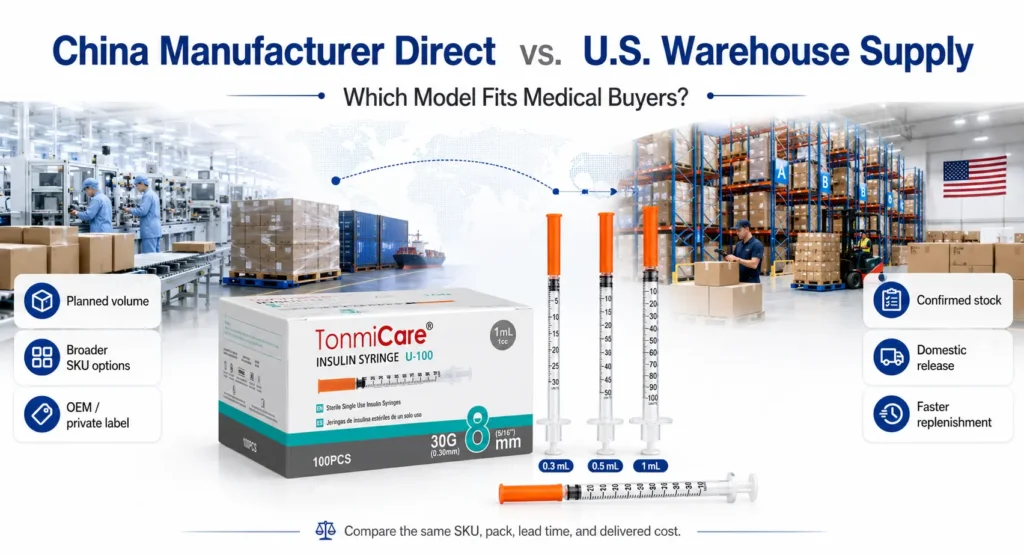
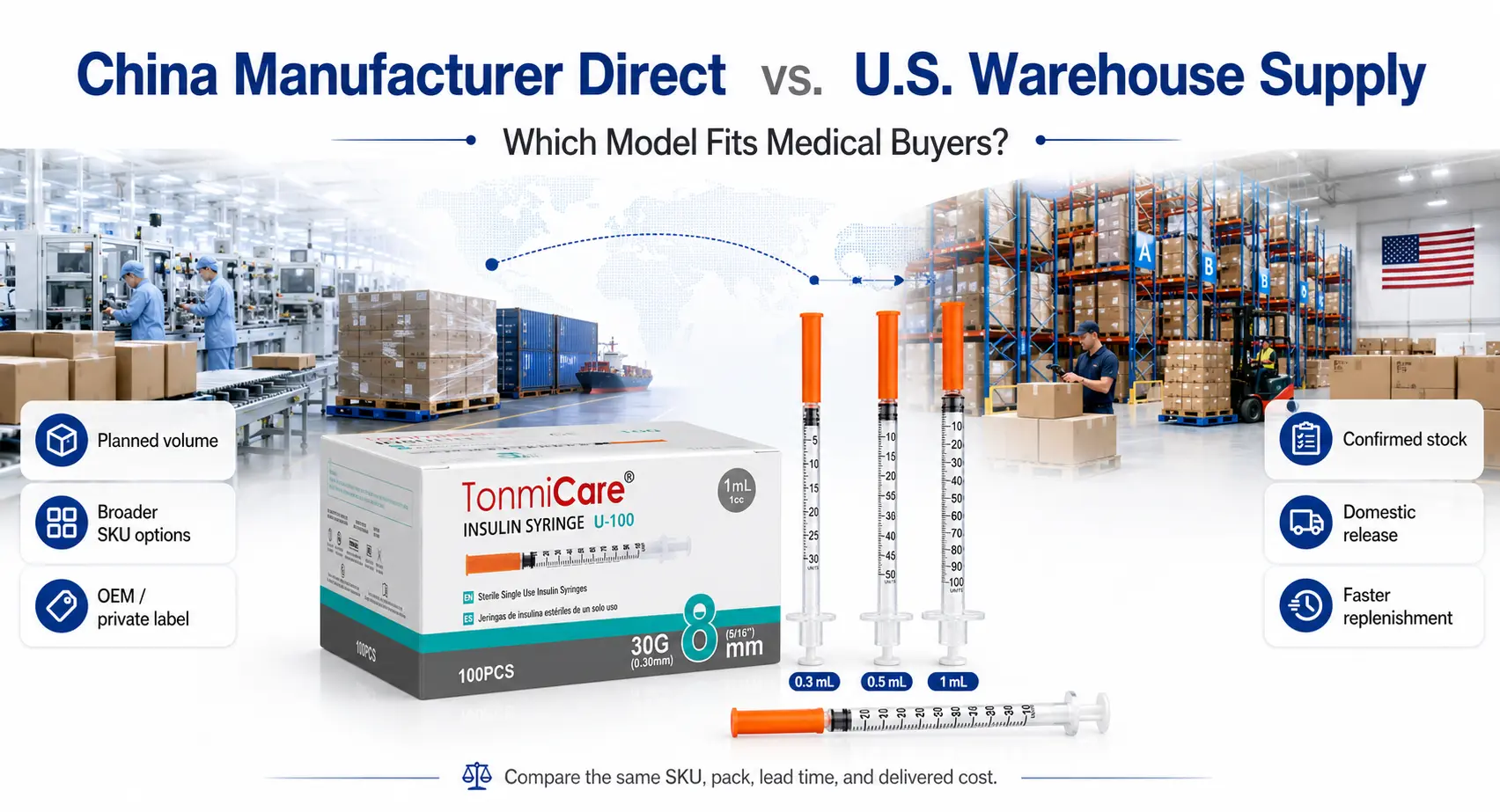
Neither path is universally better. Factory-direct supply is better suited when planned volume, broader configurations or private-label production are the primary requirements. U.S. warehouse-supported supply is better suited when confirmed standard-SKU inventory, smaller domestic orders and a shorter fulfillment path are the priority.
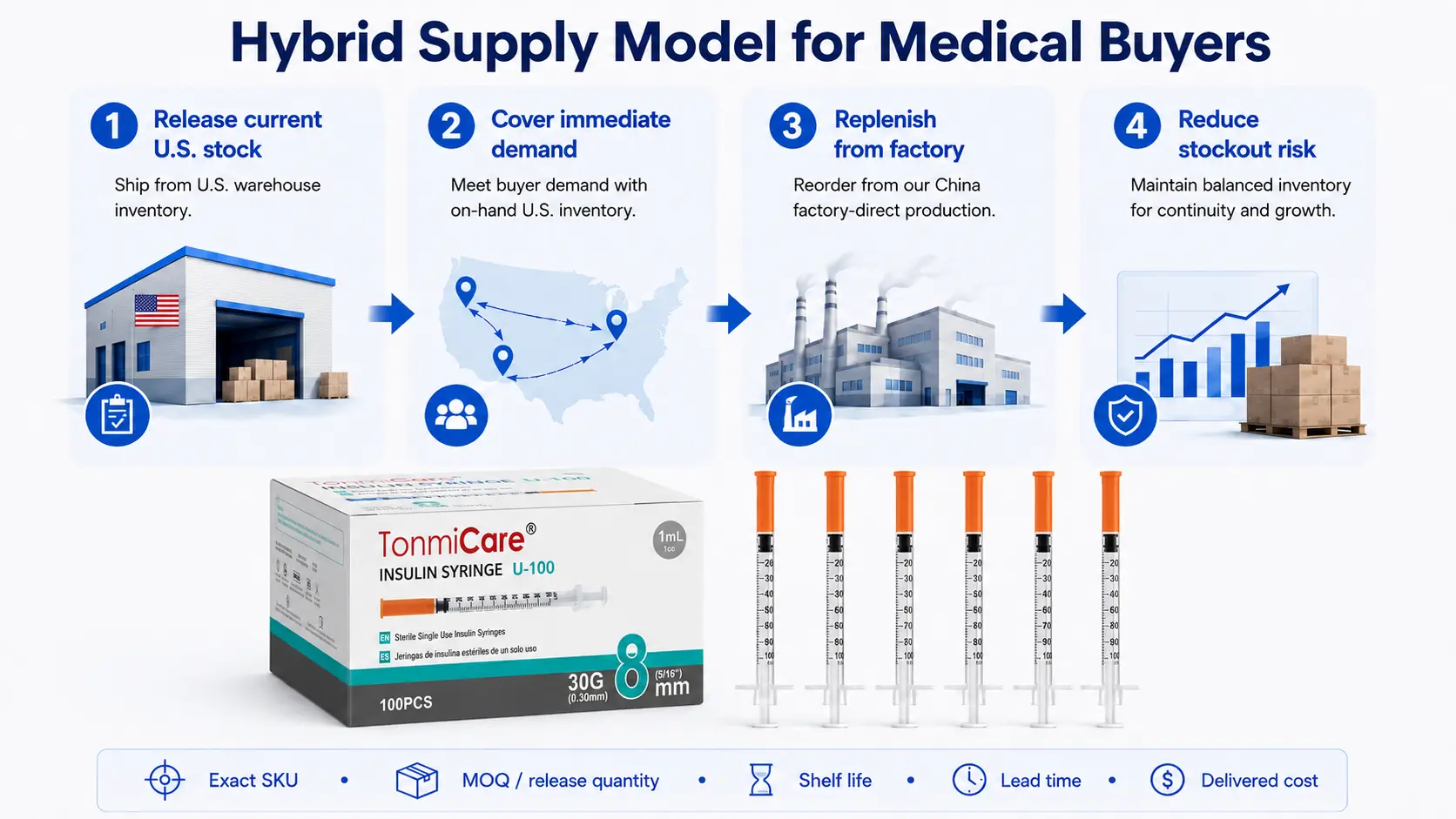
For recurring demand, a hybrid structure uses confirmed U.S. inventory for current releases and planned factory replenishment for future demand. The appropriate route depends on the same SKU and packaging, usable quantity, lot and remaining shelf life, complete lead time, delivered cost, document availability and responsibility boundaries.
1. This Is Not China-Made vs. U.S.-Made
“China manufacturer” describes a manufacturing or supply source. “U.S. warehouse” describes an inventory and fulfillment location. They are not competing country-of-origin categories. The same product can be manufactured abroad, imported into the United States and later released from domestic inventory.
A product manufactured in China does not become U.S.-made because it is stored or shipped from a U.S. warehouse. FTC guidance distinguishes shipping location from a U.S.-origin claim, and an unqualified “Made in USA” claim generally requires substantiation that the product is “all or virtually all” made in the United States.[5] Record manufacturing origin, shipping origin, seller identity, importer role and warehouse location as separate fields.
Avoid the false origin comparison
Compare “China factory-direct supply” with “U.S. warehouse-supported supply.” Do not present the second model as domestic manufacturing unless the exact product has a separately substantiated U.S.-origin claim.
2. Define Both Supply Models Before Comparing Them
China factory-direct supply
A factory-direct order is placed against export-ready inventory, production capacity, or a new manufacturing run coordinated from the manufacturer or its supply organization. Depending on the product and project, it may support a broader SKU range, volume pricing, buyer-approved specifications, private-label packaging, custom case configuration, and longer-term production planning.
“Direct” does not mean every order begins as raw-material production, and it does not prove that there is no commercial intermediary. Buyers should identify the contracting party, actual manufacturer, labeler, exporter, importer, and invoicing entity. They should also confirm whether the quoted goods are finished export stock, an allocated batch, or future production.
U.S. warehouse-supported supply
A U.S. warehouse-supported order is released from selected domestic inventory after the product, packaging, quantity, inventory status, lot or shelf-life information where available, destination and commercial terms are confirmed. Existing domestic inventory can shorten the fulfillment path, but it does not remove SKU, receiving or documentation controls.
Our U.S. warehouse program supports U.S. domestic delivery only for selected SKUs we supply. We confirm the exact SKU, packaging, available quantity, applicable lot or shelf-life information, destination and order-specific shipping requirements before treating inventory as available. Our warehouse program is not a general public warehouse, unrestricted third-party storage service or universal stock promise. You can review our U.S. warehouse and fulfillment scope for current operating boundaries.
3. China Factory-Direct vs. U.S. Warehouse: Side-by-Side
| Decision factor | China factory-direct | U.S. warehouse supply |
|---|---|---|
| Supply basis | Export stock, allocated capacity, or new production | Accepted domestic inventory available for allocation |
| Typical fit | Planned volume, broader specifications, OEM, private label | Standard stocked SKUs, replenishment, shorter domestic path |
| Quantity control | Production or commercial MOQ, often by SKU and package | Minimum release quantity, case, carton, or selected pallet |
| Customization | Potentially broader, subject to approval, tooling, MOQ, and lead time | Usually limited to the existing confirmed inventory already held |
| Buyer-facing lead time | May include production, export, international transit, import, and delivery | May include approval, allocation, processing, domestic transit, and receiving |
| Inventory risk | Buyer may commit to larger quantities or longer planning cycles | Supplier or program carries stock, but SKU and quantity can be limited |
| Shelf life | Depends on assigned export stock or production batch | Depends on the specific domestic lot available for release |
| Import path | Parties must define importer, broker, entry, and delivery responsibilities | Confirm domestic receipt and whether any regulatory, quality, or commercial hold remains |
| Returns and exceptions | May require cross-border or contract-specific resolution | May support a domestic return path, but policy must be confirmed |
| Future continuity | Connected directly to capacity and production planning | Depends on the upstream factory-to-warehouse replenishment plan |
These are common tendencies, not guaranteed terms. A factory can sometimes release finished export stock faster than a warehouse with a hold, while a warehouse may require full cases even when a factory accepts a negotiated pilot quantity. The controlled quotation and exact inventory record govern the transaction.
4. Compare the Same SKU, Packaging, and Document Scope
Compare the same product before comparing the route. A lower factory price is not meaningful if the quote uses different dimensions, packaging, labeling or document scope; a warehouse price may also include domestic inventory and processing services that are absent from a factory quote.
Lock these fields before comparing quotations
- Actual manufacturer, brand or labeler, product name, REF/SKU, and model
- Critical dimensions, capacity, gauge, needle length, connector, or other functional specification
- Sterile or nonsterile status and applicable packaging configuration
- Unit, inner pack, bag, box, case, master carton, and pallet quantities
- Labeling language, address, barcode, UDI/DI or GTIN where applicable, and artwork version
- Required general product documents and transaction-specific records
- Minimum remaining shelf life at the buyer’s expected receipt date
- Destination, freight mode, receiving conditions, and comparison currency
For product-level checks, you can review our insulin syringe configurations or review our pen needle options before requesting a route-specific quotation.
5. Factory MOQ Is Not the Same as Warehouse Release Quantity
A factory minimum order quantity is usually connected to efficient production, materials, packaging, sterilization or other processing cycles where applicable, commercial handling and export preparation. It may be defined per product, SKU, artwork, color, package, production run or total order. A total order quantity does not automatically allow unlimited SKU combinations.
A warehouse minimum release quantity is different. Inventory already exists, but the warehouse or commercial program may require one case, multiple cases, a full carton, a layer, or a pallet. Broken-case or one-box release can add pick-and-pack work and may not be permitted for every product.
| Quantity term | What it controls | Buyer question |
|---|---|---|
| Factory MOQ | Minimum production or factory-direct commercial quantity | Is the minimum per SKU, artwork, package, run, or total order? |
| Packaging MOQ | Minimum custom box, label, insert, or printed material quantity | What happens to unused packaging materials? |
| Warehouse release minimum | Smallest domestic quantity the program will process | Can the order be released by box, case, carton, or pallet? |
| Reserved quantity | Inventory allocated to a buyer under agreed terms | Who owns it, how long is it held, and what is the release schedule? |
6. Measure Complete Lead Time—Not One Shipping Segment
Factory-direct quotations sometimes show production time and carrier transit as separate numbers. Warehouse quotations may show only domestic transit. Neither is the full buyer-facing lead time. Define the start event, end event, calendar, assumptions, and approval dependencies for both models.
Factory-direct complete lead time
Specification & Commercial Approval + Export-Stock Allocation or Production + Quality Release + Export Preparation + International Transportation + Import Entry + Domestic Delivery + Buyer Receiving
U.S. warehouse complete lead time
Order Approval + Free-to-Sell Allocation + Warehouse Processing + Domestic Carrier Transit + Buyer Receiving
These are operational models, not statutory formulas. Remove steps that do not apply and add project-specific steps. For example, a factory-direct order filled from released export stock may not require new production. A warehouse order may need a delivery appointment, routing-guide approval, relabel review, or payment clearance before release.
7. Compare Delivered Cost per Accepted Usable Unit
Factory-direct unit pricing may be attractive at volume, but the buyer should not stop at EXW, FOB, or product-only pricing. U.S. warehouse supply may include inventory carrying, import coordination, and domestic processing within the product or service price. Normalize the same cost boundary before selecting a model.
Illustrative factory-direct cost model
(Product + Applicable Tooling/Custom Packaging + Export Handling + International Freight + Insurance + Applicable Duties/Taxes + Brokerage + Domestic Delivery + Receiving + Inventory Carrying + Expected Exception Cost) ÷ Accepted Usable Units
Illustrative U.S. warehouse cost model
(Product + Pick/Pack + Domestic Freight + Applicable Accessorials + Receiving + Expected Expiry or Stockout Cost) ÷ Accepted Usable Units
Use the buyer’s documented accounting method and only the components that apply. “Accepted usable units” prevents incorrect, damaged, rejected, expired, or units not accepted under the buyer’s receiving criteria from making the apparent unit cost look lower. Also review cash tied up during production and transit, payment terms, minimum order quantities, storage, forecast error, administrative workload, and shortage consequences.
Do not publish a universal savings percentage
The cost difference varies by product, volume, package, freight, HTS classification, country of origin, duties, service scope, destination, and contract. A credible article provides the calculation method instead of claiming that one model is always a fixed percentage cheaper.
8. Import and Regulatory Responsibilities Do Not Disappear
At import, FDA verifies applicable medical-device requirements such as establishment registration, device listing, premarket status where required, labeling and import-alert status. FDA entry review also relies on declared manufacturer, importer/consignee, product description and applicable Affirmation of Compliance data.[1] Separate customs controls govern tariff classification and country-of-origin marking; CBP administers the HTS and related entry requirements.[6][7]
For a factory-direct order, identify the contracting seller, exporter, importer of record, FDA initial importer where applicable, customs broker, consignee and the party responsible for accurate entry information. Under Incoterms® DDP, the seller is generally responsible for import clearance and applicable import duties to the named destination.[8] The parties should also confirm that the seller can legally and operationally complete the required import formalities in the destination country. The Incoterm does not by itself define FDA regulatory roles, product acceptance, quality, complaint or recall responsibilities, so those responsibilities should be documented separately.
U.S. warehouse stock may have completed an earlier import and receiving cycle, but physical presence in the United States does not by itself prove that the quoted quantity is free to sell. Confirm the exact SKU, assigned or eligible inventory, any applicable lot or shelf-life information, and whether regulatory, quality, allocation, payment or commercial holds remain.
Registration is not FDA approval or certification
FDA explains that establishment registration and device listing do not denote approval, clearance, authorization, or certification, and FDA does not issue medical device registration certificates.[2] Assess the applicable pathway for the exact product instead of using a generic “FDA certified” statement.
9. Prove U.S. Warehouse Inventory Before Relying on It
“On hand” can include inventory already committed to other customers or blocked from release. Time-sensitive buyers need a dated stock confirmation that defines which inventory statuses are included.
Operational free-to-sell model
Free-to-Sell = Accepted On-Hand − Allocated − Reserved − Quarantined − Recall-Held − Damaged − Expired
This is a planning definition, not a universal legal or accounting standard. Warehouse systems may use different status names. Ask the supplier to define its quantity and state how long the confirmation remains valid.
Usable days of cover
Confirmed Free-to-Sell Units ÷ Expected Daily Demand
Days of cover is only as reliable as the demand input and inventory confirmation. Correct for stockouts, promotions, new locations, seasonality, and unusual orders. Also identify open customer orders and inbound warehouse replenishment; current stock alone does not establish future continuity.
10. Compare Lot, Expiration, UDI, and FEFO by Model
Factory-direct does not automatically mean newly manufactured, and U.S. warehouse does not automatically mean short-dated. The relevant evidence is the assigned or eligible lot and the labeled expiration date for the exact product.
Remaining shelf life at expected receipt
Labeled Expiration Date − Expected Buyer Receipt Date
Calculate shelf life at expected buyer receipt, not at quotation, factory release, port arrival, or warehouse pick. State the minimum requirement in a measurable form and define what happens if the assigned lot changes.
FDA’s UDI framework generally distinguishes the device identifier (DI), which identifies the labeler and specific device version or model, from production identifiers (PI), which may include lot, serial number, expiration, or manufacturing date when present on the label. Exceptions and alternatives exist.[3] Do not treat REF, DI, GTIN, lot, and expiration as interchangeable fields.
| Control | Factory-direct question | U.S. warehouse question |
|---|---|---|
| Lot assignment | Is the order tied to export stock or a future production batch? | Which eligible or assigned domestic lots can fill the order? |
| Expiration | What date will the selected batch carry? | What is the labeled expiration of available stock? |
| Minimum shelf life | Will the batch meet the requirement after international delivery? | Will the assigned lot meet the requirement at domestic receipt? |
| FEFO | How is the released export lot selected? | Does FEFO also respect quarantine and customer shelf-life rules? |
11. Document Availability Changes by Supply Stage
Buyers frequently ask whether the factory and warehouse provide the same documents. The correct answer depends on product identity and transaction stage. General product records can often be reviewed before the order, while lot-specific and shipping records require inventory assignment or shipment preparation.
| Stage | Possible records | Key limitation |
|---|---|---|
| Supplier qualification | Company, manufacturer, quality-system, and applicable regulatory information | Must match the actual establishment and role |
| Product review | Specification, packaging, label, IFU, artwork, applicable product records | Must match the exact REF/SKU and version |
| Inventory allocation | Assigned quantity, lot, expiration, and inventory status | May not exist until stock or production is assigned |
| Shipment | Invoice, packing list, tracking, bill of lading, carton or pallet data | Depends on the confirmed transaction and freight path |
| Post-market or exception | Complaint, return, investigation, correction, removal, or recall records | Access and responsibilities depend on the parties and event |
A document issued for one manufacturer, product family, package level, or REF should not be applied automatically to another. We provide product-specific medical device documentation support for the applicable SKU and supply path when the corresponding records are available.
12. OEM and Private Label Usually Begin at the Factory
Private-label and custom-packaging programs normally require specification, artwork, barcode, label, packaging-material, production, and change-control approval before finished goods can be stocked domestically. A U.S. warehouse can hold customer-specific inventory, but it should not be treated as the place where unapproved relabeling, sterile repackaging, or product modification automatically occurs.
Define private-label inventory responsibilities
- Buyer-approved product specification, labeler role, artwork, barcode, address, and packaging version
- Product MOQ, packaging-material MOQ, production plan, and validation needs where applicable
- Ownership during production, international transit, warehouse storage, and domestic release
- Initial U.S. inventory target, reorder point, release quantity, and forecast cadence
- Storage period, inventory-aging reports, and minimum remaining shelf-life rules
- Responsibility for slow-moving, excess, expired, discontinued, or obsolete stock
- Disposition of unused labels, cartons, inserts, and finished goods after a program change
If you are planning customer-branded inventory, review our private-label and OEM program before deciding how much finished stock should be transferred to a U.S. warehouse.
13. Freight and Receiving Can Change the Better Model
A supply model that looks efficient before delivery can become unsuitable after shipment size, routing, appointment, and receiving constraints are included. Factory-direct orders may move by express, air, ocean, or another agreed method. U.S. warehouse orders may move by parcel, multi-carton, LTL, or pallet freight.
Confirm before quoting freight
- Actual origin, destination ZIP and receiving-site type.
- Carton/pallet dimensions, weight, count and stack restrictions.
- Parcel, air, ocean, LTL or pallet basis and applicable accessorials.
- Appointment, routing guide, liftgate, delivery-hour or advance-notice requirements.
- Responsibility for damage, shortage, re-delivery, detention and freight claims.
Cold-chain or temperature-controlled capability must not be inferred from the word “medical.” Confirm the labeled storage conditions and any required monitoring, validated packaging, transportation, excursion, and record controls before the supplier accepts the project.
14. Quality, Returns, Complaints, and Recalls Need One Chain
Factory-direct communication can shorten the route to manufacturing and quality personnel, while a domestic warehouse can simplify physical holds or returns. Neither benefit exists automatically. The contract and procedure should show who receives complaints, identifies affected lots, initiates a hold, investigates, communicates, authorizes return, and documents final disposition.
Minimum traceability chain
Manufacturer & Exact REF → Lot/Identifier → Quantity Produced or Received → Quantity Released → Buyer/Destination → Quantity Remaining → Hold/Return/Disposition
FDA describes a device recall as a method of removing or correcting products that violate laws it administers and distinguishes recalls from market withdrawals and stock recoveries.[4] The supply agreement should also distinguish routine commercial returns, receiving rejections, complaint samples, corrections, removals, and recalls.
No automatic substitution
Do not replace the ordered manufacturer, REF, specification, package, label version, or document set without the buyer’s documented review and approval. We recommend applying the same buyer-approved substitution control to both factory-direct and U.S. warehouse orders.
15. For Recurring Demand, U.S. Stock Needs a Replenishment Plan
A warehouse can buffer international production and transportation delays, but the buffer is finite. For a one-time purchase, future replenishment may not be material to the buying decision. For recurring programs, buyers should track two separate timelines: the time required to fulfill the current order and the longer factory-to-warehouse cycle required to rebuild domestic inventory.
Warehouse replenishment planning model
Warehouse Reorder Point = Expected Demand During Complete Factory-to-Warehouse Lead Time + Safety Stock
Continuity review should include
- Current free-to-sell inventory, allocated orders, and usable days of cover
- Open factory orders, production status, quality release, and expected ship date
- Inbound quantity, transport method, entry status, and warehouse receiving date
- Demand variability, new locations, promotions, seasonality, and known shortages
- Packaging or specification changes that could make existing stock obsolete
- Documented backorder, partial-shipment, alternate-source and communication rules
For repeat diabetes-care demand, we review recurring supply programs around exact SKUs, release quantities, forecasts and factory-to-warehouse replenishment instead of treating each purchase as an isolated urgent order.
16. When a Hybrid Medical Supply Model Can Work Better
A hybrid model is useful when current and future demand require different supply paths. Confirmed U.S. inventory supports current standard-SKU requirements, while factory-direct production supports future volume, broader configurations or private-label inventory. The model is not simply “order some from each location”; it requires a defined transition between the two paths.
A controlled hybrid agreement should identify which SKUs are stocked, which remain factory-direct, the target domestic inventory, forecast frequency, reorder trigger, replenishment lead time, allocation rules, ownership, slow-moving inventory policy, and action if inbound stock is delayed. It should also prevent the warehouse from exhausting current inventory before the factory replenishment becomes usable.
17. Choose the Model by Buyer Scenario
| Buyer scenario | Model to evaluate first | Reason |
|---|---|---|
| Pharmacy or clinic needs a standard SKU soon | U.S. warehouse | Shorter domestic path if exact usable inventory is available |
| Small first order for a buyer-qualified standard product | U.S. warehouse or pilot structure | May avoid a production-scale commitment |
| Distributor has stable quarterly or annual demand | Factory-direct or hybrid | Volume and forecast can support planned production and inventory targets |
| Private-label brand needs custom artwork | Factory-direct, then planned warehouse stock | Customization requires approval and production before domestic inventory |
| Current shortage plus predictable future demand | Hybrid | Domestic stock covers the gap while factory replenishment is prepared |
| Multiple low-volume SKUs | Warehouse, distributor, or consolidated factory order | Decision depends on mixed-SKU, case, and consolidation rules |
| High shelf-life requirement | Compare actual lots in both models | Neither location automatically guarantees longer remaining shelf life |
| High-volume standard SKU with regular releases | Reserved U.S. inventory plus factory replenishment | Balances domestic availability with upstream supply planning |
You can compare our broader wholesale medical supply order routes by exact specification, case quantity, documentation, destination and delivery requirement.
18. Downloadable Factory-Direct vs. U.S. Warehouse RFQ
Use one template for both routes so the product, destination, cost boundary and acceptance criteria remain comparable. The full working version can be copied or downloaded as a TXT file.
Buyer tool
Factory-Direct vs. U.S. Warehouse RFQ Template
We created this blank template from the comparison controls used in this guide. It is not a live stock confirmation, customs or legal opinion, product approval, QC record or delivery commitment. We confirm exact SKU, availability, documentation, lot/shelf life and commercial terms for each transaction.
Repeat the product block for each exact SKU. Keep factory-direct and warehouse quotations on the same unit, destination and cost boundary.
Frequently asked questions
Factory-Direct vs. U.S. Warehouse FAQ
Is buying medical supplies directly from a China manufacturer always cheaper?
No. Factory-direct pricing can be attractive at sufficient volume, but compare tooling, packaging, international freight, insurance, applicable duties, brokerage, domestic delivery, receiving, inventory carrying and exception costs per accepted usable unit.
Which model has the lower MOQ?
A U.S. warehouse may support a smaller release than a factory production MOQ, but not every warehouse breaks cases. Compare factory MOQ and warehouse minimum release quantity as separate terms.
Is every manufacturer product available in the U.S. warehouse?
No. Our U.S. inventory applies only to selected SKUs and quantities. Exact SKU, packaging, lot or shelf-life information and current stock require written confirmation.
Does U.S. warehouse supply guarantee faster delivery?
No. It can shorten the fulfillment path when stock is confirmed and free to sell, but timing still depends on order approval, allocation, processing, shipment size, destination, receiving constraints and carrier conditions.
Does shipping from a U.S. warehouse mean the product is Made in USA?
No. Manufacturing origin and shipping origin are different facts. Domestic fulfillment should not be converted into a U.S.-manufacturing claim.
How should a buyer verify a China medical device manufacturer?
Verify the legal manufacturer, product experience, quality-system records, applicable official database information, product-specific documents, specifications, samples where appropriate, capacity and complaint or quality procedures. Do not rely on logos or generic certificates alone.
Does FDA registration mean the manufacturer or product is approved?
No. FDA states that establishment registration and device listing do not by themselves denote approval, clearance, authorization or certification.
Does every imported medical device require a 510(k)?
No. Requirements depend on device classification, intended use, product code, exemption status and the applicable regulatory pathway. Some devices may be exempt, while others may require a 510(k), De Novo, PMA or another pathway.
Does a DDP quotation eliminate all buyer responsibilities?
No. DDP generally places import clearance and import-duty obligations on the seller under Incoterms®, but product acceptance, FDA roles, quality, complaint, recall and internal procurement responsibilities still need separate definition.
When should a medical supply buyer use a hybrid model?
Consider a hybrid when current standard-SKU demand can be filled from confirmed U.S. inventory while future, larger, broader or customized demand is supported through planned factory production and warehouse replenishment.
19. Conclusion: Use the Factory and Warehouse for Different Jobs
China factory-direct supply and U.S. warehouse supply are not mutually exclusive. Factory direct can support planned scale, broader specifications, and private-label production. A U.S. warehouse can support shorter domestic releases when the exact SKU is available, accepted, and free to sell. A hybrid model can connect both paths when current availability and future replenishment need to be managed together.
Supply-model decision chain
Exact SKU & Pack → Required Quantity → Factory MOQ or Warehouse Release → Lot & Shelf Life → Complete Lead Time → Delivered Cost → Documents & Responsibilities → Current Availability → Factory Replenishment → Model Decision
The correct model is the one that meets the buyer’s controlled product, availability, cost, timing, quality, compliance, and continuity requirements with the fewest unresolved assumptions—not simply the model with the lowest visible unit price or the closest warehouse address.
Factory-direct & U.S. inventory review
Compare Factory-Direct and U.S. Warehouse Supply Options
Send us the exact product, REF/SKU or target specification, package quantity, initial and recurring volume, destination, target date, minimum shelf life, required documents and any private-label requirements. We review the applicable factory-direct, U.S. warehouse and hybrid replenishment paths and prepare a transaction-specific quotation based on the confirmed product, quantity, destination and requirements.
Our U.S. warehouse supports U.S. domestic delivery only for selected SKUs. Final product identity, stock, quantity, documents, lot or shelf life, price, processing, import and freight responsibilities, and delivery timing are confirmed for the selected transaction.References
- U.S. Food and Drug Administration. Importing Medical Devices. Official overview of applicable device import review, registration and listing, premarket status, product classification, entry data, and labeling considerations.
- U.S. Food and Drug Administration. Are There “FDA Registered” or “FDA Certified” Medical Devices? Explains that registration and listing do not denote approval, clearance, authorization, or certification and that FDA does not issue registration certificates.
- U.S. Food and Drug Administration. UDI Basics. Explains device identifier and production identifier concepts, label/package presentation, GUDID information, and exceptions or alternatives.
- U.S. Food and Drug Administration. Recalls, Corrections and Removals (Devices). Official definitions and framework for device recalls, corrections, removals, market withdrawals, and stock recoveries.
- U.S. Federal Trade Commission. Complying with the Made in USA Standard; see also “Ships from the USA” doesn’t always mean “Made in the USA”. Explains the “all or virtually all” standard and the distinction between shipping location and manufacturing-origin claims.
- U.S. Customs and Border Protection. Harmonized Tariff Schedule — General Information. Explains that CBP administers the tariff and processes import entries under the HTS.
- U.S. Customs and Border Protection. Requirements to Import Specific Goods into the United States. Notes that import requirements depend on commodity classification and addresses country-of-origin marking considerations.
- International Chamber of Commerce. DDP — Delivered Duty Paid. Defines seller obligations for import clearance, duties and delivery under the DDP Incoterm.
Source check: FDA, FTC, CBP and ICC sources were rechecked on October 6, 2026. Official requirements, tariff treatment, product status, inventory and service scope can change. Formulas, checklists and buyer tools in this guide are operational planning models, not statutory rules. Verify current official sources, exact product labeling, controlled supplier records, quotations and contracts before implementation.
Joseph Walker, Supply Chain & Fulfillment Reviewer, prepared this update with focus on warehousing, lead time, inventory and replenishment. Richard Lewis, Supplier Evaluation Reviewer, reviewed supplier, MOQ, sourcing and private-label controls. David Anderson, Regulatory Research Reviewer, reviewed FDA, import, UDI and recall terminology.