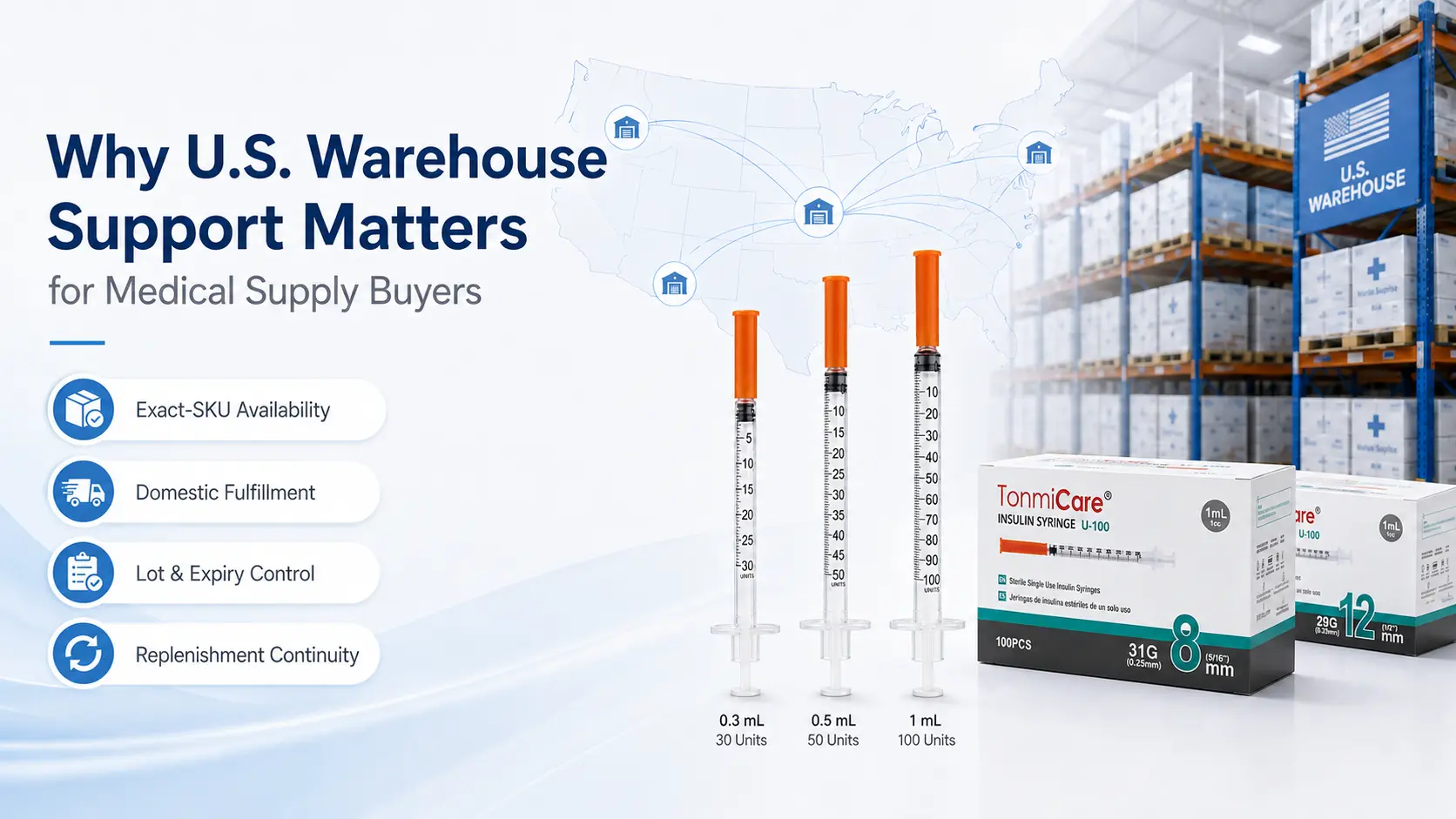
Why U.S. Warehouse Support Matters for Medical Supply Buyers

Medical Supply Warehousing & Fulfillment Guide

How to evaluate exact-SKU availability, domestic fulfillment, lot and expiry control, delivered cost, and replenishment continuity before relying on a U.S. warehouse program.

By Tonmit Medical Supply Editorial Team Reviewed August 13, 2026 Reading time 22 minutes
Inventory proof Exact SKU and free-to-sell quantity
Timing proof Processing plus domestic transit
Continuity proof Warehouse stock plus upstream plan

Scope: This guide supports U.S. B2B procurement planning for selected finished medical devices and consumables. It is not legal advice, a universal warehouse standard, a live inventory feed, a product authorization, or a delivery guarantee. Buyers should confirm the exact product, regulatory status, storage requirements, available quantity, assigned lot, remaining shelf life, destination, freight terms, and transaction documents before acceptance.

U.S. warehouse medical supply inventory reviewed by exact SKU case quantity lot expiration and delivery destination

Why Does U.S. Warehouse Support Matter?

U.S. warehouse support can shorten the buyer-facing replenishment path when the required medical supply is already accepted, releasable, and available domestically. Instead of waiting for new production, export preparation, international transportation, entry processing, and U.S. receiving, the buyer may be able to move from order approval to domestic allocation, warehouse processing, and delivery.

The practical value is transaction-specific. It depends on the exact SKU, free-to-sell quantity, package hierarchy, lot, remaining shelf life, minimum release quantity, warehouse processing time, origin location, destination, carrier method, receiving requirements, and factory replenishment plan. A U.S. warehouse address alone does not prove live stock, same-day shipping, nationwide next-day delivery, regulatory compliance, FDA approval, cold-chain capability, or U.S. manufacture.

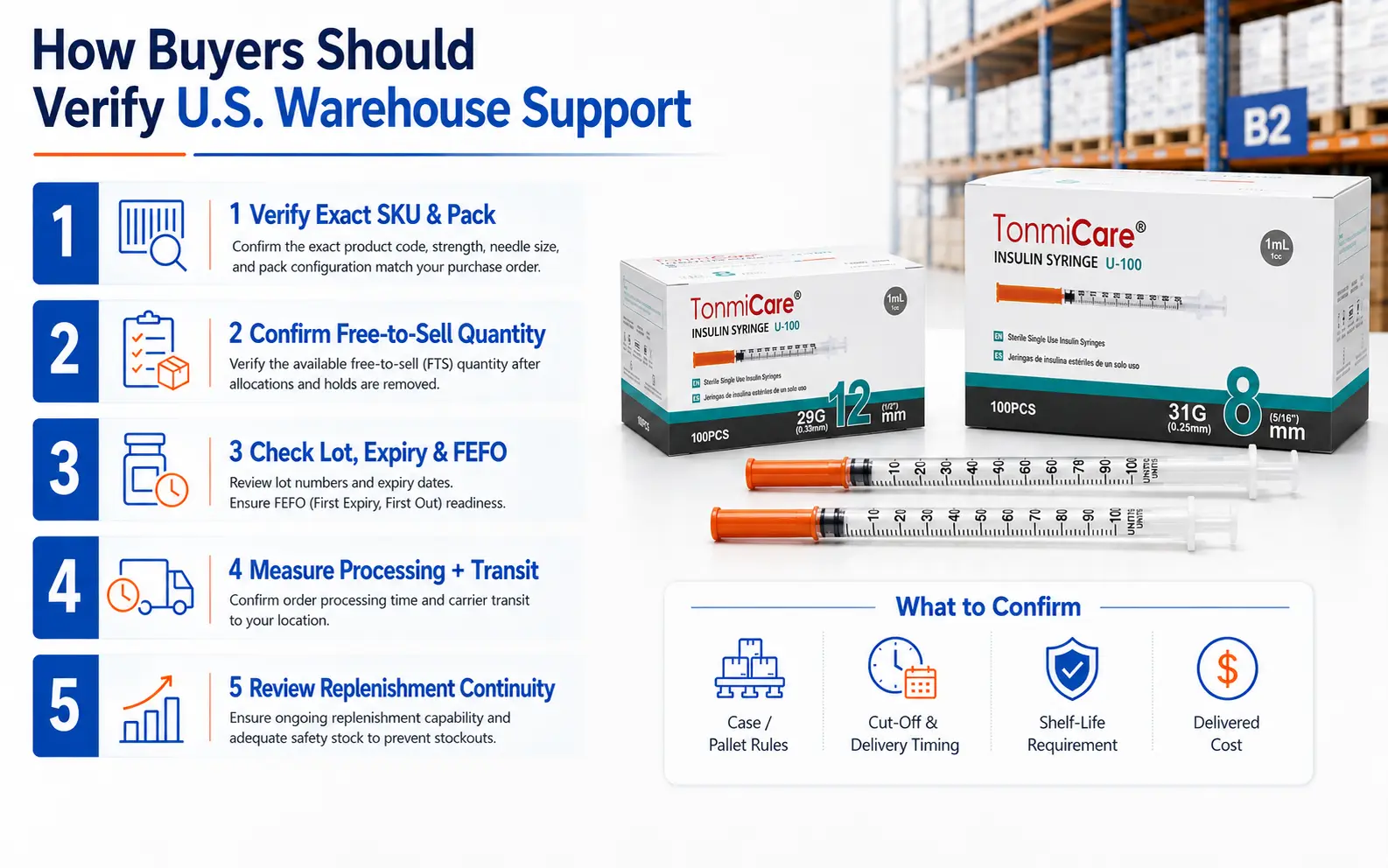
01IdentifyExact SKU and pack
02VerifyFree-to-sell quantity
03ReleaseLot, expiry and order terms
04DeliverProcessing plus transit
05ReplenishFactory-to-warehouse plan

1. What U.S. Warehouse Support Actually Means

In medical supply procurement, “U.S. warehouse support” should describe a defined operating arrangement—not a marketing shortcut. At minimum, the buyer should be able to identify where eligible inventory is held, who controls it, which SKUs are included, how orders are released, how inventory status is confirmed, and how domestic shipping is coordinated.

Depending on the program, warehouse support may include exact-SKU inventory review, case or carton preparation, selected mixed-SKU or pallet coordination, domestic parcel or freight shipment, lot and expiration information for assigned inventory, and replenishment planning. For qualified programs it may also include allocation targets, reserved stock, or factory-to-warehouse supply coordination. Buyers evaluating Tonmit’s service can review U.S. warehouse-supported medical supply fulfillment separately from this educational guide.

Availability

Domestic inventory path

Eligible stock may be allocated without waiting for a new international cycle.

Execution

Order-specific processing

Case, carton, parcel, and freight requirements are confirmed before release.

Continuity

Upstream replenishment

Repeat demand can be connected to production and future warehouse receipts.

The commercial benefit is not limited to speed. Domestic stock can also make smaller release quantities, shorter planning intervals, simpler receiving, and faster shortage response possible when the program actually supports them. Each of those benefits must be confirmed rather than assumed.

2. What a U.S. Warehouse Does Not Automatically Prove

Procurement teams often compress several questions into one: “Do you have a warehouse in the United States?” The address may be relevant, but it does not answer the operational, commercial, or regulatory questions below.

Statement What it does not prove What the buyer should request
“Stored in the USA” That the product was manufactured in the United States Country-of-origin information for the exact product and package
“U.S. inventory” That the required SKU and quantity are currently free to sell Dated written availability confirmation
“Domestic fulfillment” Same-day processing or next-day delivery Processing estimate, origin, carrier method, and destination estimate
“Medical warehouse” FDA approval, clearance, registration, or listing for the product Product- and establishment-specific regulatory records, as applicable
“Available by the case” That one box, mixed SKUs, or partial cases can be released Box, case, inner pack, and minimum release quantities
“Warehouse controlled” Cold-chain, validated temperature control, or every special condition Product label requirements and documented handling capability

Do not use warehouse location as a proxy

Verify product identity, availability, fulfillment, regulatory status, and origin as separate fields. A truthful answer to one field cannot be extended to the others without supporting evidence.

3. U.S. Warehouse vs. Distributor vs. 3PL vs. Made in USA

These terms describe different facts. A facility may perform one or several functions, and the responsible parties can change by transaction. Ask what each organization actually does instead of relying on the label used in sales copy.

Term Primary meaning Buyer question
U.S. warehouse A physical domestic storage and order-processing location Which exact inventory and activities are supported there?
Distributor or wholesaler A commercial supply-chain role that buys, sells, or distributes products Who owns the goods, invoices the order, and handles complaints or returns?
Third-party logistics provider A service provider that may store, pick, pack, or ship for another company Which functions are contracted, and who remains responsible for product decisions?
Made in USA A product-origin claim, not a warehousing claim Is the claim properly substantiated for the exact product?

The FTC states that an unqualified U.S.-origin claim generally requires a product to be “all or virtually all” made in the United States. A product manufactured abroad does not become U.S.-made merely because it was imported, stored, labeled for shipment, or fulfilled from a domestic warehouse. Qualified claims must be truthful, substantiated, and clear enough to avoid creating a broader origin impression than the evidence supports.[5]

4. Exact-SKU Availability and Free-to-Sell Inventory

A category-level answer such as “we stock syringes” is not sufficient for a purchase decision. Medical supplies that look similar may differ by manufacturer, brand or labeler, REF, model, size, gauge, needle length, capacity, connector, material, sterile barrier, package quantity, labeling version, or intended use. The availability check must use the buyer’s full specification and packaging level.

Operational free-to-sell model

Free-to-Sell = Accepted On-Hand − Allocated − Reserved − Quarantined − Recall-Held − Damaged − Expired

This is a practical planning definition, not a universal accounting or legal rule. Suppliers and inventory systems may use different status names. The important point is that physical on-hand quantity may include units that cannot be released to the new order. Buyers should ask for the supplier’s definition and the status included in the quoted quantity.

A written availability confirmation should identify

  • Manufacturer, brand or labeler, product name, and exact REF/SKU
  • Critical specification and package hierarchy: unit, inner, box, case, and pallet
  • Quantity free to sell, requested quantity, and quantity allocated to the order
  • Lot or batch, expiration date, and buyer-required minimum remaining shelf life
  • Warehouse processing estimate and the period for which the stock confirmation is valid
  • Substitution, partial-shipment, and backorder rules

A public product page is not a live inventory feed. Even when a page describes a U.S. warehouse program, quantities may change as orders are received, stock is allocated, product is placed on hold, or replenishment arrives. Time-sensitive purchases need dated, transaction-specific confirmation.

Product-category pages can help define an RFQ, but they do not replace the stock check. For example, a buyer may confirm wholesale insulin syringe availability or review wholesale pen needle configurations, then request written confirmation for the selected REF, package, quantity, lot, shelf life, and delivery destination.

5. Measure Complete Delivered Lead Time—Not Carrier Transit Alone

Domestic carrier transit is only one part of the buyer’s elapsed time. An order can spend time in commercial approval, inventory allocation, warehouse processing, freight appointment scheduling, and buyer receiving. Comparing a “two-day shipment” with a factory-direct lead time without defining both endpoints produces a weak procurement decision.

Complete delivered lead time

Order Approval + Inventory Allocation + Warehouse Processing + Carrier Transit + Buyer Receiving/Inspection

01ApproveSKU, price, terms, documents
02AllocateAssign free-to-sell stock
03ProcessPick, pack, label, stage
04TransportParcel, multi-carton, or LTL
05ReceiveAppointment, count, inspect

Always distinguish warehouse processing time from carrier transit time. Ask when the processing clock starts, the applicable cut-off time, whether weekends and holidays are excluded, and what event completes processing. Then request a carrier estimate for the actual origin, destination, service level, shipment size, and receiving conditions. Estimated dates are not guaranteed dates unless the contract expressly says so and defines the remedy.

6. How Warehouse Support Affects Reorder Points and Safety Stock

A reliable domestic release path may shorten the lead time used in inventory planning, which can reduce the amount of demand that must be covered before the next receipt. It does not automatically justify lower safety stock. Variability in demand, warehouse processing, carrier performance, upstream replenishment, and the consequence of a stockout must still be evaluated.

Planning model

Reorder Point = Expected Demand During Complete Replenishment Lead Time + Safety Stock

Define “complete replenishment lead time” according to the source. For a domestic warehouse release, it may run from purchase approval through buyer receipt. For replenishing the warehouse itself, it may include demand review, factory planning, production, release, export preparation, international transportation, import processing, and warehouse receiving. Those are two different planning clocks.

Use a two-level inventory view

Track the buyer’s reorder point against domestic stock and separately track the warehouse replenishment trigger against the longer upstream cycle. A fast local release path is temporary if the warehouse is not replenished before its usable inventory is consumed.

7. Lot, Expiration, UDI, and FEFO Control

Domestic location can improve visibility only when the inventory record and warehouse process preserve the relevant product identifiers. Buyers should confirm which lot or batch will ship, the labeled expiration date, how the remaining shelf life is calculated, and whether the selected lot meets the receiving requirement.

Remaining shelf life at expected receipt

Labeled Expiration Date − Expected Buyer Receipt Date

Calculate shelf life at expected receipt, not at quotation. A product with twelve months remaining when quoted does not still have twelve months remaining after order processing and transit. State the buyer’s minimum requirement in days or months, define the calculation date, and address what happens if the assigned lot changes before shipment.

FDA’s UDI system generally uses a device identifier (DI) for the labeler and specific device version or model, while production identifiers (PI) can contain variable data such as lot, serial number, expiration, or manufacturing date when included on the label. Exceptions and alternatives exist, so buyers should not assume every product or package has the same UDI structure.[2] UDI, REF, lot, and expiry should be treated as related but distinct fields.

Field What it helps identify Warehouse control
REF/SKU or model Exact commercial product configuration Match order, pick record, and receiving record
UDI/DI or GTIN, where applicable Labeler and device/package version identity Scan and validate the correct packaging level
Lot/batch Production group used for traceability Allocate, quarantine, investigate, or recall by lot
Expiration date Labeled end of shelf life Apply approved FEFO and minimum-shelf-life rules

First-expire, first-out (FEFO) is useful only when product status, lot, and expiration records are accurate and the selected lot still satisfies customer requirements. FEFO should not override a quarantine, recall hold, contractual shelf-life requirement, or product-specific handling rule.

Medical supply workflow from factory replenishment and U.S. warehouse allocation to domestic fulfillment and buyer receiving

8. Case, Carton, Mixed-SKU, and Pallet Orders

Warehouse inventory does not tell the buyer which quantities can be economically or operationally released. A product can have unit, inner pack, box, case, master carton, layer, and pallet quantities. The quoted price and quantity must use the same unit of measure as the purchase order and receiving system.

Confirm packaging and release rules

  • Units per box, boxes per case, cases per pallet, and total units ordered
  • Whether broken-case or one-box orders are permitted
  • Whether mixed-SKU cartons or pallets are available and how they are labeled
  • Minimum release quantity and any pick-and-pack fee
  • Case dimensions, weight, pallet height, and stack restrictions when relevant
  • Whether partial shipments require buyer approval

A selected mixed-SKU order may be possible only when the products are held in the same fulfillment arrangement and meet commercial and handling rules. Likewise, pallet availability depends on the product, quantity, warehouse configuration, destination, and freight requirements. Buyers can compare wholesale medical supply order models before choosing domestic releases, factory-direct orders, or a hybrid program.

9. Domestic Freight, Cut-Off Times, and Delivery Appointments

Domestic shipping is simpler than an international shipment only in relative terms. Parcel, multi-carton, less-than-truckload (LTL), and full-truckload movements have different cost, label, appointment, and exception processes. The destination may be a commercial dock, pharmacy, clinic, residential-style address, limited-access site, or distribution center with routing rules.

Variable Why it matters Buyer action
Order cut-off Orders approved after the cut-off may enter the next processing cycle Ask for the applicable time zone and approval requirements
Destination type Access conditions can affect carrier choice and charges Disclose receiving hours, dock, liftgate, and inside-delivery needs
Appointment Scheduling can add time beyond line-haul transit Provide routing guide and contact before shipment
Accessorials Liftgate, limited access, re-delivery, or detention can change cost Define included and pass-through charges in the quotation
Damage or shortage Claims depend on timely count, inspection, and documentation Set receiving and freight-claim procedures before the first order

Cold-chain or temperature-controlled service should never be inferred from the word “medical.” Identify the exact storage and transportation conditions on the product labeling and project requirements. If controlled, monitored, validated, refrigerated, or frozen handling is required, confirm the capability and records before approving the program.

10. Compare Delivered Cost—not Factory Unit Price Alone

A factory-direct unit price can be lower while the total procurement cost is higher for an urgent or smaller requirement. Conversely, warehouse stock can have a higher unit or handling cost while reducing international freight exposure, working capital, minimum order quantity, and shortage risk. There is no universal rule that either source is always cheaper.

Illustrative delivered-cost model

(Product Cost + Pick/Pack + Domestic Freight + Applicable Accessorials + Receiving Cost + Expected Expiry or Shortage Cost) ÷ Accepted Usable Units

Use only the components applicable to the transaction, and apply the buyer’s approved costing policy. “Accepted usable units” matters because damaged, rejected, expired, short-dated, or incorrect units do not support demand even if they appeared on the invoice. A complete comparison should also consider payment terms, inventory carrying cost, order frequency, administrative effort, and the probability and consequence of a stockout.

Ask for comparable quotations

Compare the same exact SKU, package quantity, accepted shelf life, destination, Incoterm or domestic shipping term, service level, and documentation scope. A per-box quote and a per-case quote are not comparable until both are converted to the same accepted unit.

11. Five Medical Supply Models Buyers Should Distinguish

“U.S. warehouse” can sit inside several supply structures. Selecting the right model depends on whether the demand is urgent, recurring, customized, or large enough to justify production and import planning.

Model Best fit Main control
Stocked standard inventory Repeat or urgent demand for an eligible standard SKU Confirm current free-to-sell quantity and future stock plan
Reserved inventory Forecasted repeat demand with agreed allocation Define ownership, release, storage, forecast, and excess terms
Factory-to-warehouse replenishment Ongoing domestic releases supported by planned upstream supply Set warehouse target and factory replenishment trigger
Factory-direct order Larger, broader-SKU, or customized requirements Plan production, international transit, import, and receiving lead time
Hybrid supply Immediate domestic need plus larger future demand Prevent a gap between current allocation and upstream arrival

A hybrid program is often the most realistic: release available U.S. inventory for current demand, then use factory production to rebuild future stock. Buyers with recurring diabetes-care demand can build a recurring diabetes supply program around approved SKUs, forecasts, and replenishment requirements.

12. Shortage, Backorder, and Substitution Control

U.S. inventory can buffer an upstream disruption, but it cannot eliminate factory, component, quality-release, packaging, transportation, customs, or demand risk. The buffer lasts only as long as usable domestic supply remains. Monitor warehouse inventory, open orders, consumption, inbound quantities, and expected availability dates together.

01ConfirmExact shortage and affected quantity
02ProtectAllocate approved usable inventory
03EvaluateBackorder, partial, or alternate path
04ApproveBuyer authorizes any change
05RebuildReplenish the domestic buffer

No automatic substitution

Do not substitute a different manufacturer, brand, REF, dimension, feature, packaging level, label version, or document set without the buyer’s documented review and approval. Similar appearance does not establish equivalence.

The FDA’s Medical Device Shortages List identifies device categories the agency has determined to be in shortage; it is not a live inventory feed for every supplier or exact SKU.[6] Buyers should use official shortage information as one input while continuing to verify transaction-specific availability.

13. Recall, Returns, and Reverse Logistics

A warehouse program should support controlled stops as well as outbound speed. When a recall, correction, complaint investigation, damage event, or receiving rejection occurs, the parties need a defined method to identify affected stock, place inventory on hold, communicate with customers, and document disposition.

Traceability chain

Exact Product/REF → Lot or Other Identifier → Quantity Received → Quantity Released → Customer/Destination → Quantity Remaining → Hold/Return/Disposition

FDA explains that device recalls generally involve removing or correcting products that violate laws the agency administers, and that recalls are usually conducted voluntarily by the manufacturer; reportable corrections and removals have their own requirements for manufacturers and importers.[4] The buyer’s contract should identify who receives notices, initiates a hold, provides affected-lot data, manages customer communication, authorizes return or destruction, and pays applicable freight or handling costs.

Reverse-logistics questions

  • Who authorizes returns and issues the return reference?
  • Where are returned goods sent, and may they ever re-enter saleable inventory?
  • How are damage, temperature excursion, and suspected tampering handled?
  • How quickly can warehouse records identify remaining and distributed quantities?
  • Who documents quarantine, destruction, credit, replacement, and final closure?

14. Private-Label U.S. Inventory Needs Separate Responsibilities

Customer-branded inventory is less interchangeable than a standard stocked product. Artwork, address, barcode, labeling version, case print, and product specification may be unique to one buyer. Before product is produced or placed in the United States, define ownership and the commercial consequences of forecast changes.

Responsibility Questions to resolve before stocking
Inventory ownership Who owns goods during production, international transit, warehouse storage, and release?
Forecast and commitment Which forecast is informational, and which quantity is a binding purchase commitment?
Release plan What is the minimum release, order frequency, target stock, and reorder trigger?
Change control Who approves artwork, address, barcode, specification, or regulatory changes?
Excess and obsolescence Who pays for slow-moving, expired, superseded, or discontinued customer-specific stock?
End of program How are remaining goods, packaging materials, labels, and records disposed of?

Review these controls before treating reserved private-label inventory as a simple warehouse benefit. Buyers can review private-label inventory responsibilities as part of a broader OEM or custom-packaging program.

15. Regulatory and Import Boundaries

U.S. warehousing is an operational fact, not a regulatory status. A finished medical device offered for import must meet applicable U.S. requirements. FDA identifies potential requirements such as establishment registration, device listing, quality requirements, premarket notification or approval unless exempt, labeling, and medical device reporting, depending on the product and parties involved.[1]

Do not describe every device as “FDA approved.” Devices may follow different regulatory pathways, including exemption, clearance, authorization, or premarket approval, as applicable. Establishment registration and device listing also do not, by themselves, mean FDA has approved a facility or product. Ask for records tied to the exact manufacturer, labeler, device, and activity, then assess them within the buyer’s qualification process. Tonmit buyers may request exact-SKU medical device documentation for the applicable transaction.

Warehouse registration obligations depend on the activities performed. FDA’s current registration table, for example, distinguishes a domestic distributor that does not import devices and a wholesale distributor that is not a manufacturer or importer from activities such as initial importing, manufacturing, repackaging, or relabeling. Therefore, “every medical warehouse must be FDA registered” is not an accurate general rule.[3]

Imported and domestically stored are compatible facts

A medical supply can be manufactured outside the United States, imported under applicable requirements, and then stored and fulfilled domestically. Describe manufacturing origin, import status, regulatory pathway, and warehouse location separately and precisely.

16. How to Evaluate a U.S. Warehouse Program

A strong evaluation converts general claims into evidence, responsibilities, and measurable service terms. Use the scorecard below during supplier qualification and repeat it for major SKU, packaging, location, or process changes.

Control area Evidence to request Decision question
Program scope Written description of products, order types, locations, and excluded services Does the program support this buyer, SKU, and order format?
Inventory status Dated free-to-sell quantity and status definition Can the required quantity be allocated now?
Product identity REF/SKU, specifications, packaging, label, and applicable UDI/GTIN Is it the exact approved product and package?
Lot and shelf life Assigned or eligible lots, expiration, and FEFO/minimum-shelf-life method Will the received lot meet the buyer’s requirement?
Processing Order cut-off, approval inputs, processing estimate, and release event When can the order actually enter carrier custody?
Freight Origin region, mode, estimate, accessorials, routing, tracking, and claim process Is the destination-specific delivery path workable?
Continuity Demand forecast, target inventory, factory lead time, and inbound plan What happens after current warehouse stock is used?
Exceptions Backorder, partial shipment, substitution, hold, return, and recall rules Who decides and documents deviations?
Commercial terms Delivered-cost components, minimums, ownership, storage, and excess terms Is the total cost and risk allocation acceptable?
Documentation General product records and transaction-specific lot/shipping records Are required records available at the correct stage?

A buyer does not need every supplier to use identical terminology. The goal is a complete, internally consistent answer that the purchasing, quality, receiving, finance, and operations teams can verify. Score missing information as unresolved, not as an assumed “yes.”

17. Copyable U.S. Warehouse Availability Confirmation

Copy the template below into an RFQ, email, or supplier onboarding form. Remove fields that do not apply, but do not combine product, inventory, processing, and freight answers into one general availability statement.

U.S. WAREHOUSE AVAILABILITY CONFIRMATION

Buyer/company:
Delivery destination and ZIP code:
Required delivery date or planning date:

PRODUCT IDENTITY
Product name/category:
Manufacturer:
Brand/labeler:
Exact REF/SKU/model:
Critical specification:
UDI/DI/GTIN, where applicable:
Package hierarchy (unit/inner/box/case/pallet):

INVENTORY AND RELEASE
Accepted on-hand quantity:
Quantity currently free to sell:
Quantity already allocated or reserved:
Quantity requested by buyer:
Quantity available for this order:
Minimum release quantity:
Stock-confirmation date/time and validity period:

LOT AND SHELF LIFE
Eligible or assigned lot/batch:
Labeled expiration date:
Remaining shelf life at expected receipt:
Buyer minimum remaining shelf life:
FEFO/allocation rule:

PROCESSING AND DELIVERY
Order-approval requirements:
Applicable warehouse cut-off and time zone:
Estimated warehouse processing time:
Shipping origin ZIP code or region:
Freight method/service level:
Estimated carrier transit:
Receiving hours/appointment/liftgate requirements:
Tracking or freight-document process:

ORDER RULES
One-box or broken-case release permitted? Yes / No / Conditional
Mixed-SKU shipment permitted? Yes / No / Conditional
Partial shipment permitted only with buyer approval? Yes / No
No substitution without written buyer approval confirmed? Yes / No
Backorder and cancellation policy:
Damage, shortage, return, and recall process:

CONTINUITY AND DOCUMENTS
Current inbound replenishment quantity/date:
Factory-to-warehouse replenishment lead time:
Recommended forecast and reorder frequency:
General product documents available before order:
Lot-specific documents available after allocation:
Shipping/receiving documents supplied:

COMMERCIAL CONFIRMATION
Product-price basis and unit of measure:
Pick/pack, storage, freight, and accessorial treatment:
Payment and shipping terms:
Name/title of person confirming:
Confirmation date:

U.S. Warehouse Support FAQ for Medical Supply Buyers

Does U.S. warehouse support mean the product is in stock?

No. It means a domestic warehouse arrangement exists for selected products or programs. Confirm the exact SKU, packaging, free-to-sell quantity, lot, shelf life, release quantity, and the validity period of the stock confirmation.

Are all supplier products available from the U.S. warehouse?

Usually not. U.S. availability commonly varies by product, specification, packaging, quantity, and inventory cycle. Customized or less frequently ordered configurations may require factory-direct supply or planned factory-to-warehouse replenishment.

How quickly can U.S. warehouse medical supplies be delivered?

Timing depends on order approval, inventory allocation, warehouse processing, shipment size, origin, destination, service level, appointment requirements, and carrier conditions. Request processing and transit estimates as separate fields.

Does U.S. inventory guarantee same-day or next-day delivery?

No. Domestic stock may shorten the procurement path, but it does not guarantee a cut-off, processing time, carrier service, or delivery date. Obtain an order-specific estimate and any contractual service commitment in writing.

Where is the medical supply warehouse located?

Ask for the applicable shipping origin or region for the selected SKU and program. A supplier can use more than one warehouse or arrangement, so a general company address may not identify the shipment origin.

Can a pharmacy or clinic order one box?

Possibly, but it should not be assumed. Minimum release quantities can be a full case, multiple cases, a carton, or a selected broken-case quantity. Confirm the package hierarchy, minimum, and any pick-and-pack charge.

Can different medical supply SKUs ship together?

Selected mixed-SKU orders may be possible if the products are available within the same fulfillment arrangement and meet packaging, handling, commercial, and freight requirements. Confirm labeling and receiving details before release.

Can the supplier reserve U.S. inventory for my organization?

Qualified recurring programs may support allocation or reserved stock. Define the forecast, ownership, storage, release schedule, validity period, replenishment, excess inventory, discontinuation, and end-of-program terms.

What is free-to-sell medical supply inventory?

Operationally, it is the accepted on-hand quantity that remains available after excluding inventory that is allocated, reserved, quarantined, recall-held, damaged, expired, or otherwise unavailable. Ask each supplier how its system defines the term.

Can I confirm lot and expiration before ordering?

Lot and expiration may be available for eligible or assigned inventory. State the requirement before order confirmation. General stock information can change before allocation, so the final shipping lot should be confirmed at the appropriate stage.

What minimum shelf life should a buyer require?

There is no universal number for every product and buyer. Base the requirement on labeled shelf life, consumption, inventory policy, distribution time, downstream customer needs, contract, and applicable procedures. Calculate it at expected receipt.

Does U.S. warehousing mean the product is Made in USA?

No. Storage or fulfillment location is separate from manufacturing origin. Request exact-product country-of-origin information and use U.S.-origin claims only when they are truthful, properly qualified where needed, and substantiated.

Does warehouse stock prove FDA approval or compliance?

No. Verify the applicable regulatory pathway, manufacturer, labeler, registration, listing, labeling, import, and other product-specific requirements separately. “FDA registered” and “FDA listed” are not interchangeable with “FDA approved.”

Has U.S. warehouse inventory already cleared import processing?

Do not assume this from a generic warehouse claim. Ask whether the quoted inventory has been received and accepted into domestic stock, which party imported it, and whether any entry, quality, or commercial hold remains.

Does a medical warehouse provide cold-chain service?

Not automatically. Confirm the product’s labeled conditions and the required storage, monitoring, mapping, validation, packaging, transportation, excursion, and record controls before accepting temperature-sensitive service.

Can private-label medical supplies be stocked in the United States?

A private-label program may be evaluated, but it requires approved specifications and artwork, production planning, inventory targets, release forecasts, ownership, change control, and excess or obsolete inventory responsibilities.

What happens when U.S. warehouse stock runs out?

The answer should be defined before the shortage: backorder, approved partial shipment, factory-direct supply, inbound warehouse replenishment, or an independently reviewed alternative. Current stock without an upstream plan is not a continuity strategy.

May the warehouse automatically substitute another SKU?

It should not do so unless the buyer’s controlled process and agreement expressly allow it. Manufacturer, REF, dimensions, packaging, label, documentation, and intended use changes require appropriate review and documented approval.

Is warehouse stock always more expensive than factory-direct supply?

No universal answer exists. Compare delivered cost per accepted usable unit, minimum order quantity, lead time, carrying cost, administrative effort, expiry exposure, and shortage risk using the same SKU, package, destination, and terms.

Can U.S. warehouse support help with emergency replenishment?

It may shorten the path when usable inventory is available and can be released, but “emergency” does not override stock, order-approval, processing, freight, receiving, product suitability, or documentation controls.

Can the warehouse support pallet orders?

Selected pallet quantities may be coordinated depending on product, stock, pallet configuration, warehouse capability, destination, carrier, dock, appointment, and liftgate requirements. Confirm freight details during quotation.

Which documents should accompany a warehouse order?

Requirements vary. They may include quotation or order confirmation, invoice, packing list, shipping record, tracking or bill of lading, and applicable product, lot, origin, or quality records. Distinguish general product documents from lot-assigned records.

What forecast should a recurring buyer provide?

Provide exact-SKU monthly or quarterly demand, order frequency, peak variability, minimum and target stock, target release quantities, required shelf life, expected growth, promotions, and known product or packaging changes. State whether the forecast is informational or a commitment.

Does one U.S. warehouse eliminate medical supply risk?

No. It changes the risk profile and may buffer certain delays, but concentration, warehouse, carrier, demand, quality, upstream production, and import risks remain. Use qualified alternate paths and tested exception procedures where justified.

18. Conclusion: Verify the Complete Supply Chain, Not the Address

U.S. warehouse support matters because it can turn eligible domestic inventory into a shorter and more manageable replenishment path. Its value is highest when the buyer can verify the exact product, usable quantity, lot and shelf life, release rules, processing time, freight path, delivered cost, and factory replenishment plan.

Decision chain

Exact SKU → Free-to-Sell Inventory → Lot & Remaining Shelf Life → Valid Release Quantity → Processing Time → Domestic Transit → Delivered Cost → Factory Replenishment → Continuity Decision

That sequence prevents an attractive warehouse claim from outrunning the evidence. It also gives procurement, quality, finance, receiving, and operations a common basis for comparing warehouse-supported, factory-direct, reserved, and hybrid supply models.

U.S. inventory & fulfillment review

Request an Exact-SKU U.S. Inventory Review

Share the product, manufacturer or target specification, exact REF/SKU, package quantity, required volume, destination, target date, minimum shelf life, document list, and expected repeat demand. Tonmit can review applicable U.S. inventory, fulfillment, factory-direct, and replenishment options for a transaction-specific RFQ.

Final availability, allocation, exact-SKU documentation, assigned lot, remaining shelf life, processing, freight, price, and delivery terms are confirmed for the selected transaction.

References

  1. U.S. Food and Drug Administration. Importing Medical Devices and Radiation-Emitting Electronic Products into the U.S. Describes applicable FDA requirements for imported devices and roles such as foreign manufacturers and initial importers.
  2. U.S. Food and Drug Administration. UDI Basics. Explains device identifier and production identifier concepts, package labeling, GUDID submission, and the existence of exceptions and alternatives.
  3. U.S. Food and Drug Administration. Who Must Register, List and Pay the Fee. Provides activity-specific registration and listing tables for domestic and foreign establishments.
  4. U.S. Food and Drug Administration. Recalls, Corrections and Removals (Devices). Defines and distinguishes recalls, corrections, removals, market withdrawals, and stock recoveries.
  5. U.S. Federal Trade Commission. Enforcement Policy Statement on U.S. Origin Claims. Explains substantiation and qualification principles for unqualified and qualified U.S.-origin claims.
  6. U.S. Food and Drug Administration. Medical Device Shortages List. Lists device categories FDA has determined to be in shortage and separate discontinuance information; it is not an exact-SKU inventory feed.

Evidence boundary: Official requirements, product status, inventory, service scope, and URLs can change. The formulas and scorecards in this guide are operational planning models, not statutory rules. Review current official sources, applicable law, exact product labeling, controlled supplier records, contracts, and approved buyer procedures before implementation.