
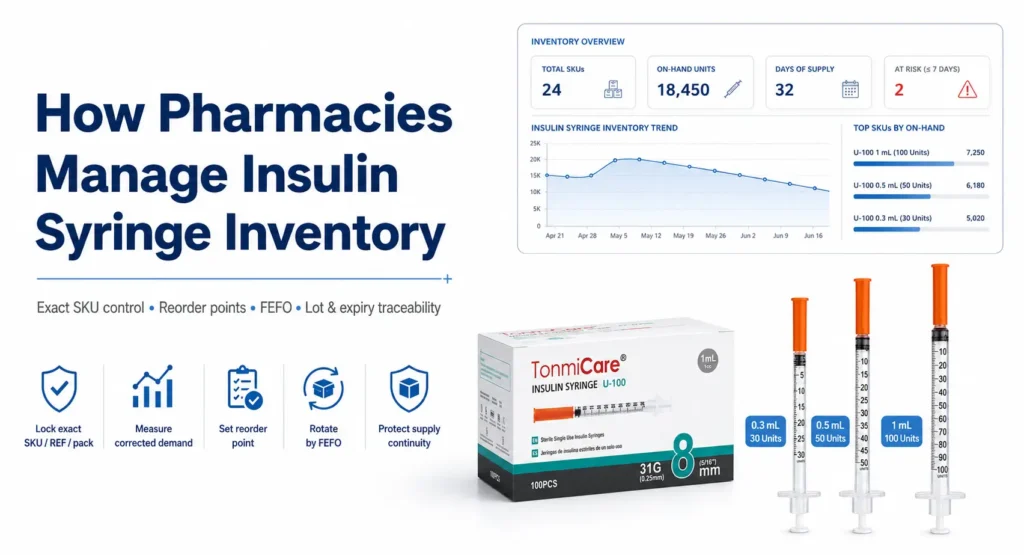
Insulin Syringe Inventory & Replenishment Guide
Manage each insulin syringe SKU with a clear replenishment trigger, verified case quantities and lot-level records. Use our worked example, planning calculator and receiving checklist to turn stock data into a repeatable purchasing process.
Editorial review team
Review scope: replenishment planning, case quantities and fulfillment.
Review scope: receiving checks, lot records and product documentation.
This guide supports pharmacy and distribution purchasing and stock control. Apply the exact product’s labeling and your approved procedures. The planning model does not select a syringe for a patient or authorize a product substitution.
Quick answer
How do pharmacies manage insulin syringe inventory?
Manage each approved insulin syringe SKU separately. Set its reorder point from expected demand during complete replenishment lead time plus approved safety stock. Compare that trigger with usable inventory position, then calculate the target gap and round the purchase to the confirmed case pack and MOQ. Inspect receipt, record each lot and expiry, and rotate acceptable stock by FEFO.
Start with the reorder calculation and worked example or copy the inventory and receiving templates.
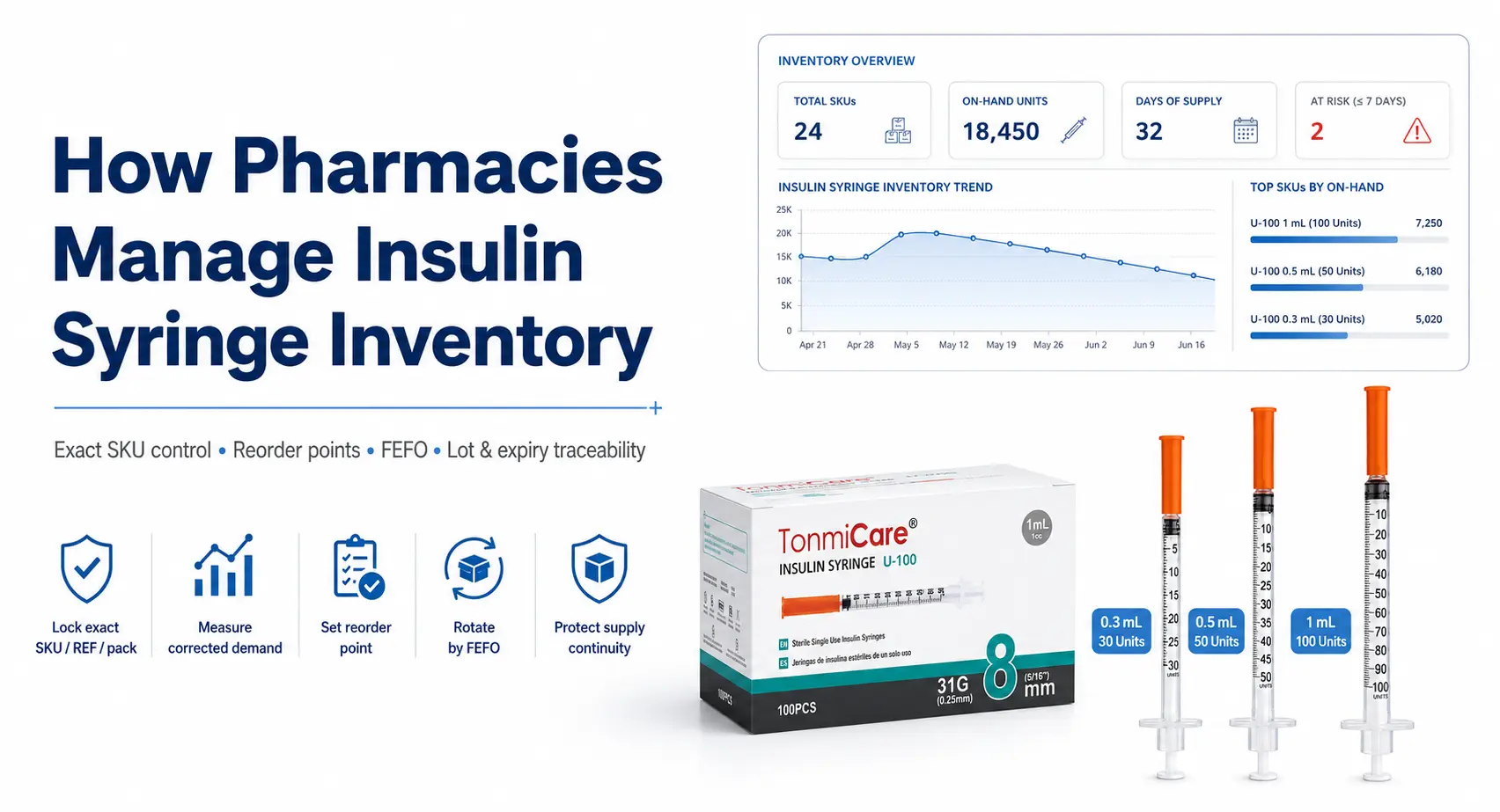
Before approving replenishment
Three checks that keep an order accurate
- Product identity: keep scale, capacity, graduation, gauge × length and REF in one approved SKU record.
- Usable quantity: exclude held stock and count reservations, backorders and inbound only once.
- Ordering unit: confirm boxes per case and the MOQ before rounding the quantity.
1. Build a separate record for each syringe SKU
An inventory item must identify the complete approved product. “31G insulin syringe” does not identify capacity, needle length, scale or package. Keep 0.3 mL, 0.5 mL and 1 mL configurations separate, and maintain separate records for different concentration scales or graduation intervals.
| Field group | Record for each approved SKU |
|---|---|
| Product identity | Legal manufacturer, brand or labeler, exact REF/model and current label revision. |
| Syringe specification | Labeled concentration scale, capacity, smallest graduation, gauge × needle length and device design. |
| Commercial pack | Syringes per box, boxes per case, any inner-pack level and applicable package identifiers. |
| Replenishment settings | Demand unit, lead-time basis, safety stock, reorder point, target, MOQ and order multiple. |
| Approval controls | Approved supplier, separate approved alternates, specification owner and last review date. |
Use our insulin syringe specification guide for pharmacy buyers to check the product fields. Record lot, expiry, location and quantity in a linked lot table rather than overwriting one expiry date whenever another delivery arrives.
Insulin drug stock and empty insulin syringe stock can share software but need different product records. DSCSA tracing concerns covered prescription drugs; it is not the device-tracing framework for empty syringes.[1]
2. Measure demand and choose a safety-stock policy
Recorded sales can understate demand when a SKU is unavailable. Mark stockout periods and review unfilled requests, emergency purchases and demand moved to approved alternatives. Count the same request once. Separate customer demand from internal transfers, returns and one-time orders.
For steady movement, calculate an average from a defined review period, then document adjustments. For intermittent demand, a new customer program or a protected configuration with few alternates, review the individual requirement instead of relying only on a daily average.
What is safety stock?
Safety stock is an approved buffer for demand or replenishment uncertainty. Set it using observed variation, service goals, product criticality, alternatives and expiry exposure. No fixed 30-day or 90-day buffer fits every SKU. Record who approved the quantity and when it will be reviewed.
Measure lead time from the reorder decision through approval, supplier processing, transport, receiving and release into usable stock. Keep demand and lead time on the same calendar basis: boxes per calendar day with calendar days, or business-day demand with business-day lead time.
3. Calculate the reorder point and order quantity separately
The reorder point answers when to order; the target and case pack determine how much to order. The lead-time-demand-plus-safety-stock relationship is a standard planning concept.[2] Our example combines that trigger with a chosen order-up-to target; it is not an EOQ calculation or a statutory stocking rule.
- Reorder point
- Average daily demand × complete replenishment lead time + safety stock
- Inventory position
- Usable on-hand + reliable confirmed inbound − outstanding commitments
- Order quantity when the trigger is reached
- Round up max(target − inventory position, MOQ) to the valid case multiple, when a positive target gap exists.
In this model, usable on-hand includes acceptable stock that is reserved; outstanding commitments are then deducted once. If your system already nets reservations out of available stock, do not deduct them again. Exclude expired, damaged, quarantined and recall-held quantities from usable on-hand.
Only count inbound that has a credible quantity and usable receipt date for the planning window. A large order due after the projected shortage cannot cover the earlier gap. Check dated supply and demand separately before approving an order.
Worked example: a 20-box case
All values below are hypothetical. Use one approved SKU and boxes as the planning unit.
| Calculation | Example result |
|---|---|
| Reorder point | 2.4 boxes/day × 6 days + 8 boxes = 22.4 boxes; round the trigger up to 23 whole boxes. |
| Inventory position | 18 usable boxes + 6 reliable inbound boxes − 4 committed boxes = 20 boxes. |
| Target gap | 40-box target − 20-box inventory position = 20 boxes. |
| Case order | At or below the trigger, a 20-box case and 20-box MOQ produce an order of 1 case. |
Reorder trigger2.4 × 6 + 8 = 22.4 boxesRound up to 23 whole boxes.
Inventory position18 + 6 − 4 = 20 boxesUsable + inbound − commitments.
Case order40-box target − 20-box positionOrder 1 × 20-box case.
Tonmit planning tool
Insulin syringe reorder calculator
Enter values for one SKU in boxes. The starting values match the hypothetical example above. Safety stock and the target are your approved inputs.
Method: a continuous-review trigger with an order-up-to target and full-case ordering. It does not forecast demand, choose safety stock, validate shelf life or calculate a service probability. For weekly review, also allow for demand during the review interval. Check receipt dates and immediately available stock before using the result.
4. Keep box and case quantities separate
A case is a shipping unit, not a universal quantity. Our selected U.S. warehouse configurations use 100 syringes per box and 20 boxes per case. Our standard China factory planning pack uses 100 per box and 36 boxes per case. Confirm the quoted REF and shipping pack before applying either conversion.
| Supply path | Box and case pack | Individual syringes |
|---|---|---|
| Selected U.S. warehouse configuration | 100 per box × 20 boxes | 2,000 per case |
| Standard China factory planning pack | 100 per box × 36 boxes | 3,600 per case |
In the worked example, changing the valid case multiple from 20 to 36 boxes rounds the 20-box requirement up to 36 boxes. Inventory position after the planned receipt becomes 56 boxes, which is 16 above the chosen target. Review storage and expiry exposure before approving that excess.
For price comparisons, use our box, case and landed-cost buying guide. Record purchasing, receiving and issue units explicitly; do not map a case barcode to a single box.
5. Inspect receipt and record each lot
Release only accepted quantities into usable stock. Compare the physical shipment with the approved item record and purchase order. Our downloadable receiving checklist below captures the decision and its evidence without requiring a new inventory system.
- Match manufacturer, REF, scale, capacity, graduation and gauge × length.
- Reconcile cases, boxes and individual syringes using the agreed conversion.
- Read applicable identifiers, lot and expiry from the received labeling.
- Check remaining shelf life against the agreed acceptance requirement.
- Inspect cartons and sterile-barrier packaging for visible damage without opening saleable sterile packs.
- Record accepted, held and rejected quantities separately, with the reviewer and disposition.
UDI may contain a device identifier and conditional production identifiers. FDA’s GUDID stores device-identification information, not the actual lot or expiry on your shelf.[3] Capture those values from labeling and receiving records; account for applicable UDI exceptions and package levels.
Use one lot row per SKU, lot, expiry, location and status. Link it to the receipt and subsequent movements. Request documentation for the exact product and shipment where needed; a generic company certificate cannot identify the lot received.
6. Apply FEFO, cycle counts and recall controls
FEFO means first-expiry, first-out. Pick the acceptable lot with the earliest labeled expiry, subject to holds, packaging condition and customer requirements. WHO storage guidance includes FEFO stock rotation; apply the exact product’s storage labeling and local procedures.[4]
Keep stock in its appropriate packaging and protect it from conditions that could damage it. Empty syringe storage is not the same as insulin drug cold-chain storage. Follow the syringe manufacturer’s conditions rather than copying temperature rules for insulin medication.
Cycle counts should reconcile quantity, lot, expiry, location and status. Choose the count interval by movement, discrepancy history and operational risk. Investigate repeated conversion or transfer errors rather than repeatedly adjusting the balance.
Keep held stock visible and unavailable
For a recall or product hold, match the notice to the exact product and affected lot range, block release, locate stock, trace relevant distribution and reconcile disposition. Follow the manufacturer’s and applicable FDA instructions.[5] Maintain separate quantities for available, allocated, quarantined, recalled, damaged and expired stock.
A supply shortage does not authorize a scale, capacity or needle change. Keep approved alternatives as separate SKUs and follow the pharmacy’s documented approval process before substitution.
7. Match the supply path to the replenishment need
Local replenishment and factory supply have different case packs and lead times. We review the exact syringe requirement, current availability, packaging and destination before quotation. Our U.S. warehouse service ships within the United States. Orders to Canada use the China supply path rather than U.S. domestic fulfillment.
Keep pharmacy stock, supplier stock, allocated purchase orders and in-transit quantities distinct. A supplier’s general stock statement does not establish the quantity or arrival date of your order. For route planning, review our U.S. warehouse and medical supply fulfillment service.
Start by reconciling SKU and lot records, then establish demand and lead-time history. Review stockout days, expiry write-offs, count discrepancies and actual usable-receipt lead times by SKU. Change the target when movement, case packs or supplier performance change. Keep a second supply path qualified before it is needed.
8. Use our inventory, receiving and RFQ templates
These Tonmit editorial templates turn the article into reusable working records. They are blank templates, not completed QC records, validated software or evidence of a customer’s inventory results. Record one SKU per master and one lot/location/status per lot row.
Inventory master and lot record
Keep product approval fields apart from quantities, lots and locations.
View or manually copy the inventory template
TONMIT INSULIN SYRINGE INVENTORY MASTER
Template revision: 2026-10-13. Complete one record per approved SKU.

Internal SKU:
Legal manufacturer / brand / labeler:
REF / model / label revision:
Concentration scale / capacity / smallest graduation:
Needle gauge x length / design:
Syringes per box / boxes per case / applicable inner pack:
Package identifier / identifier level:
Approved supplier / separately approved alternate SKU:
Demand unit / calendar basis / review period:
Observed demand / stockout adjustments / adjustment method:
Complete lead time / measured start and end points:
Safety stock / method / approval owner:
Reorder point / target / MOQ / valid order multiple:
Usable on-hand including reservations:
Reliable inbound quantity / expected usable date:
Outstanding commitments not already netted:
Last review / owner / next review:

LOT RECORD: use a separate row for each SKU + lot + expiry + location + status
SKU:
Lot / labeled expiry:
Location / status / quantity / unit:
Receipt ID / received date / accepted date:
Applicable barcode / package level:
Movement or distribution record reference:
Hold or recall notice / disposition reference:
Count date / counter / discrepancy / correction:

Exclude held, expired, damaged and recalled quantities from usable stock.
Do not deduct the same reservation or customer request twice.
Receiving inspection checklist
Record actual findings and link photos or document references to the receipt.
View or manually copy the receiving checklist
TONMIT INSULIN SYRINGE RECEIVING CHECKLIST
Blank editorial template. This is not a completed inspection record.

Receipt ID / date / PO / supplier / inspector:
SKU / manufacturer / REF / approved label revision:
Scale / capacity / graduation / gauge x length / design:
Case count / boxes per case / syringes per box:
Calculated total / physical count / discrepancy:
Lot / expiry / quantity / package identifier level:
Required remaining shelf life / measured remaining shelf life:
Carton condition: acceptable / hold / reject / observation:
Sterile barrier visual check: acceptable / hold / reject / observation:
Identity and labeling match: yes / no / unresolved:
Shipment documents match: yes / no / unresolved:
Photo / packing list / document references:
Accepted quantity / held quantity / rejected quantity / unit:
Decision owner / decision date / reason:
Storage location / system release reference:
Supplier follow-up / disposition / closure reference:

Keep each lot and status separately traceable. Do not open saleable sterile packs
solely to perform this checklist. Follow the approved inspection procedure.
Replenishment RFQ brief
Copy or download the brief, then complete it before requesting a supply review.
View or manually copy the RFQ brief
RFQ TOPIC: INSULIN SYRINGE INVENTORY REPLENISHMENT

Company / contact / business email:
Delivery country / state or region / postal code:
Approved REF or target manufacturer and brand:
Concentration scale / capacity / graduation:
Needle gauge x length / fixed or other design:
Syringes per box / boxes per case:
Monthly demand / demand unit:
Requested order quantity / delivery date:
Minimum remaining shelf life at receipt:
Required product and shipment documents:
Standard packaging or private-label requirement:
U.S. domestic replenishment or China supply path:
Split-shipment requirement / approved substitution policy:

Please confirm the exact product, case pack, MOQ, stock, lead time,
remaining shelf life, freight basis and documentation before quotation.
Insulin syringe inventory management FAQ
How many insulin syringes should a pharmacy keep in stock?
Set stock by approved SKU using demand during complete lead time, safety stock, case quantity, shelf life and the consequence of a shortage. A fixed number of months is not suitable for every item.
Does the reorder point tell me how many cases to buy?
No. It is the replenishment trigger. Calculate the target gap from inventory position, then apply the MOQ and valid case multiple. Review whether rounding creates excess stock.
Can a future delivery prevent a stockout today?
Only stock already available can satisfy an immediate requirement. Inbound helps planning when its usable receipt date precedes the shortage; an aggregate inventory position does not show every timing gap.
Should a weekly review use the same formula as continuous review?
A periodic-review plan must also consider the review interval. A common planning basis is demand over lead time plus the review interval, with an approved uncertainty buffer. The calculator here uses a continuous-review trigger.
Can U-40, U-100 or different capacities share one inventory item?
Keep different scales, capacities and other approved configurations as separate SKUs and clearly identified locations. Do not authorize substitutions through inventory software alone.
Can I find my lot and expiry in GUDID?
GUDID does not store the lot-specific production identifiers on your received stock. Read lot and expiry from the labeling and maintain your own receiving and movement records.
Keep the same SKU from forecast through receipt
Maintain one approved product identity through demand planning, the purchase order, receiving and lot records. Recalculate when demand, lead time or case packs change. Hold unresolved product or quantity differences before releasing stock, and review the timing of inbound supply before approving replenishment.
Sources and editorial basis
- FDA. Drug Supply Chain Security Act law and policies. Prescription-drug tracing context.
- Oracle. Reorder point planning. Lead-time-demand and safety-stock relationship; our order-up-to quantity method is stated separately.
- FDA. UDI basics. Device and production identifiers, exceptions and GUDID limits.
- WHO. Good storage and distribution practices for medical products, TRS 1025 Annex 7. Storage, stock rotation and distribution guidance; not a substitute for product labeling or U.S. law.
- FDA. Recalls, corrections and removals for devices. Recall context and manufacturer responsibilities.
Sources checked October 13, 2026. Confirm current labeling, supplier records and local procedures when implementing the model.
Insulin syringe supply planning
Request a replenishment quote for your approved SKU
Send the exact specification, recurring demand, required quantity, destination and receipt date. We will review the available supply path and confirm packaging, MOQ, documentation and delivery terms for the quotation.
The request opens our wholesale insulin syringe page. U.S. warehouse fulfillment serves U.S. destinations; Canada orders use the China supply path.