
Pen Needle Gauge Comparison & Procurement Guide
32G insulin pen needles have a smaller outside diameter than 31G, but gauge alone cannot establish comfort, flow or compatibility. Compare needle length, engineering design and exact product reference before approving a purchase or substitution.
This comparison supports professional purchasing and product review, not individual needle selection or a prescription change. Confirm the exact medication pen, needle instructions, supported compatibility, market-specific documentation and authorized substitution process before use.
Quick answer
31G vs 32G Pen Needles: Which Is Thinner?
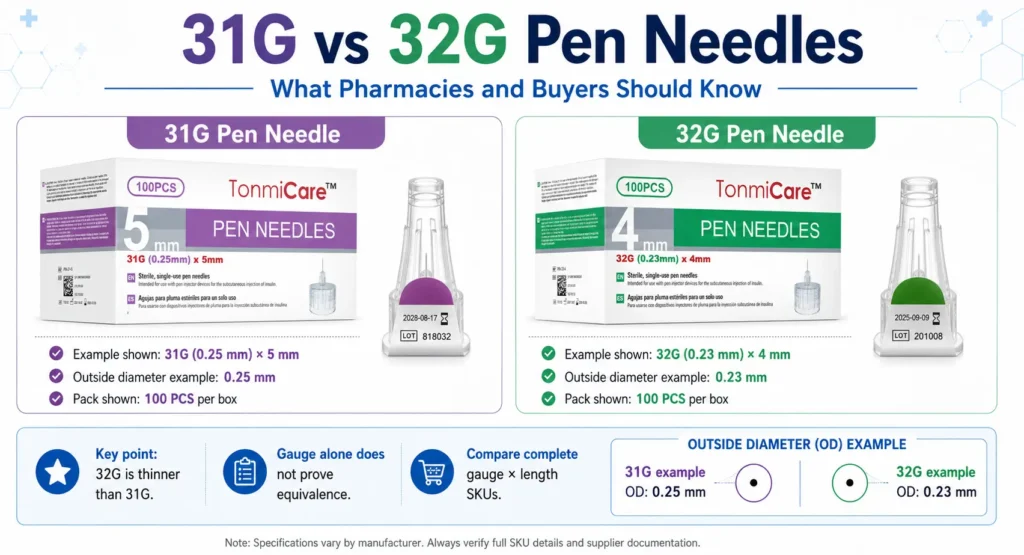
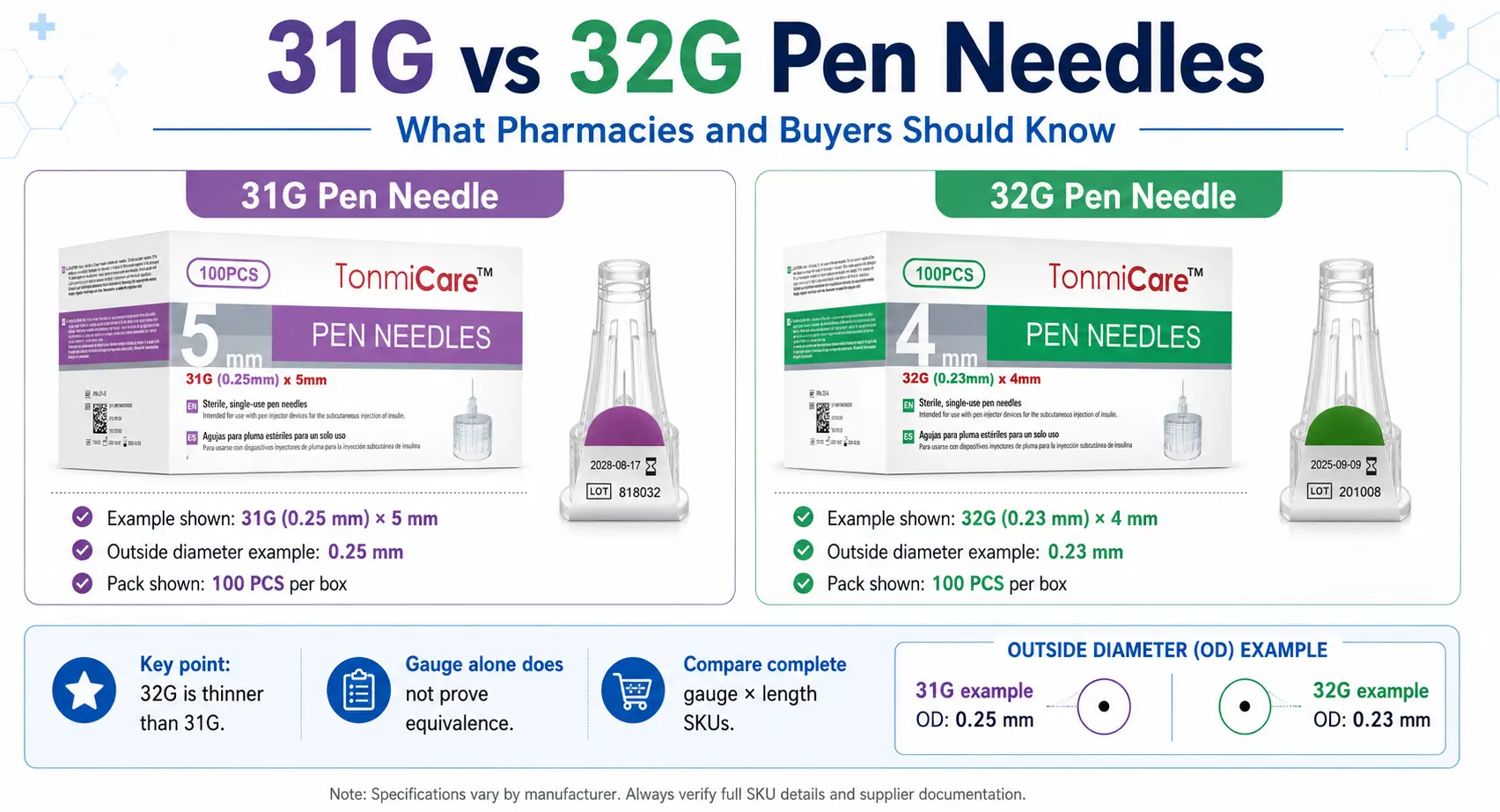
A 32G pen needle is thinner than a 31G pen needle. In one FDA-cleared pen needle family, 31G is listed with a 0.25 mm outside diameter and 32G with a 0.23 mm outside diameter—a 0.02 mm difference, or about 8% of the 31G outside diameter. [1]
That does not make every 32G product categorically better. Gauge does not reveal needle length, inner lumen, wall thickness, tip geometry, lubrication, base design, compatibility or mechanical performance. Current FITTER Forward expert recommendations identify 32G as the recommended pen-needle width, while also emphasizing wall thickness, sharpness and base design. [2] For a pharmacy or distributor, the correct choice remains the exact approved SKU—not gauge alone.
See the side-by-side comparison Use the receiving QC worksheet Prepare a gauge × length RFQ
Before approving a quote
Three fields that cannot be guessed
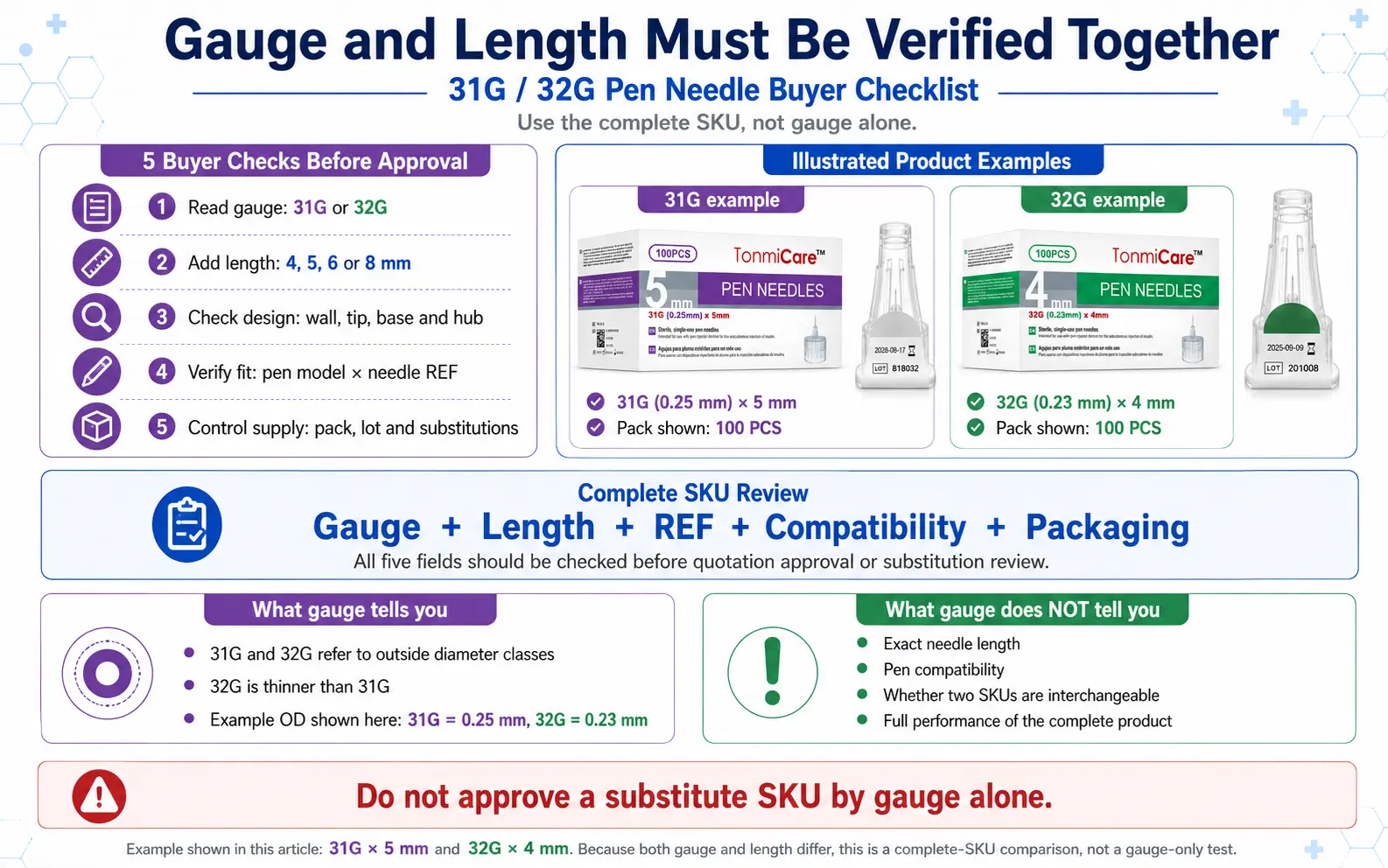
- Gauge × length: record both 31G or 32G and the exact 4, 5, 6, 8 mm or other labeled needle length.
- Pen compatibility: match the pen make/model with the needle manufacturer and product REF; gauge alone does not prove fit.
- Product and pack identity: distinguish standard from safety formats, and confirm the label, sterile presentation, units per box, lot and expiration details.
1. 31G vs 32G Pen Needles Comparison Table
The table separates facts that can be read from the controlled specification from outcomes that require product-specific evidence. For the wider size system, use our complete insulin pen needle sizes and compatibility guide .
| Comparison point | 31G pen needle | 32G pen needle | Correct interpretation |
|---|---|---|---|
| Relative outside diameter | Thicker of the two | Thinner of the two | A higher gauge number generally means a smaller outside diameter |
| FDA-file example | 0.25 mm | 0.23 mm | Values apply to the cited Promisemed family, not every manufacturer |
| Available lengths in that file | 4, 5, 6 and 8 mm common type | 4, 5 and 8 mm common type | Availability is product-family and REF specific |
| Comfort | Cannot be predicted from gauge alone | Supported by current expert guidance, but not a pain-free promise | Length, tip, lubricant, wall, base, technique and the individual also matter |
| Flow and thumb force | Not determined by outside diameter alone | Compare inner lumen, wall design and complete device performance | |
| Bending or breakage | Requires exact-product mechanical evidence | Do not infer pass/fail performance from gauge by itself | |
| Pen compatibility | Gauge does not prove fit or functional compatibility | Verify pen model, needle REF, current label and compatibility evidence | |
| Pharmacy substitution | No automatic interchangeability | Apply prescription, dispensing, payer, formulary, labeling and local requirements | |
The useful answer in one sentence
32G is thinner; whether it is the appropriate product depends on the complete gauge × length SKU, engineering design, supported compatibility, approved use and supply requirements.
2. What Gauge Means on a Pen Needle
Gauge is a diameter designation. Within the 31G/32G comparison, the higher number identifies the thinner needle outside diameter. Gauge is not a measurement of needle length, medication dose, box count or pen fit.
Procurement descriptions should therefore keep the two physical values together. A request for “32G pen needles” is incomplete because it does not state whether the buyer needs 4 mm, 5 mm, 6 mm, 8 mm or another supported length. Likewise, “4 mm pen needles” omits gauge.
Minimum physical specification
Gauge × patient-end length × product type × manufacturer and REF
Example format: 32G × 4 mm, standard pen needle, Manufacturer X, REF 12345
Gauge does not describe the entire cannula
Two pen needles labeled 32G can differ in wall thickness, internal lumen, taper, bevel geometry, lubricant, base, cartridge-end geometry and hub. Those attributes can affect penetration force, fluid resistance, handling and device interaction. The label “32G” should be treated as one controlled field—not as a complete performance claim.
3. How Much Thinner Is 32G Than 31G?
The FDA K161950 public 510(k) summary lists 31G common-type models at 0.25 mm outside diameter and 32G common-type models at 0.23 mm outside diameter. [1] In that documented family:
The percentage describes outside diameter only. It is not an 8% reduction in pain, an 8% change in flow or an 8% difference in strength. Those outcomes are not linearly determined by outside diameter and should not be calculated from the gauge label.
Do not convert one FDA example into a universal specification
The K161950 dimensions document named models from one manufacturer. A buyer should use the current drawing, specification sheet and regulatory mapping for the exact quoted REF before approving another brand or private-label version.
4. Gauge and Needle Length Are Separate Variables
Search results often compare a 32G × 4 mm product with a 31G × 5 mm or 31G × 8 mm product. That can be useful when comparing the two complete SKUs, but it does not isolate gauge because both thickness and length have changed.
| Comparison | Gauge changed? | Length changed? | What the comparison can support |
|---|---|---|---|
| 31G × 4 mm vs 32G × 4 mm | Yes | No | Closer to a gauge comparison if wall, tip, base and hub are also controlled |
| 31G × 5 mm vs 32G × 5 mm | Yes | No | Same-length comparison; still product specific |
| 32G × 4 mm vs 31G × 5 mm | Yes | Yes | Comparison of complete SKUs, not proof of a gauge-only effect |
| 32G × 6 mm vs 31G × 6 mm | Yes | No | Valid only when both exact products exist and evidence covers them |
The K161950 common-type model list includes both 31G × 4 mm and 32G × 4 mm, as well as both gauges at 5 mm. It lists a 31G × 6 mm common model but not a 32G × 6 mm common model. [1] That does not mean 32G × 6 mm is unavailable everywhere; it means this one public file cannot be used to establish coverage for it.
Practical SKU comparison
32G 4 mm vs 31G 5 mm vs 31G 8 mm Pen Needles
These are common comparison and wholesale-search phrases, but the combinations change both diameter and length. They are separate commercial SKUs, not clinically interchangeable replacements.
Confirm needle REF, the intended pen model, standard versus safety design, package count and documented compatibility.
Retain a separate item number and barcode. Verify whether the customer's formulary or approved supply list permits this configuration.
Do not position it as a direct alternative to a 4 mm needle without clinical, labeling and purchasing approval for the intended use.
For a length-specific comparison, read our 4 mm vs 5 mm vs 6 mm guide . For bulk specifications, use the wholesale buying guide .
5. Does a 32G Pen Needle Hurt Less Than a 31G?
A thinner needle can support a lower-pain design, but “32G is pain-free” would be inaccurate. Perceived discomfort is influenced by the whole device and the use event, including tip geometry, penetration force, lubrication, needle length, base pressure, injection site, technique, tissue characteristics and prior experience.
What the current expert recommendation says
The 2025 FITTER Forward device-characteristics infographic recommends 32G as the width for pen needles and states that current evidence suggests 32G can reduce pain without being too fragile. The same document separately highlights needle-wall thickness, bevel geometry and base design, which is important: the recommendation is not based on gauge in isolation. [2]
FITTER Forward was sponsored by embecta, and the expert publication should be read with that disclosure. Its recommendation is useful clinical context, not permission for a supplier to make an unqualified comfort guarantee for every 32G SKU.
Why an older head-to-head study does not isolate gauge
A randomized crossover study compared a NovoFine 32-gauge-tip 6 mm product with a Micro-Fine Plus 31G × 5 mm product and reported better ratings for several user-perception outcomes with the tested 32G-tip product. [3] However, the products also differed in length and needle geometry. The result supports the tested device comparison; it cannot prove that changing only the gauge from 31G to 32G will reproduce the same outcome in every product family.
Safer wording for a buyer-facing page
Use “32G has a smaller outside diameter, and current evidence supports 32G as a recommended pen-needle width.” Avoid “painless,” “pain-free,” “guaranteed comfort” or “always more comfortable.”
6. Gauge, Inner Lumen, Wall Thickness and Flow
Gauge commonly communicates outside diameter. Medication flows through the internal lumen. These are related dimensions, but they are not the same measurement.
Gauge describes the external size used in the 31G/32G comparison.
Regular, thin or ultra-thin wall designs allocate material differently.
A thinner wall can create a larger internal path at a given outside diameter.
Pen, dose setting, liquid, needle and injection speed interact.
FITTER Forward states that a thinner needle wall can create a larger lumen and enable a higher flow rate. [2] The practical procurement conclusion is that a 32G product with a defined thin-wall design may not behave like another 32G product with a different wall, and a buyer cannot rank 31G and 32G flow from gauge labels alone.
| Supplier claim | Why it is incomplete | Evidence to request |
|---|---|---|
| 31G always flows faster | Outside diameter does not disclose inner lumen or wall design | Controlled drawings, wall designation and relevant flow/force data |
| 32G always requires more force | A thinner wall may preserve or enlarge the lumen | Exact needle × pen × test-method results |
| Thin wall means better performance | One feature does not validate the complete device | Applicable mechanical, functional and regulatory evidence |
7. Is a 32G Pen Needle More Likely to Bend or Break?
It is reasonable to ask whether a thinner cannula changes handling or mechanical margin. It is not reasonable to conclude that every 32G pen needle is weaker than every 31G pen needle. Material, wall, length, tube processing, hub fixation, insertion conditions and applicable performance tests all matter.
FITTER Forward describes 32G as a balance between lower-pain design and fragility, while noting that still higher-gauge needles may carry greater bending or breakage risk. [2] That is an expert recommendation, not an exact-SKU mechanical certificate.
For an exact-product review, request or confirm:
- applicable cannula and pen-needle performance standards;
- needle-tube dimensions and tolerances;
- hub bond or assembly-strength controls;
- resistance to breakage and other relevant bench-test results;
- change control for cannula material, wall and manufacturing site;
- complaint categories for bending, blockage, detachment and leakage.
ISO 11608-2:2022 specifies requirements and test methods for single-use, double-ended, sterile needles used with some needle-based injection systems. [4] A supplier should map the exact device to its applicable evidence rather than using the standard's name as a broad marketing claim.
8. Does Gauge Affect Dose Delivery, Accuracy or Leakage?
Gauge may contribute to the engineering of a complete delivery system, but the number 31G or 32G does not by itself establish dose accuracy. Dose delivery depends on the medication pen, needle interface, internal fluid path, device condition, operating steps and tested performance of the intended combination.
Leakage observed during use should not automatically be blamed on gauge. A review may need to consider device attachment, compatibility, needle blockage or damage, user steps, hold time specified in the instructions, pen condition and the exact needle design. Clinical or complaint investigation should follow the relevant manufacturer instructions and organizational process.
Avoid unsupported equivalence claims
“Both are pen needles” is not enough to conclude that 31G and 32G deliver identically with every pen. Compare exact products using the applicable labeling, compatibility evidence and performance documentation.
9. Do 31G and 32G Pen Needles Fit the Same Pens?
Gauge does not determine hub fit. A 31G and a 32G needle may use a similar attachment design, but that observation does not prove that both are authorized or functionally supported with every pen injector.
ISO 11608-2 covers double-ended pen needles used with some non-integrated needle-based injection systems; it does not state that every conforming needle is universally compatible with every pen. [4] Build a controlled compatibility record instead:
| Field | Evidence to capture | Approval question |
|---|---|---|
| Medication pen | Manufacturer, marketed name, model and current instructions | Is this the exact pen used by the target program? |
| Pen needle | Manufacturer, brand, REF, gauge, length and design type | Does the evidence identify the quoted SKU? |
| Compatibility statement | Current label, IFU or controlled compatibility matrix | Is the pen model or supported interface scope stated? |
| Revision control | Document date and supplier change-notification process | Will interface or claim changes trigger review? |
“Universal,” “fits all pens” and “standard screw-on” should be treated as claims requiring current, SKU-specific support. Physical attachment alone does not replace functional and labeling review.
10. Can a Pharmacy Substitute 31G for 32G?
Not automatically. A gauge change creates a different product specification and often accompanies a change in length, manufacturer, REF, barcode, packaging, compatibility scope or instructions. Whether a substitution is allowed depends on the prescription or order, applicable dispensing rules, payer and formulary requirements, product labeling, professional judgment and organizational policy.
Capture gauge, length, manufacturer, REF and design.
Do not rely on a generic product description.
Match the exact pen and current supporting evidence.
Review prescription, dispensing, payer and policy constraints.
Approved, restricted, patient-specific, pending or prohibited.
Procurement should also block silent substitutions. A warehouse or supplier should not replace an ordered 31G SKU with 32G—or the reverse— because one is out of stock, lower priced or described as “equivalent” unless the buyer's authorized process approves the change.
11. 31G and 32G in Standard vs Safety Pen Needles
Standard and safety pen needles are different product categories. A safety design adds an engineered feature intended to reduce accidental sharps exposure; it should not be inferred from the gauge description.
The K161950 public summary is a useful boundary example. Its common-type list includes 31G and 32G models, while its safety-type list includes 29G, 30G and 31G models—not a 32G safety model. [1] This does not prove that no 32G safety pen needle exists elsewhere. It proves that buyers must not extend common-type 32G evidence to a safety product that the cited file does not name.
| Review point | Standard pen needle | Safety pen needle |
|---|---|---|
| Identity | Gauge × length × hub × REF | Gauge × length × safety mechanism × REF |
| Use review | Follow exact labeling and program controls | Add safety-feature evaluation and workflow review |
| Training | Attachment, injection, removal and disposal | All standard steps plus activation and lock confirmation |
| Substitution | Never treat standard and safety types as automatic substitutes | |
12. Building a 31G and 32G Pharmacy or Distributor SKU Mix
A useful assortment follows verified demand. It should not be created by declaring 32G the “best” and deleting every 31G option. Existing prescriptions, customer preferences, compatible pens, payer or tender specifications, standard versus safety requirements, package movement and supplier availability can all preserve legitimate demand for both gauges.
| SKU role | Evidence to review | Inventory control |
|---|---|---|
| Core 32G short-length SKU | Recurring demand, approved length, exact compatible-pen scope | Set reorder point and case-based replenishment by REF |
| Core or adjacent 31G SKU | Established demand by length, program, payer or customer group | Keep unique barcode and block unapproved gauge substitution |
| Safety pen needle | Care-setting need, safety mechanism, evaluation and training | Separate from standard products in purchasing and receiving |
| Special-order gauge × length | Low-volume but documented need | Define lead time, return status and minimum remaining shelf life |
| Private-label SKU | Volume, exact device, labeler roles and regulatory feasibility | Control artwork, MOQ, packaging inventory and change notices |
Our current wholesale insulin pen needle options identify 32G × 4 mm and several 31G lengths among common RFQ paths, with additional specifications reviewed by request. These are availability paths, not a universal formulary recommendation. Final product family, REF, packaging, documentation and market coverage must be confirmed in the quotation.
Use demand data before adding another gauge
- dispensing or order history by gauge × length and manufacturer;
- pen models represented in the target customer population;
- approved versus prohibited substitutions;
- standard and safety demand by care setting;
- monthly box and case movement, seasonality and new program volume;
- shortage history, backorder exposure and qualified alternatives;
- expiry exposure created by low-volume adjacent SKUs.
13. Packaging, Shelf Life and Exact-SKU Documentation
“31G” or “32G” is not sufficient for wholesale ordering. Packaging and identity fields determine whether the correct product can be quoted, received, replenished, traced and recalled.
| Control area | Minimum buyer record | Why it matters |
|---|---|---|
| Physical specification | Gauge, outside diameter where controlled, length, wall, tip, hub and type | Prevents incomplete or misleading comparisons |
| Commercial identity | Legal manufacturer, brand or labeler, REF and product description | Connects the quote to the actual device |
| Barcode identity | UDI/DI or GTIN where applicable at required package levels | Supports receiving, inventory and traceability |
| Pack hierarchy | Units per box, boxes per case, case dimensions and pallet quantity | Allows landed-cost and storage comparison |
| Lot and shelf life | Lot format, expiration format, labeled shelf life and minimum remaining life | Controls rotation, complaints and field action |
| Regulatory mapping | Applicable clearance/listing/UDI and current label for the exact SKU | Prevents one product family record being overextended |
FDA explains that a UDI's device identifier identifies the labeler and a specific device version or model; production information may identify the lot, serial number, expiration date or manufacture date when included on the label. [5] Buyers should determine which identifiers must be captured at unit, box and case levels.
FDA also states that registration and listing do not denote approval, clearance or authorization and that FDA does not issue registration certificates to medical-device facilities. [6] For that reason, “FDA registered” should not replace exact-SKU regulatory review.
Buyers can request SKU-specific product documentation , review responsibilities for private-label medical supply programs and verify U.S.-warehouse inventory by exact SKU . Availability and document scope vary by product, manufacturer, target market and commercial arrangement.
Original Tonmit buyer worksheet
14. Incoming QC Checklist for 31G and 32G Pen Needle Shipments
We prepared the following receiving worksheet to help a pharmacy, wholesaler or distributor compare the approved purchase order , the received box/case labels and the supplier's controlled product records . It is a buyer-side documentary and visual screening tool—not a report of Tonmit factory bench tests.
| Receiving check | Record or compare | If not consistent |
|---|---|---|
| 01 · SKU identity | Purchase order vs legal manufacturer, brand, exact REF, 31G/32G, and 4/5/6/8 mm as ordered | Hold the affected goods; request a documented identity resolution |
| 02 · Device type | Standard or safety design, protective components, IFU and any specified tip/base family | Do not silently substitute a different design or REF |
| 03 · Lot & shelf life | Lot/batch, expiration and the contracted minimum remaining shelf life | Segregate affected stock pending disposition |
| 04 · Sterile barrier | Visible package damage, breached seals, moisture or other transport damage under local SOP | Quarantine and escalate through the quality process |
| 05 · Box & case count | Units per box, boxes per case, received cartons and barcode/package-level identifiers | Document variance before stock release or payment reconciliation |
| 06 · Evidence record | Label/IFU revision, documented pen scope, supplier correspondence and change notifications | Pause product master or compatibility approval when evidence is missing |
How to use: log the receipt date, ordered REF, received lot, sampled units, evidence/photo reference, reviewer, pass/hold disposition and corrective action in your receiving record. Set sample size and pass/fail limits in your own approved SOP; this illustrative checklist does not prescribe an AQL, constitute a sterility test or establish product performance.
Blank buyer worksheet
Pen Needle Receiving QC Record
Compare the approved order, the delivered labels and the controlled product records. Use your own sampling and release procedure.
Open the template below for manual copying if the buttons are unavailable.
View receiving record
31G / 32G PEN NEEDLE RECEIVING RECORD
Blank buying-side checklist. Use one record per exact REF and received lot.

BUYER REQUIREMENT
Company / department:
Destination market:
Purchase order and line:
Required intended use: HUMAN MEDICAL / OTHER / REVIEW REQUIRED
Manufacturer / labeler / brand:
Approved product REF:
Gauge and patient-end length (e.g., 32G x 4 mm):
Needle format: STANDARD / SAFETY (design):
Compatible pen model(s) and supporting evidence:
Controlled label / IFU revision:
Pieces per box x boxes per case:
Minimum remaining shelf life:

RECEIVED PRODUCT
Delivery date / received cartons:
Delivered manufacturer / brand / REF:
Gauge x length on actual box:
Needle format / hub family on label:
Lot / expiry:
Sterile barrier / transport condition:
Actual box and case counts:
UDI / GTIN / barcode where applicable:
Photos / label / document reference:

DISPOSITION
Differences found:
SOP and sample plan used:
Decision: RELEASE / HOLD / RETURN / REVIEW REQUIRED
Responsible reviewer and date:
Corrective action / supplier response:

METHOD: Compare approved PO -> actual unit/box/case labels -> current controlled product documents. Apply the buyer's approved receiving and sampling SOP.
LIMITS: Blank documentary/visual receiving aid. Not a completed QC record, sterility test, clinical study, compatibility validation, or device clearance evidence.
Do not enter patient identifiers or doses.
15. Copyable 31G/32G Pen Needle RFQ Checklist
Use this checklist to make quotations from multiple pen needle suppliers comparable. Replace bracketed items with the buyer's requirements.
Copyable supplier request
31G / 32G Pen Needle Specification & Supply RFQ
Fill in each gauge × length configuration separately. Share complete requirements to compare supplier quotations consistently.
Open the template below for manual copying if the buttons are unavailable.
View RFQ template
31G / 32G INSULIN PEN NEEDLE RFQ
Subject: Gauge x length, exact REF and wholesale supply review

BUYER DETAILS
Company / buyer type:
Contact email:
Destination country / ZIP / postal code:
Target market and intended use:
First-order quantity (boxes / pieces / cartons):
Estimated annual volume / reorder frequency:
Requested shipping basis / delivery date:
Factory shipment or confirmed U.S. inventory inquiry:

DEVICE DETAILS (A SEPARATE LINE FOR EACH CONFIGURATION)
Required gauge: 31G / 32G
Required patient-end length: 4 / 5 / 6 / 8 mm / other
Needle type: STANDARD / SAFETY
Needle design: wall / bevel / hub / base requirements:
Intended pen manufacturer and exact model:
Manufacturer, brand/labeler and exact REF (if known):
Pack: pieces / box x boxes / carton x cartons / pallet:
Required minimum remaining shelf life:
OEM / private-label needs (if any):

PLEASE PROVIDE FOR EACH QUOTED REF
Legal manufacturer / product family / exact REF:
Actual box and unit label, IFU, controlled specification:
Supported pen-model compatibility scope and evidence:
Appropriate quality, sterility, shelf-life and market documentation:
Actual packing hierarchy, MOQ and pricing basis:
Available stock by REF, shipping point and lead time:
Any proposed change from gauge, length, REF or device type:

ACCEPTANCE CONDITION
No substitutions of gauge, length, manufacturer, REF, standard/safety design or supported pen scope without buyer approval.
Do not include patient identifiers or prescribed doses.
For bulk pen needle pricing, suppliers should quote against the complete specification rather than a generic “31G or 32G, 100 count” description. A lower unit price is not comparable if case quantity, remaining shelf life, documentation, compatible-pen scope or substitution rules differ.
Questions from buyers and users
Frequently Asked Questions About 31G vs 32G Pen Needles
Which is thinner, a 31G or 32G pen needle?
32G is thinner. In the cited FDA K161950 product family, 31G is listed at 0.25 mm outside diameter and 32G at 0.23 mm. Use the current specification for the exact manufacturer and REF.
What is the diameter difference between 31G and 32G?
In the cited product family, the difference is 0.02 mm in outside diameter. That is about 8% of the 31G outside diameter, but it does not translate directly into an 8% change in pain, flow or strength.
Is a 32G pen needle better than a 31G pen needle?
Not in every context. FITTER Forward recommends 32G as a pen-needle width, but the appropriate product still depends on the complete gauge × length SKU, design, labeling, pen compatibility, individual or program needs and approved substitution process.
Does a 32G pen needle hurt less?
A smaller outside diameter can support a lower-pain design, and current expert guidance supports 32G. Pain is not determined by gauge alone, however, and no product should be described as pain-free without an authorized, adequately supported claim.
Does a 31G pen needle deliver medication faster?
Gauge alone cannot answer this. Inner lumen, wall thickness, pen design, medication, dose and test conditions influence flow and thumb force. Compare performance data for the exact needle and intended pen.
Is a 32G pen needle more likely to bend?
Do not assume that every 32G is mechanically weaker than every 31G. Review the cannula material, wall, length, assembly and relevant mechanical evidence for the exact device.
Is 32G × 4 mm the same as 31G × 5 mm?
No. Both gauge and length differ, and the products may also have different manufacturers, REFs, hubs, labels, compatibility scopes and packaging. They are separate SKUs.
Do 31G and 32G pen needles fit the same insulin pens?
Gauge does not prove fit. Verify the exact pen model, needle manufacturer, REF and current compatibility evidence. A similar hub or apparent physical connection is not a complete approval criterion.
Can a pharmacy automatically substitute 31G and 32G?
No automatic substitution should be assumed. Apply the prescription or order, dispensing law, payer and formulary rules, product labeling, professional judgment and organizational policy, then document the decision.
Do all GLP-1 pens accept detachable 31G or 32G pen needles?
No. Drug class does not identify the delivery presentation. Some pens require a separate compatible needle, while other devices may use an integrated needle or a different delivery format. Check the exact product's current instructions.
Are 31G and 32G pen needles normally packed 100 per box?
A 100-count box is common in the market, but pack counts and case quantities are commercial SKU attributes, not gauge standards. Verify units per box, boxes per case, barcode level and remaining shelf life on the quotation and purchase order.
Which 31G and 32G SKUs should a pharmacy stock?
Use actual dispensing demand by gauge × length, compatible pens, standard versus safety needs, approved substitutions, payer or tender requirements, case movement and expiry risk. Do not build the mix from a supplier's “most popular” list alone.
What documents should support an exact 31G or 32G SKU?
Request the specification, current label/IFU, manufacturer and labeler identity, REF, compatibility evidence, applicable regulatory mapping, UDI/GTIN where applicable, quality-system scope, sterilization and shelf-life support, pack hierarchy and change-notification process.
Can one 510(k) be used for every 31G and 32G product?
No. A 510(k) covers the device and models identified within its scope. Do not extend one public summary to another manufacturer, unlisted gauge × length, different tip or wall design, safety model, brand or private-label SKU without exact regulatory mapping.
What should I include in a wholesale 31G or 32G pen needle RFQ?
State 31G or 32G plus the exact needle length, design type, intended pen model, order quantity, destination, packaging format, label/IFU and documentation needs. We quote against the confirmed REF and supply path, not the gauge alone. Use our RFQ checklist .
16. Conclusion: Choose the Complete SKU, Not Just the Gauge
The direct 31G vs 32G pen needles answer is simple: 32G is thinner. The purchasing decision is not. Outside diameter is only the first link in an evidence chain that must also account for needle length, wall and lumen, tip and base design, mechanical performance, pen compatibility, labeling, substitution approval, packaging and exact-SKU supply.
Reliable decision chain
Gauge → outside diameter → wall and lumen → tip and base → gauge × length SKU → compatibility → substitution status → supply decision
For B2B buyers, this method answers the high-volume comparison question without turning a small diameter difference into an unsupported comfort, flow or compatibility claim. It also produces a quotation that purchasing, receiving, quality and inventory teams can use consistently.
Editorial accountability
Sources, Review Method and Limits
Our technical comparison uses FDA's public K161950 summary for the named Promisemed models, FITTER Forward expert guidance for clinical context, a published patient-perception study and the published ISO standard scope. We separate a documented model's dimensions from claims about other manufacturers and distinguish evidence about the whole device from gauge-only assumptions.
Our procurement recommendations are a buying framework, not proprietary testing results. The receiving QC worksheet is our original documentary checklist; it has not been validated here as an AQL sampling plan, device-compatibility study, sterility assessment or substitute for regulated quality processes. Readers should confirm the latest labeling, records and commercial terms for the exact REF. See our editorial team and review process .
Sources and Editorial Basis
- U.S. Food and Drug Administration. K161950: Verifine Common Type and Safety Type Insulin Pen Needles . Public 510(k) summary with named models, 31G/32G outside diameters, lengths, intended use and performance information. Manufacturer named in the source: Promisemed Hangzhou Meditech Co., Ltd.
- Klonoff DC et al. Advance Insulin Injection Technique and Education With FITTER Forward Expert Recommendations. Mayo Clinic Proceedings. 2025;100(4):682–699. DOI: 10.1016/j.mayocp.2025.01.004. See the FITTER Forward device-characteristics infographic and PubMed record . FITTER Forward discloses sponsorship by embecta.
- Iwanaga M, Kamoi K. Patient perceptions of injection pain and anxiety: a comparison of NovoFine 32-gauge tip 6 mm and Micro Fine Plus 31-gauge 5 mm needles. Diabetes Technology & Therapeutics. 2009. PubMed PMID 19848573 .
- International Organization for Standardization. ISO 11608-2:2022 — Needle-based injection systems for medical use, Part 2: Double-ended pen needles .
- U.S. Food and Drug Administration. UDI Basics .
- U.S. Food and Drug Administration. Important Reminders about Registration and Listing .
Evidence boundary: Public records, recommendations, product portfolios and URLs can change. The cited FDA summary establishes information for the named models in that file; it does not establish coverage for every Tonmit, TonmiCare, private-label or third-party SKU. Review current controlled documents before a purchasing decision.
31G & 32G wholesale sourcing
Get an Exact-SKU Pen Needle Quote
Send us the required gauge × length, intended pen models, standard or safety format, first-order volume, delivery country, packaging preferences and documentation scope. We will review the relevant product family and available supply route before quoting.
Commercial hub: Wholesale Insulin Pen Needles. The query-string topic can be used to prefill the Fluent Forms inquiry using the included optional integration snippet. Final availability, compatibility, documentation and terms remain REF- and market-specific.