
2026 U.S. Pharmacy Procurement Guide
A purchasing framework for defining product scope, controlling exact SKUs, qualifying suppliers, reviewing documentation, comparing delivered cost and building a dependable replenishment path.
Editorial disclosure: This article is an educational B2B procurement resource. It is not legal, reimbursement, regulatory, clinical or patient-specific advice. Product eligibility, payer rules, prescriptions, supplier licensing, regulatory status, storage, labeling and documentation must be verified for the exact SKU, transaction, state and distribution role. Unless an authority such as FDA is expressly named, “approved” in this guide refers to the buyer’s internal procurement approval—not regulatory approval, clearance or authorization.
Executive summary
Key Takeaways
- Separate product categories before comparing suppliers. Prescription diabetes drugs, DMEPOS items, brand-specific monitoring products and general medical consumables do not share one universal purchasing, tracing or reimbursement framework.
- Procure by the complete SKU. Product name alone is insufficient; the buyer-approved procurement record should include manufacturer, model, dimensions, scale, packaging hierarchy, label version, lot, expiration and applicable device identifier.
- Verify evidence instead of collecting generic certificates. Registration, listing, clearance, approval and quality-system certification are different concepts and must be matched to the applicable product and legal entity.
- Compare accepted usable units—not headline unit price. Freight, duties or fees where applicable, inspection, handling, shortages, rejected units and expiry exposure can change the actual acquisition cost.
- Use complete replenishment lead time. Supplier qualification or order approval, allocation or production, quality release, international transit, customs processing, domestic fulfillment and receiving all affect the reorder point.
- Do not treat U.S. warehouse support as a blanket stock or delivery promise. Availability and timing must be confirmed by exact SKU, pack quantity, assigned inventory, destination and order terms.
Abstract
A pharmacy can purchase several very different product families under the broad phrase diabetes supplies: blood glucose meters and strips, continuous glucose monitoring products, insulin delivery devices, insulin syringes, pen needles, lancets, alcohol prep pads, sharps containers and other accessories. The phrase is useful for search, but it is too broad for a purchase order.
This guide gives U.S. pharmacy buyers a practical method for turning that broad category into a buyer-approved assortment, exact-SKU master, supplier evidence file, inventory policy and replenishment plan. It also separates procurement from prescription dispensing, Medicare billing and patient-specific product selection. The objective is not to prescribe one assortment for every pharmacy; it is to make each sourcing decision identifiable, comparable and auditable.
1. Define the Scope Before Requesting Prices
The first procurement task is to decide what the requested program actually includes. A supplier that can provide injection consumables is not automatically a prescription-drug wholesaler, an authorized CGM distributor, a Medicare-enrolled DMEPOS supplier or a patient-specific dispensing service.
| Product group | Examples | Primary procurement controls | Scope note |
|---|---|---|---|
| Prescription diabetes drugs | Insulin and prescription glucose-lowering medicines | Licensed drug channel, authorized trading partners, product tracing, storage and dispensing requirements | Use a separate prescription-drug procurement workflow. |
| Monitoring systems and supplies | Blood glucose meters, test strips, control solutions, CGMs and related sensors | Exact brand/model compatibility, authorized channel where required, storage, expiration, payer and billing rules | Eligibility and channel requirements are product- and contract-specific. |
| Injection and sampling consumables | Insulin syringes, pen needles, lancets and safety lancets | Capacity, scale, gauge, length, design, sterility, packaging, label and traceability | Core medical-supply procurement scope. |
| Preparation, disposal and care accessories | Alcohol prep pads, sharps containers, cooling cases and supply kits | Label claims, pack configuration, intended use, storage, disposal path and kit responsibility | Availability should be confirmed by RFQ. |
Practical boundary: Practical boundary: Our standard diabetes medical supply program focuses on insulin syringes, insulin pen needles, alcohol prep pads and selected related medical supplies. For lancets, sharps containers, blood glucose monitoring supplies, CGM accessories and other diabetes-care categories, we can review sourcing feasibility on a project-by-project basis. These categories should not be treated as standard stocked products unless availability is confirmed for the exact SKU and transaction. We do not provide prescription insulin distribution or patient-specific dispensing. Prescription insulin distribution and patient-specific dispensing are outside the standard program.
Buyers who need the commercial program rather than the educational framework can review Tonmit’s diabetes medical supply partner program.
2. Build the Pharmacy Assortment from Verified Demand
There is no universal list of diabetes supplies that every pharmacy should stock. An independent community pharmacy, a long-term care pharmacy, a specialty pharmacy and a hybrid pharmacy/DME supplier may serve different prescriptions, payer networks, device brands and order frequencies.
Start with demand evidence rather than a supplier catalog:
- Dispensing, retail and special-order history by exact product or buyer-approved equivalent.
- Current formulary, payer, PBM and manufacturer-channel requirements where relevant.
- Prescriber and patient demand patterns without converting the procurement process into clinical advice.
- Stockout frequency, lost-sale records, emergency purchases and backorders.
- Pack-size movement, remaining shelf life and write-offs by SKU.
- Seasonal, promotional, contract or location-specific changes.
Use an assortment tier instead of “stock everything”
| Tier | Typical treatment | Buyer review |
|---|---|---|
| Core stocked SKU | Repeat demand with a buyer-approved specification and predictable movement | Set reorder point, safety stock and minimum remaining shelf life. |
| Conditional stock | Demand exists but is location-, payer-, brand- or program-specific | Limit quantity and confirm channel or compatibility before replenishment. |
| Special order | Low-frequency or patient-specific demand | Order against a confirmed requirement; avoid speculative inventory. |
| Procurement hold | Incomplete evidence, unclear source, incompatible product or unacceptable shelf life | Keep the SKU on internal procurement hold until the defined gap is resolved. |
3. Create an Exact-SKU Procurement Master
A general description such as “31G insulin syringe” or “4 mm pen needle” can match multiple products. The procurement master should identify the version the pharmacy has internally approved for purchasing and provide enough information to prevent accidental substitution.
| Data field | What to record | Why it matters |
|---|---|---|
| Legal product identity | Manufacturer, labeler, brand and product name | Connects the item to labels, evidence and complaint contacts. |
| Reference identity | REF, catalog number, model and internal pharmacy SKU | Separates similar-looking configurations. |
| Critical specification | Capacity, scale, gauge, needle length, design and connector where applicable | Controls functional and prescription-related mismatches. |
| Packaging hierarchy | Units per pouch/bag, box, inner carton, case and pallet | Prevents unit-conversion and receiving errors. |
| Identifiers | UDI/DI, GTIN or UPC where applicable | Supports product matching and system records. |
| Variable production data | Lot/batch, manufacturing date and expiration date where applicable | Supports FEFO, complaints, returns and recalls. |
| Controlled documents | Specification, label, IFU, regulatory evidence and certificate versions | Prevents a document from another model being applied to the item. |
| Supply data | Qualified supplier, source path, MOQ, lead time, cost basis and reorder parameters | Connects product qualification to continuity planning. |
UDI requirements include exceptions and alternatives. Where a UDI applies, the device identifier identifies the labeler and version/model, while production identifiers can include lot, serial number, manufacturing date or expiration date when these appear on the label. Do not treat UDI, NDC, GTIN and the pharmacy’s internal SKU as interchangeable identifiers.[3]
4. Product Specifications Pharmacy Buyers Must Confirm
Insulin syringes
Confirm capacity, concentration scale, graduation, needle gauge, needle length, fixed or detachable design where relevant, sterile-barrier format, box count and case pack. Insulin syringes are concentration-specific. Where U-40 or U-100 syringes are being evaluated, confirm that the syringe scale matches the labeled insulin concentration and the pharmacy’s documented prescription or dispensing workflow. Do not treat different concentration scales as interchangeable, and do not use this procurement guide for dose conversion.
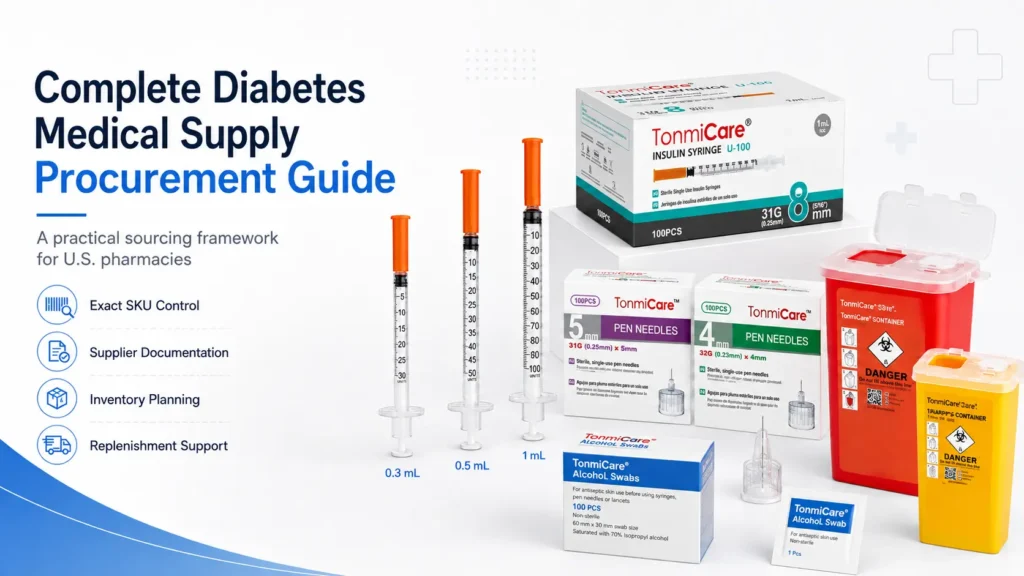
Common purchasing configurations include 0.3 mL, 0.5 mL and 1 mL capacities with multiple gauge and length options. The actual available combination must be confirmed at SKU level. Buyers can compare wholesale insulin syringe configurations before submitting an RFQ.
Insulin pen needles
Record needle length, gauge, product type, sterile-barrier format, box quantity, case pack and the compatibility statement supported by the product labeling. Do not accept a pen needle for procurement only because a supplier describes it as “universal.” Compatibility must be checked against the intended delivery device, applicable labeling and the pharmacy’s buyer-approved assortment.
Common purchasing discussions include 4 mm, 5 mm, 6 mm and 8 mm options and 31G or 32G configurations. Tonmit’s currently described program also lists these common ranges, but final availability remains quotation-specific. Buyers can review wholesale insulin pen needle options.
Lancets and safety lancets
Confirm gauge, puncture-depth design where applicable, activation method, single-use mechanism, sterility, compatible lancing device for standard lancets, pack quantity and intended professional or personal-use channel. A standard lancet and a safety lancet should not be treated as the same SKU family.
Blood glucose monitoring supplies
Match meters, strips, control solutions and accessories by exact brand and model. Review storage range, expiration, package integrity, authorized sourcing conditions and payer or PBM rules that apply to the pharmacy’s channel. Do not substitute a visually similar strip or control solution across systems.
Alcohol prep pads
Verify pad dimensions, material, active ingredient and concentration, saturation specification, sterility claim, individual pouch, box count, case pack, storage and label wording. Claims such as “sterile” or a specific alcohol concentration must be supported by the exact product label and documentation.
Sharps containers and care accessories
For sharps containers, confirm nominal capacity, usable fill line, opening, temporary and final closure, mounting accessories, label, case pack and the receiving facility’s disposal pathway. For cooling bags, travel cases or supply kits, document what the product is intended to do and avoid treating an accessory as a validated cold-chain shipping system unless supported by product-specific evidence.
5. Qualify the Supplier and the Product Separately
A well-known supplier cannot make an unidentified SKU acceptable, and a compliant product record does not establish that every seller is an acceptable source. The pharmacy should therefore maintain two connected reviews.
| Supplier review | Product review |
|---|---|
| Legal business name, address and contact | Manufacturer, labeler, brand, model and intended use |
| Business, distribution or professional licenses applicable to the transaction | Classification and applicable marketing pathway |
| Relationship to manufacturer and authorized status where relevant | Registration/listing, clearance, approval or exemption evidence where applicable |
| Quality, complaint, return and recall contacts | Specification, label, IFU, packaging and sterility information |
| Insurance, commercial terms and references | Lot, expiration, storage, identifiers and change history |
| Fulfillment locations and subcontracted roles | Exact inventory assignment and remaining shelf life |
FDA terminology check: Establishment registration and device listing do not mean that FDA approved, cleared, authorized or certified a facility or all of its products. FDA states that it does not issue medical-device registration certificates. Verify the type of record that is actually applicable to the selected device.[1]
6. Separate Regulatory, Payer and Procurement Requirements
Medical device procurement
For an imported medical device, FDA may verify requirements such as establishment registration, device listing, applicable premarket submission and labeling. The applicable requirements depend on device classification and product status. Accurate manufacturer, importer, product and entry information matters; incomplete or inconsistent information may delay entry or lead to refusal.[2]
Prescription-drug tracing
The Drug Supply Chain Security Act establishes package-level tracing and verification requirements for certain prescription drugs. It should not be described as the traceability rule for every diabetes-related device or consumable. When a pharmacy buys insulin or another covered prescription drug, use the pharmacy’s separate DSCSA process and authorized trading-partner controls.[5]
DMEPOS enrollment and billing
Medicare identifies glucose monitors and related supplies as DME benefits under defined conditions. Suppliers seeking Medicare reimbursement for DMEPOS must meet the CMS requirements applicable to their enrollment status, including supplier standards and, where required, accreditation and surety-bond requirements. Certain pharmacies may qualify for an accreditation exemption when CMS criteria are met, so pharmacy buyers should verify the requirements that apply to their own enrollment status and business model. Product availability alone does not establish coverage, medical necessity, coding or billing eligibility.[6][7][11]
Insulin and injection-supply coverage
Medicare treatment differs according to how insulin is administered and which benefit applies. For example, Medicare’s current consumer guidance states that Part B does not cover syringes, needles, alcohol swabs or gauze used with self-administered insulin, while certain injection supplies may be covered under Part D. Pharmacy buyers should confirm current plan and claim requirements instead of presenting procurement availability as a coverage promise.[8]
Authorized distribution and PBM records
Some manufacturer programs, state requirements, payer contracts or PBM manuals may impose source and invoice requirements for specific diabetic testing products. California, for example, maintains a manufacturer-submitted list of authorized distributors for nonprescription diabetes test devices. Do not generalize this one state mechanism into a nationwide requirement for every diabetes supply; review the rule and contract that govern the specific transaction.[9]
7. Build a Product-Matched Documentation File
Requesting “all certificates” often produces a folder of documents that do not identify the purchased product. A useful procurement file should connect the legal manufacturer, exact model, package version and applicable regulatory or quality record.
- Buyer-approved product specification and current label/packaging artwork.
- Instructions for use where applicable.
- Box, inner-carton, case and pallet configuration.
- Manufacturer and labeler identity.
- FDA establishment, listing, classification or premarket information where applicable.
- UDI/GUDID information where applicable.
- Quality-system certificate with legal entity, site, scope and validity.
- Sterilization-related information for applicable sterile products.
- CoC, CoA or lot-release information only where the defined document is applicable and available.
- Lot, expiration, invoice, packing list and shipping records for the confirmed transaction.
- Complaint, return, field-action and recall contacts.
2026 quality-system context
FDA’s Quality Management System Regulation (QMSR) became effective on February 2, 2026. The revised 21 CFR Part 820 incorporates ISO 13485:2016 by reference for applicable finished-device manufacturers. For procurement review, an ISO 13485 certificate can be relevant quality-system evidence, but buyers should still match the legal entity, manufacturing site, certificate scope and validity to the proposed supply arrangement. A quality-system certificate should not be treated as FDA approval or as product-specific marketing authorization.[10]
A certificate for one manufacturer, facility, product family or reference number should not automatically be applied to another SKU. Buyers can request product-specific documentation support when building the onboarding file.
8. Convert Demand into Reorder and Shelf-Life Controls
Inventory reports should distinguish saleable product from units that exist physically but cannot be released. One practical internal definition is:
The reorder point should use the complete replenishment path rather than only carrier transit time:
Complete lead time may include internal approval, supplier confirmation, inventory allocation or production, quality release, export preparation, international transportation, customs processing, U.S. receiving, order processing and domestic delivery. The applicable steps depend on the supply model.
Manage remaining shelf life at expected receipt
Set the acceptance threshold before the purchase order. Avoid a generic “long expiry” requirement; define the minimum remaining shelf life, whether split lots are acceptable and which date is used for receipt. Apply first-expired, first-out (FEFO) where expiration applies, while preserving any lot-specific quarantine or allocation controls.
Review a small operational dashboard
- Order fill rate by SKU and supplier.
- Confirmed versus actual order cycle time.
- Backorder frequency and duration.
- Forecast error by replenishment period.
- Expiry, damage and write-off rate.
- Receiving acceptance and discrepancy rate.
- Documentation completeness.
- On-time, in-full performance using the pharmacy’s documented definition.
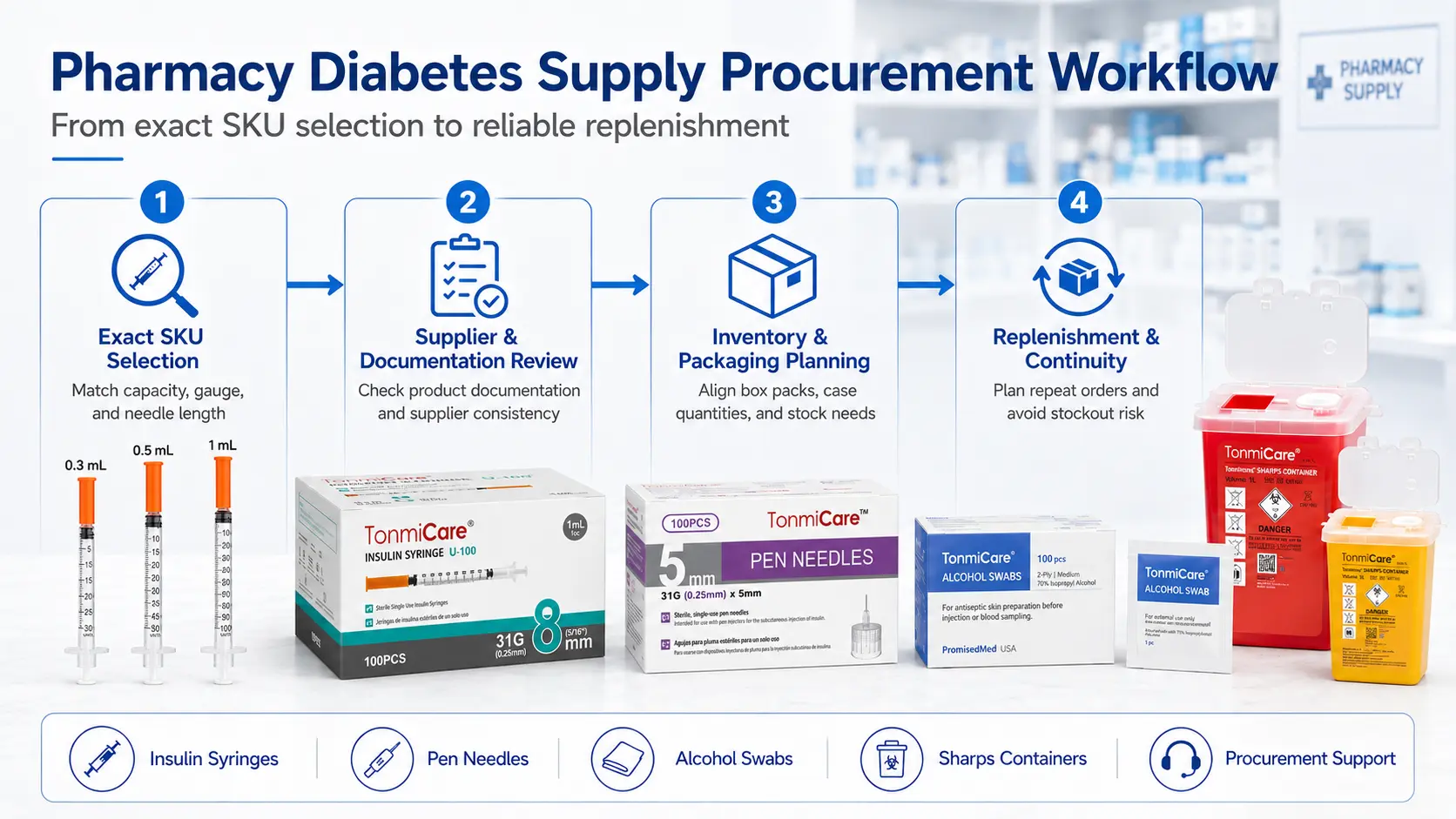
9. Choose U.S. Warehouse, Factory-Direct or Hybrid Supply
| Supply model | Best fit | Main controls | Common limitation |
|---|---|---|---|
| U.S. warehouse-supported | Confirmed standard SKUs and recurring domestic replenishment | Free-to-sell quantity, assigned lot, shelf life, pack, destination and processing schedule | Not every SKU or customized package is stocked. |
| Factory-direct | Larger orders, broader configurations or custom packaging | Production capacity, materials, artwork, quality release, export, import and international lead time | Longer and more variable procurement path. |
| Hybrid | Immediate standard demand plus planned future replenishment | Allocation rules, factory reorder trigger, ownership, forecast and transition between lots | Requires clear inventory and responsibility mapping. |
A U.S. warehouse describes a fulfillment location, not product origin. It also does not mean all catalog items are in stock or that every accepted order ships the same day. Review U.S. warehouse-supported fulfillment and confirm availability against the exact SKU and transaction.
10. Compare Delivered Cost per Accepted Usable Unit
Headline unit price can conceal different packaging, freight terms, inspection burden, shortage risk or remaining shelf life. Normalize each quotation to the same buyer-approved specification and unit of measure.
Where relevant, also review inventory carrying cost, emergency purchases, write-offs, customs brokerage, packaging conversion, minimum-order exposure and the cost of a product or document mismatch. These are management calculations, not accounting or tax rules; the pharmacy should apply its own financial policy.
11. Control Receiving, FEFO, Complaints and Recalls
A receiving procedure should decide whether goods are accepted, conditionally held or rejected before the inventory becomes available for sale or dispensing.
- Match purchase order, supplier, manufacturer, SKU and packaging description.
- Reconcile unit, box, case and pallet quantities.
- Inspect seals, sterile barriers and shipping cartons for damage or tampering.
- Record lot/batch and expiration information where applicable.
- Confirm label and packaging version against the buyer-approved SKU master.
- Review temperature or storage evidence only when required for that product.
- Confirm required invoice, packing list and product documents.
- Place discrepancies, damaged units and suspect products in a controlled quarantine status.
First-party procurement tool
Tonmit Receiving Inspection & Documentation Review Template
This Tonmit-created worksheet turns the receiving, identity and documentation controls in this guide into a repeatable buyer review record. It is a procurement receiving template, not product-validation data, lot-release evidence, a certificate or a regulatory acceptance standard.
| Review point | Record at receipt | Example disposition trigger |
|---|---|---|
| SKU identity | PO, supplier, manufacturer/labeler, REF/model, description and pack configuration | Hold if identity or packaging does not match the buyer-approved purchase record. |
| Lot & shelf life | Lot/batch, expiration where applicable, quantity by lot and expected remaining shelf life | Hold if the pre-agreed shelf-life threshold or lot requirement is not met. |
| Packaging condition | Shipping-carton damage, seal/sterile-barrier condition where applicable, moisture or tampering indicators | Segregate damaged or suspect units pending documented review. |
| Label & version | Product name, model, critical specification, label/artwork version and identifiers where applicable | Hold unexplained label, model or specification changes. |
| Document set | Invoice, packing list and transaction/SKU-specific records required by the buyer | Hold if a mandatory onboarding or transaction document is missing. |
| Final disposition | Accepted, conditionally held, quarantined or rejected; reviewer, date and reason | Release only under the buyer’s documented receiving procedure. |
Method & limitation: The template was prepared by Tonmit for B2B procurement review from the receiving, traceability and documentation controls described in this article. It does not report test results from a specific batch and should be adapted to the exact SKU, facility SOP, contract, risk controls and applicable requirements before use.
Medical device recalls are commonly initiated voluntarily by the responsible firm, although FDA has authority for mandatory actions in defined circumstances. A pharmacy’s records should allow affected model, lot or serial information to be identified and remaining stock to be stopped, segregated and handled according to the recall communication.[4]
Do not allow silent substitutions
No supplier substitution should be accepted solely because another product has the same general name or dimensions. Require buyer approval of manufacturer, model, critical specification, packaging, label and applicable evidence before releasing the substitute.
12. Add Private-Label Controls Before Approving Artwork
Private label changes more than the logo. Depending on the arrangement, it may affect labeler identity, UDI responsibility, establishment roles, packaging records, complaint contacts and change control.
- Define manufacturer, labeler, specification developer, importer and distributor roles.
- Approve the final product specification and packaging hierarchy.
- Review all label claims, symbols, warnings, IFU and contact information.
- Confirm UDI/DI, barcode and database responsibilities where applicable.
- Control artwork version, proof approval and production release.
- Define sample approval, MOQ, lead time and inventory ownership.
- Agree how complaints, field actions, recalls and product changes will be communicated.
- Set responsibility for obsolete packaging and remaining inventory.
Selected programs can be evaluated through Tonmit’s private-label medical supply program. Feasibility, MOQ, labeling, documentation and timing must be confirmed for the chosen product.
Applying the framework
What We Can Review for Your Diabetes Supply Program
We can review B2B requirements for insulin syringes, insulin pen needles, alcohol prep pads and selected related diabetes-care supplies. Depending on the product and project, our review may cover exact specifications, packaging, available documentation, bulk pricing, U.S. warehouse availability, factory-direct planning and private-label feasibility. We use the TonmiCare brand for selected product lines. A category shown on our website should not be treated as confirmation that every SKU is currently available. We confirm product availability, lot, remaining shelf life, applicable documentation, MOQ, price, lead time and fulfillment path against the defined transaction. If you are comparing a broader purchasing structure, you can also review our wholesale medical supply order models.
Tonmit is the company and supply partner; TonmiCare is the product brand used for selected product lines. Category presence is not stock confirmation. Final product availability, lot, shelf life, documentation, MOQ, price, lead time and shipping path are transaction-specific.
Buyers comparing a wider order structure can compare wholesale medical supply order models.
13. A Seven-Step Diabetes Supply RFQ Workflow
- Define buyer and channel. Identify the pharmacy type, destination state, dispensing or retail channel, DMEPOS role where applicable and expected purchasing frequency.
- Submit exact product requirements. Provide the manufacturer/model if fixed, critical specification, packaging hierarchy, quantity and acceptable alternatives.
- State document requirements. Separate mandatory onboarding records from optional, confidential or transaction-specific documents.
- Compare supply paths. Review confirmed U.S. inventory, factory-direct production and hybrid replenishment against the complete required timeline.
- Normalize the quotation. Compare identical specifications, units of measure, freight terms, shelf life and accepted usable units.
- Approve before release. Confirm SKU, label, packaging, lot/expiry expectations, substitution controls and commercial terms.
- Measure and replenish. Track receiving discrepancies, fill rate, lead time, FEFO, write-offs and future reorder triggers.
14. Copyable RFQ Checklist
Buyer tool
Diabetes Medical Supply RFQ
Use these fields as the working request. Repeat the product block for each exact SKU when the order contains multiple configurations.
A complete RFQ reduces non-comparable quotations and helps suppliers respond against the same exact-SKU assumptions.
Buyer questions
15. Frequently Asked Questions
What diabetes supplies should a U.S. pharmacy stock?
Build the assortment from verified dispensing and retail demand, payer and channel requirements, storage capacity, shelf life and replenishment capability. Maintain core, conditional, special-order and internal procurement-hold tiers instead of adopting one universal list.
Are prescription insulin and diabetes medical supplies the same procurement category?
No. Prescription insulin follows drug distribution, storage, tracing and dispensing requirements. Syringes, pen needles, lancets and other devices or consumables require a separate product-specific medical-supply review.
Does DSCSA apply to insulin syringes, pen needles or test strips?
DSCSA applies to defined prescription drugs in finished dosage form and associated transactions. It is not the general traceability rule for medical-device consumables. Product, lot and distribution records may still be required under other regulations, contracts or internal controls.
Does FDA registration mean a diabetes supply is FDA approved?
No. FDA establishment registration and device listing do not by themselves denote approval, clearance, authorization or certification. Determine which regulatory pathway, exemption or record applies to the exact device.
What specifications are required when ordering insulin syringes?
At minimum, confirm capacity, concentration scale, graduation, gauge, needle length, design, sterile packaging, box count, case pack, label and product reference. The exact combination—not one isolated specification—defines the SKU.
Can U-40 and U-100 insulin syringes be substituted?
No automatic substitution should be made. Where either concentration-specific syringe is being evaluated, confirm that the syringe scale matches the labeled insulin concentration and the pharmacy’s documented prescription or dispensing workflow. Do not attempt an informal dose conversion; obtain appropriate professional clarification when the required concentration or syringe scale is uncertain.
Are all insulin pen needles universally compatible?
Do not rely on a broad “universal” statement. Verify compatibility against the pen needle labeling, intended delivery device and buyer-approved assortment before substitution or stocking.
Should a pharmacy buy diabetic test strips from an authorized distributor?
Review the manufacturer channel, applicable state requirements, PBM manuals and payer contracts for the specific product. Some arrangements require or strongly rely on authorized-channel evidence, but the rule is not identical for every product, state or contract.
What documents should a diabetes medical supply supplier provide?
Request documents defined for the SKU and transaction: specification, label/packaging, IFU where applicable, manufacturer identity, relevant regulatory and quality records, identifiers, lot/expiry evidence, invoice, packing list and complaint/recall contacts.
Does Medicare cover all diabetes supplies sold by a pharmacy?
No. Coverage differs by benefit, product, eligibility, prescription or order, supplier enrollment and other conditions. Procurement availability does not establish Medicare coverage or the pharmacy’s eligibility to bill.
How should a pharmacy set minimum remaining shelf life?
Use expected receipt date, anticipated demand, inventory rotation, distribution time and any downstream customer requirement. State the threshold in the RFQ and purchase order; do not rely on an undefined promise of “long expiry.”
How is the reorder point calculated?
A practical model is expected demand during the complete replenishment lead time plus safety stock. Define how demand, lead time and safety stock are calculated and update them when the supply path changes.
Does U.S. warehouse support mean every product is in stock?
No. Availability is SKU-, packaging-, quantity- and inventory-cycle-specific. Confirm free-to-sell quantity, assigned lot, remaining shelf life, order approval, destination and estimated processing schedule.
Does a U.S. warehouse mean the product is made in the United States?
No. Warehouse location and country of origin are separate facts. Request country-of-origin information for the exact product and transaction when it is relevant to the purchasing decision.
Can a supplier substitute a different brand or package size?
Only under the pharmacy’s documented approval process. Review manufacturer, model, critical specification, packaging, label, identifier, source, documentation and cost before approving the substitute.
Can different diabetes-supply SKUs be combined in one order?
Sometimes. Feasibility depends on inventory location, case configuration, MOQ, warehouse handling, production source, documentation and freight. A mixed order may require separate warehouse and factory shipments.
Can diabetes medical supplies be private labeled?
Selected products may be eligible, subject to product feasibility, volume, artwork, labeling, regulatory roles, identifiers, documentation, production timing and inventory responsibilities. Confirm these items before artwork approval.
What information should be included in the first RFQ?
Provide the buyer type, shipping destination, product category, exact specification, quantity, packaging, minimum shelf life, delivery timing, document requirements, permitted alternatives and expected repeat demand.
16. Limitations and Conclusion
A complete diabetes medical supply procurement program is not created by choosing the supplier with the longest catalog or lowest displayed price. It is created by defining the product category, approving an exact SKU for internal purchasing, matching evidence to that SKU, confirming a source that satisfies the buyer’s applicable regulatory, licensing, contractual and internal procurement requirements, controlling shelf life and inventory, and selecting a supply path that can be measured over time.
This guide cannot determine an individual pharmacy’s legal, payer, PBM, accreditation, billing or clinical obligations. Those obligations can change and may differ by product, state, contract and business role. Procurement teams should verify current primary sources and obtain qualified professional guidance where required.
For an actionable supplier review, start with one or more exact specifications, expected order volume, delivery destination and the records that your organization actually requires. That information allows suppliers to return a comparable answer instead of a generic product list.
B2B sourcing & replenishment
Request a Diabetes Medical Supply Program Review
Send Us the required product category, exact specification, packaging, estimated quantity, shipping destination, documentation checklist and replenishment timing. We can review applicable product options, confirmed U.S. warehouse availability, factory-direct supply and private-label feasibility for the defined transaction.
For a comparable quotation, include the manufacturer/model if fixed, capacity or size, scale, gauge, length, box/case quantity, minimum shelf life, required documents and whether alternatives may be considered.
References
- U.S. Food and Drug Administration. Are There “FDA Registered” or “FDA Certified” Medical Devices? How Do I Know What Is FDA Approved? Accessed October 6, 2026.
- U.S. Food and Drug Administration. Importing Medical Devices. Accessed October 6, 2026.
- U.S. Food and Drug Administration. UDI Basics. Accessed October 6, 2026.
- U.S. Food and Drug Administration. Recalls, Corrections and Removals (Devices). Accessed October 6, 2026.
- U.S. Food and Drug Administration. Drug Supply Chain Security Act (DSCSA). Accessed October 6, 2026.
- Centers for Medicare & Medicaid Services. Enroll as a DMEPOS Supplier. Accessed October 6, 2026.
- Medicare.gov. Durable Medical Equipment (DME) Coverage. Accessed October 6, 2026.
- Medicare.gov. Insulin Coverage. Accessed October 6, 2026.
- California State Board of Pharmacy. Authorized Distributors of Nonprescription Diabetes Test Devices. Accessed October 6, 2026.
- U.S. Food and Drug Administration. Quality Management System Regulation (QMSR). Effective February 2, 2026; accessed October 6, 2026.
- Centers for Medicare & Medicaid Services. DMEPOS Information for Pharmacies. Pharmacy accreditation and exemption guidance; accessed October 6, 2026.
Source check: The cited FDA, CMS, Medicare and California Board of Pharmacy sources, including the 2026 QMSR and pharmacy DMEPOS guidance, were rechecked on October 6, 2026. Regulatory, payer and product requirements can change; verify the current primary source and exact SKU before purchase or dispensing.
Richard Lewis authored the procurement framework and supplier-evaluation sections. David Anderson reviewed the regulatory-source statements and FDA/CMS terminology. Contributor roles and experience are maintained on Tonmit’s Editorial Team page.