
Pharmacy Diabetes Supply Assortment & Procurement Guide
A demand-led guide to diabetes supplies for pharmacies—separating repeat-use consumables from device-specific, payer-dependent, high-cost and slow-moving products that may require conditional stocking or special order.
Scope: This guide supports U.S. B2B pharmacy assortment and procurement planning. It is not a formulary, patient-specific recommendation, coverage determination, legal opinion, live inventory feed or promise that every category is supplied by Tonmit. Confirm the exact SKU, product labeling, prescription or payer pathway, package quantity, lot, expiration, storage and commercial terms before acceptance.
Direct answer
What Diabetes Supplies Should Pharmacies Stock—and What Should They Special-Order?
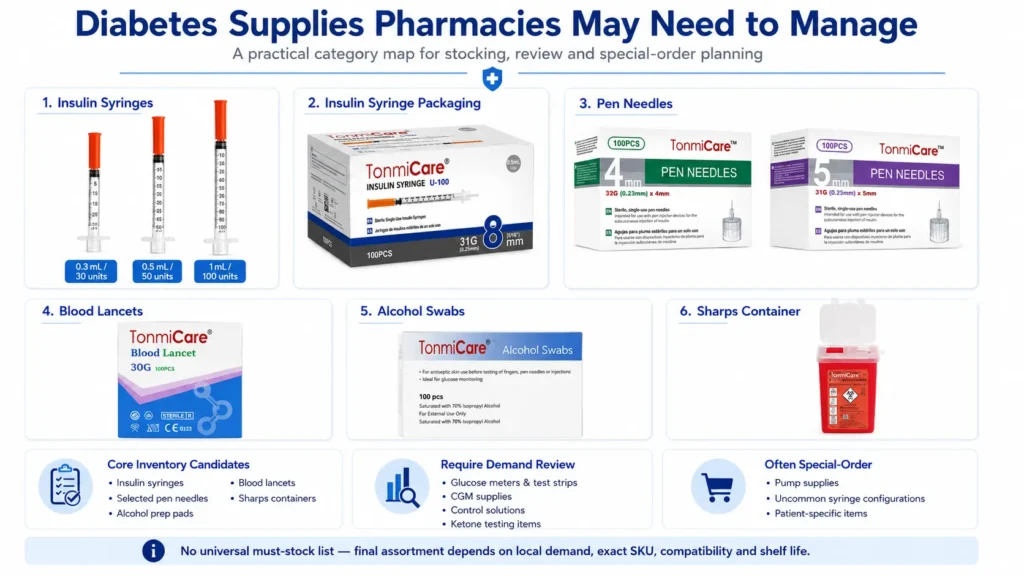
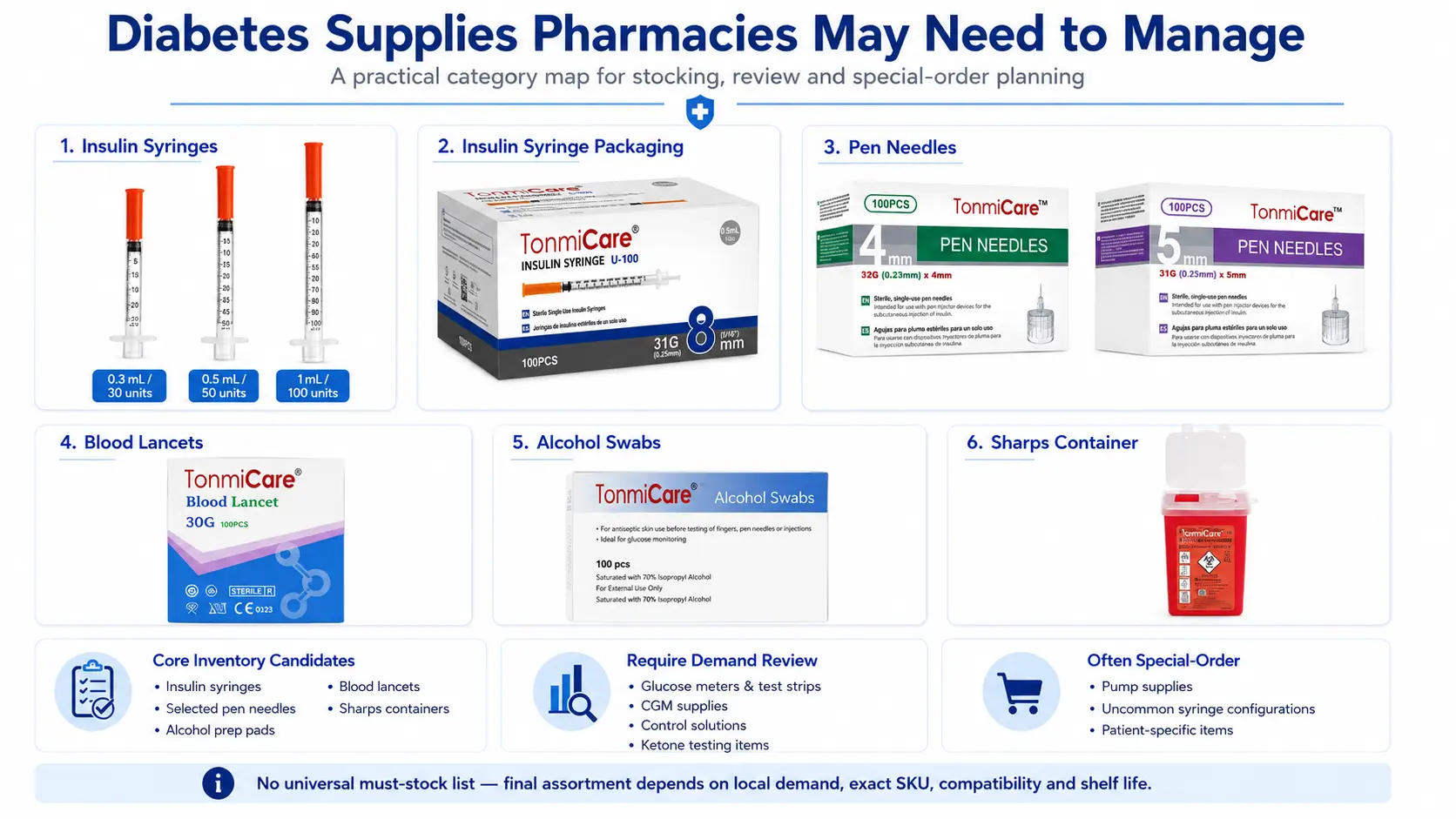
A pharmacy usually does not need every diabetes supply SKU on the shelf. Stock a narrow set of exact products with predictable repeat demand; keep device-, payer- or brand-specific products only when verified local demand justifies them; and special-order patient-specific, high-cost, low-turn or expiry-sensitive items.
Selected insulin syringes, insulin pen needles, alcohol prep pads, lancets and sharps containers may be recurring-inventory candidates. Blood glucose meters, compatible strips, control solutions, CGM products and pump supplies require closer review because product matching, coverage pathways, prescriptions and local demand can vary. There is no universal must-stock list.
1. What “Complete” Means in This Pharmacy Diabetes Supplies List
This guide covers the main supply families a U.S. pharmacy may evaluate for diabetes care: insulin-delivery consumables, blood glucose monitoring products, continuous glucose monitoring accessories, pump-related supplies, sharps disposal products and selected daily-care accessories. Prescription drugs and transactions billed through a DMEPOS pathway are identified separately because they do not use the same procurement and compliance workflow as ordinary consumables.
“Complete” describes category coverage, not a recommendation to carry every gauge, length, size, brand, device generation or package. Availability, documentation, remaining shelf life and fulfillment options must be confirmed for the exact SKU. Buyers can compare Tonmit’s current wholesale diabetes care supply categories while building the item-level list.
Core-stock candidate
Predictable repeat demand supports routine replenishment for selected exact SKUs.
Conditional stock
Compatibility, payer pathway or verified local demand controls the assortment.
Special order
Patient-specific, high-cost, low-turn or expiry-sensitive items require control.
Separate workflow
Prescription-drug sourcing and DMEPOS billing follow different requirements.
Planning tiers are not clinical or coverage determinations
Final stocking decisions should reflect dispensing history, local prescriptions, payer contracts, applicable law, product labeling, supplier terms and the pharmacy’s inventory policy.
2. Complete Diabetes Supplies Stocking Matrix for Pharmacies
Use this matrix as a first-pass assortment map. “Core candidate” means that a selected range may justify routine replenishment when local demand supports it—not that every specification or brand should be held.
| Product family | Typical planning tier | Confirm before stocking | Why the tier may change |
|---|---|---|---|
| Insulin syringes | Selected core | Capacity, concentration scale, dose markings, gauge, length and pack quantity | Multiple configurations split demand; uncommon formats may be special-order |
| Insulin pen needles | Selected core | Gauge, length, standard or safety design, labeled compatibility and pack | Demand often concentrates in few specifications; compatibility is SKU-specific |
| Alcohol prep pads | Selected core / conditional | Pad size, substrate, labeled solution/concentration, sterile claim and unit pack | Demand depends on the pharmacy workflow; stocking does not imply universal clinical necessity |
| Lancets | Selected core | Standard or safety type, gauge, penetration depth and device compatibility | Safety and specialty designs have different users, prices and turnover |
| Lancing devices | Conditional | Compatible lancets, adjustable settings, included items and replacement policy | Meter-kit inclusion can reduce standalone movement |
| Blood glucose meters | Conditional | Model, intended use, designated compatible strips, applicable control solution, payer position and channel | The ongoing strip ecosystem matters more than the meter alone |
| Blood glucose test strips | Conditional | Exact meter model, package quantity, storage, integrity, lot and expiration | Strips are system-specific and may carry expiry exposure |
| Control solutions | Conditional | Meter/strip system, control level, storage and opened-use period | Demand follows the associated system and may be low |
| Blood or urine ketone supplies | Conditional | Test type, compatible meter where applicable, storage, expiration and demand | Demand can be episodic and product-specific |
| CGM sensors, transmitters and receivers | Conditional / special | Brand, generation, order, eligibility, payer pathway, source and expiration | High SKU specificity and coverage controls can make broad stocking inefficient |
| CGM overpatches and skin accessories | Conditional | Sensor shape, material, intended use, pack and local accessory demand | Fit may be brand- or generation-specific |
| Pump infusion sets, reservoirs and cartridges | Special order | Pump model, set type, tubing or cannula specification, prescription and payer path | Products are highly device- and patient-specific |
| Sharps containers | Selected core / conditional | Capacity, opening, closure, placement, labeling and disposal workflow | Demand and disposal workflow vary by retail, professional setting and applicable local requirements |
| Gauze and routine injection accessories | General stock / conditional | Size, sterile or non-sterile label, material, pack and intended use | These may already be managed through the pharmacy’s general medical-supply inventory |
| Travel cases, cooling accessories and logbooks | Optional / special | Intended use, fit, substantiated performance claims and retail demand | These are business-model-dependent accessories |
| Oral glucose products | Optional / conditional | Dosage form, labeled contents, pack, expiration and pharmacy protocol | Retail and professional-use policies vary |
| Insulin, GLP-1 products and glucagon | Separate workflow | Prescription-drug sourcing, licensing, storage, tracing and payer requirements | Drug procurement is not ordinary consumable supply |
3. Core-Stock Candidates: Keep the Range Narrow and Demand-Led
Core inventory should be built from evidence of repeat demand, not from the number of products available in a catalog. Depending on local dispensing patterns, a small set of exact syringe, pen needle, lancet, prep-pad and sharps-container SKUs may account for recurring demand and may justify routine replenishment.
Insulin syringes
Control capacity, concentration scale, dose markings, gauge, length and pack.
Pen needles
Control gauge, length, type, labeling, compatibility statement and pack.
Alcohol prep pads
Where stocked, control dimensions, substrate, labeled solution, sterile claim and packaging.
Lancets & sharps containers
Where local demand supports them, separate standard, safety, device-compatible and container configurations.
For line-item planning, review available wholesale insulin syringe configurations and wholesale insulin pen needle options. These pages describe sourcing paths; they do not establish a universal pharmacy formulary or patient-specific selection.
Stocking does not establish clinical necessity
Items such as alcohol prep pads, gauze, sharps containers and other supporting supplies may be commercially relevant to a pharmacy without being universally required for every injection or patient. Use follows the exact product labeling, prescription or care plan, professional instructions and applicable facility or local requirements.
A category is not a SKU
“Pen needles” or “test strips” is not enough for a purchase order. Each item needs an exact identifier, specification, package hierarchy, pharmacy-approved supplier source, substitution status and replenishment rule.
4. Conditional Stock: Products Requiring Compatibility or Payer Review
Blood glucose meters, strips and control solutions
Manage the meter and its designated compatible test strips as a matched system, and confirm the applicable control solution and control level from the current product labeling. FDA advises using strips designed for the meter, following storage and expiration instructions, and avoiding products that are not authorized for sale in the United States. [1][2] Do not substitute a strip because the package count or general description looks similar.
Monitoring-system inventory controls:
- match the exact meter brand and model to the intended test strip;
- confirm the applicable control solution and control level where specified by the current labeling;
- accept intact inventory with verifiable lot and expiration information;
- review labeled storage and opened-container instructions; and
- evaluate payer or network positioning before duplicating systems.
CGM systems and related supplies
CGM products may have strong demand but remain brand-, generation-, prescription/order- and coverage-specific. A pharmacy can stock selected high-turn sensor SKUs, operate a special-order model for other components, or use the applicable pharmacy-benefit or applicable medical-benefit/DME pathway. Sensors, transmitters and receivers may follow different replacement cycles and should not share one reorder rule.
Ketone testing and specialty monitoring supplies
Blood ketone strips, urine ketone strips and associated meters are different product categories. Stocking depth should follow compatible-device use, local orders, episodic demand, storage requirements and remaining shelf life.
5. What Pharmacies Should Consider Special-Ordering
Special order is usually appropriate when demand is difficult to predict, the item is tied to one patient or device, unit cost is high, shelf life is restrictive, returns are limited or near-duplicate SKUs would fragment inventory.
| Common special-order candidate | Information to capture before ordering |
|---|---|
| Uncommon syringe capacities, scales, gauges or lengths | Exact REF, capacity, concentration scale, markings, gauge, length and pack |
| Safety-engineered or specialty injection products | Intended setting, safety mechanism, training and pharmacy-approved specification |
| Specific CGM sensors, receivers or transmitters | Brand, generation, component, order/coverage path, expiration and source |
| Pump infusion sets, reservoirs, cartridges or connectors | Pump model, set type, tubing/cannula specification and prescription details |
| Lower-volume meters and matching consumables | Exact meter, strips, control solution, quantity, lead time and return terms |
| Buyer-specific packaging or private-label supply | Artwork scope, target market, case format, forecast, MOQ and documents |
A controlled seven-step special-order workflow
Capture the request
Record the exact item, not only a category.
Verify fit
Check the device, scale, size and current labeling.
Check the pathway
Identify retail, pharmacy-benefit, DME or other channel.
Confirm supply
Review availability, pack, lot, expiration and lead time.
Disclose terms
Explain price, deposit, returns and substitution limits.
Record approval
Retain the pharmacy-approved exact item and quantity.
Inspect receipt
Verify identity, integrity, lot, expiration and quantity.
6. Products and Transactions That Need a Separate Workflow
Prescription drugs are not ordinary consumable inventory
Insulin, GLP-1 medicines, glucagon and other prescription drugs require drug-specific sourcing, licensing, storage, tracing, dispensing and payer controls. Tonmit’s standard B2B medical-consumables scope does not include patient-specific prescription dispensing, and this guide does not provide dose-conversion advice.
Medicare coverage does not automatically authorize billing
Medicare Part B covers certain blood glucose monitors and related testing supplies under the DME benefit and may cover eligible CGMs and related supplies when current eligibility and ordering requirements are met.[3][4] Medicare also explains that insulin and related supply coverage depends on how the insulin is administered and the applicable Part B or Part D pathway.[5] Coverage, a valid prescription or order, supplier eligibility and stock availability are separate controls.
A pharmacy seeking to bill Medicare for Part B DMEPOS items should separately verify current CMS enrollment, accreditation, surety-bond and product-specific requirements, including any applicable exemptions.[6]
Do not merge coverage and procurement decisions
A product may be commercially available but not covered for a particular transaction. Conversely, a benefit may describe coverage while the dispensing entity still must meet supplier, documentation and claim requirements.
7. How to Decide Whether to Stock or Special-Order a Diabetes Supply
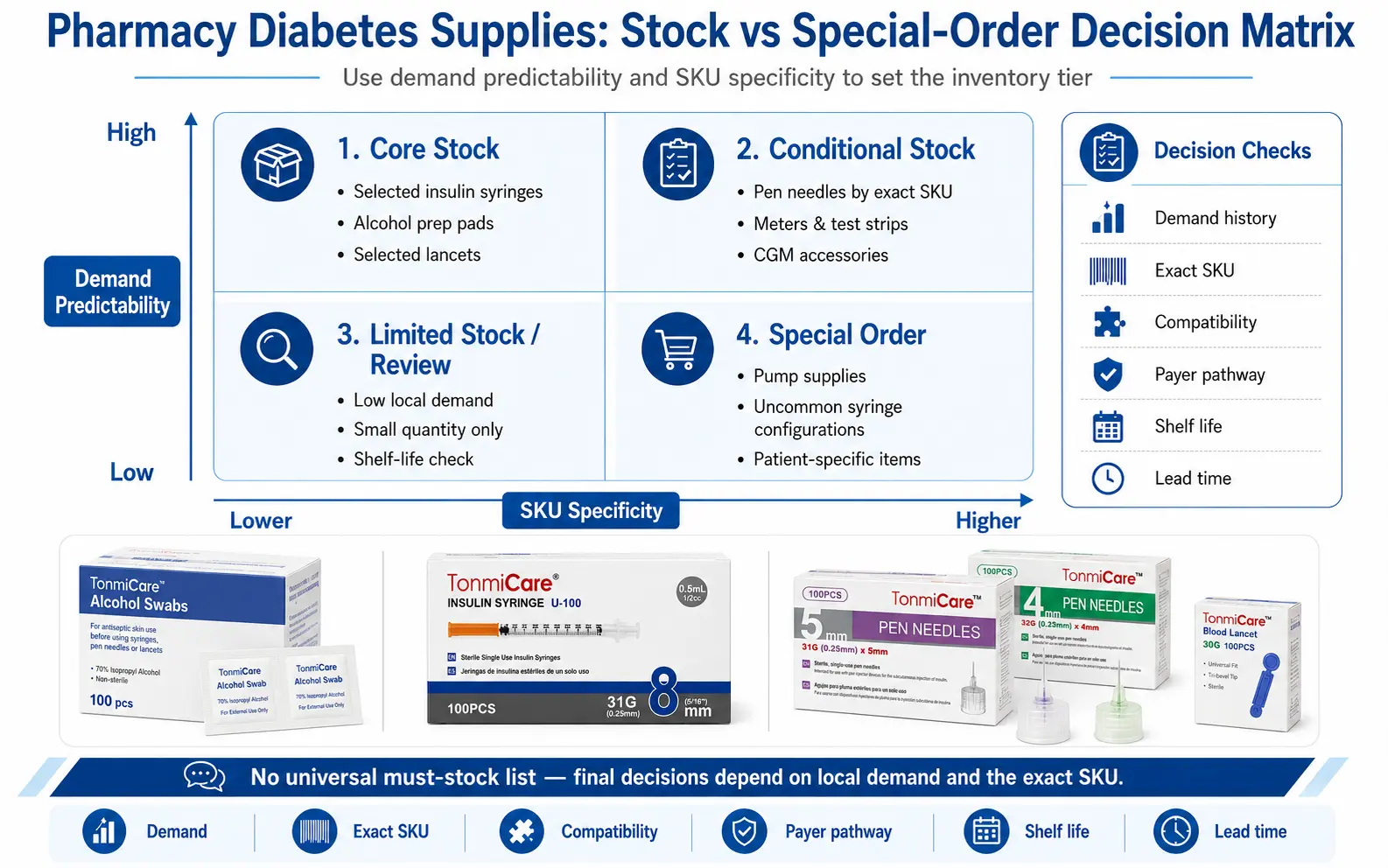
Evaluate demand predictability together with SKU specificity. High-frequency categories are not automatically core stock when each order points to a different brand or configuration. A standardized consumable may still be a poor stock item when local demand is low.
| Demand pattern | Lower SKU specificity | Higher SKU specificity |
|---|---|---|
| High, predictable demand | Strongest core-stock candidates | Selected conditional stock by exact SKU |
| Low or irregular demand | Small quantity or no routine stock | Strongest special-order candidates |
Ten questions for every stocking decision
| Decision factor | Question for the pharmacy |
|---|---|
| Demand | How many units of this exact SKU moved in the last 8–13 weeks? |
| Predictability | Is demand recurring, seasonal, episodic or tied to one patient? |
| Compatibility | Is it tied to a meter, pen, pump, sensor generation or lancing device? |
| Payer access | Does a benefit, network or formulary materially affect demand? |
| Substitution | Would a change require prescription, professional or patient confirmation? |
| Shelf life | Can expected demand consume stock before the expiry threshold? |
| Lead time | What is the complete time from order approval through receiving? |
| Pack size | Does the box/case configuration fit dispensing and storage? |
| Economics | Do carrying cost, margin, returns and expiry exposure support stocking? |
| Traceability | Can supplier, lot, expiration, receipt and inventory be traced? |
8. Exact-SKU Information Pharmacies Should Record
A master item record should prevent a similar-looking product from being ordered or substituted by mistake. Required fields vary, but the following structure is a practical starting point.
| Product | Minimum specification fields |
|---|---|
| Insulin syringe | Catalog/SKU, capacity, concentration scale, dose markings, gauge, length, needle design, labeling, units/box and boxes/case |
| Pen needle | Catalog/SKU, gauge, length, standard/safety design, labeled compatibility, labeling, units/box and boxes/case |
| Alcohol prep pad | Catalog/SKU, dimensions, substrate, labeled solution/concentration, sterile claim, individual wrap, box and case quantities |
| Lancet | Catalog/SKU, standard/safety type, gauge, penetration depth where applicable, compatible device, labeling and pack |
| Meter system | Meter model, designated compatible strip, applicable control solution, intended use, coding/calibration requirements if any and kit contents |
| Test strips | Meter compatibility, catalog/SKU, strips/vial or pack, storage, lot, expiration and opened-vial instructions where applicable |
| CGM product | Brand, generation, component type, catalog number, pack, expiration, storage and order/coverage pathway |
| Sharps container | Catalog/SKU, capacity, opening, closure, placement/mounting, labeling, units/case and disposal workflow |
Do not make automatic substitutions
Similar names, dimensions or package counts do not prove equivalence. Follow the prescription or order, product labeling, payer requirements, compatibility evidence and pharmacy policy before changing a device, accessory or injection specification.
Tonmit buyer worksheet
Pharmacy Diabetes SKU Stocking & Receiving Record
Use one record for each exact SKU. Assign an inventory tier from measured demand and product specificity, document the compatibility or payer controls that affect the decision, and carry the same pharmacy-approved identity into receiving.
This is a blank procurement-control template, not a formulary, clinical recommendation, payer determination, completed Tonmit QC report or live inventory record. Stocking tiers and acceptance limits must be approved for the pharmacy, exact SKU and transaction.
The full editable record is delivered as a text template so buyers can adapt it to the pharmacy’s approved item master and receiving procedure.
9. Set Reorder Points from Complete Lead Time
A practical starting model:
Use measured exact-SKU demand and end-to-end lead time; do not use carrier transit alone.
Total lead time includes order approval, supplier processing, warehouse picking, transport and pharmacy receiving. Safety stock should reflect demand and lead-time variability, the desired service level, expiry exposure and availability of a pharmacy-approved alternative.
Illustrative example only: If an exact SKU averages three cases per week, measured end-to-end lead time is two weeks and the pharmacy chooses two cases of safety stock under its own policy, the starting reorder point is eight cases: (3 × 2) + 2. This explains the calculation; it is not a recommended stock level.
U.S. warehouse
Verify that the exact SKU is available, allocated and saleable.
Factory-direct
Add production, release, export, international transit and customs.
Private label
Add artwork, label review, packaging approval and any required verification or validation steps.
Tonmit’s U.S. warehouse-supported fulfillment is SKU-specific. Confirm exact inventory, package quantity, lot, remaining shelf life, allocation status and destination before an order is accepted.
10. Receiving, Expiration and Traceability Checks
Set acceptance criteria before ordering. A low unit price can become expensive when a product arrives with insufficient remaining shelf life, damaged packaging or an incorrect case configuration.
Receiving checklist:
- exact product and SKU match the purchase order;
- size, gauge, length, capacity, scale or model are correct;
- box count and case pack match the quotation;
- shipping cartons and unit packaging are intact;
- lot numbers are readable and recorded;
- expiration dates meet the agreed threshold;
- available storage and handling evidence is consistent with labeled conditions where required;
- required documents are linked to the item record;
- discrepancies are quarantined before release; and
- expiring inventory is placed into the correct FEFO sequence.
Use FEFO where expiration applies
First-expired, first-out prioritizes the lot with the earliest acceptable expiration. It is more useful than simple first-in, first-out when later receipts have shorter dating. Maintain lot- and expiry-level visibility so affected stock can be found during a complaint, return or recall.
11. What to Confirm with a Diabetes Medical Supply Supplier
Ask for evidence that applies to the exact SKU. A company-level statement or a document for a related product does not establish every specification, claim, market authorization or package configuration in a catalog.
Product identity
Specification, label, REF, packaging hierarchy, lot and expiration format.
Quality & documents
Applicable records, sterility or sterilization evidence where applicable where relevant, complaint/recall contact and change notice.
Commercial controls
Exact-SKU availability, MOQ, dating commitment, lead-time basis, returns and substitutions.
Buyers can prepare exact-SKU document questions and separately review responsibilities for private-label and OEM medical supply programs. Document scope and private-label feasibility depend on the selected device, manufacturer, target market and commercial arrangement.
12. Copyable Pharmacy Diabetes Supplies RFQ Checklist
Replace the bracketed fields and send the same request to each supplier so that pricing, pack configuration, dating and lead-time responses are comparable.
Pharmacy Diabetes Supplies RFQ
- Product category: [syringe / pen needle / lancet / prep pad / sharps / other]
- Exact specification: [size, gauge, length, scale, model, design and compatibility]
- Product identity: [manufacturer, brand/labeler, exact REF or pharmacy-approved alternative]
- Package: [units/box, boxes/case, cases/pallet, barcode levels]
- Quantity: [first order, monthly use, annual forecast and order frequency]
- Supply path: [U.S. warehouse / factory-direct / private label]
- Availability: [free-to-sell quantity, allocation status and backorder policy]
- Shelf life: [labeled life and minimum remaining life at shipment or receipt — state the measurement basis]
- Documents: [specification, label/IFU and transaction-required records]
- Traceability: [lot, expiration, UDI/GTIN where applicable and change notice]
- Substitution: [none without prior written approval / defined alternatives]
- Commercial terms: [price basis, MOQ, payment, returns and cancellation]
- Destination: [country, state, postal code and delivery requirements]
- Required-by date: [date and acceptable partial-shipment rule]
Quote every line by exact SKU, package hierarchy, dating and supply path.
Use the downloadable RFQ as the working version; the visible checklist remains the quick on-page reference.
Questions from pharmacy buyers
Frequently Asked Questions About Pharmacy Diabetes Supplies
What diabetes supplies should every pharmacy stock?
There is no single list for every pharmacy. Selected syringes, pen needles, prep pads, lancets and sharps containers may be core-stock candidates when local repeat demand supports the exact SKUs. Meter, strip, CGM and pump inventories require additional compatibility, payer and turnover review.
Which diabetes supplies are usually better suited for special order?
Patient-specific, device-specific, low-frequency, high-cost or expiry-sensitive products are stronger candidates. Examples can include uncommon injection specifications, selected CGM components, pump supplies and lower-volume meter systems.
Are blood glucose test strips interchangeable?
Do not assume they are. Match the strip to the exact meter system identified in the manufacturer’s labeling. Similar packaging, appearance or quantity does not establish compatibility.
Should a pharmacy stock meters, strips and control solutions together?
Manage each meter with its designated compatible strips, and confirm the applicable control solution and control level from current labeling. Set separate reorder rules and monitor demand, lot and expiration for each component.
Should pharmacies routinely stock CGM sensors?
Only when verified demand, sourcing access, coverage pathways, expiration risk and working capital support the decision. A pharmacy may stock selected high-turn sensors and special-order other generations, receivers or transmitters.
Are all insulin pen needles compatible with every pen?
Compatibility should not be assumed from a general “pen needle” description. Check current pen and needle labeling, exact product specifications and pharmacy policy. Individual selection follows the relevant clinical and dispensing process.
What must be confirmed when ordering insulin syringes?
Confirm capacity, concentration scale, dose markings, gauge, length, needle design, sterile/single-use labeling and package configuration. Different scales should not be treated as interchangeable; this guide gives no dose conversion.
How many diabetes supply SKUs should a pharmacy carry?
There is no defensible fixed number. Start with exact-SKU demand, remove unsupported duplicates, classify items by turnover, specificity, shelf life and lead time, and review after payer, device or supplier changes.
How should a pharmacy set a reorder point?
A common starting formula is demand during measured end-to-end replenishment lead time plus safety stock. Set safety stock from demand and lead-time variability, service targets, expiry risk and pharmacy-approved alternatives.
What remaining shelf life should a pharmacy require?
Set a SKU- or category-specific threshold based on expected consumption, pack size, storage, return terms and policy. Put the threshold in the quotation or purchase order instead of relying on a general promise of “good dating.”
Does U.S. warehouse support mean every SKU is in stock?
No. Inventory is SKU- and cycle-specific. Confirm product, package, available quantity, lot, remaining shelf life, allocation status and destination before treating stock as available for an order.
Does Medicare coverage mean a pharmacy can automatically bill?
No. Coverage depends on the product, benefit, eligibility, order or prescription and other conditions. Part B DMEPOS billing may also require supplier enrollment, accreditation and other CMS requirements.
Can one diabetes supply be substituted for another?
Do not substitute from a similar name, size or package count alone. Compatibility, prescription details, payer rules, product labeling and pharmacy policy may restrict the change.
Can a wholesaler mix several diabetes supply SKUs in one order?
It depends on supplier terms, carton configuration, exact-SKU availability and supply path. Request a line-by-line quote showing item, unit pack, case pack, quantity, allocation, dating and lead time.
Does Tonmit distribute prescription insulin or dispense prescriptions?
Prescription-drug distribution and patient-specific dispensing are outside Tonmit’s standard medical-consumables supply scope. The B2B program focuses on selected diabetes care supplies, documentation, bulk supply and applicable fulfillment support.
13. Conclusion: Build the Assortment by Exact SKU, Not Category Name
A useful pharmacy diabetes supplies list is intentionally narrower than a catalog. It keeps predictable, repeat-use exact SKUs in routine replenishment; conditionally stocks device- or payer-dependent items; and routes specific, high-cost or slow-moving products through a controlled special-order process.
Reassess when demand, device generations, payer access, supplier terms or lead times change.
This method answers the buyer’s operational question without implying that one product mix fits every pharmacy. It also gives purchasing, receiving, quality and inventory teams a shared record for replenishment and substitution control.
Official Sources & Editorial Basis
- U.S. Food and Drug Administration. Blood Glucose Monitoring Devices.
- U.S. Food and Drug Administration. How to Safely Use Glucose Meters and Test Strips for Diabetes.
- Medicare.gov. Blood Sugar Test Strips Coverage.
- Medicare.gov. Continuous Glucose Monitors Coverage.
- Medicare.gov. Insulin and Related Supplies Coverage.
- Centers for Medicare & Medicaid Services. Enroll as a DMEPOS Supplier.
Source check: The cited FDA, Medicare and CMS pages were rechecked on October 6, 2026. Coverage rules, product records, inventory and transaction terms can change; verify current official requirements, exact-SKU labeling and supplier evidence before approval.
Prepared by the Tonmit Medical Supply Editorial Team. Richard Lewis reviewed assortment, supplier and purchasing logic; Michael Thompson reviewed exact-SKU, packaging, shelf-life, receiving and traceability controls; David Anderson reviewed regulatory-source and Medicare/DMEPOS statements.
Wholesale & procurement support
Build Your Pharmacy Diabetes Supply List
Share the category, exact specification, package quantity, estimated demand, destination, minimum remaining shelf life and document requirements. Tonmit can review selected product paths, U.S. warehouse support and bulk-order options by RFQ.