
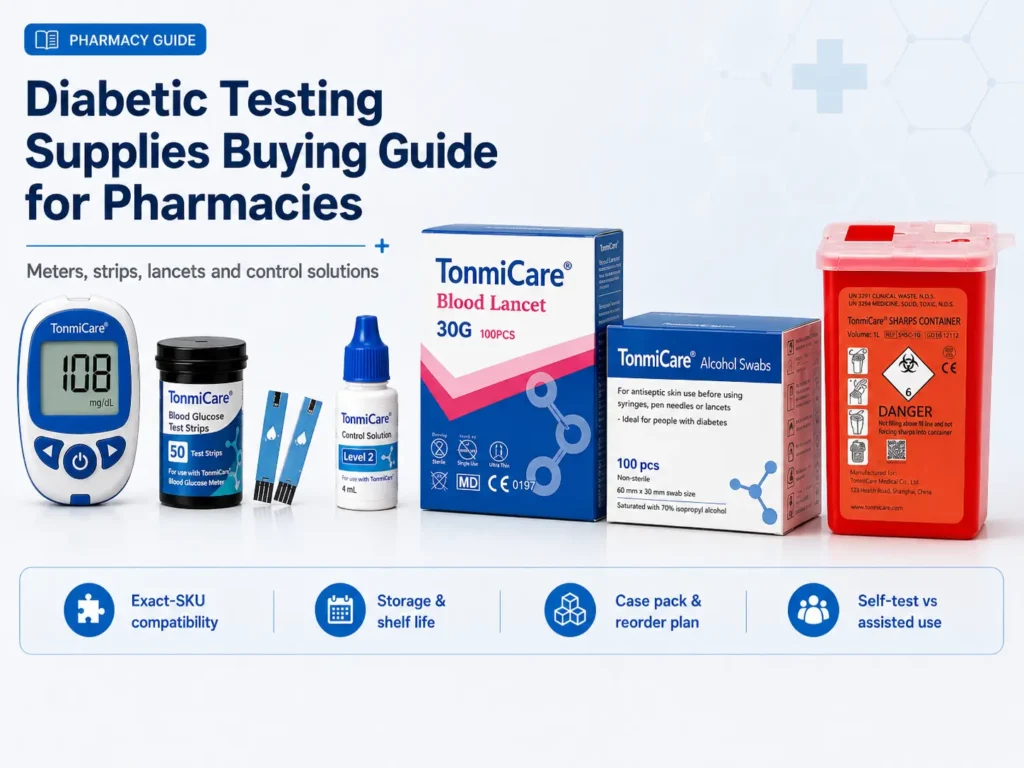
Pharmacy Blood Glucose Monitoring Procurement Guide
A system-level guide for pharmacies comparing blood glucose meters, compatible test strips, lancets, lancing devices and control solutions—covering intended use, exact-SKU compatibility, storage, shelf life, total test cost, payer pathways and supplier controls.
Scope: This guide supports U.S. B2B pharmacy procurement and inventory planning for finished blood glucose monitoring products. It is not a patient-specific testing recommendation, prescription, coverage determination, legal opinion or live inventory promise. Confirm the exact product labeling, intended user and setting, compatible components, lot, expiration, storage, payer pathway and applicable requirements before purchase or dispensing.
Direct answer
How Should Pharmacies Buy Diabetic Testing Supplies?
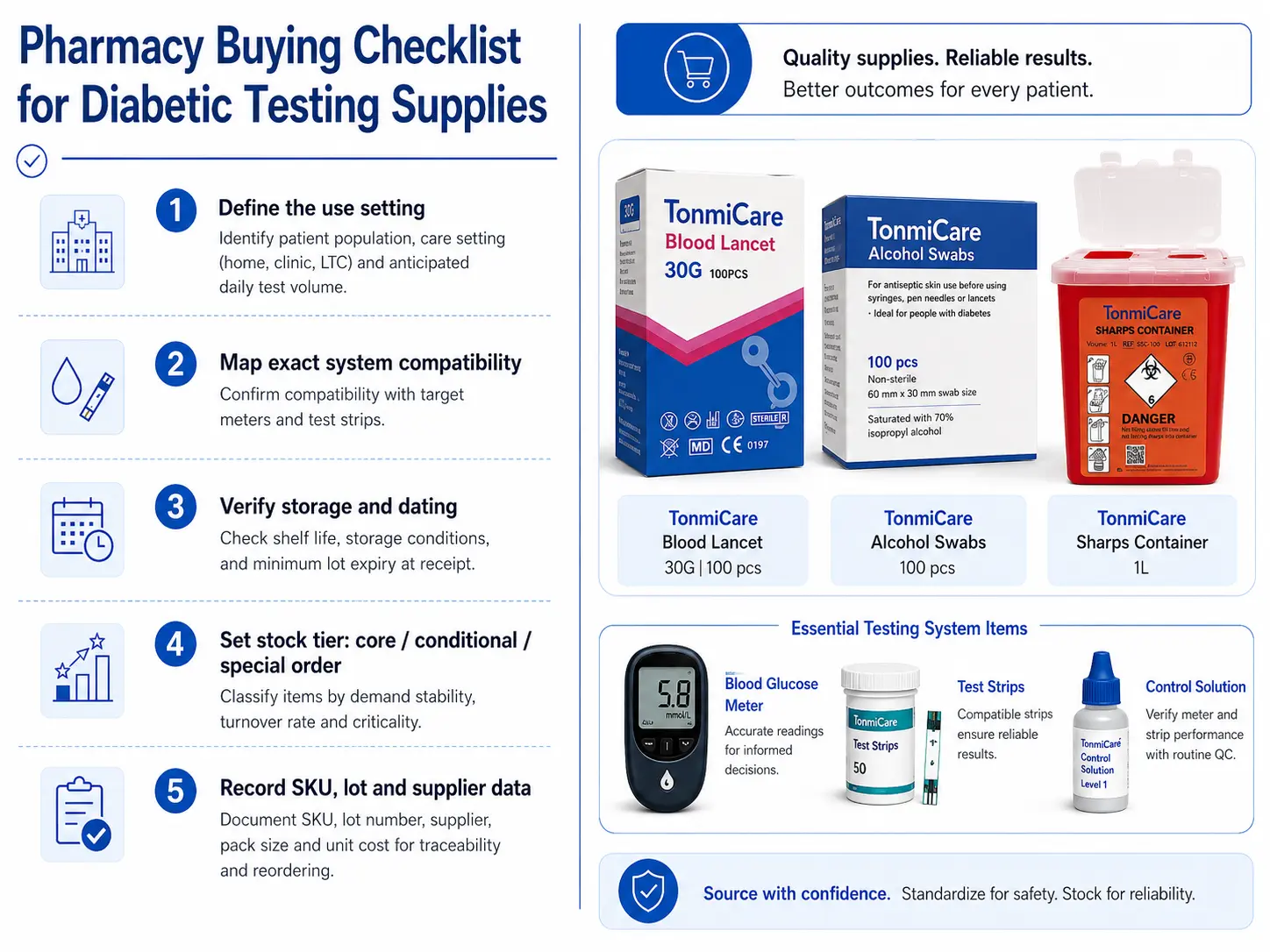
Buy diabetic testing supplies as a controlled monitoring system rather than as separate commodities. For every meter SKU, map the exact compatible strip, applicable control solution and intended sampling device; then decide whether that complete system belongs in core stock, conditional stock or a special-order workflow.
The highest unit discount is not necessarily the lowest operating cost. A practical pharmacy review also considers strip continuity, remaining shelf life, open-vial or open-container instructions, expected waste, local payer access, complete replenishment lead time and the risk of dispensing a component that does not match the patient’s meter.
1. What Counts as Diabetic Testing Supplies?
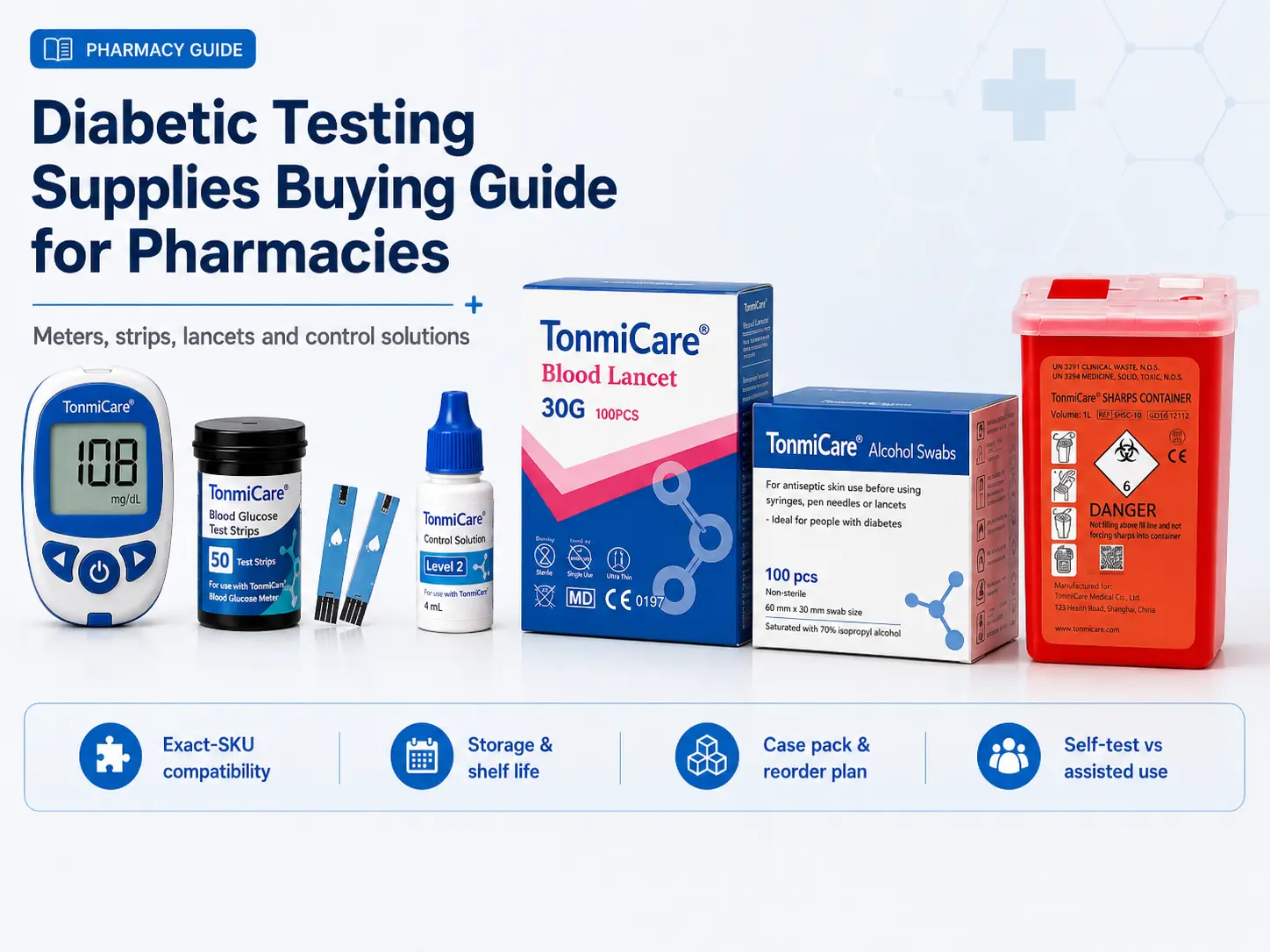
For pharmacy procurement, a blood glucose monitoring assortment normally includes four linked product groups: a glucose meter, the test strips identified for that meter, a blood-sampling setup, such as compatible lancets and a lancing device, and the control solution identified for the meter-strip system. Depending on the product, a kit may include some—but not necessarily all—of these components.
Accessories can also include batteries, carrying cases, logbooks, cable or app connectivity and sharps-disposal products. Those accessories should not distract buyers from the central procurement question: can the pharmacy replenish the correct test strip and support the labeled quality-control process for the exact meter over its expected service life?
Glucose meter
Defines the intended user, setting, strip family, result range and operating features.
Test strips
Lot- and expiry-controlled consumables that must be identified for the meter.
Lancet system
Lancet type, gauge and compatible device affect the sampling workflow.
Control solution
System-specific material used according to the manufacturer’s instructions.
A complete kit is not the same as a sustainable assortment
Before listing a meter kit, verify ongoing availability of the exact strips and control solution. A low-cost starter meter can create service failures if its consumables are unavailable, short-dated or outside the pharmacy’s payer pathway.
Buyers reviewing a broader diabetes category can compare the wholesale diabetes care supplies range and use the complete pharmacy diabetes supplies list to separate testing products from injection, daily-care and disposal categories.
2. Separate Retail Self-Testing From Professional Assisted Monitoring
Intended use and use setting must be established before price comparison. FDA information distinguishes over-the-counter blood glucose monitoring systems for self-testing from systems intended for professional healthcare settings. FDA notes that over-the-counter self-monitoring systems are for use by a single patient and should not be shared.[1]
When personnel assist with blood glucose monitoring, infection-control requirements change the product and operating model. CDC says fingerstick devices must never be used for more than one person; meters should be assigned to an individual whenever possible. If a meter must be shared, it should be a device intended for professional use and must be cleaned and disinfected after every use according to the manufacturer’s instructions.[5]
| Decision point | Retail self-testing | Assisted monitoring in a professional setting |
|---|---|---|
| Primary user | Individual using the system for self-monitoring | Trained personnel assisting one or more patients |
| Meter sharing | Do not share a single-patient OTC system | Assign where possible; if shared, use an appropriately labeled professional-use device |
| Fingerstick device | Personal device and compatible lancet per labeling | Single-use, auto-disabling fingerstick devices for assisted monitoring |
| Cleaning/disinfection | Follow the exact device instructions | After every use when a professional-use meter is shared, using the labeled method |
| Buyer control | Compatibility, affordability and refill continuity | Intended use, infection-control workflow, training and disinfectant compatibility |
Do not convert a retail meter into a multi-patient device
A device’s compact size, low price or familiar brand does not establish suitability for assisted monitoring. Review the exact labeling and facility protocol before purchasing for professional use.
3. Build an Exact-SKU Compatibility Map Before Ordering
The safest purchasing record treats the meter, strips and control solution as one version-controlled system. FDA advises users to use only the test strip recommended for their meter because incompatible strips may fail to produce a result or may produce an inaccurate result.[2] The name on the carton, physical appearance or strip count is not proof of compatibility.
| Map field | Record for every system | Do not substitute with |
|---|---|---|
| Meter identity | Manufacturer, brand, exact model, catalog number, UDI where applicable | A family name alone |
| Test strip | Exact strip name/catalog number, pack, coding status, sample requirement, labeled storage | A similar-looking strip or same-count pack |
| Control solution | Exact solution identified for the system, level(s), lot, expiration and open-container instructions | A generic or visually similar solution |
| Lancet workflow | Standalone safety lancet or compatible lancet plus lancing device; gauge/depth as labeled | An assumption that every lancet fits every device |
| Use setting | Self-testing or professional use, specimen type and labeled user population | A use case inferred from marketing copy |
| Replenishment | Supplier SKU, case pack, MOQ, lead time, shelf-life commitment and substitution rule | An unapproved replacement chosen at shipment |
Strip interchangeability must be documented, not inferred
If the meter labeling or manufacturer compatibility documentation does not identify a strip for that model, do not treat the strip as interchangeable. Require written clarification tied to the exact product identifiers before purchase.
Tonmit buyer worksheet
Blood Glucose Monitoring System Compatibility & Receiving Record
Use one record for each approved monitoring system. Link the meter, strip, control solution and sampling device before the purchase order is approved, then use the same identifiers at receiving so substitutions, short dating and mismatched components are caught before release.
This is a blank procurement-control template, not a live inventory feed, completed QC record, compatibility certificate, coverage decision or regulatory approval. The exact manufacturer labeling and transaction-specific evidence control the final decision.
The downloadable record is intentionally blank so it can be tied to the approved exact-SKU master and the received lot.
4. How to Compare Blood Glucose Meters for Pharmacy Purchasing
A pharmacy meter comparison should start with the intended use and refill ecosystem, then move to operating features. Accuracy claims should be reviewed against the exact model’s current labeling and applicable records—not carried over from another device in the same brand family.
Intended user and setting
OTC self-testing or professional use; home, pharmacy service or clinical environment.
Compatible strip continuity
Exact strip family, supply continuity, case configuration and refill availability.
Sample and operating needs
Sample volume, result time, hematocrit or environmental limitations and alternate-site claims as labeled.
Usability
Display, memory, coding workflow, language, audio, data transfer and user instructions.
Quality-control workflow
Control solution identity, levels, acceptable ranges and labeled check procedure.
Lifecycle support
Warranty, customer support, replacement process, batteries and discontinuation notice.
An inexpensive meter is commercially weak if compatible strips are unavailable or unaffordable. Compare the complete lifetime pathway and review Tonmit’s current blood glucose meter and testing supply categories at the system level rather than selecting a meter alone.
5. How to Buy Blood Glucose Test Strips
Test strips usually drive repeat purchase frequency and most of the ongoing cost. They are also sensitive to compatibility, lot, expiration and storage conditions. FDA recommends using new, unopened strips authorized for sale in the United States and warns that pre-owned, expired, tampered-with or improperly stored strips may produce unreliable results.[3] [4]
| Buyer field | What to capture | Why it matters |
|---|---|---|
| Meter compatibility | Exact meter model(s) identified by the manufacturer | Prevents unsupported strip substitution |
| Package configuration | Strips per vial or individually wrapped format; vials per retail pack; packs per case | Controls invoice, shelf and patient quantity calculations |
| Coding | No-code, auto-code or required coding procedure as labeled | Affects workflow and training; never infer from a related model |
| Sample requirement | Labeled sample type and volume | Supports accurate product comparison without making a clinical recommendation |
| Storage | Temperature, humidity, container closure, light and transport limits | Uncontrolled exposure can compromise product performance |
| Dating | Manufacturer expiration plus any labeled in-use period after opening | Supports FEFO and waste forecasting |
| Traceability | Catalog number, lot, expiration, UDI where applicable and supplier lot linkage | Supports receiving, complaint and recall controls |
Do not create a universal “discard after opening” rule
Some strip systems specify an in-use period after opening; others rely on the printed expiration date when stored and handled as labeled. Record the exact manufacturer’s instruction for each SKU instead of applying one rule to all strips.
6. Lancets and Lancing Devices: What Pharmacies Must Match
Lancets are not a single interchangeable category. The assortment may include standard lancets used with a reusable lancing device, proprietary lancets designed for a particular device, and single-use safety lancets with a fixed or selectable penetration depth. The right purchasing record distinguishes these product types.
Standard system
Lancet + reusable lancing device
- Confirm the lancet is identified as compatible with the device.
- Record gauge, available depth settings and package quantity.
- Do not share personal fingerstick or reusable lancing devices between patients. For assisted blood glucose monitoring, use single-use, auto-disabling fingerstick devices and follow the facility’s infection-control procedure.
Assisted workflow
Single-use safety lancet
- Review single-use and auto-disabling features.
- Record fixed or selectable depth and labeled intended setting.
- Confirm activation, disposal and staff-training requirements.
- Use a sharps-disposal workflow appropriate to the setting.
For product-level comparisons, review the current diabetes care accessories and wholesale lancing device options. Final selection must still be based on the exact device-lancet pairing and intended use.
7. How to Buy and Manage Glucose Control Solutions
Glucose control solution is used to check how a meter and strip system is operating when the solution is tested in place of a blood sample. It is not a universal calibration fluid. The pharmacy should purchase only the solution and level(s) identified for the exact meter-strip system and follow the manufacturer’s acceptable range and procedure.
FDA gives examples of times a control check may be considered, such as when opening a new container of strips, occasionally during use, after dropping a meter or when a result does not match how the user feels. Those examples do not replace the exact system instructions; the manufacturer’s labeling determines the required procedure and frequency.[1]
Record these fields for every control solution SKU
- Compatible meter and test-strip family.
- Control level or concentration designation.
- Catalog number, package quantity, lot and expiration.
- Storage and transport conditions.
- In-use dating and any required date-opened marking.
- Acceptable control range location and result interpretation instructions.
- Action required when a result falls outside the labeled range.
Control solution is system-specific
Do not substitute based on color, bottle size, glucose level wording or price. Require compatibility evidence for the exact meter-strip system.
8. Core Stock, Conditional Stock or Special Order?
The correct tier depends on local demand for the exact system, not broad category popularity. A nationally recognized meter may still move slowly in one pharmacy; a less common system may deserve core status where payer access and repeat demand are concentrated.
| Product | Core-stock candidate | Conditional stock | Special-order trigger |
|---|---|---|---|
| Meter kits | Few exact models with verified repeat starts and strip continuity | Payer- or population-specific model with stable local demand | High-cost, low-turn, specialty-feature or unfamiliar system |
| Test strips | Exact strips supporting active meters with predictable refill history | Moderate demand, shorter dating or variable reimbursement | Low-turn legacy, specialty or patient-specific strip |
| Standard lancets | Selected exact SKUs supported by local device demand | Less common gauge, configuration or proprietary fit | Unverified compatibility or isolated patient request |
| Safety lancets | Only where a professional service creates recurring demand | Clinic or institutional account with forecasted use | Special depth/gauge or infrequent professional requirement |
| Lancing devices | Replacement demand for selected supported systems | Model-specific device with tracked usage | Rare proprietary or legacy device |
| Control solutions | Limited quantities for supported high-volume systems | System-specific stock matched to active strip demand | Low-turn level or solution with limited remaining shelf life |
9. Compare Cost per Usable Test—not Unit Price Alone
Meter acquisition cost is only one element of the system. Pharmacies should model the cost of the strip, lancet, allocated control use, expected expiration or damage, freight and the portion of meter cost attributable to expected use. Use internal assumptions that can be audited rather than publishing one universal cost-per-test number.
Reorder planning should use complete lead time—from approved order through receipt, inspection and release—not only a supplier’s quoted transit days. A simple planning model is:
Set safety stock separately for meters, strips and control solutions. They may have different case packs, lead times and expiry exposure. Holding a meter without its compatible strips does not protect service continuity.
Commercial fields that belong in the quote comparison
- Unit, retail pack, inner pack and case quantity.
- MOQ by SKU and any mixed-case or mixed-order rule.
- Current price, price-validity period and freight terms.
- Available quantity, allocation policy and back-order handling.
- Manufacturing lead time, transit estimate and receiving/release time.
- Minimum remaining shelf life at shipment or receipt.
- Authorized substitution, discontinuation and change-notification controls.
10. Receiving, Storage and FEFO Controls
Storage instructions vary by product. Do not create a category-wide temperature, refrigeration or humidity rule. Record the conditions from the exact labeling and purchase agreement, then verify that transport, receiving and storage preserve those conditions. FDA specifically advises users to store and handle meters and strips according to the manufacturer’s instructions.[1]
Match the order
Confirm manufacturer, model, catalog number, quantity and approved substitution status.
Inspect condition
Check seals, containers, visible damage, labeling and any evidence of improper exposure.
Capture traceability
Record lot, expiration, UDI where applicable and supplier shipment linkage.
Verify dating
Compare remaining shelf life with the purchase requirement and expected stock turns.
Release to FEFO
Use first-expire, first-out rotation while preserving system and lot traceability.
Quarantine mismatched, damaged, opened, tampered or questionable products pending documented disposition. Do not relabel, combine or sell loose strips from previously opened consumer containers. Product complaints and recalls should be traceable to the exact received lot and customers or locations supplied where required by procedure.
11. Medicare Coverage and Pharmacy Billing Are Separate Questions
Medicare describes coverage under Part B for eligible blood sugar monitors, test strips, lancets and control solutions when coverage criteria are met.[6] [7] [8] Coverage of a category does not automatically authorize every pharmacy to bill Medicare for it, and it does not establish coverage for every exact product or quantity.
Pharmacies considering Medicare DMEPOS transactions should confirm current enrollment, accreditation, surety-bond and supplier-standard requirements, including any applicable exceptions, directly with CMS and their advisors. CMS maintains the current DMEPOS enrollment resources and requirements.[9]
Coverage, billing authority and procurement are three controls
Confirm: (1) whether the beneficiary and item meet the applicable coverage rules, (2) whether the pharmacy is properly authorized for the transaction, and (3) whether the exact SKU can be sourced, documented and replenished. One answer does not prove the others.
12. What to Verify With a Diabetic Testing Supplies Supplier
Supplier qualification should connect legal identity, the exact product and the specific transaction. A company-level certificate or registration does not by itself prove that a particular meter, strip, lancet or control solution is appropriate for the intended U.S. use.
| Review area | Evidence to request | Buyer question |
|---|---|---|
| Supplier identity | Legal name, address, role, contacts and relevant licenses or permits | Who is selling, importing, distributing and handling complaints? |
| Exact product | Manufacturer, brand, model, catalog number, UDI where applicable and current labeling | Does every document refer to the SKU on the quote? |
| Regulatory status | Applicable FDA records or other evidence appropriate to the exact device and role | Is the evidence current and product-specific rather than a generic claim? |
| Compatibility | Manufacturer documentation mapping meter, strip and control solution | Can the proposed system be verified without inference? |
| Quality controls | Lot release, complaint, recall, change-control and traceability procedures | How is a field issue contained and communicated? |
| Supply terms | MOQ, price, case pack, lead time, shelf-life commitment, storage and substitution rule | Are the commercial promises measurable at receipt? |
| Post-sale support | Warranty, technical support, returns and discontinuation process | Who supports the pharmacy and end user after delivery? |
Tonmit buyers can review the available medical device documentation support and U.S. medical supply fulfillment framework. Availability, applicable records and lead time must still be confirmed for every exact SKU and order.
13. Copyable RFQ Checklist for Meters, Strips, Lancets and Control Solutions
A structured RFQ reduces incompatible quotes and makes supplier comparisons more objective. Copy the following fields into the pharmacy’s purchasing request.
Diabetic Testing Supplies RFQ
Use the downloadable RFQ as the working request and repeat the product block for each exact meter, strip, lancet or control-solution SKU.
Buyer FAQ
Frequently Asked Questions About Diabetic Testing Supplies
Are blood glucose test strips interchangeable between meters?
No. Use only the strip identified by the manufacturer for the exact meter. A similar strip name, appearance or pack count does not establish compatibility.
Can a pharmacy use one control solution for every glucose meter?
No. Control solution is system-specific. Confirm the exact solution and level identified for the meter-strip system.
When should a glucose control test be performed?
Follow the exact manufacturer’s instructions. FDA lists examples such as opening new strips, occasional checks, a dropped meter or an unexpected result, but these examples do not create a universal schedule.
Do test strips expire after opening?
The rule depends on the exact product. Record both the printed expiration and any manufacturer-specified in-use period after opening. Do not apply one open-vial rule to every strip.
How should pharmacies store glucose test strips?
Store and handle each SKU according to its labeling, including temperature, humidity, light and container-closure instructions. Do not refrigerate or transfer strips unless the manufacturer specifically directs it.
Are all lancets compatible with all lancing devices?
No. Some standard lancets fit multiple devices, while others are proprietary. Verify the exact device-lancet compatibility and do not rely on the word “universal” without product-specific evidence.
Can a retail blood glucose meter be shared by multiple patients?
OTC self-testing systems are intended for a single patient and should not be shared. Assisted monitoring requires products and infection-control procedures appropriate to the professional setting.
What is the difference between a standard lancet and a safety lancet?
A standard lancet is commonly inserted into a reusable personal lancing device. A safety lancet is an integrated, single-use device, often with an auto-disabling mechanism, intended for the use described in its labeling.
Should pharmacies stock meters or focus on strips?
Stock decisions should be made for the complete system. Carrying meters without dependable compatible-strip replenishment creates avoidable service and inventory risk.
How much remaining shelf life should a pharmacy require?
There is no universal percentage. Set a written minimum by SKU using demand, lead time, case quantity, manufacturer dating and expected stock turns, then include it in the purchase agreement.
Does Medicare cover meters, strips, lancets and control solutions?
Medicare Part B may cover eligible items when current requirements are met. Coverage, allowed quantity, documentation and the pharmacy’s authority to bill must be verified separately.
What information should a wholesale glucose-test-strip quote include?
Require the exact catalog number and meter compatibility, unit and case configuration, price, MOQ, lot/expiry terms, storage, available quantity, lead time, substitution policy and supplier identity.
Can a pharmacy buy pre-owned or previously opened strips?
FDA advises buying new, unopened strips authorized for sale in the United States and warns about pre-owned, expired, tampered or improperly stored products. Procurement controls should exclude these conditions.
Does U.S. warehouse stock eliminate supplier qualification?
No. Domestic inventory may shorten part of the fulfillment path, but the buyer must still verify the supplier, exact product, lot, expiration, storage history, documentation and transaction terms.
14. Build a Reliable Testing System, Not a Shelf of Unrelated SKUs
A dependable diabetic testing supplies program begins with intended use and ends with replenishment. Map the exact meter to its strips and control solution, choose the sampling workflow appropriate to the setting, model cost per usable test and apply lot, expiration, storage and supplier controls at receipt.
This system-level approach helps pharmacies reduce incompatible substitutions, stranded meter inventory, short-dated consumables and gaps in refill continuity. It also gives suppliers a precise RFQ that can be answered with SKU-specific evidence instead of broad product-family claims.
Official Sources & Editorial Basis
- FDA — Blood Glucose Monitoring Devices. Device categories, single-patient OTC use, storage and control-solution guidance.
- FDA — Users of Blood Glucose Meters Must Use Only the Test Strip Recommended for Their Meter.
- FDA — How to Safely Use Glucose Meters and Test Strips for Diabetes.
- FDA — Risks of Pre-Owned or Unauthorized Home-Use Test Strips.
- CDC — Considerations for Blood Glucose Monitoring and Insulin Administration.
- Medicare.gov — Blood Sugar Monitors.
- Medicare.gov — Blood Sugar Test Strips.
- Medicare.gov — Lancets and Lancet Holders; see also Blood Sugar Control Solutions.
- CMS — DMEPOS Enrollment.
Source check: The cited FDA, CDC, Medicare and CMS pages were rechecked on October 6, 2026. Product instructions, coverage rules, enrollment requirements and commercial availability can change; verify the current source and exact product labeling before approval.
Prepared by the Tonmit Medical Supply Editorial Team. James Wilson reviewed product specifications and exact-system compatibility; Michael Thompson reviewed documentation, storage, lot/expiry and receiving controls; David Anderson reviewed FDA, CDC, CMS and Medicare source statements.
Pharmacy & distributor procurement
Request an Exact-SKU Monitoring System Review
Share the intended setting, meter model, compatible consumables, monthly demand, destination and documentation requirements. Tonmit can confirm the products and commercial terms available for review; no individual SKU availability is implied.