
Pharmacy & Distributor Wholesale Procurement Guide
Use this guide to compare wholesale diabetes-care supplies on the terms that change total cost and replenishment risk: MOQ, case pack, remaining shelf life, U.S. stock, factory lead time, freight terms and landed cost.
Scope: This guide supports U.S. B2B procurement planning for finished diabetes-care devices and consumables. It is not a patient-specific recommendation, prescription, coverage decision, legal opinion, customs ruling, live inventory feed or promise that every product is available from Tonmit. Confirm the exact SKU, labeling, intended market, pack hierarchy, lot, expiration, storage, regulatory status and transaction terms before purchase or distribution. Insulin and other prescription drugs follow separate sourcing and shipping controls.
Direct answer
What Should Buyers Confirm Before Ordering Wholesale Diabetic Supplies?
A reliable wholesale comparison must identify the exact product, units per box, boxes per shipping case, minimum order by SKU, remaining shelf life at a defined point, labeled storage conditions, available inventory, complete lead time and total landed cost. A low unit price is not comparable when one quote uses a different pack, shorter dating or a different delivery basis.
Start with a controlled SKU list, normalize every quote to the same sellable unit and reject unapproved substitutions. Use U.S. warehouse inventory for faster top-up orders when the exact SKU, lot and expiration are confirmed; use factory production when volume, customization and planning horizon support a larger commitment. Neither path is automatically better for every product.
1. What Counts as Wholesale Diabetic Supplies?
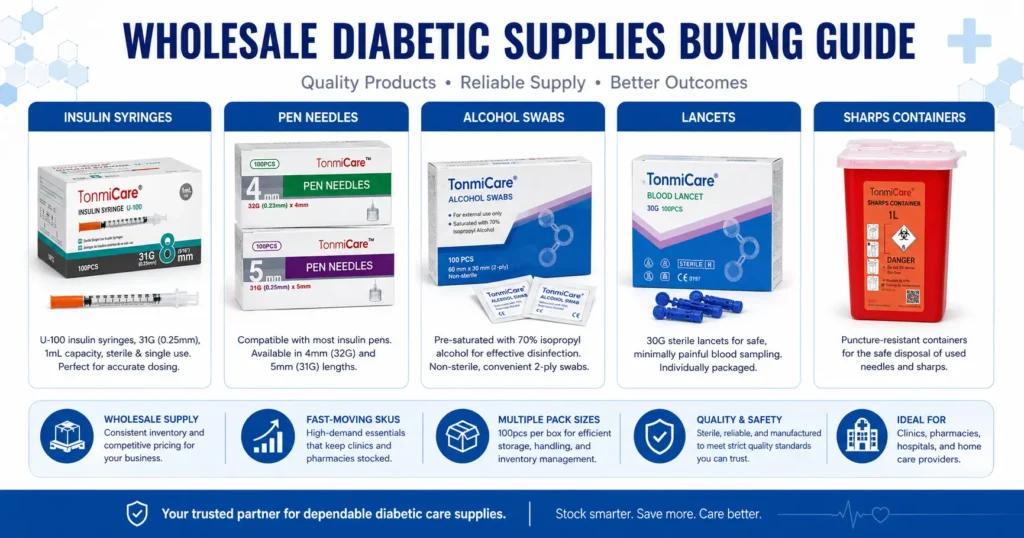
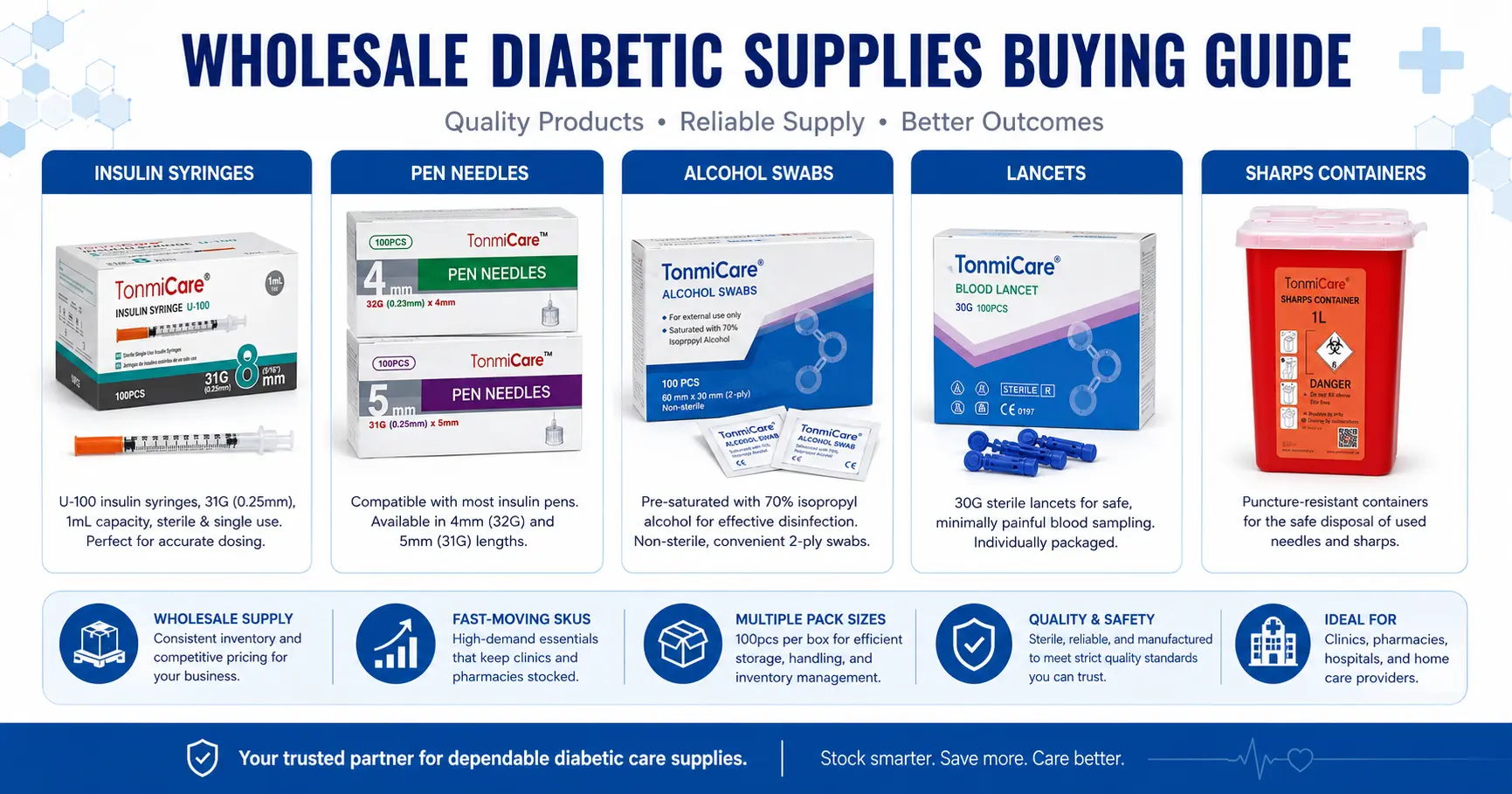
In this guide, wholesale diabetic supplies are finished devices, injection-support consumables, monitoring products and routine-care accessories purchased for resale, dispensing, institutional use or organized supply programs. The category can include insulin syringes, insulin pen needles, blood glucose meters and compatible strips, standard or safety lancets, lancing devices, control solutions, alcohol prep pads, sharps containers and selected diabetes-care accessories.
“Wholesale” describes a commercial purchasing arrangement; it does not establish a product’s regulatory pathway, prescription status, reimbursement eligibility or suitability for a particular patient. Insulin and other medicines are drugs rather than ordinary supply items and are outside this article’s storage and shipping model. CGM sensors, pump products and payer-dependent DME may also require a separate channel, authorization and replenishment workflow.
Syringes & pen needles
Control capacity or gauge × length, dose scale where applicable, sterile barrier and pack.
Meters & test strips
Control intended use, exact compatibility, lot, expiration, storage and refill continuity.
Lancets & devices
Separate standard, proprietary and safety formats; verify the complete sampling workflow.
Prep & disposal
Control pad claims and packaging; verify sharps-container capacity and shipping volume.
Use Tonmit’s current wholesale diabetes care supplies page to define the requested categories before moving into quantity and logistics. Product coverage, availability and documentation remain subject to exact-SKU review.
Approve a finished SKU—not a category label
“Diabetic supplies,” “pen needles” or “test strips” is not a complete purchase description. Record the manufacturer, product name, model or REF, version, specifications, intended market, labeling and pack hierarchy before comparing price.
2. MOQ Explained: Per SKU, Per Case, Per Order and Per Project
Minimum order quantity, or MOQ, is the smallest commercial commitment a supplier will accept under stated conditions. It may be expressed as units, boxes, shipping cases, pallets or order value. Buyers should never assume that a published “low MOQ” applies to every specification, warehouse, packaging format or private-label program.
| MOQ type | What it controls | Question for the supplier | Common source of error |
|---|---|---|---|
| Per-SKU MOQ | Minimum for one exact size, model, color or REF | How many cases of each exact SKU are required? | Adding different sizes together without written permission |
| Case MOQ | Requirement to order a complete sealed shipping case | Can the warehouse break a case, and does that change price or traceability? | Confusing a retail box with a shipping case |
| Order MOQ | Minimum total quantity or value across an order | Can approved SKUs be mixed to reach the order minimum? | Meeting order value while missing a per-SKU minimum |
| Factory MOQ | Minimum production run for a selected configuration | Is the minimum per model, packaging version or production campaign? | Assuming warehouse order minimum equals manufacturing MOQ |
| Private-label MOQ | Artwork, printed materials, packaging and brand-specific production | Which MOQ applies to each box, pouch, case label or language version? | Counting products but ignoring packaging-component minimums |
| Annual commitment | Forecast or contract volume released through multiple orders | Is pricing tied to purchase commitment, forecast or actual release quantity? | Treating a forecast as a guaranteed order without clear terms |
MOQ is a supplier constraint; the buyer’s economic order quantity is an inventory decision. A pharmacy should not buy five cases simply because five is the minimum if expected demand cannot consume them before expiry. Instead, evaluate an alternative SKU, U.S. warehouse release, mixed-SKU arrangement or scheduled order—without reducing necessary quality, documentation or packaging controls.
3. Case Packs: Convert Every Quote to the Same Packaging Hierarchy
Case pack describes how saleable items are grouped for distribution. It is not a universal term: one supplier may call the retail box a “box,” another may call it a “pack,” and a third may quote only the master carton. The purchase order should define both the name and the numerical relationship between every level.
A hypothetical case-pack calculation
Example only—this is not a Tonmit SKU specification:
- 100 units per retail box
- 10 retail boxes per shipping case
- Therefore: 1,000 units per shipping case
- If the MOQ is 5 cases: 5,000 units is the minimum order
A second quote at $8 per “box” cannot be compared until “box” is defined. It may contain 50, 100 or another number of units, and freight may or may not be included.
| Packaging field | Required RFQ data | Why it matters |
|---|---|---|
| Unit quantity | Units per pouch, vial, retail box or kit | Establishes the sellable or dispensable quantity |
| Case configuration | Boxes per case and total units per case | Normalizes case price and replenishment |
| Identifiers | SKU/REF, GTIN and UDI level where applicable | Reduces picking and receiving errors |
| Case dimensions | Length × width × height with measurement unit | Supports freight, storage and pallet calculations |
| Case weight | Net and gross weight | Supports parcel, LTL and handling decisions |
| Pallet pattern | Cases per layer, layers per pallet, total cases and pallet dimensions | Supports warehouse capacity and freight quoting |
| Packaging revision | Artwork/version date and label language | Prevents mixing obsolete and current presentations |
FDA explains that the device identifier portion of a UDI identifies a labeler and a specific device version or model; production identifiers may include lot, serial, expiration or manufacturing date when those data appear on the label.[4] UDI applicability and packaging levels must still be verified for the exact device.
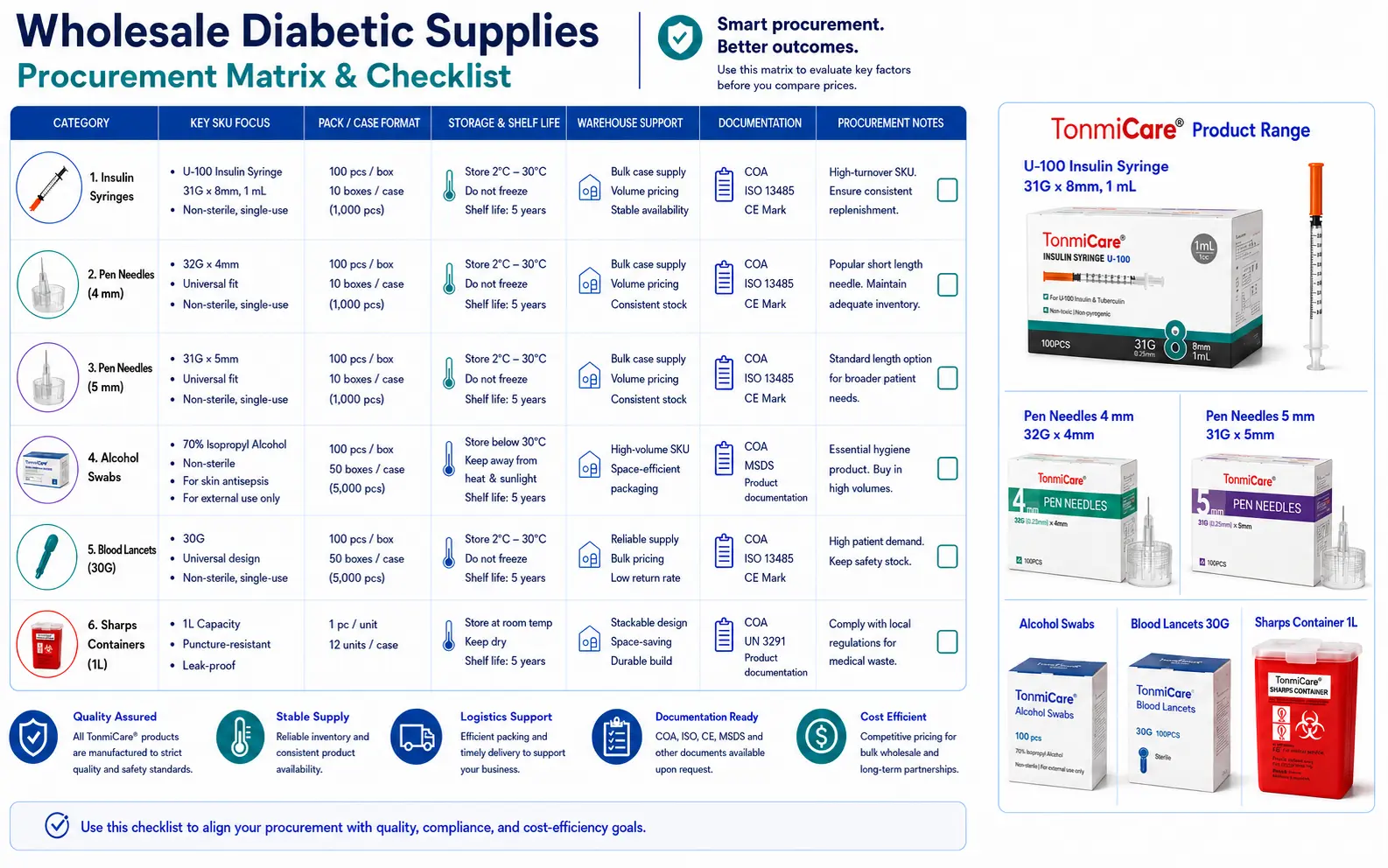
4. Wholesale Buying Matrix by Product Category
Different diabetic supply families create different MOQ, dating and freight risks. The matrix below is a buyer-control framework, not a universal product specification.
| Product family | Lock before price comparison | Shelf-life / storage focus | Case & shipping focus |
|---|---|---|---|
| Insulin syringes | Capacity, concentration scale, graduations, gauge, length, REF and pack | Sterile barrier, lot, expiration and labeled storage | Units/box, boxes/case, crush and puncture protection |
| Insulin pen needles | Gauge × length, standard or safety design, REF, compatibility evidence and pack | Individual sterile barrier, lot, expiration and storage | Box/case multiple, artwork versions and carton integrity |
| Blood glucose test strips | Exact meter compatibility, coding status, vial/pack quantity and U.S. presentation | Printed expiration, any in-use dating, temperature, humidity and container closure | Do not buy opened or pre-owned product; protect from excursions |
| Blood glucose meters | Exact model, intended user/setting, kit contents, compatible strips and warranty | Labeled storage, batteries and service lifecycle | Kit configuration, serial control and refill continuity |
| Lancets | Standard/proprietary/safety type, gauge, depth, compatible device and pack | Sterile barrier, lot and expiration where labeled | High unit count, carton volume and sampling-workflow segregation |
| Control solution | Exact meter-strip system, level, pack and instructions | Expiration, open-container dating and labeled temperature | Small demand can create expiry risk; avoid generic substitution |
| Alcohol prep pads | Intended use, formulation basis, pad size/material, sterility claim, pouch and pack | Expiration, pouch integrity, evaporation and labeled storage | Case weight, leaks, heat exposure and private-label artwork |
| Sharps containers | Capacity, opening, closure, mounting, label and intended setting | Package condition and product-specific dating if present | Dimensional weight, nesting and damage in transit |
Compare product-level information through Tonmit’s current wholesale insulin syringe supply, wholesale insulin pen needle supply, blood glucose monitoring supplies, wholesale alcohol prep pads and diabetes care accessories. The final quote should narrow each category to exact approved SKUs.
For blood glucose monitoring, compatible appearance or a similar product name is not enough. FDA advises using only the test strip recommended for the exact meter because an incompatible strip may fail to produce a result or may produce an inaccurate result.[8]
5. Shelf Life: Define What Is Measured and When
Shelf-life language is commercially useful only when it identifies the product, storage conditions and measurement point. “Long shelf life” is not a measurable purchase requirement. Buyers should distinguish total labeled shelf life from the remaining time expected at quotation, shipment and receipt.
Total labeled shelf life
The period supported for the finished product when stored as labeled.
Remaining life at quote
An inventory snapshot that can change before allocation and shipment.
Remaining life at receipt
A measurable purchasing condition tied to the delivery and acceptance point.
In-use period
Any product-specific period or instruction that applies after first opening.
FDA labeling information explains that in-vitro diagnostic products must provide an expiration date or another means of assuring quality at the time of use, while general medical devices do not all share the same expiration-dating requirement. A diagnostic reagent, sterile barrier, battery or another finite-life component can create a product-specific need for dating.[1] [2]
Do not impose one percentage or month count on every product
There is no universal rule that all supplies must arrive with 75%, 18 months or 24 months remaining. Set a written minimum by exact SKU using demand, total lead time, pack quantity, manufacturer dating, storage conditions and expected turns.
Recommended purchase-order wording
“Unless otherwise approved in writing before shipment, each quoted SKU must have at least [buyer-defined period] remaining shelf life at [shipment or receipt], measured from the labeled expiration date. Supplier must disclose lot and expiration before shipment and may not substitute shorter-dated inventory without written approval.”
First-expire, first-out rotation can reduce avoidable waste, but FEFO does not make short-dated purchasing automatically acceptable. Forecast turnover before accepting a discounted lot, segregate lots in the inventory system and define return or credit rights before purchase.
6. Shipping and Storage: Follow the Exact Product Label
Diabetic supplies do not share one universal shipping temperature. Test strips and control solutions may be sensitive to temperature, humidity or container closure; sterile injection products depend on packaging integrity; sharps containers may be driven primarily by cube and damage prevention. Insulin is a drug and should not be included in a generic medical-consumables shipping rule.
FDA advises users to buy glucose test strips new and unopened and warns that expired, tampered or improperly stored strips may give unreliable results.[3] The purchase specification should therefore preserve original packaging, define the labeled storage range and address excursion investigation rather than assuming that every strip shipment is ordinary uncontrolled freight.
Inventory confirmation
Exact SKU, quantity, lot, expiration and allocation status.
Processing
Credit release, picking, documents and carrier booking.
Production
Required only for factory, custom or replenishment orders.
Transit
International or domestic carrier movement and handoffs.
Clearance
Import review where applicable; responsibility must be defined.
Receiving release
Inspection, discrepancy handling and inventory availability.
Dispatch time is not delivery time
“Ships in two days” usually describes processing before carrier handoff. Record the inventory-ready date, carrier service, estimated transit, customs responsibility, destination, receiving appointment and whether the date is an estimate or commitment.
For imported devices, FDA states that applicable U.S. medical-device requirements apply before, during and after importation; entry information is reviewed through the FDA and CBP process. Foreign manufacturers and initial importers have role-specific obligations, and an incomplete or inaccurate entry can delay release.[6] Buyers should identify who is responsible for import entry, product compliance, duties, brokerage, detention response and final domestic delivery.
7. U.S. Warehouse Stock vs Factory Production
A hybrid supply model can match different order patterns. U.S. inventory may support trial orders, emergency replenishment or shorter domestic delivery paths. Factory production can support larger recurring volumes, additional specifications and private-label packaging. The decision should be made by SKU rather than by supplier location alone.
| Decision factor | U.S. warehouse inventory | Factory production | Buyer control |
|---|---|---|---|
| Availability | Limited to exact SKUs and lots currently allocated | Dependent on materials, production schedule and release | Confirm in writing for the transaction |
| MOQ | May support smaller case-based releases | May require a production or packaging minimum | Request both per-SKU and order minimums |
| Lead time | Domestic processing plus carrier transit | Production, inspection, international transit, clearance and delivery | Compare complete lead time |
| Customization | Usually limited to the finished stock already held | May support approved labeling or packaging changes | Control artwork and regulatory responsibilities |
| Shelf life | Specific to the warehouse lot on hand | Specific to the future production and release date | Define minimum remaining life at receipt |
| Cost | May reduce inbound time and inventory commitment | May reduce unit cost at sufficient scale | Compare landed cost and working capital |
| Risk | Stockout or limited specification choice | Forecast, delay, customs and larger inventory exposure | Use a written replenishment plan |
“In stock USA” must be converted into measurable data
Ask for the exact REF, available quantity, lot, expiration, warehouse processing time, carrier service and destination estimate. A U.S. warehouse address does not prove that every promoted specification is available or reserved for the buyer.
Tonmit’s U.S. medical supply fulfillment support can be reviewed by product, quantity and destination. Final inventory, timing and fulfillment terms must be confirmed for the selected order.
8. Calculate Landed Cost per Sellable Unit
Comparing only the invoice unit price can reward the wrong quote. A larger case may reduce the nominal price but increase expiry and storage risk; a smaller U.S. release may carry a higher price but reduce working capital and response time. Normalize each option to the same sellable unit and include the costs that place acceptable inventory in the buyer’s available stock.
Product
Exact-SKU price, packaging, setup, artwork and testing charges.
Movement
Origin handling, freight, insurance, fuel, accessorial and final-mile charges.
Import
Applicable duties, fees, broker work and transaction-specific clearance costs.
Acceptance
Inspection, quarantine, discrepancy handling, relabeling if lawful and release.
Inventory
Storage, financing, obsolescence, expiration and allocation risk.
Service failure
Back orders, split shipments, emergency freight and incompatible substitutions.
Normalize the quote before choosing a supplier
- Confirm the denominator. Use accepted sellable units, not an undefined “box.”
- Separate included and excluded charges. Record the delivery term and destination.
- Apply an expiry-loss assumption. Base it on demand and dating, not a generic percentage.
- Account for split supply. Add emergency freight or stockout exposure where relevant.
- Compare cash timing. Deposit, balance, credit terms and inventory months affect the decision.
Tonmit buyer worksheet
Wholesale Quote Comparison & Receiving Record
Use one record per exact SKU. Normalize the quote before approval, then carry the same identity, pack, dating and commercial assumptions into receiving so the accepted inventory can be reconciled against the approved purchase basis.
This is a blank procurement-control template, not a live Tonmit inventory report, completed QC record, regulatory determination or delivery guarantee. Values must be confirmed for the exact quoted SKU, lot, destination and transaction.
The full editable record is delivered as a text template so buyers can adapt it to an approved SKU list and internal purchasing workflow.
9. Plan Order Quantity Around Demand, Lead Time and Case Multiples
A purchasing plan should connect forecast demand, complete lead time, safety stock, case multiple and shelf-life limit. Those constraints can point in different directions: a supplier may require more inventory than the buyer can safely consume before expiry.
Round an order to an approved case multiple only after checking the shelf-life ceiling. If the MOQ exceeds realistic demand, document an exception, use a different release model or select another approved product. Do not quietly widen substitution rules or accept shorter dating to make the calculation work.
10. How to Request a Lower MOQ Without Weakening Controls
A buyer can sometimes reduce the first commercial commitment by simplifying the program or sharing a credible replenishment plan. The goal is to reduce manufacturing, packaging or fulfillment complexity—not to remove labeling, sterile-barrier, documentation or traceability requirements.
Use standard packaging
Start with an existing approved box and case instead of a unique print run.
Choose current SKUs
Use specifications already in recurring production or available U.S. inventory.
Mix approved SKUs
Ask whether selected products can share an order minimum; retain per-SKU case rules.
Release a contract
Discuss scheduled releases against a written commitment and forecast.
Start with a trial case
Use available finished inventory for onboarding before committing to customization.
Reduce artwork versions
Consolidate language, box size and brand variants where legally and commercially appropriate.
Do not lower MOQ by accepting an uncontrolled substitute
A different gauge, length, scale, meter compatibility, formulation, package count, label or market presentation is a product change—not merely a quantity adjustment. Require written approval and evidence before substitution.
11. Why Private-Label MOQ Is Usually a Separate Calculation
Private-label projects add packaging components, artwork approval, label responsibility, barcode administration, printing setup and inventory exposure. The finished-product MOQ may differ from the minimum for pouches, retail boxes, instructions, labels and master cartons. Buyers should request a component-level breakdown rather than a single number.
| Private-label element | What can create a minimum | Approval evidence |
|---|---|---|
| Product configuration | Dedicated size, gauge, length, formulation or assembly | Final specification, sample and change record |
| Individual package | Printed pouch, label roll, ink or plate setup | Approved artwork, material and print proof |
| Retail box | Board, finish, language and box-size run | Dieline, barcode, copy and color approval |
| Instructions | Language, fold, revision and print quantity | Controlled master and revision approval |
| Shipping case | Case label, mark, dimensions and pallet pattern | Approved shipping mark and pack specification |
| Regulatory roles | Labeler, specification developer, importer or distributor responsibilities | Role map and applicable product records |
Regulatory records must match the exact product and responsible organizations. FDA specifically states that establishment registration and device listing do not denote approval, clearance or authorization.[5] A private brand should not copy a manufacturer-level registration statement into an unsupported “FDA certified” claim.
12. Supplier and Documentation Review
Supplier qualification should connect three layers: the organization, the exact SKU and the transaction. A company certificate alone does not establish that a different model, label revision or shipment meets the buyer’s requirements.
| Review unit | Evidence to request | Buyer decision |
|---|---|---|
| Legal supplier | Legal name, address, role, contacts, permits or licenses where applicable | Who contracts, invoices and handles complaints? |
| Manufacturer | Legal manufacturer, manufacturing site and quality-system evidence appropriate to the product | Who controls design and production? |
| Exact product | Model/REF, specification, current label/IFU, UDI/GTIN where applicable and product images | Does the evidence match the quote? |
| Regulatory status | Applicable registration, listing, clearance, exemption or other records by product and role | Can the exact marketed product be supported without a blanket claim? |
| Pack and dating | Pack hierarchy, shelf life, storage, lot, expiration and minimum remaining-life commitment | Can the inventory be accepted and consumed safely? |
| Quality and traceability | Release, change, complaint, field-action and recall information | Can a lot be contained and downstream customers notified? |
| Transaction | Quote, purchase confirmation, commercial invoice, packing list and shipping documents | Do price, quantity, destination and responsibilities reconcile? |
Tonmit’s medical product documentation support outlines available specification, packaging, quality, regulatory, traceability and shipping records for qualified procurement reviews. Availability and applicability vary by product, manufacturer, destination market, buyer role and transaction.
13. Receiving Inspection Before Inventory Release
A correct purchase order can still fail at receiving. Inspect the shipment before saleable inventory is released, preserve evidence of discrepancies and separate any questionable product until its disposition is documented.
Match identity
Supplier, manufacturer, SKU/REF, version and approved substitution status.
Count the pack
Cases, boxes, units, shortages and overages against the packing list.
Inspect condition
Seals, sterile barriers, vials, cartons, moisture, punctures, crushing and tampering.
Capture traceability
Lot, expiration, UDI/GTIN where applicable and shipment linkage.
Verify dating
Compare actual remaining shelf life with the purchase requirement.
Release or quarantine
Accept conforming inventory; document and isolate discrepancies.
Receiving record
- Purchase order, supplier invoice and packing list reconcile.
- Exact product and packaging revision match the approved SKU.
- Case, box and unit quantities match the order.
- Lots and expiration dates are readable and captured.
- Remaining shelf life meets the defined acceptance point.
- No evidence of opening, tampering, moisture, crushing or puncture exists.
- Temperature or handling records are reviewed when the product and agreement require them.
- Unauthorized substitutions, short-dated lots and damaged goods remain quarantined.
- Discrepancy notice, return authorization, credit and replacement terms are documented.
14. Procurement, Coverage and Billing Authority Are Different
A product’s availability through a wholesaler does not establish that it is covered for a specific beneficiary or that the purchasing pharmacy may bill Medicare for it. DMEPOS suppliers that seek Medicare reimbursement generally must meet current enrollment, accreditation, supplier-standard and surety-bond requirements, subject to applicable exceptions and CMS guidance.[7]
Use three separate approval checks
Confirm (1) product procurement and exact-SKU evidence, (2) coverage and documentation for the transaction, and (3) the organization’s current billing or dispensing authority. A positive answer in one area does not prove the others.
15. Copyable Wholesale Diabetic Supplies RFQ
The following structure gives suppliers enough information to return comparable quotations. Replace the bracketed fields and attach the approved SKU list.
Wholesale Diabetic Supplies RFQ
Use the downloadable RFQ as the working version; the visible checklist above remains the quick on-page reference.
Buyer FAQ
Frequently Asked Questions About Wholesale Diabetic Supplies
What is the typical MOQ for wholesale diabetic supplies?
There is no universal MOQ. It varies by exact SKU, case configuration, warehouse or factory path, standard or private-label packaging and order program. Request the per-SKU, per-case and total-order minimum separately.
Is MOQ the same as case pack?
No. Case pack is the number and hierarchy of products in a shipping case. MOQ is the minimum commercial commitment. A supplier may require one case, several cases or a total order value.
Can a pharmacy place a trial order before committing to factory MOQ?
A trial order may be possible from current finished inventory. Confirm the exact SKU, case quantity, price, lot, expiration and whether the trial presentation can transition to the planned replenishment product.
Why is private-label MOQ usually higher?
Private label can add minimums for printed pouches, boxes, labels, instructions and manufacturing setup. Request a component-level MOQ and identify which materials may remain unused after the finished-product run.
How much remaining shelf life should a buyer require?
Set a written minimum by exact SKU using forecast demand, total lead time, case quantity and product dating. Define whether the requirement is measured at shipment or receipt; do not apply one month count to every category.
Do all diabetic supplies require temperature-controlled shipping?
No. Follow the exact labeling and purchase specification. Test strips and control solutions can have product-specific temperature and humidity limits, while sterile needles and syringes depend heavily on packaging integrity. Insulin is a drug and follows a separate shipping process.
Does U.S. warehouse stock mean the order can ship immediately?
No. Confirm the exact SKU, available and allocated quantity, lot, expiration, credit release, warehouse processing, carrier service and destination. Warehouse location alone is not an inventory commitment.
Can a supplier substitute a different size or pack when stock is unavailable?
Only with written buyer approval after the replacement is reviewed. A different gauge, length, scale, device compatibility, formulation, count, label or market presentation may create material clinical, regulatory and commercial differences.
What happens if short-dated or damaged inventory arrives?
The purchase agreement should define inspection time, quarantine, notice, return authorization, replacement, credit and freight responsibility. Preserve carton, lot, expiration and damage evidence before disposition.
Does buying diabetic supplies allow a pharmacy to bill Medicare?
No. Product procurement, beneficiary/item coverage and the pharmacy’s DMEPOS enrollment or billing authority are separate questions. Verify current CMS requirements and applicable exceptions.
Does FDA registration prove that a medical device is FDA approved?
No. FDA states that establishment registration and device listing do not denote approval, clearance or authorization. Verify the exact device’s applicable regulatory pathway and current records.
16. Convert Wholesale Claims Into Purchase-Order Controls
The strongest wholesale diabetic supplies quote is not the one with the most product names or the lowest undefined box price. It is the quote that lets a pharmacy or distributor reconcile the exact SKU, pack hierarchy, MOQ, remaining shelf life, storage conditions, complete lead time and landed cost before committing inventory.
Build the program in layers: use current U.S. inventory for verified near-term demand, plan factory replenishment for predictable volume, separate private-label component minimums and enforce written substitution and receiving controls. This creates a more reliable path from quotation to accepted, sellable inventory.
Official Sources & Editorial Basis
- FDA — Quality System Regulation Labeling Requirements. Expiration dating, labeling control and lot identification considerations.
- FDA — In Vitro Diagnostic Device Labeling Requirements. Lot, storage and means of assuring quality at use.
- FDA — How to Safely Use Glucose Meters and Test Strips for Diabetes.
- FDA — UDI Basics.
- FDA — Important Reminders about Registration and Listing.
- FDA — Importing Medical Devices into the United States.
- CMS — Enroll as a DMEPOS Supplier.
- FDA — Use Only the Test Strip Recommended for the Meter.
Evidence boundary: This guide supports buyer-side purchasing controls and does not replace current product labeling, transaction-specific supplier evidence, customs advice, payer rules or local legal requirements.
Source check: The official FDA and CMS URLs cited above were rechecked on October 5, 2026. Product records, program rules, inventory and commercial terms remain transaction-specific and should be revalidated before approval.
Prepared by the Tonmit Medical Supply Editorial Team. Richard Lewis reviewed supplier-evaluation and commercial purchasing logic; Michael Thompson reviewed documentation, packaging, shelf-life and receiving controls; David Anderson reviewed regulatory-source statements and coverage boundaries.
Wholesale diabetes care procurement
Request MOQ, Case-Pack, Shelf-Life and U.S. Inventory Review
Share the exact products, specifications, expected volume, packaging, minimum remaining shelf life, destination and documentation list. Tonmit can review available supply paths and transaction-specific terms; no SKU availability or delivery date is implied until confirmed in the quotation.