
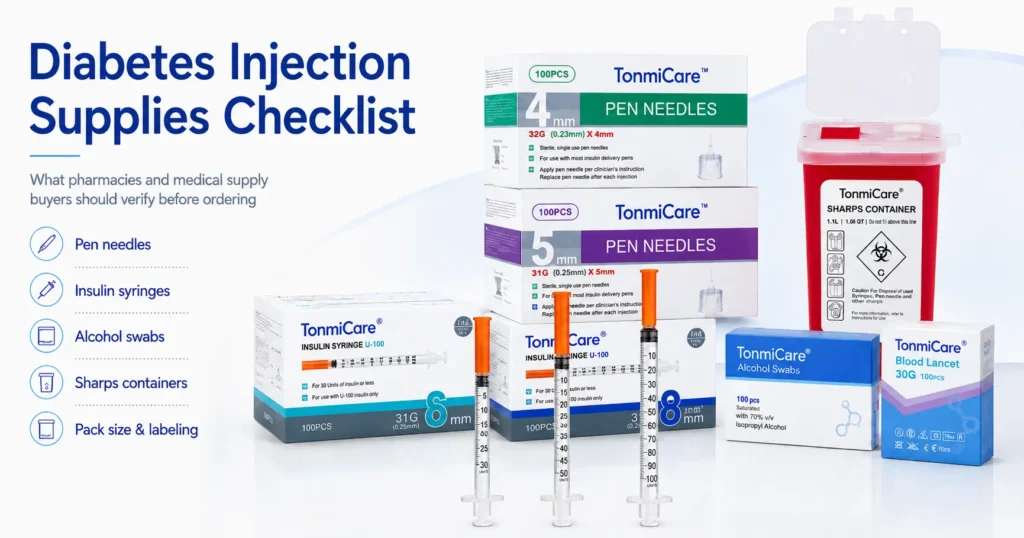
Pharmacy & Clinic Procurement Guide
A delivery-system-based checklist for U.S. pharmacies and clinics sourcing insulin syringes, pen needles, alcohol prep pads, sharps containers and related injection-safety supplies—without treating every diabetes injection as the same workflow.
Scope: This guide supports professional product review, formulary planning and institutional purchasing. It does not select a needle or syringe for an individual, replace a prescription, teach injection technique, or establish a facility’s infection-control, occupational-safety, reimbursement or medical-waste policy. Requirements must be confirmed for the prescribed product, exact SKU, care setting and jurisdiction.
Direct answer
What Belongs on a Diabetes Injection Supplies Checklist?
A reliable checklist begins with the prescribed delivery system. A vial-based insulin order may require an insulin syringe; a compatible insulin pen may require a separate single-use pen needle; an injector with an integrated needle does not automatically require an additional pen needle. The core list is completed by the applicable preparation supplies and an appropriate sharps-disposal pathway.
Pharmacies should control the prescribed or formulary specification, pack quantity, coverage rules and patient handoff. Clinics must add occupational-safety, point-of-use disposal, clean preparation, single-patient assignment and staff-training controls. There is no universal kit that is correct for every diabetes injection.
Step 1
Start With the Delivery System, Not a Universal Kit
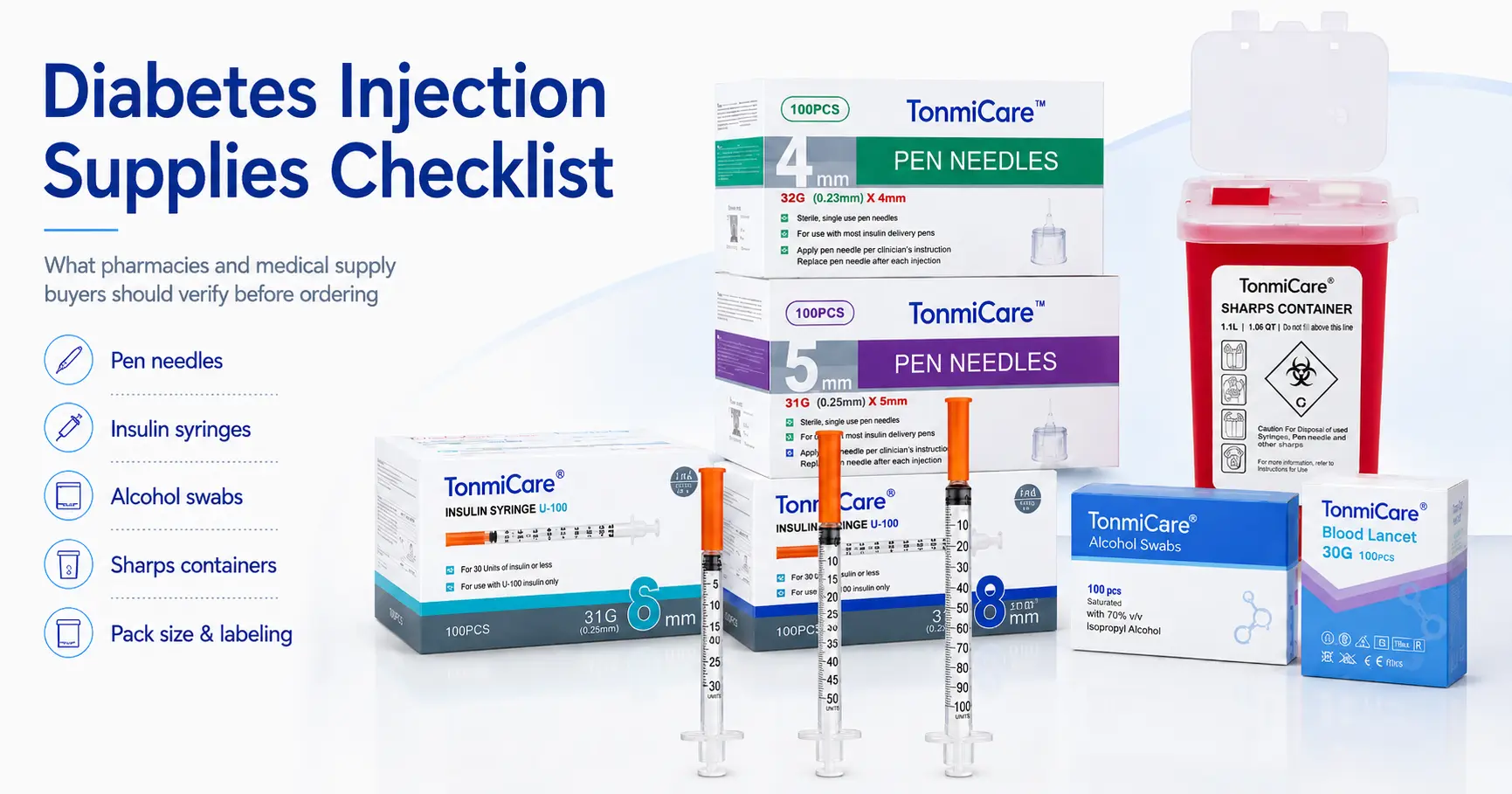
The phrase “diabetes injection supplies” describes several different purchasing pathways. Buyers should determine which pathway applies before selecting needles, syringes or accessories.
| Delivery system | Potential associated supply | Primary purchasing control | Do not assume |
|---|---|---|---|
| Insulin vial | Insulin syringe matching the prescribed specification | Concentration/scale, capacity, needle specification and package identity | That a general-purpose syringe is an acceptable substitute |
| Reusable or prefilled pen requiring an external needle | New compatible pen needle for each injection | Device instructions, connector fit, prescribed specification and pack count | That every pen needle is universally interchangeable |
| Single-dose injector with an integrated needle | Sharps-disposal pathway; no separate needle unless labeling says otherwise | Exact product presentation and instructions for use | That every injectable diabetes therapy needs a separate pen needle |
| Insulin pump or patch-pump workflow | Product-specific infusion or pump supplies | Pump model, benefit pathway and manufacturer requirements | That pump supplies belong in a standard syringe-and-pen-needle list |
Do not choose needle length, gauge, syringe capacity or scale for an individual from a general article. Capture the prescribed or approved formulary specification and verify it against the exact device labeling and supplier documentation.
Step 2
Master Diabetes Injection Supplies Checklist
The following matrix separates core injection items from products that are conditional or managed through another workflow.
| Category | Pharmacy dispensing | Clinic administration | Control point |
|---|---|---|---|
| Insulin syringes | When the prescribed product is supplied in a vial | When vial-based administration is authorized | Match concentration/scale and exact specification; never improvise a conversion |
| Pen needles | When the prescribed pen requires a separate needle | Consider an appropriate safety-engineered design where required by the exposure-control program | Verify compatibility and single-use labeling |
| Alcohol prep pads | As prescribed, covered, requested or included under pharmacy policy | As required by medication preparation procedures and facility policy | Not a replacement for hand hygiene or aseptic practice |
| Sharps containers | Home-use container or documented local disposal pathway | Accessible point-of-use container and regulated-waste process | Home and healthcare-facility requirements are not the same |
| Gloves and hand-hygiene supplies | Not a universal self-injection add-on | Based on Standard Precautions, anticipated exposure and facility policy | Do not create a blanket requirement unsupported by the setting |
| Blood glucose meters, strips and lancets | Related diabetes-care assortment | Separate assisted-monitoring controls apply | Manage as a testing workflow, not an injection consumable |
| Diluents, mixing syringes or reconstitution supplies | Do not add by default | Only for a specific authorized product and approved procedure | Product- and medication-specific; may enter sterile-compounding requirements |
Dispensing workflow
Pharmacy Diabetes Injection Supplies Checklist
A dispensing checklist should catch device mismatches before the order reaches the patient. It should also separate a product’s clinical suitability from benefit coverage and from the pharmacy’s authority to dispense or bill it.
- Confirm the prescribed medication presentation.Vial, cartridge, reusable pen, prefilled pen, integrated injector or pump workflow.
- Determine whether a separate needle or syringe is required.Use the current product labeling and prescription or formulary record.
- Match the exact specification.Review concentration/scale, capacity, needle gauge and length, safety design and connector compatibility as applicable.
- Reconcile quantity with the authorized days’ supply.Base usage on the prescribed schedule; do not infer injection frequency from the drug category.
- Check package hierarchy.Verify units per pouch, box and case rather than relying on an ambiguous “case” description.
- Address safe disposal.Offer an appropriate container or clear local disposal information consistent with pharmacy policy and jurisdiction.
- Separate coverage from product selection.A clinically appropriate item is not automatically covered, billable or in network.
- Document substitutions.Do not switch concentration, scale or device-dependent specifications without the required professional review and authorization.
For broader assortment planning, use the complete diabetes supplies list for pharmacies alongside this injection-specific checklist.
Administration workflow
Clinic Injection-Safety and Supply Checklist
Clinics, physician offices, long-term care settings and other facilities performing or assisting with injections require controls beyond a retail product list. The CDC states that insulin pens, medication cartridges and syringes are for single-patient use; insulin pens must never be used for more than one person. A fresh needle is required for each injection. Review the CDC’s insulin administration recommendations.
Engineering controls
Evaluate safer needle devices and appropriately located sharps containers under the organization’s exposure-control process.
Clean preparation
Maintain unused supplies and medication in a clean area separated from used equipment and potential contamination sources.
Patient assignment
Label pens for one person. Dedicate multidose insulin vials to one person whenever possible.
Point-of-use disposal
Discard used needles and syringes promptly into the approved sharps container without routine recapping, clipping or bending.
Standard Precautions
Provide hand-hygiene supplies and use gloves or other PPE according to anticipated blood or body-fluid exposure and facility policy.
Training and oversight
Maintain staff training, exposure response, observation and supply-use controls appropriate to the facility.
Changing the needle does not make an insulin pen safe for use on another person. Blood may be present in the pen after use. The pen must remain assigned to one patient.
OSHA identifies safer needle devices and proper sharps handling as controls for reducing occupational exposure. Facilities should apply the Bloodborne Pathogens Standard and their documented exposure-control plan—not a consumer home-use checklist. See OSHA’s pharmacy sharps-handling practices.
Product control
Insulin Syringes: What Buyers Must Verify
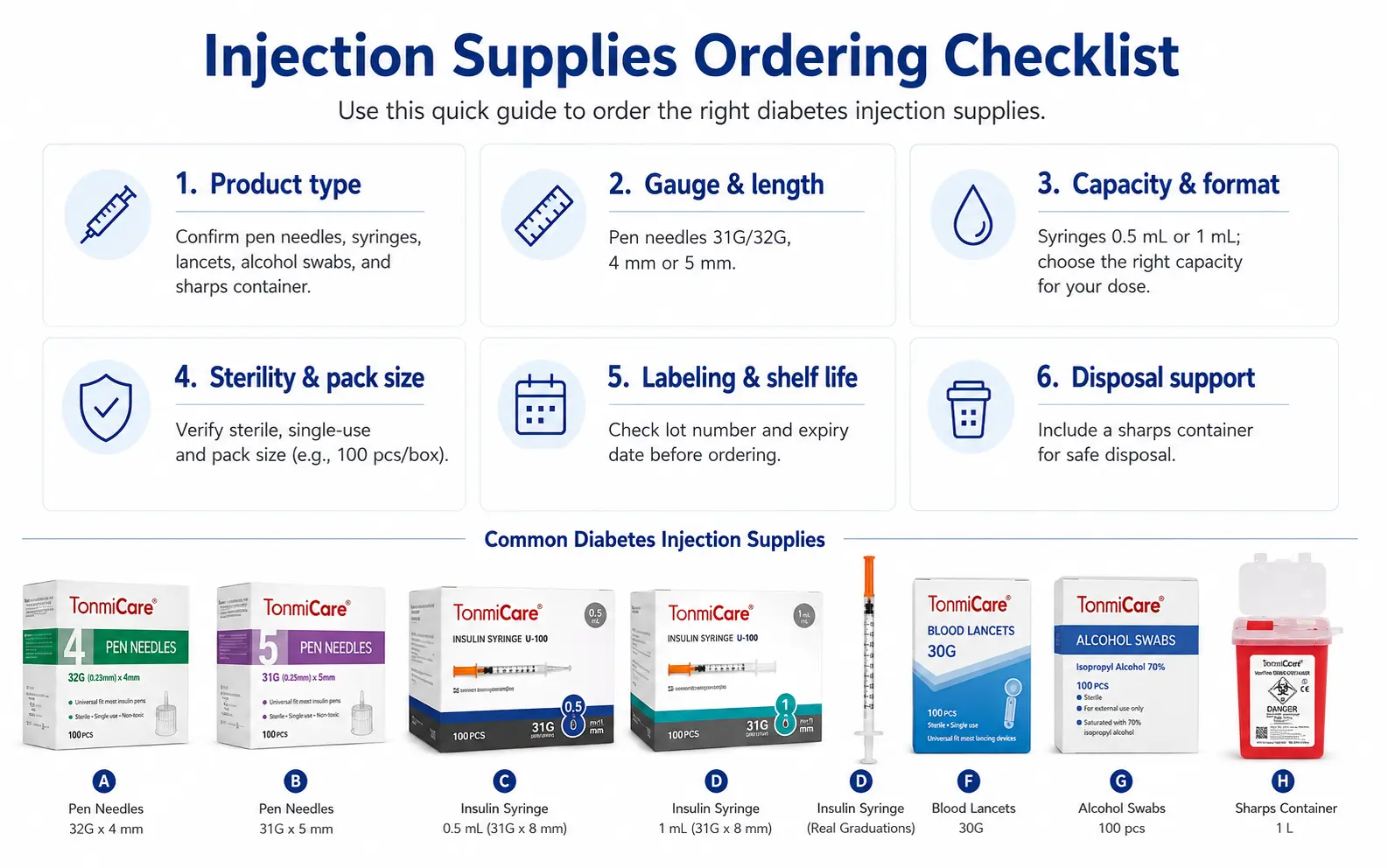
Insulin syringes are not interchangeable solely because they have a similar volume or needle. The procurement record should preserve the prescribed concentration/scale relationship and the exact device specification.
| Field | Why it matters | Evidence to request |
|---|---|---|
| Concentration and scale | A mismatch can create a medication-measurement error | Label, unit markings, product specification and prescription/formulary mapping |
| Capacity | Capacity affects scale layout and order identity | Nominal mL/cc capacity and labeled unit capacity |
| Needle specification | Gauge and length are not buyer-selected patient recommendations | Exact gauge, length, attachment design and approved documentation |
| Safety design | Standard fixed-needle and safety-engineered products are different SKUs | Mechanism description, activation instructions and applicable evidence |
| Sterile barrier and traceability | Supports receiving, storage, complaint and recall control | Packaging configuration, lot, expiry and relevant quality documents |
Tonmit’s wholesale insulin syringes page can be used to review available product families. Final suitability, regulatory status, packaging and supply terms should be confirmed for the quoted SKU and intended U.S. use.
Product control
Insulin Pen Needles: Compatibility, Safety Design and Pack Control
A pen needle order should be tied to a device workflow, not to the phrase “diabetes injection” alone. Some pens require an external needle; other single-dose injectors incorporate the needle into the disposable device.
- Device requirement: confirm that the prescribed pen requires a separate pen needle.
- Compatibility: verify the current device instructions and documented connector fit.
- Gauge and length: capture the prescribed, formulary or clinically approved specification without making a patient-specific recommendation.
- Standard versus safety design: do not represent a conventional pen needle as a passive or active safety needle.
- Use status: verify single-use labeling and ensure quantities support a new needle for each injection.
- Pack hierarchy: record units per box, boxes per case and sellable unit.
Review wholesale insulin pen needles by exact specification, then confirm compatibility and documentation before substitution or bulk ordering.
Preparation supplies
Where Alcohol Prep Pads Fit—and Where They Do Not
Alcohol prep pads may be included in dispensing, medication-preparation or clinic protocols, but the article should not present them as a universal substitute for hand hygiene, aseptic technique or the medication manufacturer’s instructions.
Procurement checks
- Active ingredient and labeled concentration
- Pad dimensions and material
- Individual-pouch seal integrity
- Units per box and boxes per case
- Lot, expiry and storage conditions
- Exact product documentation
Boundary
Do not turn a supply list into clinical technique
Whether and how skin or a vial septum is prepared depends on the medication instructions, care setting and institutional procedure. Procurement content should verify the pad SKU and availability, not prescribe an injection method.
Compare alcohol prep pads for pharmacies and clinics by the exact labeled configuration rather than relying only on “small,” “medium” or “large” marketing descriptions.
Disposal control
Sharps Containers: Separate Home and Healthcare-Facility Requirements
Every injection-supply workflow needs a disposal pathway, but the container, placement and disposal program depend on the setting. FDA consumer guidance and healthcare-facility occupational-safety requirements should not be collapsed into one rule.
| Control | Home or self-administration | Healthcare facility |
|---|---|---|
| Container | An FDA-cleared sharps container is preferred; follow current local guidance | Appropriate regulated-waste sharps container under facility policy |
| Placement | Stable, upright and inaccessible to children and pets | Accessible and as close as feasible to the point of use |
| Fill control | Follow the container’s fill line and instructions | Replace before overfilling and maintain access during use |
| Final disposal | Follow state and local collection or disposal rules | Follow regulated medical-waste, OSHA and jurisdictional requirements |
The FDA advises placing used sharps immediately in an appropriate sharps container and notes that disposal rules vary by location. Read the FDA consumer sharps guidance. Buyers can also review Tonmit’s diabetes care accessories and sharps supplies.
Scope control
Related Items That Should Not Be Added Automatically
Blood glucose testing supplies
Meters, strips, control solutions and lancets support monitoring, not medication injection. In clinics, assisted monitoring also has separate infection-control requirements.
Review blood glucose monitoring supplies →Pump and infusion supplies
Reservoirs, infusion sets and patch-pump components are device-specific and should be managed separately from syringe and pen-needle replenishment.
Diluents and reconstitution supplies
Do not include bacteriostatic water, mixing needles or draw syringes in a general diabetes kit. Use them only when a specific authorized product and approved procedure require them.
Emergency and travel products
Glucose products, glucagon, cooling products and travel cases may be valuable, but they are conditional assortment items rather than universal injection consumables.
Replenishment planning
Estimate Usage Without Guessing Clinical Frequency
Procurement teams can model volume, but the clinical inputs must come from authorized records. Do not use a general blog to decide how often a person should inject or how many units should be administered.
| Tier | Typical profile | Recommended control |
|---|---|---|
| Core stock | Stable recurring demand and repeatable exact SKU | Set reorder point, target coverage and lot-rotation rule |
| Limited stock | Moderate demand or higher assortment complexity | Carry a controlled quantity and review monthly |
| Special order | Device-specific, low-volume or unusual specification | Confirm availability, lead time and return terms before commitment |
| Contingency stock | Critical item with documented supplier or freight risk | Use an approved buffer and alternate-source plan—not uncontrolled overstock |
MOQ, box count, case pack, remaining shelf life and U.S. inventory are transaction-specific. They should be confirmed on the quotation, purchase order and receiving documents rather than published as permanent assumptions.
Supplier qualification
Evidence to Request Before Approving a Supplier or SKU
Supplier approval and product approval are related but different decisions. A buyer should qualify the responsible supplier, exact product, intended market and transaction evidence together.
Supplier identity
- Legal business name and role
- Manufacturer, importer or distributor responsibility
- Complaint and recall contacts
Exact-SKU evidence
- Product specification and label
- Applicable regulatory and quality records
- Sterile barrier, lot and expiry information
Commercial evidence
- Sellable unit, box and case hierarchy
- MOQ, lead time and available inventory
- Shipping, damage, return and substitution terms
Use Tonmit’s medical device documentation support page to structure the evidence request, and review U.S. medical supply fulfillment separately from product qualification. Warehouse availability does not establish device compatibility or regulatory suitability.
Transaction control
Receiving Checklist for Diabetes Injection Supplies
- Match purchase order, packing list and received SKU.Confirm product code, description, gauge, length, capacity and safety design where applicable.
- Verify pack and case quantity.Count sellable units rather than relying only on outer-carton labeling.
- Inspect shipping and sterile-barrier packaging.Quarantine wet, crushed, open, punctured or otherwise questionable cartons and pouches.
- Record lot and expiration.Apply the organization’s traceability and stock-rotation procedure.
- Check substitution status.Do not accept an unapproved change in concentration, scale, needle or safety mechanism.
- Release only after discrepancies are resolved.Maintain evidence for complaints, returns and recall response.
Tonmit buyer worksheet
Injection Supply SKU & Receiving Record
Use one record for each exact syringe, pen-needle or related injection-supply SKU. The goal is to connect the approved requirement, quoted configuration and received product before inventory is released.
A purchase order calls for a 0.5 mL insulin syringe and the received carton lists 1 mL while the gauge and needle length look the same. Treat that as a specification mismatch and hold the item for review; matching needle dimensions do not make the two products the same SKU.
This is a blank procurement and receiving template. It is not a Tonmit laboratory validation report, clinical recommendation, live inventory feed, regulatory determination or completed QC record. Product identity and acceptance criteria must be confirmed against the exact transaction and the buyer’s approved procedure.
View record template
DIABETES INJECTION SUPPLY SKU & RECEIVING RECORD

WORKFLOW
Buyer type / location:
Workflow: PHARMACY DISPENSING / CLINIC ADMINISTRATION / OTHER
Destination:

PRODUCT IDENTITY
Product family:
Legal manufacturer:
Brand / labeler:
REF / SKU:

REQUIRED SPECIFICATION
Insulin concentration / matching scale if applicable:
Capacity if applicable:
Gauge x length if applicable:
Standard / safety design:
Pen or device compatibility if applicable:
Primary sterile presentation:
Units / box:
Boxes / case:

TRANSACTION
Purchase order:
Quoted SKU:
Ordered quantity:
Approved substitution status:
Minimum remaining shelf life:

RECEIVING
Received SKU:
Received quantity:
Lot / batch:
Expiration:
Outer-carton condition:
Primary package / sterile-barrier condition:
Count verified: YES / NO
Unexpected substitution or artwork change: YES / NO
Evidence / photo reference:

DISPOSITION
□ RELEASE
□ HOLD FOR REVIEW
□ RETURN
□ SUPPLIER CLARIFICATION
□ AUTHORIZED ALTERNATE

Decision basis:
Receiver / reviewer:
Date:
Related complaint / return reference:

METHOD LIMIT
This blank template supports purchasing and receiving control. It is not a laboratory validation report, clinical recommendation, regulatory determination, live inventory feed or completed Tonmit QC record.
U.S. coverage boundary
Medicare Coverage Is Not the Same as Product Eligibility
Medicare currently distinguishes insulin used with a Part B-covered durable insulin pump from self-administered insulin supplied through pens or syringes. Medicare states that Part D plans may cover certain supplies used to inject insulin, including syringes, needles, gauze and alcohol swabs. Actual coverage depends on the plan, network, prescription and transaction. Review the current Medicare insulin coverage page.
Coverage language should never imply that every injection supply is automatically reimbursable or that every pharmacy is authorized to bill every benefit pathway.
Inquiry preparation
Diabetes Injection Supply RFQ Template
Send enough detail for the supplier to quote the same product configuration your team intends to approve and receive. Keep syringes, pen needles, preparation items and sharps products on separate lines when their specifications or packaging differ.
View RFQ template
DIABETES INJECTION SUPPLY RFQ

BUYER
Organization:
Buyer type: PHARMACY / CLINIC / LTC / DISTRIBUTOR / OTHER
Destination country:
Destination postal code:

PRODUCT LINE 1
Product family:
Exact REF / SKU if known:
Required capacity / scale if applicable:
Gauge x length if applicable:
Standard / safety design:
Device / pen compatibility if applicable:
Primary sterile presentation:
Units / box:
Boxes / case:
Quantity:
Recurring demand / annual forecast:
Minimum remaining shelf life:
Substitution rule:
Required documents:

ADDITIONAL PRODUCT LINES
Repeat the same fields for each product family or specification.

COMMERCIAL
U.S.-stock review required: YES / NO
Factory / custom program acceptable: YES / NO
Private label / custom packaging: YES / NO
Requested delivery window:
Freight basis requested:
Payment terms requested:
Quote validity requested:

Please disclose every deviation from the requested specification, packaging or supply route before quotation approval.
Buyer FAQ
Diabetes Injection Supplies: Frequently Asked Questions
What supplies are needed for insulin injections?
The answer depends on the prescribed delivery system. A vial may require a matching insulin syringe; a pen may require a compatible single-use pen needle; an integrated-needle injector may not require a separate needle. An appropriate sharps-disposal pathway is also needed, while preparation supplies depend on product instructions and the care setting.
Do all diabetes injection pens require separate pen needles?
No. Some reusable or prefilled pens require an external pen needle, while some single-dose injectors contain an integrated needle. Verify the exact product presentation and current instructions for use.
Can a regular syringe replace an insulin syringe?
Do not treat a general-purpose syringe as an automatic substitute. Insulin syringe selection must preserve the prescribed concentration/scale relationship, capacity and exact specification. Any substitution should pass the pharmacy’s required professional and authorization process.
Are U-40 and U-100 insulin syringes interchangeable?
No blanket interchangeability should be assumed. The syringe scale must match the prescribed insulin concentration and instructions. This procurement guide intentionally does not provide a dosing-conversion chart.
Are all insulin pen needles universally compatible?
Buyers should not rely on a universal-compatibility claim without exact evidence. Check the medication-device instructions, pen-needle documentation and approved formulary or substitution process.
How many pen needles should a pharmacy dispense?
Quantity should reflect the prescribed injection schedule, authorized days’ supply, single-use requirement, benefit rules and package configuration. The supplier should not infer clinical frequency from the product category.
Can an insulin pen be used for more than one clinic patient?
No. CDC guidance states that insulin pens are for single-patient use and must never be shared, even when the needle is changed.
Can a multidose insulin vial be used for multiple patients?
CDC recommends dedicating multidose insulin vials to one person whenever possible. If a vial must be used for more than one person, it should be stored and prepared in a designated clean medication-preparation area outside the immediate patient environment, and every entry requires a new needle and syringe.
Do clinics need safety-engineered needles?
Clinics must evaluate engineering controls under OSHA’s Bloodborne Pathogens Standard and the facility’s exposure-control plan. The appropriate device depends on the procedure, available technology, employee input and documented risk assessment.
Are blood glucose meters and lancets injection supplies?
No. They are related diabetes monitoring products but should be managed through a separate testing workflow. Assisted blood glucose monitoring also requires device-assignment, cleaning and infection-control controls.
Should a general diabetes injection kit include bacteriostatic water?
No. Diluents and reconstitution supplies should not be placed in a universal kit. They are appropriate only when a specific authorized medication presentation and approved procedure require them.
What should a buyer include in an RFQ?
Include the product family, exact specification, standard or safety design, units per box, requested case quantity, target volume, destination, required delivery window, remaining-shelf-life requirement, documentation needs and whether substitutions are permitted.
Source basis
Official Guidance Used for This Checklist
- CDC: Considerations for Blood Glucose Monitoring and Insulin Administration
- CDC: Preventing Unsafe Injection Practices
- OSHA: Pharmacy Sharps Handling Practices
- FDA: Safely Using Sharps at Home, at Work and on Travel
- Medicare: Insulin Coverage
Official links and the statements supported by them were rechecked on October 5, 2026. Product labeling, regulations, coverage and local disposal rules can change; verify current requirements, exact-SKU evidence and transaction terms before a future revision or purchasing decision.
Prepared by the Tonmit Medical Supply Editorial Team. James Wilson reviewed product specifications and exact-SKU controls; Michael Thompson reviewed quality documentation, receiving and traceability controls; David Anderson reviewed regulatory, safety and official-source statements.
Exact-SKU procurement support
Build a Defensible Diabetes Injection Supply List
Send the required syringe or pen-needle specification, packaging target, destination, volume and delivery window. Tonmit can review product availability, documentation and U.S. fulfillment options for the requested transaction.