
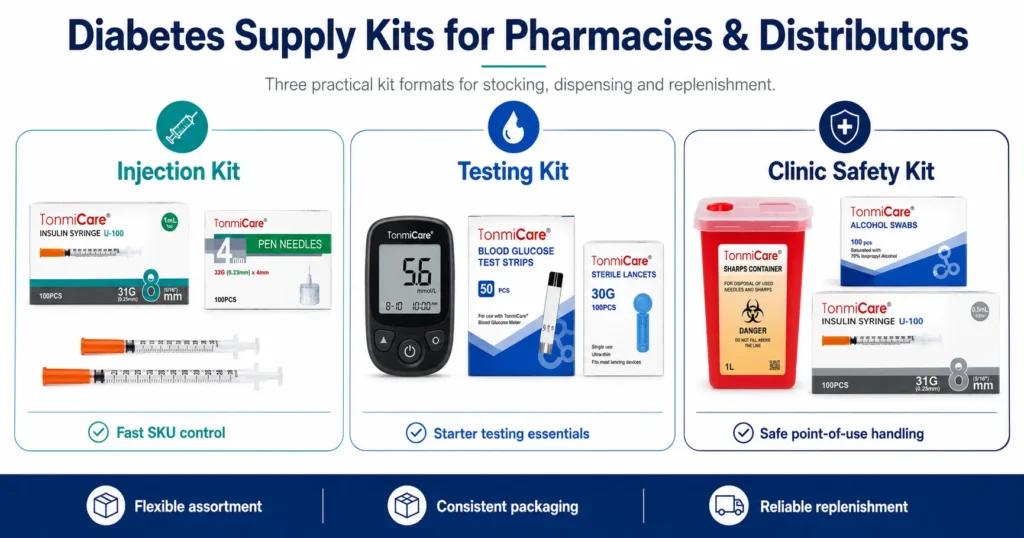
Pharmacy & Distributor Kit Procurement Guide
A kit is easy to quote as one box and harder to replenish when its components run out at different times. This guide helps pharmacy and distributor buyers define the contents, preserve the original product identity, assign packaging responsibility and plan the next order before approving the first.
Scope: This guide supports U.S. B2B procurement of finished diabetes-care devices and consumables. It does not select a product for an individual, replace a prescription, establish a billing decision, provide injection or testing instructions, or determine whether a particular assembly, relabeling or private-label activity is legally permitted. Confirm the exact product, intended use, responsible firm, labeling, quality-system, state-law and payer requirements before implementation.
Direct answer
What Is the Right Way to Build a Diabetes Supply Kit?
Start with one intended workflow and a controlled bill of materials (BOM), not a universal diabetes shopping list. A vial-and-syringe kit, pen-needle kit, personal testing starter kit and clinic-assisted monitoring kit need different components and checks.
Decide whether the order is a pre-packed kit, a virtual bundle of intact manufacturer packages, or an assortment of separately managed SKUs. Then approve component compatibility, quantities, labeling responsibility, lot and expiration mapping, and the refill method. Compare potential contents, then use the BOM record and RFQ template.
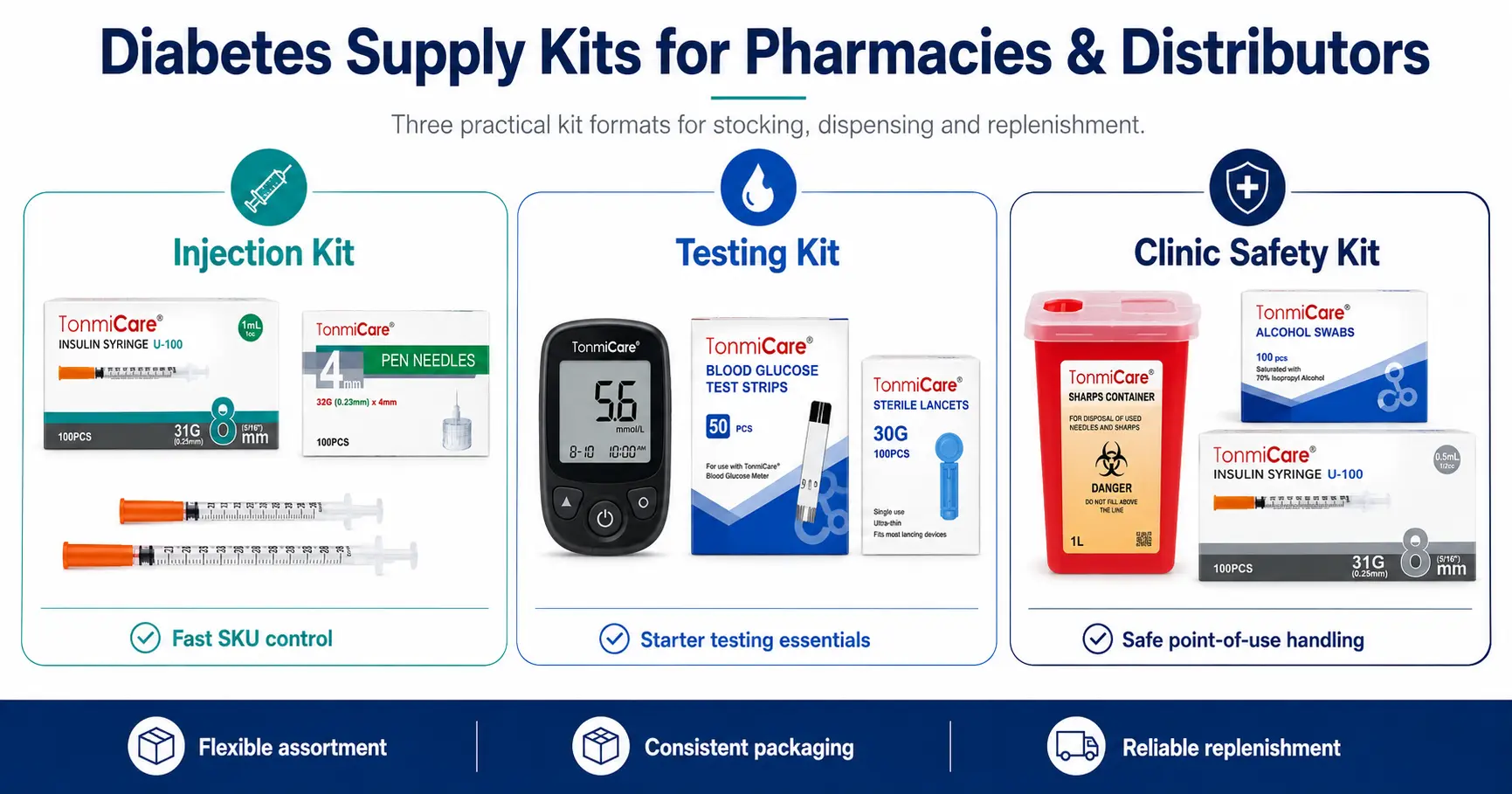
Start with structure
Diabetes Kit, Virtual Bundle and Assortment Are Not the Same
The word “kit” is often used loosely in product listings. Procurement documents should use a more precise structure because the physical handling and commercial unit determine which controls are needed.
| Structure | Physical format | Best use | Primary control |
|---|---|---|---|
| Pre-packed kit | Selected components are placed in a new outer pouch, box or tray | Repeatable dispensing, program or replenishment unit | Assembly, kit labeling, component traceability and release responsibility |
| Virtual bundle | Separate finished manufacturer packages are picked together under an order set | Lower-complexity pilots and variable component demand | Order accuracy, original labels, compatibility and component-level coverage review where applicable |
| Assortment case | Multiple separately sellable SKUs are supplied for pharmacy or distributor stock | Inventory setup, branch rollout or category expansion | SKU-level forecasting, receiving and replenishment; not patient-level suitability |
A marketing “diabetes supply kit” is not automatically an FDA-defined “convenience kit.” FDA’s convenience-kit guidance addresses a specific UDI exception and states that it does not apply to IVD devices subject to 21 CFR Part 809 or to combination products. Blood glucose meters and test strips therefore require separate IVD-labeling review rather than a blanket kit assumption.[2]
Review FDA’s UDI convenience-kit guidanceDecision 1
Choose the Intended Use Before Selecting Kit Contents
The same components can create very different risks when used for pharmacy dispensing, patient self-management, professional assisted monitoring or general inventory. Buyers should document the setting, intended user, delivery or monitoring system and replenishment objective before approving the component list.
Pharmacy dispensing
Match the prescribed or formulary product, authorized quantity, package identity and patient handoff.
Self-testing starter
Keep the meter, strips, lancing system and any control material within one verified product system.
Clinic workflow
Add professional-use, infection-control, employee-safety and point-of-use disposal controls.
Distributor inventory
Treat mixed sizes and product families as independently managed SKUs, not one patient recommendation.
Decision 2
Diabetes Supply Kit Contents Matrix
This matrix identifies potential procurement categories, not a universal patient checklist. Final contents and quantities must follow the exact product presentation, authorized records, care setting and applicable policy.
| Kit type | Potential core contents | Exact controls | Separate or conditional |
|---|---|---|---|
| Vial-and-syringe dispensing kit | Matching insulin syringes; preparation supplies when applicable; disposal information or selected home-use sharps option | Concentration/scale relationship, capacity, needle specification, pack and prescribed quantity | Medication, testing supplies, diluents and reconstitution products |
| Pen-needle dispensing kit | Compatible single-use pen needles; preparation and disposal products when applicable | Confirm that the pen requires an external needle, connector fit, gauge, length, safety design and pack | Integrated-needle injectors, pump supplies and medication |
| Blood glucose starter kit | Meter, exact compatible strips, lancing device, compatible lancets and applicable control solution or control instructions | System compatibility, intended user, strip code/calibration requirements, storage, lot, expiration and refill availability | CGM, ketone testing and prescription-dependent products |
| Clinic-assisted monitoring kit | Appropriate professional-use meter, exact compatible test strips, single-use auto-disabling fingerstick devices, compatible cleaning/disinfection supplies and point-of-use sharps container | Multi-patient labeling, manufacturer disinfection instructions, staff policy and exposure controls | Personal lancing devices and retail meters not labeled for the workflow |
| Distributor assortment | Selected finished boxes of syringes, pen needles, prep pads, monitoring products and care accessories | Each SKU, case pack, lot, expiration, sellable unit, channel and replenishment tier | Patient-specific quantity or compatibility decisions |
Use the complete diabetes supplies list for pharmacies to review broader category coverage, then convert only the approved items into a kit or bundle program.
Injection workflow
Build Injection Kits Around the Delivery System
“Insulin injection kit” does not identify which product is required. A vial, an insulin pen requiring an external needle, an injector with an integrated needle and a pump represent different procurement pathways.
Vial-and-syringe kit controls
- Record the labeled insulin concentration and matching syringe scale.
- Preserve the exact capacity, gauge, needle length and fixed-needle or other approved design.
- Base quantity on authorized usage and days’ supply; do not infer frequency from a drug category.
- Keep each sterile syringe package intact unless a qualified process authorizes another configuration.
Pen-needle kit controls
- Confirm the prescribed product actually requires a separate pen needle.
- Verify compatibility using current device instructions and exact product evidence.
- Distinguish standard and safety-engineered pen needles.
- Calculate pack requirements using the single-use labeling and authorized schedule.
The diabetes injection supplies checklist provides the detailed delivery-system and facility-safety controls that should be completed before a kit BOM is approved.
Monitoring workflow
Keep Meters, Strips, Lancets and Control Materials in One Verified System
A blood glucose starter kit should be designed as a monitoring system. A low-cost meter is not a successful starter kit if compatible refill strips are unavailable, difficult to identify, short-dated or outside the buyer’s expected supply channel.
- Confirm the intended use.Personal self-testing and professional assisted monitoring are not interchangeable settings.
- Lock the meter and strip pair.Record the exact meter model, compatible strip reference and supported lot or calibration process.
- Confirm the sampling system.Match a personal lancing device with compatible lancets. For assisted monitoring, CDC recommends single-use, auto-disabling fingerstick devices.
- Review control instructions.Include only the control solution or quality-control materials specified for the exact meter/strip system, when applicable.
- Create a refill map.List the reorder SKU, sellable pack, lot and expiration controls for strips, lancets and control materials.
Do not bundle a meter with a strip or control solution merely because the products have similar descriptions. Compatibility must be supported by the exact device labeling and manufacturer documentation.
For system-level purchasing controls, review the diabetic testing supplies buying guide.
Professional setting
Clinic Kits Require Controls Beyond a Retail Product List
Clinics, long-term care settings and other organizations assisting with blood glucose monitoring or injections must add infection-control and occupational-safety requirements. CDC states that fingerstick devices should never be used for more than one person. Whenever possible, blood glucose meters should be assigned to one person; if a meter is used for more than one person, it must be designed for professional multi-patient use and cleaned and disinfected after every use according to the manufacturer’s instructions.[3]
Review CDC’s blood glucose monitoring and insulin administration guidance. Facility buyers should also apply their current OSHA Bloodborne Pathogens exposure-control process rather than using a consumer home kit as the facility standard.
Scope control
Products That Should Not Be Added Automatically
Prescription drugs
Insulin, glucagon and other drugs require a separately authorized drug sourcing, storage, dispensing and distribution pathway. Do not treat them as ordinary medical-supply kit components.
Diluents and reconstitution items
Bacteriostatic water, mixing needles and draw syringes do not belong in a universal diabetes kit. Include them only for a specific authorized product and approved procedure.
Device-specific pump or CGM items
Sensors, transmitters, infusion sets, reservoirs and patch-pump components require model-specific and often payer-specific replenishment programs.
Universal emergency or travel claims
Emergency medicines, glucose products, cooling products and travel accessories may be relevant, but their selection and storage instructions are not universal kit rules.
Specification control
Create an Exact-SKU Bill of Materials Before Pricing the Kit
The kit name is not enough to reproduce an order. A controlled bill of materials, or BOM, should connect the commercial kit SKU to every approved component and packaging element.
| Field | What to record | Why it matters |
|---|---|---|
| Kit identity | Kit name, SKU/REF, version and intended channel | Prevents an old configuration from being reordered under the same description |
| Component identity | Manufacturer, product name, exact SKU/REF and approved substitute status | Protects compatibility and complaint traceability |
| Specification | Size, capacity, gauge, length, safety design, intended use or system compatibility as applicable | Prevents category-level substitution |
| Quantity and pack | Units per kit and original component package configuration | Separates clinical quantity from supplier box or case count |
| Traceability | Component lot/batch, expiration and kit assembly or release record | Supports receiving, complaints and recall response |
| Labeling and IFU | Approved label, insert, instructions and artwork version | Controls claims, symbols, warnings and reorder information |
| Replenishment | Whole-kit SKU, component refill SKU, lead time and reorder method | Prevents a starter kit from becoming a supply dead end |
Use a structured exact-SKU documentation review to connect the label, specifications, packaging details and transaction records to the quoted product.
Tonmit buyer worksheet
Kit BOM, Receiving & Refill Record
Use the same record to approve the component list, map delivered lots to kits, and identify the correct refill SKU. Blank worksheet; it does not represent a completed inspection.
Open the template below to select and copy it manually.
View template
DIABETES SUPPLY KIT - BOM, RECEIPT & REFILL RECORD

Blank buyer worksheet. Repeat the component block for each exact REF and lot.
Do not enter patient identifiers, clinical readings or individual dosing schedules.

KIT / ORDER IDENTITY
Buyer / department:
Program and intended use setting:
Structure: PRE-PACKED KIT / VIRTUAL BUNDLE / ASSORTMENT
Approved kit name and SKU:
BOM version / approval reference:
Purchase order / receipt number:
Target market / destination:
Planned quantity of complete kits:
Assembly / packing site, if applicable:
Responsible labeler / packer and release authority:

COMPONENT BLOCK - REPEAT FOR EACH REF AND LOT
BOM line number:
Component name / category:
Manufacturer / labeler:
Exact REF / SKU / applicable package identifier:
Approved specification / compatibility evidence:
Original pack size and unit of measure:
Packs per kit:
Units per pack:
Units per kit (packs x units per pack):
Quantity ordered / delivered / accepted:
Kit or receipt batches containing this component lot:
Delivered component lot / batch:
Labeled expiration, if any:
Opening / in-use limit and source instructions, if applicable:
Storage conditions and evidence source:
Original package intact: YES / NO / REVIEW REQUIRED
Label / IFU / artwork revision checked:
Substitution status and written authorization reference:
Discrepancy / quarantine quantity / resolution:

KIT RELEASE & TRACEABILITY
Complete-kit count verified:
Kit assembly / pick record:
Component-lot-to-kit / shipment mapping:
Dating rule and supporting document reference:
Earliest relevant dated-component limit (not automatic kit validation):
Agreed minimum remaining shelf life and measurement point:
Storage requirements compatible for the complete configuration:
Missing components / unresolved deviations:
Disposition: RELEASE / HOLD / RETURN / REWORK REVIEW
Authorized reviewer / date / evidence reference:

REFILL & RECALL MAP
Whole-kit reorder SKU:
Durable items not routinely refilled:
Component refill REF and sellable pack:
Approved modules / version restrictions:
Refill demand reference and lead time:
Backup source and change-approval rule:
Complaint / recall contact:
Affected kit / shipment lookup method:

METHOD & LIMITS
Match approved BOM and labeling to the delivered component and package records.
Do not open a sterile barrier merely to complete this worksheet.
This is not a completed Tonmit QC record, validation report, clinical protocol,
regulatory determination, billing instruction or authorization to assemble a kit.
Actual product instructions, qualified procedures and contract terms control.
Method & limits: Match approved records to actual package identification without opening sterile barriers. This worksheet records a buyer’s checks; it does not validate sterility, compatibility, kit dating, regulatory status or reimbursement.
Packaging control
Review Every Level of the Kit Packaging Hierarchy
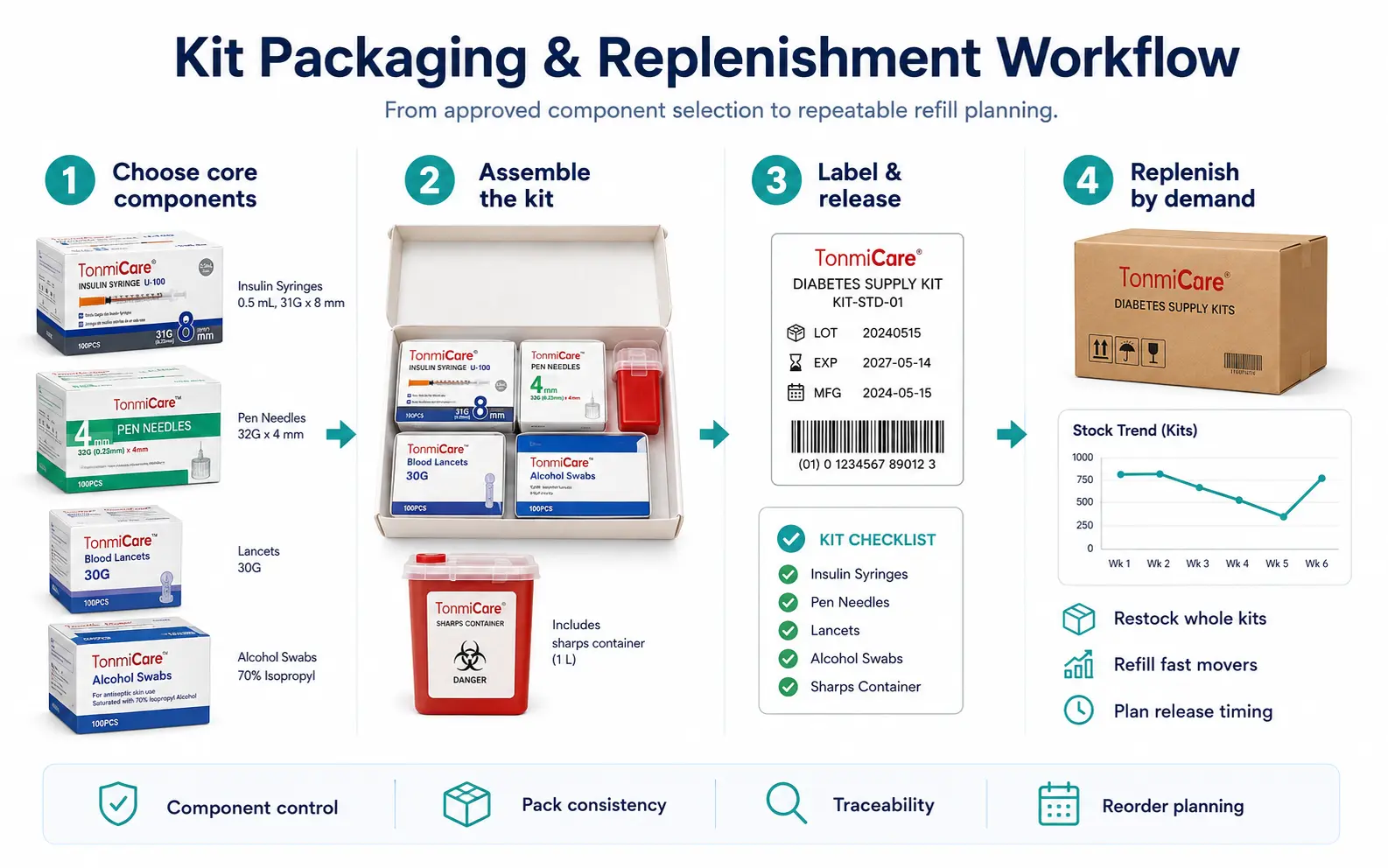
Packaging decisions affect more than appearance. They determine product protection, unit identification, warehouse handling, barcode structure, traceability, freight efficiency and which firm is responsible for the finished presentation.
Changing a sterile barrier’s material, seal, dimensions or labeling can affect package integrity, sterilization compatibility, transport performance and shelf-life support. Retaining the existing individual package and customizing an eligible outer box is often the lower-complexity route, but it still requires product- and market-specific review.
Review available custom medical kit packaging and labeling only after the exact product configuration and responsible parties have been identified.
The illustrations show example categories and packaging concepts, not an approved kit BOM. Sample dates, identifiers and charts in the artwork are not Tonmit batch records, validation data or a published stock report.
Responsibility control
Physical Assembly, Relabeling and Private Label Require Review
Putting finished products into a new commercial package may appear operationally simple, but responsibility depends on what is changed, which claims are made, who is named on the label, where assembly occurs and how the finished unit is released. FDA regulates firms that manufacture, repackage, relabel and import medical devices, and it identifies repackagers and relabelers among establishments required to list devices.[1]
Are original finished packages left intact? Record whether any unit, sterile barrier, label or instruction is opened, covered or replaced.
Who is the responsible labeler or packer? Identify the legal roles rather than relying on a sales description such as “custom kit.”
Does the outer package introduce new claims? Every claim, symbol, compatibility statement and instruction must correspond to the exact components and available evidence.
How is the kit released? Define BOM verification, artwork version, quantity check, traceability record, discrepancy handling and approval authority.
Which requirements apply in the destination market? Federal device rules do not replace state pharmacy, facility, payer, contract or waste-management obligations.
Review FDA’s current overview of medical device regulation. The FDA page also notes that the Quality Management System Regulation became effective February 2, 2026 and covers controls used for finished-device manufacturing, packaging, labeling and storage.
Traceability control
Control Lot, Expiration and Recall Mapping at Component Level
Different kit components can have different production dates, expiration dates and storage conditions. The responsible firm should define and support the finished kit’s dating rule through its labeling and quality process. As a procurement control, the kit should not be represented as usable beyond the supported period of any dated component, and the kit record should preserve the original component lot and expiration information.
| Control | Procurement requirement | Release or receiving evidence |
|---|---|---|
| Remaining shelf life | Define the minimum at shipment or receipt and state the measurement point | Component expiration records and received-lot review |
| Storage | Confirm storage conditions that satisfy every included component label; separate components if their requirements conflict | Labels, shipping plan and warehouse records |
| FEFO rotation | Rotate complete kits and separately stocked refill components by expiration | Inventory-system and physical location checks |
| Recall mapping | Identify every released kit containing an affected component lot | Kit assembly or pick record linked to component lots |
| Complaint handling | Route complaints to the responsible supplier and preserve product identity | Kit SKU, component SKU, lot, photos and transaction record |
Supply continuity
Choose Whole-Kit, Component or Modular Replenishment
A starter kit and a recurring refill are not necessarily the same SKU. Meters, lancing devices or cases may remain in use while strips, lancets, needles and preparation supplies are consumed at different rates. Replenishing the complete starter kit every cycle can create waste; replenishing only components without a controlled compatibility map can create errors.
| Model | Best fit | Advantage | Control needed |
|---|---|---|---|
| Whole-kit refill | Stable, repeatable contents consumed at similar rates | Simple ordering and picking | One component shortage can block the complete kit |
| Component refill | Durable starter items plus recurring consumables | Lower waste and better demand alignment | Exact refill map and compatibility lock |
| Core kit + modules | Standard program with controlled variations | Balances standardization and flexibility | Approved module combinations and version control |
These are inventory formulas, not treatment instructions. Injection, testing and replacement frequency must come from the applicable prescription, device labeling, payer authorization, care plan or institutional record—not from a general procurement article.
Illustrative inventory check
100 Kits Ordered Does Not Mean 100 Kits Can Ship
Suppose an approved BOM requires one intact pack of Component A and two intact packs of Component B per kit. There are 100 acceptable A packs but only 160 acceptable B packs allocated to this order.
Do not count the remaining 20 kits as complete or replace B with a similar-looking item. Obtain the missing approved packs or agree a documented delivery change. Confirm dating, storage, release status and all other BOM lines before shipment.
Hypothetical pack-count example, not a real stock report or a recommended clinical quantity. All quantities use the same intact-pack unit of measure.
Shortage control
Create a No-Substitution Matrix Before a Backorder Occurs
A supplier shortage should not turn the warehouse into the compatibility decision-maker. Each BOM line should state whether substitution is prohibited, conditionally permitted or allowed after an identified professional, quality or buyer approval.
| Relationship | Default control | Evidence before change |
|---|---|---|
| Meter ↔ test strip ↔ control solution | No cross-system substitution | Current manufacturer labeling and approved system mapping |
| Insulin concentration ↔ syringe scale | No warehouse substitution | Prescription/formulary authorization and exact device evidence |
| Pen ↔ external pen needle | Compatibility review required | Pen and needle instructions plus approved specification |
| Standard ↔ safety-engineered device | Not automatically equivalent | Facility risk assessment, exposure-control plan and product documentation |
| Original ↔ short-dated component | Buyer approval required | Remaining shelf life, demand coverage and transaction terms |
Fulfillment planning
Use U.S. Warehouse and Factory Programs for Different Kit Needs
U.S. inventory can support faster replenishment and lower top-up quantities when the exact finished SKU is already stocked. Factory production is usually better suited to planned volume, custom packaging, private-label artwork or a controlled new kit configuration. Neither model is automatically better, and warehouse location does not establish regulatory suitability or compatibility.
| Requirement | U.S. warehouse-supported option | Factory or custom program |
|---|---|---|
| Best use | Approved stock SKU, pilot, replenishment or urgent top-up | Forecasted volume, private label or new pack structure |
| Configuration | Limited to confirmed available inventory and pack | Subject to technical, regulatory, MOQ and artwork feasibility |
| Lead time | Warehouse handling plus domestic transit | Product readiness, packaging production, assembly, release and freight |
| Inventory risk | Stock may sell out or have transaction-specific dating | Larger commitment and forecast risk |
| Buyer action | Confirm SKU, lot, expiration, case count and allocation | Approve BOM, artwork, samples, release criteria and replenishment plan |
Review U.S. medical supply fulfillment separately from product and kit qualification. For broader commercial variables, use the wholesale diabetic supplies buying guide.
Transaction release
Receiving Checklist for Diabetes Supply Kits
- Match the purchase order to the kit SKU and BOM version.Do not receive against only a general kit name.
- Verify every component and quantity.Confirm manufacturer, REF/SKU, specification and units per kit.
- Inspect packaging at every applicable level.Quarantine open, wet, crushed, punctured, improperly sealed or questionable packages.
- Record kit and component traceability.Capture lot/batch and expiration information required by the organization’s procedure.
- Check artwork and label version.Confirm the approved contents, responsible-firm information, barcode and instructions.
- Review remaining shelf life.Apply the agreed measurement point and buyer acceptance threshold.
- Identify substitutions or shortages.Do not release an unapproved alternative or incomplete kit.
- Release only after discrepancies are resolved.Preserve evidence for returns, complaints and recall response.
Record receipt findings against the same BOM and receiving worksheet rather than creating an unlinked checklist for each delivery.
Coverage boundary
A Commercial Kit Is Not One Universal Medicare Benefit Unit
Medicare currently treats diabetes products through different benefit pathways. Medicare states that Part B covers certain blood glucose test strips and lancets as DME supplies when applicable requirements are met. It also states that Part D plans may cover certain supplies used to inject insulin, such as syringes, needles, gauze and alcohol swabs. Coverage still depends on the product, prescription, supplier, plan, network and transaction.[5][6][7]
Do not advertise a multi-component diabetes kit as automatically covered, billable or reimbursed as one item. Separate the commercial convenience of the kit from the benefit, prescription and supplier requirements for each component.
Inquiry preparation
Diabetes Supply Kit RFQ Checklist
A useful RFQ should allow the supplier to quote the same product and packaging structure the buyer intends to receive.
For a new program, compare a virtual bundle or standard finished-kit pilot with the fully customized option. This establishes real demand, component consumption and replenishment behavior before committing to complex artwork and packaging inventory.
Tonmit buyer worksheet
Kit Specification & Supply RFQ
Send the same component, packaging and refill requirements to each supplier. List pack counts separately from quantities prescribed or approved for use.
Open the template below to select and copy it manually.
View template
DIABETES SUPPLY KIT - PRODUCT, PACKAGING & REFILL RFQ

Subject: Diabetes supply kit review for a pharmacy / distributor program
No patient identifiers, medical records or individual dosing information.

BUYER & WORKFLOW
Company / buyer type:
Destination country and ZIP / postal code:
Intended use: DISPENSING / PERSONAL SELF-TESTING / ASSISTED MONITORING /
             DISTRIBUTOR INVENTORY / OTHER APPROVED WORKFLOW
Kit structure: PRE-PACKED / VIRTUAL BUNDLE / ASSORTMENT
Initial project quantity and recurring forecast:
Required delivery date:

EXACT BOM - ATTACH ONE CONTROLLED LINE PER COMPONENT
Kit SKU / proposed name and BOM revision:
Manufacturer, exact component REF and approved specification:
Compatible pen / meter / strip / sampling system, where applicable:
Original package presentation:
Packs per kit, units per pack and units per kit:
Mandatory components and conditional / excluded items:
Substitution restrictions and approval authority:

PACKAGING & RESPONSIBILITY
Original unit / sterile packages to remain intact:
Kit outer pack, inner carton, master carton and pallet requirements:
Assembler / packer, labeler and release responsibilities:
Artwork, barcode / UDI where applicable, IFU and language needs:
Sample / packaging review and evidence required:

SUPPLY & QUALITY
Whole-kit, component or modular refill plan:
Refill SKU / pack for each consumable:
Confirmed stock or production route:
Lot and expiration record requirements:
Minimum remaining shelf life at SHIPMENT / RECEIPT:
Component storage conditions and compatibility review:
Required specification / labeling / quality / market documents:
Shortage, damaged pack, complaint and recall process:

COMMERCIAL
MOQ by component, kit, printed pack and order release:
Price basis per component / kit / case:
Freight, delivery term and quotation validity:
Setup / artwork costs and payment terms:
Declared deviations from the requested BOM:
No unapproved component or packaging substitution.

A request is not an approved kit specification or proof of reimbursement.
Confirm commercial feasibility and the applicable product and regulatory review.
Buyer FAQ
Diabetes Supply Kits: Frequently Asked Questions
What should be included in a diabetes supply kit?
Contents depend on the defined workflow. A vial-and-syringe kit may include the exact matching syringe and applicable preparation or disposal support. A pen-needle kit requires a compatible external needle only when the pen is designed to use one. A blood glucose starter kit should keep the meter, compatible strips, lancing system and applicable control materials within one verified system.
What is the difference between a starter kit and a refill kit?
A starter kit may contain durable or reusable items such as a meter, lancing device or case. A refill kit usually focuses on recurring consumables such as compatible strips, lancets, syringes or pen needles. The two should have separate SKUs when their contents and replenishment cycles differ.
Can a pharmacy or distributor pre-pack diabetes supplies?
The answer depends on the products, actions, responsible firms, labels, claims, state requirements and intended market. FDA regulates medical-device repackagers and relabelers, so a buyer should obtain regulatory and quality review before opening packages, assembling a new commercial unit, changing labels or launching a private-label kit.
Does every diabetes kit need a sharps container?
Every sharps-use workflow needs an appropriate disposal pathway, but a container does not have to be packed inside every commercial kit. A fingerstick testing kit also produces used lancets that need sharps disposal. Choose the container and collection arrangement for the care setting, applicable rules and product instructions; do not assume a compact home container is suitable for a facility.[3][4]
Can one kit include multiple insulin syringe sizes?
A distributor assortment can include multiple separately managed syringe SKUs. A patient-dispensing kit should not present different capacities, scales or needle specifications as interchangeable choices. The exact prescribed or approved specification must remain controlled.
Can different meter and test-strip brands be bundled?
Do not assume cross-brand or cross-model compatibility. The meter, strips and any control solution should be matched using current manufacturer labeling and exact product documentation.
How should kit expiration be assigned?
The responsible firm must define and support the finished kit’s dating rule. Procurement records should preserve each dated component’s lot and expiration, prevent the kit from being represented beyond supported component dating, and apply the agreed remaining-shelf-life requirement at shipment or receipt.
Does the outer kit need a UDI?
The answer depends on the components, packaging level, labeler and applicable exceptions. FDA’s convenience-kit guidance addresses a UDI exception for devices inside a qualifying kit when the kit label bears a UDI. The guidance does not apply to IVD devices subject to Part 809 or combination products, and is not a blanket exemption from other device requirements. Obtain an exact-configuration review.[2]
Should replenishment be by complete kit or components?
Use complete-kit replenishment when approved contents are consumed at a predictable common rate. Use component refills when durable starter items and recurring consumables have different cycles. A core kit with controlled optional modules can support standardization while accommodating approved variations.
What should a buyer include in a kit RFQ?
Include the buyer type, destination, kit structure, intended use, exact component BOM, quantities, packaging hierarchy, labeling and barcode needs, initial order, annual forecast, case pack, remaining-shelf-life requirement, documentation needs, delivery window and substitution policy.
Build the Kit Around a Controlled Replenishment System
A useful diabetes supply kit is not the longest possible contents list. It is a controlled commercial unit built for one defined workflow, using compatible exact-SKU components, documented packaging and labeling responsibilities, component-level lot and expiration traceability, and a replenishment method that can be repeated without improvisation.
Keep durable starter items separate from recurring consumables when their replacement cycles differ. Use whole-kit refills only when the approved components are consumed together, and require written review before substituting device-dependent items during a shortage.
Official Sources & Editorial Basis
- U.S. Food and Drug Administration. Overview of Device Regulation.
- U.S. Food and Drug Administration. Unique Device Identification—Convenience Kits.
- Centers for Disease Control and Prevention. Considerations for Blood Glucose Monitoring and Insulin Administration.
- Occupational Safety and Health Administration. Pharmacy Sharps Handling Practices.
- Medicare.gov. Blood Sugar Test Strips.
- Medicare.gov. Lancets and Lancet Holders.
- Medicare.gov. Insulin and Related Supplies.
Editorial review: James Wilson reviewed product specifications, compatibility boundaries and component-control logic; Michael Thompson reviewed documentation, packaging, lot/expiry and traceability controls; David Anderson reviewed regulatory-role statements and the official-source basis. The article records human review on August 21, 2026.
Evidence boundary: The seven linked FDA, CDC, OSHA and Medicare pages were rechecked on October 5, 2026 for the statements retained here. Worksheets are blank tools and the pack-count example is hypothetical. These sources do not establish approval of a Tonmit kit, supplier capability or coverage of an individual order. Verify current product labeling and transaction-specific requirements before implementation.
Wholesale & procurement support
Build a Replenishable Diabetes Supply Kit
Share the intended workflow, exact components, pack quantities, destination, annual demand, packaging level and documentation requirements. Tonmit can review available product categories, packaging feasibility, U.S. fulfillment options and project-specific commercial terms.