
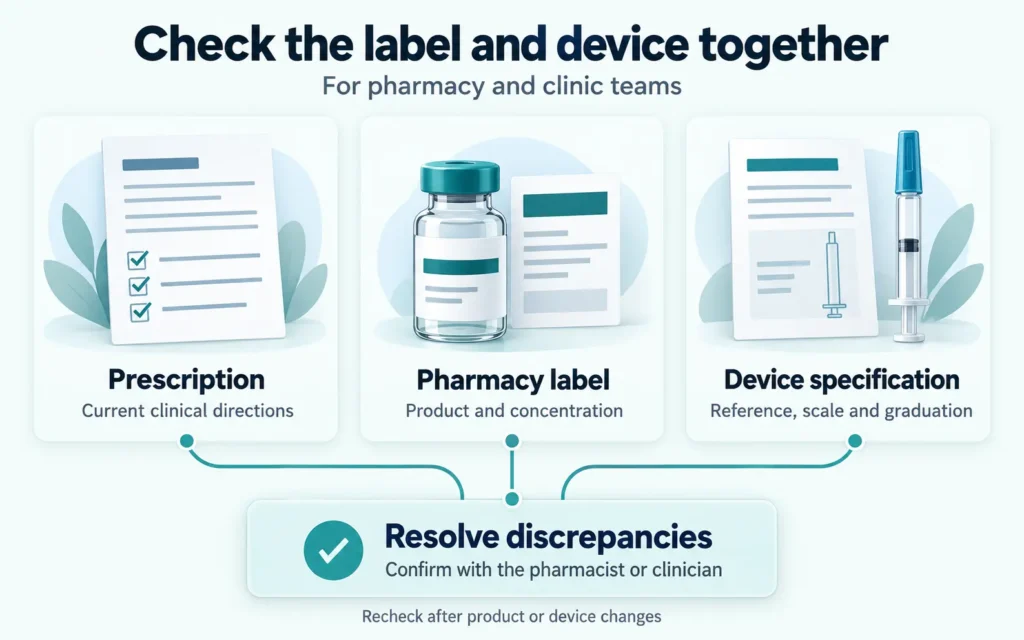
Pharmacy communication · Device specification · GLP-1 ancillary supplies
Semaglutide mg vs mL vs “units”: understand what each measurement describes, why a syringe marking cannot identify a drug dose, and how pharmacy, clinic and procurement teams can reconcile labels with the actual device.
Scope: This article explains measurement and communication errors. Individual dosing, titration, prescribing and device selection require the current prescription, the exact product label and a qualified healthcare professional. The worksheets support review and purchasing; they are not administration instructions.
Direct answer
Why Are Semaglutide mg, mL and “Units” Easy to Confuse?
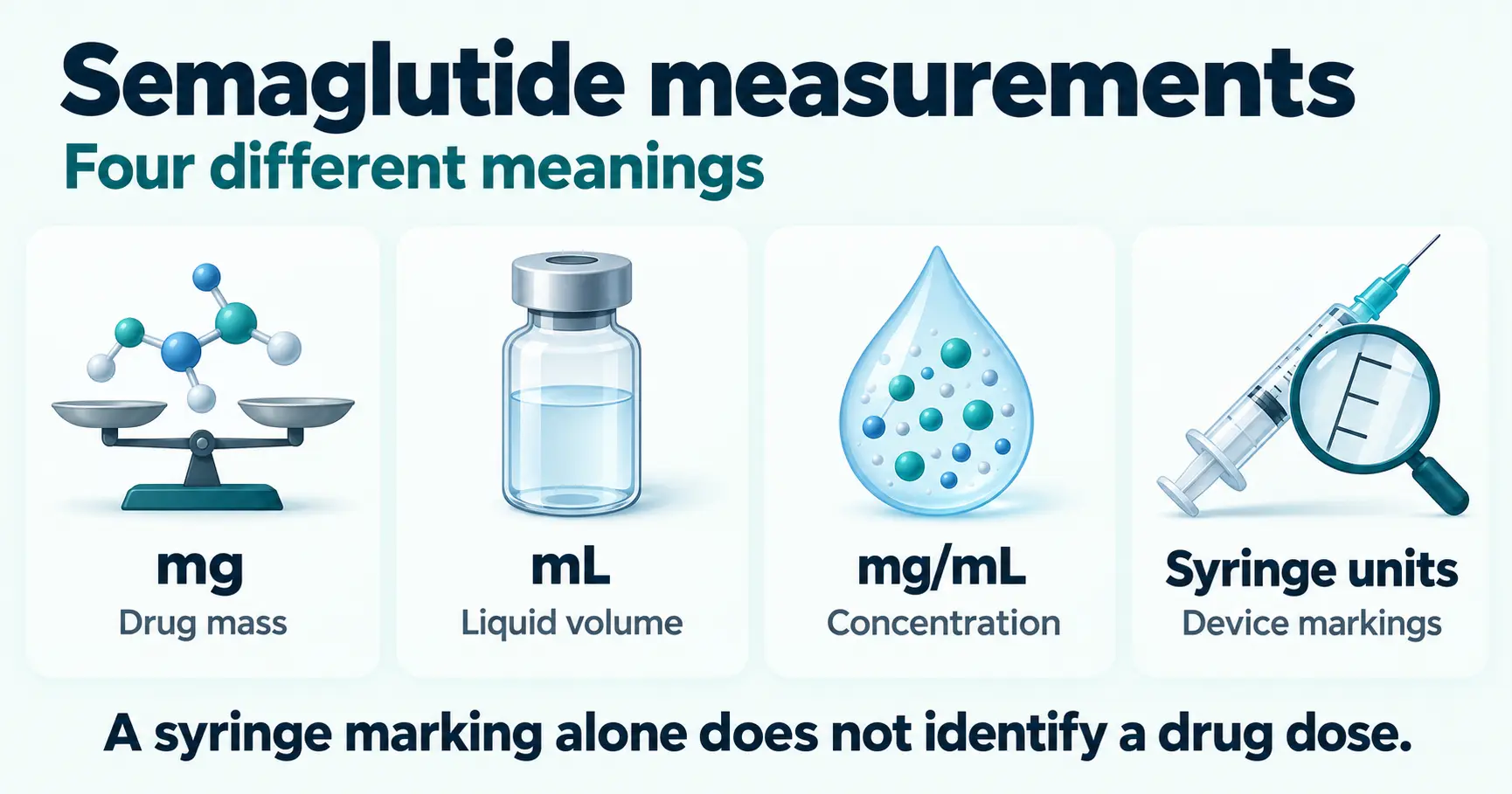
mg describes the mass of semaglutide; mL describes the volume of liquid; and “units” on a U-100 insulin syringe describes an insulin-calibrated scale. These are different measurements. To relate a prescribed mass to a liquid volume, the actual concentration in mg/mL must be known. A syringe marking by itself cannot establish how many milligrams of semaglutide the liquid contains.
Confusion arises when a prescription, a pharmacy label and a syringe express information in different systems, or when instructions from an earlier concentration or device are reused. The practical response is to reconcile the current product, concentration, prescription and supplied device before relying on a marking.
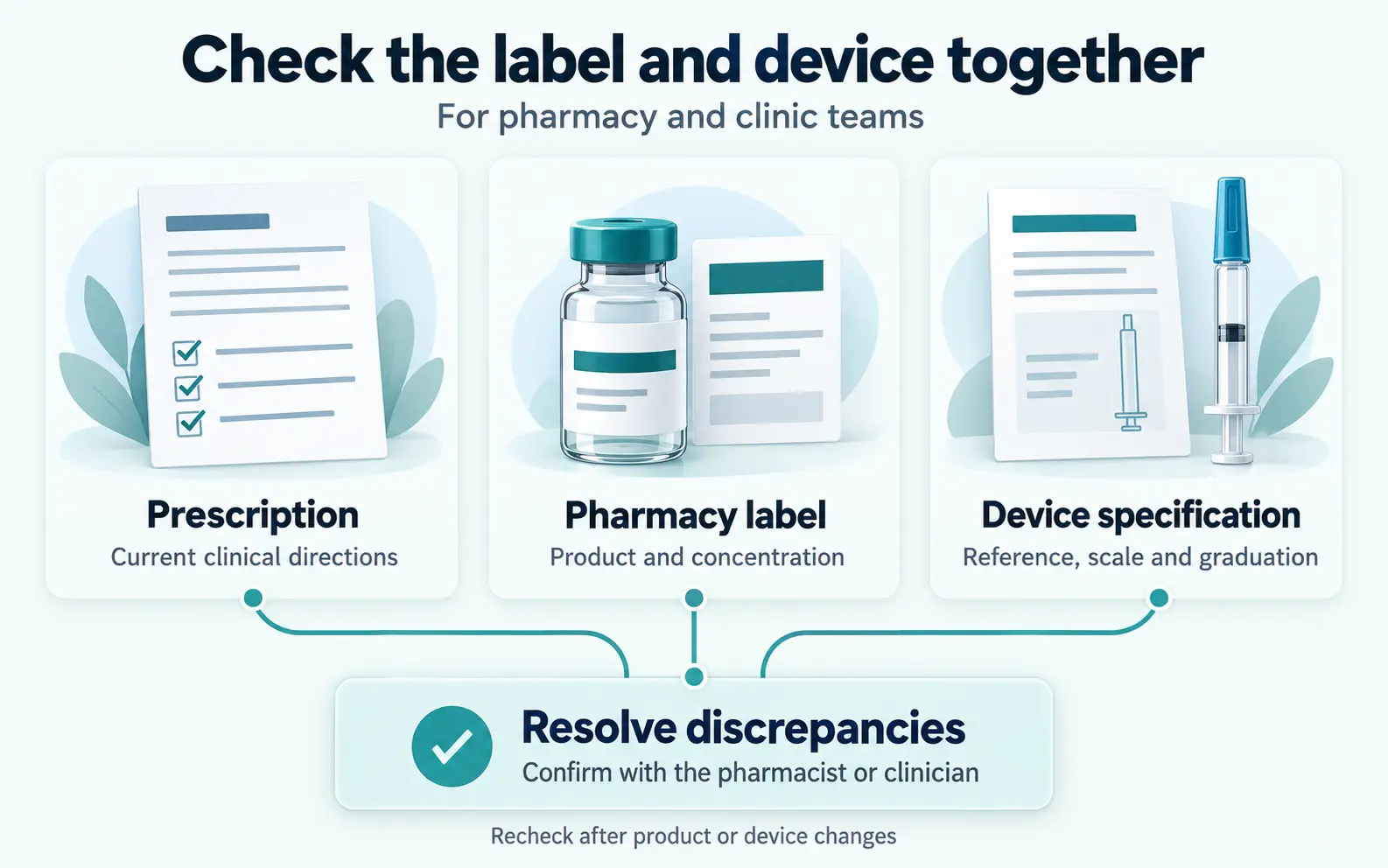
For pharmacy and purchasing teams
Key Takeaways
- Keep the measurement attached to the number. Total container content, concentration, prescribed dose and device markings answer different questions.
- Identify the actual presentation. A pen, a prefilled syringe and a pharmacy-dispensed vial require different review workflows.
- Review the device by reference. Barrel capacity, scale, graduation interval, needle configuration and labeling are separate fields.
- Recheck changes. A new concentration, pharmacy, device or instruction version can invalidate an earlier interpretation.
- Assign responsibility. The clinician or pharmacist resolves medication instructions; the supply team documents the requested device and any proposed substitution.
1. Semaglutide mg vs mL vs “Units”: Four Different Questions
A number on a carton is meaningful only when its unit and context are clear. A label can describe the medicine in an entire container, the concentration of a solution, or a dose delivered by a particular presentation. Reading all three as the same quantity creates an avoidable communication problem.
| Term | What it describes | What it cannot establish alone |
|---|---|---|
| mg | Drug mass. Its context may be a prescribed dose or total container content. | The volume to measure, without the relevant concentration and directions. |
| mL | Liquid volume, including fill volume, barrel capacity or a verified administration volume. | Drug mass, because different solutions may have different concentrations. |
| mg/mL | Concentration: drug mass per liquid volume. | The intended dose or suitability of a particular device. |
| Syringe “units” | Markings on a specifically calibrated device, such as a U-100 insulin syringe. | A universal semaglutide dose or standardized semaglutide potency unit. |
For a professional review, label each number by its purpose: “total content,” “concentration,” “prescribed dose,” “verified volume” or “device scale.” A stock description that says only “semaglutide syringe” leaves the clinical and physical requirements unresolved.
2. Concentration Connects Drug Mass and Liquid Volume
Mass and volume are related through concentration. The dimensional relationship below explains why information cannot be transferred from one bottle to another just because the active ingredient has the same name.
Conceptual relationship: volume (mL) = drug mass (mg) ÷ concentration (mg/mL).
The units cancel to mL. This explains the measurement relationship; it does not select a dose, verify a preparation or authorize self-calculation.
If the concentration changes while the intended drug mass stays the same, the corresponding volume changes. If the volume stays the same while concentration changes, the drug mass changes. Neither the color of a vial cap nor the capacity printed on a syringe supplies the missing concentration.
Also distinguish a label expressed as mass per total container volume from one explicitly expressed per mL. A pharmacist should reconcile the actual label and prescription rather than infer meaning from an isolated number in an email, photograph or search result. An online conversion tool can return plausible arithmetic while still using the wrong concentration or the wrong input field.
A refill is a new verification point
Check the new dispensed label and device together. An old worksheet, saved screenshot or remembered marking should not replace the instructions attached to the current product.
3. U-100 Identifies an Insulin Scale, Not Semaglutide Strength
U-100 insulin contains 100 insulin units per mL; the HUMULIN R prescribing information provides one current product-label example. The matching syringe scale represents that insulin concentration. Its calibration does not turn another medicine into insulin or assign an insulin potency unit to semaglutide.[2]
A U-100 scale represents 100 scale units across 1 mL; one scale unit corresponds to 0.01 mL. This is a description of the scale only. It provides no semaglutide mg value without the exact solution concentration, and not every syringe prints a line at every unit.
Maximum barrel capacity and the smallest graduation are different specifications. A smaller-capacity syringe may use the same U-100 concentration scale as a larger one, while their intervals and printed numbering differ. “One line” therefore does not identify a reproducible quantity across devices.
A unit-marked syringe may appear in a pharmacy’s patient-specific vial instructions, but that does not make insulin syringes universally appropriate for every semaglutide presentation. The responsible professional must verify the selected device, its instructions and the relationship to the current medicine. A purchasing team should preserve that approved device identity rather than invent the relationship.
4. U-100 Is Different from a 100-Unit, 50-Unit or 30-Unit Capacity
U-100 is a concentration-scale designation; “100-unit,” “50-unit” and “30-unit” can describe the capacity represented on that scale. A 50-unit-capacity U-100 syringe does not thereby become a U-50 syringe. Similarly, a 30-unit-capacity U-100 syringe does not become U-30. Read the printed scale designation and the actual product reference.
embecta’s current U.S. syringe portfolio lists 1 mL, 0.5 mL and 0.3 mL capacities.[12] The table separates those category-level capacities from scale identity. It is not a recommendation for semaglutide administration or proof of an individual product’s markings.
| Nominal capacity | Equivalent capacity on the U-100 scale | Scale identity | Still requires verification |
|---|---|---|---|
| 1 mL | 100 scale units | U-100 | Actual maximum marking, graduation and exact REF. |
| 0.5 mL | 50 scale units | U-100 | Actual maximum marking, graduation and exact REF. |
| 0.3 mL | 30 scale units | U-100 | Actual maximum marking, graduation and exact REF. |
Graduation remains a separate field. For example, the manufacturer’s 2023 BD SafetyGlide overview identifies a 0.3 mL half-unit-scale configuration by catalog number 328449.[13] That source supports the named example; it does not show that every 0.3 mL syringe has half-unit marks, or establish a Tonmit configuration.
For supplier comparisons, enter scale identity, nominal capacity, labeled maximum marking and graduation into separate columns. A quote that uses a capacity nickname without the scale or REF leaves the device identity incomplete.
5. What the Published Evidence Actually Shows
This is an established medication-safety issue. Record publication date and observation period separately. Historical reports and later analyses describe reported hazards; they do not establish the error rate among all treated patients.
| Source and date | Relevant finding | Interpretation limit |
|---|---|---|
| Lambson et al., 2023 case series | Three administration-error cases involving compounded semaglutide; two involved tenfold errors. Nausea, vomiting and abdominal pain were reported.[3] | A small case series identifies hazards; it cannot measure population-wide incidence. |
| ISMP, March 7, 2024 | Described errors involving compounded semaglutide vials and insulin syringes, and highlighted medication-history and education needs.[4] | A medication-safety newsletter is a signal and practice resource, not a controlled comparison of products. |
| FDA, July 26, 2024 alert | Reported patient measurement errors and professional miscalculations, with some adverse events requiring hospitalization. Different concentrations and confusion among mg, mL and “units” were contributing concerns.[1] | Reported cases do not supply a denominator or establish a universal error rate. |
| Miller et al., published February 3, 2026 | Examined 10,033 GLP-1 receptor agonist exposure reports from 2012–2023; most were unintentional therapeutic errors.[11] | Reports concern the broader drug class and an older observation period, not a 2026 semaglutide error rate. |
Reading the 2026 evidence: poison-center reporting is not a census of all medication users. A publication year does not change the years covered by the data or prove that unit confusion explains every report.[11]
The FDA alert also calls for an appropriate syringe size and counseling on measuring the intended dose. Those recommendations require an individualized professional review; they are not a basis for one generic syringe or one conversion chart for all patients.[1]
FDA’s current unapproved GLP-1 information distinguishes compounded medicines from FDA-approved products: compounded drugs do not undergo FDA premarket review for safety, effectiveness and quality. It also states that semaglutide sodium and semaglutide acetate are different active ingredients from the semaglutide base used in approved drugs.[5] A measurement worksheet cannot establish the legitimacy, identity or quality of a medicine.
6. Identify the Actual Presentation Before Discussing a Syringe
The drug name alone is an incomplete device-selection brief. Record the exact product, U.S. labeling and supplied presentation. Instructions for one delivery system should not be reused for another.
| Actual presentation | Review priority | Supply implication |
|---|---|---|
| Dose-selecting injection pen | Follow the pen’s current instructions and approved dose display. | Check whether that exact pen uses a separately attached needle; avoid vial-drawing instructions. |
| Other supplied injection device | Identify whether it is a prefilled syringe or another device and follow its own instructions. | Do not add a draw-up syringe just because the medication is injectable. |
| Pharmacy-dispensed vial | Reconcile the prescribed mass, labeled concentration, verified volume and selected device. | Document the professionally approved reference and scale. |
| Oral presentation | Follow the oral product’s labeling. | An injection-syringe conversion is irrelevant. |
The accessed current U.S. Ozempic prescribing information, revised May 2026, lists prefilled syringes as well as pens. Its pen instructions prohibit withdrawing medicine from a pen with a syringe and instruct users not to select a dose by counting clicks.[6] Label inclusion does not establish local stock availability. Identify the exact supplied presentation rather than assume that a familiar brand name always means one device.
For broader component planning, see the GLP-1 injection support supplies guide. Apply any general checklist to the current product instructions and the clinically approved program.
7. Why Online Semaglutide Charts Can Disagree Even When the Arithmetic Is Correct
Search results often place a mass-to-marking formula next to a concentration chart. The calculation depends on assumptions that may be absent from a cropped image, saved PDF or app screen. A current date on a webpage does not make its assumptions match a particular dispensed medicine.
For a professional comparison, ask what each chart assumes before comparing its output. Two tools can produce different results because they assume different concentrations, devices or meanings for the number entered. They can also produce the same result while both using an incorrect input.
| Assumption to inspect | What can go wrong | Evidence needed for clarification |
|---|---|---|
| Meaning of the input | Total container content is entered as the prescribed dose, or mg is confused with mg/mL. | Exact wording of the current label and prescription. |
| Concentration | A default column, prior refill or another pharmacy’s example is used. | The current pharmacy-confirmed concentration and corresponding directions. |
| Device scale | A U-100 rule is applied to an unidentified scale or a capacity nickname. | Supplied device reference, label and scale designation. |
| Display and rounding | An output is treated as measurable without checking the device’s actual graduations or performance evidence. | Professional assessment of the selected device and the written instructions. |
| Version and applicability | A screenshot survives a product, pharmacy, instruction or device change. | Document version, review date and change record. |
Rounding is not an automatic correction for a display that does not align with a device’s markings. A purchasing team should flag the mismatch for the responsible pharmacist or clinician rather than choose a nearby line or replace the device on its own.
A matching result is not a completed review
A formula checks a numerical relationship. It does not verify medicine identity, prescription suitability, the measuring device, administration timing or the legitimacy of the supplied product. Record those checks separately.
Manufacturer labeling also needs presentation-specific interpretation. Total drug content and total liquid content printed on an injection-pen carton are not directions to withdraw that liquid with a syringe. Apply the supplied device’s current instructions.
8. Audit Pharmacy Labels for Meaning, Not Just Arithmetic
The following is a proposed review framework for professional teams, not a universal legal label template. Local requirements, the medicine and the dispensing arrangement determine the final label. Its purpose is to identify unresolved information before it becomes an instruction.
- Product identity: reconcile the prescription, dispensing pharmacy, formulation and actual container.
- Concentration: establish what each mass and volume statement describes; distinguish total content from mass per mL.
- Prescribed directions: confirm the current clinical order, including dose, route and schedule, with the authorized professional.
- Measuring device: identify the supplied manufacturer reference, capacity, scale and graduation interval when a separate syringe is required.
- Instruction consistency: have the responsible pharmacist or clinician reconcile the written directions with the actual device.
- Version and contact: identify the current instruction version and the pharmacy contact for questions.
A direction expressed only as a number of “units” needs clarification if the concentration, device or underlying clinical dose is unresolved. Merely spelling out “units” does not repair a missing relationship. Similarly, adding an mL figure does not prove that the underlying dose or product identity is correct.
Typography also matters. ISMP recommends mL rather than cc, spelling out units rather than U or u, using a leading zero for a quantity below one, and avoiding trailing zeros in medication doses.[7] These communication conventions complement clinical verification; they do not replace it.
Review the full direction as it appears on the dispensed label, not only the calculation in an internal spreadsheet. A mathematically correct value can still be ambiguous when its unit, frequency, presentation or device reference is omitted in the patient-facing output.
9. Distinguish Calculation, Label, Device and Timing Errors
The phrase “semaglutide dosing error” covers different failures. Correcting arithmetic will not fix a wrong product, an ambiguous instruction or a schedule misunderstanding. The following classification is a proposed review aid for healthcare teams, rather than a validated clinical scoring system.
| Failure type | Example of the problem | Clarification focus |
|---|---|---|
| Calculation or input error | The wrong concentration or the wrong label field is used. | Authorized reconciliation of the prescription and concentration. |
| Label interpretation error | Total container mass is read as a dose, or a number is detached from its unit. | Corrected, unambiguous written directions from the responsible professional. |
| Device or reading error | A marking or graduation is interpreted using another syringe’s instructions. | Exact reference, scale, graduations and an appropriate training demonstration. |
| Timing or duplicate administration | The person misunderstands the prescribed schedule or repeats an administration. | The current product-specific directions and clinician or pharmacist advice. |
| Product or presentation mismatch | Instructions for one formulation or delivery system are applied to another. | Medicine identity, presentation and applicable current labeling. |
Do not generalize a schedule, restart instruction or missed-dose rule from one semaglutide presentation to every product. A vial-conversion discussion does not establish those decisions. Keep the approved directions attached to the actual dispensed medicine.
Also keep mass notation explicit. mg and mcg are different measurement units. ISMP identifies the microgram symbol µg as a notation that can be misread as mg and recommends mcg for micrograms.[7] A search tool, handwritten note or imported file should not silently normalize an unresolved unit.
10. Make Prescription Handoffs Explicit and Use Teach-Back
A handoff can fail when each team receives a different fragment: the prescriber communicates a drug mass, the pharmacy works with a concentration and the supply team receives a request for a familiar syringe. Assign a responsible professional to reconcile the complete set rather than expect the patient or procurement staff to connect the fragments.
For a clarification call, distinguish the unresolved question. Is it the product identity, the meaning of the concentration statement, the current prescription, the printed directions or the selected device? Ask for corrected written information when needed and record who resolved the discrepancy.
AHRQ describes teach-back as checking understanding by asking people to explain information in their own words. Its related show-me approach checks whether they can demonstrate the instructed task; a yes-or-no question about understanding does not provide the same confirmation.[8]
Applied to an injection program, the healthcare professional can use the current label and actual approved device to check whether the person distinguishes the prescription from a barrel marking. A training demonstration should follow the organization’s protocol and use appropriate demonstration materials. Document the result and resolve uncertainty before relying on the instruction.
Professional communication prompt: “Please explain which information describes the medicine, which describes the liquid volume, and which identifies the device. Show me how you will follow the current written directions using the device you were supplied.”
This prompt is an editorial example for healthcare teams, not an instruction to calculate or administer a semaglutide dose. Provide accessible support when language, vision, dexterity or familiarity with injections affects the person’s ability to follow the approved instructions.
11. Capacity, Graduation and Needle Gauge Answer Different Questions
A broad product category is insufficient for reviewing a syringe. The relevant configuration must be documented by manufacturer reference and current product evidence. This review describes the offered device; clinical suitability still requires the responsible professional.
| Field | Question it answers | Evidence to request |
|---|---|---|
| Nominal capacity | What volume can the barrel hold? | Exact product label and controlled specification. |
| Scale identity | What measurement system do the markings represent? | Barrel artwork and labeled scale designation. |
| Graduation interval | What quantity separates adjacent marks? | Current drawing, labeling and production-equivalent sample. |
| Needle gauge and length | What needle dimensions are specified? | Exact reference and dimension statements. |
| Configuration | Is the needle fixed, detachable or part of a safety device? | Product structure, intended use and instructions. |
| Performance and identity | Which product is actually being reviewed? | Manufacturer, REF, relevant performance evidence and package identifiers. |
Closely spaced marks do not, by themselves, prove measurement accuracy. A graduation statement, an accuracy claim and a usability judgment are different kinds of evidence. Buyers should not infer one from another or from an enlarged sales photograph.
A needle gauge also does not identify barrel graduation or drug concentration. Two devices with the same gauge can have different capacities, scales and configurations. Use the insulin syringe capacity and graduation guide to organize the physical specification, then have the relevant clinical team review the proposed reference for the intended workflow.
12. Reopen Review When Concentration, Device or Instructions Change
Consider a hypothetical refill in which a pharmacy changes the concentration while the intended prescribed drug mass remains unchanged. A patient retains the earlier printed marking, and a purchasing team reorders a syringe by gauge alone. The failure is not simply a calculation mistake: old instructions and incomplete device identity have survived a change that should have triggered review.
This is an illustrative workflow example, not a reported case. Its lesson is to define review triggers in advance. A repeat order can still introduce new information.
- A different pharmacy, formulation, concentration or container presentation.
- A revised prescription or instruction document.
- A different syringe reference, scale, capacity, graduation or configuration.
- A revised kit bill of materials or supplier-proposed substitute.
- A mismatch between the written device specification and the product received.
Record the affected version, the owner of the clinical clarification, the owner of the device review and the disposition of superseded materials. If instructions are printed inside a kit, changing the device or label can require a coordinated review of the kit contents and its insert.
Three Refill Changes with Different Implications
These conceptual examples contain no patient dose or administration instruction. They show which relationship needs to be checked when a refill or supply order changes.
| What changes | What follows conceptually | Review response |
|---|---|---|
| Concentration changes; prescribed drug mass is unchanged | The corresponding liquid volume changes. Reusing an old marking can change the mass administered. | Have the responsible professional reconcile the new label, instructions and actual device. |
| Total container volume increases; concentration and prescription are unchanged | A larger container does not by itself increase the drug mass prescribed for each administration. | Check that total content has not been substituted for per-administration directions. |
| Syringe REF changes; medicine and prescription are unchanged | The medicine’s concentration does not change because the device changes; markings or usability may differ. | Review the substitute and affected instructions rather than approve by gauge or price alone. |
Route, schedule, formulation and storage requirements remain separate review fields. A purchasing substitution should not create a new medication instruction as an incidental part of a stock change.
For organizations assembling supplies, a controlled injection-kit bill of materials can specify the component identities and substitution rules. Clinical directions require their own qualified approval and should remain traceable to the current program.
13. Respond to an Unclear Label or Suspected Error
When the label and device do not agree, obtain clarification from the dispensing pharmacy or prescribing clinician before administration. Keep the current container, label and device available for the discussion. Do not resolve the discrepancy by borrowing a conversion from another person’s prescription or an earlier refill.
If an incorrect amount may already have been taken, seek prompt professional advice. In the United States, Poison Help at 1-800-222-1222 provides access to poison-center expertise for GLP-1 medication and overdose questions.[9] If someone collapses, has a seizure, has trouble breathing or cannot be awakened, call 911.[10]
Healthcare teams should preserve the information needed to assess and report the event under their own procedures. Relevant details include the actual product, concentration, written directions, supplied device and instruction version. A supplier review or an online article cannot provide individual overdose management.
14. Connect the Topic to Ancillary Supplies Through Verified Specifications
For B2B buyers, the useful connection is a documented supply program. A search for “semaglutide syringe” should lead to questions about the approved workflow and actual device, rather than an assumption that one commodity configuration fits every treatment.
Once the clinical team has defined the device requirement, procurement can compare the exact offered reference, sterile presentation, packaging, documentation and fulfillment terms. Record whether needles, alcohol prep products, gauze or sharps-disposal supplies are required by that program. Their inclusion should follow the actual presentation and approved procedures.
Ask suppliers to state deviations explicitly. “Equivalent,” “same gauge” and “also U-100” are incomplete substitution rationales when capacity, graduation, configuration or instructions differ. Review the discrepancy before releasing a substitute into stock or a kit.
Tonmit’s GLP-1 ancillary injection supplies page provides a starting point for component inquiries. The exact-device documentation support page can help frame requests for SKU-specific records. These links concern supplies and evidence review; they do not establish a drug prescription or a semaglutide dosing recommendation.
Separate three approval records
Clinical: current medication directions and professionally approved device requirement.
Product: offered manufacturer reference, current label and supporting specification.
Commercial: pack count, price, order multiple, lot/expiry expectations and delivery terms.
Keeping these records linked makes a discrepancy visible without assigning clinical decisions to the supply quotation.
15. Copyable Review and Procurement Worksheets
These blank templates organize professional review. They contain no dosing values and perform no conversion. Complete clinical fields within the organization’s authorized workflow; do not place patient-identifying information in a public website tool or supplier inquiry.
Professional review worksheet
Label–Device Reconciliation Record
Record the evidence reviewed, unresolved questions and responsible decision owner. This is a review record, not a prescription or administration label.
View the complete template
SEMAGLUTIDE LABEL–DEVICE RECONCILIATION RECORD

Professional review only. Not a prescription, dose calculator or administration instruction.
Do not include patient-identifying information in a supplier inquiry.

Review reference / date / document version:
Responsible pharmacist or clinician / role:
Device specification reviewer / role:

PRODUCT AND DOCUMENTS
Exact product / formulation / dispensing source:
Presentation: pen / prefilled syringe / vial / oral / other:
Current label or instructions reviewed / version:
Concentration statement, if applicable, copied exactly from current label:
Meaning of total content vs concentration reconciled by:
Medication mass notation verified: mg / mcg / unresolved:
Current prescription and directions reviewed by authorized professional:

DEVICE, IF SEPARATELY REQUIRED
Clinical requirement approved by / approval reference:
Legal manufacturer / brand / exact REF:
Capacity / scale identity / graduation interval:
Needle configuration / gauge / length:
Label, controlled drawing and sample evidence reviewed:
Written instructions reconciled with actual device by:

DISCREPANCIES AND CHANGES
Unresolved question / affected document:
Clarification owner / written response reference:
Documents in disagreement: prescription / dispensed label / device / chart:
Issue type: input / label / scale / timing / presentation / other:
Pharmacy, concentration, presentation or device change since prior review:
Superseded instructions, saved charts and kit materials identified:
Change record: prior vs current product concentration, presentation and device REF:
Training / teach-back record reference, if applicable:

REVIEW DISPOSITION
Pending clarification / revised documents required / review completed:
Responsible decision owner / date:
Next review trigger:

This record documents review. It does not authorize medication administration.
Buyer worksheet
Ancillary Injection Supply RFQ
Use after the responsible team has defined the device requirement. Ask each supplier to identify its exact offer and every deviation.
View the complete template
GLP-1 ANCILLARY INJECTION SUPPLY RFQ

Scope: ancillary supplies only; no medication sourcing or dose selection.
Do not include patient information or individual medication directions.

Buyer / company / destination:
Initial quantity / recurring forecast / required delivery window:
Program requirement and approval reference:

REQUESTED DEVICE, IF APPROVED AND REQUIRED
Legal manufacturer / brand / exact REF:
Nominal capacity / labeled maximum marking (separate from scale identity):
Scale identity / graduation interval:
Needle configuration / gauge / exact length:
Current product label / specification / instruction revision:
Primary sterile presentation / relevant material requirements:
Package identifiers and applicable level:

OTHER APPROVED COMPONENTS
Component identity / exact SKU / quantity per kit:
Prep products / gauze / sharps supplies, where required:
Kit bill-of-materials revision and instruction-document owner:

PACK, EVIDENCE AND FULFILLMENT
Units per sales box / boxes per case / units per case:
Current labels, product specifications and relevant documentation:
Production-equivalent sample requirement:
Lot / expiry / minimum remaining shelf life at receipt:
Available exact REF and allocable quantity:
MOQ / order multiple / price basis / freight terms:
Dispatch assumptions / replenishment plan:

SUBSTITUTION CONTROL
List all deviations from the requested specification.
No substitution or artwork/pack change without written buyer approval.
Mark undecided fields 'buyer review required'; do not select a clinical device on the buyer's behalf.

Medication and patient-specific decisions remain with the qualified healthcare team.
Frequently Asked Questions
Are mg and mL the same for semaglutide?
No. mg is mass and mL is liquid volume. Their relationship depends on the exact concentration. Do not treat a number in one measurement as the same number in the other.
Why do some semaglutide instructions mention “units”?
They may refer to markings on a specified syringe. That wording needs to be reconciled with the current concentration, prescription and actual device. It does not define a universal semaglutide potency unit.
Can a semaglutide mg-to-units chart work for every vial?
No. A chart tied to one concentration and device cannot establish the relationship for every vial. Professional clarification is required when the actual product or instructions are unclear.
Does one syringe line always mean one unit?
No. The interval between printed marks is a device specification. Verify the exact scale and graduation rather than infer the interval from appearance or barrel capacity.
Does U-100 mean the syringe must hold 1 mL?
No. U-100 identifies the insulin concentration scale, not the maximum barrel capacity. Check capacity and graduation separately on the exact product.
Can I use a previous refill’s instructions?
Do not assume that they still apply. Check the new product, concentration, device and current written directions with the pharmacy, especially when any of these has changed.
Can semaglutide be withdrawn from an Ozempic pen with a syringe?
The current Ozempic pen instructions prohibit syringe withdrawal. Follow the instructions for the actual supplied presentation.[6]
Are all semaglutide products injection pens?
No. The actual presentation must be identified from its current labeling. Brand name or active ingredient alone is not enough to determine accessory requirements.
What should buyers specify for an ancillary syringe inquiry?
Provide the professionally approved device requirement, exact reference when defined, capacity, scale, graduation, needle configuration, label revision and pack quantities. Request written disclosure of deviations.
What should I do if the label and syringe do not agree?
Contact the dispensing pharmacy or prescribing clinician before administration. If an error may already have occurred, seek prompt professional or poison-center advice; do not use a new online conversion to manage the event.
Is a 50-unit syringe the same as a U-50 syringe?
No. A 50-unit-capacity syringe can be a 0.5 mL U-100 device. Capacity and concentration-scale identity are separate. Verify the exact label and reference rather than infer the scale from the capacity nickname.
Does 100 units on a U-100 syringe mean 1 mg of semaglutide?
No. On that scale, 100 scale units corresponds to 1 mL. The mass of semaglutide in that volume depends on the actual concentration. The marking does not supply an mg value or select a prescription.
What if a calculator and my pharmacy label give different results?
Have the dispensing pharmacist or prescribing clinician reconcile the current prescription, concentration, exact device and the inputs used. Do not select whichever number seems familiar or assume the newer webpage is the correct instruction.
Does a finer graduation prove that a syringe is accurate enough?
No. Graduation describes spacing between marks. Relevant performance evidence and professional assessment are also needed for the exact device and intended workflow.
Conclusion: Preserve the Relationship Between Product, Instructions and Device
Semaglutide mg vs mL is a concentration question; interpreting syringe “units” adds a device-scale question. Safe communication requires the current product, prescription and selected device to be reviewed together. None of these can be established by an isolated number or a generic shopping description.
For pharmacy and clinic teams, the practical task is to close ambiguities and document professional clarification. For buyers, it is to preserve the approved device identity, request relevant evidence and control changes to supplies and kit contents.
Sources & Editorial Basis
- U.S. Food and Drug Administration. Dosing errors associated with compounded injectable semaglutide products. July 26, 2024 historical safety alert. Cited for reported measurement errors and counseling considerations, not the current product roster or compounding permissions.
- Eli Lilly and Company. HUMULIN R prescribing information. Sections 3 and 16.1 identify U-100 as 100 insulin units/mL. Cited for insulin concentration terminology, not semaglutide treatment or device authorization.
- Lambson JE, Flegal SC, Johnson AR. Administration errors of compounded semaglutide reported to a poison control center—Case series. J Am Pharm Assoc (2003). 2023;63(5):1643–1645. DOI: 10.1016/j.japh.2023.06.017. Three cases; not an incidence study.
- Institute for Safe Medication Practices. ISMP Medication Safety Alert! Acute Care, Volume 29, Issue 5. March 7, 2024. Historical medication-safety discussion of compounded semaglutide errors.
- U.S. Food and Drug Administration. FDA’s concerns with unapproved GLP-1 drugs used for weight loss. Current agency information checked October 5, 2026. Cited for product-status and active-ingredient distinctions; not a legal determination for a particular transaction.
- Novo Nordisk. Ozempic U.S. prescribing information and Instructions for Use. Prescribing information revised May 2026; the accessed PDF includes pen and prefilled-syringe instructions. Cited for presentation-specific boundaries and pen-use restrictions.
- Institute for Safe Medication Practices. List of Error-Prone Abbreviations, Symbols, and Dose Designations. 2024 edition. Cited for measurement notation and decimal communication practices.
- Agency for Healthcare Research and Quality. Use the Teach-Back Method: Tool 5. Last reviewed April 2024. Cited for teach-back and show-me methods; the article’s semaglutide review prompt is an editorial application.
- America’s Poison Centers. GLP-1 emerging-hazard resource. Cited for U.S. poison-center access and medication-error questions. Exposure counts are not used as incidence estimates.
- National Capital Poison Center. Poison Control emergency guidance. Cited for circumstances requiring a 911 call.
- Miller J, Miller R, Varney SM, Han D. National Poison Center Trends in GLP-1 Receptor Agonist Exposures Following FDA Approval for Weight Loss. J Med Toxicol. 2026;22:275–285. Published February 3, 2026; data from 2012–2023. DOI: 10.1007/s13181-026-01121-z.
- embecta. Insulin Syringes with Ultra-Fine needle: U.S. product portfolio. Checked October 5, 2026. Cited for available nominal capacity categories, not semaglutide suitability or a Tonmit SKU.
- embecta / BD. BD SafetyGlide insulin syringe product overview. 2023 manufacturer document; page 2 identifies catalog 328449 as a 0.3 mL half-unit-scale example. No cross-brand graduation claim is inferred.
Ancillary supplies for professionally defined programs
Request a Component and Device Specification Review
Share your approved device requirement, requested reference, packaging needs, destination and forecast. Ask for SKU-specific documentation, availability and a clear statement of any proposed deviation.
Inquiry scope: devices, ancillary components, packaging and documentation. Individual medication decisions remain with the qualified healthcare team.