Sterile vs Non-Sterile Alcohol Prep Pads: What Buyers Must Confirm

Alcohol Prep Pad Sterility & Procurement Guide

An evidence-bounded comparison of sterile vs non-sterile alcohol prep pads for U.S. pharmacies, clinics, kit assemblers and medical distributors—covering 70% isopropyl alcohol, labeled use, individual pouches, sterility evidence, lot and expiry control, case packs, recalls and exact-SKU substitution.

By Tonmit Medical Supply Editorial Team Reviewed August 25, 2026 Reading time 27 minutes
Separate the claims 70% IPA and individual wrapping do not prove sterility
Workflow rule Exact label + procedure + facility policy
Buyer control unit Labeler + NDC/SKU + sterility + pack + lot

Scope: This guide supports U.S. B2B product review, formulary planning, supplier qualification, receiving and recall readiness for finished alcohol prep pads and swabs. It does not prescribe skin preparation for an individual, replace a product’s Drug Facts or other current labeling, authorize a substitution, establish an infection-control procedure, or provide legal, regulatory or clinical advice. Confirm the exact product, intended workflow, labeler, formulation, sterility statement, package, lot, expiry, facility policy and applicable requirements before purchase or use.

Sterile vs Non-Sterile Alcohol Prep Pads: What Must Buyers Confirm?

Sterile and non-sterile alcohol prep pads must be selected by the approved workflow and exact product label—not by alcohol concentration, individual wrapping or unit price alone. A 70% isopropyl alcohol statement identifies the antiseptic formulation; it does not prove that the finished pad is sterile. An individual pouch controls a unit package; it does not independently establish sterility. A sterile statement applies only to the identified product in its unopened, undamaged package and within the labeled dating and storage conditions.

Do not replace this rule with the opposite oversimplification that every non-sterile pad is prohibited from every injection-related workflow. Current U.S. DailyMed labels include non-sterile 70% IPA swabs with directions that refer to wiping an injection site.[2] Other workflows explicitly require a sterile alcohol swab; CDC vaccination guidance is one example.[4] The defensible decision therefore connects the procedure, facility policy, current label, sterility status and approved exact SKU.

01Define the useProcedure and care setting
02Read the labelDrug Facts and principal panel
03Verify sterilityNever infer from 70% or a pouch
04Lock the SKULabeler, NDC/REF and pack
05Track supplyLot, expiry, condition and recall

1. Sterility, Formulation, Packaging and Intended Use Are Separate Fields

The phrase “alcohol prep pad” compresses several independent attributes into one category name. A buyer should separate them in the item master, approved-product list and purchase order so that a truthful statement about one field is not extended to the others.

01

Sterility status

Records whether the exact finished product carries a sterile claim. If the packaging is silent or ambiguous, do not infer sterility from the category, source listing or appearance.

02

Active formulation

Identifies isopropyl alcohol or another active ingredient, its stated concentration basis, inactive ingredients and the liquid-load specification. It does not establish sterility.

03

Unit packaging

Defines the individual pouch, seal, barrier, units per box and boxes per case. Packaging supports protection and solution retention but needs its own evidence.

04

Labeled intended use

Identifies what the exact product is promoted and directed to do. Skin preparation, vial-stopper wiping, first aid and surface disinfection are not automatically interchangeable claims.

Buyer control unit Labeler + product/NDC or REF + formulation + sterility + intended use + pad/pouch + pack

2. Sterile vs Non-Sterile Alcohol Prep Pads Comparison Table

Category-level comparison—approve the exact label and SKU before ordering
Buyer field Sterile alcohol prep pad Non-sterile alcohol prep pad Required buyer check
Product statement Exact pouch or box expressly states “Sterile” Exact product states “Non-Sterile” or lacks a supported sterile claim Inspect current pouch, box and controlled label record
70% IPA Common but not universal Also common Verify active ingredient, concentration basis and Drug Facts
Individual pouch May protect the sterile contents while unopened and undamaged May support single use and solution retention Do not treat “individually wrapped” as a sterility claim
Use decision Relevant where the procedure or policy requires sterile May have a labeled skin-preparation use depending on the exact product Match current label to the approved workflow and policy
Evidence Label plus applicable sterilization, package and release information Label plus formulation, microbiological, package and release information Match every document to the legal manufacturer or labeler and SKU
Traceability Lot, expiry, package condition and distribution records The same controls remain necessary Maintain receiving, complaint, recall and kit-component records
Substitution Not interchangeable solely because another product is also sterile Not an automatic substitute for a sterile-approved SKU Require documented approval for any product change

3. Current U.S. Labels Show Why Category Assumptions Fail

DailyMed provides current structured product labeling submitted for marketed drugs. It is useful for checking the submitted Drug Facts, principal display panel, active ingredient, labeler and package information, but the record should still be matched to the physical product received.

Examples are used for label interpretation, not product endorsement or cross-SKU substitution
Current label example What the label states What it proves What it does not prove
McKesson Alcohol Prep Pad[1] Sterile; saturated with 70% v/v isopropyl alcohol; contents sterile in an unopened, undamaged package The identified product carries an express sterile claim That every McKesson-related pack or every 70% IPA pad shares the same status
Sol-M Alcohol Swabs Large[2] Non-Sterile; saturated with 70% isopropyl alcohol; directions refer to wiping an injection site A non-sterile label can coexist with a labeled injection-site direction That the product satisfies every injection, vaccination or facility protocol
Do not convert examples into universal rules

The sterile example does not prove that all individually wrapped pads are sterile. The non-sterile example does not authorize a buyer to disregard a procedure that explicitly requires a sterile swab. Each example applies only to its identified label and commercial product.

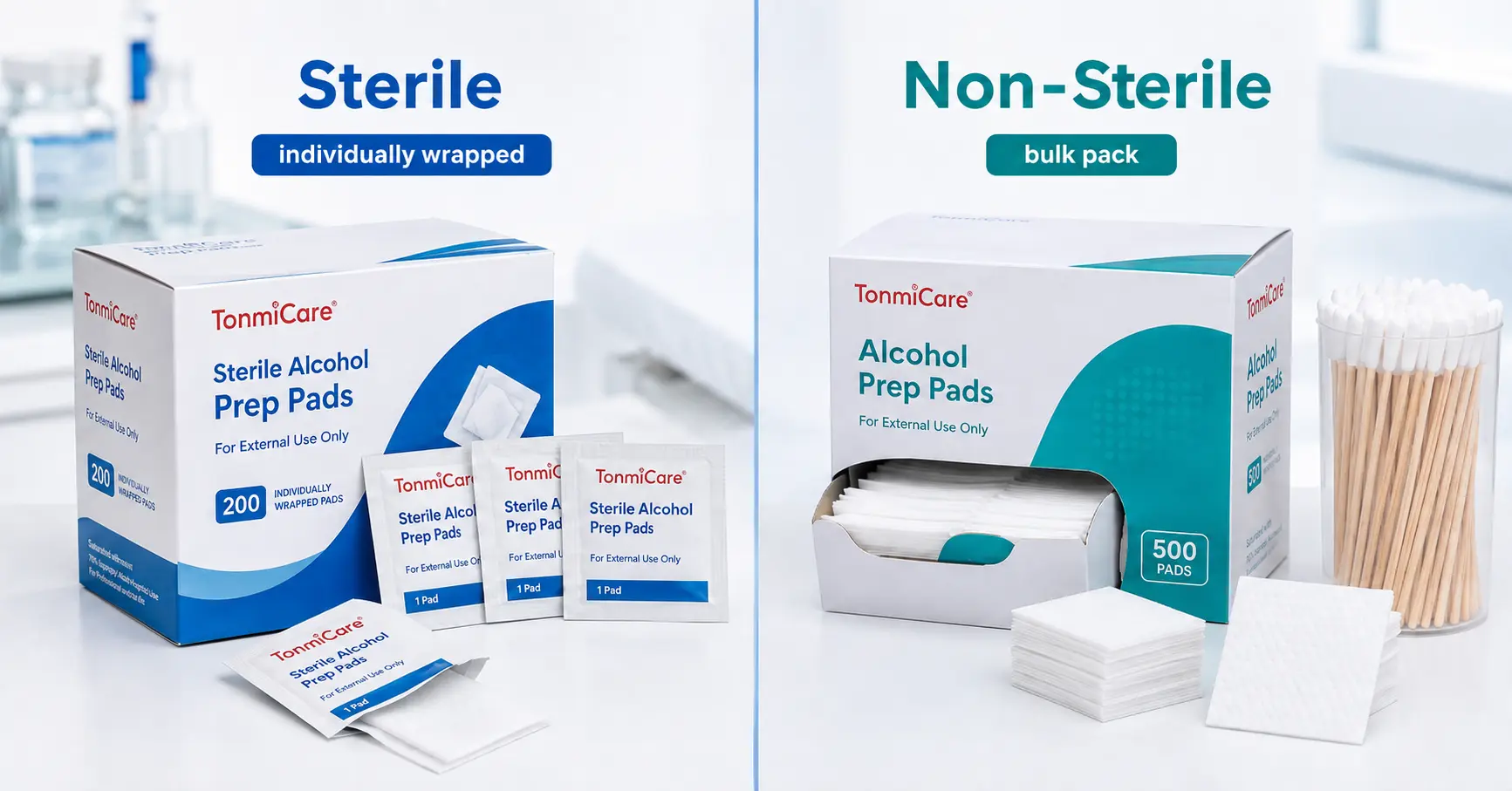
Sterile vs non-sterile alcohol prep pads comparison showing individually wrapped sterile pads and bulk-pack non-sterile pads

4. Why 70% Isopropyl Alcohol Does Not Make a Pad Sterile

Isopropyl alcohol concentration and finished-product sterility answer different questions. The concentration describes the formulation. A sterile statement describes the microbiological status claimed for the identified finished product under its controlled manufacturing, packaging and shelf-life conditions.

CDC states that alcohols have broad antimicrobial activity against many vegetative bacteria, fungi and viruses, but they do not destroy bacterial spores. CDC therefore does not recommend alcohol for sterilizing medical or surgical materials.[3] This distinction prevents three common procurement errors:

  • Do not write “70% IPA = sterile” in a specification or product page.
  • Do not describe a sterile alcohol pad as a product that “sterilizes skin.”
  • Do not use a formulation assay alone as evidence that the finished pouch is sterile.
Concentration and liquid load are also different

Two pads can both state 70% IPA yet differ in pad dimensions, substrate, folded size, solution quantity, evaporation resistance and usable wetness. A complete quotation should control the formulation and the physical pad-and-pouch system.

5. Individually Wrapped Does Not Mean Sterile

Both sterile and non-sterile alcohol pads can be placed in individual foil-paper or other flexible pouches. The pouch may reduce handling before use, provide a single-use unit and help retain alcohol, but the packaging format is not the sterile claim.

WRAP

What it may support

Unit presentation, tamper visibility, solution retention, clean handling and box-level dispensing.

STERILE

What requires a separate claim

The exact package must expressly identify the product as sterile and remain within its stated package conditions.

BUYER

What to record

Pouch material, seal condition, sterile statement, units per box, lot, expiry and complaint criteria.

Marketplace phrases such as “medical grade,” “hospital quality,” “individually sealed” or “hygienically packed” should not be accepted as alternative wording for a sterile claim. Request the actual current pouch and box artwork.

6. What a Sterile Alcohol Prep Pad Claim Means for Procurement

For procurement purposes, “sterile” should be treated as a product- and package-specific claim. The buyer should be able to connect the statement to the legal manufacturer or labeler, exact product identifier, marketed packaging and applicable supporting documentation.

  1. Verify the exact wording.Review both the individual pouch and retail-box panel rather than relying on a catalog thumbnail.
  2. Confirm the product identity.Match labeler, product name, NDC or other applicable identifier, dimensions, count and market presentation.
  3. Review the package condition.A sterile statement generally depends on the package remaining unopened and undamaged.
  4. Review applicable evidence.Request product-specific sterilization, package, shelf-life or release information at the level appropriate to the supplier review.
  5. Control changes.A new pouch, manufacturer, labeler, formulation, sterilization process or pack can require renewed review.

A sterile claim reduces neither the need for aseptic practice nor the need to reject a dry, leaking, open, damaged, expired or recalled unit. It also does not prove that another sterile brand or pack is an approved substitute.

7. What “Non-Sterile” Does—and Does Not—Mean

“Non-sterile” means the product does not carry the sterile status claimed for a sterile product. It should not be rewritten as “contaminated,” because contamination is a separate quality condition. It also should not be presented as sterile merely because it contains alcohol or arrives in a sealed pouch.

Translate the label accurately before making a use decision
Statement Accurate interpretation Buyer response
Non-Sterile No sterile claim for the identified finished product Evaluate only against workflows that permit the exact labeled product
70% Isopropyl Alcohol Active formulation statement Do not convert it into a sterile statement
Individually wrapped Unit-package configuration Review seal, wetness and package integrity separately
Injection-site direction Submitted labeled direction for that product Confirm it aligns with the actual procedure and facility policy

8. Start With the Clinical Workflow, Not the Supplier’s Category Name

A pharmacy dispensing a finished box, a vaccination clinic, an outpatient facility, a long-term-care pharmacy, a distributor and a kit assembler do not necessarily use the same acceptance criteria. Define the operational use before requesting price.

01DefineProcedure, setting and responsible policy
02ReviewCurrent label and intended use
03DecideWhether sterile is explicitly required
04ApproveExact formulation, pad, pouch and SKU
05ControlPack, lot, expiry and substitution

For injection-related assortment planning, use the diabetes injection supplies checklist to identify the delivery system and setting. That guide keeps alcohol pads within the larger controls for hand hygiene, aseptic practice, exact medication presentation and sharps disposal rather than treating one prep pad as the complete safety system.

9. Vaccination Guidance Shows When “Sterile” Becomes an Explicit Requirement

CDC’s Pink Book vaccine-administration guidance instructs healthcare personnel to cleanse the skin with a sterile alcohol swab and allow it to dry for common subcutaneous and intramuscular vaccination workflows. It also refers to a sterile alcohol swab for wiping a vaccine vial stopper.[4]

Do not generalize from one procedure to all procedures

The procurement lesson is not that every healthcare use has an identical swab rule. It is that an explicit procedure requirement must control the approved product. Review the current vaccine, medication, device and facility instructions for the actual workflow.

If a clinic’s procedure states “sterile alcohol swab,” the purchase specification should repeat that requirement, identify the approved SKU and block an automatic non-sterile substitution. A generic requisition for “alcohol pads” is insufficient.

10. Skin Preparation, Vial Stoppers and Surface Disinfection Are Not One Claim

A skin-preparation pad should not automatically be promoted as a general medical-equipment disinfectant. Conversely, a surface wipe is not automatically labeled for topical use on skin. Product identity, directions, warnings, target surface and required contact conditions differ.

Use the product and procedure instructions applicable to each task
Workflow Primary evidence Do not assume
Topical skin preparation Exact Drug Facts, principal panel and procedure That every alcohol wipe is labeled for skin
Vial-stopper wiping Medication or vaccine preparation guidance and facility procedure That a generic marketplace wipe satisfies the workflow
Small equipment surface Equipment instructions and the selected disinfectant label That a skin-prep drug is an approved surface disinfectant
Large environmental surface Applicable environmental-cleaning product and protocol That a small, fast-drying prep pad supplies the required coverage or contact time

CDC notes that alcohol can be used for certain small surfaces but evaporates rapidly, making extended contact difficult, and repeated use may damage some materials.[3] The complete alcohol prep pads buying guide addresses intended use, formulation, pad construction and packaging as one controlled specification.

11. Pouch Integrity and Shelf Life Affect Both Sterile and Non-Sterile Pads

The pouch is part of the delivered product. It must retain the formulation, protect the pad and preserve any package-dependent sterile claim through labeled storage and shelf life. Buyers should evaluate the marketed pouch—not an unpackaged pad sample alone.

  • Seal integrity: no open channel, wrinkle-related leak, puncture or delamination that compromises the unit.
  • Solution retention: no unacceptable dry-out, leakage or package-to-package variability.
  • Marking legibility: product identity, sterile/non-sterile statement, lot and expiry remain readable where required.
  • Storage alignment: purchase, warehouse and transportation controls follow the exact labeled conditions.
  • Shelf-life evidence: formulation, pouch, seal and product claim remain supported for the marketed dating.
  • Distribution protection: inner cartons and shipping cases protect individual packages from crushing, heat exposure and moisture events.

Do not invent a universal storage temperature or remaining-shelf-life threshold for the category. Define the buyer’s contractual dating requirement, but check the exact label and supplier documentation for the actual product.

12. Pad Size, Ply, Material and Wetness Do Not Establish Sterility

Pad construction affects handling, coverage and commercial comparability, but none of the fields below independently proves sterility. “Medium,” “large” and “2-ply” are especially unreliable without dimensions and construction definitions.

Write measurable fields into the RFQ
Specification What to request Common error
Pad size Folded and unfolded dimensions with tolerances where applicable Comparing “medium” across suppliers
Ply Construction definition and final folded presentation Assuming 2-ply means thicker, wetter or sterile
Substrate Material identity, texture and relevant physical specifications Using “nonwoven” as a complete specification
Solution load Target quantity and controlled acceptance criteria Confusing 70% concentration with liquid quantity
Pouch Material, dimensions, print, seal and retention performance Approving only the retail-box artwork

Buyers comparing available product formats can review Tonmit’s current wholesale alcohol prep pads page, then request an exact-SKU quotation rather than relying on a category image as live inventory or final specification.

13. DailyMed and an NDC Are Evidence Sources—not FDA Approval Badges

Many marketed isopropyl alcohol prep pads appear in DailyMed as human OTC drug labels. The buyer should therefore avoid calling the entire category “medical devices” or asking only for a generic device certificate. First determine the regulatory identity and labeling basis of the exact product.

An NDC does not mean FDA approved

FDA states that inclusion in the NDC Directory does not mean the agency verified the submitted information, and assignment of an NDC does not denote FDA approval.[5] Do not describe a product as “FDA approved,” “FDA certified” or officially endorsed merely because it has an NDC or DailyMed record.

A U.S. buyer’s controlled review may include:

  • Legal manufacturer, labeler and distributor roles;
  • Exact product name, NDC or other applicable product identifier;
  • Current Drug Facts and principal display panels;
  • Active and inactive ingredients and labeled uses;
  • Sterile or non-sterile statement;
  • Manufacturing and listing records applicable to the exact transaction;
  • Private-label responsibilities and controlled artwork;
  • Complaint, adverse-event and recall contacts.

14. Use an Evidence Hierarchy for Sterility and Product Claims

Product descriptions can be copied, shortened or assigned to the wrong variation. Use the most direct evidence available and investigate any conflict before release.

1Physical pouch and boxExact received product and current printed statements
2Controlled label recordCurrent Drug Facts, DailyMed or approved artwork
3Exact-SKU specificationFormula, pad, pouch, sterility, pack and dating
4Applicable quality evidenceSterilization, release, stability and package information
5Commercial listingUseful for discovery, not final approval

If the commercial listing says “sterile” but the pouch, box or controlled document does not, place the product on hold and resolve the discrepancy. The same applies when a certificate references a different manufacturer, model, formula, package or market. Tonmit’s exact-SKU documentation support page explains how product, manufacturer, packaging and records should be matched during a B2B review.

15. Alcohol Pads Inside Kits Need Component-Level Lot Control

An alcohol pad may be supplied inside a diabetes kit, injection kit, blood-draw pack or another convenience assembly. Recording only the outer kit SKU can make it difficult to identify which component lot reached which customer.

Kit traceability chain Kit SKU/BOM → Component manufacturer and SKU → Component lot/expiry → Assembly lot → Customer

The kit bill of materials should record the approved pad’s formulation, sterility status, dimensions, pouch, product identifier and pack contribution. If the component changes, the assembler should review the use claim, artwork, records, dating and downstream impact before release.

FDA’s 2026 correction for convenience kits containing recalled Webcol alcohol prep pads demonstrates why component-level identification matters: affected pads had to be identified and removed even though they were packed inside broader procedural kits.[7] For broader kit design and replenishment controls, use the diabetes supply kits procurement guide.

16. Current Recalls Show Why 70% IPA Is Not a Substitute for Lot Control

In March 2026, Cardinal Health announced a voluntary nationwide recall of selected Webcol Large Alcohol Prep Pad lots because of microbial contamination. FDA’s notice identifies the product as a drug and describes 70% isopropyl alcohol pads distributed in the United States and other markets.[6]

The lesson is not that every sterile or non-sterile product has the same risk. The lesson is operational: buyers need to know the exact product code, lot, quantity, storage location, downstream destination and remaining inventory before a recall occurs.

  1. Identify.Match the notice to manufacturer or labeler, product code, package and affected lot.
  2. Hold.Segregate affected and questionable inventory from free-to-sell stock.
  3. Trace.Identify pharmacies, clinics, kits, branches or customers that received the lot.
  4. Notify.Follow the responsible firm’s instructions and the organization’s recall procedure.
  5. Reconcile.Record returned, destroyed, corrected, replaced and unaccounted quantities.

Historical CDC investigation also found Bacillus species in alcohol prep pads that were not labeled clearly as sterile or non-sterile, reinforcing the need for explicit labeling and correct product selection.[8]

17. Match Sterility Status to the Approved Purchasing Scenario

This matrix supports procurement review; it does not replace a clinical procedure
Purchasing scenario Primary decision Sterility control Additional buyer checks
Vaccination clinic Match current vaccination guidance and facility procedure Use a sterile-labeled approved SKU where required Skin/vial workflow, pouch integrity, lot, expiry and box access
Pharmacy dispensing Match prescription, program, approved assortment and label Do not substitute sterility status without review Pack count, coverage, patient handoff and replenishment
Clinic procedure Follow procedure- and medication-specific policy Record whether the approved workflow explicitly requires sterile Point-of-use supply, training, disposal and complaint controls
Distributor assortment Maintain distinct sellable SKUs and truthful product data Do not merge sterile and non-sterile variants Channel, case pack, lot, expiry and downstream recall records
Kit or bundle Approve the component against the kit workflow and BOM Preserve the specified component sterility status Component lot/expiry, label responsibility and replacement plan
Private label Validate the exact formula, claim, artwork and responsible roles Support any sterile statement with product-specific evidence NDC/listing responsibilities, change control, MOQ and packaging liability
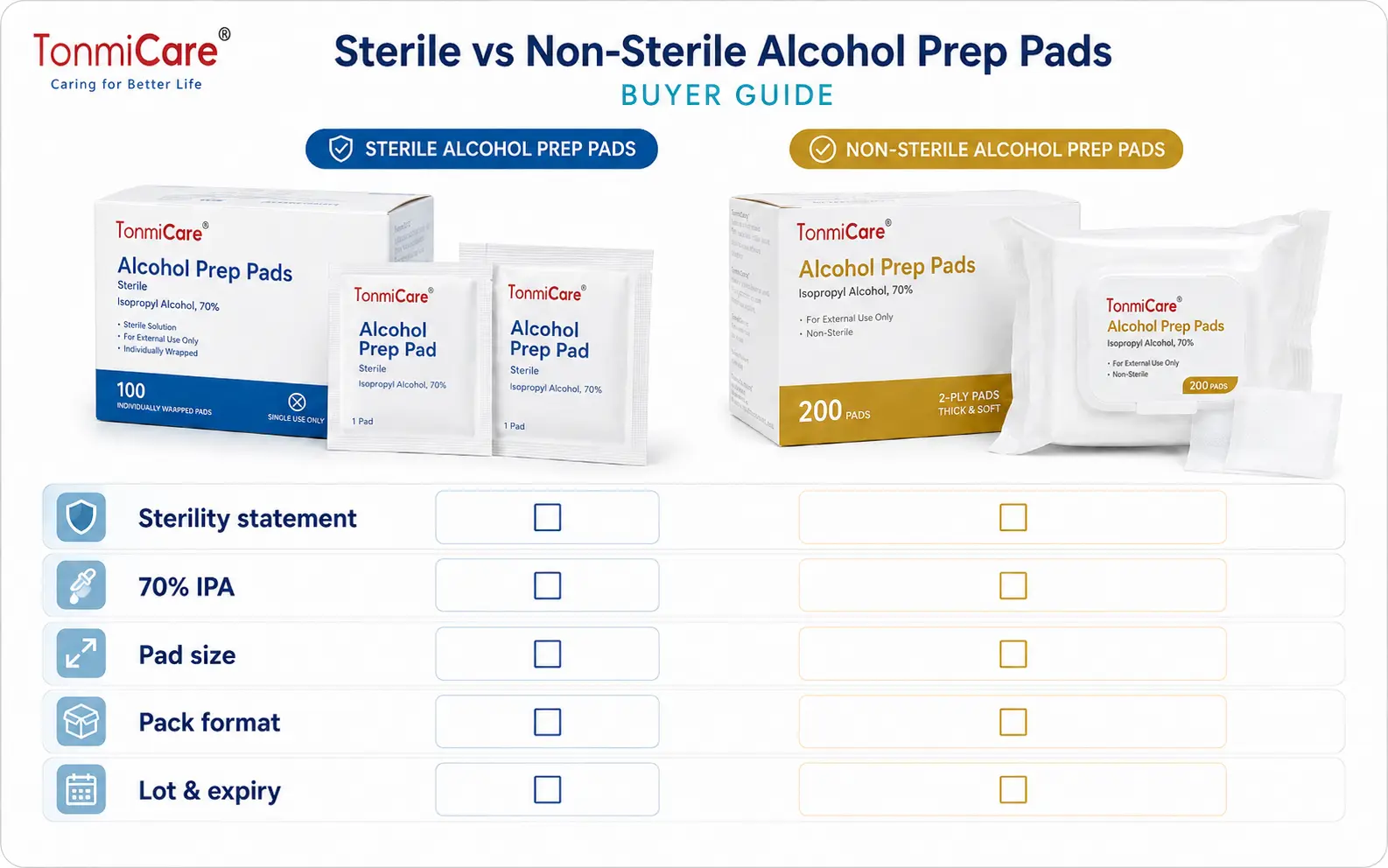
Buyer guide comparing sterile and non-sterile alcohol prep pads by sterility statement, 70% isopropyl alcohol, pad size, pack format, lot and expiry

18. Receiving and Complaint Checklist for Alcohol Prep Pads

Receiving should compare the physical shipment with the approved item master and purchase order. Do not release a case because the brand, box color or general description appears familiar.

RECEIVE

Incoming inspection

  • Labeler, product name and NDC/SKU
  • Sterile or non-sterile statement
  • Active ingredient and concentration
  • Pad and pouch specification
  • Units/box and boxes/case
  • Lot, expiry and minimum remaining life
  • Carton, box and pouch condition
  • Approved substitution status
COMPLAINT

Defect reason codes

  • Dry or insufficiently wetted pad
  • Leaking, open, punctured or delaminated pouch
  • Illegible or missing lot/expiry
  • Odor, color or appearance abnormality
  • Foreign material or suspected contamination
  • Sterility statement mismatch
  • Incorrect pad size or pack count
  • Unapproved product substitution

Photograph the affected product, pouch, box, case label and shipping condition; preserve the lot and supplier transaction; and follow the organization’s hold, complaint and reporting procedures. Do not discard evidence before the responsible quality review.

19. Should Pharmacies Stock Both Sterile and Non-Sterile Alcohol Pads?

There is no universal requirement to stock both. The assortment should follow actual approved workflows, demand, customer channels, package quantities, shelf life and the organization’s substitution controls.

Example inventory logic for professional buyers
Inventory tier Potential fit Control
Core stock Approved SKU used repeatedly across defined pharmacy or clinic workflows Set reorder point by actual consumption, case multiple and remaining shelf life
Secondary stock Distinct sterile status, size or package needed by a recurring program Use a separate bin, barcode and product description to prevent substitution
Special order Low-volume, facility-specific, private-label or unusual package requirement Confirm supplier lead time, dating and non-cancellable commitments
Kit component Approved BOM component with predictable assembly demand Plan component and finished-kit inventory together

A U.S. warehouse path may shorten replenishment only when the exact approved SKU, quantity, lot and dating are available. Review U.S. warehouse support for medical supply buyers before treating domestic storage as proof of live inventory, regulatory status or delivery timing.

20. Compare MOQ, Case Pack, Shelf Life and Cost per Usable Pad

Wholesale quotations are not comparable until they use the same approved product status, pad specification, packaging hierarchy and price denominator. One supplier may quote a retail box, another an inner carton and another a master case.

Cost per accepted usable pad Product + freight + dry/leaking waste + expiry + receiving + recall/kit rework
Normalize quotations before choosing the lower price
Commercial field Question to ask Hidden risk
Box count How many individual pouches are in one sellable box? Comparing 100-count and 200-count boxes by box price
Case pack How many boxes and total pads are in one shipping case? Ordering the wrong warehouse unit of measure
MOQ Is the minimum per SKU, case, order or private-label project? Buying more than demand can consume before expiry
Dating What minimum remaining shelf life applies at shipment or receipt? Accepting short-dated inventory at a low unit price
Fulfillment Is the quote U.S. warehouse stock, factory production or a hybrid? Assuming a category page is a live inventory promise
Private label Which minimum applies to printed pouches, boxes and cases? Unused artwork inventory and change-control exposure

Use the MOQ, case pack, shelf life and shipping guide to normalize broader diabetes-care quotations. Buyers seeking larger alcohol-pad programs can also review current bulk alcohol swab supply models.

21. Documents to Request and a Copyable Alcohol Prep Pad RFQ

PRODUCT

Exact-SKU evidence

  • Legal manufacturer, labeler and exact product
  • Current Drug Facts and pouch/box artwork
  • NDC or other applicable product identifier
  • Active ingredient, concentration basis and inactive ingredients
  • Pad dimensions, material, ply and solution load
  • Sterile or non-sterile statement
  • Applicable sterilization or microbiological evidence
  • Pouch, stability, shelf-life and storage information
TRANSACTION

Supply and traceability evidence

  • Units/pouch, pouches/box and boxes/case
  • Lot, expiry and barcode fields
  • Minimum remaining shelf-life commitment
  • MOQ and price denominator
  • Inventory status or production lead time
  • Destination and freight basis
  • Substitution and change-notification rules
  • Complaint, return and recall contacts

Copyable Alcohol Prep Pad RFQ

Organization and destination: Pharmacy / clinic / distributor / kit assembler / private-label brand; country, state, city and ZIP/postal code

Intended workflow: Exact professional, dispensing, kit or other approved use

Sterility status: Sterile required / non-sterile approved / product under review; no substitution without written approval

Active formulation: Isopropyl alcohol concentration and required concentration basis; inactive ingredients

Pad: Folded/unfolded dimensions, material, ply, texture and solution-load requirement

Pouch: Individual package material, dimensions, sterile statement, seal and print requirements

Labeling: Current Drug Facts, principal display panels, labeler, NDC/product identifier and market

Packaging: Pads/box, boxes/case, case dimensions, weight and pallet quantity

Quantity: Initial order, estimated annual demand and replenishment frequency

Dating: Minimum remaining shelf life required at shipment or receipt

Documentation: Product specification, labeling, applicable sterility/microbiological, package, stability and market records

Private label: Responsible roles, artwork, languages, barcode, MOQ and unused-packaging terms

Fulfillment: U.S. warehouse availability / factory production / hybrid; destination-specific lead time and terms

Quality controls: Lot traceability, complaint contact, recall notification and change-notification agreement

22. Sterile vs Non-Sterile Alcohol Prep Pads Frequently Asked Questions

Are all alcohol prep pads sterile?

No. Alcohol prep pads are sold as sterile and non-sterile products. Verify an express sterile statement on the exact pouch and box; do not infer sterility from the product category.

Does 70% isopropyl alcohol make an alcohol pad sterile?

No. The 70% statement describes the alcohol formulation. Finished-product sterility is a separate claim. Alcohol also lacks reliable sporicidal action and is not a sterilant for medical or surgical materials.

Does individually wrapped mean sterile?

No. Sterile and non-sterile pads can both be individually wrapped. Individual packaging may support single use and solution retention, but only an exact supported sterile statement establishes the claim.

Can non-sterile alcohol prep pads be used before injections?

Do not answer this from sterility status alone. Current DailyMed labels include non-sterile 70% IPA swabs with injection-site directions, while some procedures and facility policies explicitly require sterile swabs. Match the exact label to the actual workflow and approved policy.

Are sterile alcohol swabs required for vaccinations?

CDC’s current Pink Book guidance refers to sterile alcohol swabs for common vaccination skin preparation and vial-stopper wiping. Buyers should follow the current vaccine, facility and jurisdictional requirements for the actual program.

Does a sterile alcohol pad sterilize the skin?

No. “Sterile” describes the supplied product under its package conditions. It does not mean the pad makes skin sterile or replaces hand hygiene, aseptic technique or the applicable procedure.

Does non-sterile mean the product is contaminated?

No. Non-sterile means the product does not carry a sterile claim. Contamination is a separate quality condition that requires investigation, hold and complaint or recall action as applicable.

Can a skin-prep alcohol pad disinfect medical equipment?

Not automatically. Review the equipment instructions and the selected product’s labeled use. A topical skin-preparation drug should not be promoted as a general equipment or environmental disinfectant without an applicable label and evidence.

Can alcohol prep pads be used on vial stoppers?

Use the applicable medication or vaccine preparation guidance and facility procedure. Do not assume that every topical pad or general alcohol wipe is approved for the same vial workflow.

Does 2-ply mean an alcohol pad is sterile or better?

No. Ply is a construction description and may be defined differently across suppliers. It does not prove sterility, solution load, wetness, strength or clinical superiority.

Does “USP alcohol” prove that the finished pad is sterile?

No. A material or ingredient specification does not by itself establish the sterility of the finished pad and marketed pouch. Review the complete product claim and supporting records.

Can a damaged or leaking sterile pouch still be used?

Do not treat the contents as maintaining the packaged sterile claim when the pouch is open or damaged. Follow the label and the organization’s rejection, hold and complaint procedure.

Do alcohol prep pads expire?

Follow the expiry and storage information on the exact marketed product. Dating can support formulation, package integrity, solution retention and any package-dependent claim. Do not use a universal category shelf life.

Does an NDC or DailyMed listing mean FDA approved?

No. FDA states that NDC assignment and inclusion in its directory do not denote approval or verification of the information submitted by the labeler.

Can a sterile pad be substituted with another sterile pad?

Not automatically. Products can differ in labeler, intended use, formulation, pad size, solution load, pouch, box count, case pack, shelf life and product records. Require documented exact-SKU approval.

What should a buyer verify in a wholesale quotation?

Verify labeler and exact product, sterility status, formulation, pad and pouch specification, units/box, boxes/case, total units, MOQ, shelf life, lot/expiry controls, documentation, inventory or lead time, destination, freight and substitution rules.

How should alcohol pads be tracked inside kits?

Connect the kit SKU and BOM version to the component manufacturer, product identifier, lot and expiry, then connect the assembled kit lot to each downstream destination.

23. Approve the Exact Product—Not a Generic “Alcohol Pad”

A defensible sterile vs non-sterile alcohol prep pads decision begins with the exact workflow. The buyer then verifies the current labeled use, the express sterile or non-sterile status, the active formulation, the pad and pouch specification, the legal manufacturer or labeler, product identifier, package hierarchy, lot, expiry and approved substitution rules.

Neither 70% IPA nor individual wrapping proves sterility. Non-sterile does not automatically mean contaminated or prohibited from every injection-related label, while a sterile claim does not eliminate package, storage, receiving and recall controls. Treat each statement as a separate evidence field, preserve component traceability in kits and compare cost only after the accepted exact SKU has been fixed.

Official and Primary Sources Used for This Guide

  1. DailyMed — McKesson Alcohol Prep Pad, Sterile, 70% v/v Isopropyl Alcohol
  2. DailyMed — Sol-M Alcohol Swabs Large Non-Sterile, 70% Isopropyl Alcohol
  3. CDC — Chemical Disinfectants: Alcohol
  4. CDC Pink Book — Chapter 6: Vaccine Administration
  5. FDA — NDC Product File Definitions and Approval Disclaimer
  6. FDA — 2026 Webcol Large Alcohol Prep Pad Recall
  7. FDA — 2026 Convenience Kit Correction Involving Alcohol Prep Pad Components
  8. CDC MMWR — Contamination of Alcohol Prep Pads with Bacillus Species

Official sources and current product-label examples were reviewed on August 25, 2026. DailyMed displays labeling submitted for identified marketed products and does not endorse a product or establish that another SKU shares the same claims. CDC recommendations must be applied to the actual procedure and care setting. FDA recall notices are time-sensitive; use the current notice and affected-product information rather than copying lot numbers into an evergreen specification. Product labeling, policies, regulatory status, records and URLs can change, so verify the current exact-SKU evidence before a future purchasing decision.

Exact-SKU Alcohol Prep Pad Procurement Support

Verify the Claim Before Comparing the Price

Share the intended workflow, sterile or non-sterile requirement, 70% IPA and pad specification, pouch and pack target, estimated demand, destination, minimum remaining shelf life and document checklist. Tonmit can review available alcohol prep pad configurations, exact-SKU documentation, packaging, U.S. fulfillment options and transaction-specific commercial terms.

Leave a Reply