
Safety lancet specification & procurement guide
Compare depth terminology, fixed and adjustable designs, pressure and button activation, post-use protection and the purchasing records needed for an exact safety-lancet SKU.
Direct answer
Compare the Complete Device, Not Depth Alone
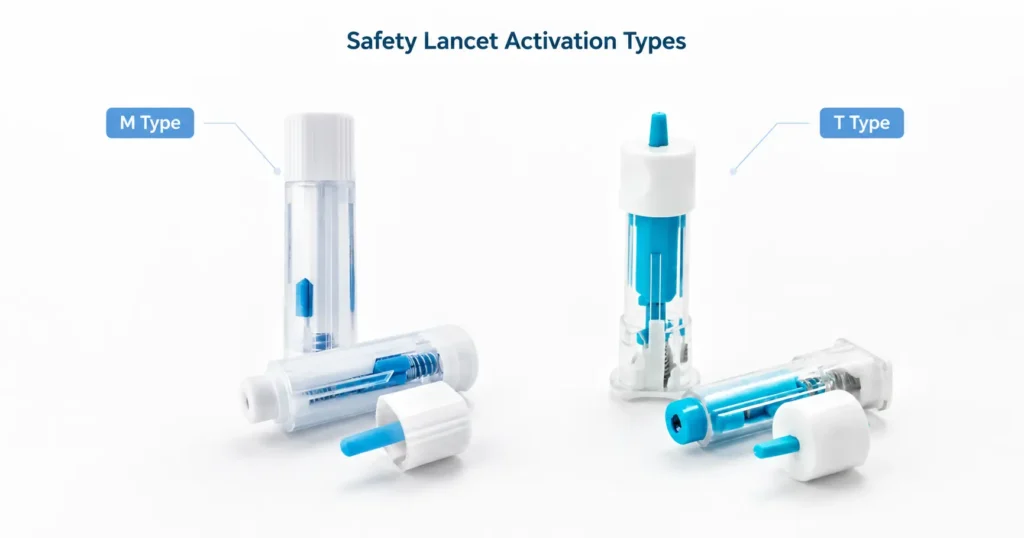
Safety lancet depth and activation are separate purchasing fields. Start with the test and intended setting, then record the exact REF, needle gauge or blade dimensions, the source’s depth or length terminology, fixed or selectable settings, triggering action, post-use protection and pack. Pressure-activated models fire through contact pressure; button-activated models use a separate trigger. Neither label alone establishes sample volume or comfort. For our M-Type and T-Type families, cap removal comes before positioning and pressing.[5][6][9][10]
Scope: Professional procurement guidance, not a patient-specific depth or puncture-site recommendation. Use current product labeling, test instructions and applicable clinical and workplace procedures.
Specification control
1. Separate Gauge, Depth, Activation and Protection
A standalone safety lancet contains its own puncture mechanism and is discarded after one use. It is not a loose lancet refill for a reusable pen-style lancing device. Keep these architectures separate in the item master and in staff training.[1][2]
Needle or blade
For a needle, record the gauge. For a blade, record the published incision dimensions. A blade width is not a needle gauge.
Depth or needle length
Copy the field name, millimeter value and unit from the exact specification. A needle-length entry does not automatically establish skin penetration depth.
Activation
Record the action that fires the prepared device: pressure/contact, a top or side button, or another labeled sequence.
Post-use state
Record retraction or shielding and the separate reuse-prevention behavior. The word automatic is not a complete mechanism specification.
Within the same gauge system, a higher gauge generally indicates a smaller needle diameter. It does not identify puncture depth, blood yield, pain or approved use. Likewise, a millimeter value needs its source terminology: depth, needle length and selectable setting are not interchangeable fields.
Depth architecture
2. Fixed-Depth and Adjustable Designs
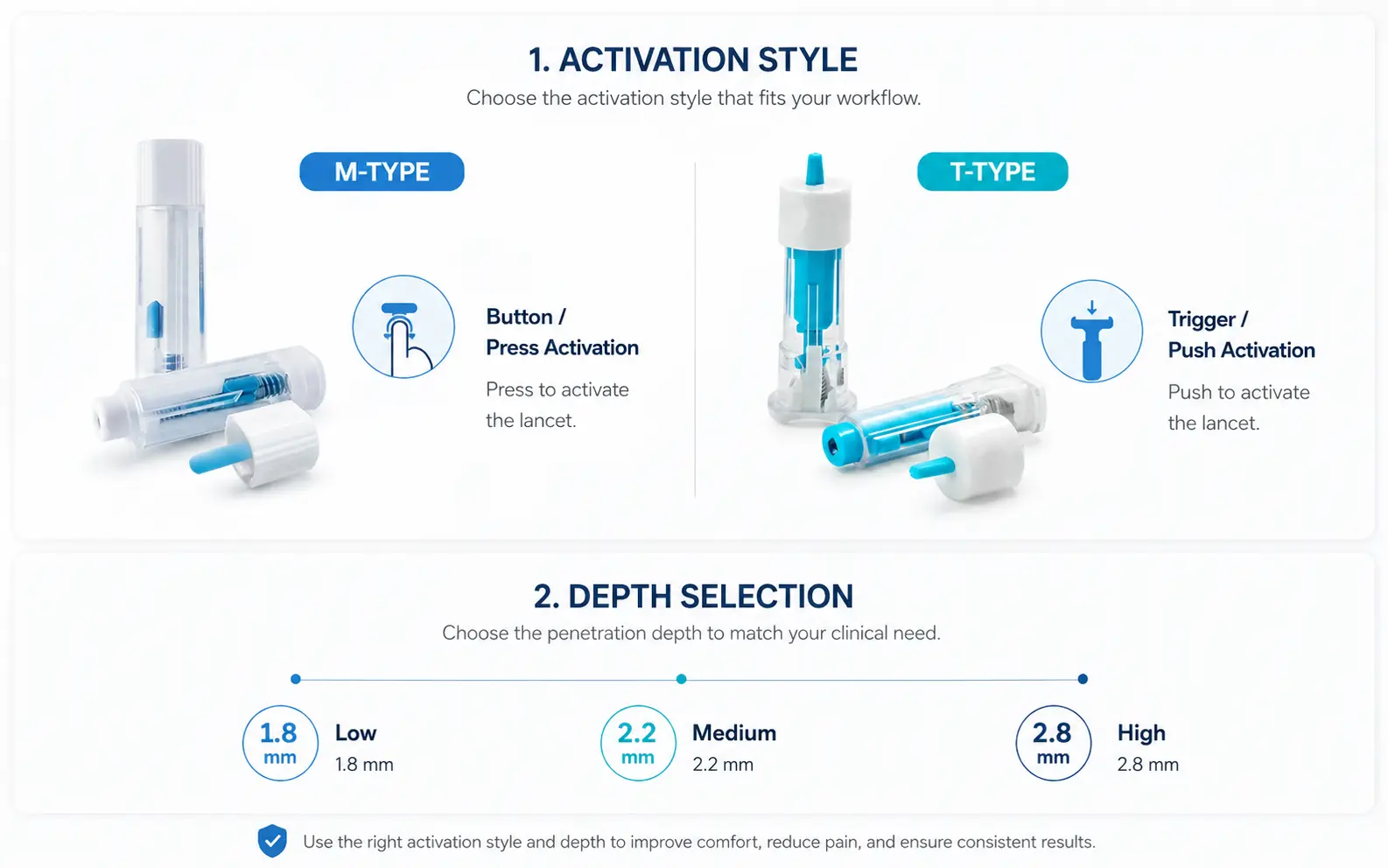
A fixed-depth product assigns one specification to an exact REF. An adjustable product provides labeled settings within one device. This distinction is independent of the activation method: a firing button alone does not establish whether depth is selectable.
| Buyer issue | Fixed-depth design | Adjustable design |
|---|---|---|
| Product identity | Record the exact REF and its published depth. | Record the REF, labeled settings and selected setting where relevant. |
| Inventory | Different requirements may need separate REFs. | One SKU may cover several approved settings. |
| Point of use | No on-device depth-selection step. | Selection, visibility and setting retention need attention. |
| Substitution | Match more than the numerical depth. | A matching setting alone does not establish equivalence. |
For a named adjustable example, the U.S. Unistik Pro Plus page lists 1.3, 1.8 and 2.3 mm settings with top-button activation. These are specifications for that product, not a depth recommendation for our M-Type or T-Type families.[6]
Do not turn commonly seen millimeter values into a chart prescribing devices by age, skin thickness or test category. The labeled site and population, exact test instructions and facility procedure remain the starting point.
Activation types
3. Pressure Activation Is Different from Button Activation
| Activation | Operating distinction | What to document |
|---|---|---|
| Contact / pressure | After labeled preparation, the device fires when pressed against the intended site. | Cap removal, correct contact end, grip, activation requirements and post-use protection. |
| Top / side button | The user positions the device, then operates a separate trigger. | Button location, orientation, intentional firing and completion feedback. |
BD describes its Microtainer contact-activated lancet as firing when positioned and pressed against the skin. Owen Mumford describes Unistik Pro Plus as top activated with a push button. These examples explain the terminology; they are not comparative tests or substitution approvals.[5][6]
One-step activation does not mean no preparation. For our M-Type and T-Type products, the illustrated sequence includes twisting and removing the protective cap before positioning and pressing. Holding the housing from the sides and pressing the contact end is not the same as pressing a separate end button.[9][10]
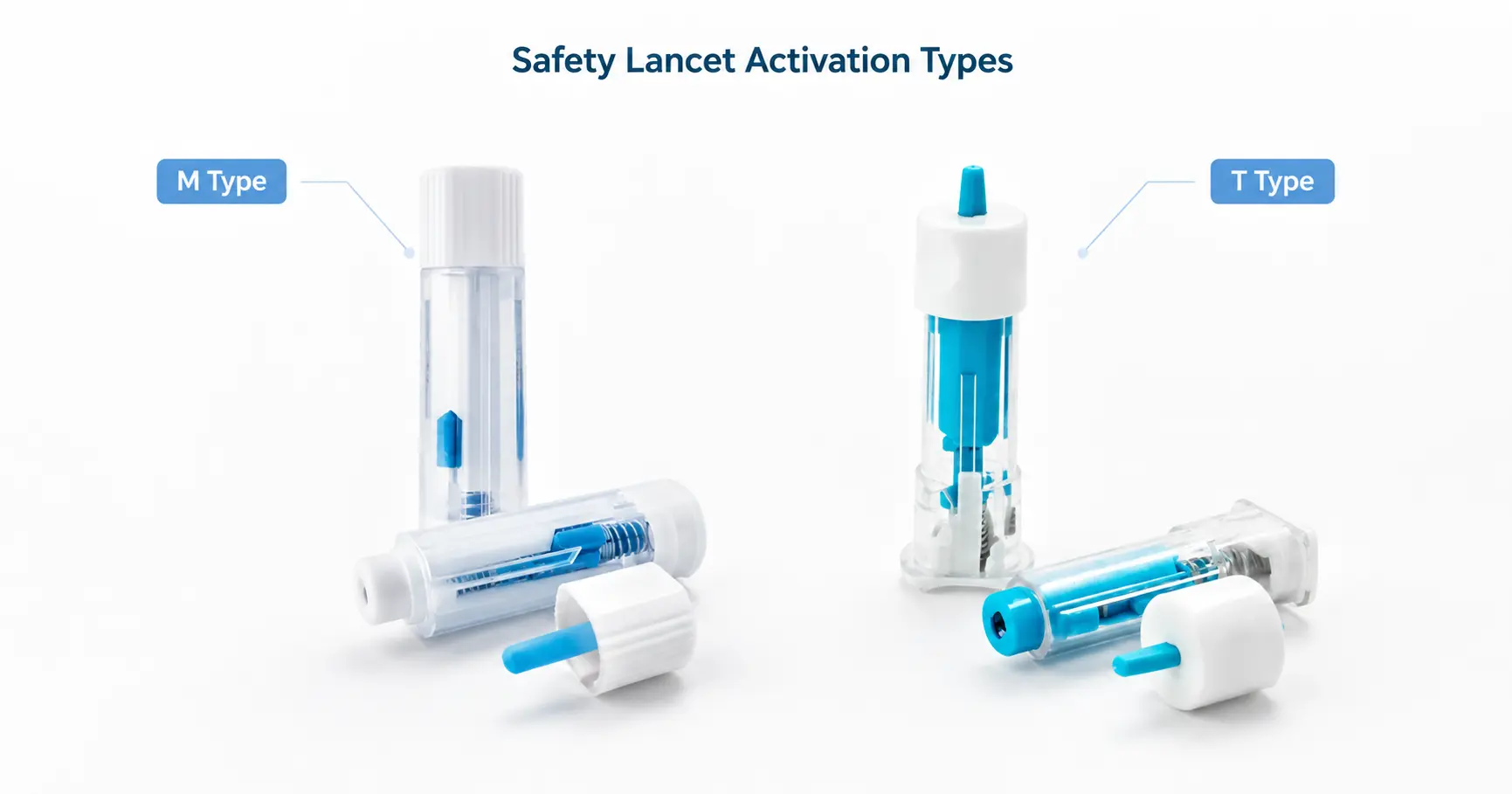
Use the current instructions for use (IFU) to identify the correct parts and sequence. Terms such as contact activated, pressure activated and one-step describe aspects of operation; they are not a universal classification system across suppliers.
Device lifecycle
4. Retraction and Reuse Prevention Are Separate Checks
Activation releases the sharp. Retraction returns it into the housing. Reuse prevention stops the device from completing another puncture. These actions can occur in one automatic cycle, but they should remain separate fields in the product record.
Protective components, labeling and package condition.
The labeled preparation, positioning and triggering action.
Automatic sharp protection and the documented used state.
Single-use handling and point-of-use sharps disposal.
Automatic retraction is a device action, not an extra task the user performs after firing. For our M-Type, the product information describes rapid retraction and a design that prevents reuse. Keep that distinction visible without suggesting that a retracted device becomes reusable.[9]
A protected used lancet still belongs in the applicable sharps-disposal process. CDC recommends point-of-use disposal in an approved sharps container; retraction does not make it ordinary waste.[1]
Test-system fit
5. Start with the Test, Then Evaluate the Device
The meter, strip, rapid test or collection method defines the accepted specimen and required sample. Record that requirement before comparing lancet gauges or depths. A product-family flow description is not a universal microliter output across brands.
For a procurement evaluation, identify the exact test and specimen, the lancet’s labeled site and population, and any adjustable setting. Keep these together with the product reference so an observed result is not attributed to gauge alone.
What the research can support
A 2020 study evaluated 16 safety-lancet versions across four families in 100 healthy adults. Blood volume differed between the tested blade- and needle-equipped groups. The authors were affiliated with HTL-Strefa; the findings apply to those devices and study conditions, not to untested Tonmit SKUs.[7]
A 1999 study in 52 healthy participants varied needle diameter and depth within one Softclix II system. Blood volume and pain relationships depended on those conditions. It does not provide a cross-brand formula for predicting either outcome.[8]
Avoid claims that a gauge always produces a stated volume, a depth fits every adult, or an activation type is painless. A heel-incision device also needs its own labeled site, population and incision dimensions; a fingerstick product is not an automatic substitute.
U.S. workflow boundaries
6. Assisted Monitoring and Occupational Exposure
CDC recommends single-use, auto-disabling fingerstick devices for assisted blood glucose monitoring, including devices whose lancets permanently retract. Reusable personal fingerstick devices must not be shared, even when the disposable lancet is changed.[1]
FDA’s blood-lancet labeling guidance recommends clear single-use or single-patient limitations, disposal instructions, and an explanation of any sharps-safety or self-disabling feature. It is labeling guidance, not an approval record for a particular SKU.[2]
OSHA scope follows occupational exposure
The federal Bloodborne Pathogens Standard applies to occupational exposure to blood or other potentially infectious materials. Covered employers must use applicable engineering and work-practice controls. It is not a single product-selection rule for every business that sells lancets.[3]
OSHA’s 2008 interpretation distinguishes personal self-testing from sampling performed as a work duty, while noting hazards from improperly discarded sharps. Apply the relevant workplace and state-plan requirements to the actual activities.[4]
Device selection does not replace staff training, hand hygiene, gloves, clean/used separation, appropriate meter handling or disposal arrangements.[1]
Our safety lancet range
7. M-Type and T-Type: Relevant Procurement Differences
Our M-Type and T-Type families are standalone safety lancets. Both use cap preparation followed by a placement-and-press sequence; M-Type should not be labeled button activated merely because its housing has a flat end.[9][10]
| Specification | M-Type | T-Type |
|---|---|---|
| Needle configurations | 21G × 2.4 mm; 23G, 28G and 30G × 1.8 mm. | 21G × 1.8 or 2.4 mm; 23G, 28G and 30G × 1.8 mm. |
| Millimeter field | Needle length. | Needle length. |
| Activation / protection | Cap removal, then pressure activation; automatic retraction and reuse-prevention design. | Cap removal, then pressure activation; needle shielded before and after use. |
| Sterilization wording | Irradiation. | Gamma irradiation. |
| Published pack | 100 pieces/box; 2,000 pieces/case. | 100 pieces/box; 1,000 pieces/case. |
Family data is cross-checked against the corresponding product specifications and IFU illustrations.[9][10] A case count is not a MOQ or a live-stock commitment.
Tonmit buyer worksheet
8. Receiving, Traceability and Complaint Records
We provide a blank receiving-review worksheet to help buyers connect each shipment to the approved REF and lot. It is a documentation tool, not a completed inspection report or evidence of tests performed on a Tonmit shipment.
Supplier, labeler, REF and approved specification revision.
Gauge or blade data; the original depth or length field.
Protective components, visible damage and labeling.
Lot, expiry, shipment and barcode packaging level.
Units/box, boxes/case and total received quantity.
Observations, evidence references and release or hold decision.
Record who reviewed the lot, the date, number of units examined and relevant photos. For complaints, retain the exact REF, lot and reported issue: no fire, premature fire, incomplete retraction, exposed sharp, damaged protective component or unclear used state.
Visual and document checks do not independently establish sterility, puncture depth, activation force, retraction speed or blood yield. Do not activate stock intended for sale as a routine receiving check; any separate functional evaluation needs an approved procedure and dedicated samples.
Keep complaint and disposition records linked to downstream customers or locations. Replacing a box should not break that traceability chain.
Commercial planning
9. Normalize Case Pack, Dating and Total Use Cost
Before comparing quotations, identify units per box, boxes per case and the price denominator. Then add the MOQ, destination, lead time, minimum remaining shelf life and whether supply comes from available inventory or new production.
Barcode or UDI information must match the exact product and packaging level. Do not use a company registration number as a product identifier, or assign another labeler’s code to private-label goods without the corresponding labeling record.
÷ Number of completed acceptable samples
Relevant inputs may include product and freight, dedicated evaluation units, repeat attempts, labor, training, unusable or expired stock, disposal and complaint handling. Define a consistent period and avoid counting the same cost twice. This is a comparison framework, not a claim that one lancet reduces repeat sampling.
Use the same accepted product requirements and accounting basis for each quotation. A lower piece price is not directly comparable when the pack, remaining shelf life or required workflow differs.
Practical buyer tools
10. Download the Checklist and RFQ Template
Use these editable text templates for receiving documentation and a first supplier inquiry. Unknown fields can remain blank; they should be resolved before final approval rather than filled with assumptions.
Safety Lancet Review Checklist
Record the requirement, observation, inspection coverage and disposition for the exact REF and lot.
Open the checklist text
Depth & Activation RFQ
Capture the test requirement, source terminology, mechanism, pack, quantity, destination and document needs.
Open the RFQ text
These are blank buyer templates, not QC results or clinical instructions. The text remains available for manual copying when download controls are unavailable.
Documents to request
Request the current specification, IFU, label and packaging information, plus relevant sterility, shelf-life and market records. Match the document’s issuer, legal manufacturer or labeler, exact model, revision/date, validity where applicable and market scope. A document for a related family is not automatically evidence for the quoted REF.
Buyer FAQ
11. Common Depth and Activation Questions
Does needle length mean penetration depth?
Not automatically. Preserve the field name used in the exact specification. Our published M-Type and T-Type millimeter entries are labeled needle length, not a general recommendation for skin penetration.
Does one-step activation mean there is no cap to remove?
No. Our M-Type and T-Type IFU illustrations show twisting and removing the protective cap before positioning and pressing. One-step activation describes triggering after that preparation.
Is our M-Type a button-activated lancet?
Its illustrated operating sequence is cap removal followed by pressing the device against the site while holding the housing. A flat housing end is not evidence of a separate firing button.
Does an adjustable depth setting make two products interchangeable?
No. Gauge or blade geometry, labeled use, trigger design, post-use protection, packaging and product evidence also need to match.
Can gauge predict blood volume or comfort?
Gauge alone cannot establish either outcome. Evaluate the exact test requirement and product-specific evidence, including the conditions under which any results were measured.
Can a retracted safety lancet be reused?
No. Treat the device as single-use, follow its IFU and use the applicable sharps-disposal process. Automatic protection does not make a used device reusable.
The Purchasing Record Should Follow the Product
Keep the published specification, preparation and triggering sequence, post-use state and pack tied to one approved REF. That record supports selection, receiving and complaint review without turning a shared gauge or millimeter value into a substitution rule.
Sources and Editorial Basis
- CDC – Considerations for Blood Glucose Monitoring and Insulin Administration
- FDA – Blood Lancet Labeling Guidance (2010; labeling recommendations)
- OSHA – 29 CFR 1910.1030, Bloodborne Pathogens Standard
- OSHA – Lancets and Lancing Devices in the Workplace (2008 interpretation)
- BD – Microtainer Contact-Activated Lancet
- Owen Mumford – Unistik Pro Plus, U.S. product information
- Serafin et al. (2020) – Blood volume and pain perception; PMID 32027205
- Fruhstorfer et al. (1999) – Lancet diameter, pain and blood volume; PMID 10700356
- Promisemed – M-Type product information, specification and IFU illustration
- Promisemed – T-Type product information, specification and IFU illustration
This guide separates official guidance, product-specific examples, research findings and our blank buyer tools. Studies are not evidence for untested SKUs. Product pages and IFU illustrations are not substitutes for the current documents supplied with the exact product.
Prepared by Tonmit Medical Supply Editorial Team. Reviewed by James Wilson, Product Specification Reviewer; Michael Thompson, Quality Documentation Reviewer; and David Anderson, Regulatory Research Reviewer. Reviewer responsibilities and professional backgrounds are published on our Editorial Team page. For corrections, use the editorial contact on that page.
Safety lancet supply review
Send Your Depth and Activation Requirements
Share the exact REF or required configuration, test and setting, quantity, destination, packaging and document needs. We will review our available lancet options against your purchasing requirements.
RFQ subject: Safety Lancets – Depth & Activation Review