
GLP-1 Pharmacy Supply Planning
Compare oral GLP-1 and injectable accessory needs by exact medicine, device and carton contents. Use a presentation-based supply plan to reduce pharmacy mismatches and unnecessary purchases.
Scope: U.S. pharmacy accessory procurement. Configurations may differ by market. Tonmit is an independent medical-supply business; brand references do not imply manufacturer affiliation, endorsement or verified compatibility of a particular Tonmit SKU. Clinical decisions and the current product labeling take precedence.
Direct answer
Does the Wegovy pill need injection supplies?
Wegovy tablets do not require pen needles, syringes, injection prep pads or a sharps container to administer the tablet itself. Injectable presentations require a separate device check: an integrated needle, a detachable needle supplied in the carton, and a detachable needle purchased separately create different procurement needs. [1][2][3][4]
A patient taking an oral medicine may still use insulin or another prescribed injectable, or monitoring supplies that create sharps. Confirm those continuing needs before removing items from the patient’s supply plan. This is a medication-reconciliation step, not a reason to bundle injection accessories with every oral prescription.
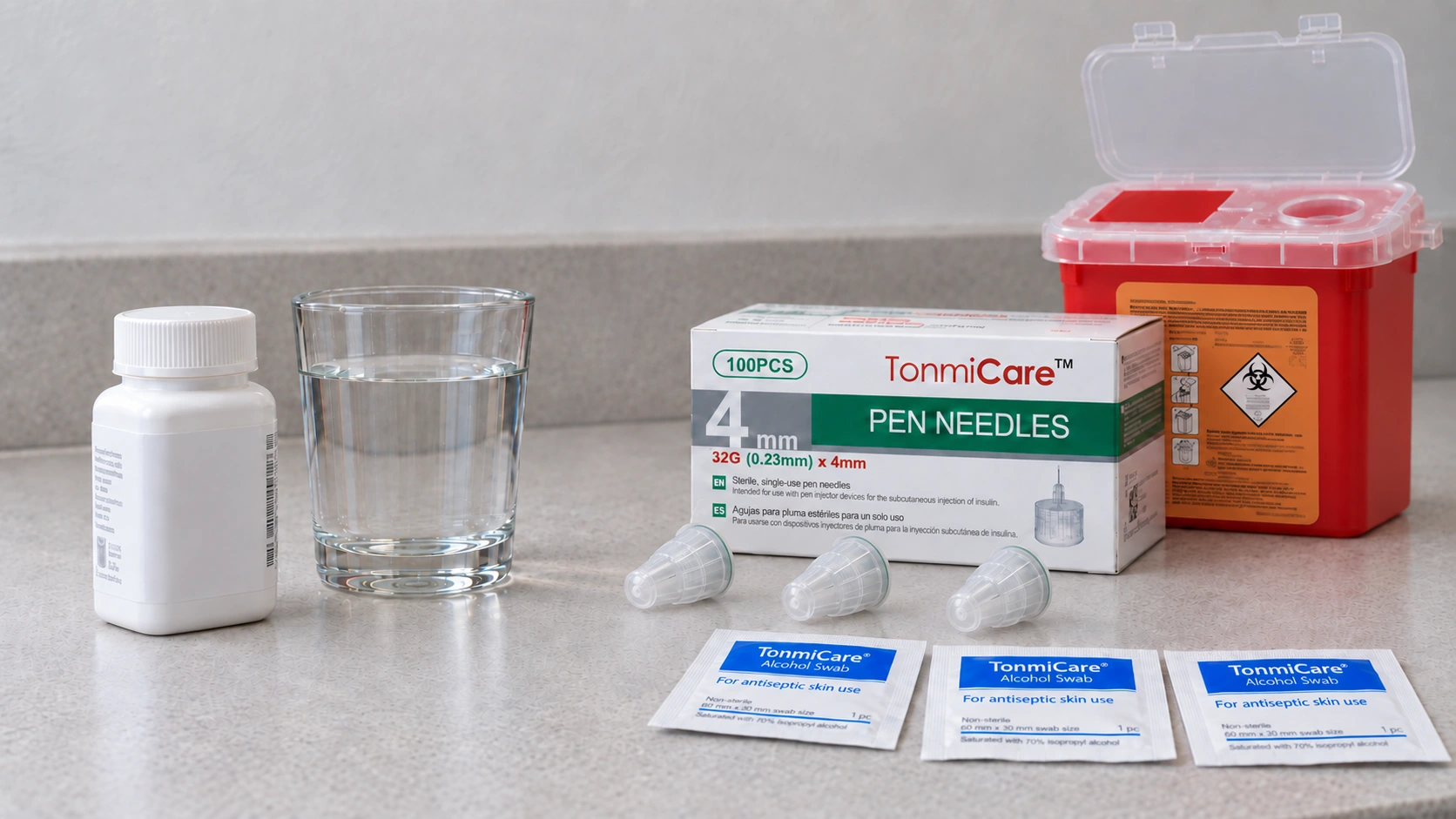
An oral GLP-1 prescription changes the supplies needed for that medicine. It does not automatically remove every injection-related need from a patient’s care plan. Pharmacies should match accessories to the exact medicine, presentation and current treatment regimen before assembling a supply bundle.
For buyers comparing oral GLP-1 vs injectable options, the practical question is: which items are necessary for this prescription, which are already supplied, and which belong to another ongoing treatment? That distinction helps prevent unnecessary needle orders and missing supplies at dispensing.
1. Compare the presentation before choosing the accessories
The current U.S. Wegovy prescribing information lists tablets, single-dose pens, single-dose syringes and a FlexTouch pen. A brand name alone therefore cannot determine the accessory list. Label-listed presentations do not establish that every configuration is in stock at a particular pharmacy. [1]
Scroll horizontally to view all columns.
| Exact medicine or presentation | Needle configuration | Supply-planning action |
|---|---|---|
| Wegovy tablets (oral semaglutide) | No injection device | Exclude injection accessories for this medicine; provide product-specific administration and storage instructions. |
| Foundayo tablets (orforglipron) | No injection device | Use a separate oral-product record and counseling materials; do not copy Wegovy’s administration instructions. |
| U.S. Wegovy single-dose pen | Built-in needle | No separate pen needle for this device; check preparation supplies and sharps-disposal access. |
| U.S. Wegovy single-dose prefilled syringe | Integrated needle | No separate pen needle for this device; use the syringe-specific instructions and disposal plan. |
| U.S. Wegovy FlexTouch, 2.4 mg per dose | Attachable needles; the specified carton includes four needles | Verify carton contents before adding separate needles; provide any verified replacement or additional supply needed. |
| U.S. Zepbound KwikPen | Compatible attachable pen needles are not included | Arrange the verified compatible needles separately, plus preparation supplies and sharps-disposal access. |
Sources for the configurations above: current Wegovy labeling and patient instructions, the FDA-approved FlexTouch carton label, Foundayo labeling, and the Zepbound KwikPen Instructions for Use. Confirm the dispensed carton and current instructions each time the presentation changes. [1][2][3][4][5][6]
Zepbound contains tirzepatide, a dual GIP/GLP-1 receptor agonist. It is included here because its accessory requirements are relevant to the same pharmacy supply workflow. [7]
2. Oral prescriptions need product-specific support
Removing injection accessories should leave a useful oral dispensing process. For Wegovy tablets, reinforce the labeled morning routine: take the tablet on an empty stomach with water, up to 4 ounces; wait at least 30 minutes before food, beverages or other oral medicines; swallow it whole. [2]
A printed routine card or phone reminder may support that routine without adding consumables. A timer or measuring cup is optional assistance, not a manufacturer-required accessory.
Storage also affects accessory selection. Wegovy tablets should remain in the original closed bottle until use, at room temperature in a dry place. A pharmacy should therefore not default to a weekly pill organizer or repackaging service for this product. [2]
Do not apply that administration routine to every oral GLP-1. Foundayo is taken once daily with or without food. Its instructions are product-specific, so the two products need distinct counseling records. [5]
3. Use five checks before releasing a supply bundle
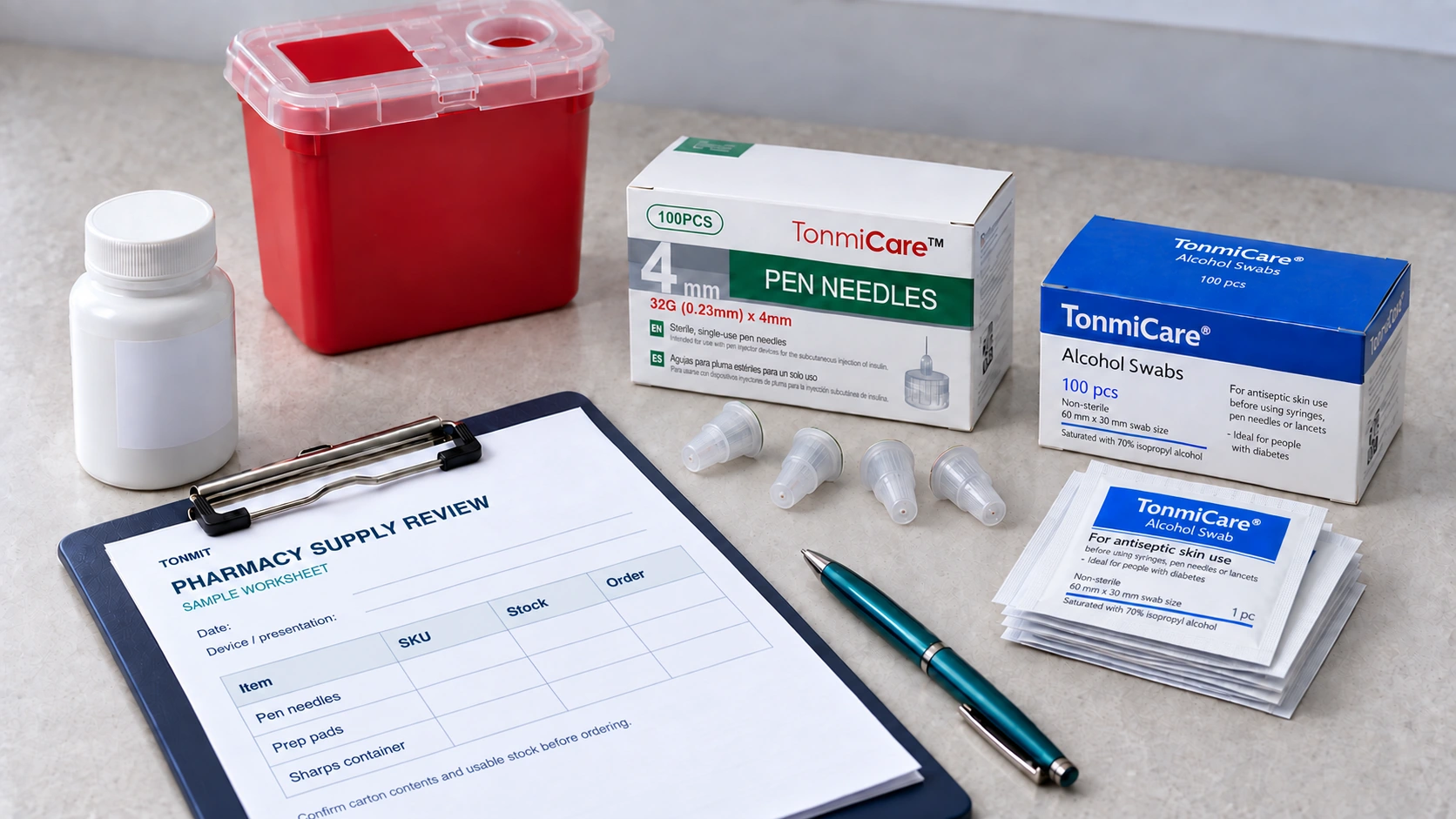
The following workflow is a proposed procurement control derived from the verified device differences. It is not a manufacturer-mandated dispensing protocol.
Check 1: identify the medicine and presentation
Record the product name, route, strength, device or dosage form, market and exact package identifier. In U.S. workflows, the dispensed NDC can help distinguish presentations. A patient request for “Wegovy supplies” needs clarification against the actual prescription and carton.
Check 2: confirm how the needle is supplied
Record whether a needle is integrated, detachable and included, or detachable and excluded. For an attachable needle, retain compatibility evidence for the proposed supplier SKU and the exact pen. A shared gauge, length or broad “GLP-1 compatible” description does not by itself establish compatibility.
Check 3: reconcile other continuing treatments
Ask which injection and monitoring supplies the patient still uses. Link each continuing item to its own treatment or task. Do not cancel insulin pen needles, lancets or an existing sharps-disposal arrangement solely because the GLP-1 prescription is oral.
Check 4: check usable stock and disposal access
Confirm compatible, unopened, unexpired supplies already available to the patient and whether the sharps container needs replacement. Avoid issuing another full accessory pack automatically at every refill.
Check 5: resolve discrepancies before fulfillment
If the prescription, device record and accessory order disagree, hold the conflicting accessory selection for pharmacist clarification. For example, an oral Wegovy prescription linked to a KwikPen needle bundle needs review; a KwikPen order without a needle plan also needs review. Document the resolved presentation and supply decision.
4. Build separate supply modules instead of one universal kit
A modular purchasing system lets staff select only the components relevant to the confirmed prescription and patient needs.
Scroll horizontally to view all columns.
| Supply module | Release condition | Waste-reduction control |
|---|---|---|
| Oral administration support | Confirmed oral product | Select the correct routine and storage information; avoid automatic injection accessories. |
| Separate pen needles | Confirmed attachable-needle device and a supply gap | Deduct needles included in the medicine carton and usable patient stock. |
| Injection preparation | Confirmed injectable presentation | Use the current Instructions for Use to select alcohol swabs, gauze or other required items and quantities. |
| Sharps disposal | Confirmed sharps-generating treatment or monitoring task | Check existing capacity, the items being discarded and the replacement need. |
| Transport and storage support | Exact product requirements and delivery conditions | Assess the specific presentation; avoid attaching the same cooling package to every order. |
Sharps-container planning should consider the discarded item, not just injection frequency. A whole single-dose pen occupies different space from a detached pen needle. Do not promise a fixed disposal capacity from container volume alone.
FDA recommends promptly placing used sharps in an FDA-cleared disposal container. Use the marked fill line and local disposal arrangements when planning replacement. Home-use guidance and health care facility waste procedures are distinct. [8]
5. Forecast separate needles from the device mix
Patient totals are an incomplete purchasing input. Separate-needle demand depends on how many patients use attachable-needle devices, how many scheduled injections they will take in the planning period, and how many usable needles are already supplied.
Illustrative four-dose planning cycle: assume 300 patients in mutually exclusive groups, no other injection-related needs within this example, and verified carton contents. The injectable groups below each have four scheduled weekly injections. Oral dispensing calendars are managed separately.
Scroll horizontally to view all columns.
| Group | Patients | Baseline separately supplied pen needles |
|---|---|---|
| Oral GLP-1 prescriptions | 120 | 0 |
| Integrated-needle single-dose devices | 80 | 0 |
| Specified Wegovy FlexTouch cartons, with four included needles | 40 | 0, assuming the included needles cover the scheduled doses |
| Zepbound KwikPen, needles supplied separately | 60 | 60 × 4 = 240 |
| Total | 300 | 240 before stock adjustments or reserve |
Four fixed weekly doses and the contrasting needle inclusion are supported by the relevant device instructions and carton label. The patient mix and calculation are hypothetical. [4][6]
For each attachable-needle group, calculate the supply gap after usable included needles and patient-held stock. Aggregate those gaps, add a justified operational reserve, then deduct unallocated pharmacy stock and confirmed receipts. Round the remaining requirement to the supplier’s pack size. Count each stock item only once.
If the pharmacy chooses an illustrative 10% reserve, the example becomes 240 + 24 = 264 needles before inventory deductions. With no stock or receipts and packs of 100, purchasing three packs supplies 300 needles. The additional units are a pack-rounding consequence; they do not change the patient’s prescribed use. The 10% reserve is a buyer assumption, not a label requirement.
Use actual due dates for the forecast. Four weekly doses represent a 28-day supply cycle, while a once-daily 30-tablet fill represents 30 days. Treating both as one identical “monthly” cycle can distort replenishment dates.
6. Recheck supplies when a patient changes route or device
A route or device change should trigger a new accessory review. Check the pharmacist-verified treatment plan, the final injection date where relevant, the first oral dose date, other continuing medicines and the patient’s usable supplies. Do not infer a clinical switch or calculate a dose conversion from an accessory order.
Wegovy labeling provides specific switching instructions; oral and injectable milligram amounts should not be treated as interchangeable. The dispensing pharmacist should verify the applicable instructions and prescription. [1]
Update the recurring accessory order before the next release. Stop obsolete GLP-1-specific supplies after confirmation, retain supplies needed for other treatments, and replace device instructions when the injector changes. Set a date for any unresolved follow-up so a temporary supply decision does not become a permanent recurring order.
7. Give suppliers a presentation-based purchasing brief
A useful accessory request states the market, exact device, number of patients or devices in each group, scheduled administrations, carton inclusions, existing usable stock and requested replenishment period.
For separately sourced pen needles, request the manufacturer and REF/SKU, gauge and length, device-specific compatibility documentation, sterile single-use packaging information, expiration and lot traceability, box and case quantities, lead time and minimum order quantity. Evaluate the actual proposed SKU rather than a product-family claim.
For preparation and disposal items, state the expected use, existing stock, container design and opening requirements, disposal route and delivery frequency. Ask for separate line items so the pharmacy can adjust needles, prep pads and sharps containers independently.
Frequently asked questions
Does every injectable GLP-1 need separately purchased needles?
No. The device and carton determine that decision. Some devices have integrated needles; some attachable-needle pens include needles. Check the exact presentation and any additional supply gap. [1][3][4][6]
Should an oral GLP-1 patient receive a sharps container?
Not for tablet administration alone. Confirm whether another continuing treatment or monitoring task generates sharps before deciding that no container is needed.
Can all oral GLP-1 products use the same routine card?
No. Wegovy and Foundayo have different administration instructions. Maintain a product-specific version and check it against the current labeling. [2][5]
Can a pharmacy use the same storage instructions for every injectable presentation?
No. Confirm the exact product and device, storage conditions and applicable time limits. Record opening or temperature-excursion dates when required by the product instructions rather than applying one generic rule.
Does an oral switch mean glucose-monitoring supplies can be stopped?
Do not make that decision from route alone. Keep monitoring supplies aligned with the patient’s current clinical plan and have the pharmacist resolve any proposed change.
Buyer worksheet
Copy a presentation-based RFQ checklist
Use this checklist to organize your accessory request. Add aggregate demand and stock figures, then confirm any clinical or device discrepancy with the pharmacist.
View or edit the RFQ template
You can also select and copy the text manually. The worksheet supports procurement planning and does not select medicines or doses.
Pharmacy accessory procurement
Plan around the verified presentation
For a pharmacy supply review, prepare the device mix, needle inclusions, scheduled use, usable stock and replenishment period. These inputs support a practical purchasing discussion and help avoid a universal kit that sends some patients unnecessary items while leaving others short of compatible needles.
Send your purchasing brief
Request a GLP-1 accessory supply review
Share the destination, exact presentation, accessory quantities, existing stock and replenishment period. Use the checklist above to prepare your request.
Official sources and references
- Novo Nordisk. Wegovy U.S. Prescribing Information, Medication Guide and Instructions for Use. Revised June 2026. Sections 2, 3 and 16, plus device-specific IFUs.
- Novo Nordisk. Wegovy Pill Guide and Dosing Information. Administration, original-bottle storage and patient FAQs.
- Novo Nordisk. Wegovy Pen Guide and Dosing Information. Single-dose pen needle configuration and disposal.
- FDA. Wegovy approved labeling, application 215256 supplement 025. FlexTouch IFU and carton labeling, especially PDF page 86 of 88 (printed carton label).
- Eli Lilly. Foundayo (orforglipron) U.S. Prescribing Information. Sections 2.1 and 16.
- Eli Lilly. Zepbound KwikPen U.S. Instructions for Use. Dose count, compatible-needle requirement and needle exclusion.
- Eli Lilly. Zepbound U.S. Prescribing Information. Drug class and mechanism of action.
- FDA. Sharps Disposal Containers. Home-use disposal, fill line and distinction from facility guidance.
Source check: Official sources were checked on October 6, 2026. Recheck the current labeling and dispensed package when the medicine, market or presentation changes. The workflow, patient mix and 10% reserve are planning assumptions, not manufacturer requirements.
Prepared under the Tonmit Medical Supply Editorial Team byline. Katherine Scott, James Wilson and Joseph Walker are the assigned reviewers for evidence, specifications and supply planning. Named approval is pending.
Medicine selection, switching, dosing and patient-specific counseling remain clinical decisions. The applicable prescribing information and Instructions for Use take precedence.