
Injection accessory supply planning
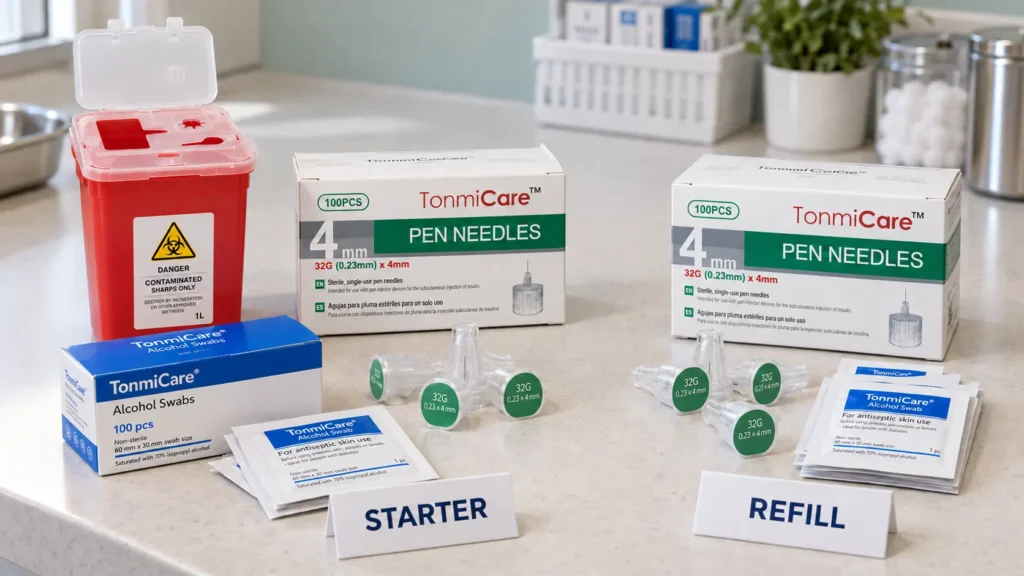
For a GLP-1 weight loss program, the first delivery sets up injection supplies and disposal arrangements. Later deliveries top up what is actually running short. We explain how to separate starter and refill kits, account for usable stock, and keep replacement items out of automatic consumable orders.
Assigned reviewers
We cover injection-accessory procurement and use current U.S. labeling for the device examples. Medication selection, dosing, training and treatment changes remain with the dispensing pharmacy and treating healthcare professional. Check the exact presentation and local instructions for each order.
Quick answer
What belongs in a GLP-1 starter kit and refill kit?
A GLP-1 starter kit should establish the device-appropriate injection supplies, preparation materials and a safe sharps-disposal route. A GLP-1 refill kit should replenish consumables against the next confirmed use period and remaining usable stock. An existing sharps container or reusable organizer usually needs a separate replacement trigger.
- Each injection: a new external pen needle or syringe-and-needle assembly when the device requires it; the prescribed single-use injector already provides its own needle.[1][2][3][4]
- Each refill decision: check supplies used, supplies already included, the next delivery date and changes to the device.
- Conditional replacement: sharps containers, travel cases and reusable organizers. Do not attach them automatically to every medicine refill.
GLP-1 weight loss: where an accessory kit fits
At Tonmit, we supply medical consumables and coordinate injection-accessory kit projects. We do not supply or compound GLP-1 medicines. In this guide, the starter kit establishes the supplies needed for an approved device; the refill kit replenishes those consumables after a stock check.
A prescription refill should trigger a supply review, not a repeat of the whole starter box. If needles and prep supplies remain sufficient, the next accessory shipment may be smaller or unnecessary. A route or device change, however, can require a new component review even while treatment continues.
Our GLP-1 support-supply procurement guide covers the broader component, documentation and supplier checks. The starter/refill decisions below turn those requirements into shipment quantities and reorder rules.
1. Which weight loss injection supplies does the device need?
When requesting weight loss injection supplies from us, include the exact medicine presentation, device name, intended market and current package instructions. The same medicine brand can appear on devices with different accessory requirements.
Here, starter kit means an accessory bundle rather than a medicine initiation pack. The prescription medicine is ordered and dispensed separately through its authorized process.
| Presentation | External injection item | First order and refill check |
|---|---|---|
| Single-dose pen with an integrated needle | No separate pen needle for that presentation. | Confirm the exact injector. Examples include U.S. Wegovy single-dose pens and Zepbound single-dose pens.[3][5] |
| Multi-dose pen using detachable needles | A new compatible pen needle for each injection. | U.S. Zepbound KwikPen needles are not included. U.S. Ozempic multi-dose pen cartons include needles; count them before adding more.[1][2] |
| Wegovy FlexTouch multi-dose pen | A new compatible pen needle for each injection. | The June 2026 U.S. label includes this presentation and states that needles are included. Check the supplied carton rather than using a single-dose-pen checklist.[3] |
| Single-dose or multi-dose vial | The pharmacy-approved syringe and needle configuration. | Confirm the exact vial and its current instructions. The U.S. Zepbound label lists both vial formats; their preparation and discard instructions are not interchangeable. Use a new syringe and needle for each injection.[4][11] |
| Single-dose prefilled syringe with an integrated needle | No separate empty syringe or pen needle for that presentation. | Current U.S. Wegovy and Ozempic labels also list prefilled syringes. Verify the product actually being dispensed.[2][3] |
| Oral treatment | No injection accessories for the oral medicine itself. | Stop its injection-accessory refill rule. Retain supplies still needed for another prescribed injectable.[3] |
Device examples describe accessory requirements, not treatment eligibility or local stock availability. Ozempic is included as a device example, not as a claim of a weight-management indication.
Do not turn a vial order into a generic insulin-syringe bundle
The dispensing pharmacist must approve the syringe and instructions for the specific vial and concentration. FDA has reported dosing errors involving confusion between milligrams, milliliters and syringe “units” with compounded semaglutide.[6] We need that approved specification before quoting a vial-supply configuration; a request for a “GLP-1 vial kit” does not establish a dose conversion.
Device and program checks · October 2026
Changes worth checking before the next accessory order
Zepbound KwikPen needles: confirm the separate supply order
Needles are not supplied with the U.S. Zepbound KwikPen.[1] Confirm the approved needle reference and a supply route before the pen is handed over. For the next refill, check remaining needles rather than repeating the original box quantity. Use the Zepbound KwikPen needle compatibility guide for the device and needle evidence checks.
Wegovy pill vs injection: change the accessory rule with the route
The current U.S. label includes oral tablets and several injection presentations.[3] Once the pharmacy confirms a switch from injection to an oral prescription, remove that medicine’s injection consumables from recurring orders. Check other ongoing injectables first. The oral GLP-1 vs injectable supply guide explains how to keep the supply records separate.
Medicare GLP-1 Bridge: arrange pen needles separately
CMS states that Zepbound KwikPen pen needles are not covered by the Medicare GLP-1 Bridge and should not be billed to the Bridge or the patient’s Part D plan under this program; patients may purchase them separately.[10] Before handoff, confirm who will order the needles and how they will be paid for. Check the currently listed drug NDC; medicine coverage does not establish accessory availability.
2. GLP-1 starter kit vs refill kit: compare the contents
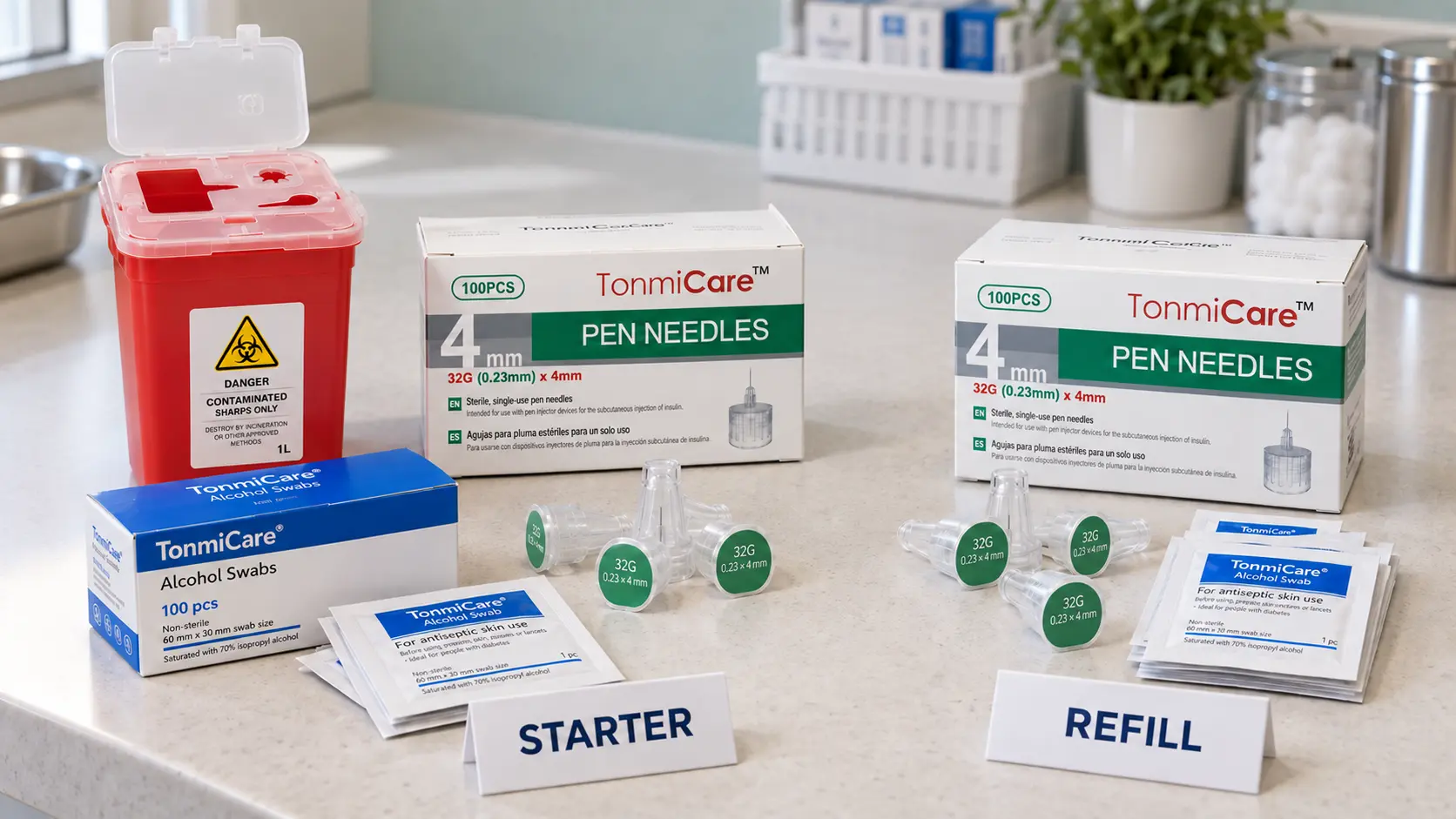
Keep two controlled bills of materials, or BOMs: one for the initial handoff and one for replenishment. Use a third, small add-on list for replacement items. This allows a pharmacy to order consumables without repeatedly purchasing the whole starter box.
| Component | Starter kit | Refill kit or replacement rule |
|---|---|---|
| Pen needles | Only for a pen that requires detachable needles. Confirm the exact approved needle reference. | Replenish planned use after subtracting usable stock and needles included with the current medicine carton. |
| Empty syringes and needles | Only for the approved vial workflow. Keep the approved capacity, scale and needle configuration together. | Reorder that same approved configuration unless the pharmacy approves a change. |
| Alcohol prep supplies | Provide the materials required by the product instructions and applicable care protocol. | Count actual preparation tasks. Do not assume every device needs the same number of pads. |
| Gauze or cotton | Provide a small quantity where the instructions call for it. | Top up actual use. It may be needed for light pressure if bleeding occurs, rather than consumed at every injection.[1][4] |
| Sharps container | Provide a suitable container if one is not already available, with disposal instructions. | Replace against fill limits, damage or another applicable replacement requirement. The refill date alone is insufficient. |
| Reusable case or organizer | Optional, based on an identified need. | Replace for loss, damage or a changed requirement; remove from routine replenishment. |
| Transport packaging | Select for the specific shipment and medicine handling requirements. | Review for every shipment that needs it. A personal cooler bag is a different item and does not validate a shipping method. |
| Instructions and contact card | Include current product instructions and the pharmacy contact route. | Supply revised information when the product, device or instructions change. Keep inserts version-controlled. |
For prep pads, specify the individually wrapped product, labeled contents, dimensions, count and storage conditions. Record sterile status only when the actual product label supports it. An alcohol pad is not interchangeable with a dry cotton pad or a general cleaning wipe.
A “one pad per injection” packing rule needs device-specific review. For example, Zepbound KwikPen instructions explicitly require wiping the pen’s red inner seal; vial instructions require wiping the stopper. Count the approved preparation steps before setting the pad quantity.[1][4]
3. Calculate the refill from the use period and usable stock
Start with the number of prescribed injections scheduled before the next confirmed supply arrival. Four weekly injections cover a four-dose cycle. A calendar month can contain five scheduled injection dates, so “monthly” is not a sufficient quantity specification.
Run the calculation separately for each approved consumable. Keep patient-level stock separate from pharmacy warehouse stock; a needle box held in a warehouse is not yet available to a patient.
Net units needed = planned uses × units per use + agreed reserve − usable stock − included units available
Use zero when the result is negative. If supply must be in full packs, round a positive requirement up to the next approved pack quantity.
“Usable” means the correct approved item, within its usable life, stored as labeled and with intact packaging. Count each unit once. If included needles are already in the on-hand total, do not subtract them again. Do not deduct a shipment that may arrive after the supplies are needed.
A worked accessory example
Suppose a pharmacy has approved a detachable-needle pen workflow with five scheduled injections before the next supply arrival. There are two usable needles on hand, none arriving with the medicine, and an agreed allowance of one spare needle.
If the program permits four individually sealed units to be dispensed with compliant labeling, the net requirement is four. If the approved supply format is a 100-count box, dispatching one box creates 96 units above the net requirement. After the five planned uses, expected closing stock is 97 needles, including the one-unit reserve. Record that usable stock for the next refill.
The figures are an inventory illustration, not a recommended reserve or a recommendation to break a manufacturer’s pack. Any smaller dispense format needs pharmacy approval, intact sterile barriers, adequate traceability and appropriate labeling. Extra needles for troubleshooting are separate from routine consumption; follow the device instructions when a problem occurs.
Carry the closing stock into the next refill check
Continue the same example with the approved 100-count supply format. For illustration, the following period also has five scheduled uses and a one-unit reserve. All remaining needles are still usable, and none arrive with the medicine.
| Supply period | Opening stock | Uses + reserve | Net need | Units sent | Closing stock |
|---|---|---|---|---|---|
| Current period | 2 | 5 + 1 | 4 | 100 | 97 |
| Following period | 97 | 5 + 1 | 0 | 0 | 92 |
The reserve is part of closing stock, not an additional consumed unit. Repeating a 100-count box at the second medicine refill would add stock despite a zero net requirement. Review prep supplies and container capacity separately; zero needle demand does not necessarily mean zero demand for every accessory.
Buyer tool
Accessory replenishment planner
Calculate one approved consumable at a time, using counts at the same stock location. Enter scheduled uses from the pharmacy-confirmed plan. This tool calculates accessory inventory, not medicine doses or injection schedules.
4. Replace condition-based items when their trigger is reached
Sharps containers: keep access continuous; do not send one every month by default
A disposable container may serve more than one refill period, but it is not emptied and reused. Follow its marked fill limit and replacement instructions. FDA’s home-use guidance advises disposal at about three-quarters full and according to local rules. Healthcare facilities need their own applicable waste procedures.[7][8]
Plan the next container before the current one reaches its limit. Ask about remaining capacity and the disposal route during the refill check. A single-dose injector takes a different amount of space from a detached pen needle, so do not promise a universal number of injections per container.
Travel cases and cold-chain materials: separate personal use from shipping
A reusable case may remain useful for many deliveries. Replace it when its condition or the user’s needs justify doing so. Shipping insulation, coolant and other transport materials still need assessment for each relevant shipment. The medicine’s current label and the validated shipping process govern temperature control; a cooler bag by itself does not establish either.
Optional extras: ask whether they are being used
Bandages, adhesive products and organizers can accumulate when every refill repeats the starter list. Record them as optional lines with an agreed top-up rule. Nutrition products, glucose-monitoring supplies and side-effect medicines require their own care-plan or product review; do not make them default components of an injection-accessory kit.
5. Put a short stock check between the prescription refill and dispatch
The person confirming the prescription and the person packing accessories may be different. Give the packing team a current accessory order, rather than asking them to infer it from the medicine name.
- Confirm the presentation. Compare the new medicine order with the previous device record. A change from a single-dose injector to a detachable-needle pen needs a new accessory review.
- Confirm the use period. Record the next confirmed supply arrival and the scheduled uses it must cover. A treatment pause or switch should suspend the related automatic accessory order until the pharmacy updates it.
- Reconcile stock. Count usable items and included accessories without double counting; check sterile barriers, expiry and storage.
- Check disposal access. Confirm an available container, remaining capacity and a local disposal route.
- Release the accessory order. State the approved component references, dispatch quantities and exceptions. Keep dose questions with the pharmacy.
Use a dispatch decision rather than repeating the last kit
| Finding at the refill check | Dispatch decision | Record to update |
|---|---|---|
| Usable consumables cover the next period | No extra units of that consumable are needed; still check disposal access. | Stock count and the next review date. |
| The medicine carton includes the approved needles | Count the included units once, then top up only the net shortfall. | Carton presentation and included quantity. |
| The device has changed | Hold the old kit rule until the pharmacy approves the new component list. Existing needles are not automatically suitable for the new pen. | Device, approved REF and compatibility evidence. |
| The related injectable has been stopped or changed to oral treatment | Suspend its consumable refill after pharmacy confirmation; retain supplies needed for other injectables. | Active accessory lines and effective date. |
| The sharps container is approaching its fill limit | Arrange a container replacement even if needles and prep supplies remain sufficient. | Replacement timing and disposal route. |
A medicine strength change is a review trigger, not an automatic larger kit
If the device and injection frequency remain unchanged, a higher prescribed strength does not by itself establish a need for more pen needles. Recheck the presentation and carton contents. For a vial, the pharmacy must also reconfirm the measurement instructions and suitable syringe.
6. Approve the contents and replenishment rules before assembly
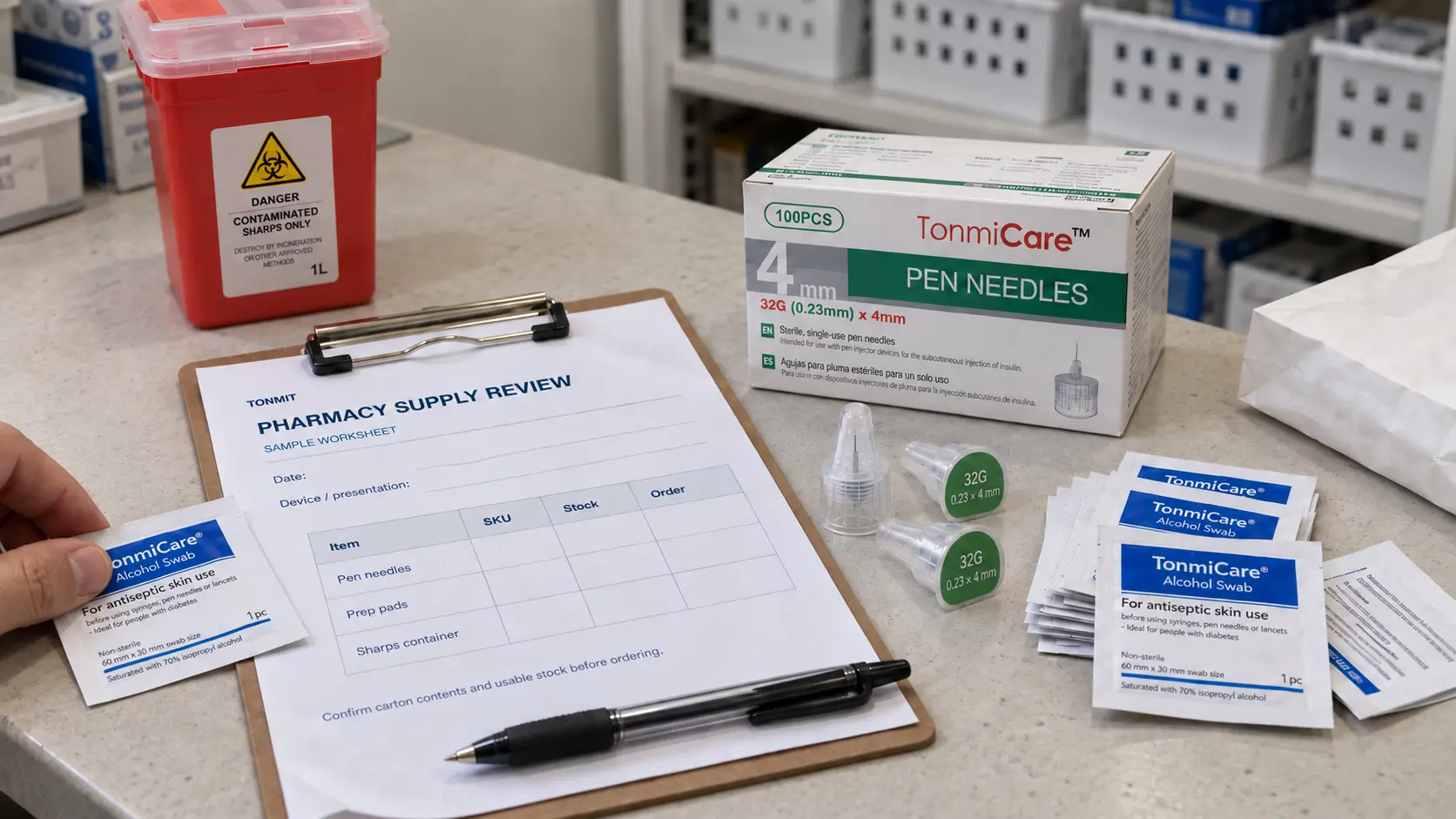
A kit name does not control its contents. The approved specification should identify every component reference, units per starter kit, units per refill kit, replacement triggers and any permitted substitution. Include units per inner pack and kits per case so a quote cannot silently change the delivered quantity.
Keep the component’s original protective packaging intact. Record the component lot and expiry information needed for traceability, the minimum remaining shelf life at dispatch and the kit insert version. An outer kit label must not imply that the entire assembled box is sterile just because one component is sterile.
For a proposed replacement needle, request evidence for the exact pen-and-needle combination and intended market. Similar gauge, length or thread appearance alone does not establish compatibility. If evidence is incomplete, resolve it with the pharmacy and relevant manufacturer before dispatch.
During a pilot shipment, compare the approved BOM with the packed sample and receiving record. Check component identity and counts, sealed packaging, lot/expiry visibility, insert version and case quantities. Report actual findings; do not replace those records with a generic “quality checked” statement.
Send us separate starter, refill and replacement order lines
For a recurring program, give us three quantities: starter kits for new enrollments, refill kits released after stock review, and replacement containers or optional accessories. Specify the forecast period and approved contents for each. An active patient count alone does not tell us how many accessory packs should ship.
Through our custom injection kit service, we coordinate component and BOM review, packaging and assembly planning.[9] Send both kit specifications with your destination and forecast so we can review the packaging, case quantities, availability and commercial terms for your project.
If you need components rather than assembled kits, review our alcohol prep pad supply and sharps container options. Include the required product reference and packaging format in your inquiry.
Purchasing template
Copy a starter and refill kit RFQ
Send us this brief for a component bundle or assembled kit. Program quantities and product specifications are sufficient; no patient-identifying information is needed.
Open the template below to select and copy the text.
View the RFQ template
GLP-1 ACCESSORY KIT RFQ
Target market / delivery destination:
Program owner and pharmacy approver:
Medicine presentation / exact device:
Current IFU title, market and revision:
Kit scope: injection accessories; prescription medicine excluded:
Forecast period / initial shipment date:
Starter kits for new enrollments:
Refill kits released after stock review:
Replacement accessories and quantities, listed separately:

STARTER KIT BOM
Component manufacturer and REF | units/kit | pack format:
Pen-and-needle compatibility evidence, when applicable:
Approved syringe specification, when applicable:
Prep supplies and quantity basis:
Sharps container and initial disposal information:
Optional items and acceptance rule:

REFILL KIT BOM
Confirmed coverage period / scheduled uses:
Units per use for each consumable:
Usable stock and included-accessory reconciliation rule:
Agreed reserve and supply increment:
Replacement triggers for containers / reusable items:
Hold rules for device changes, treatment pauses or switches:
Refill release approver and next stock-review date:
Separate pen-needle purchasing / payment route, if applicable:

ASSEMBLY AND COMMERCIAL TERMS
Kit packaging / insert version / label requirements:
Component lot and expiry traceability:
Minimum remaining shelf life at dispatch:
Approved substitutions and written approval process:
Kits per case / pilot quantity / recurring forecast:
Sample approval / acceptance checks:
MOQ / lead time / shipment terms / quotation validity:
Discuss your program with us
Request a starter and refill kit quote
Send us the approved device, separate starter and refill BOMs, replacement lines, destination and forecast. We can then review component availability, packaging, MOQ and lead time for the project.
Buyer FAQ
What is GLP-1, and do all GLP-1 medications need a kit?
GLP-1 stands for glucagon-like peptide-1. Medicines discussed under this term include GLP-1 receptor agonists and dual GIP/GLP-1 medicines such as tirzepatide.[3][11] Accessory needs depend on the prescribed route and exact device. An oral medicine does not need an injection kit for its administration.
What should a semaglutide injection kit contain?
Start with the exact prescribed presentation, then use the device table above. A single list for “semaglutide” can add needles to an integrated injector or duplicate needles already included with a multi-dose pen. The pharmacy should approve the actual component list.
Do all GLP-1 injections need separate pen needles?
No. Detachable-needle pens need compatible external pen needles. Integrated single-dose pens and integrated-needle prefilled syringes do not need an additional pen needle. Verify the exact presentation rather than the brand name alone.[1][2][3]
Is four needles always enough for a monthly refill?
No. Count the scheduled injections in the actual coverage period, then consider included needles, usable stock and any agreed reserve. A monthly delivery and a four-dose cycle are different planning periods.
Should a sharps container be included every time?
Confirm access to a suitable container every time. Send a replacement when fill limits, condition or another applicable requirement calls for one; arrange it before disposal access is lost. Never empty a disposable sharps container for reuse.[7]
Should the kit include extra needles just for priming?
Do not automatically count a second needle for every routine priming step. Follow the actual IFU. Zepbound KwikPen is primed before each weekly injection; routine Ozempic pen flow checks are before first use of each new pen. Troubleshooting may require a replacement needle, so manage that allowance separately.[1][2]
Are GLP-1 drugs included in our starter or refill kits?
No. The configurations in this guide cover injection accessories. We do not supply or compound GLP-1 medicines. Each kit quote should list the exact components and device-specific needle requirements, without implying universal compatibility or endorsement by a medicine manufacturer.
What happens to the refill kit when someone switches to an oral treatment?
Stop the accessory rule for the discontinued injectable once the pharmacy confirms the change. First check whether another injectable still requires supplies. Keep the instructions for safe disposal of any remaining sharps.
Should an accessory kit include products for GLP-1 side effects?
Our accessory kit scope does not include medicines for GLP-1 side effects. Direct symptom questions to the dispensing pharmacist or prescriber. If your care program needs separate support products, give them their own professional approval and ordering process.
Sources and editorial basis
We checked the device examples and single-use requirements against the manufacturer instructions below. The starter/refill split, stock calculations and dispatch checks are our procurement guidance. We use stated, hypothetical inventory inputs for the numerical examples.
- Lilly: Zepbound KwikPen U.S. Instructions for Use. Revised January 2026.
- Novo Nordisk: Ozempic U.S. prescribing information and Instructions for Use. PI revised May 2026; see section 16 and the device-specific IFUs.
- Novo Nordisk: Wegovy U.S. prescribing information and Instructions for Use. PI revised June 2026; see section 16 and the relevant device IFU.
- Lilly: Zepbound single-dose vial U.S. Instructions for Use. Supply list and preparation instructions.
- Lilly: Zepbound single-dose pen U.S. Instructions for Use.
- FDA: Dosing errors associated with compounded injectable semaglutide. Used for the measurement-risk discussion, not as an up-to-date list of available presentations.
- FDA: Best Way to Get Rid of Used Needles and Other Sharps. Home-use disposal guidance.
- FDA: Sharps Disposal Containers in Health Care Facilities.
- Our Custom GLP-1 Injection Kits & Kit Assembly Service. Project scope and RFQ process.
- CMS: Medicare GLP-1 Bridge — Information for Providers. Formulations, NDC updates and separate Zepbound KwikPen pen-needle purchasing; checked October 7, 2026.
- Lilly: Zepbound U.S. prescribing information. Revised August 2026; medicine classification, vial presentations and handling instructions.
Sources checked October 7, 2026. Medicine brand and device names identify the presentations discussed; they do not indicate manufacturer endorsement of our accessories.