
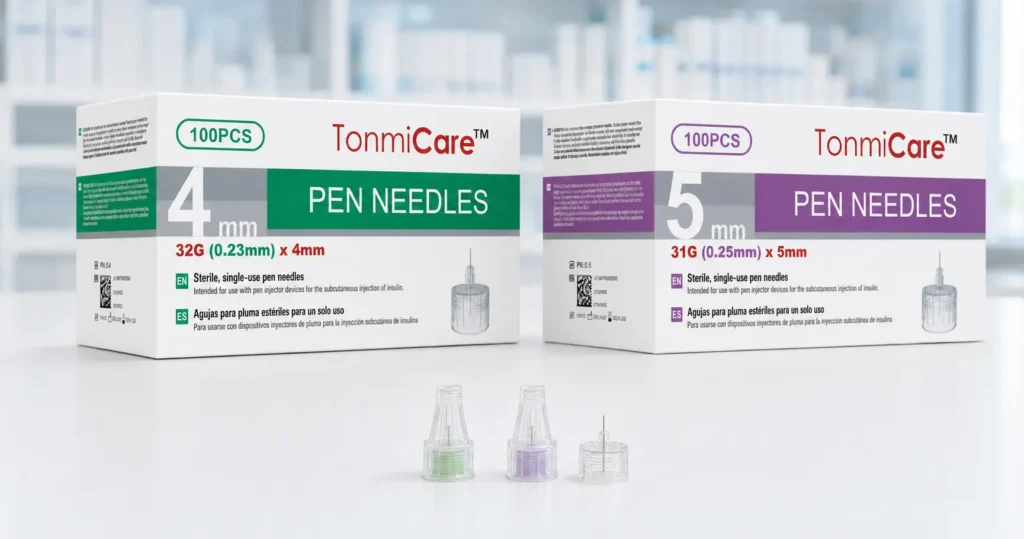
2026 Pharmacy Procurement Guide
A specification-led framework for comparing pen needle length, gauge, device compatibility, safety design, packaging, documentation and bulk supply requirements.
Editorial disclosure: This article is published by Tonmit as an educational procurement resource. It does not recommend a needle for an individual patient and does not replace product labeling, clinical judgment, prescribing requirements, regulatory review or workplace-safety obligations. Compatibility, availability, documentation and commercial terms must be verified for the exact SKU.
Executive summary
Key Takeaways
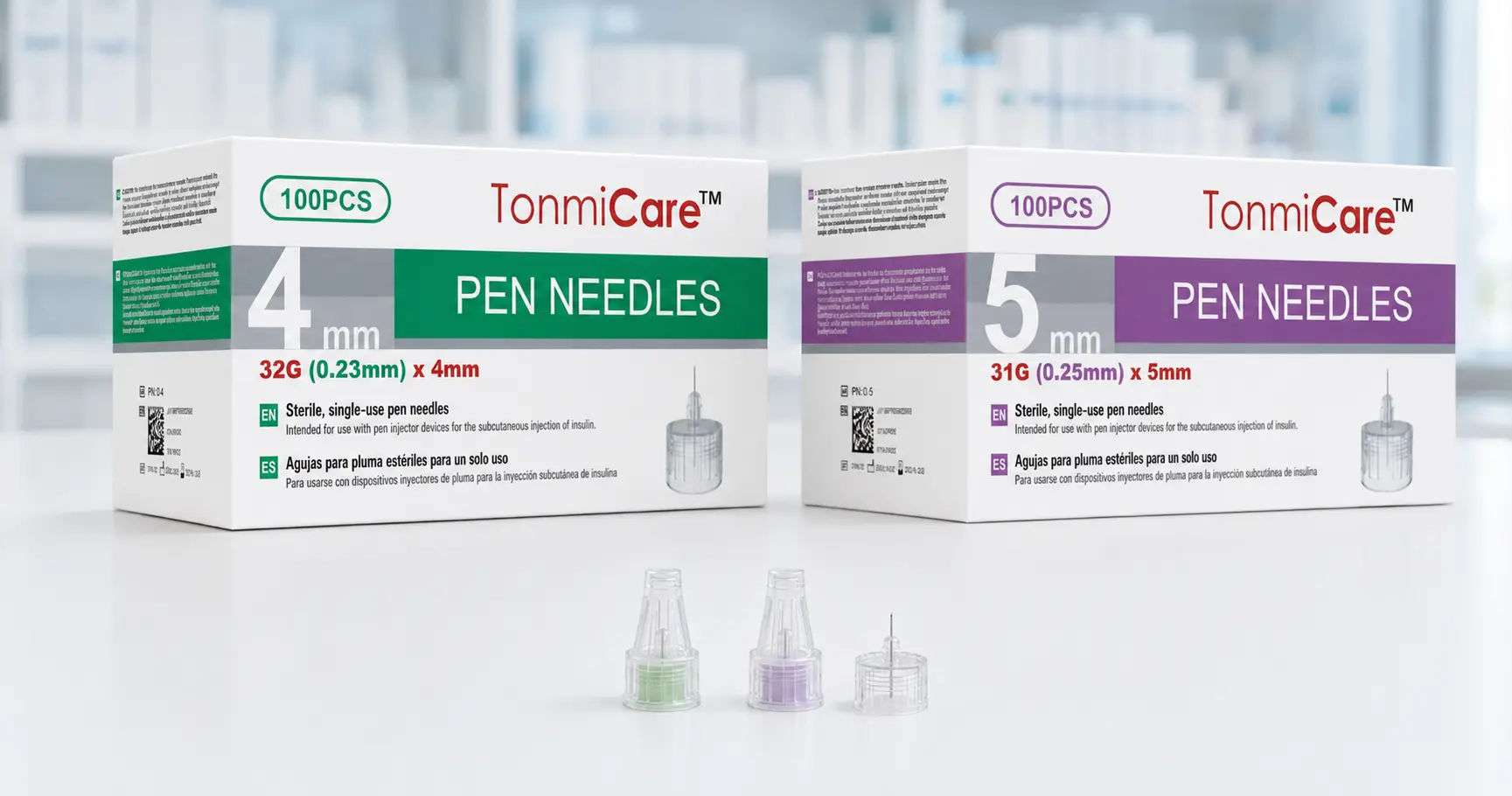
- Length and gauge describe different attributes. A specification such as 32G × 4 mm identifies both; neither value establishes compatibility on its own.
- A higher gauge number generally corresponds to a smaller outside diameter. In one FDA-cleared Promisemed family, 31G is identified as 0.25 mm and 32G as 0.23 mm.[2]
- Do not accept “universal” or “fits all pens” without current, SKU-specific evidence. Verify the pen model, needle REF, labeling and compatibility statement before approval.
- Standard and safety pen needles serve different operating contexts. Safety features should be evaluated against the use environment, workflow and applicable occupational-exposure controls.[4]
- Build the purchase specification around a controlled SKU: length, gauge, hub and shield design, sterile barrier, pack hierarchy, catalog number, UDI/GTIN where applicable, shelf life, labeling and permitted substitutions.
- FDA registration is not FDA clearance. Buyers should map the exact marketed SKU to the responsible manufacturer, product code, applicable 510(k), current labeling and quality records.[5]
Abstract
Insulin pen needles are often purchased through a short description such as “32G 4 mm” or “31G 8 mm.” For a professional buyer, that description is only the beginning. The selected SKU must also be compatible with the intended pen injector, supplied in the approved standard or safety configuration, supported by appropriate regulatory and quality documentation, packed for the organization’s dispensing model, and traceable through receipt, storage and distribution.
This guide provides a procurement framework for pharmacies, clinics, long-term care organizations and medical-supply distributors comparing insulin pen needle specifications. It explains what length and gauge communicate, how to control compatibility without relying on broad marketing claims, when standard and safety designs require different evaluation, and how to construct an RFQ that produces comparable quotations. It also applies the framework to Tonmit’s current wholesale pen needle program without assuming that every promoted configuration is covered by the same regulatory record.
Keywords: insulin pen needle sizes guide; 4mm pen needles; 31G vs 32G pen needles; insulin pen needle compatibility; wholesale insulin pen needles; pharmacy procurement; safety pen needles; pen needle supplier
1. Scope and Method: Specifications Before Recommendations
This article addresses institutional procurement and SKU governance. It does not select a needle for an individual patient. Product choice and injection technique depend on the applicable prescription, device labeling, clinician guidance, organizational policy and patient-specific factors.
The analysis uses four types of evidence:
- FDA 510(k), registration, listing, UDI and quality-system resources;
- ISO’s published scope for the current pen needle standard;
- OSHA and CDC resources relevant to sharps and injection safety in professional settings;
- Tonmit’s current product and wholesale-program information.
ISO 11608-2:2022 covers requirements and test methods for single-use, double-ended, sterile needles used with certain needle-based injection systems.[1] FDA’s public K161950 summary describes both common and safety insulin pen needles manufactured by Promisemed Hangzhou Meditech Co., Ltd. as Class II devices under product code FMI and 21 CFR 880.5570.[2] These records provide a defensible technical starting point, but they do not eliminate the need to verify the exact commercial SKU, current label and intended market.
2. Understanding Pen Needle Length: 4 mm, 5 mm, 6 mm and 8 mm
Needle length is the exposed patient-end length stated in millimeters. Common wholesale requests include 4 mm, 5 mm, 6 mm and 8 mm. Longer legacy configurations also exist in the market, but they should not be treated as interchangeable with shorter options.
For procurement, length affects more than the number printed on the box:
- the approved clinical or formulary specification;
- the catalog number and barcode identity;
- the combination of gauge and product family available from the supplier;
- packaging artwork and color coding;
- inventory segmentation and substitution rules;
- training or instructions associated with the selected device.
The K161950 public summary identifies common-type Promisemed configurations at 4 mm, 5 mm, 6 mm, 8 mm and 12 mm, while the safety-type configurations listed in the submission cover 4 mm, 5 mm, 6 mm and 8 mm in specific gauges.[2] This illustrates an important purchasing rule: a length available in one product family or gauge is not automatically available in every other combination.
| Length | Common RFQ context | Buyer control |
|---|---|---|
| 4 mm | Frequently requested short-length SKU, often paired with fine gauges | Confirm exact gauge, hub design, product family, label and pen compatibility |
| 5 mm | Adjacent short-length option used in selected pharmacy and distributor assortments | Do not treat as a substitute for 4 mm without prior approval |
| 6 mm | Mid-length option found in common and safety product families | Verify gauge-specific availability and whether the program requires standard or safety design |
| 8 mm | Longer option maintained for defined demand or established formularies | Control gauge, labeling and substitution separately from other lengths |
This table describes procurement positioning, not clinical suitability. Buyers should derive the approved mix from prescribing and dispensing data, clinical governance and actual demand—not from a supplier’s generic “most popular” list.
3. Understanding Gauge: 31G vs 32G
Gauge describes needle diameter using an inverse numbering convention: within comparable needle specifications, a higher gauge number indicates a smaller outside diameter. Gauge does not describe length.
The Promisemed K161950 public summary provides a useful example:
- 30G: 0.30 mm outside diameter;
- 31G: 0.25 mm outside diameter;
- 32G: 0.23 mm outside diameter;
- 33G: 0.20 mm outside diameter for the identified common-type model.
Those values are taken from that specific submission and should not be used as a substitute for the current controlled specification of another product.[2]
For a buyer, the practical difference between 31G and 32G is therefore not a simple “better versus worse” decision. It changes the exact SKU, possible length combinations, supplier availability, product family, packaging identity and supporting records. Claims about comfort, flow or performance should be supported for the exact device and should not be inferred from gauge alone.
Procurement rule: Write gauge × length together on the RFQ, purchase order, approved-product list and receiving record. “Fine pen needle” is not a controlled specification.
4. Length and Gauge Comparison for Purchasing
| Example spec | What it states | What it does not prove | Minimum RFQ follow-up |
|---|---|---|---|
| 32G × 4 mm | Gauge and patient-end length | Pen compatibility, tip design, flow performance or regulatory coverage | REF, product family, compatibility evidence, label, pack and documentation |
| 31G × 5 mm | Gauge and patient-end length | Equivalence to a 4 mm or 6 mm SKU | Approved-use list, substitution status, case quantity and inventory |
| 31G × 6 mm | Gauge and patient-end length | Whether the device is standard or safety type | Shield mechanism, IFU, use environment and applicable safety review |
| 31G × 8 mm | Gauge and patient-end length | Permission to replace a shorter needle already on formulary | Demand evidence, clinical approval, label and SKU-specific ordering controls |
Tip geometry, wall design, lubrication, cartridge-end design, hub geometry and safety mechanism can differ even when gauge and length match. If a supplier promotes a 5-bevel, thin-wall, extra-thin-wall or comfort-related feature, request evidence tied to the quoted REF and approved claims rather than extending a claim from another model.
5. Pen Compatibility: Control the Claim, Not Just the Thread
Compatibility is the highest-risk point in many pen needle quotations. A needle may appear to attach to a pen, but physical attachment alone is not a complete procurement standard. The buyer should verify that the intended combination is supported by current labeling or controlled compatibility evidence and that the needle’s cartridge-end interface functions as intended.
Do not approve a SKU solely because a catalog says “universal,” “standard screw-on,” or “fits most pens.” Instead, construct a compatibility matrix:
| Compatibility field | Evidence to capture | Approval question |
|---|---|---|
| Pen manufacturer and model | Exact marketed name, model and current instructions | Is this the device used by the target pharmacy or program? |
| Pen needle identity | Manufacturer, brand, REF, gauge, length and UDI/GTIN where applicable | Does the evidence identify the same SKU being quoted? |
| Needle manufacturer statement | Current label, IFU or controlled compatibility list | Does it name the pen model or a defined interface category? |
| Pen manufacturer instructions | Current pen labeling and needle-use directions | Are there restrictions, named needle types or setup requirements? |
| Change control | Revision date and notification process | Will the buyer be notified if the hub, needle or compatibility claim changes? |
| Decision record | Approved, restricted, pending or rejected status | Can purchasing and receiving identify the authorized combination? |
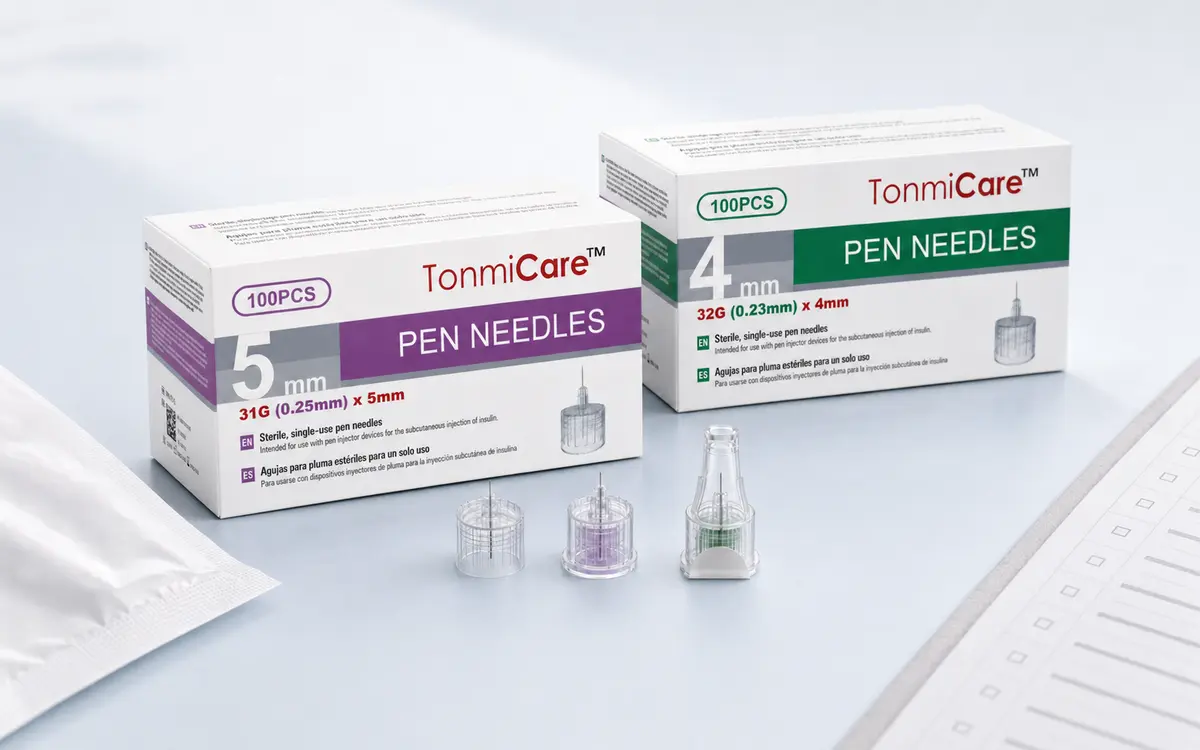
Compatibility evidence should be retained with the approved SKU record. When a pen model, needle REF, labeling revision, hub design or manufacturing site changes, the combination should return to the organization’s change-review process.
6. Standard vs Safety Pen Needles
A standard pen needle typically uses removable protective components around the needle and hub. A safety pen needle adds a feature intended to reduce accidental sharps exposure. In K161950, the safety design uses a shield that retracts during insertion, then extends and locks over the patient-end needle after withdrawal.[2]
OSHA defines engineering controls to include self-sheathing needles and sharps with engineered sharps-injury protections that isolate or remove the bloodborne-pathogens hazard from the workplace.[4] Whether a particular safety pen needle is appropriate for a facility must be determined through the organization’s exposure-control, device-evaluation and clinical processes.
| Review area | Standard pen needle | Safety pen needle |
|---|---|---|
| Primary procurement context | Defined self-use, dispensing or program requirements | Professional environments where sharps-exposure controls require evaluation |
| Device features to verify | Hub, shields/caps, sterile barrier and single-use labeling | Activation, coverage, lockout, visibility and disposal workflow |
| Training review | Attachment, use, removal and disposal instructions | All standard steps plus safety-feature activation and confirmation |
| Commercial comparison | Unit, box and case cost | Total program cost, training, waste volume and occupational-safety value |
| Substitution rule | Never substitute one design for the other without documented approval | |
CDC also states that insulin pens are intended for one person and that a new needle should be used for each injection; the pen itself must not be shared between patients even if the needle is changed.[7] Facilities purchasing pen needles for administration programs should keep device selection, training, single-patient pen controls and sharps disposal aligned.
7. Building a Pharmacy or Distributor SKU Mix
A good assortment is not the largest possible assortment. It is the smallest controlled set that covers approved demand without creating avoidable substitutions, dead stock, picking errors or fragmented case quantities.
Start with transaction data:
- prescription or dispensing demand by gauge and length;
- pen models represented in the target customer base;
- standard versus safety demand by care setting;
- monthly use, seasonality and new-program forecasts;
- insurance, formulary, contract or tender constraints;
- box and case movement by location;
- substitution approvals and prohibited substitutions;
- remaining shelf-life requirements.
Tonmit’s current wholesale page identifies 32G × 4 mm, 31G × 5 mm, 31G × 6 mm, 31G × 8 mm and 30G × 8 mm among its common RFQ paths, with additional fine-gauge options promoted for selected product families.[8] These are useful starting points for an availability conversation, not a recommended formulary.
| SKU role | Planning question | Control |
|---|---|---|
| Core volume SKU | Which approved specification produces the majority of recurring demand? | Set reorder point, case quantity, safety stock and supplier allocation |
| Adjacent specification | Is demand sufficient to justify a separate gauge or length? | Keep a unique barcode and block automatic substitution |
| Safety SKU | Which care settings require evaluation of engineered protection? | Separate standard and safety devices in contracting, training and receiving |
| Special-order SKU | Can low-volume demand be supplied without routine local stock? | Define lead time, nonreturnable status and patient/customer communication |
| Private-label SKU | Does volume justify separate artwork, MOQ and lifecycle controls? | Complete regulatory, quality and labeler-responsibility review first |
8. Packaging, Case Quantity and Shelf-Life Review
Two pen needles with the same gauge and length can create different operational outcomes if their package count, sterile barrier, carton dimensions, barcode level or shelf-life policy differs. The RFQ should therefore define the full packaging hierarchy.
Request the following for each quoted REF:
- individual sterile-barrier format and opening method;
- units per dispenser box;
- boxes per shipping case and cases per pallet;
- box and case dimensions and gross weight;
- catalog number, GTIN/UDI where applicable and barcode location at each level;
- lot, manufacture and expiration-date format;
- labeled shelf life and minimum remaining shelf life at shipment;
- storage and transportation conditions;
- tamper evidence, sterile-barrier inspection and damage criteria;
- country of origin and current label revision.
The K161950 summary reports ethylene oxide sterilization at a sterility assurance level of 10−6 and a five-year shelf life for the submitted common and safety product families.[2] Buyers should not transfer those attributes to a different SKU, brand or private-label version without confirming the applicable controlled documents.
At receiving, verify the purchase-order REF, gauge, length, design type, box count, case count, lot, expiration, labeler and package condition. A receiving team should not have to infer the product identity from color alone.
9. FDA Records, Product Identity and Documentation
FDA’s public records distinguish establishment registration, device listing and premarket clearance. FDA states that registration and listing do not denote approval, clearance or authorization and that FDA does not issue registration certificates to medical-device facilities.[5]
For insulin pen needles sold in the United States, a buyer should request a SKU-specific identity sheet covering, as applicable:
- legal manufacturer and manufacturing site;
- brand owner or labeler;
- U.S. agent and initial importer roles where applicable;
- product code and device classification;
- applicable 510(k) and models covered;
- device listing and UDI/GUDID information where applicable;
- current U.S. label and instructions for use;
- gauge, length, standard/safety configuration and catalog number;
- quality-system certificate and scope;
- sterilization, shelf-life and biocompatibility evidence appropriate to the review.
FDA’s QMSR became effective February 2, 2026 and incorporates ISO 13485:2016 by reference into the amended 21 CFR Part 820 framework.[6] A current ISO 13485 certificate can support supplier review, but it does not replace SKU-level clearance, listing, labeling or change-control verification.
FDA’s UDI system is intended to identify devices through distribution and use. A UDI contains a device identifier, while production information may include lot, batch, serial number, expiration date or manufacturing date when those data appear on the label.[3] Buyers should determine which data levels they need to capture for inventory, complaint and field-action responsibilities.
Tonmit program review
Applying the Framework to Tonmit’s Current Pen Needle Program
Tonmit’s current wholesale page promotes common RFQ specifications across standard, 5-bevel, Plus and Plus 5-bevel product paths, including 4 mm, 5 mm, 6 mm and 8 mm lengths. It also states that packaging, documentation, private label/OEM and bulk pricing are reviewed by request.[8]
The public Promisemed K161950 summary identifies specific common-type models from 29G through 33G and safety-type models from 29G through 31G, with defined gauge-and-length combinations.[2] Tonmit’s current wholesale page separately promotes selected 34G options.[8] Buyers should therefore request the exact regulatory mapping for any 34G, 5-bevel, Plus, safety or other quoted configuration instead of assuming that K161950 covers every promoted option.
Recommended RFQ wording: “Please identify the legal manufacturer, trade name, REF, gauge, length, design type, applicable 510(k), U.S. listing/UDI information, label revision, pack hierarchy and available quality documents for the exact item quoted.”
For a reliable quotation, the buyer should submit required gauge and length, pen models or compatibility requirements, standard or safety design, annual volume, order frequency, target market, packaging format, documentation list, destination and private-label requirements. Final availability and coverage should be confirmed in writing for the selected REF.
10. Quality, Traceability and Change Control
A product sample can demonstrate appearance and basic fit, but supplier approval requires a repeatable evidence chain:
Quoted REF → approved specification → current label/IFU → manufacturing and release controls → lot/UDI → shipment and customer record
Evaluate at least:
- incoming and finished-device specification controls;
- needle dimensions, hub assembly and relevant performance testing;
- sterile-barrier and sterilization controls;
- lot release and certificate-of-conformance process;
- complaint intake, investigation and escalation;
- nonconformance and corrective-action handling;
- traceability from received lot to downstream order;
- recall, field-action and quarantine cooperation;
- change notification for material, design, labeler, site, sterilization, packaging or compatibility claims.
Before full rollout, conduct a desktop traceability exercise. Select a hypothetical lot, locate current inventory, identify outbound shipments, demonstrate quarantine and document who would communicate with affected locations. A barcode or traceability code is useful only when the records behind it can support action.
11. Private Label and Custom Packaging Considerations
Private label is not merely a logo change. Depending on the arrangement and market, it can affect labeler identity, UDI/GUDID responsibilities, device listing, artwork control, complaint exchange, recall communication and change management.
Before approving artwork, define:
- legal manufacturer, labeler and distributor identities;
- who owns and maintains the device identifier and database record where applicable;
- which claims, compatibility statements and symbols are authorized;
- how gauge, length and design type appear on all package levels;
- lot, expiration, country-of-origin and contact information;
- artwork approval, revision control and obsolete-label disposition;
- complaint forwarding and regulatory-reporting responsibilities;
- recall, correction and customer-notification responsibilities;
- MOQ, setup cost, production lead time and remaining shelf life;
- ownership and disposition of unused packaging inventory.
A distributor should not launch a private-label pen needle until the exact device, regulatory path, label responsibilities and lifecycle controls are documented. Standard branded stock can be the lower-risk starting model while demand and operating capability are being validated.
12. Procurement Checklist and RFQ Workflow
- Define approved demand. List each allowed gauge, length, standard/safety design and pen compatibility requirement.
- Issue a controlled RFQ. Require REF-level pricing and prohibit unapproved substitutions.
- Obtain the compatibility matrix. Match every needle REF to the pen models or interface evidence accepted by the buyer.
- Verify regulatory identity. Reconcile manufacturer, labeler, product code, applicable 510(k), listing, UDI/GTIN and current label.
- Review quality evidence. Confirm QMS scope, sterilization, shelf-life, performance, complaint and change-control information appropriate to the SKU.
- Approve samples and packaging. Inspect gauge, length, design, attachment, sterile barrier, labels, barcodes and package count.
- Model landed and operational cost. Include unit price, freight, MOQ, case quantity, storage, expiry exposure, training, returns and private-label setup.
- Place a controlled first order. Test order accuracy, lot capture, shelf life, damage, documentation and delivery performance.
- Monitor the supplier. Track fill rate, on-time shipment, backorders, complaints, corrective actions, documentation response and changes.
| RFQ field | Required detail | Buyer status |
|---|---|---|
| Product | Standard or safety pen needle; product family and REF | Required / approved |
| Specification | Gauge, outside diameter where controlled, and length | No substitution |
| Compatibility | Required pen models and acceptable evidence | Verified / pending |
| Commercial pack | Units/box, boxes/case, cases/pallet and dimensions | Confirmed |
| Identity | Manufacturer, labeler, catalog number and UDI/GTIN where applicable | Reconciled |
| Documentation | FDA mapping, labels, QMS scope, sterilization and shelf-life evidence | Accepted / gap |
| Supply | MOQ, stock, lead time, shelf life, freight and replenishment | Contracted |
| Lifecycle | Complaints, recall cooperation, changes and returns | Assigned |
Questions from pharmacy buyers
13. Frequently Asked Questions
What does 32G × 4 mm mean?
It states the needle gauge and length. In the cited Promisemed K161950 family, 32G corresponds to a 0.23 mm outside diameter, while 4 mm is the available patient-end length for the identified model.[2] The description does not by itself establish compatibility, product family, tip design, packaging or regulatory coverage.
Which is thinner: 31G or 32G?
32G has the higher gauge number and the smaller outside diameter in the cited product family: 0.23 mm compared with 0.25 mm for 31G.[2] Buyers should still use the manufacturer’s controlled specification for the exact SKU.
Are all insulin pen needles universally compatible?
No universal conclusion should be made from gauge, length or appearance. Verify the exact pen model, needle REF, current labeling and compatibility evidence. A physical connection alone is not a complete compatibility assessment.
Can a pharmacy substitute 4 mm, 5 mm, 6 mm or 8 mm pen needles?
Procurement should not authorize substitution based only on product availability. Substitution must follow applicable prescribing, dispensing, labeling, clinical, formulary and legal requirements. Each length should remain a distinct SKU unless the organization has formally approved an alternative.
When should a buyer consider a safety pen needle?
Professional care settings should evaluate safety-engineered sharps within their exposure-control and device-selection processes. OSHA identifies self-sheathing needles and sharps with engineered sharps-injury protections as examples of engineering controls.[4] The final choice depends on the facility’s workflow, user evaluation and obligations.
Does FDA registration mean the pen needle is FDA cleared?
No. FDA states that establishment registration and device listing do not denote approval, clearance or authorization and that it does not issue registration certificates to medical-device facilities.[5] Review the applicable product code, 510(k), model, labeler, listing and current commercial SKU.
What information is needed for accurate bulk pricing?
Provide the exact gauge, length, standard or safety design, required pen compatibility, box and case format, annual volume, order frequency, destination, documentation list, shelf-life requirement and private-label status. A quotation without a controlled specification is not reliably comparable.
Does K161950 cover every pen needle promoted by Tonmit?
That should not be assumed. The public K161950 summary lists defined Promisemed common and safety models and specific gauge-length combinations.[2] Tonmit’s wholesale page promotes additional product paths and specifications.[8] Request SKU-level regulatory mapping for the exact item quoted.
14. Limitations and Conclusion
This guide is based on public records and webpages available on the review date. Public databases, product portfolios, labels, compatibility statements and commercial availability can change. A public 510(k) summary for one manufacturer or product family does not establish coverage for every gauge, length, tip design, brand, package or private-label configuration.
For procurement purposes, the correct buying unit is not simply “a 4 mm pen needle” or “a 32G needle.” It is a fully identified SKU supported by:
- a controlled physical specification—gauge, length, hub, standard/safety design and sterile barrier;
- verified compatibility—the intended pen model and current supporting evidence;
- regulatory and quality identity—manufacturer, labeler, applicable FDA pathway, current labeling and QMS scope;
- commercial control—pack hierarchy, barcode, shelf life, MOQ, inventory and delivery terms;
- lifecycle control—traceability, complaints, recalls, changes and permitted substitutions.
When those five elements are fixed before price comparison, pharmacies and distributors can reduce incompatible purchases, uncontrolled substitutions, documentation gaps and avoidable inventory complexity.
Wholesale & documentation support
Request a Pen Needle SKU Review
Tonmit supports pharmacies, clinics and medical distributors reviewing wholesale insulin pen needles, packaging options, documentation and private-label requirements.
Share the required gauge × length, pen models, standard or safety design, annual volume, packaging format, destination and document list. Tonmit can confirm available product paths, exact REF details and transaction-specific pricing by RFQ.
Final compatibility, regulatory mapping, availability, labeling, packaging, documentation, lead time and private-label feasibility are confirmed for the selected SKU and target market.
References
- International Organization for Standardization. “ISO 11608-2:2022 — Needle-based injection systems for medical use — Requirements and test methods — Part 2: Double-ended pen needles.” ISO.
- U.S. Food and Drug Administration. “K161950: Verifine Common Type Insulin Pen Needle and Verifine Safety Type Insulin Pen Needle, Promisemed Hangzhou Meditech Co., Ltd.” The public summary identifies product code FMI, specific common and safety models, dimensions, sterilization and performance information. FDA 510(k) Summary.
- U.S. Food and Drug Administration. “UDI Basics.” FDA.
- Occupational Safety and Health Administration. “29 CFR 1910.1030 — Bloodborne Pathogens.” The standard defines engineering controls and provides examples including self-sheathing needles and sharps with engineered sharps-injury protections. OSHA.
- U.S. Food and Drug Administration. “Important Reminders about Registration and Listing.” FDA.
- U.S. Food and Drug Administration. “Quality Management System Regulation (QMSR).” Effective February 2, 2026. FDA.
- Centers for Disease Control and Prevention. “Considerations for Blood Glucose Monitoring and Insulin Administration.” CDC.
- Tonmit. “Wholesale Insulin Pen Needles for Pharmacies, Clinics & Distributors.” Current product-family, specification and RFQ information reviewed July 22, 2026. Tonmit.