
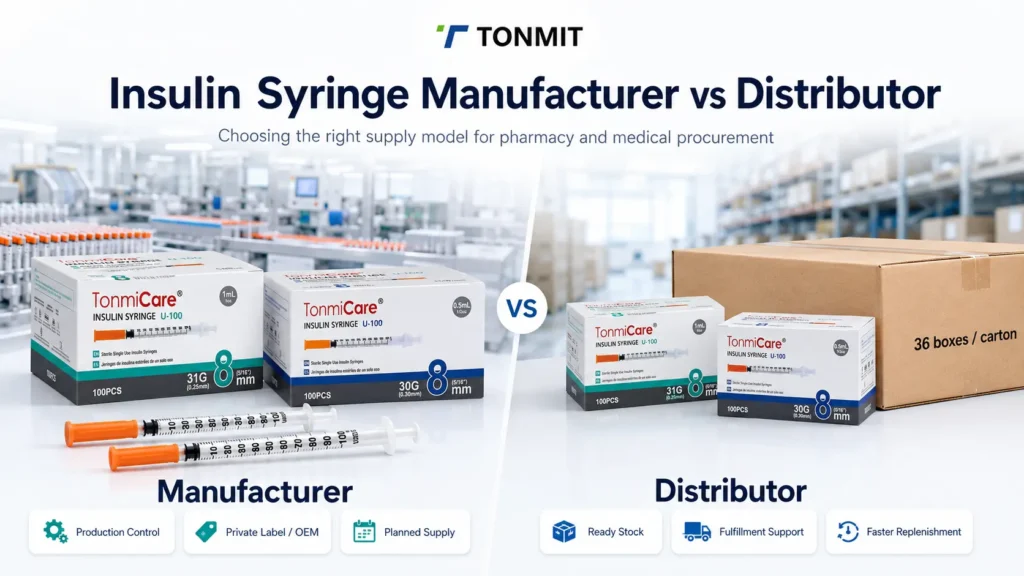
Pharmacy Sourcing Channel & Replenishment Guide
A practical decision framework for pharmacies comparing manufacturer-direct, distributor and U.S.-warehouse-supported insulin syringe supply by exact-SKU demand, MOQ, landed cost, lead time, shelf life, documentation and continuity risk.
Scope: This guide supports institutional and commercial purchasing. It is not legal, regulatory, clinical, prescribing or patient-specific advice. Manufacturer, importer, labeler and distributor responsibilities depend on the actual activities, device, labeling and transaction. Approve the exact syringe specification through the pharmacy’s applicable clinical, quality, legal and procurement processes.
Quick answer
Should a Pharmacy Buy From an Insulin Syringe Manufacturer or Distributor?
When comparing an insulin syringe manufacturer vs distributor, choose the channel that fits the order—not the seller’s label. Distributor or verified U.S.-stock supply often fits smaller, mixed or short-cycle orders. Manufacturer-direct supply becomes more attractive when stable exact-SKU demand supports the MOQ and the buyer can manage planning, logistics, documentation and inventory.
Many regional groups benefit from a hybrid model: planned upstream supply for base demand plus approved domestic stock for short-cycle replenishment. Freeze the REF or complete specification first, then review wholesale insulin syringe options using the same product identity.
Executive summary
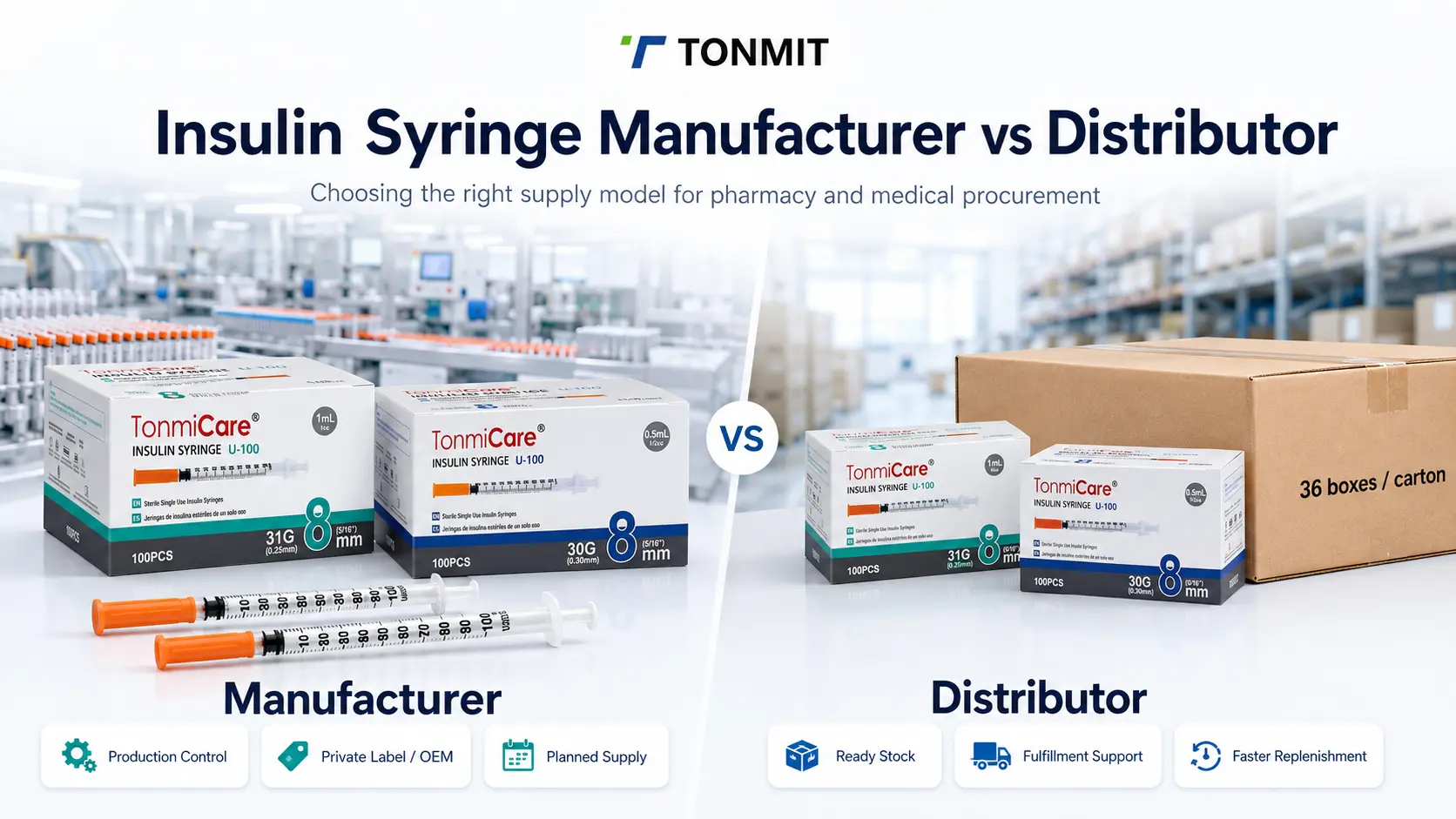
Key Takeaways for Pharmacy Buyers
- One company may perform several roles. Identify who manufactures, labels, imports, owns stock, invoices and handles complaints.
- Direct is not automatically cheaper. Include freight, import, handling, financing, expiry, shortage and claims.
- Distributor supply is not automatically faster. Require exact-REF inventory, lot, expiry and destination timing.
- Demand shape drives the model. Stable REF-level volume favors planning; fragmented demand favors smaller releases.
- Channel choice never replaces qualification. Documentation, traceability and postmarket controls still apply.
- Dual sourcing requires two approved paths. It cannot mean uncontrolled substitution.
1. Manufacturer vs Distributor: What Do the Terms Actually Mean?
A manufacturer may produce the finished device, control specifications or use contract production. A distributor typically stores, sells and ships another organization’s product. Roles can overlap: a manufacturer may hold U.S. stock, an importer may distribute, and a brand owner may use a contract manufacturer.
“Factory direct” and “U.S. distributor” therefore do not identify the whole chain. Under 21 CFR 801.1, a device label can identify the manufacturer, packer or distributor; relationship wording such as “Manufactured for” or “Distributed by” matters.[2]
Buyer rule: Use “manufacturer-direct” to describe the purchasing route only after documenting the legal manufacturer, actual production site, labeler, importer, inventory owner and seller of record.
2. Why Insulin Syringe Sourcing Is Different From Pharmaceutical Distribution
An insulin syringe is a medical device, not the insulin drug. Its controlled identity includes scale, capacity, graduation, gauge, length, design, sterile presentation, REF, identifiers, package, lot and expiration.
FDA states that a domestic distributor that does not import or perform another listed regulated activity is generally not required to register and list merely for ordinary distribution.[1] Buyers must still verify the upstream product, labeling, traceability and recall path; “show us your FDA registration” is not a complete distributor screen.
Before requesting quotes, compare insulin syringe sizes and specifications. Prices for different SKUs are not comparable.
3. Manufacturer-Direct vs Distributor: Side-by-Side Pharmacy Comparison
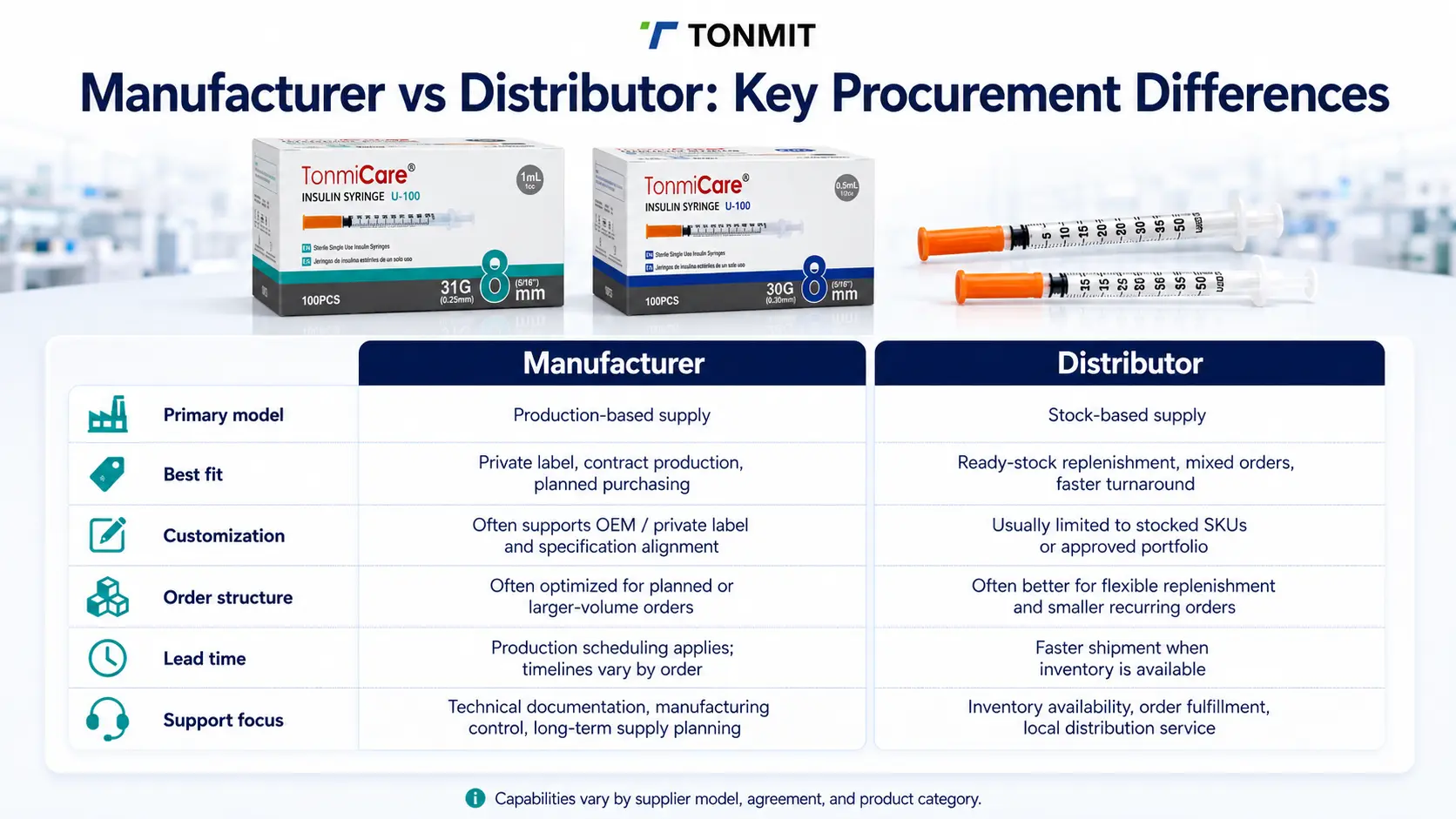
| Decision factor | Manufacturer-direct supply | Distributor or U.S.-stock supply | Buyer test |
|---|---|---|---|
| Quantity | Production or program MOQ | Cases or smaller releases | Compare MOQ with 90-day REF demand |
| SKU mix | Fewer SKUs may improve economics | Easier multi-SKU consolidation | Count annual units by approved REF |
| Price | Potential ex-factory advantage at scale | Includes stocking and service value | Use landed cost per 100 accepted |
| Lead time | Production, release and transit | Shorter only with confirmed stock | Request ATP and destination timing |
| Inventory | Buyer may carry more stock | Channel may carry more stock | Model shelf life and variance |
| Private label | Better aligned with custom programs | Usually existing branded stock | Separate all MOQ layers |
| Documents | Closer technical communication | May require upstream retrieval | Test a real REF-level request |
| Claims | Contract and Incoterms govern | Domestic handling may be simpler | Put rules in the PO |
| Substitution | Lifecycle changes remain possible | Alternates may be offered | Require written approval |
| Continuity | Upstream visibility; site dependence | Alternatives; allocation dependence | Preapprove backup paths |
These are patterns, not guarantees. A manufacturer with allocated U.S. stock may outperform a general distributor, while a specialized distributor may outperform an unmanaged direct-import program.
4. When Should a Pharmacy Buy From a Distributor or U.S.-Stock Channel?
Distributor or domestic stock is a practical starting model when demand is below MOQ, fragmented, difficult to forecast or subject to short replenishment windows.
- Orders are measured in cases, not production runs.
- The PO combines several approved products.
- Demand varies by month or location.
- Short domestic replenishment is required.
- Cash, storage or expiry exposure outweighs ex-factory savings.
For mixed programs, compare broader wholesale medical supply models without losing item-level identity, cost or shelf-life data.
5. When Does Manufacturer-Direct Insulin Syringe Supply Make Sense?
Direct supply becomes credible when demand is repeatable by REF, volume supports MOQ, and private-label or direct technical coordination creates value.
- Demand is stable by exact REF.
- Annual use absorbs product and packaging MOQ.
- The buyer can forecast and control changes.
- Logistics and import roles can be managed.
- Storage, cash and document review capacity are sufficient.
For custom programs, review private-label insulin syringe requirements, including role, artwork, identifier, MOQ and postmarket controls.
6. What Are the Risks of Manufacturer-Direct Purchasing?
Direct-supply risk rises when a large commitment lacks demand evidence, logistics planning or recovery capacity.
Use a staged order, sample-to-production check, minimum shelf life, change notice, assigned Incoterms, acceptance criteria and claim process. Do not buy more than can be consumed economically.
7. What Are the Limitations of Distributor Purchasing?
A distributor can simplify fulfillment but reduce direct visibility into upstream allocation, changes and document ownership. Similar catalog items are not necessarily interchangeable.
Do not accept “equivalent product” as an uncontrolled backorder solution
Require written approval before any change in manufacturer, brand, REF, concentration scale, capacity, graduation, gauge, needle length, sterile presentation, package count, UDI/GTIN, country of origin or label revision. A clinically or commercially similar description is not an approved substitution.
Test markup, technical response, lot selection and upstream dependence by requesting exact-REF stock, lot/expiry, manufacturer documents, change notice, complaint contact and a mock recall response.
8. How Does U.S. Warehouse Support Change the Decision?
U.S. warehouse support can combine upstream coordination with smaller domestic releases, but it does not prove availability. Confirm manufacturer, REF, ATP quantity, lot/expiry, minimum shelf life, ownership, allocation, ship-from point, processing time and destination window. Also ask for the upstream replenishment lead time.
Verified domestic supply = exact REF + confirmed quantity + lot/expiry + allocation status + processing window + destination-specific delivery basis
A warehouse address without those fields is a capability claim, not an order commitment.
Review U.S.-warehouse-supported fulfillment; final inventory, shelf life, timing and freight remain transaction-specific.
9. Choose the Sourcing Channel by Pharmacy Type and Order Pattern
| Buyer scenario | Practical starting model | Why it may fit | Primary control |
|---|---|---|---|
| Independent | Approved distributor/U.S. stock | Lower commitment | SKU, shelf life, no substitution |
| Regional group | Planned supply + domestic stock | Base volume with backup | Forecast and allocation |
| Long-term care | Scheduled releases + backup | Repeat multi-site demand | Fill rate and traceability |
| Private label | Qualified production partner | Packaging control | Roles, MOQ and change control |
| New program | Standard approved inventory | Tests real movement | 90-day REF demand |
| Multi-category | Consolidated distributor | Fewer POs | Item-level data |
Use actual demand, service level and inventory capacity—not organization size alone.
10. Compare Total Landed Cost, Not Only Unit Price
Manufacturer and distributor quotes often use different commercial boundaries. Normalize them before comparison.
Landed cost per 100 accepted syringes =
(product + freight + duty/brokerage + warehouse/handling + receiving/inspection + financing + expected expiry + emergency replenishment + claim administration − credits) ÷ accepted syringes × 100
Use accepted quantity after shortages or damage. Model normal demand, a spike and delayed replenishment.
| Cost field | Manufacturer quote | Distributor quote | Normalized buyer input |
|---|---|---|---|
| Product | Ex-factory/program | Case/delivered | Same REF and pack |
| Freight | International + domestic | Domestic + accessorials | Destination total |
| MOQ | Excess-stock risk | Smaller-order premium | Consumable units |
| Shelf life | Longer holding time | Lot age/reorder cycle | Expected expiry loss |
| Interruption | Rush/slow recovery | Backorder/allocation | Expected failure cost |
For packaging conversions, quote normalization and first-receipt checks, use Tonmit’s guide to calculate case quantities and landed cost.
Tonmit buyer worksheet
Manufacturer vs Distributor Channel Decision Record
Use one record for each exact syringe REF. Compare the same product identity across both channels before deciding whether manufacturer-planned supply, distributor stock or a hybrid path is the better fit.
This is a blank procurement-comparison template, not a live inventory feed, regulatory approval, supplier audit or completed Tonmit QC record. Cost, stock, shelf life, legal roles and delivery terms must be confirmed for the exact SKU and transaction.
View decision record template
MANUFACTURER VS DISTRIBUTOR CHANNEL DECISION RECORD

PRODUCT IDENTITY
Legal manufacturer:
Labeler / brand:
Manufacturer REF:
Insulin scale:
Capacity / graduation:
Needle gauge x length:
Primary sterile presentation:
Pieces / box:
Boxes / case:
UDI / GTIN where applicable:

DEMAND
Initial quantity:
Average monthly demand:
Annual forecast:
Number of locations:
Demand variability / seasonality:
Minimum remaining shelf life required:

MANUFACTURER-DIRECT PATH
MOQ:
Quoted basis:
Production / release lead time:
International freight / import basis:
Expected landed cost per 100 accepted syringes:
Shelf-life commitment:
Change-notification terms:
Claim / return process:
Evidence gaps:

DISTRIBUTOR / U.S.-STOCK PATH
Seller:
Inventory owner:
Exact REF ATP quantity:
Case pack:
Assigned lot / expiration:
Allocation status:
Domestic freight basis:
Destination-specific timing:
Expected landed cost per 100 accepted syringes:
Backorder / substitution rule:
Evidence gaps:

CONTINUITY
Primary channel:
Approved backup channel:
Same REF or separately approved alternate:
Backup activation trigger:
No substitution without written approval: YES / NO

ROLE MAP
Manufacturer:
Importer:
Inventory owner:
Seller of record:
Complaint contact:
Recall / correction contact:

DECISION
□ MANUFACTURER-DIRECT
□ DISTRIBUTOR / U.S. STOCK
□ HYBRID
□ HOLD FOR EVIDENCE

Decision basis:
Approver:
Date:

METHOD LIMIT
This blank template compares procurement and supply-channel inputs. It is not a live inventory feed, supplier audit, regulatory determination, QC report or delivery guarantee.
11. Verify the Legal Manufacturer and Supply-Chain Roles
Ask the seller to complete this role map for the quoted REF.
| Role question | Evidence to record | Why it matters |
|---|---|---|
| Legal manufacturer? | Name, site, product link | Maps manufacturing records |
| Specification owner? | Design/change authority | Controls lifecycle changes |
| Labeler? | Label name, relationship, UDI | Separates brand from factory |
| Importer? | Role and U.S. address | Clarifies entry duties |
| Inventory owner? | Owner, warehouse, allocation | Tests stock availability |
| Seller? | Invoice, ship-from, terms | Defines commercial liability |
| Postmarket contact? | Complaint/recall escalation | Supports lot containment |
FDA defines the initial-importer role and its U.S.-address expectations.[1] A foreign manufacturer’s U.S. Agent is different; do not use agent, importer and distributor interchangeably.
12. Documentation, Lot, Shelf Life and Substitution Controls
Apply the same product-identity gate to both channels.
Distributor or U.S.-stock checklist
- Manufacturer, labeler, REF and full specification.
- Box/case hierarchy and packaging revision.
- ATP quantity, lot/expiry and minimum shelf life.
- Source/chain of custody and document access.
- No-substitution, backorder, complaint and recall terms.
Manufacturer-direct checklist
- Product, print, IFU, label and case MOQ.
- Production-to-delivery timeline.
- Sample, artwork and release controls.
- Applicable quality evidence and shelf-life commitment.
- Incoterms, import, change notice and claim terms.
Then use the insulin syringe supplier qualification framework and request SKU-specific documentation. Registration/listing never replaces exact-product review.[3] Manufacturer quality evidence should reflect the QMSR framework effective February 2, 2026.[4]
Capture the applicable device and production identifiers, including lot or expiration data where present,[6] and define how both channels will communicate recalls, corrections and removals.[5]
13. When Should Pharmacies Use a Dual-Source Model?
Dual sourcing is useful when interruption cost justifies two approved paths. Decide whether backup means the same REF through another channel or a separately approved product.
Forecast by approved REF and location
Planned production or allocated stock
Same product or controlled alternate
Lead-time, inventory or fill-rate threshold
Place a controlled backup order
Define the activation trigger, approver, location communication and return to primary supply.
14. When Should a Pharmacy Switch Sourcing Channels?
Change channels when economics and operating capability support it—not from volume alone.
Recalculate annually and after material demand, product, site or delivery changes.
15. Copyable Manufacturer and Distributor RFQ Checklist
Send both channels the same specification and require disclosed deviations.
Product: manufacturer [name]; labeler [name]; REF [number]; scale [type]; capacity [mL]; graduation [interval]; needle [gauge × length]; configuration [type].
Pack & demand: [number]/box; [number] boxes/case; initial [quantity]; recurring [quantity]; annual forecast [quantity].
Supply: ATP [quantity]; lot/expiry; minimum shelf life [months]; ship-from [location]; destination [ZIP]; delivery [window].
Commercial: unit/box/case price; freight; MOQ/tier; validity; payment; Incoterms; claims and returns.
Channel: direct/distributor/U.S. stock; manufacturer/site; labeler; importer; inventory owner; seller; warehouse.
Controls: no substitution; documents; labeling; change notice; complaint/recall contacts; backorder process.
Private label: product/print MOQ; artwork/UDI responsibility; setup cost; timeline.
A comparable quote must identify its assumptions. “Price subject to final specification” is appropriate at an early stage, but it is not a final quotation for pharmacy approval.
View RFQ template
INSULIN SYRINGE MANUFACTURER / DISTRIBUTOR RFQ

PRODUCT
Legal manufacturer:
Labeler / brand:
Manufacturer REF:
Insulin scale:
Capacity:
Graduation:
Needle gauge x length:
Needle configuration:
Primary sterile presentation:

PACK & DEMAND
Pieces / box:
Boxes / case:
Initial quantity:
Recurring quantity:
Annual forecast:

SUPPLY
Channel to quote: MANUFACTURER-DIRECT / DISTRIBUTOR / U.S. STOCK / BOTH
Current ATP quantity where applicable:
Assigned lot / expiration where applicable:
Minimum remaining shelf life:
Ship-from location:
Destination ZIP / postal code:
Requested delivery window:

COMMERCIAL
Price per piece / box / case:
Freight basis:
MOQ / price tier:
Quote validity:
Payment terms:
Incoterms where applicable:
Claims / return terms:

ROLE MAP
Manufacturer:
Manufacturing site:
Labeler:
Importer:
Inventory owner:
Seller:
Warehouse:
Complaint / recall contact:

CONTROLS
No substitution without written approval: REQUIRED
Required product / regulatory / quality documents:
Change-notification requirement:
Backorder / allocation process:
Private-label requirement:
Artwork / UDI responsibility:
Open deviations:

Please disclose every assumption or deviation from the requested exact SKU.
Pharmacy Buyer FAQ
Is it cheaper to buy insulin syringes directly from a manufacturer?
Sometimes at scale, but not automatically. Compare the same REF and add MOQ, freight, import, handling, financing, expiry, shortage and claims. Use landed cost per 100 accepted syringes—not the lowest unit quote.
Should an independent pharmacy buy from a manufacturer or distributor?
Distributor or verified U.S. stock is often practical when case quantities and short replenishment matter most. Direct supply can fit after exact-SKU demand, MOQ absorption, shelf life and operating capability are demonstrated.
What is the MOQ for manufacturer-direct insulin syringes?
There is no universal MOQ. Confirm separate minimums for each SKU, batch, printed package, box, IFU, label and case. Ask whether it is per REF, mixable and releasable over time.
Can a U.S. pharmacy buy from an overseas manufacturer?
Potentially, if import, customs, regulatory, quality, insurance and transport duties are assigned correctly. Foreign-manufacturer, U.S. Agent and initial-importer roles differ.[7] Obtain transaction-specific regulatory advice.
Can a manufacturer supply insulin syringes from a U.S. warehouse?
Yes. Verify whether stock is owned, reserved or shared, then obtain REF, quantity, lot/expiry, shelf life, ship-from point, processing time and destination estimate.
Does a medical-device distributor need FDA registration?
Not for ordinary distribution alone in every case. FDA states that a domestic non-importing distributor is generally not required to register and list solely for that activity.[1] Importing, manufacturing, relabeling or repackaging changes the analysis.
How can a pharmacy identify the actual syringe manufacturer?
Review label relationship wording, REF, identifiers and public records, then ask for the production site and specification owner. “Distributed by” means the most prominent company may not be the manufacturer.[2]
How much remaining shelf life should a pharmacy require?
Set measurable months at shipment or receipt based on demand, reorder cycle, safety stock and storage. Avoid “fresh stock.” Large direct orders may need more remaining shelf life than frequent domestic releases.
What information is needed for an insulin syringe bulk quote?
Provide REF or full specification, pack, initial/recurring volume, destination, delivery window, minimum shelf life, documents, private-label status and substitution rule. State whether direct, domestic stock or both should be quoted.
Conclusion: Choose the Supply Model That Fits the Exact Order
The useful answer to “insulin syringe manufacturer vs distributor” is not that one channel is always better. Manufacturer-direct supply is strongest when demand is stable by exact REF, volume absorbs MOQ, the buyer can plan and carry inventory, and direct technical or private-label coordination creates measurable value. Distributor or U.S.-stock supply is strongest when smaller orders, mixed products, short domestic replenishment and lower inventory exposure matter more.
For many pharmacy groups, the resilient answer is a controlled hybrid: planned upstream supply for predictable base demand, allocated domestic inventory for routine releases and a preapproved backup for disruption. Whichever model is selected, the buyer should lock the SKU, normalize landed cost, verify every supply-chain role, control lot and shelf life, prohibit unapproved substitution and test complaint and recall communication.
The decision should be revisited when demand, approved products, manufacturing sites, lead times, working capital or service requirements change. Channel strategy is a purchasing control, not a permanent label.
Official Sources & Editorial Basis
- U.S. Food and Drug Administration. Who Must Register, List and Pay the Fee. Includes FDA’s current role table for manufacturers, initial importers and domestic distributors. Accessed August 6, 2026.
- Electronic Code of Federal Regulations. 21 CFR 801.1—Medical devices; name and place of business of manufacturer, packer or distributor. Accessed August 6, 2026.
- U.S. Food and Drug Administration. Important Reminders about Registration and Listing. Registration and listing do not denote approval, clearance or authorization. Accessed August 6, 2026.
- U.S. Food and Drug Administration. Quality Management System Regulation (QMSR). QMSR became effective February 2, 2026. Accessed August 6, 2026.
- U.S. Food and Drug Administration. Recalls, Corrections and Removals (Devices). Accessed August 6, 2026.
- U.S. Food and Drug Administration. UDI Basics. Accessed August 6, 2026.
- U.S. Food and Drug Administration. Importing Medical Devices. Accessed August 6, 2026.
Evidence boundary: The official references below were last checked on August 6, 2026. This article was updated on October 5, 2026 for buyer workflow, authorship, receiving controls, link routing and RFQ tools; the source-access dates were not cosmetically changed. Recheck current official records, exact product labeling and transaction-specific supplier evidence before approval.
Prepared by the Tonmit Medical Supply Editorial Team. Richard Lewis reviewed supplier-evaluation logic; Michael Thompson reviewed documentation and traceability controls; David Anderson reviewed regulatory-role statements and official sources.
Manufacturer · U.S. Stock · Hybrid Supply
Request an Insulin Syringe Sourcing Model Review
Share the exact syringe specification or REF, initial and recurring volume, destination ZIP code, delivery window, shelf-life requirement, required documents and private-label status. Tonmit can compare applicable TonmiCare or selected supply configurations across manufacturer-planned and U.S.-warehouse-supported fulfillment paths.
Tonmit is the company and website operator. TonmiCare is the product brand used for selected supply programs. Final specification, manufacturer mapping, documentation, MOQ, inventory, shelf life, price and delivery are confirmed for the exact SKU and transaction.