
Pharmacy Pen Needle & Ancillary Supply Procurement Guide
A practical guide to Zepbound KwikPen needles for U.S. pharmacies, clinics and distributors: what the carton includes, how to verify the exact needle product, and how to plan preparation supplies, sharps disposal and replenishment.
Scope: This guide covers accessory purchasing for the U.S. Zepbound KwikPen. Current U.S. labeling governs use; Canadian needle guidance is identified as supplementary information. Patient-specific needle selection belongs with the pharmacist or clinician. Inventory examples are purchasing models.
Independent supplier information: This accessory-procurement guide does not imply affiliation with or endorsement by Eli Lilly and Company.
Direct answer
Does Zepbound KwikPen Come with Needles?
- Pen needles are supplied separately. The U.S. Zepbound KwikPen instructions identify a compatible pen needle as a required, non-included supply.[1]
- Start with the exact device and needle REF. A gauge and length describe a specification; they do not establish the suitability of an unidentified product.
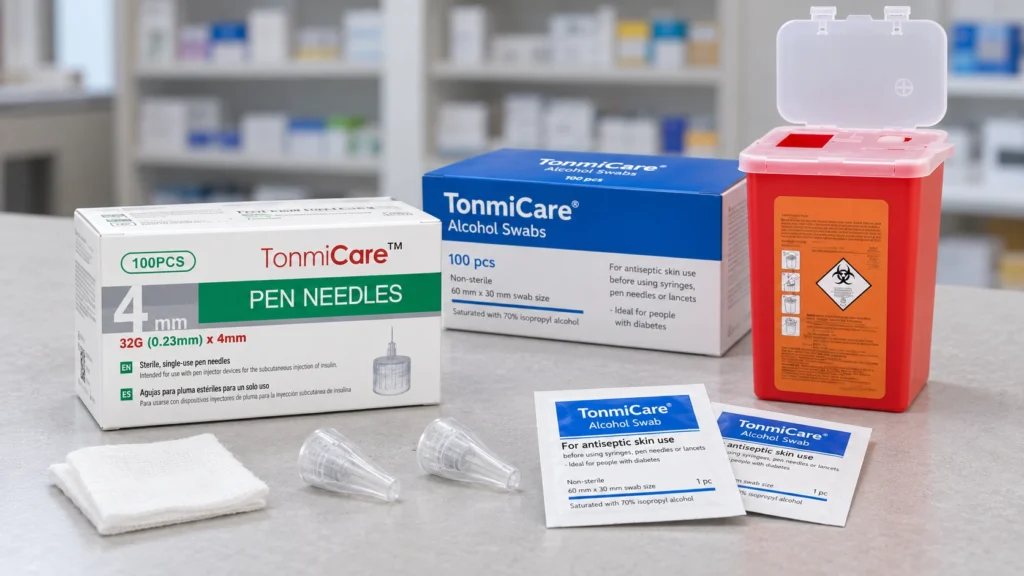
- Plan the whole handoff. Include alcohol prep supplies, gauze or cotton balls and an appropriate sharps container alongside the approved pen needles.[5] Confirm counseling and the replenishment route.
- Separate facts from planning assumptions. The stock example below is a purchasing model, not a manufacturer-specified kit or a patient prescription.
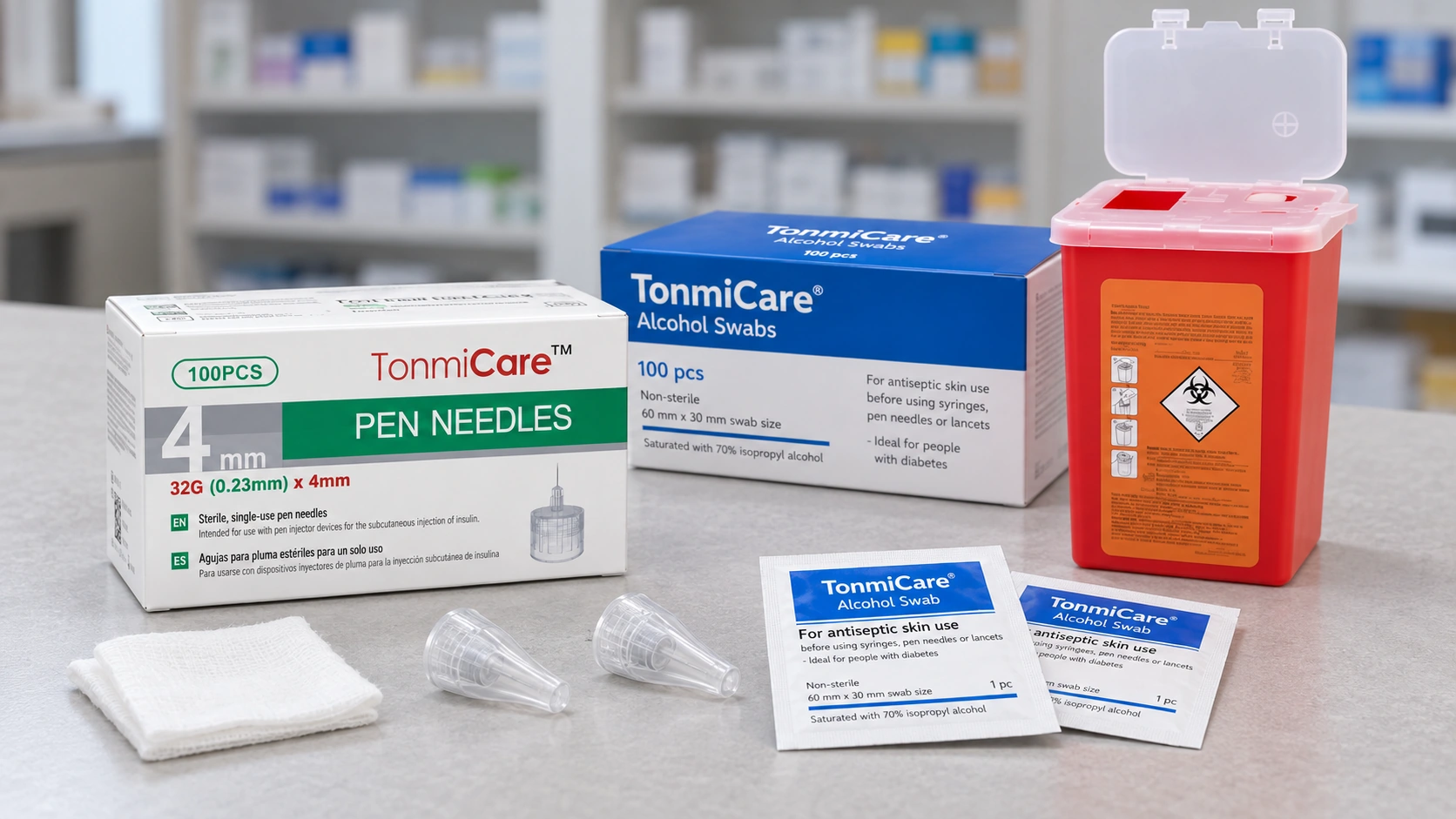
Sourcing Zepbound pen needles requires more than choosing a gauge and length. A pharmacy needs the exact catalog number, compatibility support, package quantity and refill arrangement. Keep those details connected from the quotation through dispensing so that a product substitution does not create an incomplete handoff.
1. Identify the Zepbound presentation before ordering
“Zepbound” alone is an incomplete accessory-order description. The U.S. product information covers several presentations, including a single-dose pen, vials and the single-patient-use KwikPen. Match the prescription and actual carton to the correct instructions before building an order.[6]
| Presentation | Needle workflow | Purchasing consequence |
|---|---|---|
| Zepbound KwikPen | Attach a separate compatible pen needle. | Build an approved pen-needle SKU into the handoff.[5] |
| Single-dose pen | Uses an integrated injection device. | Do not add an attachable pen needle automatically.[10] |
| Vial presentation | Uses its own syringe-and-needle instructions. | Maintain a separate supply list for the prescribed vial.[5] |
The ordering system should distinguish these presentations rather than group them under one generic “GLP-1 injection kit.” A change in presentation should trigger a new accessory check, even when the medicine name stays the same.
2. Verify KwikPen needle compatibility at SKU level
Lilly Canada states that Zepbound KwikPen is compatible with ISO 11608-2-compliant pen needles and lists multiple lengths and gauges. It directs users to packaging, the needle manufacturer’s website or the manufacturer for compatibility information.[2] This is supplementary manufacturer guidance from Canada; the U.S. instructions remain the controlling source for the U.S. pen.
ISO 11608-2:2022 addresses requirements and test methods for single-use, sterile, double-ended pen needles used with certain injection systems. Its published scope does not cover ordinary hypodermic needles or pre-attached syringe needles.[3] A general ISO statement therefore needs to be connected to the actual pen-needle product being purchased.
| Record | What the buyer should retain |
|---|---|
| Pen identity | Zepbound KwikPen, intended market, carton identity and current IFU revision. |
| Needle identity | Manufacturer, brand, REF/catalog number, gauge × length and standard or safety design. |
| Compatibility support | Current needle labeling, a controlled compatibility statement or written manufacturer clarification for the intended combination. |
| Standards evidence | Identify the cited standard, revision, covered REF and supporting conformity or performance documentation. |
| Approval and changes | Buyer decision, approval date and triggers for reassessment when the pen, needle or labeling changes. |
An attachment demonstration is a limited check. It does not replace the manufacturer’s evidence for the intended combination. If a quotation says only “universal pen needle,” ask the supplier to identify the product and the basis for that claim before releasing the purchase order.
3. Compare gauge, length and needle design
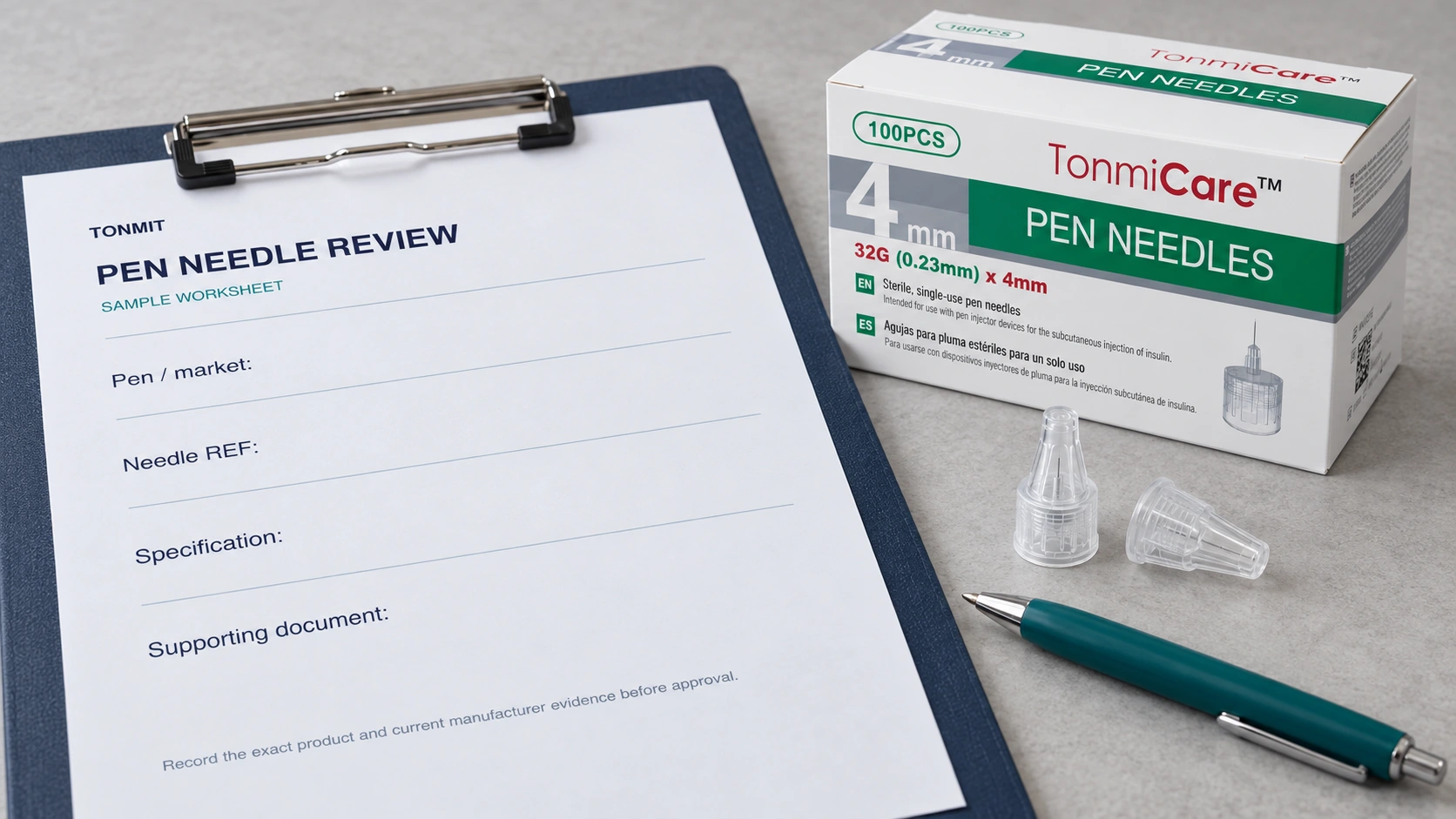
The Canadian Lilly FAQ lists lengths of 4, 5, 6, 8 and 12.7 mm and gauges from 29G through 34G, while noting that not every combination is commercially available.[2] That range is not an instruction to substitute any size for a patient’s selected needle.
For example, embecta’s U.S. product catalog identifies a 32G × 4 mm pen-needle SKU. This establishes that a specific marketed product exists; it does not establish that another supplier’s 32G × 4 mm needle is equivalent.[4]
- Write the complete gauge × length and REF on every quotation and order.
- Keep the clinician- or pharmacy-approved specification separate from the supplier’s availability list.
- Treat changes in length, gauge, hub, shields or safety mechanism as substitutions requiring review.
- Evaluate comfort and flow claims only against evidence for the quoted product.
For broader specification comparisons, see Tonmit’s pen needle sizes and compatibility guide .
4. Build a complete pharmacy supply checklist
Lilly’s U.S. healthcare-professional instructions list a KwikPen-compatible needle, an alcohol swab, gauze or a cotton ball, and an appropriate sharps container alongside the pen.[5] The pharmacy should establish what it supplies directly, what the patient already has, and what requires separate arrangement.
| Component | Define before ordering | Handoff question |
|---|---|---|
| Compatible pen needles | Approved REF, specification, package count and replacement stock. | Are sufficient approved needles available before the first use? |
| Alcohol prep pads | Exact product, labeled use, sterile or non-sterile status, pack quantity and expiry. | Does the supply quantity reflect the preparation workflow? |
| Gauze or cotton balls | Product format and supply arrangement. | Are these included or already available to the patient? |
| Sharps container | Market-appropriate model, opening, closure, fill limit and disposal route. | Can the patient safely contain and dispose of used needles? |
| Instructions and counseling | Current pen IFU, needle instructions and pharmacy contact details. | Has the patient received training for this presentation? |
Do not calculate prep-pad quantities from injection count alone: the U.S. IFU also instructs users to wipe the pen’s red inner seal.[1] Agree the quantity from the actual pharmacy preparation protocol.
Use a controlled bill of materials for assembled accessory packs. State each component and quantity explicitly, and keep the prescription medicine outside the ancillary-supply quotation unless separately scoped. Tonmit’s injection-support kit page describes this component-based approach.[9]
5. Control the pharmacy handoff and presentation changes
Use a short release check: correct presentation, approved needle, preparation supplies, disposal route and presentation-specific counseling. Record unresolved items before the order leaves the pharmacy. Recheck patients switching from an integrated single-dose pen because their existing supply routine may not include attachable needles.
Needle-handling counseling should cover a new needle for every injection, priming before each weekly injection, and removing the needle after use rather than storing the pen with it attached.[1] The detailed procedure belongs in the current IFU and pharmacist training.
A Zepbound KwikPen must not be shared between people even if the needle is changed. Lilly also instructs users not to inject leftover medicine or transfer it into a syringe.[5]
Kit-labeling control: Name the supported presentation, list the accessory contents and make the refill route easy to find. Avoid packaging that implies Lilly endorsement or compatibility approval beyond the evidence retained for the components.
6. Calculate needle demand and replenishment separately
Each KwikPen provides four fixed weekly doses.[1] Four routine injections therefore create a baseline demand of four new needles. This is a consumption baseline, not a guarantee that exactly four needles will cover every situation.
The IFU includes needle replacement in troubleshooting, including failed priming and a potentially blocked needle.[1] A pharmacy can account for replacements and damaged packs in its inventory policy without changing the prescribed injection schedule.
Worked purchasing example: one four-dose cycle
Assumptions: 250 patients; one four-dose cycle each; a buyer-selected 10% inventory allowance; 100 needles per approved box; no usable stock or confirmed receipts deducted yet.
- Baseline consumption: 250 × 4 = 1,000 needles.
- Inventory allowance: 1,000 × 10% = 100 needles.
- Planning total: 1,000 + 100 = 1,100 needles, or 11 boxes.
The 10% allowance is a buyer-selected example, not a Lilly requirement or a patient-level needle quantity. The 11-box total assumes no stock deduction and no additional case-pack or minimum-order constraint.
For a rolling program, forecast from scheduled injections and actual dispensing data rather than multiplying every calendar month by four. A four-dose cycle covers four weekly administrations; calendar-month demand can differ.
Keep the reorder trigger separate from the quantity to purchase. Expected consumption during replenishment lead time plus safety stock defines a planning trigger; the net purchase quantity also depends on what is already usable and what will arrive on time.
Net order requirement
Forecast demand in the planning window + reserve allowance − usable, unallocated stock − confirmed receipts due within that window.
Round a positive result up to the approved buying pack; a zero or negative result creates no additional order under this model. Exclude expired, damaged, quarantined or already allocated stock, and receipts due after the planning window.
In the example above, 200 usable needles plus 300 confirmed needles arriving within the cycle reduce the 1,100-needle planning total to 600 needles, or six 100-needle boxes, before any case-pack or minimum-order adjustment. Keep pharmacy reserve stock separate from the patient-level quantity decided at dispensing.
7. Match the container to the waste pathway
For home users, FDA recommends putting used sharps into an appropriate container immediately and arranging final disposal under local rules. Its consumer guidance advises disposal when a container is about three-quarters full and warns against overfilling or reusing it.[7] Follow the selected container’s labeled fill limit as well.
Container purchasing should review the opening, stability, closure and how the used needle assembly enters the container under its instructions. Do not convert a stated volume, such as 0.05 L or 0.2 L, into a promised needle count without model-specific capacity evidence.
A compact container can be considered for a defined portable-use requirement; a home replenishment program may need a different format. A product-category link is a starting point for review, not evidence of U.S. clearance for every model. Request the applicable records for the exact quoted container.
Home disposal advice does not establish a healthcare facility’s waste procedure. FDA provides separate guidance for healthcare facilities, including use of appropriate sharps containers and the applicable regulated-waste arrangements.[8]
8. Keep storage support specific to the presentation
The current U.S. prescribing information sets the following storage limits for the single-patient-use KwikPen.[6]
| Status | Current U.S. labeling |
|---|---|
| Unopened, refrigerated | 2–8°C (36–46°F). May be used until the labeled expiry if kept refrigerated. |
| Unopened, at room temperature | Up to 30°C (86°F). Discard after 30 days. |
| Opened / in use | Keep in the original carton at 2–8°C (36–46°F) or at room temperature up to 30°C (86°F). |
| Discard an opened pen | After a total of 30 days at room temperature, 30 days after first use, or four weekly doses. Discard once any of these limits is reached, even if medicine remains. |
Keep the pen in its original carton, protect it from heat and light, and do not freeze it. Discard a pen that has been frozen.[6]
The single-dose presentation has different room-temperature instructions; do not copy its 21-day limit onto KwikPen labeling.[6]
If a program adds a cooler bag or cooling cup, define the journey, ambient conditions, duration and separation from frozen elements. Request performance evidence for the proposed configuration. A temperature display alone does not demonstrate that a pack maintains the required conditions throughout transport.
9. Qualify the supplier and control substitutions
Compare quotations only after the component list is fixed. The following is a proposed acceptance checklist, not a certification of any supplier or SKU.
| Stage | Evidence or check | Decision |
|---|---|---|
| Before quotation approval | Component REF, compatibility support, intended-market records and approved pack quantity. | Accept the named items or return the quotation for clarification. |
| Before first shipment | Sample label, sterile-barrier format where applicable, lot/expiry format and minimum remaining shelf life. | Approve the production and packaging configuration. |
| At receiving | Match REF, specification, quantity, lot and expiry; inspect packaging and record damage. | Release conforming stock; segregate discrepancies for review. |
| During replenishment | Track fill rate, replacement demand, complaints, supplier changes and shelf-life losses. | Adjust inventory and reassess changed components. |
Ask suppliers to quote needles, prep pads, containers, assembly, freight and customization separately. This makes a unit-price comparison useful and shows whether the apparent saving comes from removing components or changing the package.
For U.S. inventory, request confirmation by exact SKU and quantity at the time of order. Keep stocking location, available lots and promised delivery dates in the quotation rather than assuming that every product family is held domestically.
10. Frequently asked buyer questions
Does Zepbound KwikPen come with needles?
No. Compatible pen needles are supplied separately.[1] Verify that they are available at the prescription handoff.
What pen needles fit Zepbound KwikPen?
Use a supported pen-needle SKU. Lilly Canada identifies ISO 11608-2-compliant pen needles and directs users to current manufacturer compatibility information.[2] Confirm the evidence for the intended U.S. combination.
Is 32G × 4 mm the only permitted specification?
No such exclusive requirement appears in the cited U.S. IFU. The supplementary Canadian FAQ lists several lengths and gauges.[2] The pharmacist or clinician determines the patient’s specification.
Can a supplier guarantee compatibility from gauge and length alone?
Those fields do not identify the complete product. Require the REF, current labeling and controlled compatibility support before approving it.
Should every four-dose supply pack contain exactly four needles?
Four is the routine-use baseline. Pack design should also address the approved replacement arrangement, remaining patient stock and pharmacy dispensing policy. A wholesaler’s stock allowance does not set a patient prescription.
Can an insulin syringe be supplied to remove leftover medicine?
No. Lilly instructs users not to transfer medicine from the KwikPen into a syringe or inject the leftover medicine.[5]
Can a small sharps container replace the home disposal arrangement?
Only if the selected product and replacement route meet the program’s requirements. Capacity in liters does not establish a needle count or a collection service. Final disposal follows local rules.[7]
What should an RFQ include?
Specify the product family, gauge × length, pen model and market, quantity, destination, packaging, compatibility evidence, shelf-life requirement and any assembly or private-label needs.
B2B Supply Planning
Request a pharmacy supply review
Share your product family, required gauge × length, exact pen model, quantity and destination. Include the prep-pad and sharps-container requirements if you need a coordinated accessory order.
We review the requested pen needle components, packaging and document requirements against the selected SKUs. We confirm availability and quotation terms for the requested quantity and destination; compatibility and market suitability remain item-specific checks.
Accessory supply inquiry
Send your pharmacy supply requirements
Include the pen presentation and intended market, needle REF or required gauge × length, quantity, destination, remaining shelf-life requirement, and any prep-pad, container or custom-packaging needs.
References
- Eli Lilly and Company. Zepbound KwikPen U.S. Instructions for Use. Revision shown: January 2026.
- Lilly Canada. Zepbound KwikPen Needles: Compatibility and Availability Explained. Canadian supplementary manufacturer guidance.
- International Organization for Standardization. ISO 11608-2:2022: Double-ended pen needles. Published scope and standard identity.
- embecta. BD Nano 2nd Gen Pen Needles. U.S. catalog example, REF 320550, 32G × 4 mm.
- Lilly USA. Getting Patients Started: How to Use & Resources. Presentation-specific instructions and supply list.
- Eli Lilly and Company. Zepbound U.S. Prescribing Information. Revision shown: August 2026; Section 16.2, Storage and Handling.
- U.S. Food and Drug Administration. Best Way to Get Rid of Used Needles and Other Sharps. Consumer disposal guidance.
- U.S. Food and Drug Administration. Sharps Disposal Containers in Health Care Facilities.
- Tonmit. GLP-1 Injection Kits Wholesale . Ancillary-component and kit-scope information.
- Eli Lilly and Company. Zepbound Single-Dose Pen U.S. Instructions for Use. Revision shown: April 2026.
Zepbound and KwikPen are trademarks of Eli Lilly and Company. Other product names belong to their respective owners. Their inclusion identifies the devices and sources discussed and does not imply affiliation or endorsement.