
Venous collection reference · Colors, additives & practical checks
Find the routine venous blood tube draw order and the common uses of each tube group. Understand the exceptions that color-only charts miss, then use a blank worksheet to verify the exact tube and collection requirements.
Review Status & Editorial Responsibility
Scope: An educational reference for routine venous collection using familiar U.S. conventions. Trained personnel must follow the receiving laboratory’s validated procedure, the ordered test requirements and the exact device instructions. Capillary, line and special-kit collections need their applicable procedures.
Quick answer
What Is the Correct Blood Tube Draw Order?
- For routine venous collection, the reference sequence is blood cultures → sodium citrate → serum → heparin → EDTA → glycolytic inhibitor.[1]
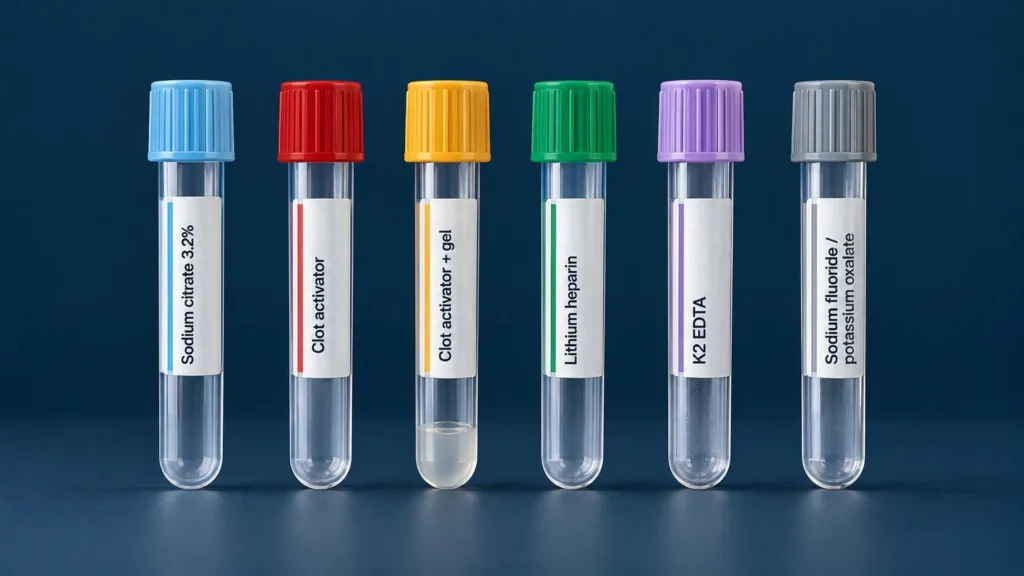
- Common color cues are culture bottles → light blue → red / gold / tiger → green → lavender / pink → gray. Read the additive on the label.
- Collect the specimens ordered; the sequence does not require a tube from every group.
- Red and gold are serum options within one group, rather than two mandatory collection steps.
- When a winged set is used and citrate is the first tube needed, a discard tube clears tubing air before the citrate specimen.[3]
- Correct fill, mixing, identification and test-specific handling matter alongside the sequence. Capillary collection follows a separate protocol.
Need a quick lookup? Start with the venous order of draw chart, light-blue tube checks or collection problem table.
1. Venous Order of Draw Chart: Colors, Additives and Tests
The lab draw order organizes blood collection tubes by additive group. This chart brings the sequence and common test examples together. It uses familiar U.S. color conventions; the receiving laboratory’s test directory determines the accepted container and specimen.
| Order / group | Common color cue | Additive / specimen | Common test examples |
|---|---|---|---|
| 1 Blood cultures | Culture-system bottle colors vary | Culture medium; whole blood inoculated into the specified system | Blood cultures for organisms causing bloodstream infection |
| 2 Sodium citrate | Light blue | Buffered sodium citrate; citrated plasma for routine coagulation assays | PT / INR, aPTT and other specified coagulation tests |
| 3 Serum | Red; gold / tiger | No additive or clot activator, with or without separator gel; serum | Serum lipid panels and other chemistry/serology assays that accept the selected tube |
| 4 Heparin | Green / light green | Heparin, with or without separator gel; plasma | Plasma chemistry, such as a laboratory-validated basic metabolic panel |
| 5 EDTA | Lavender / purple; some pink tubes | EDTA; whole blood or plasma as required by the test | CBC; specified HbA1c assays; designated blood-bank testing |
| 6 Glycolytic inhibitor | Gray | For example, sodium fluoride / potassium oxalate; specimen per test instructions | Glucose testing where that additive and handling method are accepted |
Sequence and grouping: CLSI public guidance and Greiner Bio-One’s manufacturer chart.[1][4] Test examples identify common uses, not interchangeable tubes or a complete test directory.[8][9][10][17][18]
Example: if the orders require citrate plasma, serum and an EDTA whole-blood specimen, collect those three groups in that order. There is no reason to add a culture bottle, heparin tube or gray tube solely to complete a memorized list.
2. Which Color Tube Is Used for Which Test?
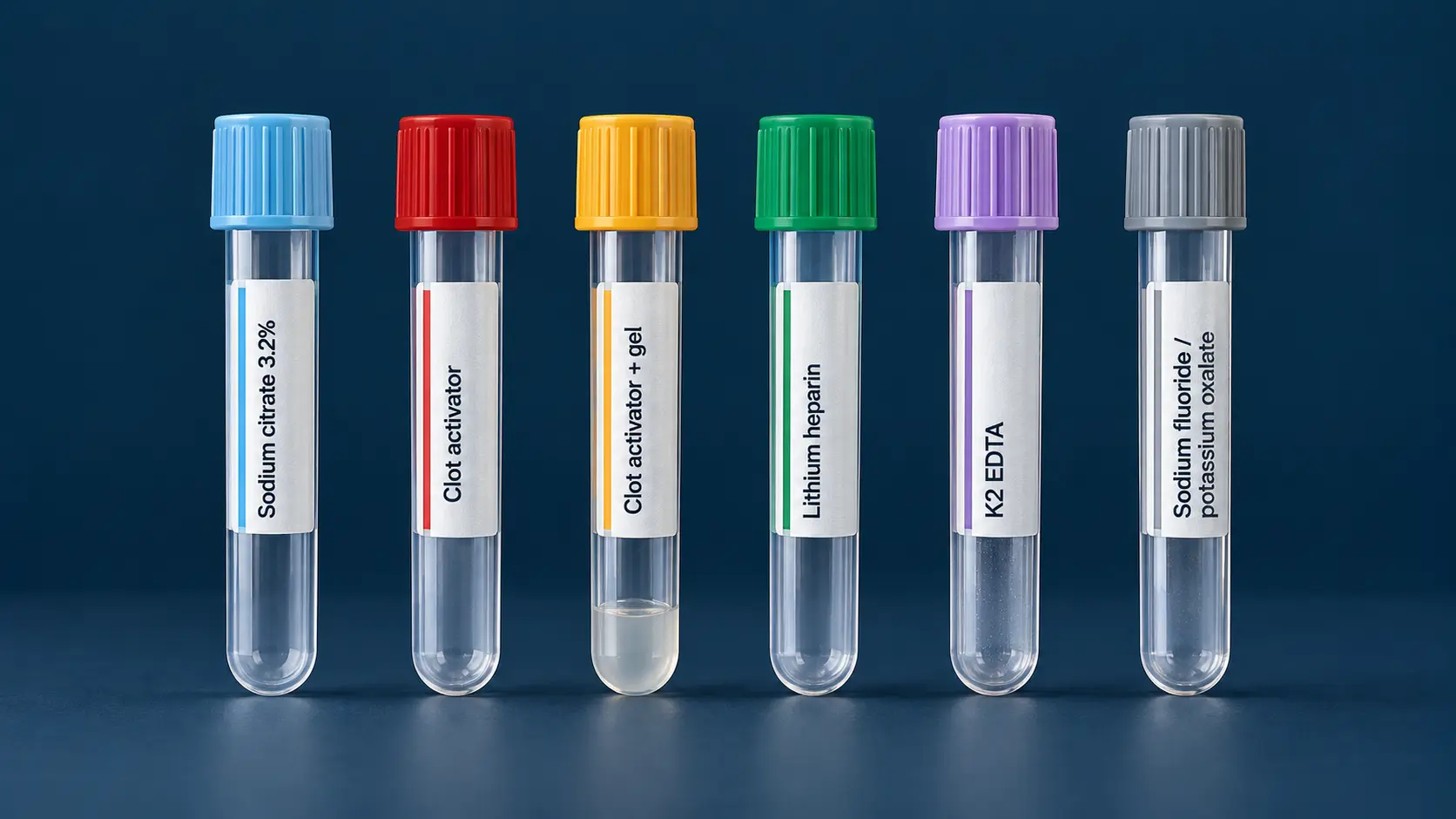
A useful answer connects color + additive + specimen + test requirement. “Chemistry” or “blood test” alone is too broad to select a container. Serum is obtained after blood clots; anticoagulated blood can provide plasma after processing, while whole-blood tests retain the cellular components.[8]
Blood culture bottles and light-blue tubes
Blood cultures belong first among the routine groups. Bottle color, collection volume and aerobic-versus-anaerobic bottle order are system-specific; this article’s six-group chart does not establish those details. Light-blue coagulation tubes contain citrate and require the specified fill to preserve the blood-to-anticoagulant ratio.[5]
Red top versus gold or tiger top
A red cap does not always mean “no additive.” BD product 367815, for example, is a plastic red-closure serum tube containing clot activator. Gold or tiger serum separator formats combine the specified clotting chemistry with a gel barrier. Both belong to the serum group, but gel suitability and clotting or processing requirements must match the assay. Do not assume a serum separator tube can replace every red-top tube.[6][4]
Green, lavender and gray tubes
Green heparin tubes and lavender EDTA tubes are anticoagulant formats, but they serve different specimen requirements. Mayo Clinic Laboratories’ CBC listing specifies lavender-top EDTA whole blood; its cited HbA1c assay also uses EDTA. Neither example makes EDTA suitable for every chemistry test.[9][10]
Two laboratory examples: Mayo Clinic Laboratories’ serum lipid panel lists serum gel as preferred and red top as acceptable. St. Clair Hospital’s plasma basic metabolic panel specifies lithium-heparin plasma and lists light-green PST as preferred. These examples explain the chart; the receiving laboratory’s own test directory controls the actual order.[17][18]
In a fluoride/oxalate gray tube, fluoride inhibits glycolysis and oxalate provides anticoagulation. Sodium fluoride does not immediately stop glycolysis after collection. Other glucose-tube formulations exist. Follow the receiving laboratory’s validated separation, transport and time requirements for the actual product; cap color does not establish specimen stability.[13][16]
3. Why Does the Phlebotomy Order of Draw Matter?
The purpose is to limit additive contamination of specimens collected for other tests. Potassium EDTA contamination, for example, can increase measured potassium and lower measured calcium. That combination can misrepresent the patient’s condition and trigger investigation or another collection.[7]
The risk needs accurate wording. Mayo’s evidence discussion distinguishes closed evacuated collection from syringe transfer and direct pouring. A sequence error does not prove that contamination occurred, and contamination is not an inevitable consequence of every out-of-order tube. Continue to follow the validated order, record a deviation and involve the laboratory when specimen suitability is uncertain.[7]
Order is one part of collection quality. It cannot compensate for an incorrect patient label, an underfilled citrate tube, poor mixing or unsuitable transport. Preventing those problems helps reduce avoidable repeat collections and delays; no sequence guarantees an accurate result on its own.
4. Light-Blue Tube Filling: The 9:1 Ratio and Underfill Problem
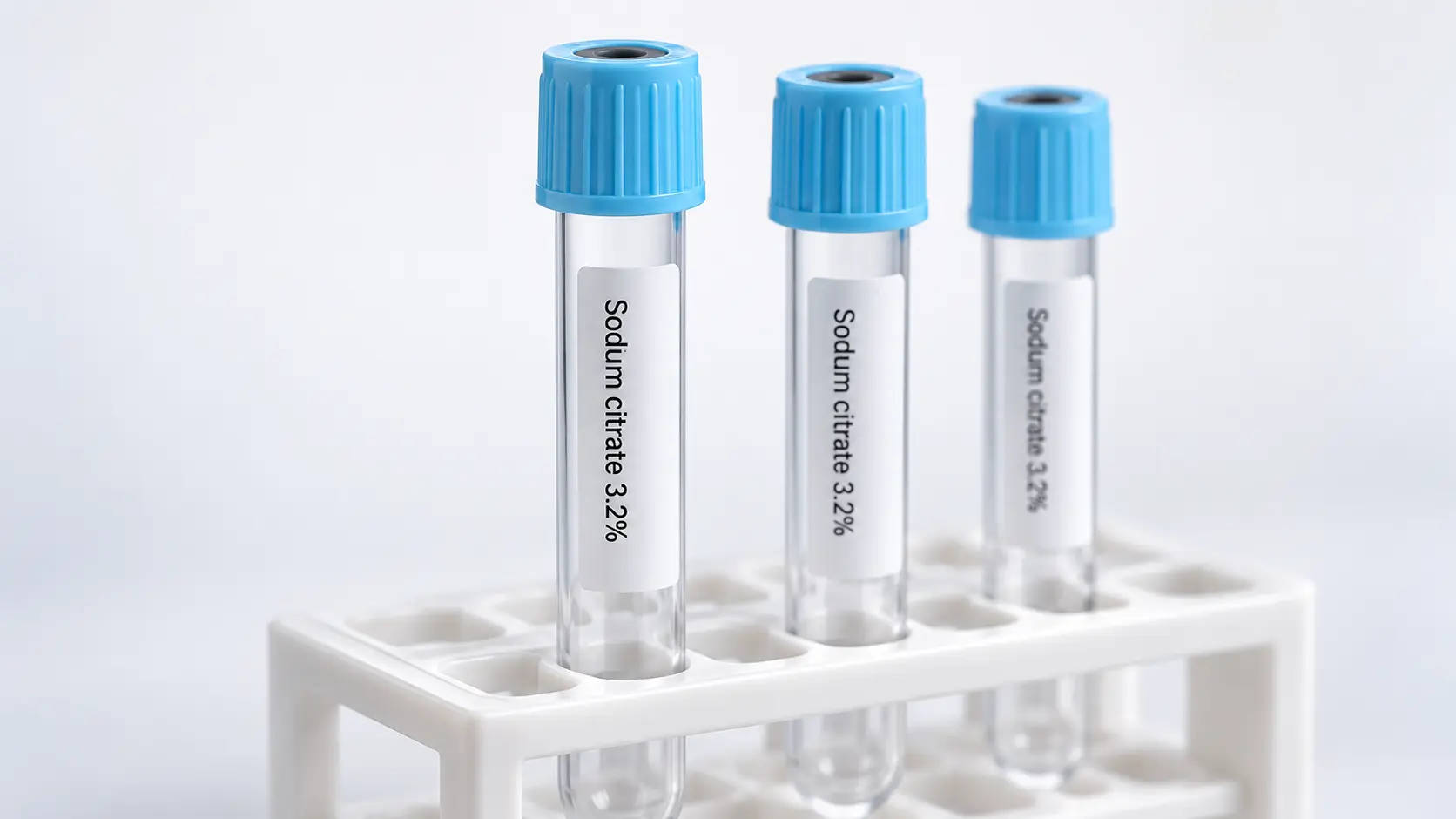
Routine coagulation collection commonly uses 3.2% buffered sodium citrate. The target is nine parts blood to one part citrate anticoagulant, rather than nine parts plasma. Underfilling changes that ratio and can produce inaccurate coagulation results.[5]
- Read the exact tube’s fill requirement. Tube dimensions and nominal capacity do not replace the labeled draw volume or fill indicator.
- Check the collected volume against the approved criterion. Do not accept a partly filled tube solely because there appears to be enough material for the analyzer.
- Resolve an underfill through the laboratory. Do not combine separate citrate specimens, pour blood from another additive tube into it or add water to reach the line.
- Flag hematocrit above 55%. ARUP’s guidance calls for citrate adjustment in this situation. Arrange the laboratory’s controlled collection process; do not improvise an adjustment at the bedside.
The receiving laboratory determines acceptance and recollection requirements for the ordered assay. A general website percentage must not replace its validated criteria.
5. When Does a Butterfly Needle Need a Discard Tube?
When a winged blood collection set is used for venipuncture and a citrate tube is the first tube needed, collect a discard tube first. BD explains that the discard clears air in the tubing so the citrate tube can receive the intended blood volume. This is a tubing-volume issue, not a rule to discard blood before every venipuncture.[3]
| Situation | What to verify |
|---|---|
| Winged set; citrate is first needed | Use the specified discard tube to clear tubing air before collecting the citrate specimen. |
| Winged set; an earlier required specimen has already been collected | Follow the validated sequence and protocol; do not assume an additional discard is always required. |
| Straight-needle venipuncture | The winged-set air-space explanation does not automatically apply. Check test-specific requirements. |
| Special coagulation testing or a line draw | Ask for the relevant laboratory/device procedure. These situations can have additional requirements. |
Discard requirements also differ by assay: ARUP’s hemostasis instructions recommend a pilot tube for coagulation testing other than PT/INR and aPTT. That laboratory-specific instruction is distinct from the winged-set air rule. The required discard container and volume come from the applicable procedure.[5]
6. Mixing and Processing: Why There Is No Universal Inversion Count
Mix additive tubes promptly using gentle, complete inversions as instructed. Greiner Bio-One describes one inversion as turning the tube upside down and returning it upright; its chart assigns different counts to different tube types. A no-additive tube and a clot-activator serum tube do not have identical mixing requirements.[4]
Read the current instructions for the exact manufacturer and product reference (REF), together with the laboratory’s validated procedure. Do not apply “invert everything eight to ten times” to every brand and tube. Vigorous shaking is not a substitute for gentle mixing.
Processing is a separate check. Confirm any clotting interval, centrifugation conditions, separation deadline and storage temperature for the assay. A correctly ordered and mixed specimen still needs the correct preparation and transport.[8]
7. Special Tube Colors: Royal Blue, Pink, Pearl and Yellow
Place special tubes by the verified additive and test instructions. Do not insert them into the sequence using cap color alone.
- Royal blue: trace-element tubes exist with different additives. Mayo’s metals instructions place the royal-blue tube first within its additive group. Trace-element work also requires the specified collection and transfer materials.[11]
- Pink and pearl: CLSI includes these as examples within the EDTA group. The particular product’s gel, intended use and test acceptance still need confirmation.[1]
- Yellow: BD lists yellow-closure products containing ACD and other yellow-closure products containing SPS. Those are different additives, so “yellow goes first” is not a complete instruction.[12]
If the test directory specifies a special kit or preservative tube, obtain its collection instructions before the draw. An unlisted tube is not automatically a gray-tube equivalent or the last tube.
8. Is the Capillary Order of Draw the Same?
No. Do not apply this venous chart to finger-stick or heel-stick collection. Capillary sampling uses separate procedures and microcollection devices. CLSI addresses diagnostic capillary blood specimens in GP42, separately from its PRE02 venous standard.[14]
Before a capillary collection, confirm the microcollection system, the required specimens and any blood-gas requirements using the relevant laboratory and device instructions. A chart for evacuated venous tubes does not supply those directions. Line draws and specialized collection kits likewise need their own procedures.
9. Common Collection Mistakes and What to Do Next
| Problem | Why it matters | Appropriate next step |
|---|---|---|
| Selecting a tube by cap color only | The additive or gel may not match the assay. | Reconcile the label, exact REF and test directory. |
| Underfilled citrate tube | The blood-to-citrate ratio changes. | Refer the volume and collection details to the laboratory’s acceptance/recollection procedure. |
| Wrong collection order | Additive interference is a potential concern; it is not proven by the sequence alone. | Report the actual sequence and device so the laboratory can assess the affected tests. |
| Clotting in an anticoagulant specimen | The specimen may be unsuitable for the requested test. | Follow the rejection/recollection process. Do not remove a clot and submit the remainder as an intact specimen. |
| Vigorous shaking or a difficult collection | Specimen damage or hemolysis requires assessment. | Document the issue and follow the assay’s suitability criteria; order alone does not resolve it. |
| Wrong, missing or mismatched identification | The specimen cannot reliably be linked to the intended patient. | Follow the identification-error procedure; do not guess or independently relabel it. |
| Decanting whole blood to “fix” the tube | An additive already in the blood remains present in the second container. | Do not transfer between additive tubes to rescue a wrong tube or underfill. Seek laboratory direction. |
This follow-up table synthesizes manufacturer handling guidance and laboratory specimen requirements.[3][4][5][7][8]
Aliquotting is different. An authorized laboratory procedure can require transferring properly processed serum or plasma into a specified transport container. That controlled step must not be confused with pouring anticoagulated whole blood into a different collection tube to change its identity.[8]
10. Patient Identification, Comfort and Collection Safety
Before collection, trained personnel reconcile the patient, request and required specimens, explain the procedure and check relevant preparation requirements. Follow the facility’s patient-identification and specimen-labeling process, with the required identifiers, collection details and verification at the collection site.[8][15]
Use an appropriate collection device for the patient and ordered tests. The smallest available needle is not a universal solution for comfort or sample quality. Follow hand-hygiene, skin-preparation, single-use device, safety-mechanism and sharps-disposal procedures; never improvise a syringe-transfer method.
Patients can help by reporting previous fainting, difficult draws or adhesive sensitivities and by following the clinician’s preparation instructions. Multiple tubes often provide different specimen types for different tests; they do not necessarily mean multiple needle punctures. Correct collection supports useful results while reducing avoidable repeat procedures.
11. An Order of Draw Mnemonic That Tracks Additives
Cultures → Citrate → Serum → Heparin → EDTA → Fluoride/oxalate.
This recall phrase follows the six routine groups. It avoids making red and gold compulsory separate steps or treating every yellow cap as the same additive. Use it to remember the reference sequence, then verify the actual tube label and applicable protocol.
12. Download a Tube and Collection-Requirements Verification Sheet
Our original blank worksheet connects an ordered specimen to the exact tube, current instructions and unresolved questions. It is useful when updating a collection station, comparing an offered alternative or preparing a laboratory-approved reference.
Tube Additive & Collection Requirements Verification Sheet
Use one record per exact REF and test requirement. Open the complete sheet below, or copy/download it with the buttons.
Open the complete blank worksheet
TUBE ADDITIVE & COLLECTION REQUIREMENTS VERIFICATION SHEET
Original blank editorial resource | One exact REF / test requirement per record

RECORD CONTROL
Organization / collection area:
Prepared by / date:
Laboratory contact / procedure reference / revision:

ORDERED SPECIMEN AND PRODUCT IDENTITY
Test name / laboratory test code:
Required specimen: whole blood / serum / plasma / culture / other:
Legal manufacturer / brand:
Exact product REF / catalog number:
Closure color (visual cue only):
Labeled additive and concentration:
Separator gel: yes / no / type:
Tube material / dimensions:
Labeled draw volume / fill indicator:
Lot / expiry / storage conditions:

COLLECTION AND HANDLING EVIDENCE
Current manufacturer IFU title / revision / source:
Receiving laboratory test-directory entry / date checked:
Applicable venous / capillary / line / special-kit procedure:
Additive group and validated order placement:
Collection device / holder / winged set and exact REF:
Discard needed? Condition / container / required volume / procedure source:
Acceptable fill criterion and source:
Gentle inversion requirement / count / source:
Clotting interval if applicable:
Processing / centrifugation / aliquot-container requirements:
Time limits / temperature / transport / light protection:
Identification and labeling procedure reference:
Special hematocrit or other laboratory-directed requirements:

COMPARISON OR FOLLOW-UP
Requested REF / offered alternative, if relevant:
Differences in additive, volume, gel, material or handling:
Missing evidence / questions for the laboratory or manufacturer:
Decision: unresolved / hold / accepted under referenced procedure / reject:
Qualified reviewer / role / date / approval reference:
Next review trigger / action owner:

METHOD AND LIMITS
Record the current IFU and receiving laboratory's requirements together.
Resolve conflicting instructions through qualified laboratory review.
This blank worksheet is not a completed QC record, validated clinical SOP,
proof of sterility, or authorization to substitute products. Do not include
patient names, identifiers or test results in this resource.
How this resource was prepared
We organized publicly available standards guidance, manufacturer instructions and laboratory requirements into a blank evidence record. No patient samples were collected and no product testing was performed for this article. The sheet is an editorial aid, not a completed QC record, validated collection SOP or evidence that two products are clinically interchangeable. A qualified laboratory reviewer must resolve local requirements.
Common questions
Blood Tube Draw Order: Frequently Asked Questions
What is the order of draw for lab tubes?
The routine venous sequence is blood cultures, sodium citrate, serum, heparin, EDTA and glycolytic inhibitor. Collect only the required groups, following the laboratory’s protocol and device instructions.
Why does my laboratory’s order of draw chart look different?
Charts can separate tube colors within the same additive group or include special tubes and collection-specific exceptions. CLSI’s public guidance allows certain verified nonadditive serum tubes before citrate; a clot-activator tube does not meet that exception. Follow the laboratory’s validated procedure for the actual tubes.
Does a red-top tube always contain no additive?
No. Plastic red-top products can contain clot activator. Read the additive field on the exact tube and its manufacturer specification.
Do I need both a red and a gold tube?
Only if the ordered tests and laboratory requirements call for both. Both are serum-group options; their presence in a chart does not make both mandatory or interchangeable.
Does a butterfly needle always require a discard tube?
The specific air-clearance rule applies when a winged set is used and citrate is the first tube needed. Other discard requirements depend on the test, device and laboratory procedure.
Can an underfilled light-blue tube still be accepted?
Acceptance depends on the assay and laboratory’s validated fill criteria. Do not assume sufficient analyzer volume means the blood-to-citrate ratio is acceptable. Ask the receiving laboratory.
How many times should blood tubes be inverted?
Use the count in the current instructions for the exact product and validated laboratory procedure. Different additives and products have different requirements; gentle inversion and vigorous shaking are not equivalent.
Where does a royal-blue tube go in the order?
Identify its additive first. Mayo’s trace-metals instructions place royal-blue tubes first within the corresponding additive group, with additional requirements for collection materials and processing.
Does drawing tubes out of order always mean a redraw?
No automatic conclusion follows from order alone. Report the sequence, collection system and affected tests; the laboratory assesses specimen suitability and whether recollection is necessary.
Why are several tubes collected during one blood draw?
Different tests require different additives, specimen types or handling. Several tubes can be collected through one suitable venipuncture system according to the ordered tests and protocol.
For laboratory and supply teams
Make a Blood Collection Supply Enquiry Specific
Send the required product category, manufacturer/REF if known, additive, draw volume, pack quantity and destination market. Ask Tonmit to confirm availability and supporting documentation for the exact request before comparing an offered alternative.
Sources and Editorial Basis
Sources checked October 17, 2026. This guide draws on publicly available CLSI guidance, manufacturer documentation and laboratory specimen requirements. Follow the current product instructions and the receiving laboratory’s validated procedures for actual collection.
- CLSI. Order of Blood Draw Tubes and Additives, March 19, 2019. Public venous sequence and additive groups.
- CLSI. PRE02: Collection of Diagnostic Venous Blood Specimens, eighth edition, February 13, 2025; public sample. Edition status and scope.
- BD. BD Vacutainer Blood Collection Tubes: Label Reference Guide, October 2024. Fill indicators and the winged-set/citrate-first discard condition.
- Greiner Bio-One. VACUETTE Blood Collection Tubes: Order of Draw and Specimen Handling, L0742003R7. Manufacturer chart based on GP41 seventh edition; current product IFUs govern exact use.
- ARUP Laboratories. Hemostasis/Thrombosis Specimen Collection and Handling, revision December 2019. Laboratory-specific citrate, hematocrit and pilot-tube instructions.
- BD. Product 367815 specifications. Plastic red-closure tube with clot activator.
- Mayo Clinic Laboratories, Brad Karon, MD, PhD. Phlebotomy Top Gun: Order of Draw—Do We Still Care?, February 12, 2019. Carryover mechanisms and limitations of the evidence.
- Mayo Clinic Laboratories. Specimen Collection and Preparation: Blood Specimens. Test-specific container, processing, identification and transport requirements.
- Mayo Clinic Laboratories. Complete Blood Cell Count with Differential, Blood. EDTA whole-blood test example.
- Mayo Clinic Laboratories. Hemoglobin A1c, Blood (A1CJ). Assay-specific EDTA example.
- Mayo Clinic Laboratories. Metals Analysis Specimen Collection and Transport, revision June 2025. Royal-blue tube grouping and trace-element materials.
- BD. Yellow-closure product specifications: 364606 (ACD) and 364960 (SPS). Product-specific examples of different additives.
- BD. Fluoride/oxalate tube 367921. Additive roles and product-specific specimen context.
- CLSI. GP42: Collection of Capillary Blood Specimens, seventh edition, 2020. Separate capillary scope; a detailed capillary protocol is not reproduced here.
- World Health Organization. WHO Guidelines on Drawing Blood: Best Practices in Phlebotomy, 2010. Background patient and worker safety guidance.
- Sacks DB, et al. Guidelines and Recommendations for Laboratory Analysis in the Diagnosis and Management of Diabetes Mellitus. Diabetes Care, 2023. Fluoride-related delay in glycolysis inhibition and specimen handling.
- Mayo Clinic Laboratories. Lipid Panel, Serum (LPSC1). Laboratory-specific serum gel / red-top example.
- St. Clair Hospital Laboratory. Basic Metabolic Panel, Plasma (BMP). Laboratory-specific lithium-heparin / PST example.