
U-100 scale, sizes & practical product checks
U-100 insulin syringes use a scale for insulin labeled 100 units/mL. This guide explains capacities, unit markings, mL equivalents and needle specifications, with clear answers to common reading mistakes and safe-use questions.
Reviewed by
Review scope and professional backgrounds
Review scope: Capacity, scale, graduation and needle configuration.
Background: Medical-consumable product information and configuration comparisons.
Review scope: Document scope, protective presentation and traceability.
Background: Quality-documentation assessment for medical-consumable supply programs.
Review scope: Label fields, protective presentation and package hierarchy.
Background: Packaging content and customer-brand project coordination.
Scope: Educational scale and product guidance. The medicine’s current labeling, prescription, device instructions and qualified professional teaching govern actual use. The numerical examples do not prescribe a dose or authorize another medicine or concentration.
Quick answer
How Do You Read U-100 Insulin Syringes?
- U-100 identifies the scale for insulin labeled 100 units/mL. It does not identify the barrel capacity.[1]
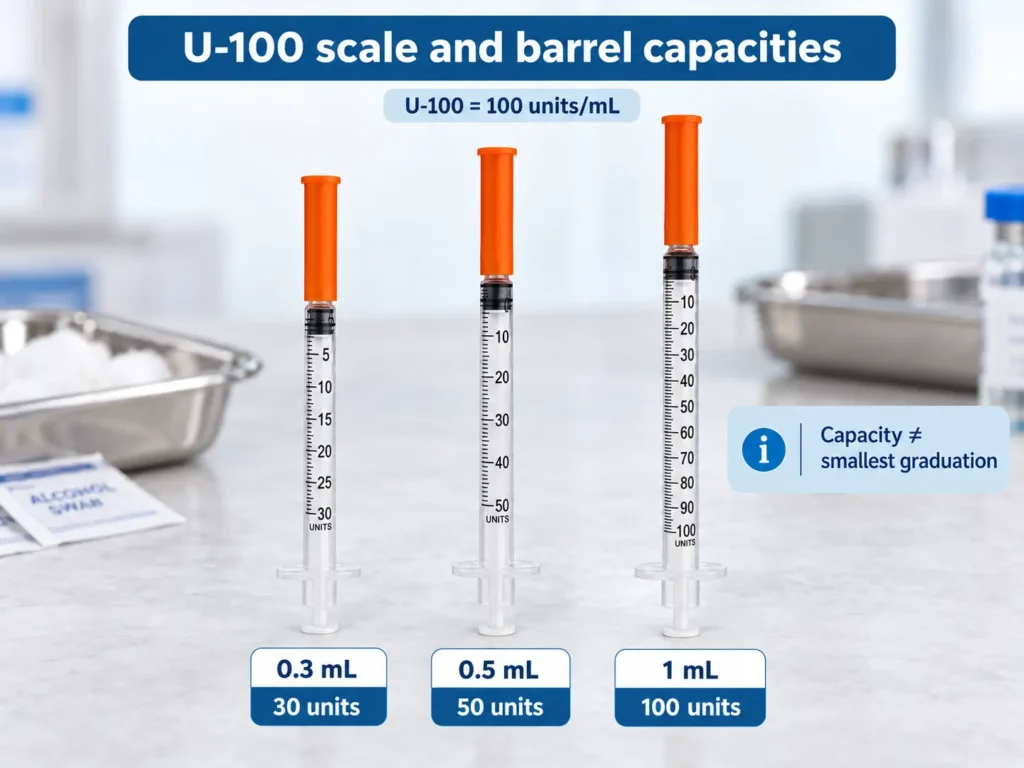
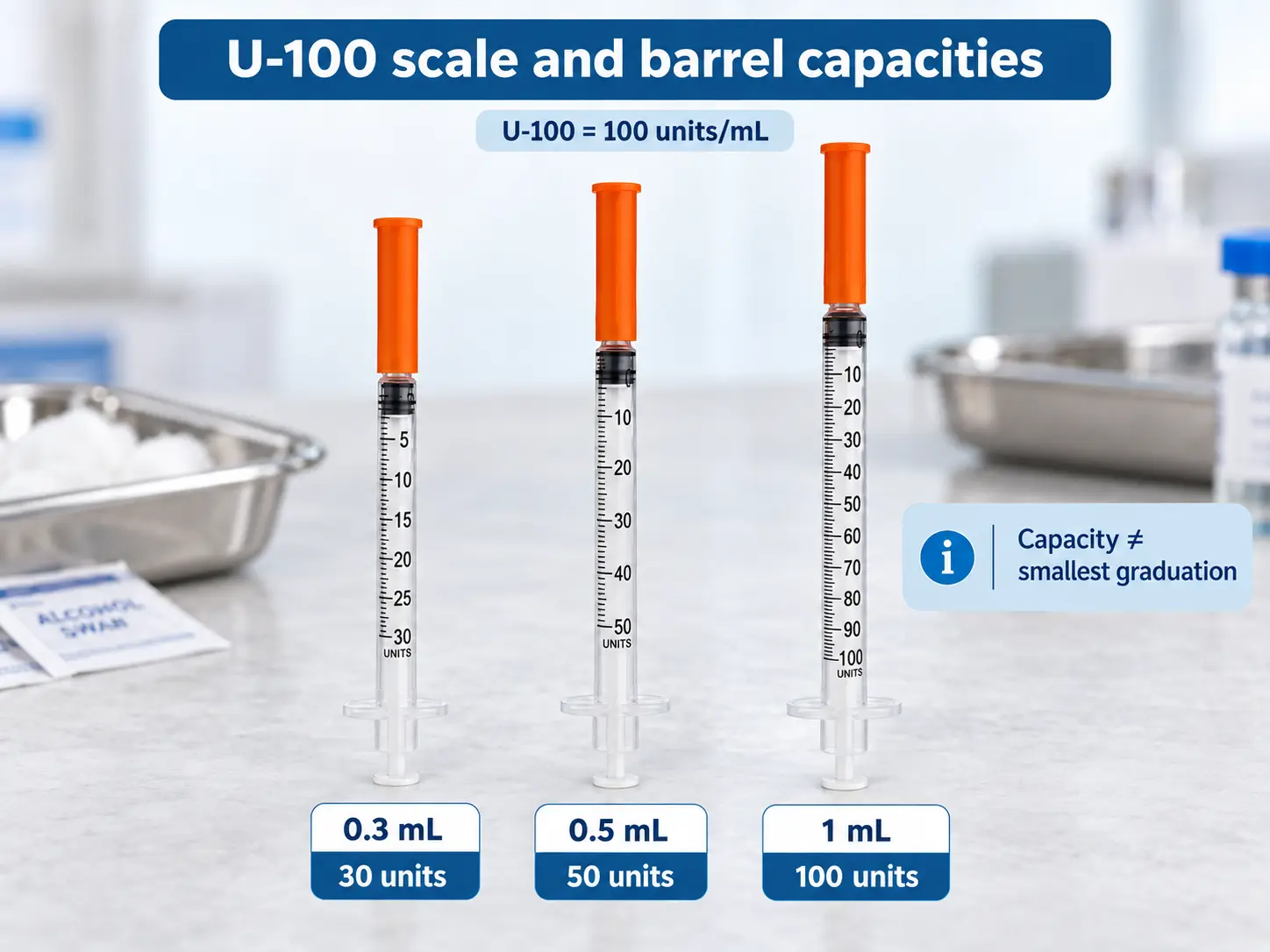
- Common capacity categories are 0.3 mL / 30 units, 0.5 mL / 50 units and 1 mL / 100 units on the U-100 scale.
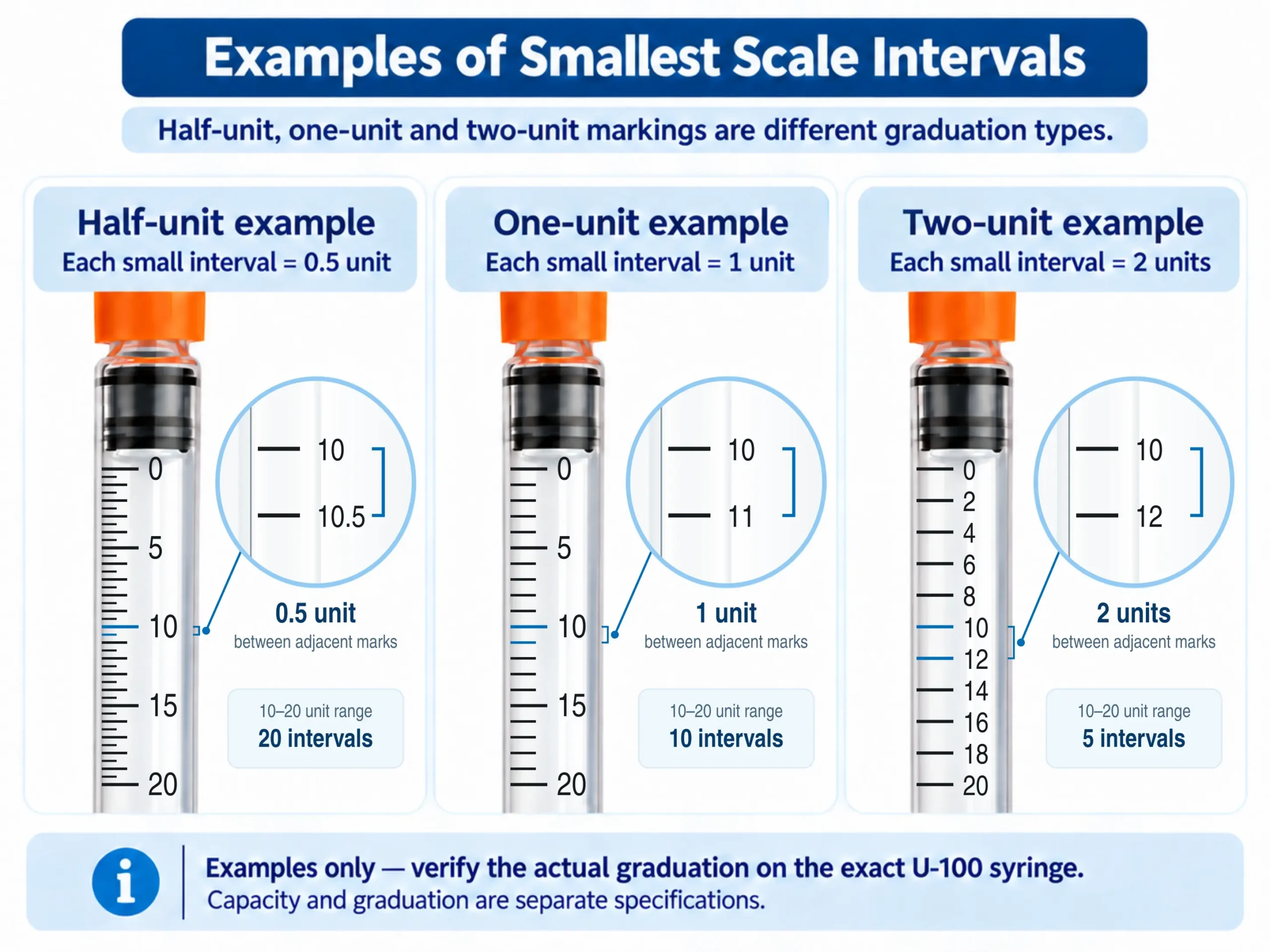
- On that scale, 1 unit corresponds to 0.01 mL. Each printed interval represents the graduation specified for that REF, such as half-unit, one-unit or two-unit divisions.
- Read the actual graduation and manufacturer instructions. Capacity alone cannot tell you what each small interval represents.
- Needle gauge, needle length, safety design and packaging are separate specifications.
- There is no universal mg-to-syringe-units conversion. A chart for U-100 insulin does not establish instructions for another medicine.
Looking for a specific answer? Jump to the units-to-mL chart, scale-reading method or common mistakes.
1. U-100 Insulin Syringes: Meaning and Common Use
U-100 means 100 insulin units per milliliter. The American Diabetes Association identifies it as a common insulin strength. A matching U-100 syringe has a concentration-specific unit scale, allowing the prescribed insulin units to be read on that scale.[1]
This guide covers empty U-100 insulin syringes. The U-100 marking identifies the concentration scale; the barrel capacity identifies the volume it holds. Read the scale, capacity and maximum marking as separate fields.
| Field | Example | What it tells you |
|---|---|---|
| Concentration scale | U-100 | The insulin concentration represented by the unit scale |
| Barrel capacity | 0.5 mL | The nominal liquid volume the barrel can contain |
| Maximum marking | 50 units | The upper marked capacity of that U-100 format |
| Graduation | 1 unit per interval | The difference between adjacent printed scale divisions |
For a purchasing overview of product identity and supply controls, see our U-100 insulin syringe guide for healthcare buyers.
2. Understand the Parts Before Reading the Scale
On a conventional syringe, the barrel carries the scale and the plunger moves the stopper inside it. The needle specification describes a different part of the device. Reading these features separately helps prevent a familiar-looking product from being mistaken for an exact match.
| Part | Function | What to check |
|---|---|---|
| Barrel and printed scale | Contain liquid and display the graduated markings | Scale identity, maximum marking and smallest interval |
| Stopper and plunger | Move within the barrel | The manufacturer’s specified reading edge or reference line |
| Needle | Provide the injection pathway | Gauge, length, attachment and labeled intended use |
| Finger flange / thumb pad | Provide handling surfaces | Grip, handling and readability with the approved device |
| Needle cover / protective components | Protect the unused device as designed | Intact presentation and the manufacturer’s opening instructions |
Fixed-needle, detachable-needle and safety syringes are distinct device configurations. Verify the attachment design and any protective mechanism in the manufacturer’s specification. A standard needle cap and a needlestick-prevention mechanism serve different functions.
3. U-100 Syringe Sizes: 0.3 mL, 0.5 mL and 1 mL
Published manufacturer portfolios list the following U-100 capacity categories. The exact manufacturer REF defines the available needle and graduation combination.[2]
| Nominal capacity | Equivalent volume notation | U-100 maximum | Still verify |
|---|---|---|---|
| 0.3 mL | 0.3 cc / 3/10 cc | 30 units | The graduation specified for the exact REF: half-unit, one-unit or another stated interval |
| 0.5 mL | 0.5 cc / 1/2 cc | 50 units | Actual graduation, needle and device configuration |
| 1 mL | 1 cc | 100 units | Actual graduation; do not assume every small interval is one unit |
Capacity sets the nominal volume; graduation defines the labeled interval. Check measurement performance and clinical suitability separately. The prescribed amount must fit the approved device and be readable using its labeled scale.
For a complete purchasing comparison, use our 0.3 mL versus 0.5 mL versus 1 mL size guide.
4. How Many Units Are in a mL? A U-100 Reference Chart
For U-100 insulin, 1 mL contains 100 units and 0.5 mL contains 50 units. Conversely, 100 units of U-100 insulin occupy 1 mL. A unit is not a universal volume measurement: the relationship depends on the labeled insulin concentration.
Volume in mL = U-100 scale value ÷ 100
U-100 scale value = volume in mL × 100
| U-100 scale value | Corresponding volume | Reading limitation |
|---|---|---|
| 1 unit | 0.01 mL | Not every device prints a one-unit interval |
| 5 units | 0.05 mL | Check whether that value is directly marked |
| 10 units | 0.10 mL | Read the specified stopper reference, not a guessed position |
| 25 units | 0.25 mL | A scale with only two-unit divisions does not directly mark 25 |
| 30 units | 0.30 mL | Common maximum for a 0.3 mL U-100 format |
| 50 units | 0.50 mL | Exceeds the capacity of a 0.3 mL format |
| 100 units | 1.00 mL | Requires an appropriate capacity; not every U-100 syringe holds this volume |
What about 0.25 mL on a 1 mL syringe? On a U-100 scale, 0.25 mL corresponds numerically to 25 units. A syringe graduated directly in mL uses volume markings instead of a U-100 unit scale. Identify the printed scale first, then follow the exact device instructions. Use only values readable on the approved scale; do not estimate an unprinted value.
5. How to Read a U-100 Insulin Syringe Scale
The essential task is to identify what each printed interval means and where the manufacturer says to read it. Confirm that the device matches the prescribed insulin and the instructions you have been given before using it.
- Identify the scale. Check U-100 labeling, barrel capacity and maximum marking. Do not use packaging color as the only identifier.
- Choose two neighboring numbered values. Subtract the lower printed value from the higher one.
- Count the equal spaces between them. Count intervals, not the total number of lines including both endpoints.
- Determine the interval value. Divide the numerical difference by the number of equal intervals and reconcile the result with the product specification.
- Use the instructed reading reference. Locate the stopper edge or reference line shown in the exact device instructions. Do not automatically use the middle or back of the stopper.
Worked scale example
Compare the intervals between 10 and 20
The two simplified teaching examples below share the numbered endpoints 10 and 20. Example A divides that range into ten equal spaces; Example B divides it into five. These conceptual examples explain the arithmetic and are separate from manufacturer-controlled product drawings.
| Example segment | Difference | Equal intervals | Value per interval |
|---|---|---|---|
| A | 20 − 10 = 10 | 10 | 1 unit |
| B | 20 − 10 = 10 | 5 | 2 units |
The practical lesson: the numbered labels alone do not identify the smallest graduation. If the intervals are unclear, irregular or inconsistent with the instructions, ask the pharmacist or supplier to resolve the exact product identity instead of guessing.
Read the stopper at the reference identified in the exact manufacturer’s instructions. An embecta teaching guide, for example, specifies a thin black plunger line. Apply that reference to the device covered by those instructions.[3]
6. Half-Unit, One-Unit and Two-Unit Markings
Half-unit describes a graduation, not a half-milliliter capacity. A 0.5 mL syringe and a half-unit syringe are not synonymous. Likewise, a 0.3 mL capacity does not establish half-unit markings.
| Graduation description | Adjacent-division difference | What it does not establish |
|---|---|---|
| Half-unit | 0.5 unit | Barrel capacity, needle specification or clinical suitability |
| One-unit | 1 unit | That every other syringe of the same capacity has this scale |
| Two-unit | 2 units | A labeled line for every odd-numbered unit value |
Two public records establish specific graduation examples. FDA summary K212499 lists both one-unit and half-unit increments for the identified 0.3 mL BD family. AccessGUDID describes VanishPoint model 15391 as a 0.5 mL insulin syringe with half-unit markings.[4][5] These records identify those manufacturers’ devices. Confirm the configuration in a Tonmit quotation against its stated REF and supporting documents.
Graduation describes the printed interval. Measurement accuracy requires product-specific performance evidence, and readability requires assessment of the actual device. Our half-unit versus one-unit guide explains these separate checks.
7. Needle Gauge and Length: Separate From Syringe Capacity
Gauge identifies nominal needle outside diameter; length identifies needle length. Within comparable needle specifications, a higher gauge number denotes a smaller nominal outside diameter. Record capacity and graduation separately from a needle label such as 31G × 8 mm.
embecta’s U.S. catalog lists insulin syringe configurations with 6 mm, 8 mm and 12.7 mm needles, and separately lists 4 mm pen needles.[2] Compare each requested configuration within its correct device category and manufacturer REF.
Does a larger amount require a longer needle?
Barrel capacity and needle length are independent specifications. A larger required volume does not by itself establish a need for a longer needle. Follow the prescribed device and professional instruction rather than selecting needle length from a dose-range table.
Keep the manufacturer’s nominal dimensions when comparing labels. One-half inch equals 12.7 mm exactly; a 12 mm label is not an exact equivalent. Needle gauge or a claim of being “ultra-fine” alone does not establish a painless injection.
For procurement details, see our insulin syringe gauge and length guide.
8. U-100 vs U-40 and Other Insulin Concentrations
U-40 and U-100 identify different concentration systems: 40 and 100 units/mL respectively. The same printed number on different concentration-calibrated scales does not represent the same volume. Similar capacity, needle or cap appearance cannot make the devices interchangeable.
Check the insulin label and presentation as well as the syringe. A vial, cartridge and prefilled pen are not interchangeable presentations. Concentrated insulin must be used with the delivery device specified by its current labeling; do not transfer insulin from a pen into a syringe to apply this chart. ADA’s concentration guidance emphasizes matching vial concentration and syringe scale.[6]
Human-use or veterinary context alone is also insufficient to choose a scale. Confirm the actual prescription and product labeling. Our U-40 versus U-100 guide covers concentration-specific storage, ordering and substitution controls.
9. How to Choose the Right Specifications
Begin with the insulin and device requirements already established by the prescriber or pharmacist. Then confirm the device can display the prescribed amount using its labeled capacity and graduation. Avoid deciding from “U-100,” “31G” or a product photograph alone.
- Capacity: the prescribed amount must fit within the device’s labeled range.
- Graduation: verify that the required increment is actually marked on that REF.
- Needle and configuration: match the instructed gauge, length and standard or safety design.
- Readability and handling: if the scale or plunger is difficult to use, request a demonstration with the actual product.
- Supply continuity: compare the replacement against every required field, including the graduation, and document differences before approval.
Changes in prescription, difficulty reading the scale, persistent discomfort or problems at injection sites are reasons to contact the care team for reassessment. Do not independently change the insulin amount, concentration, device or injection technique to solve a supply or comfort problem.
10. Safe Use, Storage and Sharps Disposal
Scale literacy supports safe use, but the preparation and injection sequence must come from the medicine’s current instructions, the device instructions and hands-on teaching. This article does not provide an insulin-mixing procedure or select an injection site for an individual.
Before use and during preparation
- Match the medicine, concentration, prescribed amount and exact syringe. Check the expiration and labeled presentation.
- Inspect the protective or sterile presentation as instructed; do not use a compromised or expired device.
- Use a new sterile syringe and needle for each injection. Never share them, even if a needle is changed.[7]
- Follow the taught preparation sequence. Ask for clarification if air bubbles, an unclear stopper reference or an unreadable line prevents confident measurement.
Follow the injection-site rotation plan taught by your care team. Repeated injections into the same small area increase the risk of fatty lumps called lipohypertrophy. Have the care team assess lumps or persistent site problems and confirm the appropriate injection technique.[12]
Store the device and medicine according to their own labels
Keep unused syringes in their labeled protective presentation and follow the manufacturer’s storage conditions. Insulin storage is a separate question: temperature limits and in-use periods depend on the particular medicine and presentation. Do not apply a universal “28 days” rule or refrigerate a syringe simply because the insulin requires refrigeration.
Plan disposal before the injection
Place used sharps promptly in an appropriate sharps container and do not recap used needles. Never put loose sharps into ordinary trash or recycling. For home use, follow FDA guidance and local disposal rules; if a cleared container is unavailable, use the required features in FDA guidance to assess a household alternative.[8] In healthcare facilities, follow the approved sharps and medical-waste procedures.[9]
11. Common Reading Mistakes and How to Resolve Them
| Mistake or question | What is being confused? | Useful next check |
|---|---|---|
| “Every small line is one unit.” | Capacity versus graduation | Verify the smallest interval from the actual scale and instructions |
| “U-100 means 100-unit capacity.” | Concentration scale versus barrel size | Read the nominal mL capacity and maximum marking separately |
| “0.5 mL means half-unit.” | Volume versus smallest printed increment | Confirm whether half-unit markings are explicitly specified |
| “25 must be a printed line.” | A mathematical value versus an available graduation | Check whether the actual scale directly marks that value; do not guess between lines |
| Confusing the 5-unit and 50-unit markings | A tenfold difference on the same scale | Have the pharmacist demonstrate and confirm the prescribed reading |
| “The box says 100, so the barrel holds 100.” | Pack quantity versus capacity | Find the separate capacity and unit-count fields |
| “The new product has the same gauge.” | One matching field versus a complete match | Also compare scale, capacity, graduation, length and exact REF |
If the label, instructions and actual device disagree, stop using the affected item and ask the dispensing pharmacist or responsible supplier to resolve it. If you think you have administered an incorrect amount, seek urgent medical advice rather than attempting to correct it with an online conversion.
12. Why “1 mg” or “2.5 mg in Syringe Units” Has No Fixed Answer
Milligrams describe mass; milliliters describe volume; insulin units describe biological activity. The labeled insulin concentration links those units to a volume. A syringe marking cannot independently reveal how many milligrams of another medicine are present.
Therefore, neither “1 mg on an insulin syringe” nor “how many units is 2.5 mg?” has a universal answer. The medicine, its exact concentration and the authorized instructions matter. A U-100 scale reference is not a medication-specific dose instruction.
FDA documented dosing errors involving compounded injectable semaglutide, confusion between mg, mL and “units,” and differing product concentrations. Its reports include substantial overdoses.[10] Ask the dispensing pharmacist to explain the exact product and supplied device together. Our mg, mL and units explainer covers that topic.
13. What Pharmacies, Clinics and Distributors Should Verify
For a professional buyer, a useful specification connects the readable barrel scale to the actual item being quoted, stocked and received. Record the following before comparing alternatives:
- Legal manufacturer, brand or labeler, exact REF/model and current specification revision.
- Concentration scale, capacity, maximum marking and smallest graduation.
- Gauge × labeled needle length, fixed or other connection, and standard or safety design.
- Protective/sterile presentation, label and applicable UDI/GTIN at the relevant package level.
- Pieces per box, boxes per case, lot/expiry controls and substitution restrictions.
Request a clear scale image and controlled specification for the offered REF. During receiving, follow the agreed inspection plan; do not open sterile presentations merely to inspect a scale. Compare prices only after the product and pack match, using case quantity and landed-cost controls.
Public regulatory example
A 1 mL label did not identify the syringe inside
FDA recall Z-1768-2026 concerns identified Monoject lots packaged as 1 mL Luer Lock tuberculin syringes but containing U-100 insulin syringes. The firm initiated the action on February 27, 2026.[11]
Reconcile package identity, device scale and the exact product/lot before release. This public FDA record applies to the product codes and lots identified in the recall notice.
When an approved REF is unavailable, request a documented alternative with all differences listed. Matching capacity and gauge alone is not an authorization to substitute.
14. Use Our Scale and Specification Verification Record
We organized the identity and scale checks above into a blank record for comparing a requested product with an offered one. Keep the source evidence next to each field so that an unresolved graduation is visible before ordering.
U-100 Scale & Specification Verification Record
Copy the record or save it as a text file. Use one record per exact REF and revision.
Open the complete blank record
U-100 SCALE AND SPECIFICATION VERIFICATION RECORD
Blank editorial worksheet — one exact REF / revision per record

PRODUCT IDENTITY
Record date / organization / responsible contact:
Legal manufacturer / brand or labeler:
Requested REF / offered REF:
Current specification or label revision:

RECORD REQUESTED | OFFERED | EVIDENCE REFERENCE
Concentration scale:
Nominal barrel capacity in mL:
Maximum printed unit marking:
Smallest labeled graduation:
Manufacturer's instructed reading reference:
Needle gauge x labeled length:
Fixed / detachable / verified safety configuration:
Protective or sterile presentation:
Pieces per box / boxes per case:
UDI or GTIN and package level, where applicable:
Storage / expiry / minimum remaining shelf life:

SCALE EVIDENCE
Controlled specification / drawing reference:
Clear scale image / approved sample reference:
Does the labeling agree with the specified graduation?:
Unresolved differences or unreadable fields:

DECISION
Accept / request clarification / hold / reject / approved alternative:
Reviewer / date / authorization reference:
Substitution restrictions and follow-up:

METHOD AND LIMITS
Compare the exact REF, current instructions and controlled specification.
Use the organization's approved sample and inspection process. Do not open
sterile presentations merely for this check. This blank record is not a
completed QC record, proof of accuracy or sterility, or patient dosing advice.
Do not include patient identifiers.
Method and scope
We built this original blank worksheet to document the requested configuration, offered product, evidence and approval decision. Use it alongside current specifications and the organization’s inspection procedure. Product accuracy, sterility and clinical suitability require their respective evidence and qualified assessment. The worksheet records the comparison; the scale examples teach interval arithmetic.
Common questions
Frequently Asked Questions About U-100 Insulin Syringes
Is 100 units the same as 1 mL?
For U-100 insulin, yes: 100 units occupy 1 mL. That statement is concentration-specific and does not mean every U-100 syringe holds 1 mL.
How many units are in a 0.5 mL U-100 syringe?
A 0.5 mL U-100 format has a 50-unit maximum. Its smallest graduation must be checked separately; “0.5 mL” does not mean half-unit markings.
What is 30 units in mL?
On the U-100 scale, 30 units correspond to 0.3 mL. Use only the concentration-matched device specified for the medicine and prescription.
Is each small line on a 1 mL insulin syringe one unit?
One mL identifies capacity, not the value of each line. Read the smallest graduation specified for the exact REF. A scale with two-unit divisions advances by two units at each adjacent division.
Where are 5, 8 or 10 units on an insulin syringe?
First verify the scale and the interval between adjacent divisions. A value is directly readable only if the device labels that value through its graduation and instructed reading method. Ask a pharmacist to demonstrate the actual prescribed reading; do not estimate a missing mark.
Does every 0.3 mL syringe have half-unit markings?
No. Capacity does not determine graduation. Verify the exact product reference; documented 0.3 mL product families include different scale options.
Is a 31G syringe smaller than a 30G syringe?
Within comparable needle specifications, 31G denotes a smaller nominal needle outside diameter than 30G. Check barrel capacity, needle length and unit scale as separate fields.
Can I replace an unavailable syringe with the same capacity?
Capacity alone is insufficient. Confirm concentration scale, graduation, needle, design and the approved product requirements with the pharmacist or responsible reviewer before substitution.
Can insulin syringe units tell me a dose in milligrams?
A syringe marking identifies its labeled scale value. Determining a medicine’s mass requires the exact product concentration and authorized instructions. There is no universal mg-to-units chart.
Are insulin syringes all individually wrapped?
Packaging is specified by manufacturer REF. Read the exact product’s protective/sterile presentation and opening instructions; bag count and retail box quantity are separate packaging fields.
Read the Scale, Then Confirm the Complete Device
Understanding a U-100 syringe starts with four separate fields: concentration scale, capacity, maximum marking and graduation. Add the needle and device configuration to identify the complete product. If a number, line or label is unclear, resolve that uncertainty using the actual instructions and qualified support before use or substitution.
For pharmacy, clinic and distribution buyers
Request a U-100 Scale and Specification Review
Send us the required capacity, graduation, gauge × length, exact REF if known, pack quantity and destination. Our specification review covers the offered configuration, supporting documents and supply terms so you can compare clearly defined products.
Sources and Editorial Basis
Sources checked October 16, 2026. Manufacturer and regulatory examples support only the identified product and claim; they do not establish Tonmit inventory or another brand’s specifications.
- American Diabetes Association. Insulin Basics. Concentration terminology and U-100 context.
- embecta, United States. Published pen needle and insulin syringe configurations. Capacity, needle and half-unit product examples.
- embecta, Canada. Injection technique guide. Manufacturer-specific plunger reference; not a universal device instruction.
- U.S. FDA. K212499: BD Insulin Syringe, 0.3 mL, comparison table. Identified graduation options.
- AccessGUDID. VanishPoint model 15391. Identified 0.5 mL half-unit device example.
- American Diabetes Association. Overview of Insulin Concentration for School Nurses, August 2022. Concentration matching principle; current medicine labeling controls available presentations.
- U.S. CDC. Preventing Unsafe Injection Practices. Single-use and cross-patient precautions.
- U.S. FDA. DOs and DON’Ts of Proper Sharps Disposal. Home/community sharps precautions.
- U.S. FDA. Sharps Disposal Containers in Health Care Facilities. Institutional disposal context.
- U.S. FDA. Dosing errors associated with compounded injectable semaglutide. Unit confusion and concentration-related errors.
- U.S. FDA. Recall Z-1768-2026. Specific package/device mismatch example; action initiated February 27, 2026.
- NHS. How and when to take intermediate-acting insulin. General injection-site rotation and lipohypertrophy context.