
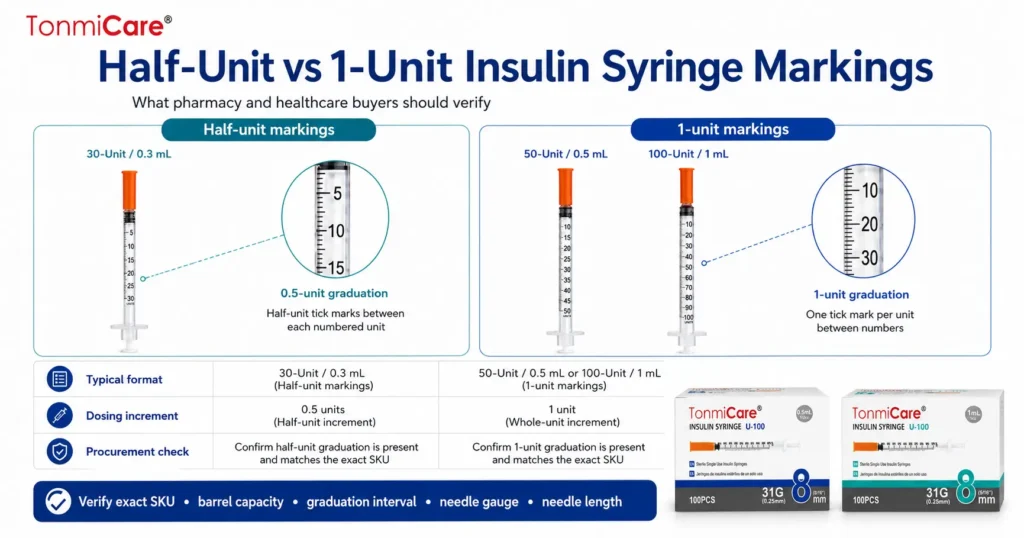
Pharmacy procurement guide · Insulin syringe graduations
Half-unit and 1-unit markings describe the smallest printed increment on an insulin syringe. They do not describe barrel capacity. For an order, check the exact concentration scale, graduation, manufacturer REF, barrel artwork and pack before accepting a substitution.
Medical-consumable specifications and SKU comparisons, including capacity, needle dimensions and case packs.
Source relevance, claim-to-source alignment and the limits of public product evidence.
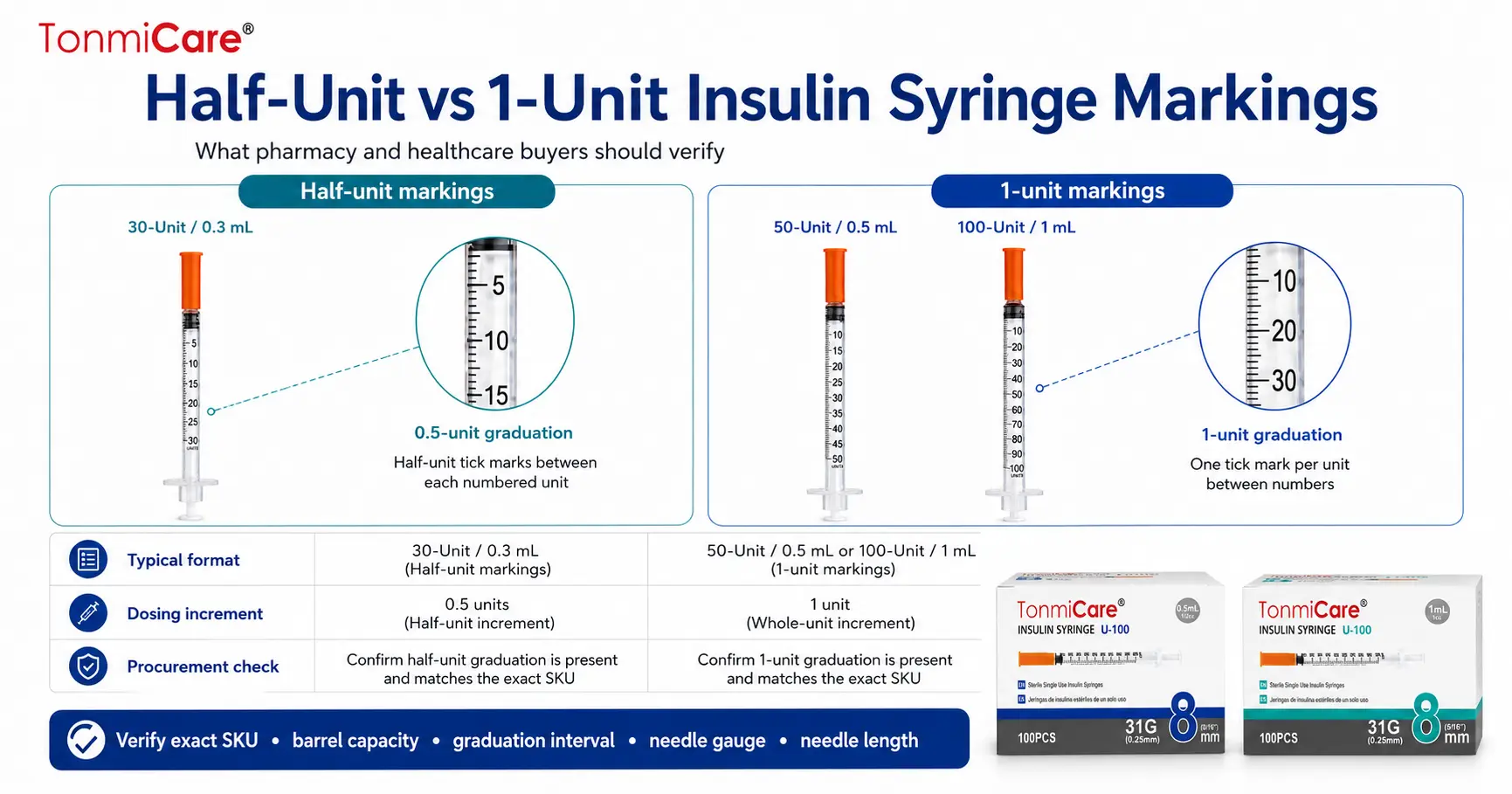
- A half-unit syringe has a smallest labeled division of 0.5 insulin unit on its stated concentration scale; a 1-unit syringe has a 1-unit division.
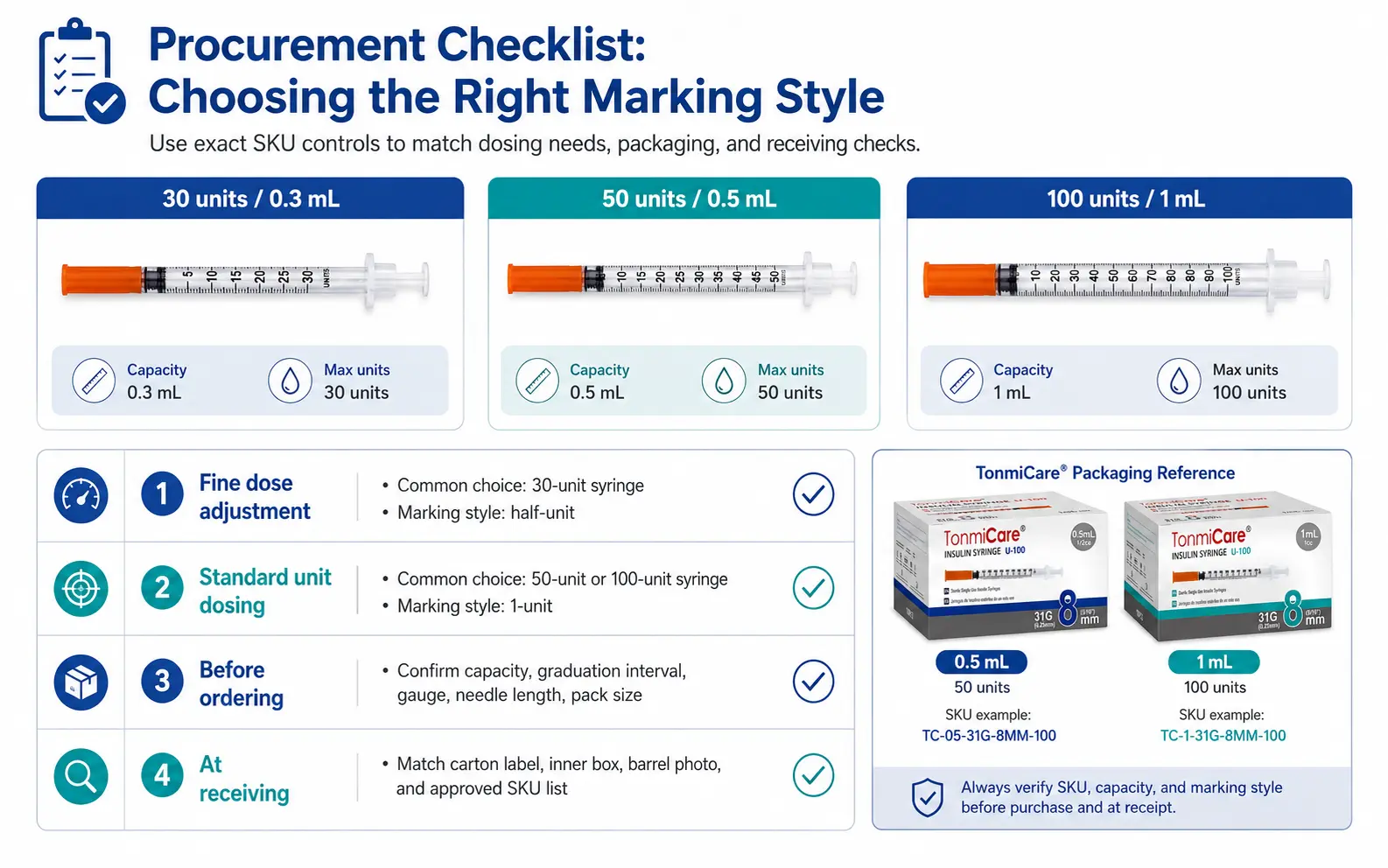
- “0.5 mL” is the barrel’s nominal volume. It does not promise half-unit graduation.
- Check the exact REF and current barrel/label artwork: capacity, needle size and product photos alone cannot establish graduation.
- Finer printed divisions do not by themselves prove better overall measurement accuracy.
- If the prescribed or institutional requirement specifies half-unit markings, do not silently substitute a 1-unit SKU.
Half-unit versus 1-unit markings
The term graduation refers to the value between adjacent printed scale divisions. A finer printed interval changes what is labeled on the barrel; it does not determine the syringe’s volume, concentration system, needle or package.
| Field | Half-unit SKU | 1-unit SKU | Purchase control |
|---|---|---|---|
| Smallest labeled interval | 0.5 unit | 1 unit | Compare the current barrel scale and label for the exact REF. |
| Nominal capacity | Specified separately, such as 0.3 mL or 0.5 mL | Record mL capacity and maximum unit marking independently. | |
| Concentration scale | Must match the labeled product and intended insulin | Never use the shared word “unit” as proof that U-40 and U-100 are interchangeable. | |
| Needle and design | Gauge × length, fixed needle and any safety feature vary by REF | Verify separately. | |
| Performance | Not established by printed intervals alone | Ask for product-specific specifications and test evidence for performance claims. | |
For a U-100 product, a 0.5 mL barrel commonly corresponds to a 50-unit maximum marking, while “half-unit” refers to the smallest graduation. This is a terminology explanation, not a dosing or conversion instruction. Keep the insulin label, prescription and approved clinical workflow controlling.
Four fields that should never be merged
The insulin concentration represented by the printed scale, for example U-100.
Nominal barrel volume, such as 0.3, 0.5 or 1 mL.
The highest numbered value on that concentration-specific barrel.
The smallest labeled increment: 0.5 unit, 1 unit or another stated interval.
A title such as “0.3 mL, 31G × 8 mm” still leaves scale and graduation unresolved. Likewise, the phrase “half-unit syringe” is incomplete for a purchase order. For capacity selection, use the insulin syringe sizes guide; for concentration systems, see U-40 versus U-100.
What named product records establish
The FDA 510(k) summary for BD’s identified 0.3 mL U-100 family, K212499, lists both 1-unit and half-unit scale increments. This shows that 0.3 mL capacity alone cannot settle the graduation for every product. Read the identified FDA summary.
A separate AccessGUDID record for VanishPoint model 15391 describes a 0.5 mL insulin safety syringe with half-unit markings. This is another manufacturer’s specific device, not evidence that Tonmit carries the model or that all 0.5 mL syringes share its markings. Tonmit’s 0.3 mL product page states that selected references may offer finer graduations and instructs buyers to confirm the exact scale drawing or label.
A public regulatory summary or third-party listing describes only the identified device and stated scope. It does not verify another brand, a private-label SKU, current Tonmit inventory, or a lot delivered to a buyer.
What finer graduations do not prove
A half-unit scale prints more divisions over the same unit range. It does not automatically double accuracy or remove error from line width, barrel geometry, stopper position, manufacturing tolerances or the user’s reading of the scale. Do not advertise a product as “twice as accurate” based only on the printed interval.
Ask for the current scale artwork, specification and applicable product-specific validation if a procurement decision depends on measurement performance. A photo can help screen a sample, but glare or low resolution can hide a small graduation. Never use a rendered or AI-generated syringe illustration as an approval record.
Build the purchase description around the exact SKU
Freeze the concentration scale, capacity and maximum marking, graduation, gauge × needle length, fixed or safety design, legal manufacturer, brand, REF, sterile presentation, units per box and boxes per case. When applicable, reconcile UDI/GTIN information and controlled label revision with the quoted item. The FDA’s UDI basics explain what device and production identifiers convey; an identifier does not replace direct checking of the physical scale.
Handle substitutions and shortages deliberately
Two syringes with the same capacity and needle can still have different graduations. When a required half-unit REF is unavailable, first identify the affected SKU, lot and expected recovery date. Compare approved alternatives against scale, graduation, capacity, maximum marking, needle, design, label and pack. Escalate any difference under the pharmacy’s or institution’s approval process; document the approver, scope and duration of a temporary change.
Do not treat a U-40 veterinary syringe as a substitute for a U-100 human-use syringe. Intended use, concentration-specific markings and destination-market labeling must be reviewed separately. A standard syringe and a safety syringe also require distinct design and workflow evaluation.
Compare commercial offers only after the SKU is fixed
Request MOQ, stock, production lead time, shelf-life terms, shipping origin, box/case counts and destination-specific documents for the exact reference. Normalize the landed cost per accepted unit rather than comparing case prices that may hide different pack counts, graduations or expiry dates. U.S. stock and China factory fulfillment can differ by configuration; confirm the route on the quotation.
Tonmit pack-based receiving example
Tonmit’s public insulin syringe catalog describes its listed range as 100 pieces per box and 2,000 pieces per case. For an illustrative order of three cases under that catalog pack, a receiving clerk would expect 60 boxes and 6,000 pieces. The clerk would then inspect one or more actual samples under the buyer’s own sampling plan and reconcile every sampled box and case label with the approved REF, scale, graduation, lot, expiration and packaging record.
| Check | Example / method | Record or action |
|---|---|---|
| Quantity | 3 cases × 20 boxes × 100 pieces | 60 boxes / 6,000 pieces expected; count actual receipt. |
| Identity | Compare PO, carton, box and sample barrel | Record manufacturer and REF, concentration scale, capacity, graduation and gauge × length. |
| Traceability | Read actual box and case labels | Record lot, expiry, label revision and any applicable UDI/GTIN. |
| Condition | Inspect selected sterile packs and shipping cartons | Document damage or mismatch and hold affected stock for review. |
Method and limits: The pack numbers come from the cited public catalog; “three cases” is arithmetic only. This is a Tonmit-specific desk checklist, not a record of a real order, validated sampling plan, lab test or proof that any half-unit REF currently uses that exact pack. A buyer must confirm the selected half-unit SKU and carton pack in its quotation and inspect the actual received lot.
Download the receiving and RFQ templates
These editable templates turn the checks above into a buyer’s working record. Leave a field blank until verified against the approved SKU; replace the example quantity and pack with the actual quotation.
Upload both files to these exact media URLs before publishing this article. A completed checklist requires a real receiving inspection; the blank file contains no QC result.
Common buyer questions
Is a 0.5 mL syringe automatically half-unit?
No. Capacity and smallest printed increment are separate fields. Confirm the exact barrel artwork and REF.
Are all 0.3 mL syringes half-unit?
No. The cited FDA summary identifies both 1-unit and half-unit versions in a named 0.3 mL product family.
Can a 1-unit syringe be approved by estimating midway between lines?
Do not represent visual estimation as a labeled half-unit device. Any alternative requires the relevant clinical and purchasing approvals.
Does half-unit marking prove superior accuracy?
No. It describes the printed graduation; performance claims need evidence for that exact product.
Sources and review limits
- FDA, K212499 510(k) summary — named 0.3 mL U-100 product family and scale increments.
- AccessGUDID, DI 00613703153906 — named 0.5 mL half-unit safety device.
- Tonmit, 0.3 mL product range — SKU-specific fine graduation statement.
- Tonmit, wholesale insulin syringe catalog — published catalog pack used in the illustrative calculation.
- FDA, UDI Basics — device and production identifier concepts.
Reviewed against these public sources on September 28, 2026. Product labels, inventory, market requirements and catalog packs may change. Confirm all transaction-specific claims and approvals for the actual REF before ordering.
Exact-SKU quotation
Review your half-unit syringe requirement
Share the concentration scale, capacity, maximum marking, graduation, needle size, projected volume, destination and package requirements. Availability and documentation are confirmed for the quoted SKU.
Request exact-SKU review