
Insulin Syringe Specification & Procurement Guide
An evidence-bounded comparison of 6 mm, 8 mm and 12.7 mm insulin syringe needles for pharmacy, clinic and distributor buyers—covering metric and inch labels, gauge, barrel capacity, exact-SKU control, assortment planning, substitution, case packs and supplier documentation.
Scope: This guide supports professional purchasing, formulary review and inventory planning for finished insulin syringes. It does not choose a needle for an individual, prescribe injection technique, replace current product labeling or professional instruction, or authorize a substitution. Match the exact syringe to the prescribed insulin concentration, approved scale and graduation, current label, patient-specific direction, organizational policy and applicable law before dispensing or use.
Direct answer
Which Insulin Syringe Needle Length Should a Buyer Stock?
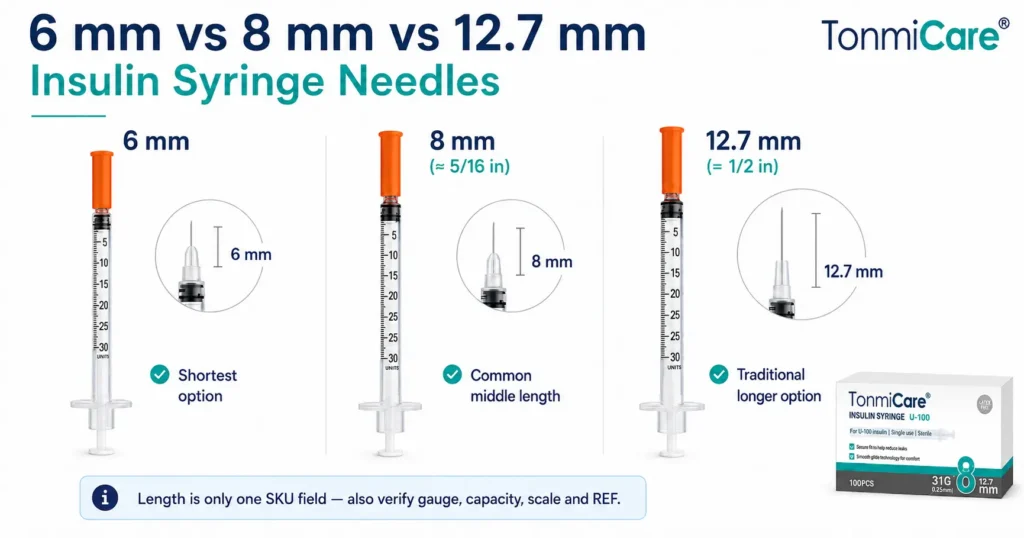
There is no universal purchasing winner. For pharmacy and distributor buyers, 6 mm, 8 mm and 12.7 mm are separate product specifications—not interchangeable versions of one syringe. A 6 mm syringe is the shortest length addressed by widely cited insulin-delivery recommendations and can reduce the risk of unintended intramuscular delivery compared with longer needles. An 8 mm syringe remains a commonly listed middle-length option. A 12.7 mm, or 1/2-inch, syringe is a traditional longer configuration that may remain in an assortment where an exact, authorized demand exists.
The purchasing decision should follow the approved exact SKU. Needle length must be matched with gauge, insulin concentration scale, barrel capacity, graduation interval, fixed-needle or safety design, manufacturer reference, sterile presentation and pack hierarchy. A shortage, price difference or similar-looking package does not by itself authorize a change from 6 mm to 8 mm or from 8 mm to 12.7 mm.
Correct the purchase description
12 mm Is Not Automatically the Same as 12.7 mm
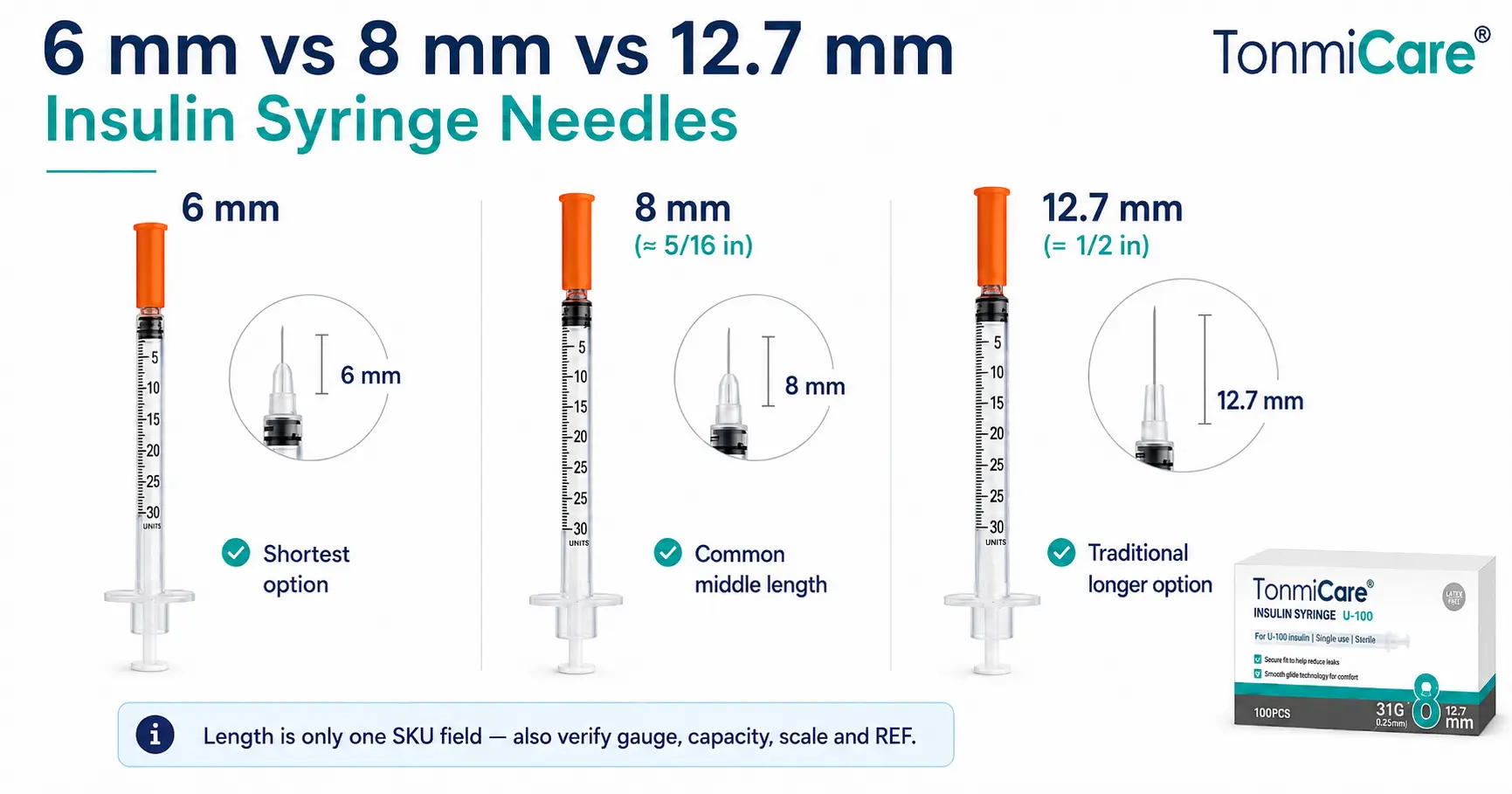
In U.S. insulin syringe catalogs, the traditional half-inch needle is commonly shown as 12.7 mm. A true 12 mm needle is approximately 0.472 inch, while 12.7 mm is exactly 0.5 inch. The 0.7 mm difference is small visually, but it is not acceptable to erase it from a product specification, purchase order, item master or comparison table.
Some search results use 12 mm for pen needles, round a 12.7 mm syringe listing, or omit the device type entirely. Preserve the search term in explanatory copy, but approve the purchase only from the exact product label, manufacturer REF and controlled specification.
Specification fundamentals
What Needle Length Tells a Pharmacy Buyer—and What It Does Not
Needle length describes the exposed needle dimension specified by the manufacturer. It is relevant to the injection pathway and handling of the product, but it does not identify the entire syringe. FDA documentation for one insulin syringe family describes products intended for subcutaneous insulin injection and presents different needle dimensions across 1 cc, 1/2 cc and 1/3 cc barrel sizes. That example demonstrates why barrel capacity and needle length must remain separate fields.
Length can identify
- The manufacturer-declared needle length
- The corresponding inch label when documented
- One dimension needed to compare exact configurations
- A clinically relevant change that needs review
Length cannot identify
- Needle outside diameter or gauge
- Barrel volume, insulin scale or graduation
- Fixed-needle, removable or safety design
- Pack quantity, shelf life or regulatory status
Side-by-side review
6 mm vs 8 mm vs 12.7 mm Insulin Syringe Comparison
This table supports purchasing review. It does not select a needle length or injection technique for an individual.
| Length | Common inch expression | Evidence context | Procurement control |
|---|---|---|---|
| 6 mm | Approximately 0.236 in; confirm the label’s dual-unit expression | Shortest syringe needle addressed in the 2016 FITTER recommendations; shorter length reduces unintended IM risk relative to longer needles | Confirm gauge, scale, capacity, graduation, REF and authorized demand |
| 8 mm | Approximately 5/16 in; the two values differ slightly because 5/16 in equals 7.9375 mm | Commonly listed middle-length syringe option; technique and individual suitability remain clinical matters | Do not replace a 6 mm or 12.7 mm SKU from gauge or capacity alone |
| 12.7 mm | Exactly 1/2 in | Traditional longer configuration; longer needles carry greater potential for unintended IM delivery | Maintain only where exact demand and approval justify the inventory |
| 12 mm | Approximately 0.472 in | May be a real product specification, a pen-needle result or a rounded listing | Verify device type and exact label; never convert it automatically to 12.7 mm |
Length profile 01
6 mm Insulin Syringes: Short Length, Full-SKU Review
The 2016 international injection-technique recommendations described 6 mm as the shortest insulin syringe needle then available and supported shorter needles as a first-line approach across patient categories. The clinical rationale is not that a short needle changes the insulin dose; it is that insulin is intended for subcutaneous delivery and a shorter needle generally reduces the chance of reaching muscle.
For the buyer, “6 mm insulin syringe” remains incomplete. Selected market configurations may pair 6 mm with a fine gauge and several barrel capacities, but the available combination depends on the product family. Tonmit’s current wholesale category lists selected 31G × 6 mm configurations, while final scale, capacity, graduation, packaging and availability remain SKU-specific.
Length profile 02
8 mm Insulin Syringes: A Common Option, Not a Neutral Substitute
Eight-millimeter fixed-needle insulin syringes recur across current product portfolios and are commonly labeled alongside a 5/16-inch expression. The conversion is approximate rather than mathematically identical, so buyers should retain the wording used on the actual controlled label.
Do not describe 8 mm as automatically intended for people with “thicker skin,” larger bodies or a specific injection site. Skin and subcutaneous tissue dimensions vary by site and person, and the literature does not support a simple rule that body size requires a longer syringe needle. Procurement content should direct individual selection questions to current labeling and qualified clinical guidance.
A catalog search may return 31G × 8 mm when the approved item is 31G × 6 mm. The gauge match does not make the products equivalent. Record needle length as a controlled substitution field and require approval before enabling the replacement.
Length profile 03
12.7 mm Insulin Syringes: Traditional Demand Requires Deliberate Control
A 12.7 mm insulin syringe needle is a half-inch needle. Longer configurations remain commercially listed, including selected 29G and 30G products, but continued availability does not prove that the length is clinically preferred or nationally high-turn. Current assortment decisions should be based on documented local demand, approved product records, clinical or formulary requirements, and a controlled substitution policy.
Do not create a rule that 12.7 mm is “for obese patients.” The FITTER recommendations supported shorter needles across patient categories and did not require longer needles solely because of BMI. A pharmacy may still have a legitimate, established demand for a specific long-needle SKU, but that demand should be measured rather than assumed.
Separate 12.7 mm products from short-needle stock in the item master and analyze their exact-SKU movement. Where demand is infrequent and lead time is manageable, a special-order or central-stock model may control expiration exposure better than duplicating long-needle inventory at every location.
Evidence boundary
What the Clinical Evidence Supports
Insulin syringes are intended to place insulin in subcutaneous tissue. FDA’s public 510(k) summary for one insulin syringe family states that intended use directly and documents 8 mm and 12.7 mm configurations. The 2016 FITTER recommendations concluded that shorter needles—including the 6 mm syringe needle—were safe, effective and generally less painful first-line options across broad patient categories, while longer needles increased the risk of unintended intramuscular injection without evidence of better glucose control.
A 2004 randomized crossover study compared a 31G × 6 mm syringe with a 29G × 12.7 mm syringe in adults with obesity. That study contributes to the evidence base for shorter syringes, but the compared products differed in both gauge and length. It therefore cannot prove that length alone caused every difference in satisfaction or experience.
Ultrasound research in children also shows that skin-to-muscle distance varies by site, age, sex and use of a raised skinfold. That study supports the general importance of avoiding simplistic length rules; its pediatric percentages should not be transferred to all adults or used as a retail selection chart.
Avoid overclaiming
What the Evidence Does Not Prove
| Evidence-safe statement | Unsupported or misleading shortcut | Why the shortcut fails |
|---|---|---|
| Shorter needles generally reduce unintended IM risk. | “A 12.7 mm needle always enters muscle.” | Tissue depth, site and technique vary. |
| 6 mm has evidence supporting subcutaneous insulin delivery. | “6 mm is best for every patient.” | Individual selection remains outside a buyer guide. |
| Needle experience can differ by product. | “6 mm is always less painful than 8 mm.” | Gauge, bevel, lubrication, design and technique can confound the comparison. |
| Shorter needles can be appropriate across body-size categories. | “People with obesity need 12.7 mm.” | BMI alone does not establish the required syringe length. |
| Length is one exact-SKU field. | “Changing length does not matter if gauge matches.” | Length is clinically relevant and must be controlled independently. |
Two independent dimensions
Needle Gauge and Needle Length Are Not the Same Specification
Gauge describes outside needle diameter according to the applicable product specification; a higher gauge number generally represents a smaller outside diameter. Length describes how long the needle is. A description such as “31G insulin syringe” or “short insulin needle” is therefore not orderable by itself.
A 31G × 6 mm syringe and a 31G × 8 mm syringe share a gauge but are different SKUs. A 29G × 12.7 mm syringe and a 30G × 12.7 mm syringe share a length but are also different SKUs. Price comparisons should begin only after both fields match.
Keep measurement systems separate
Needle Length Does Not Determine Capacity, Scale or Graduation
Barrel capacity describes nominal liquid volume. The insulin concentration scale tells the user which concentration-specific unit system the markings represent. Graduation is the smallest printed interval. These are separate from needle gauge and length.
| Field | What it controls | Common buyer error |
|---|---|---|
| Capacity | Nominal barrel volume, such as 0.3 mL, 0.5 mL or 1 mL | Assuming smaller capacity always uses a shorter needle |
| Scale | Concentration-specific unit markings, such as U-40 or U-100 where applicable | Inferring the scale from barrel volume |
| Graduation | Smallest printed division on the barrel | Assuming every 0.3 mL syringe has half-unit markings |
| Gauge | Needle outside-diameter category | Using “31G” as a complete syringe description |
| Length | Needle length in millimeters and any documented inch expression | Treating 12 mm and 12.7 mm as identical |
For a broader capacity and graduation framework, use Tonmit’s common insulin syringe specifications for U.S. pharmacies as a companion resource.
Item-master discipline
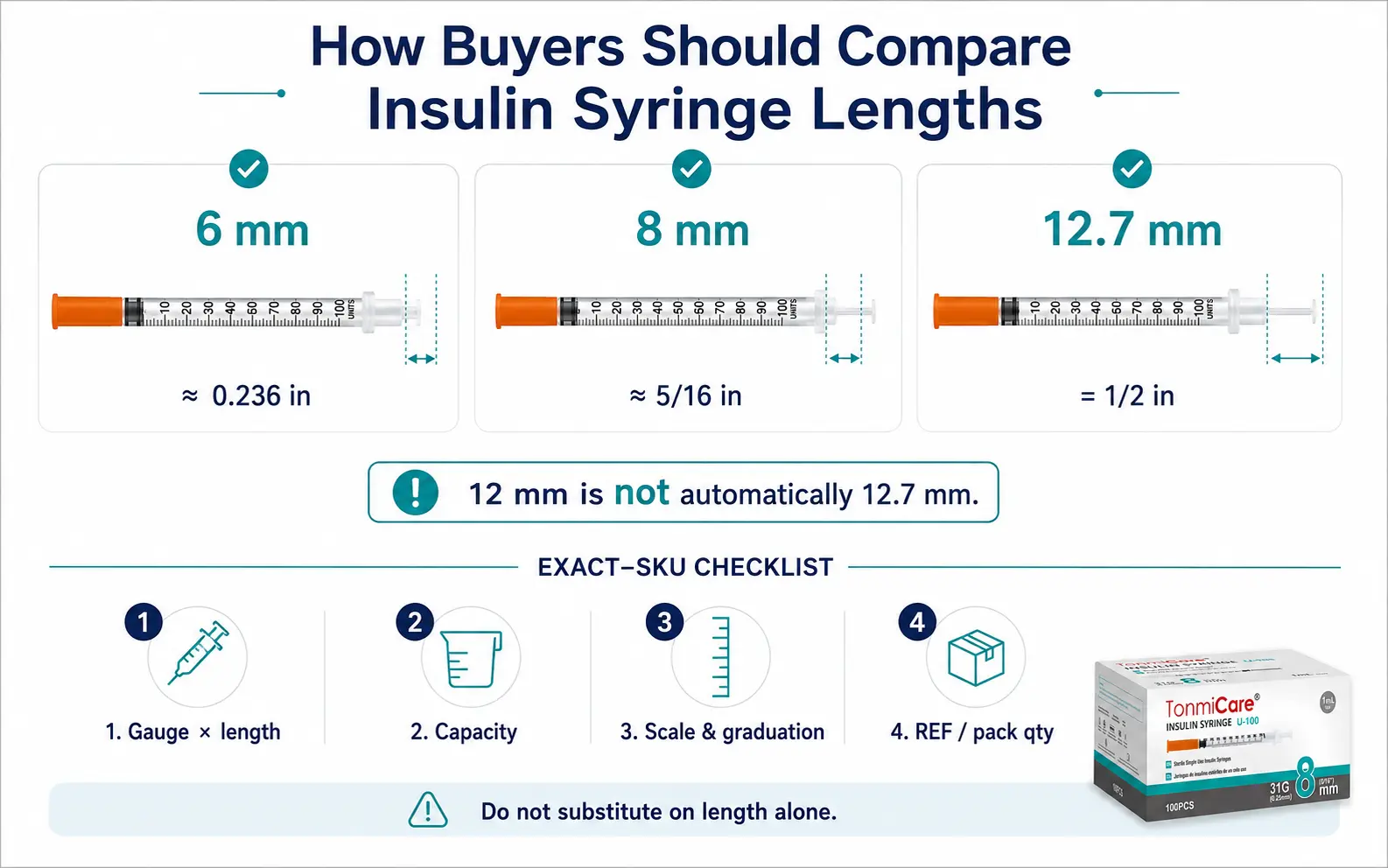
How to Write a Complete Insulin Syringe SKU
A buyer should be able to identify the product without relying on a photograph, color cap or marketplace title. Use a fixed sequence so quotations, purchase orders and receiving records can be compared field by field.
[insulin scale] | [capacity / maximum marking] | [graduation] | [gauge × exact length] | [fixed needle or safety design] | [sterile presentation] | [quantity per box] | [boxes per case] | [legal manufacturer] | [brand or labeler] | [manufacturer REF] | [UDI/GTIN where applicable] | [lot and expiration format]
U-100 scale | 1 mL / 100-unit maximum | exact graduation by REF | 31G × 8 mm fixed needle | sterile, single use | 100 pieces per box | exact boxes per case | manufacturer and labeler | REF | identifiers | lot and expiration.
If the actual product uses a different scale, graduation, box count, inner pack or case quantity, the controlled record must use the actual values.
Assortment planning
Stock by Exact Demand, Not by a Generic “Insulin Syringe” Bucket
A pharmacy can carry all three needle-length categories and still have poor service if its inventory system pools products by gauge or capacity. Build movement reports at the manufacturer-REF or controlled-SKU level, then assign each approved item to a stocking tier.
Repeated exact-SKU demand
Use routine min/max or reorder-point replenishment supported by the pharmacy’s own movement data and lead time.
Stable but lower-frequency demand
Use a lower par level, central stock or hub-and-spoke availability when service requirements allow.
Narrow or infrequent configuration
Order against a confirmed need when lead time and continuity risks remain acceptable.
No approved automatic substitute
Block fulfillment until the exact product or an authorized replacement is confirmed.
Do not publish “most popular” or “best-selling” claims from a supplier catalog. A portfolio shows what is listed; it does not establish national pharmacy market share. Use 90-day and 12-month exact-SKU history, stockout events, special orders, transfers, lead time and expiration write-offs to build the actual assortment.
Change control
Needle-Length Substitution Is a Controlled Product Change
Two syringes can share scale, capacity and gauge but differ in length. They can also share length while differing in graduation, fixed-needle geometry, sterile presentation, manufacturer, labeler or package quantity. A text match on one or two fields is not evidence of equivalence.
- Identify the requested productRecord the exact manufacturer, REF, scale, capacity, graduation, gauge, length, design and pack.
- Identify every proposed differenceDo not hide a length change inside a new supplier, new brand or new case-pack comparison.
- Review clinical and operational impactFollow the prescription, approved product list, label, professional direction, state requirements and organizational policy.
- Obtain authorizationUse the pharmacy’s documented approval pathway before the replacement becomes orderable or dispensable.
- Update the recordsKeep the original and replacement REF, effective dates, reason, approver and communication record.
Orange caps, similar retail boxes or identical “31G” claims do not establish the same needle length, barrel scale, graduation or product identity.
Backorder workflow
Respond to a 6 mm, 8 mm or 12.7 mm Shortage Without Losing SKU Control
The supplier should disclose the exact unavailable REF and propose alternatives as separate products. The pharmacy should not allow the order-entry system to replace one length merely because another is in stock.
Wholesale comparison
Compare MOQ, Case Packs, Shelf Life and Landed Cost After the SKU Matches
Commercial terms should be evaluated only after suppliers quote the same approved product specification. A lower carton price is not a valid saving if the quotation uses another needle length, different graduation, shorter remaining shelf life or an unusable package hierarchy.
Tonmit’s wholesale insulin syringe configurations page provides a current starting range. Final gauge, length, capacity, scale, graduation, package quantity, documentation and fulfillment terms must still be confirmed by selected SKU and target market.
Warehouse control
Insulin Syringe Receiving Checklist
Receiving staff should be able to reject a wrong-length shipment before it enters saleable inventory. Place both metric and inch expressions on the approved specification when both appear on the label.
Tonmit buyer control
Exact-SKU Needle Length Verification Record
Use this blank record to document the exact insulin syringe configuration reviewed for purchasing or receiving. It is a procurement and traceability tool—not a Tonmit clinical assessment, laboratory validation report or proof that one needle length is suitable for an individual patient.
This template records visible product identity, labeling, package and procurement evidence. It does not determine patient-specific needle selection, establish clinical equivalence between lengths, verify sterility performance, or replace manufacturer labeling, a prescription, formulary policy or professional review.
View blank verification template
INSULIN SYRINGE NEEDLE LENGTH — EXACT-SKU VERIFICATION RECORD

Product / brand:
Legal manufacturer:
Labeler:
Manufacturer REF:
Insulin scale:
Barrel capacity:
Graduation:
Gauge × exact needle length:
Metric / inch label as packaged:
Device design: FIXED / REMOVABLE / SAFETY-ENGINEERED
Sterile presentation:
Pieces per box:
Boxes per case:
UDI / GTIN (if applicable):
Lot / batch:
Expiration date:
Label / IFU revision:
Substitution status: APPROVED / NOT APPROVED / CONDITIONAL
Approved differences or exception reference:
Evidence reviewed:
Disposition: APPROVED / HOLD / REJECTED
Reviewer:
Review date:
Notes:

METHOD LIMIT:
This is a blank procurement and traceability record. It does not determine patient-specific needle selection, establish clinical equivalence, verify sterility performance, or replace current product labeling, prescription, formulary policy or professional review.
INSULIN SYRINGE NEEDLE LENGTH — RECEIVING RECORD

Legal manufacturer:
Labeler:
Brand / product:
Manufacturer REF:
Insulin scale:
Barrel capacity:
Graduation:
Gauge × exact needle length:
Metric / inch label as received:
Device design:
Sterile presentation:
Pieces per box:
Boxes per case:
UDI / GTIN (if applicable):
Lot / batch:
Expiration date:
Received quantity:
Package condition:
Label / IFU revision:
Disposition: RELEASED / HOLD / REJECTED
Reviewer:
Review date:
Notes:

METHOD LIMIT:
This is a blank receiving-control record for product identity, package condition and traceability. It does not determine patient-specific needle selection, establish clinical equivalence, verify sterility performance, or replace current product labeling and professional review.
Professional-use boundary
Standard and Safety Insulin Syringes Need Separate Evaluation
A conventional fixed-needle insulin syringe should not be called a safety syringe unless it has a documented engineered sharps-injury protection feature. In workplaces with occupational exposure, OSHA’s Bloodborne Pathogens standard requires an exposure-control program and appropriate engineering and work-practice controls. The standard identifies safer medical devices and sharps containers as examples of engineering controls.
This does not mean that every retail self-use insulin syringe must be converted automatically to a safety syringe. The use setting, employee exposure, facility evaluation, device effectiveness, training and applicable law determine the professional workflow. Create separate item-master records for standard and safety designs even when gauge and needle length match.
Standard fixed-needle SKU
- Scale, capacity and graduation
- Gauge × length
- Sterile presentation and REF
- Pack, lot and expiration
Safety syringe SKU
- All standard identity fields
- Safety-feature design and activation
- Training and disposal workflow
- Workplace exposure-control review
Qualification evidence
Documents to Request From an Insulin Syringe Supplier
Request a matched product record rather than a general certificate folder. ISO 8537:2016 remains the current published ISO standard for sterile, single-use insulin syringes as of August 21, 2026. ISO has a fourth edition in final-draft development, but the FDIS is not yet the published replacement. Do not describe a product as complying with “ISO 8537:2026” unless and until a new standard is published and the exact product evidence supports that claim.
Tonmit’s exact-SKU documentation review explains how product, manufacturer, model, packaging and destination-market records should form one evidence chain.
Comparable quotation
Copyable RFQ Checklist for Bulk Insulin Syringes
A wholesale inquiry should be detailed enough that suppliers cannot silently quote different needle lengths or package structures.
Insulin syringe | scale: [required] | capacity: [required] | graduation: [required] | needle: [gauge × exact mm/inch label] | design: [fixed/safety] | sterile presentation: [required] | [pieces/box] | [boxes/case] | quantity: [required] | destination: [required] | minimum remaining shelf life: [required] | documents: [list]
View RFQ template
INSULIN SYRINGE NEEDLE LENGTH RFQ

RFQ subject: Insulin Syringes — Gauge × Needle Length Review

PRODUCT
Insulin scale:
Barrel capacity:
Graduation:
Gauge × exact needle length:
Metric / inch label required:
Device design: FIXED / SAFETY / OTHER
Sterile presentation:
Manufacturer / brand requirement:
Approved REF (if applicable):

PACKAGING & TRACEABILITY
Pieces per box:
Boxes per case:
Barcode / UDI / GTIN requirement:
Lot / expiration requirement:
Minimum remaining shelf life at receipt:
Substitution rule: NO CHANGE WITHOUT WRITTEN APPROVAL

COMMERCIAL
Initial order quantity:
Annual / monthly demand:
Destination:
Required delivery window:
U.S. warehouse / factory supply preference:
Private-label / packaging requirement:
Required documents:
Notes:
Buyer FAQ
Insulin Syringe Needle Length Questions
Is a 12 mm insulin syringe needle the same as 12.7 mm or 1/2 inch?
No. Twelve millimeters is approximately 0.472 inch. Twelve-point-seven millimeters is exactly 0.5 inch, or 1/2 inch. A manufacturer may market an exact 12 mm product, while another lists 12.7 mm. Use the exact label and REF rather than treating the values as interchangeable.
Is an 8 mm insulin syringe needle the same as 5/16 inch?
They are commonly paired in product labeling, but the mathematical values are not identical: 5/16 inch equals 7.9375 mm. Retain the manufacturer’s controlled dual-unit expression instead of changing it during catalog entry.
Which is shorter, a 6 mm or 8 mm insulin syringe needle?
The 6 mm needle is 2 mm shorter. That factual comparison does not by itself authorize a pharmacy to replace one product with the other.
Is 6 mm the shortest insulin syringe needle?
The 2016 FITTER recommendations described 6 mm as the shortest insulin syringe needle then available. Current catalogs can change and some product pages may show other dimensions, so buyers should verify the exact device type and manufacturer portfolio rather than use the statement as a permanent market claim.
Does a shorter needle deliver less insulin?
Needle length does not define the measured dose. Dose measurement depends on the correct insulin concentration scale, barrel capacity, graduation, syringe performance and proper use. The exact product and professional directions must still be followed.
Does needle length determine dose accuracy?
Not by itself. Dose accuracy is a property of the complete syringe system and its scale, graduation, design, manufacturing controls and use. FDA’s reviewed product documentation includes dose-accuracy testing alongside mechanical testing; it does not make length a stand-alone accuracy rating.
Is a 6 mm insulin syringe appropriate for every patient?
Widely cited recommendations support 6 mm syringe needles across broad patient categories, but a procurement article should not select for an individual. Follow current product labeling, prescriptions, clinical instruction and organizational policy.
Do people with obesity require a 12.7 mm insulin syringe needle?
BMI alone does not establish a need for a longer syringe needle. Evidence and expert recommendations support shorter needles across body-size categories. Individual selection remains a clinical decision.
Can a pharmacy substitute a 6 mm syringe for an 8 mm syringe?
Not automatically. Compare the complete SKU and use the pharmacy’s authorized prescription, formulary, clinical and operational review pathway before substitution.
Is 31G always paired with a 6 mm needle?
No. Current portfolios include 31G products in more than one needle length and barrel capacity. Gauge and length must be specified independently.
Does a 0.3 mL, 0.5 mL or 1 mL barrel determine needle length?
No. Capacity and needle length are separate fields. Available combinations vary by manufacturer and REF, and FDA documentation for one product family shows multiple capacities across different needle specifications.
Are insulin syringe needles and insulin pen needles interchangeable?
No. An insulin syringe is a graduated barrel-and-needle system used to draw and inject insulin as labeled. A pen needle is a separate component designed to attach to a compatible pen system. Their lengths, connectors, evidence and purchasing controls must not be mixed.
Which insulin syringe needle length is most common in U.S. pharmacies?
Public product portfolios repeatedly list 6 mm, 8 mm and traditional longer options, but they do not provide a reliable national sales ranking. Use the pharmacy’s own exact-SKU movement, local demand, approved product list and supplier lead time to determine stocking priority.
What should a buyer verify before ordering insulin syringes by the case?
Verify scale, capacity, graduation, gauge × exact length, device design, manufacturer and REF, sterile presentation, quantity per box, boxes per case, identifiers, remaining shelf life, lot/expiry format, destination-market documents, substitution terms and delivered cost.
Conclusion
Treat Needle Length as a Controlled SKU Field
The useful buyer comparison is not simply “6 mm versus 8 mm versus 12.7 mm—which is best?” The evidence supports shorter insulin syringe needles as effective options that reduce relative intramuscular injection risk, while the commercial market still contains multiple lengths. A pharmacy or distributor must convert that evidence into a controlled product process rather than an individual treatment recommendation.
Start with the exact device type, preserve metric and inch labels accurately, separate length from gauge and barrel specifications, approve the complete REF, forecast by exact-SKU demand, prohibit silent substitutions and receive against lot- and label-level evidence. That process protects both product correctness and wholesale comparability.
Source basis
Official and Clinical Sources Used for This Guide
- PubMed: New Insulin Delivery Recommendations
- PubMed clinical trial: 31G × 6 mm vs 29G × 12.7 mm insulin syringes
- PubMed: Skin-to-muscle distance and inadvertent intramuscular injection risk
- FDA 510(k) summary K024112: BD insulin syringe configurations and intended use
- ISO 8537:2016: Sterile single-use syringes for insulin
- ISO/FDIS 8537: fourth edition under development
- OSHA 29 CFR 1910.1030: Bloodborne Pathogens
Evidence boundary: Links and the statements supported by them were reviewed on August 21, 2026. The 2016 FITTER publication is an expert-recommendation paper, not a 2026 regulation. The FDA document is a product-family-specific 510(k) record from 2003 and should not be transferred to another manufacturer or SKU. ISO 8537:2016 remains the current published edition while its replacement is still under development. Standards, guidance, labeling, portfolios and laws can change; verify current official sources and exact-product documentation before a later revision or purchasing decision.
Exact-SKU insulin syringe procurement support
Compare the Right Gauge, Length and Pack Before Pricing
Share the required scale, capacity, graduation, gauge × needle length, device design, box/case quantity, order volume, destination and document checklist. Tonmit can review selected configurations, U.S. fulfillment options where available and project-specific commercial terms.