
Insulin Syringe Identification & Receiving Guide
Check the exact REF and syringe specification first, then match the LOT, expiry, package UDI and case quantity to the purchase order. A readable insulin syringe box label alone cannot approve a shipment.
Scope: This guide supports professional procurement and receiving of finished insulin syringes. A box label or UDI record does not by itself establish authenticity, sterility, FDA clearance or suitability for an individual. Verify the exact item, supplier records and package condition under your current purchasing and release procedure.
Direct answer
How Do You Read an Insulin Syringe Box Label?
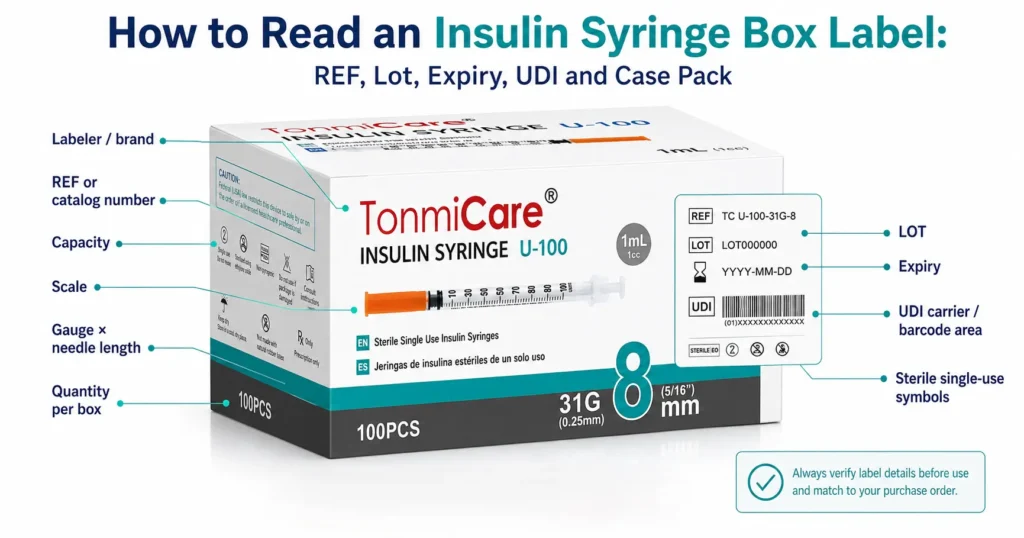
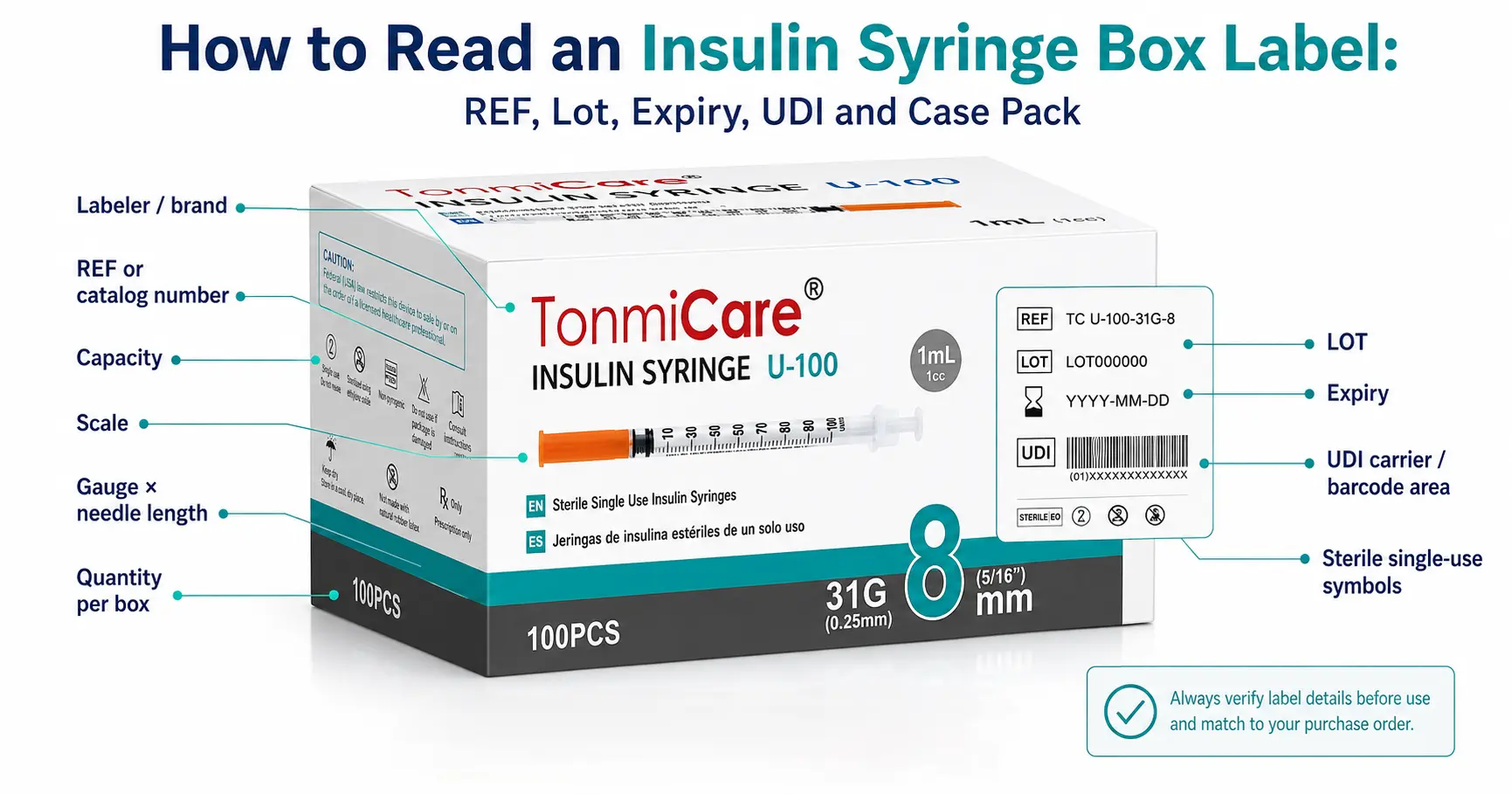
Read the box in four passes: match the item (labeler, REF, scale, capacity, gauge and needle length); capture the batch (LOT and expiry); read the UDI at the correct package level; and count the units in each inner pack, box and case.
Reconcile those fields with the approved item master, purchase order and packing list. A matching REF, successful barcode scan or public GUDID record alone cannot establish the received lot, remaining shelf life, package condition or release decision.
Start with the correct object
Box Label Information Is Not the Same as Barrel Markings
The box label identifies a packaged commercial product. Barrel markings support dose measurement and may display the scale, capacity or brand, but they are not a substitute for the package label. Lot, expiry, catalog number, UDI carrier, sterile-barrier status, package quantity and storage statements are commonly controlled at one or more packaging levels rather than printed in full on every syringe barrel.
For procurement, compare the box with the approved specification. For use, follow the labeling of the exact product and local clinical controls. Buyers who first need to define capacity, concentration scale, gauge and length can use Tonmit’s insulin syringe sizes guide before creating the item master.
Box/package label
Identity and traceability
- REF or catalog number
- LOT and expiry
- UDI carrier where required
- Package quantity and symbols
Syringe/barrel
Device-use markings
- Graduated scale
- Nominal capacity
- Concentration identification where labeled
- Other product-specific markings
Field hierarchy
Separate Product Identity, Batch Identity, UDI Data and Commercial Pack
| Layer | Typical fields | What it answers | What it does not prove |
|---|---|---|---|
| Product identity | Labeler/manufacturer name, REF, description and dimensions | Which cataloged configuration? | The received lot or expiration |
| Batch identity | LOT, expiry and sometimes manufacture date | Which production batch and dating? | That every specification matches the order |
| UDI data | UDI-DI and conditional UDI-PI elements | Standardized identification at a package level | FDA approval, authenticity or all transaction fields |
| Commercial pack | Count, packaging level, case quantity and order unit | How many units are being bought and received? | Clinical suitability or lot status |
The name shown in GUDID is the UDI labeler. FDA explains that the labeler causes a label to be applied or modified with the intent that the device be commercially distributed; buyers should not automatically treat that name as the physical production site’s name.[1]
Product-level control
What Does REF Mean on an Insulin Syringe Box?
REF commonly denotes the manufacturer’s reference or catalog number. It is the practical starting point for ordering an exact configuration, but its format is manufacturer-controlled. Do not assume that REF is the UDI, GTIN, lot number or supplier stock code. A distributor may also assign its own SKU, so an item master should retain both the manufacturer REF and any internal or supplier identifier.
A bare catalog number can be ambiguous outside its source system.
These attributes prevent unsafe or commercially disruptive substitutions.
The same general device description may be offered in different packs.
When purchasing, use the exact item description recommended in the U.S. pharmacy specification guide and request written confirmation if the supplier proposes an alternative REF.
Production-level control
What Does LOT Mean, and Why Must It Stay Linked to the Expiry?
LOT or batch identifies a defined production grouping under the manufacturer’s system. Its value is variable: two boxes of the same REF may carry different lots. Record the lot exactly as printed, including leading zeros, letters, punctuation and case where your system supports them. Do not decode a manufacture date, factory or production line from an unfamiliar lot syntax unless the manufacturer provides an authorized decoding rule.
Lot and expiry should remain linked in receiving, inventory, complaint and recall records. A lot match alone does not authenticate a product; it is one traceability element that must be considered with supplier provenance, package condition, label consistency and other controls. Splitting one received shipment across lots also requires separate quantities for each lot-expiry combination.
Date interpretation
How Should a Buyer Read the Expiration Date?
Capture the expiration date as labeled and preserve the relationship to the lot and packaging level. Under 21 CFR 801.18, a device label bearing a date intended to be brought to the user’s attention generally uses the year-month-day sequence in the format YYYY-MM-DD, subject to the rule’s stated exceptions.[4] Encoded dates inside a UDI carrier can follow the format rules of the issuing agency, so the human-readable date and barcode data need to be interpreted in their proper context.
A future expiration date does not override a damaged sterile barrier, water exposure, tampering, a recall, a temperature excursion outside labeled conditions or an unresolved identity mismatch.
A buyer should also define the minimum remaining shelf life at the exact contract point— shipment, warehouse receipt, quality release or pharmacy delivery. “Fresh stock” is not a measurable term. State the required number of months or percentage of labeled shelf life, together with permitted split-lot rules and exception approval.
UDI interpretation
UDI-DI vs UDI-PI: Which Part Identifies the Device and Which Part May Change?
FDA describes a UDI as having two parts. The device identifier (DI) is the mandatory fixed portion that identifies the labeler and the specific version or model. The production identifier (PI) is a conditional variable portion that may identify one or more of the following when included on the label: lot or batch, serial number, expiration date, manufacture date and—where applicable—the distinct identification code for a human cell, tissue, or cellular and tissue-based product.[1]
Therefore, “the UDI contains the lot and expiry” is not a safe universal rule. Buyers must inspect the human-readable label and the encoded data. If the product is expected to carry particular PI fields but a scan omits them, do not manually invent the missing values; confirm the label and supplier data before release.
UDI-DI
Labeler + specific version/model at a package level.
UDI-PI
Variable production data actually present on the label.
Received unit
DI, lot, expiry, quantity and packaging level.
Database boundary
What Can GUDID Confirm—and What Can It Not Confirm?
FDA’s Global Unique Device Identification Database contains the DI portion of UDI and associated device-identification attributes. It does not contain the PI values printed on a particular box, such as that unit’s actual lot or expiration date. Instead, a public record can indicate whether certain production identifiers are present on the label.[2]
| Question | Use GUDID? | Use the physical box/transaction record? |
|---|---|---|
| Is this DI associated with a submitted device record? | Yes | Also verify the label matches |
| What lot was received? | No—actual lot values are not stored | Yes |
| When does this box expire? | No—actual expiry values are not stored | Yes |
| What is the package quantity for a package DI? | May be shown for that record | Reconcile to the received pack |
| Is this physical box authentic or FDA approved? | No | No single label field proves it; perform supplier and product verification |
Data-carrier control
How Do GS1 Application Identifiers Fit into the Label?
When a UDI uses the GS1 system, common application identifiers include (01)
for the GTIN used as the DI, (10) for lot, (11) for manufacture
date, (17) for expiration date and (21) for serial number. FDA’s
UDI format examples show how issuing-agency syntax can differ.[7]
Do not apply GS1 parentheses to every barcode: FDA-accredited issuing agencies also include
HIBCC and ICCBBA, each with its own data structure.
(01)Device identifierGTIN / DI(10)Batch or lotVariable length(11)Manufacture dateYYMMDD encoded(17)Expiration dateYYMMDD encoded(21)Serial numberWhen applicableConfigure scanners to retain leading zeros and delimit variable-length fields correctly. Validate the decoded result against the human-readable interpretation during setup; a successful beep only means the scanner read something, not that the result belongs to the ordered item or was parsed into the correct fields.
Packaging hierarchy
Does Every Wrapper, Box and Shipping Carton Need Its Own UDI?
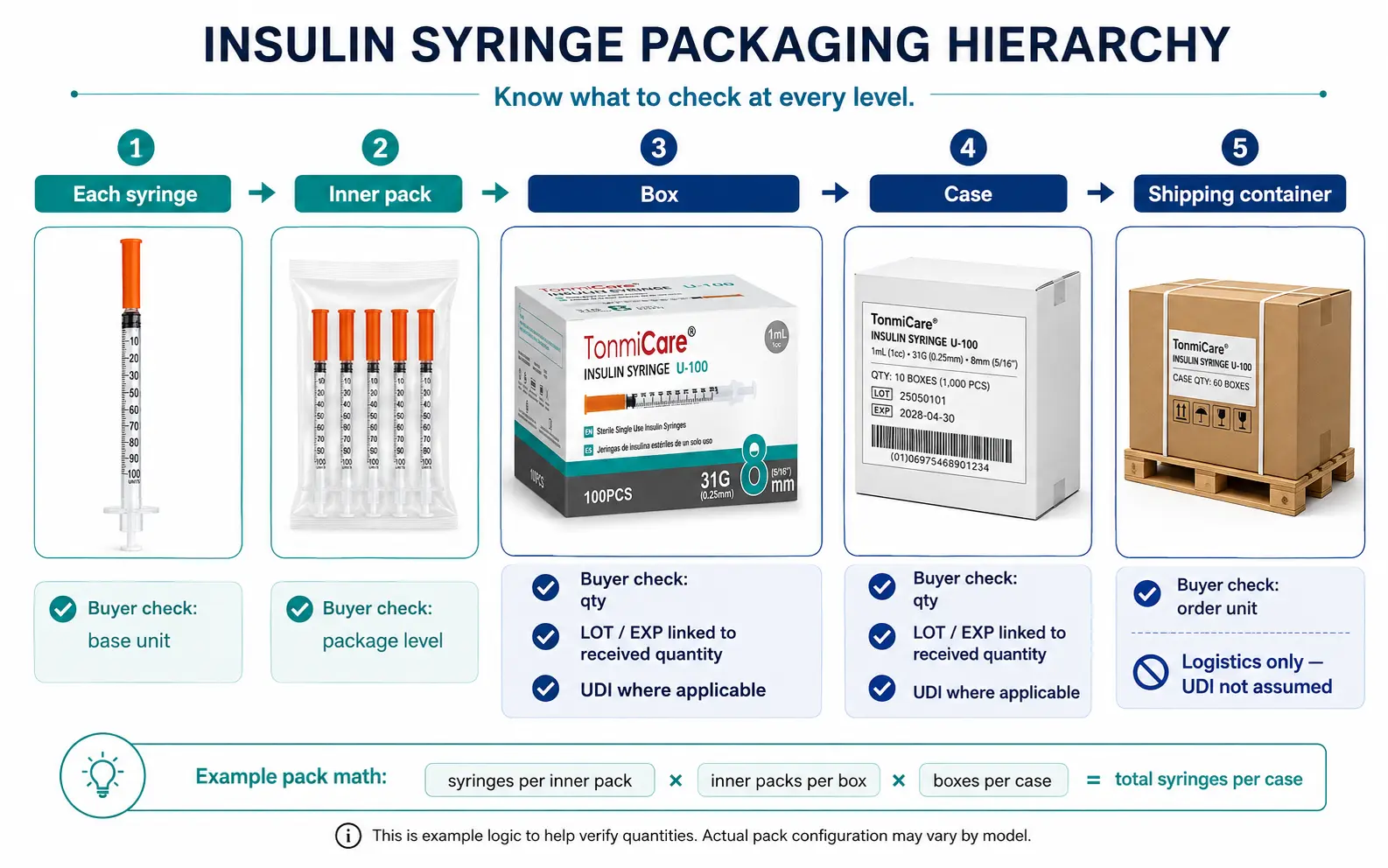
Not necessarily. 21 CFR 801.20 generally requires a UDI on a device label and on each device package, subject to exceptions and alternatives. “Device package” means a fixed quantity of a particular version or model.[3] Each higher device-package level generally needs its own UDI, but 21 CFR 801.30 provides important exceptions.[5][6]
- Single-use-device exception: individual single-use devices distributed together in one device package, not intended for individual commercial distribution and kept in that package until use may qualify; the containing package must bear a UDI.
- Shipping-container exception: a shipping container used to transport devices is not required to bear a UDI under 21 CFR 801.30(c).
- Commercial reality: a logistics barcode or supplier case label may still appear on a shipping carton. Its presence does not automatically make that carton a regulated device-package level.
The practical question is not “Is there a barcode?” It is “What package level does this identifier represent, how many devices does that package contain, and is that the unit shown on the purchase order and invoice?”
Commercial quantity
How Do You Verify Box Quantity and Case Pack?
Define the base “each” before performing case math. Depending on the supplier system, “EA” may mean one syringe, one sealed inner pack or one retail box. “Case of 20” is equally incomplete unless the buyer knows what the 20 units are and how many syringes each contains.
| Field | Buyer question | Evidence to retain |
|---|---|---|
| Base unit | What exactly is one “each”? | Supplier UOM definition and item master |
| Inner quantity | Are syringes individually wrapped or grouped? | Exact packaging description and label/photo |
| Box quantity | How many syringes are in one saleable box? | Physical box label and approved specification |
| Case quantity | How many boxes are in one case? | Case label, quotation, packing list and PO |
| Order multiple | Can the supplier break a case? | Quotation and fulfillment terms |
A count such as 100 syringes per box is common in the market but is not universal. Always verify the exact SKU and channel configuration. Tonmit’s wholesale insulin syringe guide explains how specification, packaging and purchasing quantity should be stated together.
Current public record example
One AccessGUDID Record Shows Why Package-Level Verification Matters
As a public example—not a Tonmit product and not a universal pack standard—AccessGUDID record 00681131311762 describes a 1/2 mL, 31G × 8 mm insulin syringe with catalog number 328509. The public page lists a primary package device count of 100 and a separate package DI for a case quantity of five. It also marks lot, expiration date and manufacture date as production identifiers present on the label.[8]
The lesson is structural: the box and case can have different DIs, while the actual lot and expiry remain on the physical label rather than in the GUDID record. Do not transfer those quantities or identifiers to another manufacturer or REF.
Tonmit published pack · illustrative receipt
Apply the Box-Label Check to a Tonmit Catalog Pack
Tonmit’s published wholesale insulin syringe range lists 100 syringes per box and 2,000 per case for the catalog configurations shown there. That gives a buyer a concrete first-party pack reference to compare with a quote; it does not identify the actual REF, lot, expiry or quantities on a shipment you have received.
| Record | Catalog or example value | What to verify on receipt |
|---|---|---|
| Published box pack | 100 syringes / box | Exact REF, U-40/U-100 scale, capacity, needle size and box label |
| Published case pack | 2,000 syringes / case = 20 boxes of 100 | Quote, case label, packing list and actual box count |
| Illustrative PO | 3 cases × 20 boxes = 60 boxes = 6,000 syringes | Received cases / boxes / shortages: ______ |
| Lot allocation | Not provided by the catalog listing | Each actual LOT + expiry + box quantity: ______ |
| Release decision | Not provided by the catalog listing | Packaging condition, DI/REF match and disposition: ______ |
Method and limits: The box and case counts come from Tonmit’s public catalog; the three-case order is hypothetical arithmetic. No box was inspected and no lot, UDI or QC result is asserted here. Other channels, OEM packs or quoted SKUs may use different case quantities. Receiving staff must check the actual labels and approved order documents, then record lot-expiry quantities and apply their own release criteria.
Receiving control
A Seven-Step Workflow for Scanning and Releasing an Insulin Syringe Case
- 01
Verify the supplier and order
Open the approved PO, exact item master and expected packaging level before scanning.
- 02
Inspect the transport and saleable packaging
Check crushing, moisture, tampering, contamination, opened seals and sterile-barrier concerns.
- 03
Match product identity
Compare labeler/manufacturer, REF, description, concentration scale, capacity, gauge and needle length.
- 04
Capture traceability
Record every lot-expiry combination and the quantity assigned to each.
- 05
Scan the correct packaging level
Decode the UDI carrier and confirm the DI belongs to the box or case being received.
- 06
Reconcile quantity
Convert ordered cases to boxes and base units; investigate shortages, overages and split cases.
- 07
Release or quarantine
Release only when identity, condition, dating, documentation and quantity satisfy the applicable controls.
For multi-location buyers, pair this workflow with defined lot allocation and outbound traceability. Tonmit’s U.S. medical supply fulfillment resource covers inventory and distribution support questions to include in a supplier review.
Exception management
What Should You Do When the Box, Barcode and Documents Disagree?
Do not “correct” a mismatch by choosing the field that is easiest to scan. Segregate the affected quantity, prevent sale or distribution, preserve the packaging and transaction records, and obtain written clarification through the approved supplier or manufacturer channel. Document who made the disposition decision and why.
Hold as an identity/substitution discrepancy.
Check package level, scanner parsing and current public record.
Do not create a value from invoice text alone without authorized evidence.
Recount by packaging level and reconcile UOM conversions.
Quarantine; a future expiry does not clear the damage.
Preserve evidence and follow organizational and regulatory escalation procedures.
Supplier qualification and document review sit upstream of label inspection. Use the medical device documentation support guide to define exact-SKU records before the first shipment arrives.
Data governance
Minimum Item-Master and Lot-Record Fields for Buyers
Keep master data separate from lot data: REF, DI and standard pack are normally controlled product fields, while lot, expiration, quantity received and disposition change with each receipt. This separation improves FEFO rotation, complaint investigation, recall response and replenishment accuracy.
Copyable procurement tool
Insulin Syringe Box Label RFQ and Receiving Checklist
PRODUCT IDENTITY
Labeler/manufacturer: ______
Exact REF/catalog number: ______
Concentration scale: ______ Capacity: ______
Needle gauge × length: ______
Fixed needle / other configuration: ______
UDI AND PACKAGE LEVEL
Primary package DI: ______ Package level: ______
Higher-level package DI: ______ Package level: ______
UDI issuing agency/data format: ______
PI fields expected on label: LOT / EXP / MFG / SERIAL / other: ______
COMMERCIAL QUANTITY
Define one EA: ______
Syringes per inner pack: ______
Inner packs per box: ______
Boxes per case: ______
Total syringes per case: ______
Case-break policy/order multiple: ______
RECEIPT AND RELEASE
Received LOT(s) and quantity per lot: ______
Expiry per lot: ______
Minimum remaining shelf life met: Yes / No
Package integrity accepted: Yes / No
Label, barcode, PO and packing list reconciled: Yes / No
Disposition and reviewer: ______
Buyer FAQ
Frequently Asked Questions About Insulin Syringe Box Labels
Is the REF number the same as the UDI or GTIN?
No. REF is commonly the manufacturer’s catalog/reference number. The UDI-DI is a standardized device identifier assigned under an FDA-accredited issuing system; in GS1, the GTIN commonly serves as the DI. Store them in separate fields.
Does a valid UDI mean the insulin syringe is FDA approved?
No. FDA states that a UDI database record does not, by itself, mean a device has been cleared or approved. It also does not authenticate the physical box being inspected.
Can GUDID tell me the lot number and expiration date?
GUDID contains DI records and may indicate which PI types appear on the label; it does not store the actual lot and expiration printed on an individual received box.
Should the box and case have the same barcode?
Do not assume so. Different device-package levels can have different DIs. A transport shipping container is treated differently from a fixed-quantity device package, and it may also carry separate logistics identifiers.
Does every individually wrapped insulin syringe need its own UDI?
Not in every configuration. The single-use-device exception in 21 CFR 801.30(a)(3) may apply when the devices are distributed together in a UDI-bearing package, are not intended for individual commercial distribution and remain in that package until use.
What if the scanned expiry differs from the printed expiry?
Quarantine the affected quantity, confirm the scanner configuration and data format, preserve the original packaging, and obtain written clarification through an approved source before release.
Is 100 insulin syringes per box a universal case-pack rule?
No. It is a common box count, not a universal standard. Verify the exact REF, inner configuration, box count, boxes per case and supplier order unit.
Procurement conclusion
Treat the Label as a Set of Linked Controls, Not One Barcode
A reliable insulin syringe receipt links the exact product to the exact batch and exact commercial quantity. Match the labeler and REF, verify controlled specifications, capture lot and expiry, interpret the UDI at the correct package level, reconcile box and case quantities, and hold any unresolved conflict. That workflow is more useful than a generic “scan passed” result because it supports ordering, FEFO, complaints, recalls and inventory replenishment with the same traceable record.
Source basis
Official and Primary Sources Used for This Guide
- FDA — UDI Basics
- FDA — Global Unique Device Identification Database (GUDID)
- eCFR — 21 CFR 801.3, Definitions
- eCFR — 21 CFR 801.18, Format of dates
- eCFR — 21 CFR 801.20, UDI label requirements
- eCFR — 21 CFR 801.30, UDI exceptions and alternatives
- FDA — UDI formats by accredited issuing agency
- AccessGUDID — Public device and package record example
Sources and links were reviewed on August 22, 2026. Regulations, databases, guidance, product labeling and commercial configurations can change. Verify the current exact-SKU record and applicable requirements before a future purchase, release or distribution decision.
Exact-SKU insulin syringe procurement support
Verify the Box Before You Approve the Case
Share the exact REF, specifications, label photos, package DI, required quantity, remaining shelf-life target and destination. Tonmit can review available configurations, packaging, documentation and U.S. fulfillment options.