
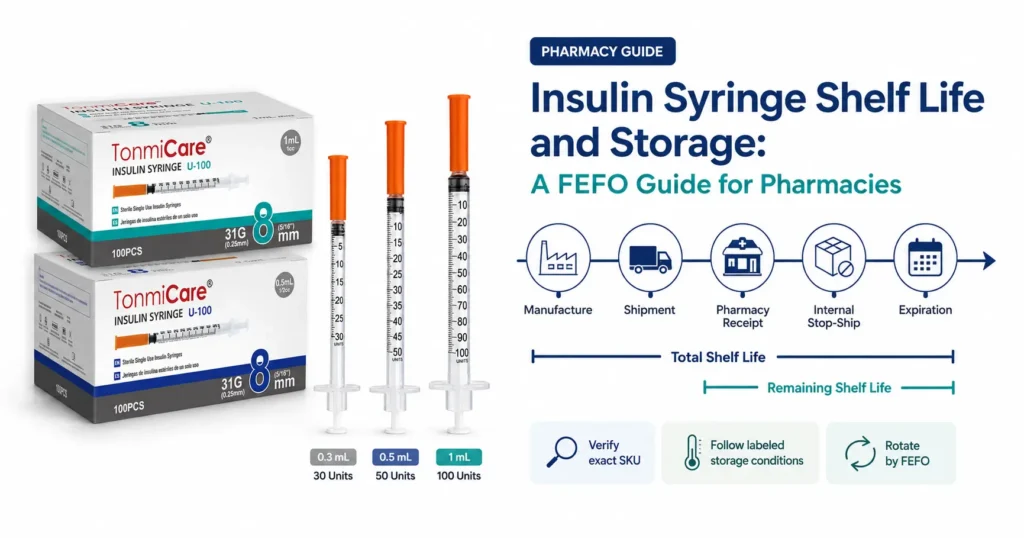
Pharmacy Inventory & Shelf-Life Control Guide
An exact-SKU framework for U.S. pharmacies, clinics and distributors reviewing insulin syringe expiration dates, remaining shelf life, labeled storage conditions, packaging integrity, receiving controls and first-expiry-first-out rotation.
Scope: This guide addresses unused, finished, sterile, single-use insulin syringes in professional procurement and inventory workflows. It does not address insulin medication storage, pharmacy-prepared or manufacturer-prefilled syringes, patient-specific product selection, injection technique, or permission to use an expired or compromised device. The exact product label, manufacturer documentation, organizational policy, contract terms and applicable law control each decision.
Direct answer
What Is the Shelf Life of an Insulin Syringe?
There is no universal insulin syringe shelf life that applies to every brand, catalog number, sterile-barrier configuration or sterilization process. Some exact products or cleared product families publicly document a five-year shelf life, but that evidence cannot be transferred to an unrelated syringe. A pharmacy should use the expiration date and storage conditions assigned by the manufacturer to the exact product being purchased.
FEFO—first expiry, first out—means selecting the earliest-expiring conforming and released lot before an otherwise identical lot with a later expiration. It does not permit expired, damaged, recalled, quarantined or storage-compromised stock to be sold or used. Package condition, product identity and release status take priority over rotation.
Terminology control
Shelf Life, Expiration Date and Remaining Shelf Life Are Different
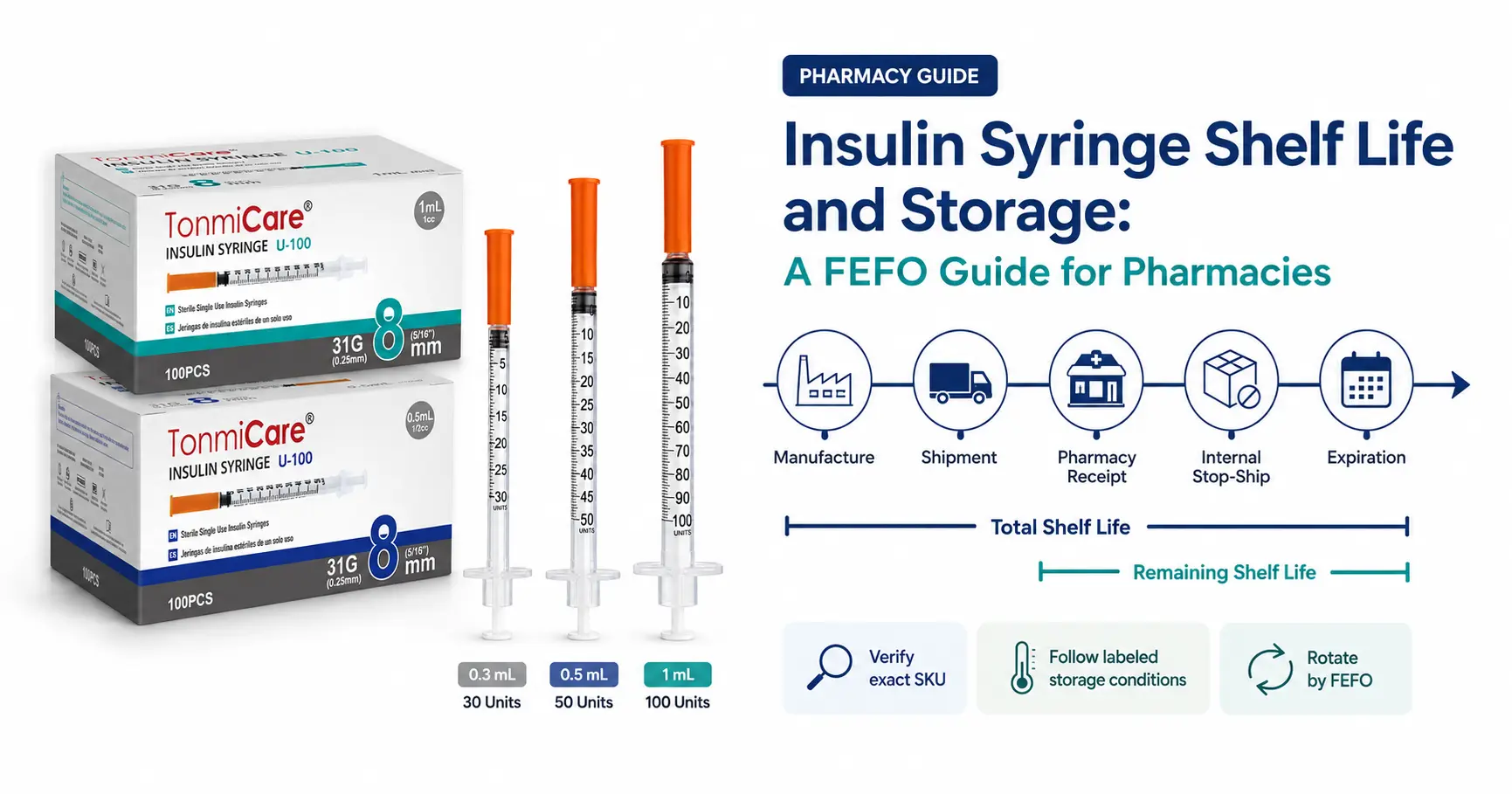
A buyer cannot manage expiration risk if the item master treats every date as the same field. WHO defines shelf life as the period during which a product is expected to remain within its approved specification when handled and stored under defined conditions. It defines remaining shelf life as the period from the agreed delivery date to the expiry or other manufacturer-established use-before date. The WHO document expressly includes medical devices within its broader “medical products” scope.[1]
| Field | Meaning for the buyer | Control required |
|---|---|---|
| Manufacturing date | Date defined by the manufacturer for production of the batch. | Request it when needed; do not derive it from a lot code without an authorized decoding rule. |
| Total shelf life | Supported period under the defined packaging, handling and storage conditions. | Confirm against exact-SKU documentation rather than a category average. |
| Expiration date | Manufacturer-assigned date after which the product should not be used. | Capture the date exactly as labeled and retain its lot relationship. |
| Remaining shelf life | Time from the contractually defined delivery point to expiration. | State whether compliance is measured at shipment, receipt, release or end-user delivery. |
| Internal stop-ship date | An earlier operational cutoff reserved for downstream delivery and use. | Configure it separately; it does not change the labeled expiration date. |
| Event-related hold | Status created by damage, tampering, recall, excursion or uncertain history. | Quarantine even when the printed expiration date remains in the future. |
This guide does not address how long insulin remains usable in a syringe after it has been filled. Medication stability, preparation conditions and beyond-use decisions are separate clinical and pharmacy-practice questions.
Evidence boundary
Do All Unused Insulin Syringes Last Three to Five Years?
No category-wide period should be assumed. Online answers commonly state that sterile syringes last three to five years or remain sterile indefinitely while sealed. Neither statement is an adequate pharmacy purchasing specification. Shelf-life support is tied to a defined product, material system, sterile barrier, sterilization process, labeling and storage condition.
Packaging standards for terminally sterilized medical devices address the sterile-barrier and packaging system rather than treating an undamaged-looking wrapper as unlimited proof of sterility.[4] FDA guidance for sterile devices also discusses packaging, aging, integrity and distribution simulation as part of the evidence submitted for a labeled sterile product.[5]
SKU-bounded language
“The manufacturer documentation for REF [___] states a [___]-month shelf life under the labeled conditions.”
Category-wide language
“All insulin syringes last five years,” or “a sealed syringe stays sterile indefinitely.”
Exact-product verification
Public Five-Year Examples Do Not Establish a Universal Rule
Public records are useful when their scope remains explicit. The FDA 510(k) summary for K223453 reports shelf-life testing supporting five years for the insulin syringe family covered by that submission.[3] A current embecta product page for catalog number 328418 lists a shelf life of 1,825 days and describes its commercial package hierarchy.[6] These are examples of product-level evidence—not permission to assign five years to another brand, REF, private-label configuration or sterile-barrier format.
| Public example | What it supports | What it does not support |
|---|---|---|
| FDA K223453 summary | Five-year shelf-life testing for the submitted insulin syringe family. | A universal five-year life for every insulin syringe on the market. |
| embecta REF 328418 | A listed 1,825-day shelf life for that identified catalog item. | The same period for another embecta REF or a competing product. |
| Supplier quotation | Commercial terms for the quoted item and assigned inventory, when documented. | Manufacturer shelf-life evidence unless the underlying controlled record is supplied. |
Buyers comparing wholesale insulin syringes should ask for the exact manufacturer, REF, label revision, package configuration, assigned lot and expiration date before comparing shelf life or price.
Acceptance policy
Set Minimum Remaining Shelf Life at a Defined Delivery Point
Total shelf life describes the product’s supported life. Remaining shelf life determines whether a specific shipment provides enough usable time for receiving, quarantine, replenishment, downstream delivery and expected consumption. A buyer asking only for “fresh stock” has not created a measurable acceptance term.
WHO recommends a contextual, risk-based remaining-shelf-life decision that considers product type, inventory, production and transit lead time, local release time, storage, distribution chain, replenishment frequency and the delivery point. It also recommends agreements among suppliers, purchasers and recipients.[1] WHO provides illustrative values, but they are not a universal U.S. insulin syringe rule.
Contract language
Replace “fresh stock” with measurable terms
- Minimum remaining shelf life: [___ months or days].
- Measurement point: [shipment / receipt / release / end-user delivery].
- Assigned lot and expiration: disclosed before shipment.
- Short-dated exception: prior written approval required.
- Nonconforming stock: return, replacement and freight responsibility defined.
Label-first storage
How Should Unused Insulin Syringes Be Stored?
Store the exact product under the conditions stated on its current label and supporting manufacturer documentation. Do not assign one internet-derived temperature or relative humidity range to every insulin syringe, and do not refrigerate empty syringes merely because the word “insulin” appears in the product name. Insulin medication and an unused syringe are different products with different storage evidence.
WHO good storage and distribution practices call for compliance with product labeling, clean and orderly storage, protection from direct sunlight, appropriate separation from floors and walls, sufficient space for cleaning and inspection, and monitoring when special temperature or humidity controls are required.[2] This WHO guidance is a useful quality framework; U.S. pharmacies must still apply their own legal, accreditation, contractual and product-specific requirements.
Preserve identification
Keep the product connected to its manufacturer, REF, lot, expiry and approved package level.
Protect the package
Prevent crushing, moisture, contamination, direct sunlight and uncontrolled handling.
Control exceptions
Quarantine damaged, wet, opened, tampered or storage-questionable inventory.
Sterile-barrier control
Expiration Date Does Not Override Packaging Damage
An expiration date assumes the product remains within the supported packaging and storage conditions. A future date does not release an item whose sterile barrier is open, torn, punctured, wet, visibly contaminated or otherwise compromised. A crushed shipping case and a damaged unit sterile barrier are not automatically the same event, but both require inspection and documented disposition at the appropriate package level.
| Observed condition | Immediate action | Release principle |
|---|---|---|
| Outer shipper scuffed; inner sales boxes unaffected | Inspect counts, moisture, crushing and inner packaging. | Release only under the organization’s documented receiving criteria. |
| Sales box crushed or wet | Quarantine affected quantity and inspect the package hierarchy. | Do not infer unit integrity from appearance alone. |
| Individual sterile barrier torn, open or punctured | Remove the affected unit from usable inventory. | A future expiration date does not restore barrier integrity. |
| Lot or expiration unreadable | Place affected stock on hold. | Release only after authorized identity and traceability resolution. |
Rotation logic
FEFO vs FIFO: Which Lot Should a Pharmacy Pick First?
FIFO prioritizes the item received first. FEFO prioritizes the conforming item with the earliest expiration date. They produce the same answer only when receipt order and expiry order happen to match. For expiring medical products, FEFO provides the more direct control of expiry exposure and is recommended in WHO storage and distribution guidance.[2]
Product identity and approval → recall/hold status → package integrity → storage history → labeled expiration → internal cutoff → FEFO sequence. A lot that fails an earlier gate must not be selected merely because it expires first.
Receiving to disposition
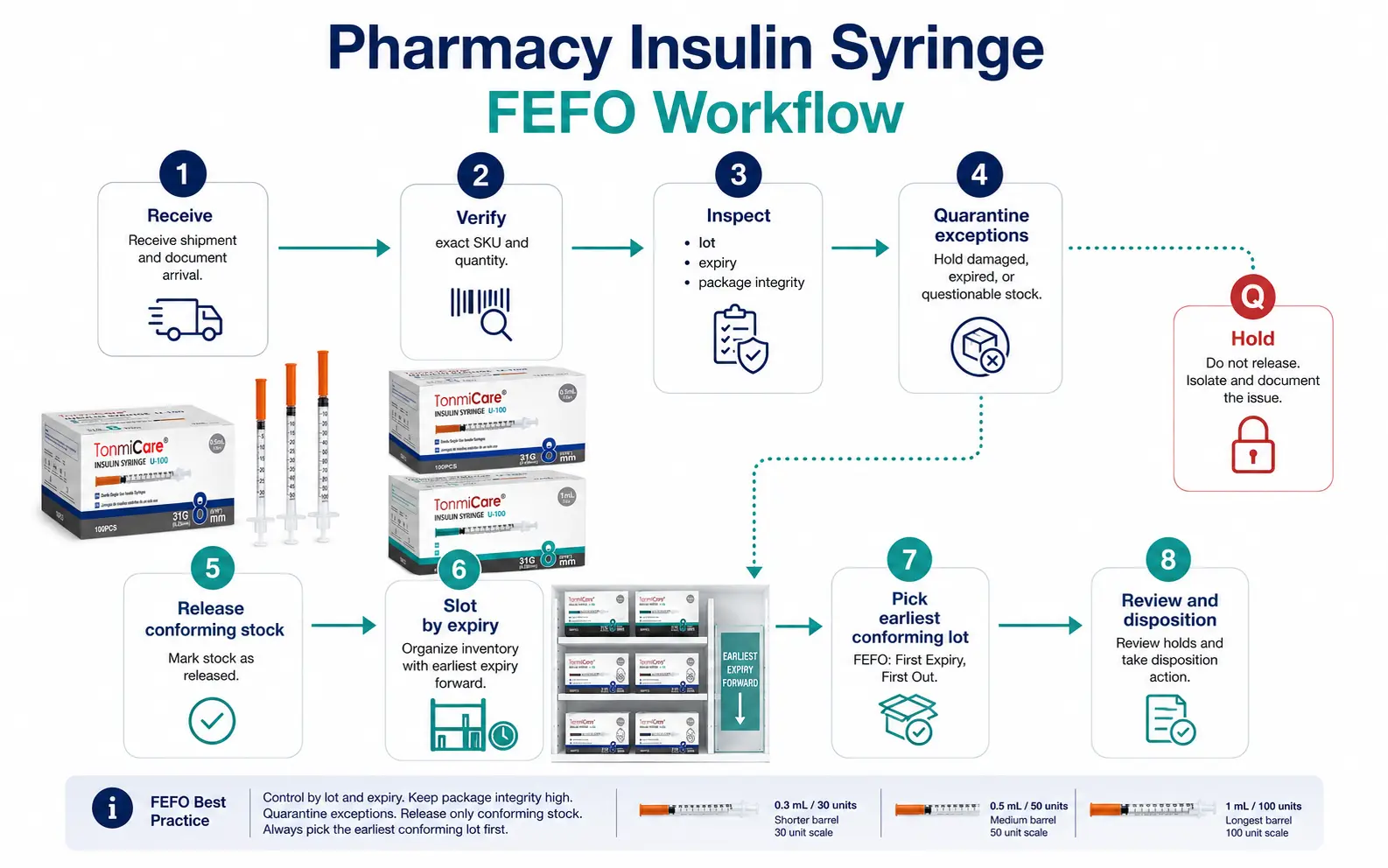
A Practical FEFO Workflow for Pharmacy Insulin Syringe Inventory
-
01
Match the purchase order
Confirm legal manufacturer or approved brand, REF, concentration scale, capacity, graduation, gauge × length, package hierarchy and quantity.
-
02
Inspect the delivery
Check lot, expiration, labeling, counts, tampering, wetness, crushing and sterile-package concerns before release.
-
03
Calculate remaining shelf life
Use the contractually defined measurement point and compare each lot against the approved minimum.
-
04
Quarantine exceptions
Separate unapproved substitutions, short-dated lots, unreadable dates, damage, recalls and questionable storage history.
-
05
Record and release
Capture the lot-to-location relationship, expiration, quantity, package level, release status and supporting receipt record.
-
06
Slot for FEFO
Place the earliest-expiring released lot in the preferred pick position without obscuring lot identity or mixing uncontrolled product.
-
07
Pick the earliest conforming lot
Use system and physical checks to prevent a later-expiring lot from being selected first.
-
08
Review and document disposition
Monitor configurable action bands; document transfer, supplier return, removal or other authorized disposition.
Item-master discipline
Keep Shelf-Life Data Connected to the Exact Package and Lot
A generic description such as “31G insulin syringe” is not enough to run FEFO. Different capacities, concentration scales, graduations, needle lengths, package configurations and manufacturers can share similar search terms. Review the insulin syringe sizes guide when defining the product, then retain the lot and expiration relationship for the actual received configuration.
UDI or GTIN data may help identify a device and package level where applicable, but it does not replace the operational need to capture the assigned lot, expiration and inventory status. Use the current label and supplier mapping for the exact commercial configuration.
Configurable monitoring
Use Action Bands as Internal Controls, Not Regulatory Expiry Dates
A pharmacy may configure 180-, 90-, 60- or 30-day reviews, but these are examples—not universal legal thresholds. The bands should reflect demand, supplier return terms, transfer options, downstream delivery time and the organization’s stop-ship or stop-dispense policy.
| Example band | Possible internal review | Boundary |
|---|---|---|
| More than 180 days | Routine FEFO rotation and replenishment review. | Still subject to minimum RSL and downstream needs. |
| 91–180 days | Confirm projected depletion and block unnecessary replenishment. | Do not force demand or make unsupported sales claims. |
| 31–90 days | Escalate transfer, supplier-return or controlled customer-allocation review. | Follow contract, policy and customer disclosure requirements. |
| 30 days or less | Apply the organization’s stop-ship, hold or disposition decision. | This example is not permission to use through a specific day. |
| Expired | Remove from usable inventory and follow authorized disposition. | FEFO no longer applies as a pick instruction. |
Nonroutine decisions
Short-Dated Stock, Storage Excursions, Damage and Returns
Require written exception approval
Record the lot, expiry, quantity, discounted or standard terms, expected depletion, customer-use window and disposition responsibility before acceptance.
Quarantine before evaluation
Document time, conditions, location, lot and package status. Obtain an authorized product-specific assessment; do not subtract days or invent a new expiration date.
Assess the affected package level
Keep photographs, counts, transport records and lot data. Separate cosmetic shipper damage from possible product or sterile-barrier damage without assuming either outcome.
Do not return directly to saleable stock
Quarantine and assess identity, package integrity, storage history, tampering risk, lot, expiry and applicable return policy. If quality is uncertain, do not reissue.
WHO advises that returned medical products be quarantined and critically assessed, and that products should not be reissued when there is doubt about their quality.[2] WHO also states that purchasers or recipients should not retest products carrying an expiration date for the purpose of extending shelf life; exceptional extension requires scientific data, risk management and the relevant regulatory authorization.[1]
Fulfillment review
How U.S. Warehouse Inventory Affects Remaining Shelf Life
A U.S. warehouse can shorten part of the replenishment and domestic delivery path, but it does not by itself prove that the allocated lot has a particular remaining shelf life. Warehouse location, available quantity, reservation status, lot, expiration, receipt status, processing time and delivery destination must be confirmed for the transaction.
Buyers considering U.S. warehouse-supported medical supply fulfillment should request the assigned or eligible lots before relying on a delivery estimate or reducing safety stock. For bulk procurement, compare product identity, units per case, landed cost and expiration exposure—not the case price alone. The separate guide explains how to buy insulin syringes by the case using comparable packaging fields.
Warehouse confirmation
Ask for transaction-specific facts
Performance monitoring
FEFO Metrics That Expose Expiration Risk
Inventory value alone does not show whether rotation is working. Review the following by exact REF, lot and location, then investigate repeated exceptions rather than treating write-offs as an unavoidable annual event.
Copy-ready specification
Insulin Syringe Shelf-Life and Storage RFQ Checklist
Use the block below when requesting bulk insulin syringes. Replace every bracketed field and require suppliers to disclose exceptions instead of silently substituting a different product or lot.
Product: Sterile, single-use insulin syringe
Legal manufacturer / labeler: [__________]
Exact manufacturer REF: [__________]
Scale / capacity / graduation: [__________]
Needle gauge × length / design: [__________]
Primary sterile presentation: [individual wrap / other exact configuration]
Commercial pack: [units/bag] × [bags or units/box] × [boxes/case]
Labeled total shelf life: [__________]
Labeled storage conditions: [quote or attach current document]
Assigned lot and expiration date: [confirm before shipment]
Minimum remaining shelf life: [___ months/days] at [shipment/receipt/release]
Required documents: current specification, label/IFU, shelf-life and packaging information, applicable regulatory and quality records
Volume: trial [___ cases]; monthly [___ cases]; annual forecast [___ cases]
Delivery: destination ZIP [_____]; requested date [_____]
Exception control: no product, lot, RSL, package or label change without prior written disclosure and approval
For supplier onboarding, Tonmit’s medical product documentation support page explains how product identity and available records can be organized for an exact-SKU review.
Buyer FAQ
Frequently Asked Questions About Insulin Syringe Shelf Life
Do unused insulin syringes expire?
Use the expiration information and storage requirements assigned to the exact product. A pharmacy should not assume that an unopened syringe has unlimited life merely because its wrapper appears intact.
What is the typical shelf life of an insulin syringe?
No single period applies to all products. Public records for some exact products or families support five years, but another brand, REF, package or sterilization process requires its own evidence.
Are all insulin syringes good for five years?
No. Five years is an exact-product or product-family claim only when supported by the applicable manufacturer or regulatory documentation.
Is shelf life counted from manufacturing or sterilization?
Follow the manufacturer’s defined shelf-life basis and labeled expiration date for the exact device. Do not calculate an expiration date from an assumed production or sterilization date.
What is remaining shelf life?
It is the period from the contractually defined delivery point to the manufacturer-established expiration or use-before date. The purchase agreement should state whether measurement occurs at shipment, receipt, release or another point.
How much remaining shelf life should a pharmacy require?
Set a risk-based minimum that covers receiving, any quarantine or release time, expected depletion, downstream delivery or customer-use time, and an internal buffer. There is no universal U.S. requirement for every insulin syringe purchase.
What is the difference between FEFO and FIFO?
FIFO selects the stock received first. FEFO selects the released and conforming stock with the earliest expiration date. The two methods can produce different pick decisions.
Can a pharmacy use an expired syringe if the package is intact?
An intact appearance does not extend the manufacturer-assigned expiration date. Remove expired stock from usable inventory and follow the organization’s authorized disposition process.
Should unused insulin syringes be refrigerated?
Do not refrigerate empty syringes by default. Follow the exact device label and manufacturer storage information. Storage instructions for insulin medication do not automatically apply to an unused syringe.
What should a pharmacy do after a storage excursion?
Quarantine the affected stock, document the time, conditions, location, lot and package status, and obtain an authorized product-specific assessment before release or disposition.
Can short-dated inventory be accepted at a discount?
It may be considered only through the buyer’s documented exception process, with the exact lot, expiration, quantity, remaining shelf life, expected depletion, customer disclosure and disposition responsibility agreed before acceptance.
Can a pharmacy test a syringe and extend its expiration date?
A purchaser should not retest an expiring product simply to extend shelf life. Any exceptional manufacturer- or regulator-authorized extension requires appropriate scientific and regulatory support and updated product information.
Conclusion
Manage a Released Lot, Not a Generic Expiration Claim
Effective insulin syringe shelf-life management begins with an exact product identity and ends with a documented lot disposition. Verify the manufacturer and REF; follow labeled storage conditions; measure remaining shelf life at a defined delivery point; quarantine damage, excursions, recalls and uncertain returns; then apply FEFO only to released, conforming inventory.
That sequence protects more than inventory value. It gives pharmacy buyers a defensible receiving specification, a measurable supplier term and an auditable method for preventing later-expiring stock from hiding an earlier-expiring usable lot. Continue with Tonmit’s U.S. pharmacy insulin syringe specification guide or review all medical supply procurement insights.
Source basis
Official and Primary Sources Used for This Guide
- WHO — Points to Consider for Setting the Remaining Shelf-Life of Medical Products Upon Delivery
- WHO — Good Storage and Distribution Practices for Medical Products
- FDA — 510(k) Summary K223453, Insulin Syringe
- ISO 11607-1:2019 — Packaging for Terminally Sterilized Medical Devices
- FDA — Sterility Information in 510(k) Submissions for Devices Labeled as Sterile
- embecta — Product Page 328418
Sources and linked pages were reviewed on August 22, 2026. WHO documents provide an international procurement and quality framework; they are not presented here as a substitute for U.S. federal or state requirements. Product specifications, labels, standards, guidance and URLs can change. Reconfirm the current exact-SKU documentation before a future purchasing, release or disposition decision.
Exact-SKU shelf-life review
Verify the Lot Before You Compare the Case Price
Share the required scale, capacity, graduation, gauge × length, exact manufacturer or approved equivalent criteria, case quantity, annual demand, destination ZIP code and minimum remaining shelf life. Tonmit can organize available product, documentation and U.S. fulfillment information for transaction-specific review.