
Sterile Packaging & Procurement Guide
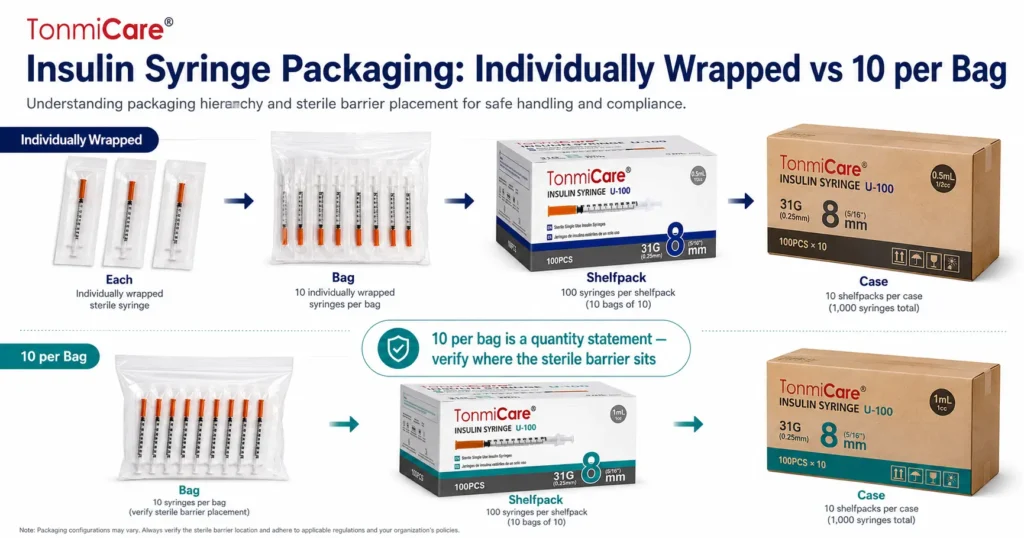
A “10 per bag” count does not tell buyers whether each insulin syringe has its own sterile barrier. Compare the exact REF, barrier level, post-opening controls, lot traceability and case quantities before approving a packaging format.
Scope: This guide supports professional purchasing, packaging review and inventory planning for finished, sterile, single-use insulin syringes. It does not select a syringe for an individual, replace current product labeling, authorize repackaging, establish a pharmacy’s dispensing policy or provide state-specific legal advice. The manufacturer’s exact SKU, current label and instructions for use, buyer procedures and applicable law control.
Direct answer
Individually Wrapped or 10 per Bag: Which Packaging Is Better?
For insulin syringe packaging, neither format is universally better. The correct choice depends on where the validated sterile barrier sits, whether the buyer needs to dispense or pick less than ten syringes, what identifying information remains with each unit, and how the product will be stored, replenished and traced after the outer package is opened.
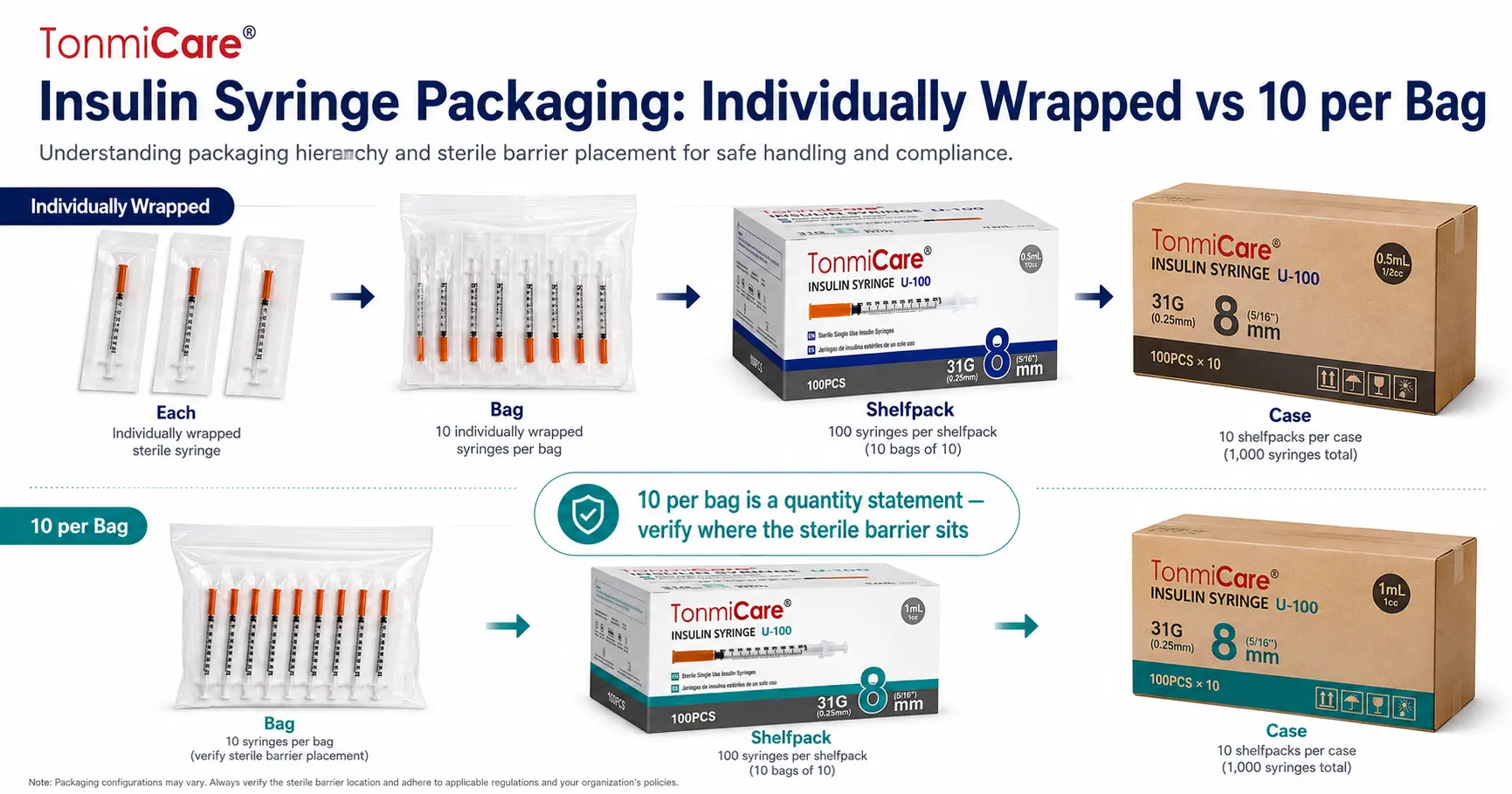
“10 per bag” is a quantity statement—not proof that ten syringes share one sterile barrier. Ten syringes may each be individually packaged and then grouped in an outer bag, or the ten-unit presentation may use another manufacturer-defined protection system. A “10 count” retail listing reveals even less. Buyers should obtain the current label, packaging specification and instructions for the exact manufacturer reference before deciding what remains protected after opening.
Terminology first
1. Define Individually Wrapped, 10 per Bag and 10 Count
Search listings frequently use “individually wrapped,” “polybag,” “10 per bag” and “10 count” as if they describe the same attribute. They do not. Each term answers a different purchasing question.
| Term | What it can establish | What it does not establish | Buyer evidence |
|---|---|---|---|
| Individually wrapped | Each syringe has a separate wrapping or primary package | That every wrapping design has the same sterile-barrier performance or shelf life | Unit-package specification, label, opening method and integrity evidence |
| 10 per bag | The manufacturer or seller groups ten syringes in one bag-level presentation | Whether each syringe is separately wrapped or what happens after the bag is opened | Packaging drawing, bag label, unit photographs and instructions for use |
| Polybag | A flexible plastic bag is used at some packaging level | Whether the polybag is a sterile barrier, protective package or sales pack | Manufacturer’s declared sterile-barrier system and material specification |
| 10 count | The listed commercial quantity is ten syringes | The manufacturer pack level, sterile-barrier location or permitted partial dispensing | Manufacturer REF, original package and label—not the retailer title alone |
| Tamper evident | The package may provide visible evidence of opening or interference | That it is necessarily a validated sterile barrier | Package function defined in controlled product documentation |
A current retailer page can describe a product as both “individually wrapped” and “Packaging Type: Poly Bag.” That is not necessarily contradictory: the bag may be an outer grouping layer. The exact package specification must resolve the hierarchy.
Control every level
2. Map Each, Bag, Shelfpack, Box and Case
A complete packaging specification separates physical containment from commercial quantity and traceability. An official embecta insulin-syringe SKU, for example, lists one syringe as an each, ten per bag, 100 per shelfpack and 500 per case, with separate GTINs published for bag, shelfpack and case levels.[6] This is useful evidence of that SKU’s hierarchy, but the count fields alone still do not identify the sterile barrier.
Physical package
Record what physically surrounds one syringe and what surrounds a group of syringes. Include caps, wrap, pouch, blister, bag, shelfpack and case as applicable.
Commercial unit
Identify the smallest unit the supplier quotes, the smallest unit the pharmacy receives and the unit the distributor is permitted to resell.
Traceability unit
Determine which level carries the catalog number, UDI or GTIN where applicable, lot, expiration date, quantity and responsible organization.
Recommended packaging hierarchy record
| Level | Quantity | Package function | Identity fields | Buyer control |
|---|---|---|---|---|
| Each | 1 syringe | Device or individually packaged unit | Confirm what remains with the unit | Can it be picked or dispensed without losing required information? |
| Bag | Example: 10 | May be primary, secondary or sales packaging | Bag identifier, quantity, lot and expiry as applicable | What changes when the bag is opened? |
| Shelfpack / box | Example: 100 | Storage and dispensing presentation | REF, barcode, lot, expiry and labeler | Can mixed lots enter the same opened box? |
| Case | Example: 500 or SKU-specific | Shipping and warehouse handling | Case GTIN, lot mapping and shipping marks | Reconcile case count, dimensions and received lots |
| Pallet | Supplier-specific | Freight and allocation | Pallet or logistics identifier where used | Confirm cases, dimensions, weight and mixed-lot policy |
Tonmit catalog example · buyer QC record
Apply the pack check to a published Tonmit insulin syringe case
Tonmit’s published wholesale insulin syringe range lists 100 syringes per box and 2,000 per case for the catalog configurations shown. That is 20 boxes per case. The table below is a buyer receiving template built from Tonmit’s published pack counts; it is not a record of an inspected shipment.
| Control | Catalog or illustrative value | Actual receipt: record or verify |
|---|---|---|
| Approved product | Exact manufacturer REF and syringe specification: not stated by a pack count | REF, scale, capacity, gauge × length, supplier and PO: ______ |
| Box quantity | 100 syringes / box | Count on actual box label: ______; mismatches: ______ |
| Case quantity | 2,000 syringes / case = 20 boxes of 100 | Cases received: ______; boxes / case: ______; damaged boxes: ______ |
| Illustrative order | 3 cases × 20 boxes = 60 boxes = 6,000 syringes | PO quantity: ______; received quantity: ______; shortage: ______ |
| Barrier and lot | Individual wrap, bag design, sterile barrier, LOT and expiry are not established by catalog case counts | Confirm approved packaging specification, actual labels, LOT / expiry for each accepted quantity: ______ |
| Release decision | Catalog information does not prove condition or conformity of a shipment | Hold / accept / escalate under buyer procedure; evidence and reviewer: ______ |
Download the receiving QC template (CSV) ↓
Method and limits: Box and case numbers come from Tonmit’s public catalog, checked September 24, 2026; the three-case PO is arithmetic for illustration. No received box was inspected and no lot, sterility test, UDI scan or QC result is claimed. A different SKU, OEM pack or supply channel may use a different hierarchy. Verify the exact quotation, controlled package specification, labels and actual receipt before release.
Buyer comparison
3. Individually Wrapped vs 10 per Bag Comparison Table
The table below compares two procurement concepts. It does not assign a sterile-barrier design to every 10-per-bag SKU. Where the bag is only an outer grouping package and each syringe has its own labeled sterile barrier, the unit-level characteristics may resemble the individually wrapped column.
| Buyer factor | Individually wrapped unit | 10-per-bag presentation | Verification question |
|---|---|---|---|
| Sterile-barrier control | Potentially controlled at each unit when supported by the exact label and package design | May be controlled at the bag or another level; do not infer | Which package is the validated sterile barrier system? |
| Partial dispensing | May better preserve unit separation and identity | May require the entire intact bag to remain the dispensing unit | What information and protection remain with a loose syringe? |
| Clinic opening workflow | One package opened for one syringe | Potentially faster access at higher volume, subject to labeling and aseptic controls | What does the manufacturer state about remaining contents? |
| Traceability | Unit package may carry more information, but confirm actual artwork | Lot and expiry may appear only on the bag or higher level | At which level are REF, lot, expiry and barcode printed? |
| Picking errors | More unit-level visual separation | Fewer commercial packs to pick when ten are required | Which level is scanned and reconciled in inventory? |
| Packaging material | May use more unit-level material | May use less material per syringe, depending on the complete system | What are the measured material weights and pack dimensions? |
| Usable cost | Potentially higher pack cost but lower partial-pack write-off | Potentially lower purchase cost but higher loss if an opened pack cannot remain saleable | What is the cost per usable sealed unit in the actual workflow? |
| Private label | More individual artwork and line complexity may be involved | Bag-level artwork may simplify some projects | Who is the labeler, and what requires a new UDI/GTIN review? |
The controlling question
4. Where Is the Sterile Barrier System?
ISO 11607-1 distinguishes the sterile barrier system from the broader packaging system for terminally sterilized medical devices.[1] In procurement terms, the sterile barrier is the minimum package that prevents entry of microorganisms and allows the product to be presented appropriately for use. Protective packaging may surround it without itself being the sterile barrier.
FDA’s current guidance for devices labeled sterile recommends that a 510(k) describe the sterile barrier system, explain how it maintains sterility and identify package test methods. The guidance also discusses simulated distribution, aging, package integrity and seal-strength evidence supporting package integrity and shelf-life claims.[3]
What is the minimum sterile package?
- One individually sealed pouch or wrap
- A bag containing several units
- Another validated sterile-fluid-path configuration
- A product-specific design described in the label or IFU
Terms that answer different questions
- Sterile: a labeled product condition supported by applicable evidence.
- Tamper evident: visible evidence that a package may have been opened.
- Sealed: a closure description, not automatically a sterility claim.
- Protective package: protection against physical or environmental hazards.
Do not write “polybag means individually wrapped,” “polybag means ten syringes share one barrier” or “individually wrapped guarantees sterility.” All three statements can be wrong without the exact product specification and current labeling.
Post-opening control
5. What Happens to the Other Syringes After the Bag Is Opened?
The answer depends on the validated design and labeled package level. The procurement team should document the decision before the product reaches a dispensing shelf, medication room or distribution pick face.
Confirm whether every syringe has its own intact sterile barrier. If yes, unopened units remain protected only as supported by their individual packaging and current label.
If the bag is the sterile barrier, follow the manufacturer’s post-opening statement. Do not invent an open-bag storage period or assume remaining units keep their original labeled status.
If the design is unclear, hold the decision. Request the packaging specification, label and written manufacturer clarification for the exact REF.
Preserve the original identity record. Keep the product REF, lot, expiration date, quantity and responsible organization linked to any remaining inventory.
Separate opened stock from intact saleable stock. Use the buyer’s approved quarantine, opened-package or nonconforming-material process when status is uncertain.
Closing an opened zipper, folding a bag or applying tape does not recreate a validated sterile barrier. Only rely on a post-opening process that is specifically supported by the manufacturer’s labeling and the buyer’s approved procedure.
Dispensing operations
6. Packaging Decisions for Independent and Retail Pharmacies
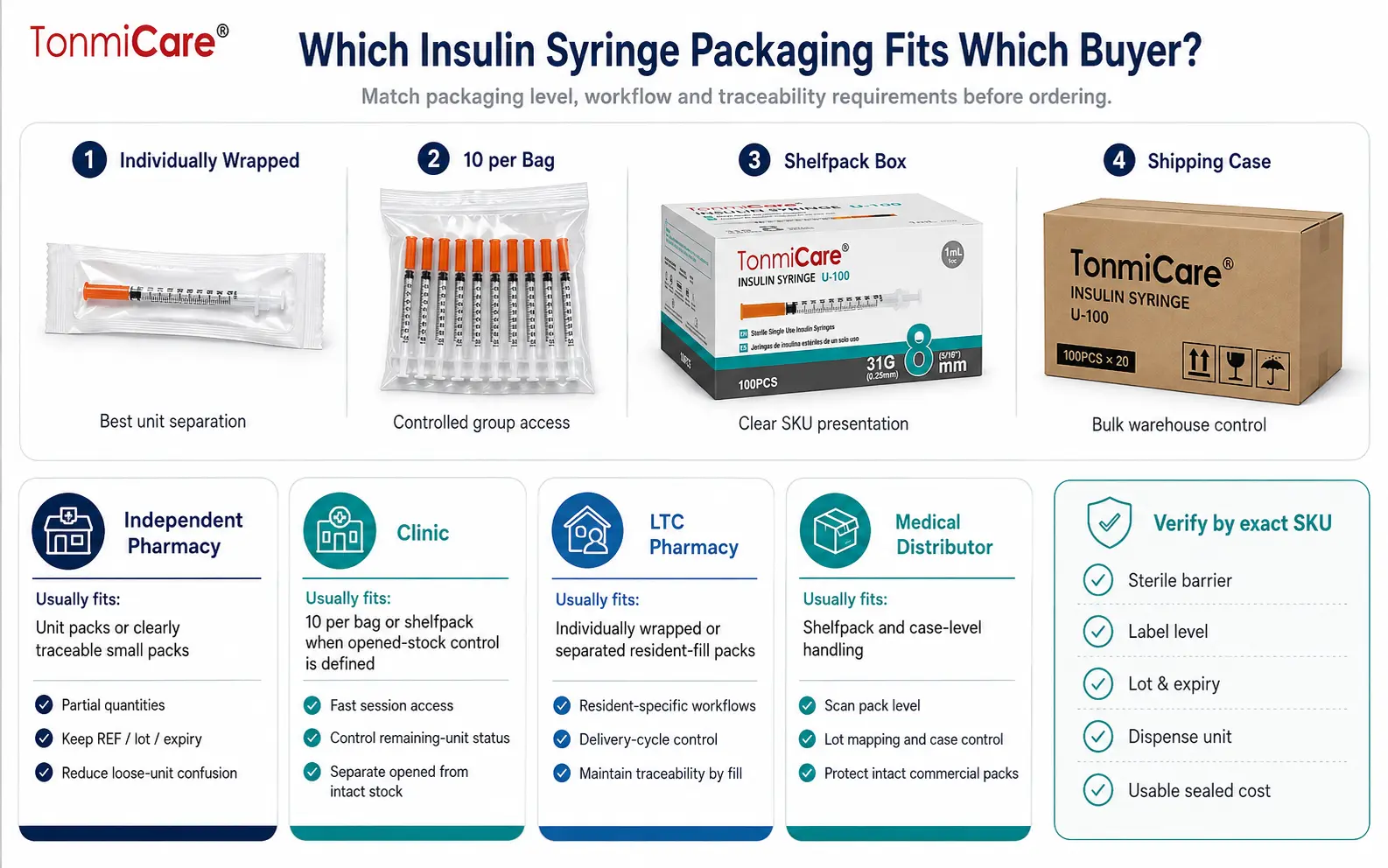
A pharmacy that routinely supplies less than a manufacturer bag or box has different requirements from a buyer that dispenses the complete intact presentation. Individual packaging may support partial quantities, but the pharmacy still has to determine what label information, instructions, traceability and legal controls must accompany the dispensed product.
When unit-level packaging may help
- Small or patient-specific quantities are common
- Inventory is picked one syringe at a time
- Each unit must remain physically separated
- Partial-pack write-off is otherwise material
- Kits use controlled, separately managed components
When an intact 10-count bag may fit
- The complete bag is the normal commercial or dispensing quantity
- The original bag label remains with the product
- Demand is predictable in multiples of ten
- The buyer does not need uncontrolled bag breaking
- Scanning and replenishment are configured at bag level
Pharmacy controls before permitting partial quantities
- Confirm the exact product, concentration scale, capacity, graduation, gauge and length. Packaging does not make different syringe specifications interchangeable; use the insulin syringe sizes guide as a separate specification review.
- Determine what product label, patient information and state-specific requirements apply to the transaction.
- Preserve lot and expiration traceability from receiving through dispensing and complaint handling.
- Block staff from identifying a loose syringe by cap color, appearance or a handwritten description alone.
- Define whether an opened manufacturer bag remains active inventory, opened stock or non-saleable material.
Point-of-use planning
7. Clinic and Long-Term Care Pharmacy Considerations
Clinics may value rapid point-of-use access, while long-term care pharmacies may prioritize patient-specific fills, delivery cycles and traceability across facilities. Neither setting should choose a package only because it is faster to open or appears less expensive.
| Setting | Workflow question | Packaging implication | Control record |
|---|---|---|---|
| Outpatient clinic | How many syringes are accessed during a session, and where are unopened units stored? | A multi-unit bag may reduce openings only if remaining-unit status and storage are clearly supported | Medication-preparation SOP, package label and inventory record |
| Long-term care pharmacy | Are supplies filled by resident, cycle or facility stock? | Unit-level packaging may better support separated workflows, but the exact dispensing and labeling process controls | Patient/facility assignment, lot/expiry record and delivery manifest |
| Facility floor stock | Who opens the bag and who controls the remaining quantity? | Bag-level accountability may be needed | Opened-date/status procedure and storage responsibility |
| Emergency or backup stock | Will the pack remain intact for long periods? | Remaining shelf life and package integrity become primary | FEFO record, inspection frequency and replacement threshold |
CDC’s injection-safety guidance requires a new sterile needle and syringe for each injection and prohibits reuse of a syringe for more than one patient, even if the needle is changed.[5] Package selection should support—not replace—the facility’s infection-control and occupational-safety program.
Channel control
8. What Distributors Must Verify Before Breaking a Bag, Box or Case
Breaking a shipping case into intact manufacturer shelfpacks is not the same as opening a 10-count bag and selling loose syringes. The distributor should define the lowest approved resale unit and ensure it retains the information and packaging required for commercial distribution.
Approved resale level: case, shelfpack, box, intact bag or individual unit.
Identity retention: manufacturer, labeler, REF, UDI/GTIN where applicable, lot and expiration.
Physical protection: no damage, puncture, seal disruption, contamination or shipping exposure.
Inventory mapping: parent case linked to every distributed lower-level unit.
Change of role: determine whether relabeling or repackaging creates additional labeler responsibilities.
Returns: define whether opened, partial or customer-returned packages can re-enter saleable inventory.
FDA explains that a device labeler can include a manufacturer, specification developer, convenience-kit assembler, repackager or relabeler, depending on who causes a label to be applied or modified for commercial distribution.[4] A distributor should therefore obtain qualified regulatory review before changing packaging or labeling rather than treating repacking as a warehouse-only activity.
Identity and traceability
9. Label, UDI, GTIN, Lot and Expiration Checks
The package hierarchy should reconcile with the product master and receiving system. FDA’s UDI framework generally uses a Device Identifier to identify the labeler and specific version or model, while conditional Production Identifier data can include lot, serial number, expiration date and manufacturing date when those data appear on the label.[4] Applicable exceptions and package-level requirements must be reviewed for the exact device.
| Field | Buyer question | Common control failure |
|---|---|---|
| Legal manufacturer / labeler | Who is responsible for the marketed package? | Applying one company’s record to another private-label configuration |
| Manufacturer REF | Does every package level match the quotation and PO? | Accepting a similar gauge or capacity as the approved SKU |
| UDI / GTIN | Which identifiers apply to bag, shelfpack and case? | Scanning a case identifier as though it identified a single syringe |
| Lot or batch | Can received and distributed quantities be traced to the source lot? | Combining lots without a mapping record |
| Expiration date | Where is it printed and what remains after breaking the package? | Loose units no longer linked to an expiration date |
| Package quantity | Does the label match the physical count and system master? | Confusing ten per bag with ten bags per box |
| Artwork revision | Was the current approved packaging supplied? | Uncontrolled change to claims, symbols or barcode placement |
Evidence, not adjectives
10. Packaging Evidence Buyers Should Request
ISO 11607-1 addresses materials, sterile barrier systems and packaging systems, while ISO 11607-2 addresses validation of forming, sealing and assembly processes.[1][2] Buyers do not necessarily receive unrestricted access to complete proprietary validation reports. A practical supplier-qualification package can instead identify the controlled design and provide available specifications, declarations, test summaries or certificates appropriate to the project.
Exact-SKU product evidence
- Legal manufacturer, brand, labeler and REF
- Concentration scale, capacity, graduation, gauge and length
- Current label and instructions for use
- Sterile status and declared sterilization method
- Labeled shelf life and storage conditions
Packaging-system evidence
- Packaging hierarchy and quantity at every level
- Identification of the sterile barrier system
- Material and seal specification or available summary
- Distribution, integrity, aging and seal-strength evidence appropriate to the design
- Approved artwork, UDI/GTIN mapping and change control
Depending on the package design and validation protocol, applicable methods may include seal-strength, visual-seal, dye-penetration, bubble-leak, distribution and accelerated-aging evaluations. The article should not state that one ASTM method or one acceptance value is mandatory for every insulin syringe package. The manufacturer’s risk analysis, product design, applicable standards and regulatory submission determine the evidence set.
A validation summary for one manufacturer, REF, package material, sterilization method or artwork configuration should not automatically be applied to another SKU. Tonmit’s medical product documentation support page explains how product, manufacturer, packaging configuration and record should form one evidence chain.
Commercial comparison
11. Compare Usable Landed Cost—not Only Price per Bag
A lower package price may not produce a lower operating cost. The buyer should normalize the exact syringe specification, package counts, freight, warehouse labor, remaining shelf life and expected partial-pack loss before comparing quotations.
| Cost input | Individually wrapped impact | 10-per-bag impact |
|---|---|---|
| Purchase price | May include more unit-level packaging cost | May reduce packaging or handling cost, but must be proven by quote |
| Warehouse cube | Depends on pouch and box dimensions | Depends on bag, shelfpack and case configuration |
| Picking labor | Supports single-unit picks but creates more individual handling | Efficient when the normal pick is ten |
| Opened-pack loss | Potentially limited to the opened unit | Potentially affects remaining units if bag-level status cannot be maintained |
| Returns | Unopened unit packages may be easier to identify, subject to policy | Partial bags may become nonreturnable or non-saleable |
| Sustainability | Potentially more unit packaging | Potentially less material, but compare measured material, freight and waste |
For current B2B supply options, buyers can review wholesale insulin syringes and request a quotation that identifies the exact REF, unit/bag/box/case quantity, current inventory path and transaction-specific terms.
Incoming control
12. Insulin Syringe Packaging Receiving Checklist
Match the exact SKU. Verify manufacturer, labeler, REF, capacity, scale, graduation, gauge and length against the PO.
Reconcile counts. Confirm syringes per bag, bags or units per shelfpack, shelfpacks per case and total received quantity.
Inspect package integrity. Look for punctures, open seals, tears, moisture, crushing, contamination or other shipping damage without performing destructive testing on saleable stock.
Verify labels. Check REF, UDI/GTIN where applicable, lot, expiration, quantity, sterile statement and artwork revision at the approved levels.
Check shelf life. Compare expiration dates with the purchase agreement and minimum remaining-shelf-life requirement.
Record lot relationships. Link the shipping case and lower package levels to receiving, inventory and downstream distribution records.
Quarantine discrepancies. Hold mixed SKUs, changed package formats, missing labels, damaged seals and unapproved substitutions for review.
Retain evidence. Keep receiving photographs, packing list, PO, supplier item mapping and disposition record according to policy.
Copy-ready purchasing tool
13. Exact-SKU Insulin Syringe Packaging RFQ Checklist
Require competing suppliers to quote the same complete requirement. A description such as “31G insulin syringes, 10 per bag” leaves capacity, scale, graduation, sterile barrier and case hierarchy unresolved.
| RFQ field | Required response |
|---|---|
| Product identity | Legal manufacturer, labeler, brand, exact REF and country of origin |
| Syringe specification | Concentration scale, capacity, graduation, fixed-needle design, gauge × length |
| Unit packaging | Individually wrapped, capped, pouched, blistered or other exact configuration |
| Sterile barrier | Identify the minimum sterile package and post-opening statement |
| Packaging hierarchy | Each/bag/shelfpack/box/case/pallet quantities and dimensions |
| Identification | UDI/GTIN by applicable level, lot and expiration locations, artwork revision |
| Evidence | Current label/IFU, product specification, packaging specification and available validation summary |
| Shelf life | Labeled shelf life, storage conditions and minimum remaining shelf life at shipment |
| Commercial terms | MOQ, case price, freight basis, lead time, returns and substitution restrictions |
| Supply plan | Available inventory, destination, replenishment lead time and change-notification process |
Required product: [manufacturer/approved equivalent]; [U-100/U-40 or other authorized scale]; [0.3/0.5/1] mL; [graduation]; [gauge × length]; [individual wrap/10-per-bag/other] package; sterile barrier at [required level]; [units] per bag; [units] per shelfpack; [units] per case; annual demand [quantity]; delivery destination [ZIP/country]; minimum remaining shelf life [requirement]. Please identify the exact REF, labeler, UDI/GTIN by applicable package level, lot/expiry placement, current label/IFU, packaging specification, available validation evidence, MOQ, case price, lead time and any exception. No substitution or packaging change without written approval.
Questions buyers ask
14. Insulin Syringe Packaging FAQ
Does 10 per bag mean every insulin syringe is individually wrapped?
No. It establishes a quantity at the bag level. Each syringe may be individually wrapped inside that bag, or the product may use another manufacturer-defined package design. Confirm the exact REF, package photographs, label and packaging specification.
Is a 10-count polybag of insulin syringes sterile?
The product may be labeled sterile, but “polybag” by itself does not identify the sterile-barrier design. Determine which package level maintains the labeled sterile condition and what the manufacturer states about opening.
What happens to the remaining syringes after a 10-count bag is opened?
If every syringe has its own intact, labeled sterile barrier, the unopened individual packages remain protected as labeled. If the bag is the sterile barrier, the manufacturer’s post-opening instructions control. If the design is unclear, do not assign an unsupported status to the remaining syringes.
Can an opened syringe bag be resealed?
A simple closure does not recreate a validated sterile barrier. Follow only a manufacturer-supported process and the buyer’s approved procedure.
Can a pharmacy dispense one syringe from a 10-count bag?
There is no universal answer. The pharmacy must evaluate the exact package design, remaining sterile protection, labeling and traceability, prescription or dispensing requirements, internal policy and applicable state law. This article does not authorize bag breaking or partial dispensing.
Is individually wrapped packaging always better for pharmacies?
No. It may support unit-level picking and partial quantities, but an intact 10-count bag can be more efficient when ten is the normal dispensing or resale unit. Compare workflow, evidence and usable cost rather than choosing by one feature.
Is 10 per bag always less expensive or more sustainable?
No. Compare the actual quotation, packaging material, case cube, freight, labor, damage, opened-pack loss and disposal. A claim about lower cost or lower environmental impact requires SKU-specific data.
Does individually wrapped packaging provide a longer shelf life?
Not automatically. Shelf life belongs to the validated product and package system for the exact SKU. Compare the labeled expiration and supporting evidence rather than the package name.
Does every syringe need its own UDI, lot and expiration label?
Applicable UDI and labeling requirements depend on the device and packaging level, including any exception or alternative. The buyer should map what appears on each, bag, shelfpack and case and determine what must remain with the distributed unit.
Can a distributor break a manufacturer bag and sell loose syringes?
Do not assume so. Opening or changing a manufacturer package can affect sterile protection, labeling, traceability and potentially repackager or labeler responsibilities. Obtain qualified regulatory and quality review before changing the approved resale level.
What packaging tests should a buyer request?
Request evidence appropriate to the exact sterile-barrier and packaging design. Depending on the design, this may address sealing, integrity, distribution and aging. Do not require one test method or acceptance value for every product without a technically justified specification.
What is the best way to compare supplier quotes?
Lock the exact syringe specification and packaging hierarchy, then compare cost per usable conforming syringe, freight, remaining shelf life, receiving labor, partial-pack loss, documentation, inventory availability and replenishment terms.
Conclusion
15. Buy a Controlled Packaging System, Not Only a Pack Count
The practical difference between individually wrapped insulin syringes and a 10-per-bag presentation is not captured by the number ten. A defensible purchase identifies the exact syringe, the sterile-barrier level, every commercial package quantity, the information that remains after opening and the workflow in which the product will be dispensed, administered or redistributed.
For pharmacies and distributors, the strongest approval record connects manufacturer REF, syringe specification, unit package, bag, shelfpack, case, label/UDI, lot, expiration, packaging evidence, usable landed cost and replenishment terms. That structure makes competing quotations comparable and reduces uncontrolled substitution, opened-package loss, traceability gaps and receiving errors.
Source basis
Official and Primary Sources Used for This Guide
- ISO 11607-1:2019 — Packaging for Terminally Sterilized Medical Devices, Part 1
- ISO 11607-2:2019 — Validation Requirements for Forming, Sealing and Assembly Processes
- FDA — Submission and Review of Sterility Information in 510(k) Submissions for Devices Labeled as Sterile
- FDA — UDI Basics
- CDC — Preventing Unsafe Injection Practices
- embecta — Insulin Syringe SKU 328418 Packaging Hierarchy
- ASTM F88/F88M-21 — Seal Strength of Flexible Barrier Materials
- ASTM F1980-21 — Accelerated Aging of Sterile Barrier Systems and Medical Devices
- ISO 8537:2016 — Sterile Single-Use Syringes for Insulin
Primary sources are linked above for review. The Tonmit catalog pack example was checked September 24, 2026. Standards, guidance, product labeling and package configurations can change; verify the current edition and exact SKU before a future revision or purchasing decision.
Exact-SKU packaging support
Verify the Package Before Comparing the Price
Share the required syringe specification, individual or bag-level packaging target, case quantity, annual demand, destination, remaining-shelf-life requirement and documentation checklist. Tonmit can review applicable product options, available packaging information, U.S. fulfillment paths and transaction-specific commercial terms.