
Pen Needle Safety & Procurement Comparison
An evidence-bounded comparison of safety pen needles vs standard pen needles for pharmacies, clinics, long-term care providers and medical distributors—covering protection mechanisms, compatibility, user evaluation, occupational-safety review, packaging and total use cost.
Scope: This guide supports professional purchasing, formulary review and occupational-safety evaluation. It does not select a needle for an individual, prescribe an injection technique, interpret a facility’s legal duties, or declare one design suitable for every pen, medication, user or care setting. Current product labeling, the exact cleared product, the employer’s exposure assessment, applicable federal and state requirements, and qualified clinical and safety personnel control the final decision.
Direct answer
What Is the Difference Between Safety and Standard Pen Needles?
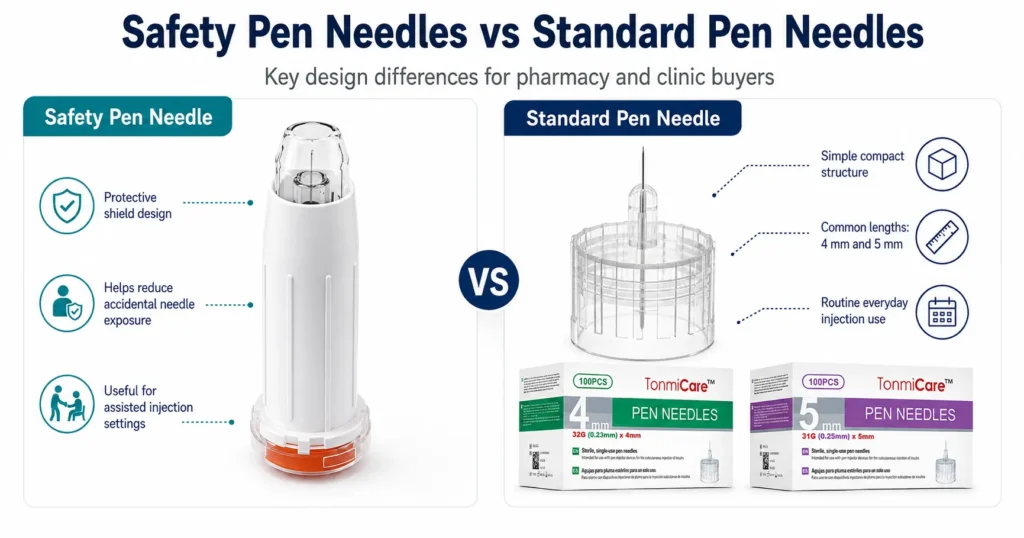
A standard pen needle is a sterile, single-use, double-ended needle that connects a compatible pen injector to the injection site but does not incorporate a post-use sharps injury protection mechanism. A safety pen needle adds an active or passive feature intended to reduce accidental contact with one or both sharp ends. The word “safety” does not describe one universal design and does not mean that injury is impossible.
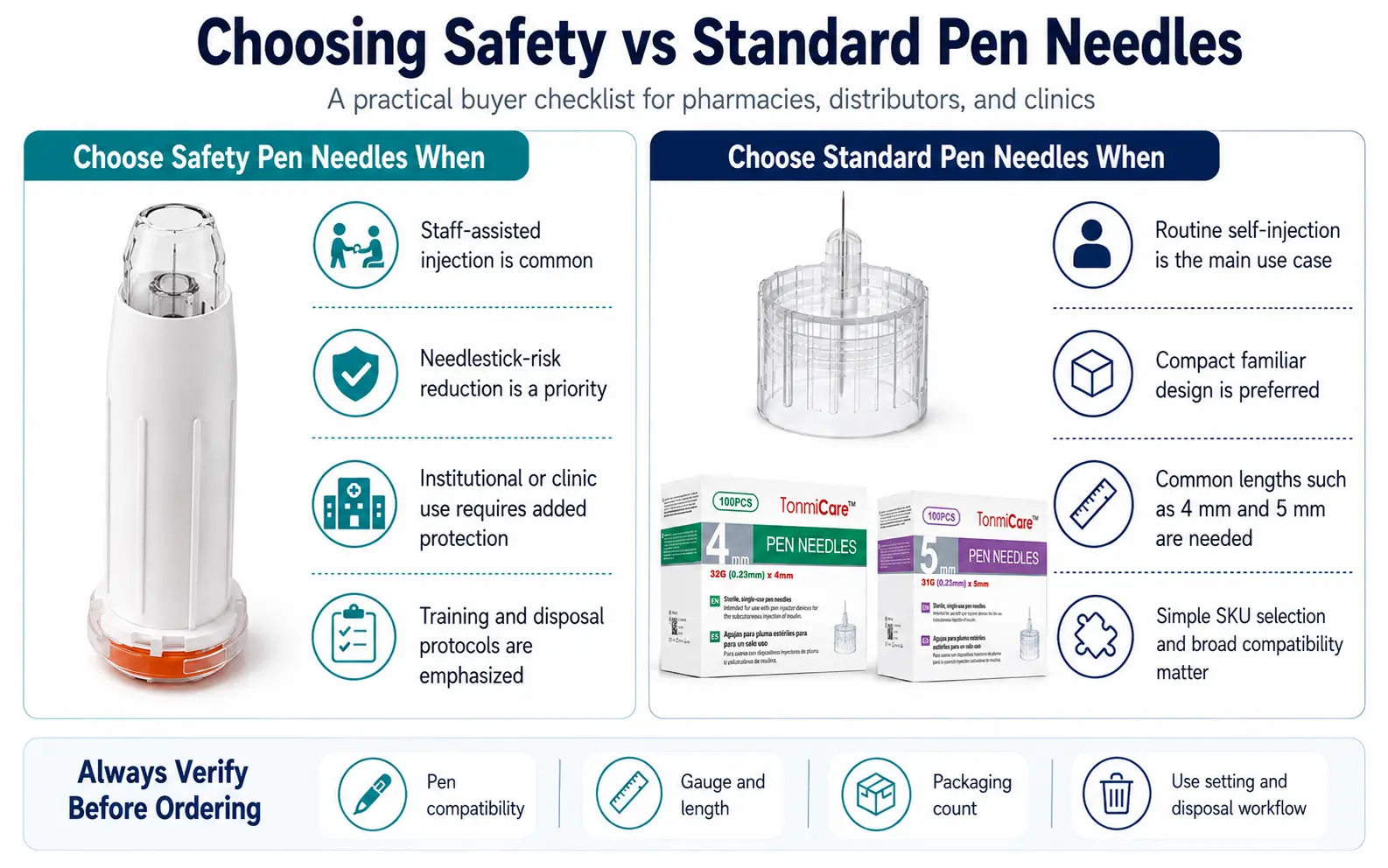
For a pharmacy that only dispenses unopened boxes, assortment, prescription demand, compatibility and price may lead the decision. When employees administer injections and may be occupationally exposed to blood, the employer’s exposure-control process should evaluate appropriate commercially available and effective safer devices. The correct SKU must still support the intended pen, medication, workflow and trained user.
A useful safety pen needles vs standard pen needles comparison therefore starts with the administration setting and exposure pathway, then moves to mechanism, compatibility, human factors, evidence, supply continuity and total use cost.
Terminology control
“Standard,” “Traditional,” “Safety” and “Protected” Are Not Exact Specifications
Standard and traditional are commonly used commercial terms for pen needles without an integrated post-use protection mechanism. Safety, safety-engineered and protected usually describe a needle with a feature intended to minimize sharps injury. These labels are useful for category search, but they do not tell a buyer how the mechanism activates, which sharp is covered, whether the feature locks, or which pen injectors were evaluated.
FDA describes a sharps injury prevention feature as an active or passive component or attachment designed to protect the user from a sharps injury. Its 2005 guidance addresses the safety feature in addition to—not instead of—the underlying medical device.[3] A buyer should therefore purchase an exact cataloged configuration, not a generic “safety needle.”
The sharp must be controlled through the labeled handling and disposal workflow.
Activation force, hand position and confirmation method are product-specific.
Buyers must still confirm when locking occurs and whether premature activation is possible.
Do not infer dual protection from the word “safety”; verify the exact design.
Buyer comparison
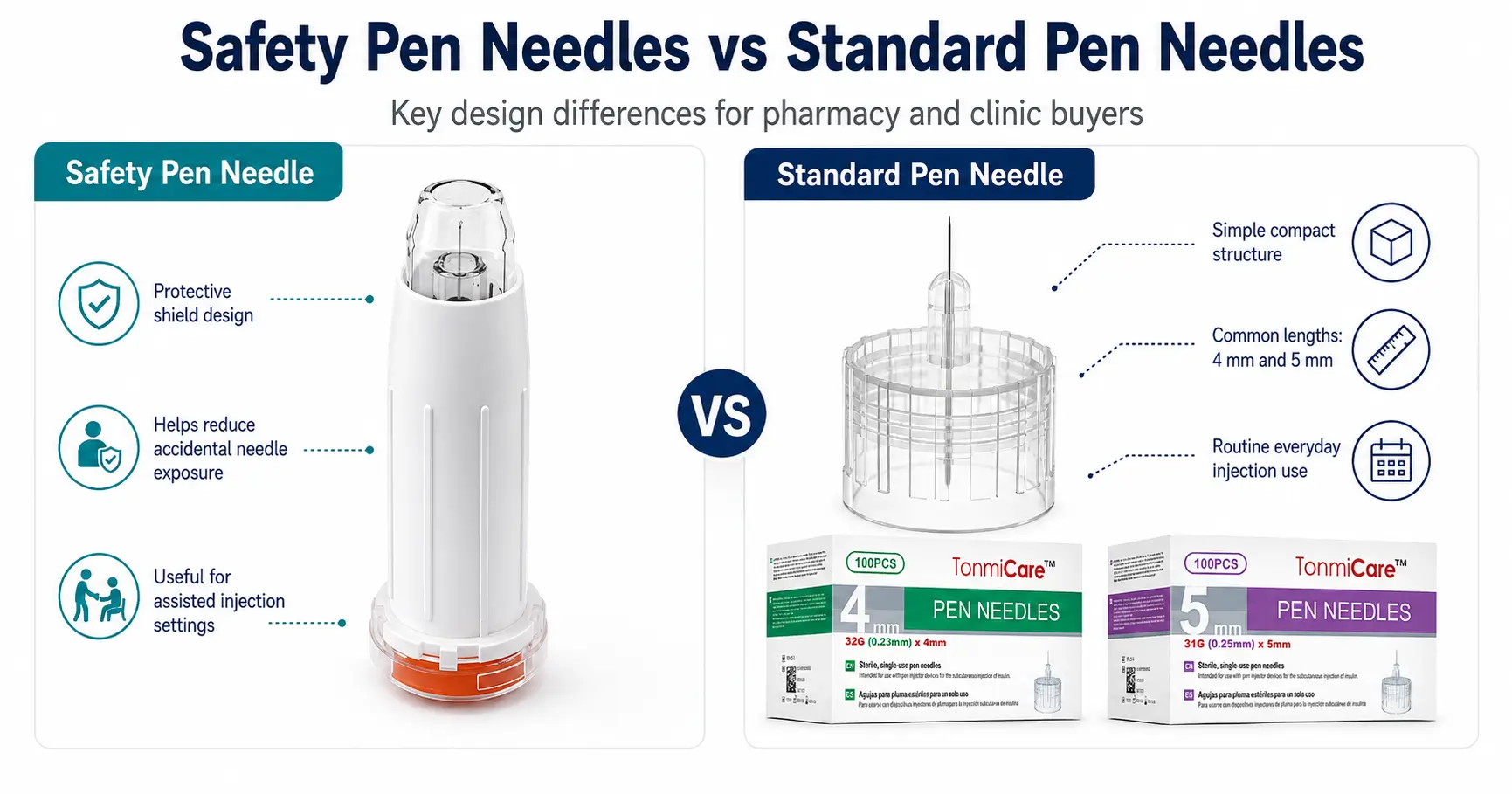
Safety Pen Needles vs Standard Pen Needles Comparison Table
| Buyer factor | Standard pen needle | Safety pen needle | Required verification |
|---|---|---|---|
| Post-use sharp | Normally remains exposed after withdrawal until controlled for disposal | Designed to cover or isolate a sharp after activation | Which end is covered and when? |
| Activation | No integrated safety activation step | May be active or passive | Force, timing, one-hand use and failure state |
| Confirmation | Not applicable to a safety mechanism | May use visual, audible or tactile feedback | Can the user determine that protection is locked? |
| Needle visibility | Often directly visible after cap removal | May be visible or partly concealed by housing | Effect on positioning and user acceptance |
| Compatibility | Product-specific despite common threaded designs | Product-specific; housing can add dimensional constraints | Exact needle REF and named pen models |
| Training | Standard connection, handling and disposal training | Add mechanism-specific activation and confirmation training | IFU, competency check and retraining trigger |
| Unit price | Usually the lower device-acquisition category | Additional mechanism generally increases acquisition cost | Compare quotations for equivalent exact SKUs |
| Total use cost | Depends on handling controls and exposure experience | Depends on price, adoption, reliability and risk reduction | Use facility data; do not assume automatic savings |
Gauge, needle length, wall design, bevel geometry and lubrication are separate specifications. A safety housing does not automatically make the needle thinner, shorter, more comfortable or clinically preferable. Buyers should compare like-for-like dimensions wherever possible.
Use-setting decision
Which Organizations Should Evaluate Safety Pen Needles?
Begin with the task, not the facility name. A community pharmacy that dispenses sealed boxes has a different exposure profile from a clinic pharmacy whose staff administers injections. A long-term care pharmacy may supply products without administering them, while nurses at the receiving facilities perform repeated injections. Procurement should identify who uses the product, who is exposed, and which organization controls selection and training.
| Setting/workflow | Primary buyer question | Practical procurement direction |
|---|---|---|
| Retail dispensing only | What specifications and coverage does the customer population require? | Build an assortment around verified demand; do not infer an occupational administration requirement. |
| Clinic-administered injections | Are employees exposed to contaminated sharps? | Include safety and employee-health personnel in device evaluation. |
| Long-term care administration | Can the mechanism perform reliably across repeated medication rounds? | Test with representative nurses, medication carts, gloves and disposal containers. |
| Home health professional use | Can one user activate and dispose of it safely in variable environments? | Assess portability, one-handed workflow and access to an appropriate sharps container. |
| Patient self-use | What does the prescription, pen labeling and qualified clinician support? | Avoid making a procurement article into an individual clinical recommendation. |
| Distributor inventory | Which buyer segments need standard, safety or both? | Separate SKUs, compatibility claims, pack data, documents and replenishment forecasts. |
Sharps map
Does the Safety Mechanism Protect the Patient End, the Pen End or Both?
A removable pen needle is double-ended: the patient end enters the injection site and the shorter inner end pierces the pen cartridge or reservoir closure. ISO 11608-2:2022 addresses single-use double-ended pen needles as a device category.[5] Safety designs may address the patient end only or add protection for both ends. The package name alone is not enough to determine coverage.
Patient-facing end
Check pre-use concealment, visibility during positioning, shielding after withdrawal, lock status and finger access.
Pen-facing end
Check whether the cartridge-piercing end remains exposed during removal and whether the product claims post-use protection.
Some commercial products advertise dual-end protection; others use a patient-end shield. Record the exact mechanism in the approved item master and training materials.
Mechanism control
Active vs Passive Safety Pen Needles
An active feature requires the user to perform an activation action. A passive feature is designed to activate during the normal use sequence. Neither label establishes performance by itself. Active designs can provide intentional control but depend on correct completion; passive designs can reduce a separate activation step but still require evaluation for premature activation, incomplete dose workflow and clear confirmation.
Active mechanism
Separate user action
- Confirm one-handed operation where intended
- Measure activation force and reach
- Check hands remain behind the sharp
- Require clear confirmation of lock
Passive mechanism
Activation through normal use
- Define the exact trigger point
- Check premature activation resistance
- Confirm protection remains after removal
- Evaluate whether the user recognizes failure
FDA recommends that activation be readily detectable, that protection remain effective through disposal and that active features be capable of single-handed activation with the user’s hands behind the exposed sharp.[3]
User acceptance
A Safety Feature Works Only When Users Can Operate and Confirm It
Procurement should not treat a technical data sheet as a substitute for workflow evaluation. FDA’s sharps-prevention guidance recommends simulated-use assessment with representative healthcare professionals and conditions such as gloved hands, dry and wet fingers, one-handed technique, activation detection, required changes in technique, time, learning curve and any observed failures.[3]
Can the device be connected without touching a hazardous area?
Does the housing support the intended positioning workflow?
Is force and motion practical for representative users?
Can users see, hear or feel successful locking?
Do users know what to do when activation is uncertain?
Does the activated device fit the available sharps container opening?
Exact-device verification
Are Safety and Standard Pen Needles Compatible with Every Insulin Pen?
Compatibility should never be assumed from gauge, length or a “universal fit” marketing phrase alone. Verify the pen needle manufacturer’s current labeling or compatibility list, the intended pen injector, the connection interface and any medication-specific restriction. Safety housings can also introduce dimensional or workflow differences not present on a basic threaded hub.
FDA’s public 510(k) summary K202319 is a useful example. It covers ordinary and safety insulin pen needle types but lists specific pen injectors used for compatibility testing rather than claiming every pen on the market.[7] The record is an example of evidence structure, not proof that an unrelated Tonmit or third-party SKU fits the same pens.
Gauge and length should be managed separately through an approved specification. Tonmit’s 4 mm vs 5 mm vs 6 mm pen needle guide explains why size comparison cannot be replaced by the safety-mechanism decision.
Performance boundary
Does a Safety Shield Affect Dose Delivery or Injection Technique?
It can change visibility, contact pressure, hand position, attachment, removal or activation steps, depending on the product. That does not mean every safety needle impairs delivery, nor does a successful safety activation prove that a complete medication dose was delivered. Buyers should review the exact instructions for use and include normal administration tasks in their controlled user evaluation.
- Separate outcomes: injection completion and sharps protection are related but distinct observations.
- Do not reuse: standard and safety pen needles are supplied as single-use products when so labeled.
- Do not share pens: a new needle does not make a multi-dose pen safe for another person.
- Follow the exact IFU: priming, injection contact, hold time, activation and disposal instructions are product- and pen-specific.
CDC states that multi-dose insulin pens are for one person only and must not be shared even when the needle is changed; a new needle is used for each injection.[6]
U.S. occupational-safety boundary
Does OSHA Require Safety Pen Needles?
OSHA does not publish a universal product list stating that every U.S. pharmacy, every injection and every pen must use one named safety pen needle. For covered employers with reasonably anticipated employee exposure to blood or other potentially infectious materials, the Bloodborne Pathogens Standard requires engineering and work-practice controls to eliminate or minimize exposure.[1][2]
The exposure-control plan must reflect relevant technology changes, document annual consideration and implementation of appropriate commercially available and effective safer medical devices, and document input from non-managerial employees responsible for direct patient care who may be exposed to contaminated sharps. OSHA-approved State Plans may have additional or more stringent requirements.[1]
Accurate statement
Evaluate through the exposure-control process
Connect device selection to actual employee exposure, effective engineering controls, employee input and applicable law.
Avoid this claim
“OSHA approves this needle”
OSHA requirements and FDA device-market status are separate questions; do not convert compliance language into a product endorsement.
Evidence hierarchy
Which FDA Records and ISO Standards Should Buyers Recognize?
| Source | What it addresses | Buyer limitation |
|---|---|---|
| FDA 510(k) record | Marketed device, indications, technological comparison and summary evidence | Match applicant, trade name, REF and current configuration; do not rely on establishment registration alone. |
| ISO 11608-2:2022 | Requirements and test methods for single-use double-ended pen needles | A standard reference does not establish fit with every injector. |
| ISO 23908:2024 | Performance and usability of sharps injury protection mechanisms | Ask which finished product and mechanism the evidence covers. |
| FDA sharps guidance | Design, testing, simulated use and labeling recommendations for safety features | Nonbinding guidance does not replace applicable statutes, regulations or product-specific review. |
| IFU and compatibility list | Product-specific connection, use, activation and disposal instructions | Check revision date and regional product version. |
FDA currently recognizes ISO 23908:2024 and provides a transition from the 2011 edition for premarket declarations of conformity through July 4, 2027.[4] Procurement should ask what evidence applies to the finished exact SKU rather than requesting “ISO certification” as an undefined checkbox.
Controlled product trial
How Should a Facility Evaluate a Safety Pen Needle Before Conversion?
Use a written, organization-approved protocol. Include representative non-managerial users from the actual workflow rather than relying only on purchasing personnel or manufacturer demonstrations. The pilot is an operational selection tool; it is not a substitute for the manufacturer’s premarket testing or a new clinical study.
- 01
Define the exposure and task
Identify who administers, how often, where the needle is attached and removed, and how used sharps reach disposal.
- 02
Lock the candidate SKUs
Record manufacturer/labeler, REF, gauge, length, protection endpoints, pack and pen compatibility.
- 03
Review evidence first
Check current labeling, U.S. market record, IFU, standards claims, sterility, shelf life and complaint contacts.
- 04
Train evaluators consistently
Use the current IFU and define what successful attachment, dose workflow, activation and disposal look like.
- 05
Observe realistic conditions
Include gloves, representative pens, medication-round constraints, dry/wet grip as relevant and the actual sharps containers.
- 06
Record all failures and near failures
Capture premature activation, uncertain lock, difficult removal, workflow interruption and user comments—not only preference scores.
- 07
Approve and monitor
Control the item master, training version, conversion date, exception process and post-rollout injury or complaint signals.
Commercial evaluation
Compare Total Use Cost, Not Only Price per Needle
Safety mechanisms generally add material and assembly complexity, so a safety SKU may carry a higher acquisition price than a dimensionally comparable standard SKU. That price difference should not be ignored, but it is not the whole economic decision. Equally, an injury-reduction claim should not be converted into guaranteed savings without facility-specific evidence.
In a commercial safety pen needles vs standard pen needles review, compare equivalent gauge, length, box quantity and annual volume before attributing a price difference to the protection mechanism.
Report assumptions separately. Use actual annual volume, staff time, waste, sharps injuries and contract data where available. Do not insert a generic dollar value for an occupational exposure into a public procurement claim.
Supply-chain fit
Packaging, Case Pack, Shelf Life and Replenishment Still Matter
A technically acceptable mechanism can fail commercially if its packaging does not fit the buyer’s workflow or replenishment plan. Safety housings may create a different individual-pack or carton footprint from standard needles. Confirm the actual saleable unit and do not assume that two products with “100 count” have identical case dimensions, case quantity or order multiple.
| Field | Buyer question | Evidence |
|---|---|---|
| Individual package | Is each device sterile and individually sealed? | Label, IFU and approved packaging specification |
| Box quantity | How many individually packaged needles are in a box? | Exact-SKU box label |
| Case pack | How many boxes are in one case, and can the case be broken? | Quotation, case label and packing list |
| Shelf life | What expiration and minimum remaining life apply at receipt? | Lot-specific label and manufacturer documentation |
| Fulfillment | What stock location, lead time and backorder control apply? | Current written supply terms |
| Substitution | Can a standard SKU be replaced by a safety SKU—or vice versa? | Authorized formulary and exact-SKU approval process |
Tonmit’s wholesale insulin pen needle buying guide provides a broader framework for gauge, length, packaging, compatibility, MOQ and supply planning.
Assortment planning
Should a Pharmacy or Distributor Stock Both Types?
Often the most practical answer is a controlled two-segment assortment rather than an all-or-nothing conversion. Standard pen needles may serve retail or self-administration demand, while approved safety configurations support professional administration accounts. The correct mix depends on prescription demand, contracts, reimbursement, customer type and local policy.
Core standard range
Demand-led retail assortment
Use a limited gauge × length matrix, verified compatibility and predictable replenishment.
Controlled safety range
Institutional exact-SKU program
Do not substitute mechanisms without the customer’s occupational and clinical approval.
Special order
Low-volume or contract-specific SKUs
Confirm MOQ, case pack, shelf life and lead time before promising availability.
Buyers reviewing conventional configurations can start with Tonmit’s standard insulin pen needles page. Product availability and documentation must be confirmed against the selected reference.
Supplier qualification
Documents Healthcare Buyers Should Request
A registration or database listing is not a product approval certificate, and a general quality certificate does not establish the safety mechanism of an exact SKU. Tonmit’s medical device documentation support page explains how buyer, product and market must be matched during review.
Tonmit buyer control
Exact-SKU Safety Pen Needle Evaluation Record
Use this blank review record to document a specific safety pen needle SKU. It is a procurement control template, not a clinical study, laboratory validation report or regulatory certification.
PRODUCT IDENTITY
Manufacturer / labeler: ______
Product name and REF: ______
Gauge × length: ______
Safety mechanism: Active / Passive / Other ______
Protected end(s): Patient / Pen / Both ______
EVIDENCE REVIEWED
□ IFU and compatibility evidence
□ Activation and confirmation description
□ Protection mechanism evidence
□ Packaging and traceability records
□ User evaluation requirements
DECISION
Status: Approved / Conditional Review / Not Approved
Reviewer: ______
Date: ______
Evidence reference: ______
Copyable procurement tool
Safety or Standard Pen Needle RFQ Checklist
USE SETTING
Facility/customer type: ______
Dispensed for self-use or administered by staff: ______
Estimated injections/needles per month: ______
Occupational-safety or formulary requirements: ______
PRODUCT CONFIGURATION
Standard / safety pen needle: ______
Gauge × length: ______
Safety activation: active / passive / not applicable
Protected end(s): patient / pen / both / not applicable
Activation confirmation: visual / audible / tactile / other: ______
COMPATIBILITY AND EVIDENCE
Pen brand and exact model: ______
Medication/device restrictions: ______
Required U.S. product records: ______
Required IFU, standards or testing evidence: ______
User-evaluation samples required: Yes / No
COMMERCIAL AND SUPPLY
Box quantity: ______ Boxes per case: ______
Annual volume and initial order: ______
Minimum remaining shelf life at receipt: ______
Destination and required delivery date: ______
U.S. warehouse / factory supply / either: ______
OEM or private-label requirement: ______
For domestic programs, review current inventory and exact-SKU availability through Tonmit’s U.S. medical supply fulfillment support. Stock location and delivery timing should be confirmed in writing for each order.
Buyer FAQ
Frequently Asked Questions About Safety and Standard Pen Needles
Do safety pen needles completely prevent needlestick injuries?
No. They are designed to reduce accidental sharps injury when the exact mechanism is used and functions as intended. No device removes the need for training, correct handling, immediate disposal, exposure reporting and investigation of failures.
Does OSHA require every healthcare facility to buy safety pen needles?
No universal statement should be made. Covered employers with occupational blood exposure must follow the Bloodborne Pathogens Standard, use engineering and work-practice controls, consider appropriate safer devices annually and obtain required employee input. The applicable result depends on the exposure assessment, effective available technology, state requirements and facility process.
Do all safety pen needles protect both ends?
No. Designs vary. Some address the patient-facing needle while others also protect the pen-facing end. Verify the exact REF, labeling and protection sequence.
Is a passive safety mechanism always better than an active mechanism?
No universal ranking is valid. Evaluate mechanism reliability, premature activation, confirmation, hand position, workflow, user acceptance and disposal for the actual setting.
Are safety pen needles compatible with all insulin pens?
Compatibility should not be assumed. Check the exact needle manufacturer’s current compatibility evidence and the intended pen injector labeling before approval.
Are safety pen needles more painful than standard pen needles?
The safety category alone does not determine pain or clinical suitability. Gauge, length, point geometry, lubrication, injection technique and individual factors are separate variables. Patient-specific questions belong with a qualified clinician.
Can safety or standard pen needles be reused?
Use each product according to its labeling. Pen needles described in this guide are sterile single-use devices; a safety shield is not a reuse mechanism.
Can an insulin pen be shared if a new safety needle is attached?
No. CDC states that a multi-dose insulin pen is for one person only and must not be used for another person even when the needle is changed.
Should a pharmacy stock both standard and safety pen needles?
It may be appropriate when the pharmacy serves both retail/self-use and institutionally administered workflows. Control each exact SKU, customer requirement and compatibility claim separately.
What is the most important purchasing question?
Ask who will administer with which pen, in what setting, under what occupational-safety controls. That answer determines which mechanism, evidence, training and supply model require evaluation.
Procurement conclusion
Choose the Workflow First, Then Approve the Exact Pen Needle
Standard and safety pen needles solve different procurement problems. Standard needles can support broad dispensing demand and simpler unit economics; safety needles add a mechanism intended to minimize sharps exposure in appropriate workflows. Neither category should be approved by name alone. Define the use setting, map both sharp ends, verify activation and compatibility, involve representative users, review exact-SKU evidence, model total cost and control the rollout through the item master and training system.
Source basis
Official and Primary Sources Used for This Guide
- OSHA — Bloodborne Pathogens and Needlestick Prevention Standards
- eCFR — 29 CFR 1910.1030, Bloodborne Pathogens
- FDA — Medical Devices with Sharps Injury Prevention Features
- FDA — Recognized Consensus Standard ISO 23908:2024
- FDA — Recognized Consensus Standard ISO 11608-2:2022
- CDC — Insulin Pens Must Never Be Used for More Than One Person
- FDA 510(k) K202319 — Public ordinary and safety pen needle example
- ISO — ISO 23908:2024 overview
Sources and links were reviewed on August 22, 2026. Regulations, recognized standards, product labeling, compatibility lists and commercial configurations can change. Verify the current exact-SKU evidence and applicable requirements before a future purchasing or use decision.
Exact-SKU pen needle procurement support
Compare the Product, Mechanism and Supply Plan
Share the use setting, intended pen models, gauge × length, safety-mechanism requirements, packaging, annual demand, destination and documentation needs. Tonmit can review available configurations and supply options without treating one mechanism as universally interchangeable.