
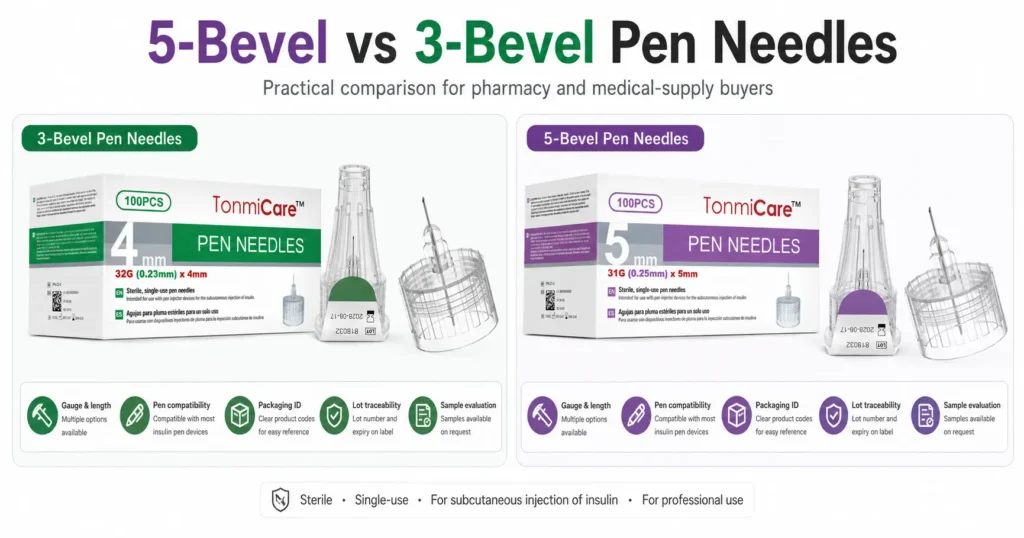
Pen Needle Tip Design & Procurement Evidence Guide
An evidence-bounded comparison of 5-bevel vs 3-bevel pen needles for pharmacies, clinics and medical distributors—covering tip geometry, penetration, drag and extraction forces, pain-study limitations, exact-SKU verification, compatibility, documentation and supply planning.
Scope: This guide supports professional procurement, supplier qualification and formulary review. It does not select a pen needle for an individual, prescribe injection technique, guarantee a comfort outcome, or establish that every 5-bevel product outperforms every 3-bevel product. Current product labeling, the exact marketed SKU, applicable regulatory records, compatibility evidence, qualified clinical judgment and organizational policy control the final purchasing and use decision.
Direct answer
Are 5-Bevel Pen Needles Better Than 3-Bevel Pen Needles?
Not as a universal category rule. A well-designed 5-bevel tip can distribute cutting surfaces differently from a conventional 3-bevel tip, and particular tested 5-bevel products have produced lower penetration force, lower sliding or extraction force, or lower insertion–extraction energy. Those results apply to the tested geometry, gauge, length, manufacturing process, lots, substrate and protocol—not automatically to every product marketed as “5-bevel.”
The most relevant human study found no significant difference in pain, comfort, insertion ease or preference when people with diabetes compared matched 3-bevel and 5-bevel pen needles while blinded to the tip design. More favorable 5-bevel ratings appeared after short home use and in informed comparisons, but those phases were not fully blinded and the study was funded and authored by the manufacturer.[1]
For healthcare buyers, the defensible conclusion is therefore conditional: use bevel count as one design field, then verify exact-SKU force data, lot consistency, gauge, length, wall and lubrication, compatibility, labeling, market status, packaging and supply terms before approving a product.
Terminology control
What Do “3-Bevel” and “5-Bevel” Actually Describe?
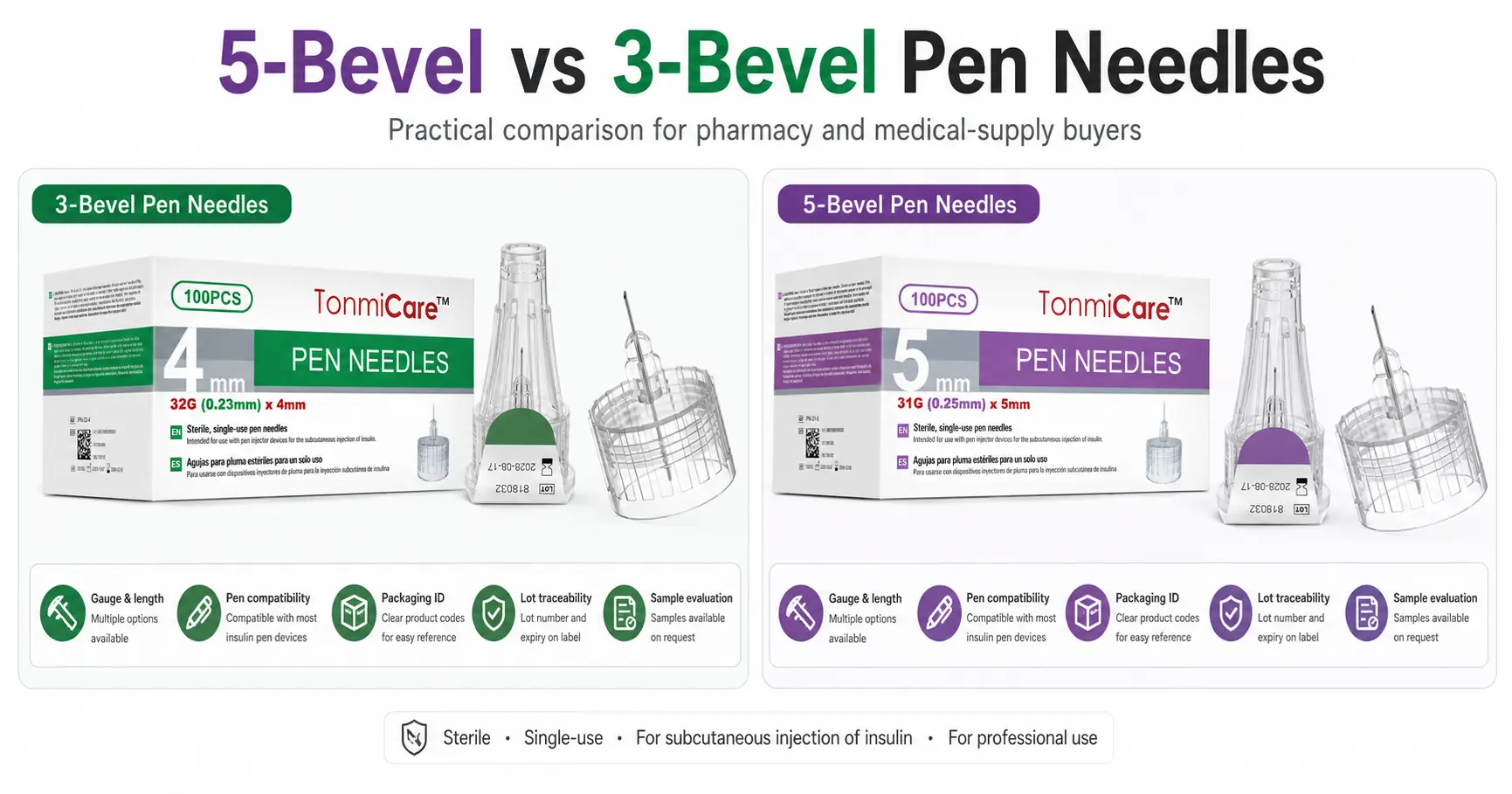
Bevel count describes the number of ground facets used to form a needle point. A conventional 3-bevel design commonly uses one primary face and two secondary faces. A 5-bevel design adds facets to create a different point profile. The label does not disclose the primary and secondary angles, point length, facet symmetry, edge finish, burr control, lumen opening, coating or dimensional tolerances. Those engineering details can change the measured performance of two tips carrying the same bevel-count description.
Can be manufactured to different angles, lengths, finishes and quality levels.
May refine a specific point geometry but does not define one universal design.
Should be supported by a defined force test—not inferred from a marketing label.
Cannot be established by microscopic appearance or bevel count alone.
Request the exact product reference and supporting evidence. Two “5-bevel” needles can use different facet geometry, manufacturing controls and test methods.
Buyer comparison
5-Bevel vs 3-Bevel Pen Needles Comparison Table
| Buyer factor | 5-bevel | 3-bevel | Defensible conclusion |
|---|---|---|---|
| Tip geometry | Five ground facets in the specified design | Three ground facets in the specified design | Count does not reveal angles, finish or tolerances |
| Peak penetration force | Lower in one 2012 test program; not significantly different in a 2023 test | Comparator performance varied by product and method | Request exact-SKU results and protocol |
| Drag and extraction | Lower for the two variants tested in the 2023 laboratory study | Higher in that particular latex-substrate comparison | Evidence is bench-based and design-specific |
| Perceived pain | No advantage detected during blinded paired insertions in the 2012 study | Similar blinded pain ratings in that study | Do not promise less pain from bevel count alone |
| Flow or thumb force | Not established by facet count | Not established by facet count | Evaluate inner diameter, wall design, pen and fluid separately |
| Compatibility | Product- and pen-model-specific | Product- and pen-model-specific | Verify the exact needle REF and intended pen |
| Regulatory identity | Requires exact-device review | Requires exact-device review | Bevel count is not clearance, approval or listing evidence |
| Commercial value | May support differentiation when evidence and demand justify it | May remain an appropriate controlled core SKU | Compare landed and operational cost, not feature label alone |
Evidence hierarchy
What Evidence Is Strong Enough for a Purchasing Claim?
Evidence should be matched to the claim. A product photograph can show that a manufacturer markets a 5-bevel tip, but it cannot establish penetration force. A force curve can compare a defined test, but it cannot independently prove lower patient pain. A preference study can describe the enrolled population and protocol, but it does not establish equivalence across untested brands or SKUs.
Use the evidence for
The outcome it directly measured
Geometry for geometry, peak force for peak force, compatibility for a named pen, and human ratings for the tested users and conditions.
Do not extend it to
Untested claims or products
Do not convert an artificial-substrate result into “painless,” or a branded study into proof for every supplier’s 5-bevel range.
Human evidence review
What the 2012 3-Bevel and 5-Bevel Pen Needle Study Found
The 2012 study evaluated a modified 5-bevel point against marketed 3-bevel pen needles. Laboratory testing covered matched fine-gauge configurations, while the clinical study enrolled adults with diabetes using insulin pens. Eighty-six participants completed all three study parts. The first visit used randomized paired dry insertions with no insulin cartridge and participants blinded to the tip geometry.[1]
| Study phase | Reported result | Buyer interpretation |
|---|---|---|
| Laboratory force | Mean penetration force was reported 23% lower for the tested 5-bevel designs than similar-sized 3-bevel comparators | Useful for those designs and protocol; not a category guarantee |
| Blinded paired insertions | 5-bevel and 3-bevel acceptability was 92.5% and 93.7%; no significant difference in ease, comfort, preference or pain | The most controlled human comparison did not detect a comfort advantage |
| Short home use | Participants used the 5-bevel product for at least five injections over 1–7 days and rated it more favorably than their usual needle | Actual injections were included, but comparison to the usual needle was not blinded |
| Informed comparison | After participants were told about the geometry and lower laboratory force, ratings favored the 5-bevel product | Expectation and disclosure can influence subjective outcomes |
| Funding | The work was funded by BD and all authors were BD employees | Disclose the relationship and avoid extending the result to unrelated products |
The study itself states that benefits such as reduced tissue trauma remained speculative and that better acceptance of self-injection would require additional study. A rigorous buyer article should preserve those limitations rather than quoting only the 23% laboratory result.
Bench evidence review
What the 2023 Force and Energy Study Added
A 2023 engineering study compared 3-bevel and 5-bevel 31G × 5 mm and 32G × 4 mm pen needles. Testing used a 1 mm natural-latex substrate at a controlled 100 mm/minute insertion and extraction speed. For each needle type, 50 measurements were taken from samples randomly drawn from three lots. The procedure was based mainly on indications in Annex D of ISO 7864.[2]
What differed
Sliding, extraction and cycle energy
- Drag force was lower for the 5-bevel samples in both tested sizes.
- Extraction force was lower for both 5-bevel variants.
- Reported cycle energy was lower by approximately 29% for 31G × 5 mm and 11% for 32G × 4 mm.
What did not differ
Peak penetration force
- The peak penetration-force difference was not statistically significant for either tested size.
- The substrate was artificial, not living human tissue.
- No participants rated pain or comfort.
The paper treats energy as a possible proxy for pain, but also states that clinical validation is needed. The correct purchasing statement is therefore “lower measured force or energy under this protocol,” not “proven to cause less pain.”
Metric control
Peak Penetration, Drag, Extraction and Energy Are Different Metrics
A single highest value during entry; it may be sensitive to point geometry and test variability.
Influenced by shaft contact, coating, substrate friction and the path used for averaging.
Measured after insertion; it is not interchangeable with the entry peak.
Combines more of the insertion–extraction process but remains a laboratory measure.
A product can show similar peak force but different average sliding resistance.
Requires a human protocol and cannot be back-calculated from one force value.
Clinical claim boundary
Why Lower Penetration Force Does Not Automatically Mean Less Pain
Injection-site pain is multidimensional. Published reviews identify contributors including needle diameter and length, injection volume, formulation properties, temperature, injection speed, site, technique and individual sensitivity.[3] For a pen needle, lubrication, point finish and anticipation can also affect experience. A force test removes many of those variables so that one mechanical outcome can be measured; a real injection reintroduces them.
- Use “may” or “was associated with” when connecting bench mechanics to possible comfort.
- Name the tested size and protocol when quoting a percentage difference.
- State whether participants were blinded before presenting pain or preference results.
- Separate dry insertion from medication injection because they are not the same experience.
- Do not use “painless” unless an authorized exact-product claim supports that wording—which should not be assumed.
Confounding controls
Variables That Can Matter as Much as Bevel Count
Buyers comparing diameter should use the separate 31G vs 32G pen needles guide. For length-related assortment decisions, review 4mm vs 5mm vs 6mm pen needles. Do not allow a change in gauge or length to be hidden inside a bevel-design comparison.
Apples-to-apples review
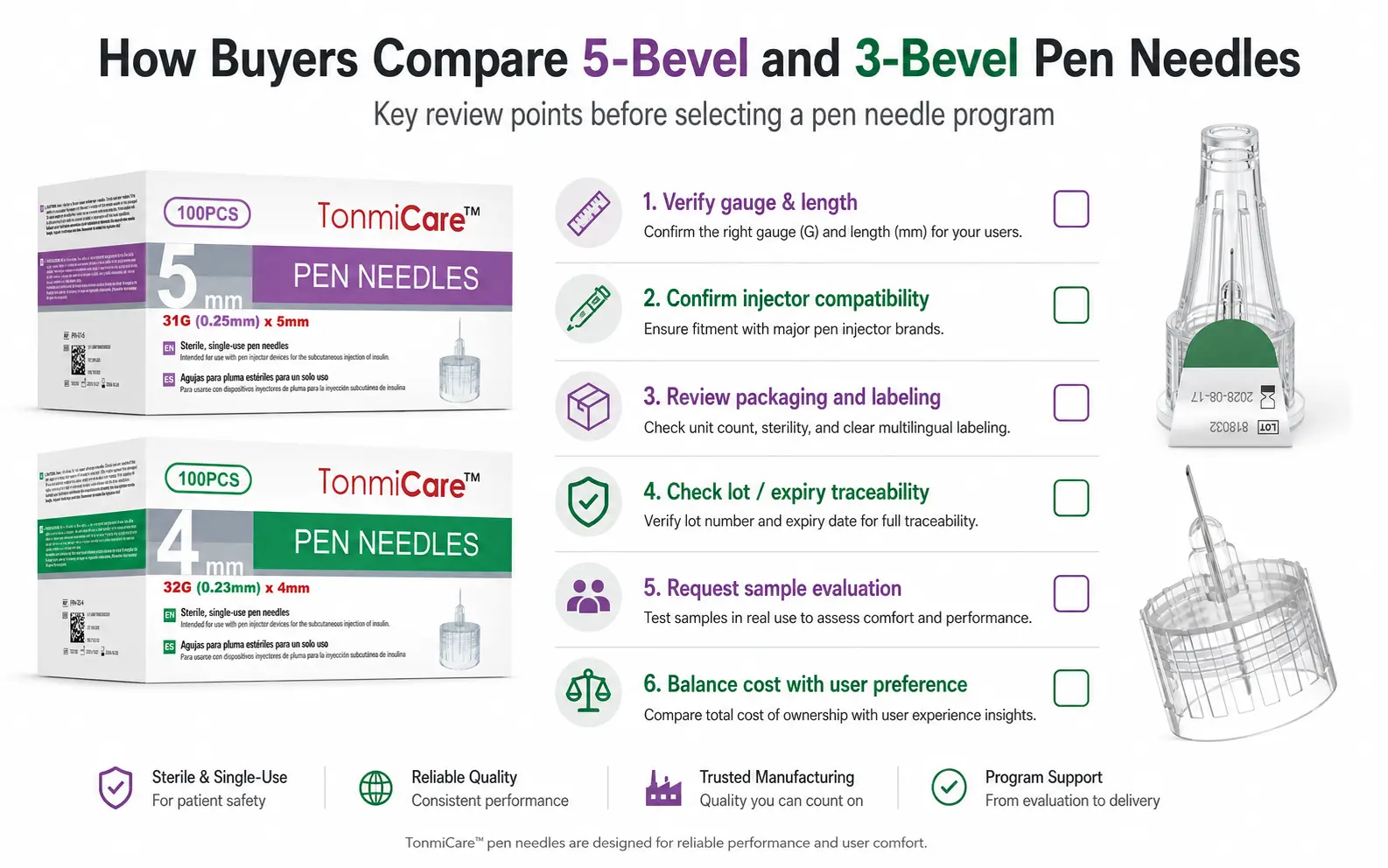
How to Compare 5-Bevel and 3-Bevel Exact SKUs Fairly
A fair comparison changes the bevel design while holding other important variables as constant as practical. If a 32G × 4 mm 5-bevel needle is compared with a 31G × 8 mm 3-bevel needle, any difference can reflect diameter, length, construction or test condition—not only tip facets.
| Control field | What to match or disclose | Why it matters |
|---|---|---|
| Product identity | Manufacturer, brand, REF and production site | Prevents evidence from one product being assigned to another |
| Cannula size | Gauge, outside diameter, length and wall design | Diameter and shaft contact can influence force |
| Point construction | Facet geometry, finish, polishing and coating | Bevel count alone is incomplete |
| Samples | Number tested, lot count, selection method and exclusions | Shows whether results reflect one lot or repeat production |
| Substrate | Material, thickness, hardness, tension and replacement frequency | Different media can produce different absolute forces |
| Machine settings | Insertion angle, speed, depth, load cell and conditioning | Makes force curves comparable and reproducible |
| Analysis | Peak, mean path, energy calculation, variability and statistics | Prevents unlike metrics from being presented as the same result |
| Human protocol | Blinding, randomization, comparator, injection or dry insertion and population | Defines what a comfort or preference conclusion can support |
Separate product claims
Bevel Count Does Not Establish Pen Compatibility, Flow or Dose Delivery
The patient-end tip geometry does not by itself establish the performance of the pen-facing end, threaded hub, cartridge-septum interface or fluid path. Two products with the same bevel count, gauge and length can still use different hubs, inner diameters, labeling and compatibility evidence. Physical attachment alone is not a complete compatibility assessment.
Patient-facing evidence
Point geometry, penetration, sliding, extraction, coating and human-use evidence relate primarily to the tissue-facing end.
Pen-facing evidence
Hub interface, cartridge-end needle, flow path and compatibility must be verified against the intended pen and exact REF.
Use Tonmit’s insulin pen needle sizes and compatibility guide to build the full specification. Claims about faster flow or lower thumb force require separate evidence for wall design, internal diameter, fluid, dose and injection device; they should not be attributed to five facets without supporting data.
Regulatory boundary
What ISO and FDA Records Can—and Cannot—Confirm
ISO 11608-2:2022 specifies requirements and test methods for single-use, double-ended, sterile pen needles intended for certain needle-based injection systems. FDA lists the complete standard as a recognized consensus standard.[4] Recognition can support an applicable submission or technical evaluation, but the standard does not declare that five bevels are clinically superior to three.
ISO 7864:2016 covers sterile single-use hypodermic needles and explicitly excludes devices covered by their own standard, including pen needles. The 2023 study used indications from its penetration-force annex as a laboratory method reference; that does not convert ISO 7864 into the governing pen-needle product standard.[5]
Appropriate statement
Evidence mapped to the exact device
Identify the legal manufacturer, model/REF, applicable U.S. pathway, current label, standards used and scope of each test.
Inappropriate shortcut
“FDA registered” or “ISO means approved”
FDA states that registration and listing do not denote approval, clearance or authorization and that FDA does not issue device registration certificates.[6]
Production consistency
Why Lot-to-Lot Control Matters More Than a Prototype Image
A polished micrograph can show one needle point. Procurement needs evidence that commercial lots repeatedly meet the controlled specification. Grinding-wheel condition, fixture alignment, cannula variation, cleaning, polishing, lubrication, assembly and package protection can affect the finished point and measured force. A supplier should be able to explain how the relevant characteristics are controlled and released without exposing proprietary process details.
- 01
Approve the drawing and specification
Record the exact REF, gauge, length, bevel designation, wall design and applicable dimensional requirements.
- 02
Review the test plan
Confirm method, sample size, acceptance criteria, equipment and how results are linked to commercial production.
- 03
Look beyond one lot
Ask whether development and verification included multiple lots and how routine variation is monitored.
- 04
Inspect package protection
Verify that the sterile package and shields protect the point through shipment, storage and opening.
- 05
Control future changes
Require notice for material, geometry, site, coating, sterilization, packaging, label or compatibility changes.
Supplier claim review
Marketing Claims Buyers Should Challenge
| Claim | Why it is incomplete | Buyer follow-up |
|---|---|---|
| “Always sharper” | Sharpness depends on the exact geometry, finish, coating and test method | Request matched force data and variability |
| “23% less force” | The published figure belongs to specific tested products and conditions | Ask whether the quoted REF was tested under that protocol |
| “Less painful” | Blinded human testing did not detect a bevel-based pain difference in the key 2012 study | Request exact-product human evidence and authorized wording |
| “Painless” | No needle category can guarantee an individual sensory outcome | Reject or require substantiation and regulatory review |
| “Faster flow” | Flow depends on inner diameter, wall, fluid and pen system—not facet count alone | Request dose-delivery or flow evidence for the full configuration |
| “Universal fit” | Bevel design does not establish hub and pen compatibility | Obtain a current exact-SKU compatibility statement |
| “FDA certified” | FDA does not certify medical devices or issue registration certificates | Map the exact device to applicable public records and labeling |
Assortment planning
Should a Pharmacy or Distributor Stock Both Bevel Types?
Stocking does not need to become a binary conversion. A pharmacy or distributor can maintain a controlled standard range for established demand and add a verified 5-bevel line where customer requests, differentiation, contract requirements and evidence justify a separate SKU. Avoid treating bevel type as an authorized substitute for a different gauge, length, pen compatibility or prescribed item.
Core range
Demand-led standard SKUs
Use transaction history, approved specifications and predictable replenishment to minimize fragmentation.
Differentiated range
Evidence-supported 5-bevel SKUs
Keep claims, pricing, documentation and compatibility attached to the exact item.
Special order
Low-volume or project SKUs
Define MOQ, case pack, shelf life, lead time and return status before quoting customers.
Review Tonmit’s current Plus 5-bevel insulin pen needles and standard insulin pen needles as separate product paths. Listed sizes, documentation, regulatory mapping, packaging and availability must be confirmed for the selected reference.
Supplier qualification
Documents Healthcare Buyers Should Request
Tonmit’s medical device documentation support page explains how supplier, exact product and destination market should be matched. A general certificate or establishment record does not replace device-level evidence.
Tonmit buyer control
Exact-SKU Pen Needle Evaluation Record
Use this blank review record to document the evidence reviewed for a specific pen needle SKU. It is a procurement control template, not a Tonmit clinical study, laboratory validation report or performance certification.
PRODUCT IDENTITY
Manufacturer / labeler: ______
Product name and REF: ______
Gauge × length: ______
Bevel design: 3-bevel / 5-bevel / other ______
EVIDENCE REVIEWED
□ Drawing / geometry description
□ Bench test method and results
□ Lot information
□ Compatibility documentation
□ Packaging and traceability records
DECISION
Status: Approved / Conditional Review / Not Approved
Reviewer: ______
Date: ______
Evidence reference: ______
Copyable procurement tool
5-Bevel vs 3-Bevel Pen Needle RFQ Checklist
Copy this checklist for supplier review or adapt it into your internal purchasing workflow.
PRODUCT IDENTITY
Legal manufacturer and manufacturing site: ______
Brand / labeler: ______
Product name and REF: ______
Intended U.S. market record or pathway: ______
CONTROLLED SPECIFICATION
Bevel design: 3-bevel / 5-bevel / other: ______
Gauge and outside diameter: ______
Patient-end needle length: ______
Wall design and inner diameter: ______
Lubrication/coating description: ______
PERFORMANCE EVIDENCE
Bench test method and substrate: ______
Penetration / drag / extraction / energy metrics: ______
Sample size and number of lots: ______
Variability and acceptance criteria: ______
Human study available for this exact SKU: Yes / No
COMPATIBILITY AND PACKAGING
Intended pen brands and exact models: ______
Compatibility document revision: ______
Individual sterile package: ______
Pieces per box / boxes per case: ______
Labeled shelf life / remaining shelf life: ______
COMMERCIAL AND SUPPLY
Initial order and annual volume: ______
MOQ and lead time: ______
U.S. warehouse / factory supply / either: ______
Destination and required delivery date: ______
OEM or private-label requirement: ______
Change-notification requirement: ______
Use the wholesale insulin pen needle buying guide to combine this tip-design review with case packs, shelf life, supplier onboarding and replenishment planning.
Buyer FAQ
Frequently Asked Questions About 5-Bevel and 3-Bevel Pen Needles
Are 5-bevel pen needles always sharper than 3-bevel pen needles?
No. Additional facets allow a different point geometry, but sharpness depends on the complete design, grinding quality, finish, coating, tolerances and test method. Compare exact products under matched conditions.
Do 5-bevel pen needles hurt less?
That should not be stated as a universal fact. The 2012 blinded paired-insertion phase found no significant difference in pain, comfort, insertion ease or preference. Later non-blinded phases favored the tested 5-bevel product, so the complete evidence and its limitations should be disclosed.
Does the published 23% lower penetration force apply to every 5-bevel needle?
No. It was the mean result from a specific manufacturer-funded laboratory program involving defined 5-bevel designs and comparators. A supplier should provide evidence for the exact SKU being quoted.
Why did the 2023 study find no significant peak-force difference?
It used a different design set, latex substrate, protocol and analysis. It found lower drag, extraction force and cycle energy for the tested 5-bevel samples, while peak penetration force remained statistically similar. This illustrates why buyers must compare methods and metrics.
Can bench energy be used as proof of less patient pain?
No. It can be presented as a mechanical result and a possible pain-related proxy, but the 2023 study did not include people and explicitly called for clinical validation.
Does bevel count affect insulin flow?
Not by itself. Flow and thumb force depend on the internal fluid path, wall design, inner diameter, medication, dose and pen injector. Require separate exact-product evidence.
Are 5-bevel needles compatible with more pen injectors?
No such conclusion follows from the tip. Compatibility depends on the complete needle, hub, cartridge-end interface, current labeling and the intended pen model.
Does ISO 11608-2 require five bevels?
No. ISO 11608-2:2022 provides requirements and test methods for the covered double-ended pen-needle category; it does not rank five facets above three.
Can a pharmacy substitute a 5-bevel SKU for a 3-bevel SKU?
Not solely because the gauge and length appear similar. Follow applicable prescribing, dispensing, labeling, formulary and legal requirements, and verify the exact product identity, compatibility and approved substitution process.
Should a distributor stock both designs?
It can be commercially sensible when there is documented demand for both a controlled standard range and a differentiated 5-bevel range. Keep each REF, claim set, compatibility statement, packaging hierarchy and replenishment forecast separate.
What is the most important supplier question?
Ask whether the evidence being presented was generated on the exact commercial REF being quoted, using which method, how many samples and lots, and what claim the result is intended to support.
Procurement conclusion
Use Bevel Count as a Design Field, Not a Purchasing Verdict
Five facets can be part of a lower-force pen-needle design, but the label alone does not establish sharpness, pain reduction, compatibility, flow, sterility, market status or supply quality. Approve the exact SKU by matching its dimensions and construction, reviewing the force method and measured outcome, separating bench data from human evidence, checking multiple-lot consistency, confirming the intended pen and current documents, and comparing commercial terms without allowing unapproved substitution.
Source basis
Official and Primary Sources Used for This Guide
- Hirsch et al. — Impact of a Modified Needle Tip Geometry on Penetration Force, Acceptability, Preference and Perceived Pain
- Ponsiglione et al. — Impact of the Number of Needle Tip Bevels on Forces and Energy in Insulin Pen Injections
- Usach et al. — Factors Influencing Pain Sensation at the Subcutaneous Injection Site
- FDA — Recognized Consensus Standard ISO 11608-2:2022 for Double-Ended Pen Needles
- FDA — Recognized Consensus Standard ISO 7864:2016 and Scope
- FDA — Important Reminders About Medical Device Registration and Listing
Sources and links were reviewed on August 22, 2026. Published studies address particular devices, populations, test materials and protocols. Product portfolios, labels, standards, regulatory records and commercial availability can change. Verify current exact-SKU evidence before a future purchasing decision.
Exact-SKU pen needle procurement support
Compare the Evidence Before Comparing the Price
Share the required bevel design, gauge × length, intended pen models, annual volume, packaging, destination and document list. Tonmit can review available configurations and supply paths without treating a design label as proof of universal equivalence or superiority.