
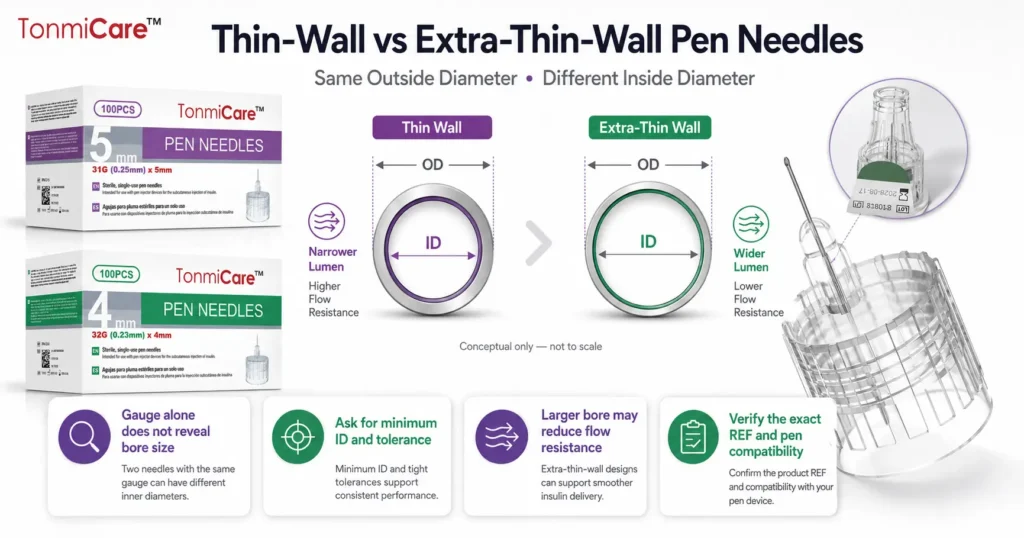
Pen Needle Flow Evidence & Procurement Specification Guide
At the same gauge, an extra-thin-wall pen needle can have a larger inner diameter and lower flow resistance. Buyers should compare the exact REF, minimum bore, compatible pen and test method before accepting a faster-flow claim.
Scope: This guide supports professional product comparison and procurement. Wall labels and published test results do not establish performance for every REF or select a needle for an individual. Confirm the current label, exact-SKU specifications, compatible pen, test conditions and applicable policy before purchase or use.
Direct answer
Thin-Wall vs Extra-Thin-Wall: What Should Buyers Compare?
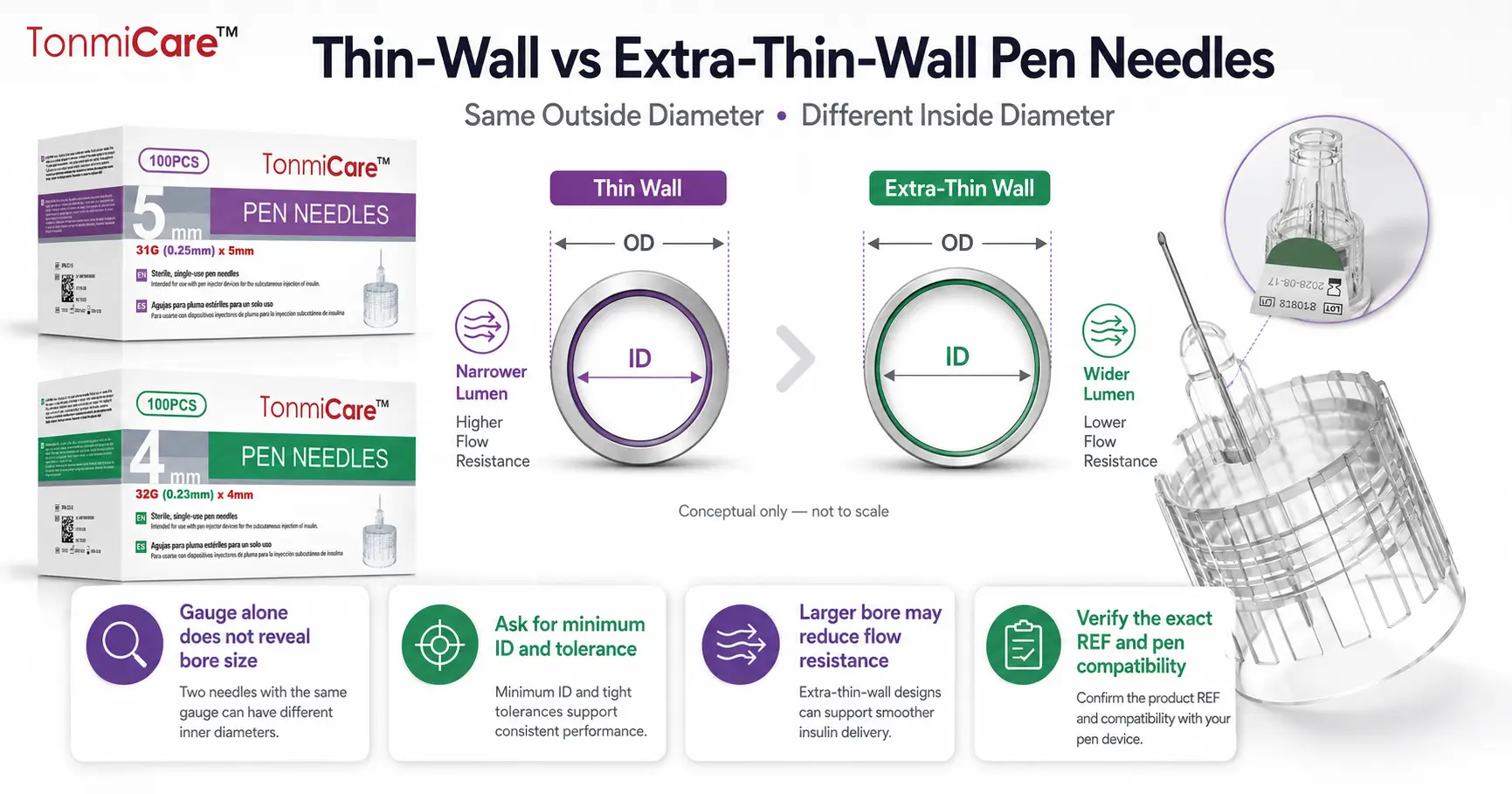
At a matched gauge and outside diameter, extra-thin-wall construction can create a larger inner bore. That may lower the force needed at a fixed flow, or increase flow at a fixed force. The result depends on the finished needle, pen, fluid, dose and test protocol.
For an RFQ, ask for the exact commercial REF, actual outside diameter, minimum inside diameter, compatible pen models and a flow or force report with stated conditions. A 2013 study supports specific tested designs, but also changed tip geometry; it does not prove every extra-thin-wall needle is faster or establish dose accuracy.[1]
Terminology control
What Thin-Wall and Extra-Thin-Wall Actually Describe
Wall class describes the relationship between a cannula’s outside diameter and inside diameter. When the outside diameter is held constant, removing material from the tube wall creates a larger internal pathway. The description is meaningful only when tied to a defined gauge or metric size, dimensional table, controlled drawing and tolerance.
It does not independently state the bore, wall thickness, length or compatibility.
Compare the exact nominal value and tolerance rather than relying on gauge alone.
Minimum ID or an ID range is more direct than a wall label when flow is important.
Thin-wall, extra-thin-wall and ultra-thin terminology must be mapped to controlled dimensions.
A supplier’s “Extra-Thin” and another supplier’s “Ultra-Thin” cannot be assumed equivalent until gauge, OD, minimum ID, tolerances and finished-device performance are reconciled.
Buyer comparison
Thin-Wall vs Extra-Thin-Wall Pen Needle Comparison Table
| Buyer factor | Thin-wall | Extra-thin-wall | Procurement conclusion |
|---|---|---|---|
| Outside diameter | Can use the same nominal OD as another wall class | Can preserve the same nominal OD while enlarging the bore | Match gauge and actual OD before comparing |
| Inside diameter | Generally larger than regular-wall at the same OD | Generally larger than thin-wall at the same OD | Request minimum ID or controlled ID range |
| Flow resistance | May meet the defined dose-delivery requirement | A larger qualified bore may reduce resistance | Verify on the complete needle-and-pen system |
| Thumb force | Product and pen dependent | Lower in a published test of specific XTW products | Read whether flow or force was controlled |
| Delivery time | Depends on bore, length, pen, dose and fluid | Shorter in the cited constant-force tests | No universal percentage applies |
| Dose accuracy | Requires finished-system evidence | Not established by wall class or the 2013 study | Do not convert confidence into accuracy |
| Mechanical integrity | Requires applicable tube and finished-device tests | Requires the same plus close control of a smaller wall section | Do not assume stronger or weaker without data |
| Compatibility | Exact needle and pen specific | Exact needle and pen specific | Wall class does not establish fit or function |
| Stocking role | Potential core SKU where performance and demand are established | Potential differentiated SKU where evidence and demand justify it | Do not create duplicate inventory from a label alone |
Dimensional relationship
OD, ID and Wall Thickness: The Specification Buyers Need
For a concentric circular tube, nominal one-side wall thickness can be represented as half the difference between outside and inside diameter. This simple relationship explains why two needles with the same nominal outside diameter can have different bores.
The formula does not replace a dimensional drawing. Real tubing includes manufacturing tolerances, concentricity variation and measurement uncertainty. A procurement specification should state whether values are nominal, minimum, maximum or a controlled range and should identify the test or measurement method.
Useful for early sourcing, but incomplete for a validated flow comparison.
Creates a measurable dimensional basis for comparing products.
Confirms that the larger bore remains functional after tip, hub and assembly processes.
Engineering explanation
Why a Larger Inner Diameter Can Change Flow and Thumb Force
Under ideal laminar flow in a straight circular tube, the Hagen–Poiseuille relationship shows that flow is highly sensitive to the internal radius. With pressure difference, fluid viscosity and tube length held constant, flow is proportional to the fourth power of the internal radius.
This relationship explains direction; it should not be used to calculate a commercial performance promise from ID alone. A finished pen needle contains two needle ends, a hub, internal transitions, adhesive and a connection to the pen cartridge. Tip openings, assembly variation, partial bore obstruction, insulin formulation, temperature, dose and the pen’s drive mechanics can all affect the measured result.
Defensible statement
Larger qualified ID may reduce resistance
Use this as the physical explanation, then cite complete-system testing for the exact product claim.
Unsupported shortcut
“30% larger ID means 30% faster dosing”
Flow does not scale linearly with diameter, and the complete pen-needle system is not an ideal isolated tube.
Protocol literacy
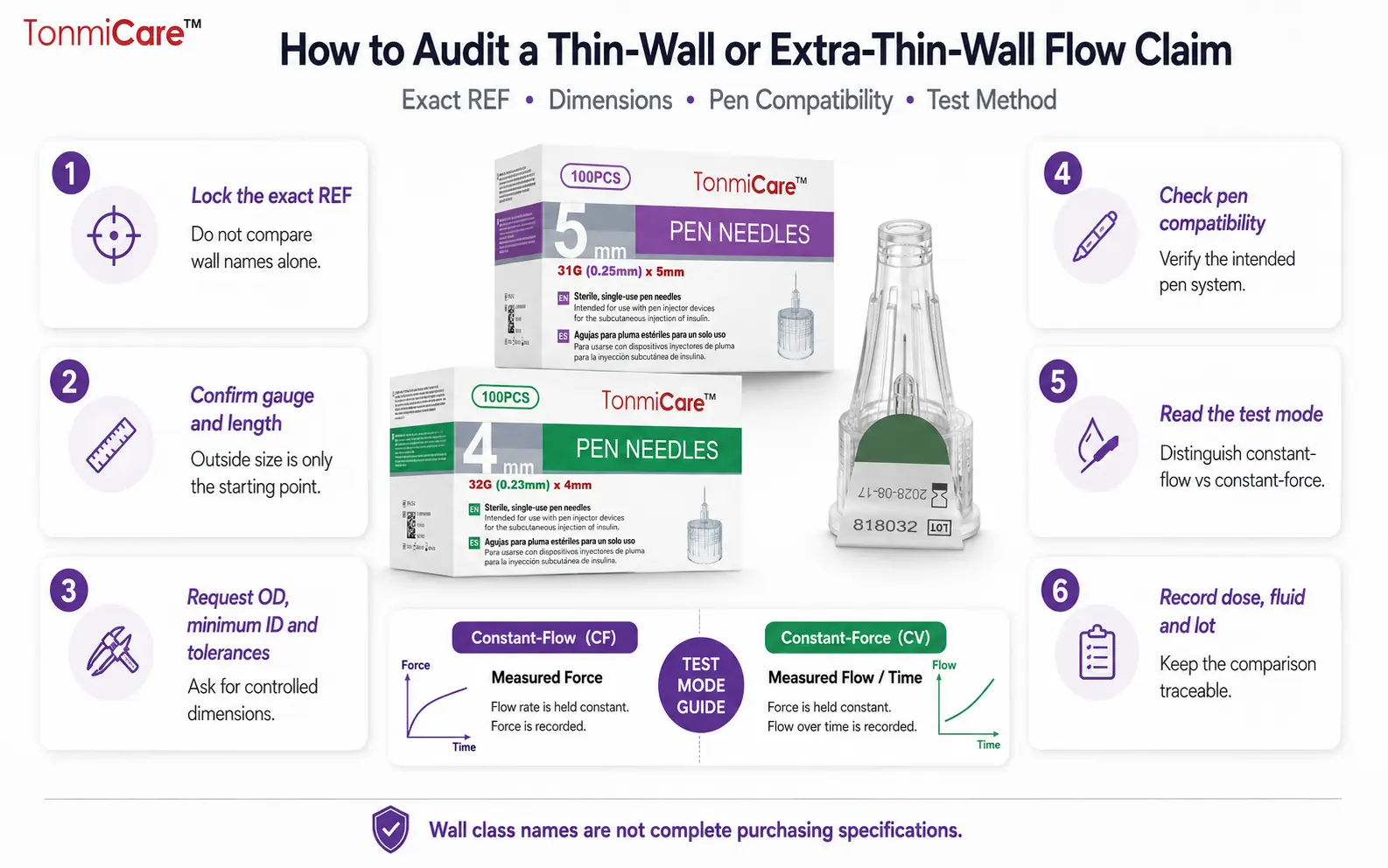
Constant-Flow and Constant-Force Tests Answer Different Questions
A supplier can report force, flow and delivery time from the same development program, but the controlled variable must be identified. Two percentages are not comparable when one was generated by fixing flow and the other by fixing force.
Constant-flow test
Measure the required actuation force
- Set a defined volumetric delivery rate.
- Measure maximum or average force required.
- Useful for “less thumb force at the tested flow” claims.
- Requires the pen, dose, fluid and machine settings.
Constant-force test
Measure flow rate and delivery time
- Apply a defined actuation force.
- Measure resulting flow and time to dispense.
- Useful for “higher flow at the tested force” claims.
- Requires the same system and environmental controls.
“Lower force,” “higher flow” and “shorter time” require separate method descriptions even when they appear in the same publication or supplier presentation.
Published evidence review
What the 2013 Extra-Thin-Wall Pen Needle Study Found
Aronson and colleagues evaluated new extra-thin-wall pen needles in laboratory testing and a randomized, two-period, open-label crossover study. The laboratory program included 32G × 4 mm, 31G × 5 mm and 31G × 8 mm XTW products, commercially available comparison groups and three pen brands: KwikPen, FlexPen and SoloSTAR.[1]
Maximum thumb force was tested while delivering 50 units at a constant 6 mL/min, equivalent to 10 units per second. Flow and delivery time were measured while applying a constant 4.5-pound force to a 50-unit dose. The insulin was dispensed through air into a collection disk. Two XTW lots and generally three comparator lots were used, with sample sizes of 15–45 per comparison.
| Tested XTW size | Maximum thumb force | Flow rate | Delivery time |
|---|---|---|---|
| 32G × 4 mm | 61.9% lower across the three pens combined | 148.9% higher | 59.8% shorter |
| 31G × 5 mm | 47.3% lower across the three pens combined | 107.6% higher | 51.7% shorter |
| 31G × 8 mm | 54.8% lower across the three pens combined | 126.2% higher | 55.8% shorter |
These are the paper’s average percentage improvements for the tested products and conditions. They are not market-wide specifications. The 32G comparator group covered 4–8 mm lengths and the 31G × 5 mm group included 4.5–6 mm comparators, so not every comparison held length perfectly constant.
Evidence boundaries
Why the Clinical Findings Cannot Be Assigned to Wall Thickness Alone
The clinical phase randomized 216 adults aged 35–80; 198 were evaluable. Participants used their usual needle and the corresponding XTW needle for approximately one week each while continuing the same pen and insulin routine. Ratings favored the XTW product for preference, perceived thumb force, time, confidence, insertion ease and several other subjective outcomes.[1]
The XTW needles also incorporated a 5-bevel tip. Participants who had already been using a BD 5-bevel needle were standardized to an equivalent 3-bevel BD reference because the investigational needle was 5-bevel. Therefore, as an evidence interpretation, patient ratings for pain, insertion and overall preference do not isolate wall thickness from tip geometry and other product-level features.
| Limitation | Why it matters to a buyer |
|---|---|
| Open-label design | Participants knew which labeled product they were using, so subjective ratings may be influenced by expectations. |
| Short duration | Approximately one week per product does not establish long-term adherence, reliability or health outcomes. |
| No glucose measurement | The study did not demonstrate improved glycemic control. |
| Subjective leakage reports | Reported leakage and dripping were not a quantitative dose-recovery test. |
| Dose accuracy not established | The authors stated that accuracy and precision required further study. |
| Design confounding | The investigational product combined XTW construction with a 5-bevel tip. |
| Manufacturer relationship | All authors except one were BD employees; the external investigator reported payments and grants from BD. |
Claim translation
What Common Pen Needle Flow Claims Actually Prove
| Claim | Evidence it requires | What it does not prove |
|---|---|---|
| “Larger inner diameter” | Controlled dimensions for the exact gauge and REF | Finished-system flow, compatibility or dose accuracy |
| “Up to X% faster flow” | Comparator, pen, fluid, force, dose, lots and calculation | The same percentage with other pens or products |
| “Less thumb force” | Defined flow, pen, dose and force measurement method | Better clinical outcomes or universal ease of use |
| “Shorter injection time” | Defined applied force and delivered dose | That technique or post-dose dwell instructions change |
| “Greater full-dose confidence” | Human-factors or patient-reported study | Measured dose accuracy or precision |
| “Less leakage” | State whether subjective reporting or quantitative recovery | Guaranteed complete dosing for every user |
| “Better for limited dexterity” | Relevant population, dexterity severity and defined endpoint | Suitability for every individual or care setting |
Commercial terminology
Is Extra-Thin-Wall the Same as Ultra-Thin-Wall?
Do not assume they are interchangeable across brands. The 2013 publication describes the tested design as extra-thin-wall or XTW, while a current Embecta product page uses the commercial phrase “Ultra-Thin wall” when discussing increased insulin flow and patient confidence.[1] [5] This terminology difference is a practical reason to compare dimensions and product references rather than names.
A buyer should also distinguish a commercial wall name from an assertion that a product meets a particular dimensional requirement. Ask the supplier to identify the applicable standard edition, size category, controlled drawing and acceptance values instead of accepting “highest standard” as a complete technical statement.
Standards boundary
ISO 9626 Controls Tubing; ISO 11608-2 Addresses Finished Pen Needles
ISO 9626:2016 applies to rigid stainless steel needle tubing used to manufacture medical devices. Its published scope covers dimensions and mechanical properties for designated tubing sizes and states that additional testing may be required when the component is incorporated into a ready-to-use device.[2] FDA currently recognizes the complete standard.[3]
ISO 11608-2:2022 specifies requirements and test methods for single-use, double-ended, sterile pen needles used with certain needle-based injection systems. FDA also recognizes that complete standard.[4] It is the more relevant finished-product standard, but compliance does not by itself prove that one wall class has a particular flow advantage.
ISO 9626 review
Use for the rigid stainless steel tubing component, dimensional category and applicable mechanical properties.
ISO 11608-2 review
Use for covered double-ended sterile pen-needle requirements and finished-device test methods.
ISO lists ISO 9626:2016 as published and “to be revised,” with a draft replacement under development. Procurement documents should identify the edition used and trigger review when the applicable standard changes.
Specification control
How to Build an Exact-SKU Thin-Wall or Extra-Thin-Wall Specification
“32G 4 mm extra-thin-wall pen needle” is a sourcing description, not a complete approval record. The controlled unit should connect product identity, dimensions, system performance, compatibility, packaging and evidence.
| Control field | Information to capture | Reason |
|---|---|---|
| Identity | Legal manufacturer, brand/labeler, family, REF and manufacturing site | Prevents evidence transfer between unrelated items |
| Cannula | Gauge, actual OD, patient-end length, minimum ID or range, wall class and tolerances | Defines the claimed flow path |
| Tip and surface | Bevel design, lubrication/coating and applicable finish | Separates wall effects from other construction differences |
| Pen-facing end | Cartridge-end cannula and hub/interface specification | The complete fluid path can control performance |
| Performance | Force, flow, time, leakage and dose-delivery methods as applicable | Links claims to measured outcomes |
| Compatibility | Named pen models, evidence revision and limitations | Attachment alone is not sufficient |
| Packaging | Sterile barrier, pieces/box, boxes/case, barcode, lot and expiry | Controls receiving and distribution |
| Market evidence | Applicable U.S. regulatory mapping, current label and IFU | Connects the commercial item to its authorized identity |
Complete-system review
Wall Class Does Not Establish Insulin Pen Compatibility
A larger internal bore does not prove that the hub, thread, cartridge-end cannula and pen-facing geometry function with a particular injector. A product may attach physically but still require review of labeling, septum penetration, dose delivery and the supplier’s current compatibility evidence. Gauge, length and wall class are not substitutes for a pen-model matrix.
Use Tonmit’s insulin pen needle sizes and compatibility guide to combine wall construction with gauge, length, hub design, labeling and exact-SKU controls. When pen models or product references change, return the combination to the organization’s approval and change-control process.
- Record the complete commercial name and REF of the pen needle.
- List the intended pen manufacturer and exact model—not only “universal fit.”
- Retain the current compatibility statement or accepted technical evidence.
- Verify that the flow study used the same or a justified pen system.
- Block automatic substitution when compatibility or performance evidence differs.
Mechanical and manufacturing review
Does a Thinner Wall Make the Pen Needle Weaker?
A smaller wall section changes the design margin, but it does not justify a universal conclusion that an extra-thin-wall pen needle is unsafe, weak or more likely to break. Mechanical performance also depends on outside diameter, material condition, unsupported length, tip processing, hub assembly, handling and packaging. The appropriate response is testing, not assumption.
Review applicable ISO 9626 requirements and product-specific verification.
Grinding, burrs, polishing and coating should not distort or obstruct the fine tube.
Excess adhesive or deformation can remove the intended flow advantage.
Dimensional variation matters more as the available wall section becomes smaller.
Shields and sterile packaging must protect the product through transport and opening.
Require notification when a change can affect dimensions, flow or compatibility.
Assortment planning
Should Pharmacies and Distributors Stock Both Wall Designs?
Stocking both can be appropriate when each REF serves documented demand, contract requirements or a differentiated product position. It is not necessary merely because two suppliers use different wall names. Begin with the smallest controlled assortment that covers approved gauge, length, compatibility and customer demand, then add a differentiated XTW or Ultra-Thin product only when the evidence and commercial case justify another SKU.
Core inventory
Established thin-wall SKU
Suitable where the approved product already meets force, flow, compatibility, service and cost requirements.
Differentiated inventory
Verified extra-thin-wall SKU
Maintain separate claims, evidence, REF, pricing and replenishment if demand supports it.
Special order
Low-volume wall or size option
Define MOQ, lead time, shelf life, case pack and nonreturnable status before committing.
Review current standard insulin pen needle options and the broader wholesale insulin pen needle program as starting points. Wall construction, exact dimensions, documents and availability must be confirmed for the selected REF; public product-family wording is not an automatic performance claim.
Supplier qualification
Documents Healthcare Buyers Should Request
Tonmit’s medical device documentation support page explains why supplier identity, exact product and destination market must be reconciled. FDA states that establishment registration and device listing do not denote approval, clearance or authorization and that it does not issue device-registration certificates.[6]
Tonmit buyer tool · blank working template
Exact-REF Pen Needle Evidence and Receiving Card
Use this original request and receiving template to keep a supplier’s flow claim attached to the commercial item that will arrive. Ask the supplier for its controlled documents first; then compare one received pack and its paperwork against the agreed REF. Record any mismatch before approval.
| Check | Supplier evidence to request | Receiving entry |
|---|---|---|
| Product identity | Legal manufacturer, labeler, exact REF and controlled drawing revision | REF / revision / match: ______ |
| Cannula specification | Gauge, length, OD range, minimum ID and wall designation for this REF | Document ID / revision: ______ |
| Flow claim | Comparator REF, pen models, fluid, dose, force or flow control, lots and results | Report ID / limits: ______ |
| Compatibility | Named pen models, test record and current label or IFU | Models / evidence date: ______ |
| Pack and traceability | Approved label, units per pack, sterile barrier, lot, expiry and barcode format | Lot / expiry / pack count: ______ |
| Disposition | Documented deviations and buyer acceptance criteria | Accept / hold / escalate; owner and date: ______ |
Method and limit: This is a blank procurement and receiving checklist created for this guide, not a Tonmit test report or proof that any supplier or shipment passed QC. A pack and paperwork comparison cannot measure bore, flow, sterility, dose accuracy or clinical performance. Qualified personnel should apply the approved sampling plan, validated tests and product-specific acceptance criteria.
Copyable procurement tool
Thin-Wall vs Extra-Thin-Wall Pen Needle RFQ Checklist
PRODUCT IDENTITY
Legal manufacturer and manufacturing site: ______
Brand / labeler: ______
Product family and exact REF: ______
Intended market and applicable regulatory mapping: ______
CONTROLLED DIMENSIONS
Wall description: thin-wall / extra-thin-wall / ultra-thin / other: ______
Gauge and actual outside diameter: ______
Minimum inside diameter or controlled ID range: ______
Patient-end length and dimensional tolerances: ______
Applicable ISO 9626 edition / drawing revision: ______
FLOW AND FORCE EVIDENCE
Tested commercial REF and lots: ______
Pen brands and exact models: ______
Dose and insulin / justified test fluid: ______
Constant-flow setting and force result: ______
Constant-force setting, flow result and delivery time: ______
Sample size, variability, statistics and acceptance criteria: ______
FINISHED-DEVICE REVIEW
ISO 11608-2 evidence or applicable finished-device test plan: ______
Hub and cartridge-end construction: ______
Pen compatibility evidence revision: ______
Mechanical integrity and assembly controls: ______
Sterility, shelf life and package integrity: ______
COMMERCIAL AND SUPPLY
Pieces per box / boxes per case: ______
Initial quantity and annual forecast: ______
MOQ, lead time and minimum remaining shelf life: ______
U.S. warehouse / factory supply / either: ______
Destination and required delivery date: ______
OEM / private-label and change-notification requirements: ______
Buyer FAQ
Frequently Asked Questions About Thin-Wall and Extra-Thin-Wall Pen Needles
What is the main difference between thin-wall and extra-thin-wall pen needles?
At a matched outside diameter, the extra-thin-wall design generally uses a smaller wall section to create a larger inner diameter. The actual dimensions and performance must be confirmed for the exact gauge and REF.
Do pen needles with the same gauge have the same inner diameter?
No. Gauge primarily identifies an outside-diameter category. The internal diameter can differ with wall class, tolerances and manufacturer design.
Do extra-thin-wall pen needles always flow faster?
No universal rule or percentage applies. A larger qualified bore can reduce resistance, but finished flow also depends on length, tip openings, hub transitions, assembly, pen mechanics, dose, fluid and test method.
How much faster was the product in the published study?
In the 2013 laboratory program, the tested XTW sizes produced average combined flow improvements of 107.6%–148.9% across three pen brands under a constant 4.5-pound force. Those values belong to the tested products and protocol, not every extra-thin-wall needle.
Does a larger ID make the needle larger on the outside?
Not necessarily. The engineering purpose of a thinner wall is to enlarge the bore while preserving the selected outside diameter. Verify both dimensions rather than inferring one from the other.
Does extra-thin-wall technology improve dose accuracy?
The 2013 study did not establish dose accuracy or precision, and the authors stated that those outcomes required additional study. Perceived confidence in full-dose delivery is not a quantitative accuracy result.
Does extra-thin-wall construction reduce leakage?
Participants in the cited study reported less leakage and needle-tip dripping with the tested XTW product, but those were subjective observations. Do not present them as quantitative dose-recovery evidence or a universal guarantee.
Is extra-thin-wall the same as ultra-thin-wall?
Do not assume so across manufacturers. Treat each as a commercial or technical term that must be tied to a specific REF, gauge, OD, ID, dimensional table and evidence package.
Are thinner-wall needles more likely to bend or break?
That cannot be concluded from the label alone. Mechanical performance depends on material, OD, ID, length, processing, assembly and packaging. Review applicable tubing and finished-device test evidence.
Does wall class affect compatibility with insulin pens?
Wall class alone does not establish compatibility. Verify the exact hub, cartridge-end cannula, needle REF, current labeling and intended pen model.
Can a pharmacy substitute an ETW SKU for a TW SKU?
Not solely because gauge and length match. Follow applicable prescribing, dispensing, formulary, labeling and legal requirements and the organization’s approved substitution process.
Which standards should a buyer review?
ISO 9626:2016 addresses rigid stainless steel needle tubing, while ISO 11608-2:2022 addresses covered single-use, double-ended sterile pen needles. The applicable editions, tests and exact-device evidence must be identified.
Should a distributor stock both wall classes?
Only when each SKU serves verified demand or a defined product position. Keep the product identity, evidence, claims, compatibility, pricing and replenishment plan separate.
What is the most important supplier question?
Ask whether the dimensions and flow or force data were generated on the exact commercial REF being quoted, with which pen, dose, fluid, method, sample size and lots.
Procurement conclusion
Buy the Measured Fluid Path—not the Wall Label
Extra-thin-wall construction can create a larger internal pathway without increasing the outside diameter, and specific tested designs have demonstrated lower actuation force and faster delivery. A defensible purchase decision still requires exact dimensions, a complete test protocol, the named pen and fluid, multiple-lot evidence, mechanical and compatibility verification, current labeling, packaging and lifecycle controls. When those fields are fixed before price comparison, pharmacies and distributors can evaluate a meaningful performance difference without turning a product-specific claim into an unsupported category promise.
Source basis
Official and Primary Sources Used for This Guide
- Aronson et al. — Insulin Pen Needles: Effects of Extra-Thin Wall Needle Technology on Preference, Confidence, and Other Patient Ratings
- ISO — ISO 9626:2016, Stainless Steel Needle Tubing for the Manufacture of Medical Devices
- FDA — Recognized Consensus Standard ISO 9626:2016
- FDA — Recognized Consensus Standard ISO 11608-2:2022 for Double-Ended Pen Needles
- Embecta — BD Ultra-Fine Pen Needles and Ultra-Thin Wall Product Terminology
- FDA — Important Reminders About Medical Device Registration and Listing
Sources and links were reviewed on August 22, 2026. Published results address particular products, pens, populations, doses, test conditions and comparison groups. Standards, product portfolios, labels, regulatory records and commercial availability can change. Verify current exact-SKU evidence before a future purchasing decision.
Exact-SKU pen needle procurement support
Verify the Bore and Evidence Before Comparing the Price
Share the required gauge × length, wall design, minimum ID, intended pen models, annual volume, packaging, destination and document list. Tonmit can review available product paths and supply options without treating a wall label as proof of universal performance.