
Pen Needle Packaging & Traceability Guide
A packaging-level procurement guide for U.S. pharmacies, clinics and medical distributors reviewing insulin pen needle packaging, 100-count boxes, exact-SKU case packs, UDI/GTIN data, lot and expiration controls, receiving scans and recall traceability.
Scope: This guide supports professional purchasing, item-master setup, receiving and distribution of finished insulin pen needles. It does not choose a needle for an individual, establish compatibility with a pen injector, replace current product labeling or legal advice, or prove that a product is authentic, sterile, cleared or otherwise marketable. Apply every control to the exact manufacturer, labeler, REF, package level, lot and destination market.
Direct answer
What Does 100/Box Actually Tell an Insulin Pen Needle Buyer?
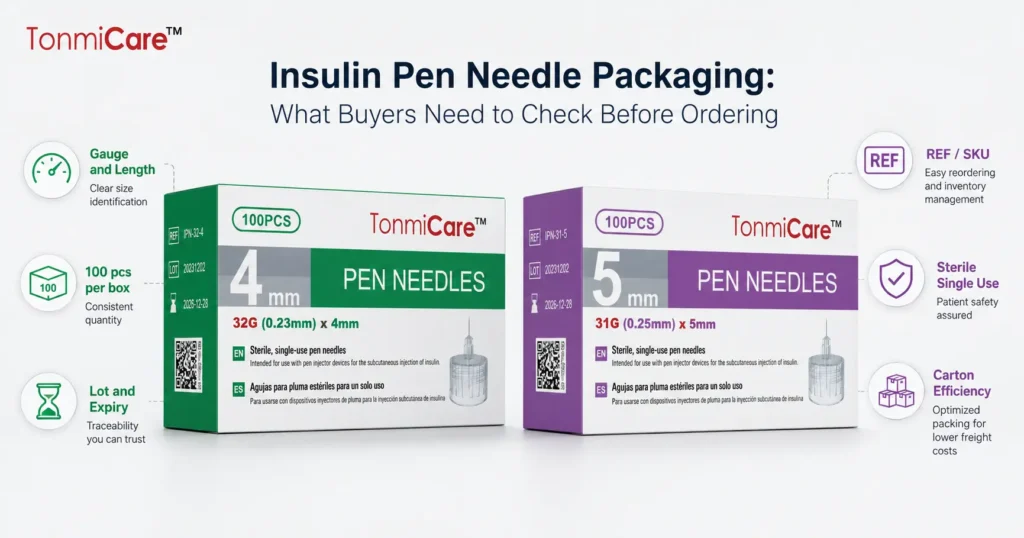
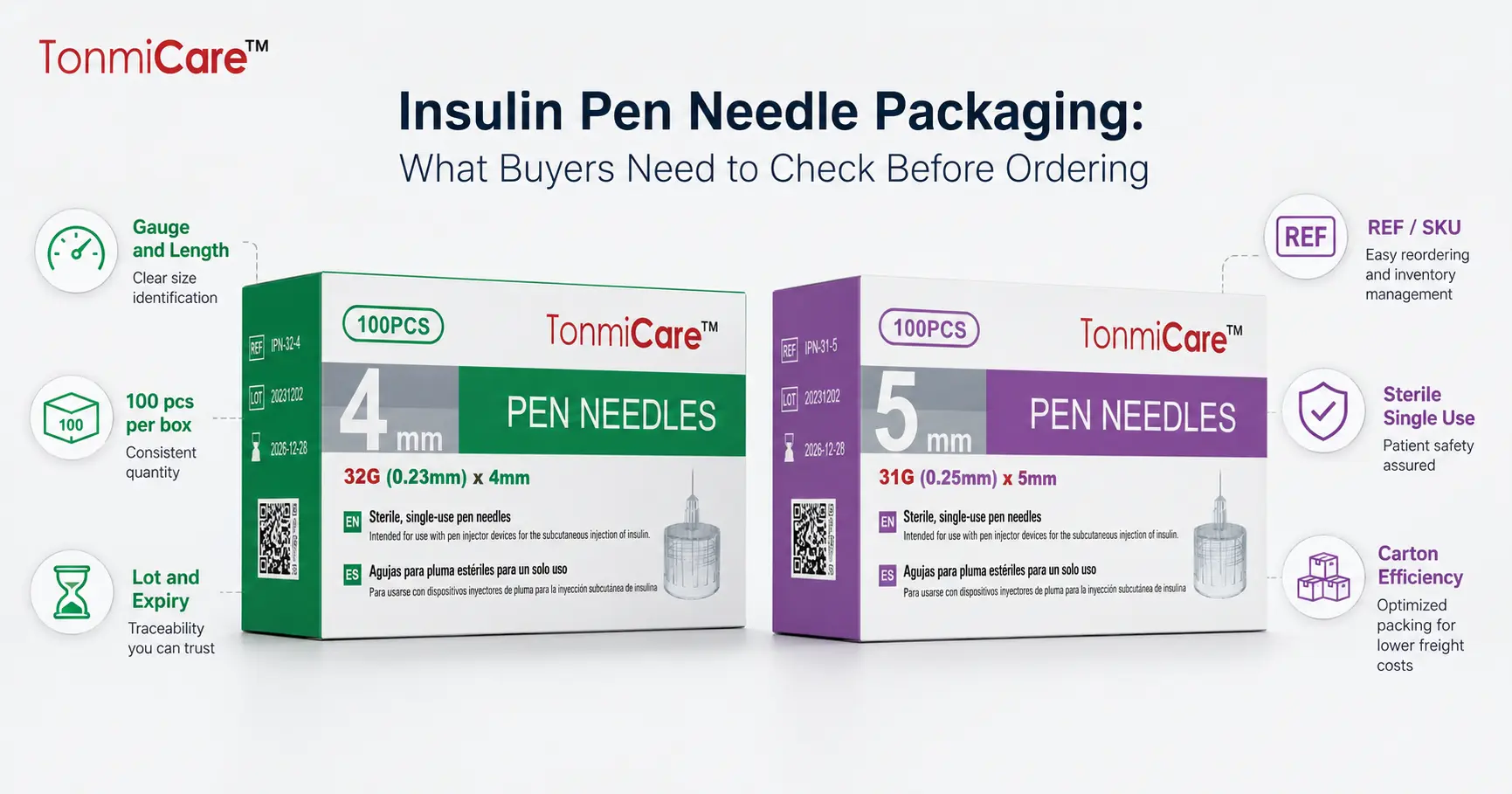
“100/box” identifies the quantity in one sales box or shelfpack; it does not define the complete insulin pen needle packaging hierarchy. It does not establish how many boxes are in a case, whether an inner carton exists, which package level is orderable, whether the case has a different DI/GTIN, how lot and expiration data are encoded, or how the shipment should be received.
A purchase specification should therefore lock the legal manufacturer or labeler, exact REF, gauge × length, design type, sterile presentation, needles per box, boxes per case, total needles per case, package-level identifiers, barcode data, lot and expiry format, dimensions, weight, remaining shelf life and permitted substitutions. A quote based only on “32G × 4 mm, 100 count” is not yet commercially or technically normalized.
Packaging map
1. Build the Packaging Hierarchy Before Comparing Quotes
Professional buyers need to know what is being counted, sold, scanned and transported at each level. The same pen needle may pass through several physical and commercial levels, and the vocabulary used by manufacturers and distributors is not always identical. A “box,” “shelfpack,” “inner,” “case,” “master carton” and “shipping container” should not be treated as interchangeable without a controlled definition.
| Level | Typical role | Fields to confirm | Operational use |
|---|---|---|---|
| Individual device package | Protects one sterile, single-use pen needle where that is the approved presentation | Barrier format, opening method, damage criteria and markings | Use-point handling and package-integrity review |
| Sales box / shelfpack | Common pharmacy dispensing, picking or consumer unit | REF, quantity, DI/GTIN where applicable, lot, expiry, label revision and IFU | Item master, dispensing, replenishment and returns |
| Inner pack | Intermediate grouping, when present | Boxes per inner, barcode, dimensions, weight and break-pack policy | Warehouse storage, picking and count conversion |
| Case / master carton | Defined shipping or trade-item grouping | Boxes per case, total needles, identifier, lot treatment, dimensions and gross weight | Purchasing, receiving, freight and case-level inventory |
| Pallet / logistics unit | Transport and warehouse movement | Cases per layer, layers, total cases, height, weight, GTIN if traded and SSCC if used | ASN, dock receiving, space planning and logistics traceability |
Within the GS1 system, a hierarchy level that may be priced, ordered or invoiced is treated as a trade item and can require its own GTIN. A logistics unit assembled only for transport can instead be identified through an SSCC; a case or pallet may carry both product and logistics identifiers depending on its role.[4] The buyer should ask the labeler or supplier to provide the approved hierarchy rather than trying to derive it from a photograph.
Count control
2. What “100/Box” Confirms—and What It Does Not
One hundred pen needles per box is a familiar commercial configuration, but it is neither a complete SKU nor a universal industry rule. A supplier may offer other box counts, a different case multiple, a disposal-integrated package or a market-specific presentation. Even when two quotations both state 100/box, their case pack, barcode hierarchy, remaining shelf life and freight profile can differ.
Quantity at one declared level
- The stated number of needles in that sales box or shelfpack
- A useful starting unit for price-per-box and price-per-needle calculations
- A field that can be matched to the physical label and approved item master
The rest of the commercial identity
- Gauge, length, standard or safety design, wall or tip construction
- Individual sterile presentation or compatible pen scope
- Boxes per case, cases per pallet, case identifier or carton dimensions
- Lot, expiration, label revision, regulatory mapping or remaining shelf life
Do not use “100-count pen needles” as the item-master description. At minimum, connect the count to the legal manufacturer or labeler, exact REF, gauge × length, design, sterile presentation, current label and applicable package identifier.
Exact-SKU evidence
3. Case Packs Are Product- and Supply-Path Specific
The number of boxes in a case is not determined by the fact that each box contains 100 needles. It must be confirmed for the exact REF and supply path. A manufacturer, private-label program, regional distributor or warehouse may use a different case configuration, provided the applicable product, labeling, identifier and commercial records are controlled.
As a current public example—not a Tonmit product and not an industry standard—Embecta’s U.S. record for REF 320119 lists a shelfpack quantity of 100 and a case quantity of 1,200. That equals 12 shelfpacks per case. The same page displays separate shelfpack and case GTIN fields.[9] The correct procurement lesson is structural: package levels can carry different quantities and identities. Those values must not be copied to another brand or REF.
| Field | Quotation A | Quotation B | Required decision |
|---|---|---|---|
| Exact manufacturer + REF | Record | Record | Do the products and evidence actually match? |
| Needles per box | Record | Record | What is the saleable count? |
| Boxes per case | Record | Record | What is the valid order multiple? |
| Needles per case | Calculate | Calculate | Are case prices normalized? |
| Case dimensions + gross weight | Record | Record | What is the freight and storage effect? |
| Lot, expiry + remaining life | Record | Record | How much inventory will remain saleable? |
Package purpose
4. Separate the Sterile Barrier, Device Package and Shipping Container
A pen needle’s individual sterile package, its sales box and its shipping case do not perform the same function. For a terminally sterilized device, the approved sterile barrier or packaging system is intended to maintain sterility until the point of use. FDA recognizes ISO 11607-1:2019 with Amendment 1:2023 for materials, sterile barrier systems and packaging systems used for terminally sterilized medical devices.[7]
The outer shipping carton primarily protects grouped product during logistics. It should not be described as the sterile barrier unless the exact approved packaging specification establishes that role. A crushed case can justify inspection or quarantine even when some inner boxes appear intact; an intact shipping carton does not prove that every individual package is acceptable.
Inspect the case
Check wetness, crushing, puncture, contamination, resealing, label damage and evidence of mishandling.
Inspect sampled boxes
Reconcile REF, quantity, lot, expiry, artwork version and the condition of the sales package.
Apply exact acceptance criteria
Use the manufacturer’s packaging specification and the buyer’s approved receiving procedure.
UDI rules also distinguish device packages from shipping containers. Under 21 CFR 801.30, individual single-use devices distributed together and not intended for individual commercial distribution may qualify for an exception when the containing device package bears the UDI. The same section states that the rule does not require a UDI on a shipping container.[2] A logistics barcode can still appear on a shipping case, but its presence does not automatically make that carton a regulated device-package level.
Identification control
5. UDI, DI and PI: Keep Product Identity Separate From Batch Identity
FDA’s UDI system uses a fixed device identifier and, when applicable, variable production identifiers. The DI identifies the labeler and specific version or model. PI can identify one or more production attributes when those attributes appear on the device label: lot or batch, serial number, expiration date, manufacturing date or a distinct HCT/P code.[1]
| Data type | Examples | Typical behavior | Buyer record |
|---|---|---|---|
| Device Identifier (DI) | Applicable package-level device identity | Fixed for the controlled version or model and package configuration | Item master and approved package hierarchy |
| Production Identifier (PI) | Lot, serial, expiration or manufacture date when labeled | Variable by production or individual device | Receipt, lot inventory, complaint and recall record |
| Distributor SKU | Wholesaler’s internal catalog number | May differ by seller or channel | Cross-reference; never replace manufacturer REF or DI |
| Purchase order line | Buyer item ID, unit of measure and quantity | Transaction-specific | Link to the physical product and receipt |
GUDID contains the DI and PI flags, not the actual lot number or expiration date printed on the box in front of the receiver. A public GUDID match supports product identification; it does not replace capture of the physical package’s batch data.[3]
Use exact-SKU medical device documentation support to connect the manufacturer, labeler, REF, packaging configuration, DI record and current artwork. A barcode that decodes successfully does not by itself prove authenticity, sterility, market authorization or conformity with the purchase order.
Machine-readable data
6. GTIN and Barcode Controls at Box and Case Level
A GTIN is an identification number within the GS1 system; a barcode is the data carrier that a scanner reads. The same number can be represented in more than one permitted carrier depending on the packaging level, regulation, channel and trading-partner requirement. A buyer should therefore record both the identifier and the expected symbology or data format.
When GS1 is the selected UDI issuing system, common application identifiers include (01) for GTIN, (10) for lot, (11) for manufacture date, (17) for expiration date and (21) for serial number. GS1 DataMatrix can carry these fields in a compact healthcare barcode.[5] These parentheses and meanings must not be applied to a HIBCC or ICCBBA code, which uses a different structure.
What does the code identify?
- The individual unit, sales box, inner pack, case or logistics unit
- The exact version or package configuration approved in the item master
- The correct labeler or brand-owner record
What does the scanner return?
- DI/GTIN only, or DI plus lot and expiration
- Leading zeros, separators and variable-length fields intact
- Correct mapping into ERP, WMS or pharmacy inventory fields
A scanner can read the wrong package level, place a case GTIN into a box field, drop leading zeros or parse a lot value into the wrong field. Validate the decoded data against the human-readable text and approved item record before production use.
GS1 rules also state that changing a predefined pack or case quantity requires a new GTIN at the changed packaging level and affected levels above.[4] For private-label or carton redesign projects, barcode review belongs in formal packaging change control—not at the final print-proof stage.
Production identity
7. Control Lot and Expiration as Linked Receiving Fields
Lot and expiration are variable records that must remain linked to the exact REF, package level and received quantity. Two boxes with the same DI can belong to different lots and have different expiration dates. Do not overwrite one lot with another simply because the product description and barcode DI match.
FDA’s labeling information explains that when expiration dates are used, they should reflect the period after final packaging during which the device remains fit for its intended use under labeled storage, supported by stability information. FDA also notes that expiration dating solely for package integrity and sterility is not universally required for every general medical device; lot or serial numbers are widely used by sterile-device manufacturers even where requirements vary by device.[6] The correct buyer approach is to follow the exact product label and approved shelf-life specification, not to make a universal claim about every pen needle.
- Capture the lot exactlyPreserve letters, leading zeros, punctuation and case where the receiving system supports them.
- Capture the labeled expirationDo not infer an expiration from the lot code unless the manufacturer supplies an authorized decoding rule.
- Keep lot and expiry pairedStore a separate quantity for every lot-expiry combination received.
- Record the package levelKnow whether the case, box and individual package display the same or different data.
- Preserve source evidenceRetain the physical label image or controlled receiving record when required by the buyer’s procedure.
Complete lot information supports complaint and field-action reporting. FDA’s MedWatch instructions ask reporters to record model, catalog, lot, expiration and UDI exactly as found on the device or its packaging when available.[8]
Operational workflow
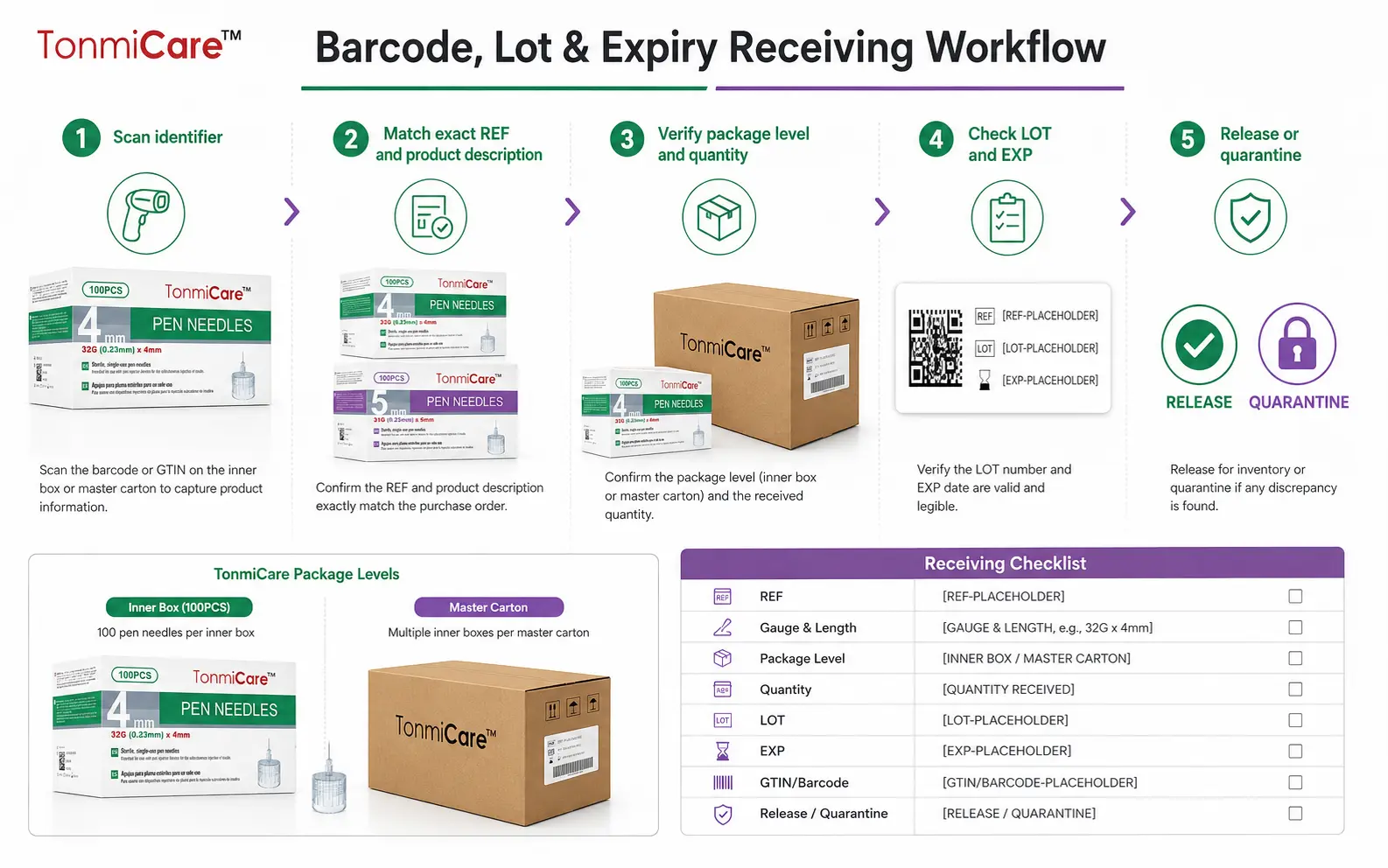
8. Use a Defined Pen Needle Receiving and Scan Workflow
The receiver should verify identity, quantity, traceability and condition before releasing stock. The process should be designed around the organization’s actual ERP, WMS or pharmacy system and tested with production packaging—not only a supplier-provided barcode image.
- Match the purchase order and packing listConfirm supplier, manufacturer or labeler, exact REF, ordered unit and expected case quantity.
- Inspect the external shipmentRecord shortage, overage, wetness, crushing, puncture, resealing, contamination or temperature concern where applicable.
- Scan the receiving unitDetermine whether the scanned code represents a box, case or logistics unit.
- Decode and map the identifierMatch DI/GTIN to the approved package-level record; do not rely on the product description alone.
- Capture variable dataImport or manually record lot and expiration when they appear on the label or in the approved data carrier.
- Reconcile human-readable textCompare the scanner result with the printed REF, lot, expiry and quantity.
- Open and sample according to procedureVerify box count, box labels and package condition without compromising saleable product.
- Apply remaining-shelf-life criteriaCalculate from the labeled expiration and actual receiving date.
- Release, quarantine or rejectPrevent unresolved discrepancies from entering available inventory.
- Retain the transaction linkConnect receipt, supplier, lot, expiry, quantity, location and reviewer.
Test a normal label, a second lot, a higher-level case code, an expired or near-expiry test record and a deliberately mismatched item. Confirm that the system blocks the wrong package level instead of silently converting it.
Exception management
9. Quarantine Barcode Conflicts, Mixed Lots and Count Errors
A receiving discrepancy should be handled as a controlled exception, not corrected by guessing. Preserve the original packaging, receipt record, scan output and photographs, then obtain written clarification through the approved supplier or manufacturer contact.
| Observed condition | Risk | Immediate action | Release evidence |
|---|---|---|---|
| Scanned DI differs from printed DI/GTIN | Wrong product, label or scanner parsing | Quarantine the affected quantity | Verified scanner configuration and written identity resolution |
| Scanned expiry differs from print | Incorrect FEFO or release decision | Hold the lot and preserve both data forms | Authorized clarification or corrected product disposition |
| Case label identifies box-level GTIN | Quantity conversion and replenishment error | Stop automated case receipt | Approved package-hierarchy mapping |
| Unexpected mixed lots in one case | Incomplete lot capture and recall exposure | Segregate and count every lot-expiry combination | Reconciled packing list and buyer-approved mixed-lot treatment |
| Actual boxes per case differ from PO | Shortage, overage or unapproved pack change | Record physical count and hold conversion update | Corrected transaction and approved pack configuration |
A buyer may contractually require one lot per case, but that requirement should be written into the purchasing specification. Do not state that every mixed-lot shipping case is universally prohibited. If mixed lots are accepted, the packing list and receiving system must support exact quantities by lot and expiry; a single case-level PI cannot be allowed to hide multiple box-level batches.
Inventory rotation
10. Use FEFO Based on the Labeled Expiration Date
First-expire, first-out should rotate the earliest acceptable expiration before later-expiring stock, subject to quarantine, recall, allocation and product-specific restrictions. Receipt date alone is not a substitute. A newer shipment can expire earlier than inventory already on hand.
The purchasing agreement should define the minimum remaining shelf life at shipment or receipt, the remedy for short-dated stock and whether approval is required before shipping a lot below the threshold. Avoid a universal percentage because acceptable life depends on demand, lead time, contract, returns, customer requirements and the exact labeled shelf life.
Released inventory
Correct REF, acceptable packaging, traceable lot and sufficient remaining shelf life.
Allocated or short-dated
Controlled separately with customer, location, date or approval restrictions.
Quarantined or expired
Excluded from usable stock and protected from accidental shipment.
Commercial comparison
11. Compare Case Cube, Damage and Landed Cost—not Box Price Alone
A low box price can be offset by a larger carton, higher freight, an inconvenient order multiple, lower usable remaining life, split-case restrictions or recurring receiving errors. Normalize every quotation to the same approved product and saleable quantity before comparing cost.
| Cost driver | Buyer input | Failure if omitted |
|---|---|---|
| Order unit | Box, inner, case or pallet | Price is compared at different quantity levels |
| Case cube and weight | Exact outer dimensions and gross weight | Freight and warehouse space are understated |
| MOQ and case-break rule | Valid order multiple by supply path | Excess inventory or unavailable split cases |
| Damage and discrepancy rate | Rejected boxes and claim resolution | Nominal quantity exceeds saleable quantity |
| Remaining shelf life | Lot, expiry and demand forecast | Low-price stock expires before sale |
| Replenishment path | U.S. stock, scheduled import or factory production | Lead time and safety stock are modeled incorrectly |
Review the wholesale insulin pen needle buying guide for the broader MOQ, landed-cost, sample and supply-continuity framework. Keep this article’s item master focused on packaging and traceability.
Lifecycle control
12. Treat Private-Label Packaging and Case Changes as Controlled Changes
Private label is not a visual artwork exercise alone. The parties must define the legal manufacturer, labeler, brand owner, importer or distributor roles as applicable; approve the exact device and claims; determine UDI and database responsibilities; and control the box, IFU, lot/expiry fields, barcode and shipping case as one system.
Freeze the product and responsibilities
- Legal manufacturer, labeler, brand and exact REF
- Gauge × length, design, compatibility scope and sterile presentation
- Destination market and applicable regulatory mapping
- Package hierarchy and quantity at every level
Approve data and production evidence
- DI/GTIN, barcode carrier, lot and expiry format
- Artwork revision, IFU, symbols and complaint contact
- Print proof, packaged sample and case-label scan test
- Change notification, old-stock transition and obsolescence plan
FDA’s labeling information emphasizes specifications, proofreading and formal change control for labeling.[6] Under GS1 rules, a change to the predefined number of trade items in a case requires a new GTIN for the changed level and affected higher levels.[4] A familiar brand name cannot be used to hide a changed case count or identifier.
Supplier qualification
13. Documents Healthcare Buyers Should Request
Request records that map to the exact commercial product. A certificate, regulatory record or packaging drawing for one product family should not be transferred to another gauge, length, design, manufacturing site or private-label configuration unless the document clearly covers it.
| Document or record | Minimum fields | Buyer decision supported |
|---|---|---|
| Product specification | Manufacturer, REF, gauge, length, design, materials, sterile presentation and intended scope | Exact-SKU identity |
| Package hierarchy sheet | Units/box, boxes/inner, boxes/case, cases/pallet, dimensions and weights | Order units, freight and warehouse planning |
| Approved label and IFU | Artwork revision, REF, quantity, symbols, claims, lot/expiry fields and contacts | Label reconciliation and current use information |
| UDI/GTIN hierarchy | DI by package level, issuing agency, data carrier and GUDID record where applicable | Scanner and item-master setup |
| Lot and shelf-life information | Labeled shelf life, storage, lot/expiry format and minimum remaining life | FEFO, acceptance and recall readiness |
| Transaction records | PO confirmation, packing list, lot quantities, shipment and discrepancy contacts | Receipt and claim resolution |
| Change-control agreement | Notice for product, site, label, barcode, pack, sterilization or documentation change | Lifecycle and substitution control |
Tonmit can coordinate available product, packaging, UDI and lot-traceability documentation for qualified sourcing projects. Availability and applicability must be confirmed for the selected product, manufacturer, destination and transaction.
Copyable procurement tool
14. Exact-SKU Insulin Pen Needle Packaging RFQ
Use one RFQ line per exact product and packaging configuration. Do not combine several gauges, lengths or case packs into one line.
PRODUCT IDENTITY
Legal manufacturer: [company]
Brand / labeler: [name]
Exact REF / catalog number: [REF]
Design: [standard / safety / exact commercial family]
Gauge × length: [G × mm]
Intended pen / compatibility evidence required: [models or controlled scope]
PACKAGING HIERARCHY
Individual sterile presentation: [describe]
Needles per sales box / shelfpack: [quantity]
Boxes per inner pack: [quantity or none]
Boxes per shipping case: [quantity]
Total needles per case: [quantity]
Case dimensions and gross weight: [L × W × H; weight]
Cases per pallet: [quantity]
IDENTIFIERS AND TRACEABILITY
Box-level DI / GTIN: [identifier]
Case-level DI / GTIN or logistics identifier: [identifier + level]
Issuing agency and barcode format: [GS1 / HIBCC / ICCBBA / other applicable system]
PI fields encoded: [lot / expiry / manufacture date / serial / none]
Lot and expiry printed at levels: [list]
GUDID record where applicable: [link or DI]
COMMERCIAL AND RECEIVING TERMS
Initial order and annual forecast: [quantity + unit]
Valid order multiple / case-break policy: [details]
Labeled shelf life: [months or days]
Minimum remaining shelf life at receipt: [requirement]
Destination ZIP / country: [destination]
Inventory source: [U.S. stock / factory / scheduled replenishment]
Required documents: [list]
No substitution or packaging change without written approval: [required]
For available specifications, packaging paths and bulk review, see Tonmit’s current wholesale insulin pen needle supply program. Public product-family information is an RFQ starting point, not approval of a specific REF.
Buyer questions
Insulin Pen Needle Packaging FAQ
Are insulin pen needles always packaged 100 per box?
No. One hundred per box is common, but it is not a universal standard. Verify the exact manufacturer, REF, sterile presentation, box quantity and case configuration for the item quoted.
How many boxes are in a case of insulin pen needles?
There is no universal answer. The case pack is exact-SKU and supply-path specific. Obtain boxes per case, total needles per case, case identifier, dimensions and weight in writing. Do not transfer a 12-, 20- or 50-box case pack from another product.
Does 100/box prove that every pen needle is individually packaged?
No. Box count and sterile presentation are separate specifications. Confirm the approved individual package or sterile-barrier format and inspect it against the exact product documentation.
Does every individual pen needle need its own UDI?
Not in every configuration. Under 21 CFR 801.30(a)(3), qualifying individual single-use devices distributed together, kept in the containing package until use and not intended for individual commercial distribution may be excepted; the containing device package must bear a UDI. Confirm the labeler’s applicable package hierarchy and any exception or alternative.
Does a shipping case need a UDI?
21 CFR 801.30(c) states that the UDI rule does not require a UDI on a shipping container. A case may still carry a commercial or logistics barcode. Determine whether the carton is a device-package trade item, a logistics unit or a shipping container and what its identifier represents.
Is a GTIN the same as a barcode?
No. A GTIN is a GS1 identification number. A barcode is the machine-readable carrier. Record the GTIN or other DI, its package level and the expected barcode format separately.
Does the barcode always contain lot and expiration?
No. A barcode can contain only the DI/GTIN or can also encode PI data such as lot and expiration. Scan and decode the exact label; never infer the data content from the barcode’s appearance.
Can I look up the actual lot and expiry in GUDID?
No. FDA states that GUDID contains only the DI, with flags indicating which PI attributes may appear. The actual lot and expiration must be captured from the physical label and transaction records.
What should receiving do if the scanned expiry differs from the printed expiry?
Quarantine the affected quantity, preserve the package and scan record, verify scanner configuration and data parsing, and obtain an authorized written resolution before release. Do not choose whichever date is more convenient.
Can one case contain more than one lot?
A buyer may require one lot per case by contract, but mixed-lot treatment is not answered by a universal slogan. If mixed lots are accepted, each lot-expiry combination and quantity must be declared, received and retained separately.
Does a change in case quantity require a new GTIN?
Under GS1 allocation rules, changing the predefined quantity in a pack or case requires a new GTIN at the changed level and affected levels above. Other issuing systems and regulatory obligations should be reviewed separately.
What should a pharmacy send in the first packaging RFQ?
Send the manufacturer or required brand, exact REF or specification, gauge × length, standard or safety design, intended pen scope, box count, requested case quantity, annual volume, destination, shelf-life requirement, barcode/UDI fields, documents and substitution restrictions.
Procurement conclusion
15. Approve the Packaging System, Not Just the 100-Count Box
A reliable insulin pen needle purchase connects the exact device to the exact commercial and traceability structure. Verify the manufacturer and REF, map every package level, distinguish the sterile presentation from the shipping carton, reconcile DI/GTIN and barcode data, capture lot and expiration, test the receiving workflow and calculate landed cost from saleable product.
The practical rule is simple: 100/box is one quantity field—not approval of the product, case pack or supply program. When an identifier, quantity, lot, expiration or packaging version is unresolved, hold the affected stock until the evidence chain is complete.
Source basis
Official and Primary Sources Used for This Guide
- FDA — UDI Basics
- eCFR — 21 CFR 801.30, General UDI Exceptions
- FDA — Global Unique Device Identification Database
- GS1 — Healthcare GTIN Allocation Rules
- GS1 — 2D Barcodes in Healthcare
- FDA — Quality System Regulation Labeling Requirements
- FDA Recognized Standard — ISO 11607-1:2019, AMD1:2023
- FDA — Instructions for Completing Form FDA 3500
- Embecta — U.S. Product Record 320119, Packaging and GTIN Example
- FDA Recognized Standard — ISO 11608-2:2022 for Pen Needles
Sources and links were reviewed on August 24, 2026. Regulations, standards, product pages, package quantities, labels and database records can change. Recheck the current official source and exact product documentation before a future procurement, labeling or receiving decision. The Embecta record is included only as a package-level example and does not establish a Tonmit or industry-wide case pack.
Exact-SKU Pen Needle Procurement Support
Confirm the Box, Case and Barcode Before Ordering
Share the required gauge × length, design, exact or target REF, intended market, box count, case quantity, annual demand, destination, remaining-shelf-life requirement and documentation checklist. Tonmit can review available wholesale pen needle options, packaging configurations, U.S. inventory support and project-specific supply terms.