
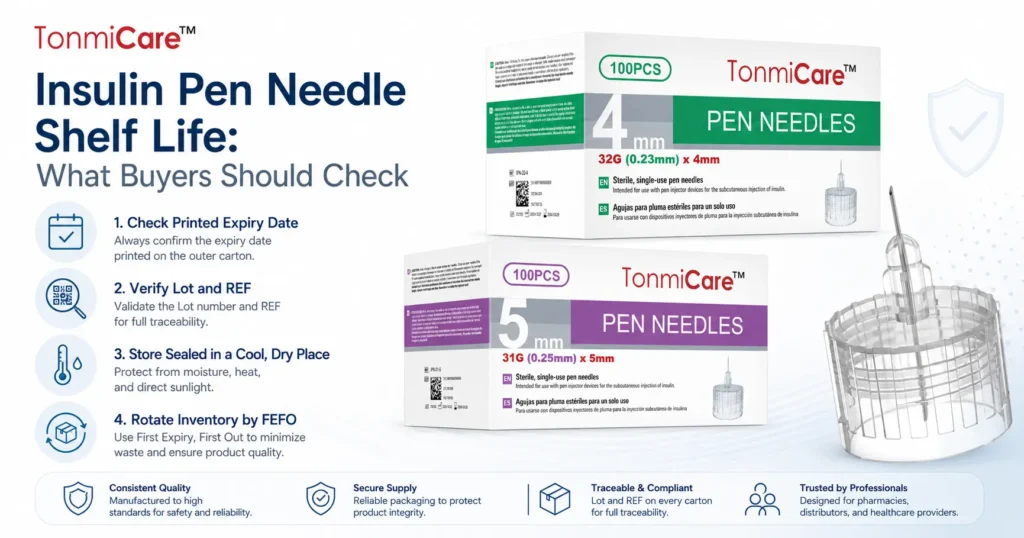
Pen Needle Shelf Life, Storage & FEFO Guide
An exact-SKU inventory guide for U.S. pharmacies, clinics and medical distributors managing insulin pen needle shelf life, expiration dates, labeled storage conditions, remaining-life acceptance, FEFO rotation, lot traceability, damaged packaging and short-dated stock.
Scope: This guide supports professional procurement, receiving, storage and inventory control for finished, sterile, single-use insulin pen needles. It does not select a needle for an individual, provide injection instructions, define medication storage, authorize use after expiration, replace the current label or IFU, or provide legal, regulatory or pharmacy-practice advice. Apply every decision to the exact manufacturer or labeler, REF, package configuration, lot, destination market and current controlled documentation.
Direct answer
How Long Do Insulin Pen Needles Last in Pharmacy Inventory?
Insulin pen needle shelf life is exact-SKU specific. Public FDA records include one injection pen needle family with a three-year shelf life and another insulin pen needle family with a five-year shelf life.[4][5] A current manufacturer product record also lists 1,825 days for one specific 31G × 5 mm U.S. pen needle SKU.[6] These examples show why a pharmacy should not apply a universal “five-year” assumption.
Use the expiration date and storage statement on the exact product label and IFU, verify the remaining shelf life of the quoted lot before purchase, and manage released stock by lot and FEFO. Do not automatically refrigerate detachable pen needles because insulin or a GLP-1 medication may require cold storage. The drug and the needle are different products with different controlled labeling.
First correction
1. Separate Pen Needle Storage From Insulin Pen Storage
Search results for “insulin pen storage” usually address the medication inside a prefilled pen or cartridge. They discuss refrigeration before first use and a product-specific in-use period after the medication is opened. Those rules do not automatically define how unopened boxes of detachable, sterile pen needles should be stored.
| Inventory object | Primary control source | Inventory clock | Buyer error to prevent |
|---|---|---|---|
| Detachable pen needle | Exact needle label, IFU, specification and shelf-life evidence | Printed expiry and buyer-defined remaining-life threshold | Copying medication refrigeration or 28/56-day rules to the needle |
| Insulin or GLP-1 pen | Exact medication labeling and manufacturer storage instructions | Unopened expiry plus product-specific in-use period | Assuming every drug pen uses the same temperature or in-use limit |
| Pen needle already attached to a pen | Medication and device instructions plus institutional policy | Use workflow, not unopened pharmacy needle inventory | Using an attached needle as a storage presentation |
A product page may state “normal conditions,” while another controlled label may provide numerical limits. Do not convert one manufacturer’s wording into a universal 15–30°C rule for all pen needles. If the applicable label is unclear, obtain the current storage statement in writing before approval.
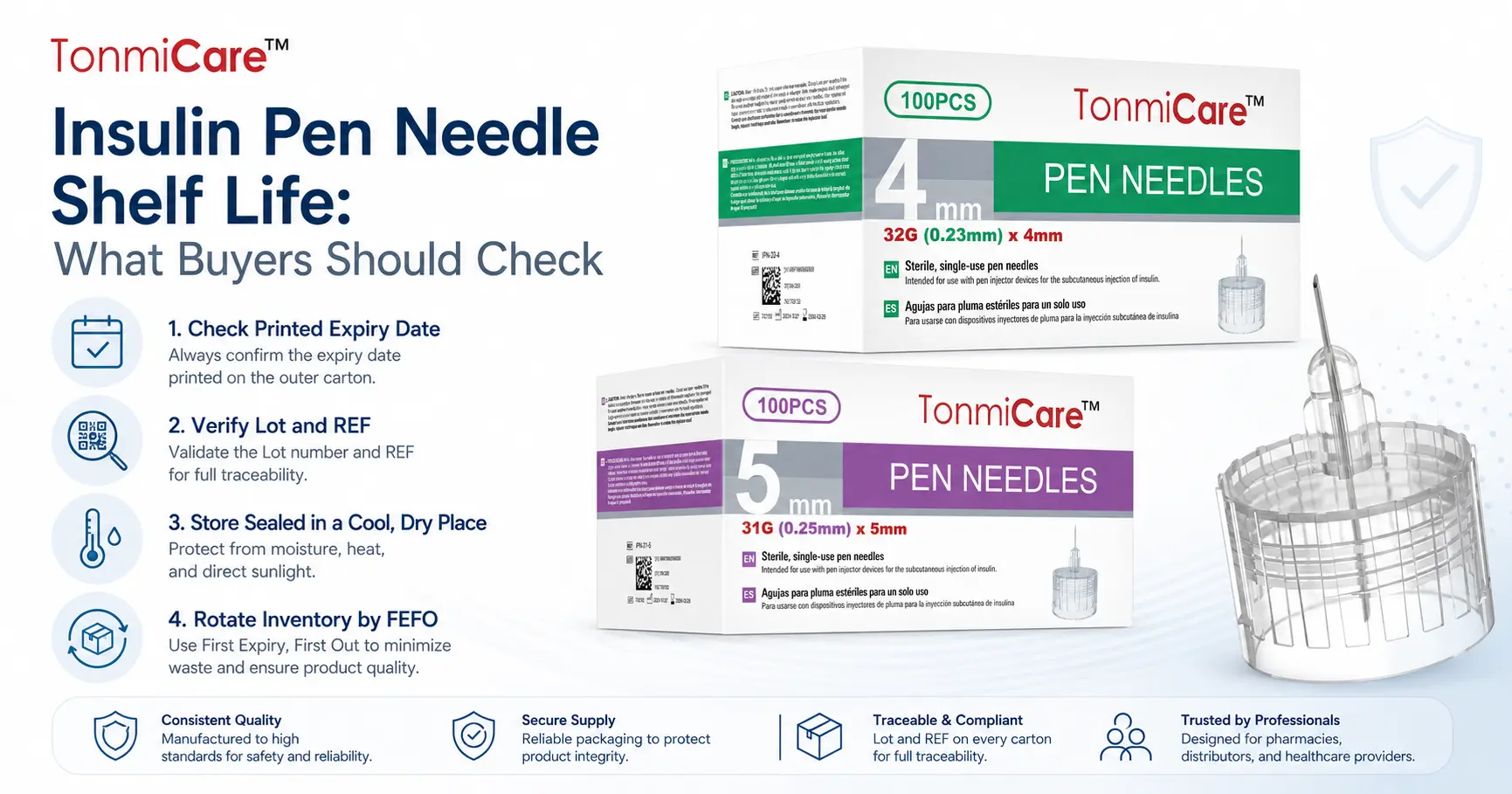
Inventory definitions
2. Shelf Life, Expiration Date and Remaining Shelf Life Are Different
A procurement team needs three separate fields. Treating them as synonyms makes it difficult to compare suppliers or enforce receiving requirements.
Supported period
The manufacturer-supported period for the exact finished device and packaging system under labeled storage conditions.
Lot-level release limit
The date printed or encoded for the actual product package. This is the date the pharmacy manages operationally.
Buyer acceptance window
The time from receipt, quote or current date to the printed expiration date for the specific lot.
A “five-year shelf life” claim does not mean a pharmacy will receive five years of usable inventory. A lot manufactured and released earlier may have substantially less time remaining when it reaches a distributor or pharmacy. The purchase order should specify the minimum acceptable remaining life and the date on which it is measured.
Evidence boundary
3. Is Pen Needle Shelf Life Three Years or Five Years?
Both values can be correct for different finished devices. The controlled question is not “What is the industry shelf life?” but “What shelf life and expiry apply to this exact manufacturer, device family, REF and package?”
| Public record | Device scope in that record | Reported shelf life | Correct buyer use |
|---|---|---|---|
| FDA K192464 | Injection Pen Needle sizes identified in the submission | 3 years | Evidence that a documented pen needle may use a three-year period; not proof for another SKU |
| FDA K202319 | Ordinary and safety insulin pen needle families identified in the submission | 5 years | Evidence that a documented family may support five years; map only to covered products |
| Embecta REF 320119 | One current 31G × 5 mm U.S. product record | 1,825 days | Exact product-page example; do not transfer its value, case pack or storage wording to Tonmit or another REF |
The public record supports the device scope described in that submission. It does not automatically validate every future private-label configuration, packaging material, sterilization process, production site, artwork revision or unrelated catalog number. The quoted commercial SKU must map to its own controlled evidence.
What the date represents
4. Shelf-Life Review Covers More Than the Metal Needle
A sterile pen needle is a finished device inside a packaging system. Shelf-life support can involve device performance, material aging, sterilization-related considerations and the ability of the sterile barrier to remain suitable through the claimed period. FDA’s recognized ISO 11607-1 standard addresses materials, sterile-barrier systems and packaging systems intended to maintain sterility until the point of use.[3] FDA also recognizes ISO 11608-2:2022 for finished single-use, double-ended sterile needles used with certain needle-based injection systems; that performance standard does not create one shelf-life value for every marketed pen needle.[7]
Performance-related evidence
- Needle, hub, covers or safety components
- Materials, adhesive and lubricant where applicable
- Connection and finished-device performance
- Applicable aging and post-aging acceptance criteria
Sterile-barrier and distribution evidence
- Seal and package integrity
- Environmental conditioning and transport simulation where applicable
- Label readability and correct product identification
- Final sterile, packaged configuration
K202319, for example, reports package-integrity testing after environmental conditioning and simulated transport, sterile-barrier package tests and five-year accelerated-aging support for the proposed device family.[5] That evidence illustrates why a buyer should request more than a marketing statement.
Expiry does not prove that sterility or performance disappears instantaneously, but the manufacturer-supported labeled period has ended. A pharmacy should not release expired stock based on visual appearance or an assumption that the date is conservative. Any formal extension would require authorized evidence and a controlled disposition—not an inventory judgment.
Storage controls
5. How Pharmacies Should Store Insulin Pen Needles
The exact label and IFU control. A buyer should not create a universal temperature or humidity specification from retailer copy, another brand’s label or the storage conditions for insulin. Where the product gives numerical limits, the pharmacy should determine how those limits are monitored and how an excursion is assessed. Where the label uses broader wording, retain that controlled wording and obtain clarification when the operational environment may be outside it.
- Retain the approved label and storage statementConnect the current document to the exact manufacturer, REF and packaging revision.
- Keep saleable product in its controlled packageDo not remove sterile units from the approved sales presentation merely to save shelf space.
- Protect the package from avoidable physical damageControl crushing, puncture, water exposure, contamination, excessive stacking and contact with floors or leak-prone areas.
- Separate inventory statusReleased, quarantined, recalled, damaged, returned and expired stock should not share an uncontrolled pick location.
- Investigate storage deviationsRecord the lot, duration, observed conditions and affected quantity; obtain an authorized disposition before release.
- Do not use the medication refrigerator by defaultRefrigeration can create a separate handling and condensation-control problem and should not be chosen unless the exact device labeling or an authorized instruction supports it.
FDA’s public labeling guidance states that labels should remain legible during customary processing, storage, handling, distribution and use. It also notes that shelf-life dating solely for package integrity and sterility is not usually required for general medical devices, even though manufacturers of sterile devices commonly use lot or serial controls and many finished products bear an expiration date.[1] Buyers should therefore avoid claiming that FDA mandates one universal dating period while still enforcing the actual label on the product received.
Dock-to-release workflow
6. Build an Exact-SKU Receiving Acceptance Gate
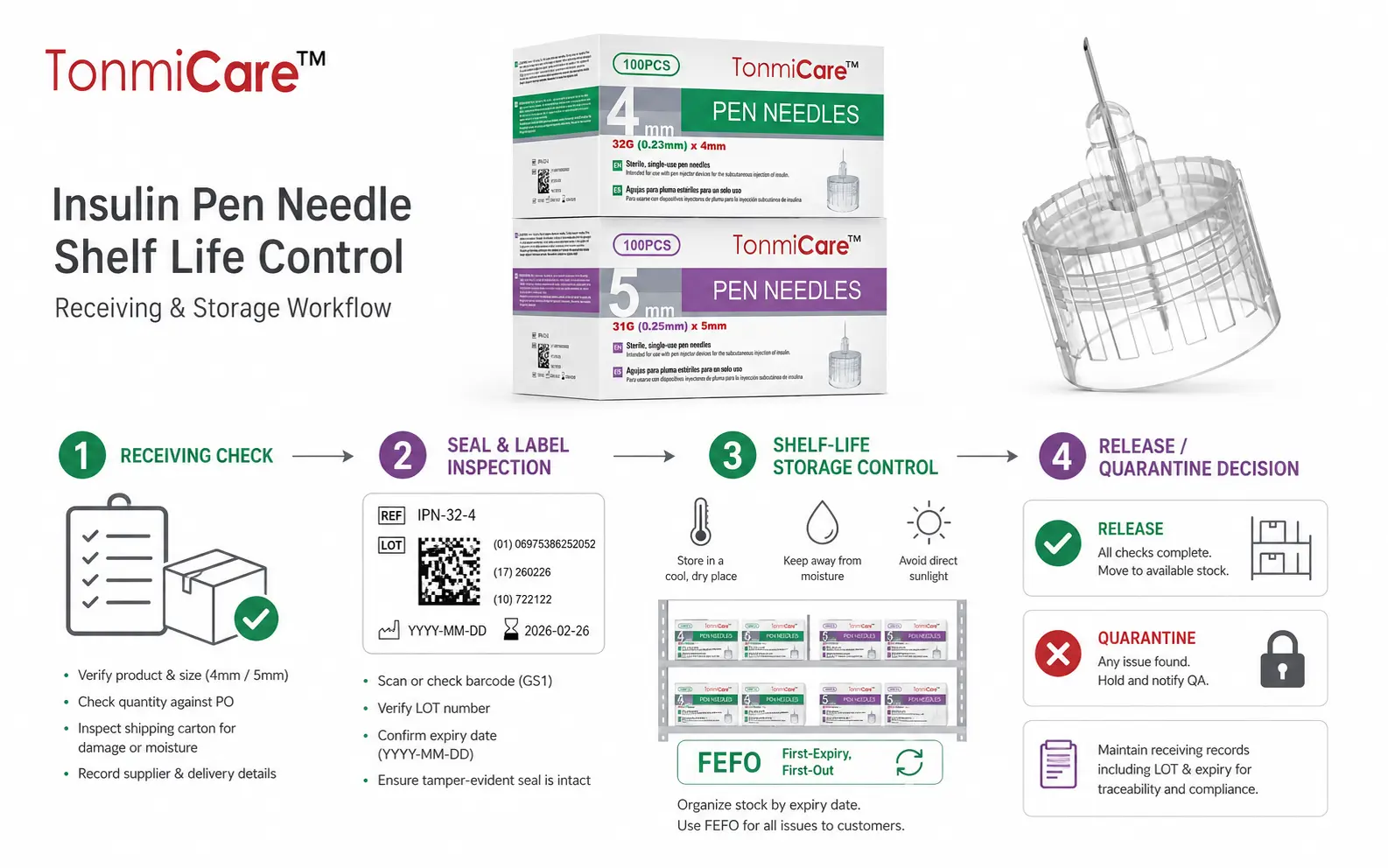
Receiving should determine whether the shipment is the approved product and whether the specific lots are still commercially usable. A packing list that matches the purchase-order quantity is not enough.
| Control | Evidence at receipt | Release question | Hold trigger |
|---|---|---|---|
| Product identity | Manufacturer/labeler, brand, REF, gauge × length and design | Is this the approved exact SKU? | Wrong, missing or substituted REF |
| Packaging | Needles/box, boxes/case, package-level identifier and label revision | Does the physical hierarchy match the PO? | Unexpected count, case pack or artwork |
| Lot and expiry | Printed and scanned values plus quantity by lot | Does each lot meet the remaining-life rule? | Missing, unreadable, conflicting or unacceptable date |
| Package condition | Case, box and sampled sterile-unit condition under the receiving plan | Is saleable packaging intact? | Water, crushing, puncture, open seal or contamination concern |
| Storage evidence | Required shipment or excursion records when the exact label calls for them | Were labeled conditions maintained? | Unresolved excursion or missing required record |
Record quantity by lot-expiry combination. If one case contains multiple lots, each lot and quantity should be declared and received separately unless the buyer’s approved system can preserve the relationship without ambiguity.
Tonmit buyer control record
Lot & Expiry Receiving Record
This is a blank receiving and documentation-control template for buyer use. It records visible package condition, product identity, lot, expiry and transaction evidence. It is not a completed Tonmit inspection report and does not independently establish sterility, package-integrity performance, shelf-life validation, storage-excursion acceptability or clinical performance.
Commercial acceptance
7. Set a Minimum Remaining Shelf-Life Requirement
There is no universal FDA rule requiring a pharmacy to receive a fixed percentage of the original shelf life. A minimum remaining-life requirement is generally a buyer, contract, tender or distribution-policy control. It should reflect demand, replenishment lead time, customer requirements, returns and the time needed to remove stock before expiry.
| Policy field | What to state | Why it matters |
|---|---|---|
| Measurement date | At quotation, shipment, delivery or receipt | Prevents the same number being measured at different transaction points |
| Minimum period | Buyer-approved months/days or percentage | Creates an objective release threshold |
| Exception approval | Named authority and written customer acceptance | Prevents short-dated stock from being silently released |
| Return treatment | Returnable, nonreturnable, replacement or credit rules | Allocates the commercial expiry risk |
| Customer cutoff | Minimum life required at outbound shipment | May be earlier than the printed product expiry |
It does not identify the original validated period, the manufacturing or release date, the allowable loss before receipt, or the lot being quoted. Request the actual expiration date or a minimum remaining period measured at a defined transaction point.
Inventory rotation
8. Use FEFO After Product Release
FIFO sends the earliest receipt first. FEFO sends the earliest acceptable expiration first. For dated medical-device inventory, FEFO is usually the more useful rotation logic, but it cannot override quarantine, recall status, customer shelf-life requirements or an approved allocation plan.
- Create the item master at exact-REF levelDo not combine non-equivalent manufacturers, designs or packaging revisions under one uncontrolled item.
- Capture every lot and expiration dateUse the printed label and validated barcode parsing where applicable.
- Apply the receiving shelf-life gateRejected or pending lots enter quarantine, not the FEFO pick queue.
- Pick the earliest acceptable expiryRespect customer-specific remaining-life and substitution requirements.
- Run exception reportsReview configurable warning bands, zero-demand lots, overstocks, returns and location imbalances.
- Block expired and recalled lotsUse both system status and physical segregation.
- Retain outbound traceabilityConnect lot-expiry quantities to the destination or customer record required by the operation.
Warning bands such as 12, 9, 6, 3 and 1 months may help a buyer build reports, but they are examples rather than universal pharmacy requirements. The correct thresholds depend on product velocity, order frequency, customer rules and returns.
Data capture
9. Connect UDI, Lot and Expiration Without Confusing Them
FDA describes the UDI device identifier as the fixed portion identifying the labeler and specific device version or model. The production identifier is the variable portion and may include lot, serial number, expiration date or manufacturing date when those data appear on the label.[2]
| Field | Meaning | Inventory treatment |
|---|---|---|
| Manufacturer REF | Catalog identity used in purchasing and product documentation | Primary exact-SKU cross-reference |
| DI / applicable GTIN | Fixed identifier for the labeler, version/model and package level | Item and package-level identity |
| Lot / batch | Production grouping assigned by the labeler | Traceability, recall, complaint and disposition |
| Expiration date | Variable date for the physical product lot/package | Receiving gate, FEFO and expiry blocking |
| Distributor item number | Channel-specific ordering code | Cross-reference only; never a replacement for manufacturer identity |
GUDID contains only DI data, not the actual PI values for the lot in a pharmacy’s possession.[2] The buyer must capture the real lot and expiry from the physical label or transaction records. If scanned and printed values disagree, quarantine the affected quantity and investigate the scanner configuration, barcode parsing and source label before release.
Complaint and safety-report records should retain the product name, manufacturer, model or catalog number, lot, expiration and UDI when available. FDA’s Form 3500 instructions request device-identification details of this type because they help identify the product involved.[8]
Condition overrides the calendar
10. Packaging Damage Can Make Stock Unacceptable Before Expiry
A future expiration date does not override a damaged sterile barrier, unreadable label, contaminated package or product-identity discrepancy. Inspection criteria should distinguish a damaged shipping case from damage to the saleable box or individual sterile presentation, then define what quantity is affected.
Assess containment
Record crushing, puncture, water exposure and affected inner quantities. Do not assume every box is damaged or every box is unaffected.
Assess identity and saleability
Confirm label readability, tampering concerns, count, closure and the condition of contained sterile units under the approved plan.
Do not repair the barrier
An open, torn, punctured or otherwise compromised individual sterile package should not be re-taped or re-sealed for release.
Quarantine questionable stock, preserve photographs and lot data, and obtain the supplier or manufacturer’s authorized disposition. Do not create a new expiry date, rework a sterile barrier or average good and damaged quantities into one released lot without a controlled basis.
Expiry-adjusted economics
11. Price Short-Dated Stock by Expected Saleable Quantity
A lower case price can become more expensive when the pharmacy cannot sell or distribute enough boxes before its customer cutoff. Compare the expected usable quantity, not only the invoiced quantity.
| Question | Evidence needed | Risk if ignored |
|---|---|---|
| How many boxes can sell before the customer cutoff? | Demand history, confirmed programs and seasonality | Overstated saleable quantity |
| How much buffer must remain? | Safety-stock policy and replenishment lead time | Stockout or expiry from excess buffer |
| Can inventory be returned or transferred? | Written returns, transfer and customer-life rules | Unrecoverable write-off |
| Is customer approval required? | Contract or written short-date acceptance | Dispute, rejection or loss of account |
Do not present a percentage discount as proof of value. A short-dated offer should state the exact REF, lot, expiration date, quantity, location, delivery date, returnability and any outbound shelf-life restriction.
Network inventory
12. Control Expiry Across Multiple Pharmacy Locations
Multi-location operators can reduce expiry exposure by moving an earlier-expiring lot to a location with verified demand, but the transfer must preserve product identity, lot, expiration, condition and storage history. Moving stock does not eliminate expiry risk; it changes its location.
- Use one controlled item identityAll locations should map the distributor code to the same approved manufacturer REF and package level.
- Retain lot-expiry by locationDo not reduce branch inventory to a total quantity that hides which lot expires first.
- Transfer only to evidenced demandUse consumption and customer shelf-life rules, not an assumption that a larger store will sell it.
- Record the movementPreserve source, destination, quantity, date, condition and responsible person.
- Re-run FEFO at the destinationThe transferred lot enters the local acceptable-expiry queue; it does not automatically move to the front.
Supply-path comparison
13. U.S. Warehouse Stock and Factory Stock Can Carry Different Expiry Risk
Domestic inventory can shorten delivery time, but an available U.S. lot may have less remaining shelf life than a later factory lot. Factory production can offer a more recent lot, but production, release and transport time consume part of the available period. Neither route is automatically better; compare the exact lot and delivery plan.
| Field | Available U.S. inventory | Factory / scheduled supply |
|---|---|---|
| Exact product | Confirm REF, lot, pack and U.S. market documentation | Confirm finished configuration and destination-market scope |
| Expiry evidence | Request current lot-expiry and quantity available | Request expected manufacture/release window and minimum life at receipt |
| Lead time | Domestic pick, handling and delivery | Production, release, freight, import and final delivery |
| Case pack | Use the warehouse trade unit actually offered | Use the factory-standard or approved project pack |
| Decision | Choose from landed cost, acceptable remaining life, required documents, demand and continuity—not location alone | |
Tonmit’s U.S. warehouse support guide explains how buyers can compare domestic availability with factory-direct supply. Inventory, exact lot, shelf life, documentation and delivery terms remain quotation-specific.
Lifecycle control
14. Private Label and Packaging Changes Need Shelf-Life Review
A shelf-life claim belongs to a defined product and packaging system. Private-label artwork alone may not change the physical sterile barrier, but a project can also change the label stock, ink, carton, package hierarchy, sterilization-related configuration, manufacturing site or materials. Each proposed change should be reviewed against the supporting evidence and applicable change-control process.
Map the evidence
- Legal manufacturer, labeler and exact model/REF
- Sterile-barrier and secondary-package configuration
- Sterilization method and production site
- Labeled shelf life and storage conditions
- UDI/GTIN, lot and expiry presentation
Control the transition
- Document the approved effective date and revision
- Separate old and new packaging inventory
- Update item master, scans and receiving instructions
- Prevent unsupported carryover of a three- or five-year claim
- Notify buyers according to the agreed change process
Supplier qualification
15. Documents Pharmacies and Distributors Should Request
Request a document set that maps to the commercial product being purchased. A product-family brochure or certificate image should not be used as shelf-life evidence for an unrelated REF.
| Document or record | Minimum fields | Buyer decision supported |
|---|---|---|
| Current product specification | Manufacturer, labeler, REF, gauge, length, design, materials and sterile presentation | Exact-SKU identity |
| Approved label and IFU | Expiry, storage, symbols, package quantity, revision and complaint contact | Operational label control |
| Shelf-life statement | Supported period, covered models/packs and applicable storage conditions | Claim-to-product mapping |
| Packaging evidence summary | Sterile-barrier configuration and applicable aging, integrity or distribution support | Package and shelf-life review |
| UDI/GTIN hierarchy | DI by applicable package level and PI fields expected on the label | Item master and scanning |
| Lot-expiry availability | Actual lot, expiry, quantity, inventory location and quote date | Remaining-life decision |
| Change notification agreement | Product, package, label, site, sterilization and document changes | Lifecycle control |
Qualified buyers can request available medical-device documentation support for a defined sourcing project. Document availability and applicability must be confirmed for the selected product, manufacturer, destination and transaction.
Copyable procurement tool
16. Pen Needle Shelf-Life and Storage RFQ Template
Use one line for each exact product and packaging configuration. Require written approval before accepting a different REF, lot-life profile or package.
Lot & Expiry Receiving Checklist
Blank worksheet for exact-SKU identity, lot, expiration, remaining-life acceptance, package condition and disposition.
View template
PEN NEEDLE LOT & EXPIRY RECEIVING CHECKLIST

Product / brand:
Legal manufacturer / labeler:
Exact REF / catalog number:
Gauge × length:
Design / family:
Needles per box:
Boxes per case:
Label / IFU revision:

Lot / batch:
Expiration date:
Quantity in this lot:
Receipt date:
Minimum remaining-life requirement:
Remaining-life result: PASS / HOLD / EXCEPTION

Case condition:
Saleable-box condition:
Sampled sterile-unit condition:
DI / GTIN (if applicable):
Storage / shipment evidence required:
Storage / shipment evidence received:

Disposition: RELEASED / QUARANTINED / REJECTED / EXCEPTION
Reviewer:
Review date:
Evidence / exception reference:
Notes:

METHOD LIMIT:
This is a blank procurement and receiving-control template. It records visible packaging, identity, lot, expiry and transaction evidence. It does not independently establish sterility, package-integrity performance, shelf-life validation, excursion acceptability or clinical performance.
Pen Needle Shelf-Life RFQ
Copyable request for exact-REF shelf life, storage, lot-expiry availability, case pack and commercial terms.
View template
PEN NEEDLE SHELF-LIFE & LOT REVIEW RFQ

RFQ subject: Insulin Pen Needles — Shelf-Life & Lot Review

PRODUCT
Legal manufacturer:
Brand / labeler:
Exact REF / catalog number:
Design / family:
Gauge × length:
Current label / IFU revision:

SHELF LIFE & STORAGE
Labeled shelf life:
Storage statement exactly as labeled:
Expiration-date format:
Shelf-life evidence applicable to this REF / pack:
Minimum remaining shelf life required at receipt:
Measurement point: QUOTE / SHIPMENT / DELIVERY / RECEIPT

LOT / PACK / TRACEABILITY
Needles per box:
Boxes per case:
Actual available lot(s):
Actual expiration date(s):
Quantity by lot:
DI / GTIN by package level where applicable:
Mixed-lot case: YES / NO / APPROVAL REQUIRED

COMMERCIAL
Order quantity:
Annual / monthly demand:
Inventory source: U.S. STOCK / FACTORY / SCHEDULED SUPPLY
Destination:
Required delivery window:
Returns / short-date terms:
Private-label / packaging requirement:
Required documents:
No substitution or shelf-life exception without written buyer approval: REQUIRED
PRODUCT IDENTITY
Legal manufacturer: [company]
Brand / labeler: [name]
Exact REF / catalog number: [REF]
Design: [standard / safety / exact commercial family]
Gauge × length: [G × mm]
Current label / IFU revision: [revision and date]
SHELF LIFE AND STORAGE
Labeled shelf life: [months / years / days]
Storage statement exactly as labeled: [text]
Expiration-date format and package levels: [details]
Shelf-life evidence applicable to this REF and pack: [document]
Minimum remaining shelf life at receipt: [months / days / percentage]
Measurement date: [quote / ship / delivery / receipt]
LOT, PACKAGE AND TRACEABILITY
Needles per box / boxes per case: [quantity]
DI / GTIN by applicable package level: [identifiers]
PI fields encoded: [lot / expiry / manufacture date / other]
Actual available lot(s), expiry and quantity: [list]
Mixed-lot case permitted: [yes / no / approval required]
Packaging and sterile-barrier damage criteria: [document]
COMMERCIAL AND RECEIVING TERMS
Order quantity and annual forecast: [quantity + unit]
Inventory source: [U.S. stock / factory / scheduled supply]
Destination ZIP / country: [destination]
Returns and short-date terms: [details]
Storage or transport records required: [details]
No substitution, shelf-life exception or packaging change without written buyer approval: [required]
For exact specification, packaging and supply-path planning, use the wholesale insulin pen needle buying guide and review current wholesale pen needle options. Public family information is an RFQ starting point, not final approval of a specific lot.
Buyer questions
Insulin Pen Needle Shelf Life and Storage FAQ
Do insulin pen needles expire?
Many finished pen needle products bear an expiration date. Follow the date and storage conditions on the exact product label. Do not authorize expired inventory for release based only on an intact-looking box.
Do all insulin pen needles have a five-year shelf life?
No. Public FDA records include both three-year and five-year pen needle examples. Verify the exact manufacturer, model or REF, packaging system, label and supporting evidence for the product being purchased.
Do insulin pen needles need refrigeration?
Do not refrigerate detachable pen needles merely because the medication pen requires refrigeration. Follow the exact needle label or IFU. If storage wording is unclear, obtain the manufacturer or labeler’s current controlled statement before approval.
Can a pharmacy use the medication refrigerator for pen needle boxes?
Not by default. A refrigerator is a separate storage environment and may introduce condensation or handling risks. Use it only when the exact device labeling or an authorized instruction supports that condition and the pharmacy can control it.
Does opening the 100-count sales box start a new expiry period?
Opening an outer sales box is not automatically equivalent to opening an insulin drug product. The exact label and packaging configuration control. Individual sterile packages must remain intact, and the opened box must still meet the pharmacy’s identity, count, storage and saleability requirements.
Can an expired pen needle be dispensed if the individual seal looks intact?
No pharmacy release decision should extend the manufacturer’s labeled period based on visual inspection alone. Quarantine expired stock and follow the organization’s controlled disposition process.
What if the sterile package is damaged before the printed expiry?
Quarantine the affected unit or quantity. A future expiration date does not override an open, torn, punctured or otherwise compromised sterile barrier. Do not tape or reseal it for release.
Should pharmacy inventory use FIFO or FEFO?
FEFO is generally more useful for dated inventory because it prioritizes the earliest acceptable expiry. It must still respect quarantine, recall, customer remaining-life requirements, product identity and allocation controls.
How much remaining shelf life should a pharmacy require?
There is no universal percentage. Set a written threshold based on demand, delivery and replenishment time, customer cutoffs, returns and risk. State whether it is measured at quote, shipment, delivery or receipt.
Can GUDID show the actual expiration date of the lot received?
No. FDA states that GUDID contains DI data and does not contain the actual PI values. Capture the real lot and expiration from the physical label and transaction records.
What if the scanned expiry differs from the printed expiry?
Place the affected quantity on hold. Preserve the scan and label evidence, verify scanner and date parsing, and obtain an authorized written resolution. Do not select whichever date gives the longer shelf life.
Can one case contain multiple lots?
A buyer may prohibit mixed lots by contract. If they are accepted, receive and retain the quantity for each lot-expiry combination separately so FEFO, recall and complaint records remain usable.
Can a three- or five-year shelf-life claim be reused for a private-label product?
Not automatically. The private-label finished device, packaging, sterilization, manufacturer/labeler roles and supporting evidence must be mapped. A public record for another SKU is not a transferable shelf-life certificate.
What should buyers request before accepting short-dated inventory?
Request the exact REF, lot, expiry, quantity, inventory location, expected delivery date, price, returnability, customer remaining-life restrictions and written exception approval. Compare cost per expected saleable box.
Procurement conclusion
17. Manage the Exact Lot, Not a Generic “Five-Year” Claim
A defensible pharmacy inventory process connects the exact pen needle SKU to its controlled label, supported shelf life, storage statement, physical lot, printed expiry and package condition. It then applies a written remaining-life gate, FEFO, traceable transfers and a controlled disposition for damaged, recalled or expired stock.
The practical rule is: verify the exact REF, receive the exact lot, store to the exact label and release the earliest acceptable expiry—not simply the oldest carton.
Source basis
Official and Primary Sources Used for This Guide
- FDA — Quality System Regulation Labeling Requirements
- FDA — UDI Basics
- FDA Recognized Standard — ISO 11607-1:2019, including AMD1:2023
- FDA 510(k) Summary K192464 — Injection Pen Needle, Three-Year Shelf-Life Example
- FDA 510(k) Summary K202319 — Insulin Pen Needle, Five-Year Shelf-Life Example
- Embecta U.S. Product Record 320119 — 1,825-Day Exact-SKU Example
- FDA Recognized Standard — ISO 11608-2:2022 for Single-Use Pen Needles
- FDA — Instructions for Completing Form FDA 3500
This guide was reviewed by James Wilson (Product Specification Reviewer), Michael Thompson (Quality Documentation Reviewer) and David Anderson (Regulatory Research Reviewer). Reviewer roles and team information are available on the Tonmit Editorial Team page.
Official links and the cited product record were reviewed again on September 22, 2026. Regulations, standards, product records, labels, storage statements and commercial availability can change. Recheck the current official source and exact product documentation before a future procurement, storage or release decision. The K192464, K202319 and Embecta records are included as product-specific examples; they do not establish a Tonmit or industry-wide shelf life.
Exact-SKU Pen Needle Inventory Support
Confirm the Lot, Expiry and Supply Path Before Ordering
Share the required gauge × length, design, exact or target REF, packaging, annual demand, destination, minimum remaining shelf life and document checklist. Tonmit can review available pen needle configurations, U.S. inventory support, factory supply paths and transaction-specific lot, packaging and delivery information.