
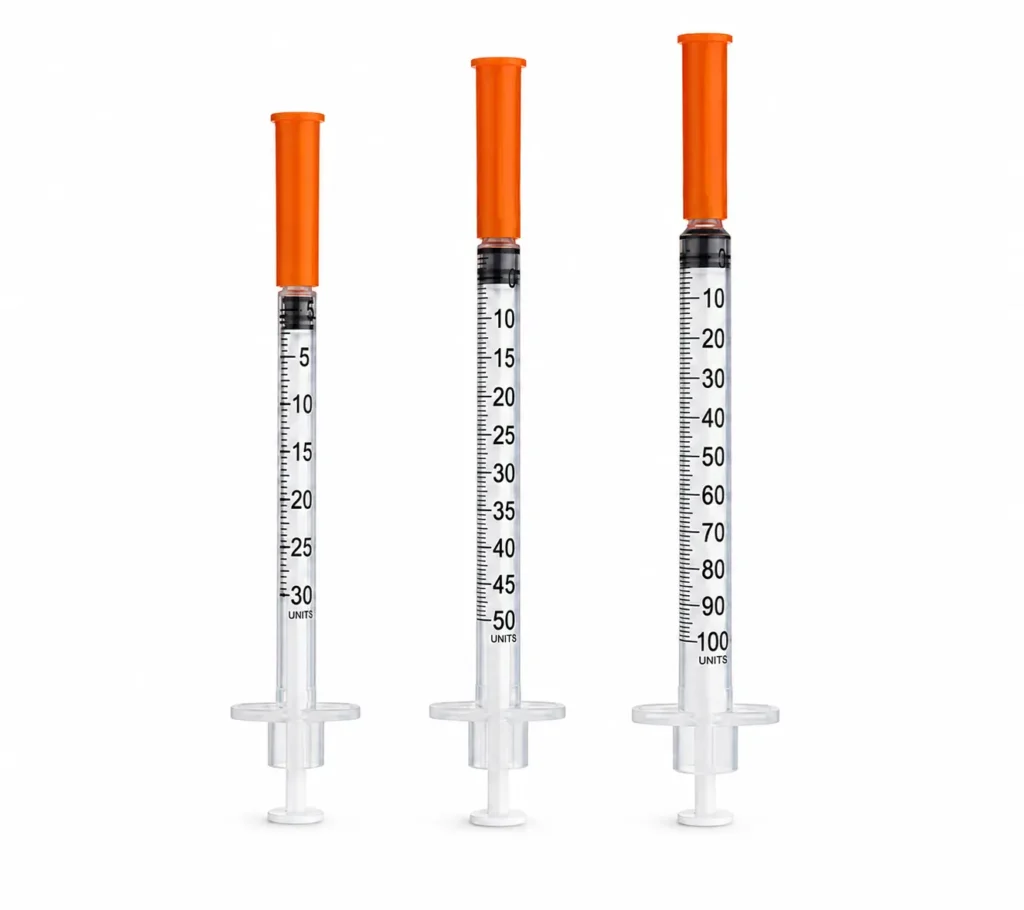
Insulin delivery · Needle specifications
What do 29G, 31G, 6 mm and 5/16 inch actually tell you? Use this guide to compare insulin syringe needle sizes, read a product label and distinguish needle dimensions from barrel capacity and insulin concentration.
This guide explains specifications and labeling. For personal use, confirm the syringe, needle and injection technique with your diabetes care professional and follow the product instructions.
Quick answer
What size are insulin syringe needles?
Insulin syringe needle size has two parts: gauge, which describes thickness, and length, which is usually stated in millimeters or inches. A 31G needle is thinner than a 29G needle. Common examples in a major U.S. manufacturer's syringe range include 6 mm, 8 mm and 12.7 mm lengths; the available combinations vary by brand and product.[1][2]
A label such as 31G × 8 mm describes the needle only. It does not tell you whether the barrel holds 0.3, 0.5 or 1 mL, or whether its markings are for U-100 insulin. Read those specifications separately.
Needle size at a glance
Insulin syringe needle sizes: gauge and length chart
Read these as two separate measurements. Gauge does not determine length, and the examples below do not imply that every combination is available.
Gauge: higher number, thinner needle
Scroll horizontally to view all columns.
| Gauge | Thickness comparison |
|---|---|
| 28G | Thicker than 29G–32G |
| 29G | Thicker than 30G–32G |
| 30G | Between 29G and 31G |
| 31G | Thinner than 29G and 30G |
| 32G | Thinner than 31G |
Length: millimeters and inches
Scroll horizontally to view all columns.
| Length | Decimal inches | Inch label |
|---|---|---|
| 6 mm | ≈ 0.236 in | Not 3/16 in |
| 8 mm | ≈ 0.315 in | ≈ 5/16 in |
| 12.7 mm | 0.500 in | Exactly 1/2 in |
Example: 31G × 6 mm identifies thickness and length; it does not identify barrel capacity or concentration scale.
Key takeaways
- Gauge and length are independent: a higher gauge number means a thinner needle, not a longer one.
- Capacity is a barrel specification: a larger prescribed dose does not, by itself, call for a longer needle.
- Device type matters: syringe needles and pen needles are different products, even when their gauge numbers overlap.
- Read the complete label: check concentration scale, capacity, graduation interval, gauge and length before comparing products.
Gauge, length, capacity and scale: four different specifications
Searching for an “insulin needle size chart” can bring together information about needles, syringe barrels and pen devices. Separating the following fields makes those results easier to interpret.
Scroll horizontally to view all columns.
| Specification | Example | What it tells you |
|---|---|---|
| Needle gauge | 29G, 30G or 31G | The needle's outside thickness. Higher numbers indicate thinner needles. |
| Needle length | 6 mm or 8 mm | The labeled needle length; this is independent of gauge and barrel capacity. |
| Barrel capacity | 0.3 mL, 0.5 mL or 1 mL | The maximum volume the syringe is designed to hold. |
| Concentration scale | U-100 | The insulin concentration for which the unit markings are calibrated. |
Graduation interval is another label detail: it means the amount represented by each small scale division. Two syringes with the same capacity can have different marking intervals. Our insulin syringe capacity guide covers barrel sizes in more detail.
Insulin needle gauge size chart: 28G to 32G
What gauge are insulin needles? Insulin syringe product families include several gauges, rather than one universal size. For example, the FDA's public K223453 summary lists 28G through 32G in that particular syringe family. This demonstrates available design options; it does not establish that every brand supplies every gauge.[3]
Scroll horizontally to view all columns.
| Gauge | Relative thickness | What to check on the product |
|---|---|---|
| 28G | Thicker than 29G–32G | Exact needle length and syringe configuration |
| 29G | Thinner than 28G; thicker than 30G | Capacity, concentration scale and length |
| 30G | Between 29G and 31G | The complete specification, not gauge alone |
| 31G | Thinner than 30G | Length and barrel markings; these remain separate choices |
| 32G | Thinner than 31G | Device category and exact SKU; 32G is not exclusive to pen needles |
29G vs 30G vs 31G: what changes?
The gauge number describes outside diameter. It does not fully describe the opening inside the needle: wall thickness also affects that internal opening, or lumen. Needle design therefore matters alongside the gauge printed on the box. Avoid treating a gauge comparison as a complete comparison of comfort or flow characteristics.[1]
How long are insulin syringe needles?
The following chart uses the 6 mm, 8 mm and 12.7 mm lengths listed in embecta's U.S. Ultra-Fine syringe portfolio as familiar examples. They are not an exhaustive list of all syringe needles or a recommendation to switch sizes.[2]
Scroll horizontally to view all columns.
| Labeled length | Decimal inches | Interpretation |
|---|---|---|
| 6 mm | Approximately 0.236 in | A short syringe needle option; check the associated gauge and capacity. |
| 8 mm | Approximately 0.315 in | Often described as 5/16 inch in product labeling. |
| 12.7 mm | 0.500 in | Exactly 1/2 inch; longer than the other examples in this table. |
What is the shortest insulin syringe needle?
There is no reliable worldwide answer without specifying the product range and market. Embecta identifies its 6 mm × 31G option as its shortest syringe needle. Other product documentation includes different lengths, so a brand-specific statement should not be presented as a universal minimum.[2][3]
5/16 inch, 1/2 inch and 3/16 inch: check the conversion
Fractional inch labels are common in purchasing lists. A small labeling difference can create a different order, especially when one supplier uses inches and another uses millimeters.
Scroll horizontally to view all columns.
| Inch label | Exact conversion | Comparison note |
|---|---|---|
| 3/16 in | 4.7625 mm | Approximately 5 mm; it is not equivalent to 6 mm. |
| 5/16 in | 7.9375 mm | Approximately 8 mm; confirm how the manufacturer states the length. |
| 1/2 in | 12.7 mm | An exact conversion; do not silently replace it with 12 mm. |
A list containing “12 mm,” “12.7 mm” and “13 mm” should not be treated as three interchangeable labels. Ask whether a value is an exact specification or a rounded description, and record the manufacturer item number.
Insulin syringe needles vs insulin pen needles
An insulin syringe has a barrel and plunger for measuring insulin drawn from a vial. A pen needle is an attachment used with a compatible insulin pen. A standalone pen needle has no syringe barrel. These products should not be substituted for one another based on a matching gauge number.
The 2025 FITTER Forward device guidance distinguishes a 6 mm, 31G syringe needle from a 4 mm, 32G pen needle in its recommendations. That distinction is useful when reading general needle-size advice: a recommendation for a pen device is not automatically a syringe product specification.[4]
For pen users, the device connection and manufacturer compatibility instructions matter as well as dimensions. See our insulin pen needle sizes and compatibility guide for that separate product category.
How to choose insulin syringe needle gauge and length
Start with the correct device and insulin concentration, then check needle dimensions and barrel markings. “Better” depends on the product and the person's injection needs.
What size is recommended for insulin syringes?
The 2025 FITTER Forward guidance recommends 6 mm length and 31G for syringe needles. Its pen-needle guidance specifies 4 mm and 32G. Confirm the syringe choice and the appropriate injection technique with your diabetes care professional.[4]
- Confirm the device and concentration. A vial-and-syringe system differs from a pen. Match the syringe's unit scale to the prescribed insulin concentration.
- Compare length and gauge separately. Read both fields on the package; a higher gauge number means a thinner needle, not a shorter one.
- Match capacity and graduations to the prescribed dose. The barrel must accommodate the dose and its markings must support measuring it. Our insulin syringe capacity and marking guide explains the barrel options.
- Confirm technique for the individual. Ask the care team to review the injection site, skinfold and angle. These should not be inferred from body size or a needle chart alone.[6]
Does a thinner or longer insulin needle work better?
Thickness, length and technique answer different questions, so a simple ranking from best to worst would be misleading.
A higher gauge does not guarantee a painless injection
Finer needles can help reduce discomfort, but needle tip geometry and other design features also affect the injection experience. Gauge alone cannot promise a painless injection. If injections are painful, ask your care team to review the device and technique rather than choosing a replacement solely from a thickness chart.[1][4]
A larger dose does not automatically need a longer needle
Dose volume affects the required barrel capacity. Needle length relates to reaching the intended subcutaneous tissue while avoiding muscle. These are separate considerations. Do not infer needle length from the syringe's maximum unit count.[5][6]
A larger body size does not automatically require a longer needle
Published injection recommendations support short needles across patient categories; longer is not inherently more effective. A clinician can assess the site, age, body composition and technique, including whether a skinfold or a different angle is needed. Children and very lean people require particular care to avoid unintended intramuscular injection.[6]
How to read “U-100 · 0.5 mL · 31G × 8 mm”
This illustrative label contains four useful specifications. Reading each field separately prevents a needle comparison from becoming a concentration or capacity mix-up.
- U-100: the unit scale is calibrated for insulin containing 100 units per mL.
- 0.5 mL: the barrel's capacity. On a U-100 syringe, this corresponds to a maximum of 50 units.
- 31G: the needle's gauge, not its length.
- 8 mm: the needle length, not the barrel volume.
For U-100 syringes specifically, the common 0.3, 0.5 and 1 mL capacities correspond to maximum markings of 30, 50 and 100 units. That does not determine the smallest graduation: verify whether the exact product has half-unit, one-unit or another marking interval.[5]
These U-100 relationships must not be carried over to a different concentration. Our U-40 vs U-100 syringe scale guide explains the labeling distinction. For Humulin R U-500 supplied in a vial, Lilly's instructions require a U-500 syringe and warn against using other syringe types.[9]
From package to syringe
Match all four specifications
An illustrative label and schematic syringe show which details to compare.
Example package label
Insulin syringe
- Concentration scale
- U-100
- Barrel capacity
- 0.5 mL
- Needle gauge
- 31G
- Needle length
- 8 mm
For U-100 insulin, 0.5 mL corresponds to a maximum capacity of 50 units. This is capacity, not a dose recommendation.
Check the syringe and its packaging
- Scale: confirm U-100 markings.
- Capacity: confirm the 0.5 mL barrel.
- Needle: confirm 31G × 8 mm on the label.
- Graduations: read the actual value of each scale division.
For pharmacies, clinics and distributors
A purchasing checklist that goes beyond needle gauge
For a replacement or bulk order, start with the currently approved item specification. Compare proposed products field by field before accepting a substitute. A quote that says only “31G insulin syringe” leaves several important details unresolved.
- Identify the device: insulin syringe, concentration scale and fixed or other specified needle configuration.
- Record the barrel: capacity, maximum unit marking and graduation interval.
- Record the needle: gauge and labeled length, retaining both inch and metric descriptions when supplied.
- Verify the order unit: individual sterile packaging, pieces per box and boxes per carton.
- Confirm the exact SKU: manufacturer item number, labeling, shelf-life requirements and documentation applicable to the destination market.
For broader supplier checks, read our insulin syringe supplier evaluation guide. Needle dimensions alone do not establish the regulatory status or availability of a particular SKU.
Specification request template
Product: Insulin syringes
Insulin concentration scale:
Barrel capacity and maximum unit marking:
Graduation interval:
Needle gauge:
Needle length (manufacturer label):
Needle configuration:
Manufacturer / current item number:
Sterile packaging and pieces per box:
Required quantity / recurring demand:
Destination market:
Labeling / documentation requirements:
Substitution permitted: only after written specification approval
Frequently asked questions about insulin needle sizes
What needle size is best for insulin injections?
For vial-and-syringe use, FITTER Forward's 2025 guidance recommends 6 mm, 31G syringe needles. This general guidance differs from its pen-needle recommendations. Confirm your product and injection technique with your diabetes care professional.[4]
Are shorter insulin syringe needles effective?
Yes. Short syringe needles can deliver insulin into the intended subcutaneous tissue when used with the appropriate technique. A longer needle is not automatically more effective. Ask your care team whether a skinfold or a different angle is needed for your syringe.[4][6]
What should I check if insulin injections are painful?
Ask your diabetes care team to review needle dimensions, injection technique and site rotation. A finer needle may improve comfort, but gauge alone does not guarantee a painless injection; needle-tip design also matters.[1][6]
Can I reuse an insulin syringe or needle?
Use a new sterile syringe and needle for each injection, following single-use labeling. Never share syringes, even if the needle is changed. Place used sharps promptly in an appropriate sharps container and follow local disposal instructions.[2][7][8]
Is a 31G insulin needle thinner than a 29G needle?
Yes. The higher gauge number indicates a thinner outside diameter. This comparison does not tell you the length, barrel capacity or graduation interval.[1]
Are all insulin needles the same size?
No. Both gauge and length vary, and syringe needles are a different device category from pen needles. Compare the complete product label rather than the phrase “insulin needle.”
Does 31G always mean a 6 mm needle?
No. Gauge and length are independent specifications. A 31G × 6 mm label states one combination; another product can pair that gauge with a different length.
Is 5/16 inch the same as 8 mm?
It is a common rounded description: 5/16 inch converts to 7.9375 mm. For a purchase or substitution, use the manufacturer's labeled specification and item number.
Does a 1 mL insulin syringe always have a longer needle?
No. The barrel capacity does not determine needle length. Check the gauge and length fields separately from the 1 mL capacity.
Can an insulin syringe have a 32G needle?
Yes. The FDA's K223453 summary includes 32G insulin syringes in that specific family. A 32G label alone does not identify a pen needle or confirm a particular brand's catalog.[3]
References and editorial notes
We checked professional guidance, published research, manufacturer labeling and public regulatory documentation. Product examples describe the cited range only. The FITTER infographic below is sponsored by embecta. This article provides specification education and does not assign a needle size to an individual patient.
- Heinemann L, et al. Needle Technology for Insulin Administration: A Century of Innovation. Journal of Diabetes Science and Technology. 2023;17(2):449–457. Published online in 2021. DOI: 10.1177/19322968211059564.
- embecta. U.S. Ultra-Fine insulin syringe product information. Manufacturer information on lengths, capacities and scale options.
- U.S. Food and Drug Administration. K223453 insulin syringe 510(k) summary (PDF). Product-family comparison table, page 5 of the PDF.
- FITTER Forward. 2025 device characteristic recommendations (PDF). Companion resource to Klonoff DC, et al. Advance Insulin Injection Technique and Education With FITTER Forward Expert Recommendations. Mayo Clinic Proceedings. 2025;100(4):682–699. DOI: 10.1016/j.mayocp.2025.01.004.
- American Diabetes Association Professional Practice Committee. Diabetes Technology: Standards of Care in Diabetes—2026. Diabetes Care. 2026;49(Suppl. 1):S150–S165. DOI: 10.2337/dc26-S007.
- Frid AH, et al. New Insulin Delivery Recommendations. Mayo Clinic Proceedings. 2016;91(9):1231–1255. DOI: 10.1016/j.mayocp.2016.06.010.
- Centers for Disease Control and Prevention. Preventing Unsafe Injection Practices.
- U.S. Food and Drug Administration. DOs and DON'Ts of Proper Sharps Disposal. Consumer guidance for home, work and travel.
- Eli Lilly and Company. Humulin R U-500 vial instructions for use (PDF). Syringe-specific concentration warning.
Source check date: October 10, 2026. Tell our editorial team if you notice a labeling change or a correction that would make this guide more useful.