
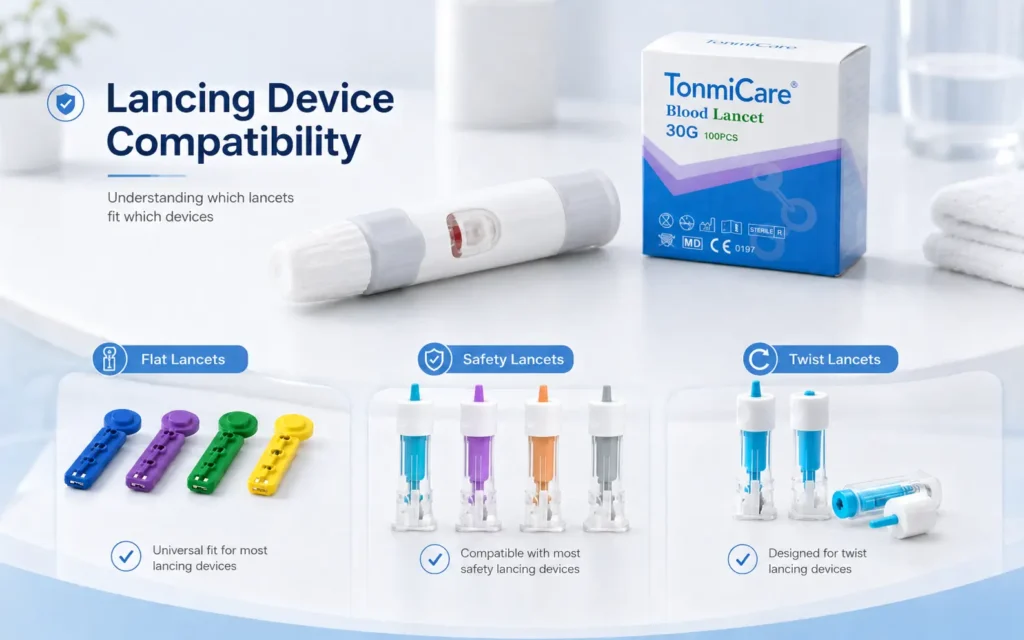
2026 Blood Glucose Monitoring Guide
An evidence-informed framework for comparing 28G, 30G and 33G lancets by gauge, penetration depth, sample requirement, device fit, care setting, safety design and controlled SKU documentation.
Editorial disclosure: This article is an educational product-selection and procurement resource. It does not select a lancet for an individual, replace a device’s instructions for use, or establish a facility infection-control policy. Healthcare professionals, purchasers and users should follow the meter and lancing-device instructions, current product labeling, organizational policy and applicable law. Compatibility, gauge, depth, sterility, regulatory status, packaging and availability must be verified for the exact SKU.
Direct answer
Quick Answer: 28G vs 30G vs 33G Lancets
When comparing lancet gauge sizes, 33G is generally thinner than 30G, and 30G is thinner than 28G. Gauge alone does not determine comfort or blood volume. Penetration depth, device mechanics, tip design, skin characteristics, technique and the meter’s sample requirement also matter. Compatibility must be confirmed from the exact lancing-device instructions; some systems accept standard lancets, while others require a proprietary lancet or drum.
Executive summary
Key Takeaways
- Gauge describes diameter, not penetration depth. A 33G lancet is generally finer than a 30G or 28G lancet, but the depth setting or fixed-depth design must be reviewed separately.
- “Thinner equals less painful” is not a universal clinical result. A study of 28G, 30G and 33G lancets found that depth and lancing-device type influenced outcomes more clearly than gauge alone.
- Lancets are not universally compatible. Standard twist-top products may fit multiple conventional devices, but proprietary drums, cartridges and model-specific lancets require an exact match.
- Personal self-monitoring and assisted monitoring are different use environments. CDC recommends single-use, auto-disabling fingerstick devices for assisted blood glucose monitoring.
- Color is not a compatibility code. Match the device model, lancet family, dimensions, gauge, tip cover, insertion geometry and instructions—not cap or body color.
- Bulk approval should control the complete SKU. Gauge, depth, device compatibility, sterile barrier, label, REF, case pack, remaining shelf life, regulatory mapping and change notification belong in the RFQ.
1. Lancet Gauge Sizes: What 28G, 30G and 33G Mean
Lancet gauge sizes use an inverse numbering convention: within comparable products, a higher gauge number generally describes a thinner penetrating element. This means 33G is finer than 30G, while 28G is the thickest of the three. That relationship is useful, but it is only one field in the complete device specification.
| Gauge | Relative thickness within this comparison | What it may change | What it does not prove |
|---|---|---|---|
| 28G | Thicker than 30G and 33G | May be used in designs intended to support a larger or more reliable sample under defined conditions | Does not guarantee a larger drop, successful first puncture or greater pain |
| 30G | Between 28G and 33G | Commonly appears in personal lancet and safety-lancet product ranges | Does not establish compatibility, depth, sample volume or intended care setting |
| 33G | Finer than 28G and 30G | May be selected in a compatible system where a finer lancet is desired and the required sample can be obtained | Does not guarantee less pain or adequate blood volume for every user, meter or depth setting |
Avoid copying a generic millimeter value into a purchase order unless it appears in the controlled specification for the quoted product. Commercial charts may use rounded gauge-to-diameter conversions, while tip geometry, grinding, coating and tolerances can also differ. If outside diameter is an approval field, request the manufacturer-stated metric dimension and test method for the exact REF.
Procurement rule: “30G lancet” is a category description, not a complete SKU. It does not identify penetration depth, compatible device, sterile-barrier format, single-use mechanism, manufacturer, REF or regulatory record.
2. Separate Gauge, Penetration Depth and Required Sample Volume
Search results often combine three variables that should remain separate:
| Field | What it describes | How buyers should verify it |
|---|---|---|
| Lancet gauge | Relative diameter of the penetrating element | Exact gauge on specification, label and purchase order |
| Penetration depth | How far the lancet is intended to enter the skin; adjustable in some reusable devices and fixed in many safety lancets | Device instructions, depth-setting range or exact fixed-depth SKU |
| Required blood sample | Minimum sample the meter or point-of-care test requires | Current meter or test-system instructions for use |
| Obtained blood volume | What the complete device-user-skin interaction actually produces | Usability evidence, product performance records and controlled evaluation |
In a reusable pen-style lancing device, the same compatible lancet may be used at different device depth settings. In a single-use safety lancet, gauge and penetration depth are normally integrated into one fixed product configuration. A purchaser who records only “30G” can therefore receive two functionally different products.
The meter is another part of the system. A product intended for a small-sample blood glucose meter may not be the right choice for a test requiring a larger capillary sample. Do not infer sample compatibility from a marketing phrase such as “ultra thin.” Record the exact test system, its current minimum sample requirement and the approved lancing configuration.
3. Do Finer Lancets Hurt Less or Produce Less Blood?
It is reasonable to expect needle diameter to influence the puncture, but it is inaccurate to promise that a higher gauge will always be less painful or that a lower gauge will always produce more blood. Lancing depth, device motion, tip geometry, skin thickness, callus, puncture location, hand temperature and technique can change the result.
A randomized study evaluated three lancing devices with 28G, 30G and 33G personal lancets at minimum and maximum depth settings. Ninety adults with diabetes underwent 360 lancing procedures. In the aggregated comparison, the investigators did not find a statistically significant effect of lancet gauge on blood volume or pain. Maximum depth produced higher blood volume and pain than minimum depth, and pain also differed by device type.[1]
This study does not prove that gauge never matters. It tested three device designs, two settings and a defined adult population. It does show why an article should not turn “28G vs 30G vs 33G” into a universal pain ranking. The complete lancing system matters.
A more defensible comfort claim
Instead of stating “33G is painless,” a supplier can say:
A finer gauge may be considered as one part of a comfort-oriented configuration, but comfort and sample adequacy also depend on penetration depth, device design, skin characteristics and technique. Evaluate the exact compatible system.
When a sample is difficult to obtain
Do not automatically substitute a thicker lancet. First check the meter instructions, compatible lancet family, device assembly, depth setting, puncture site and technique. A second unplanned puncture may create more discomfort than using a properly configured first attempt. Individual users should follow their healthcare professional’s and device manufacturer’s instructions.
4. Are Lancets Universal?
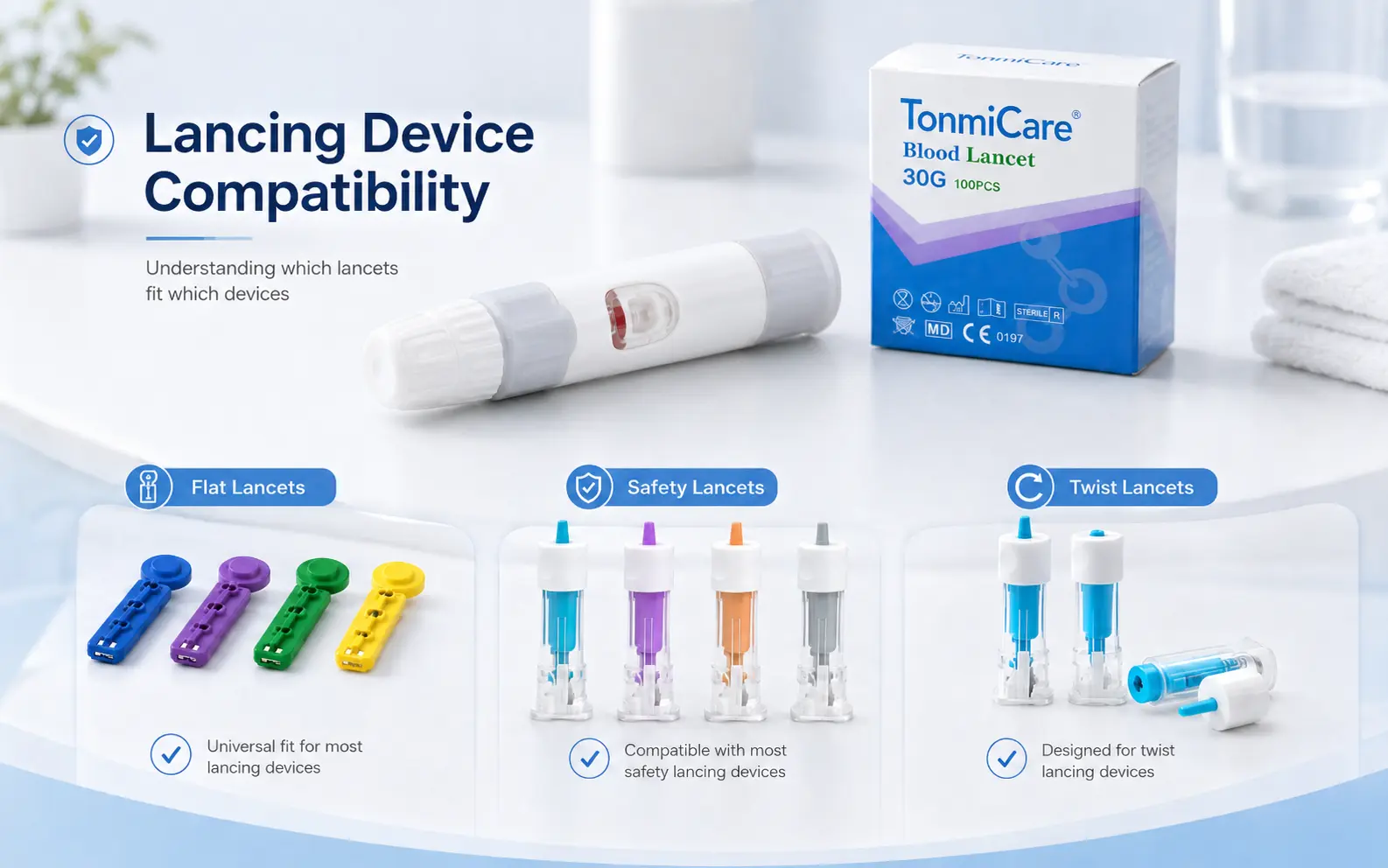
No—“universal lancets” should not be treated as a universal compatibility guarantee. Some conventional twist-top lancets are designed to fit a range of standard pen-style lancing devices, but other systems use proprietary lancets, drums, cartridges or insertion geometry. Even within a broad-fit family, the supplier’s compatibility statement should name the supported device models.
For example, the manufacturer states that Accu-Chek FastClix lancets can only be used with the Accu-Chek FastClix lancing device. The product uses 30G lancets preloaded in drums, demonstrating that the gauge number does not reveal the physical interface.[2]
| Lancet system | Compatibility approach | Main procurement risk |
|---|---|---|
| Standard twist-top lancet | May fit multiple conventional devices when supported by supplier or device documentation | “Universal” claim is accepted without a named compatibility list or fit evaluation |
| Model-specific lancet | Match the exact lancet family to the named device model | Similar appearance is mistaken for interchangeability |
| Drum or cartridge system | Use only the drum or cartridge specified by the device manufacturer | Gauge is matched but loading mechanism and housing are incompatible |
| Single-use safety lancet | No separate reusable lancing device is normally required; gauge, depth and activation are integrated | Buyer searches for pen compatibility instead of confirming fixed-depth and activation requirements |
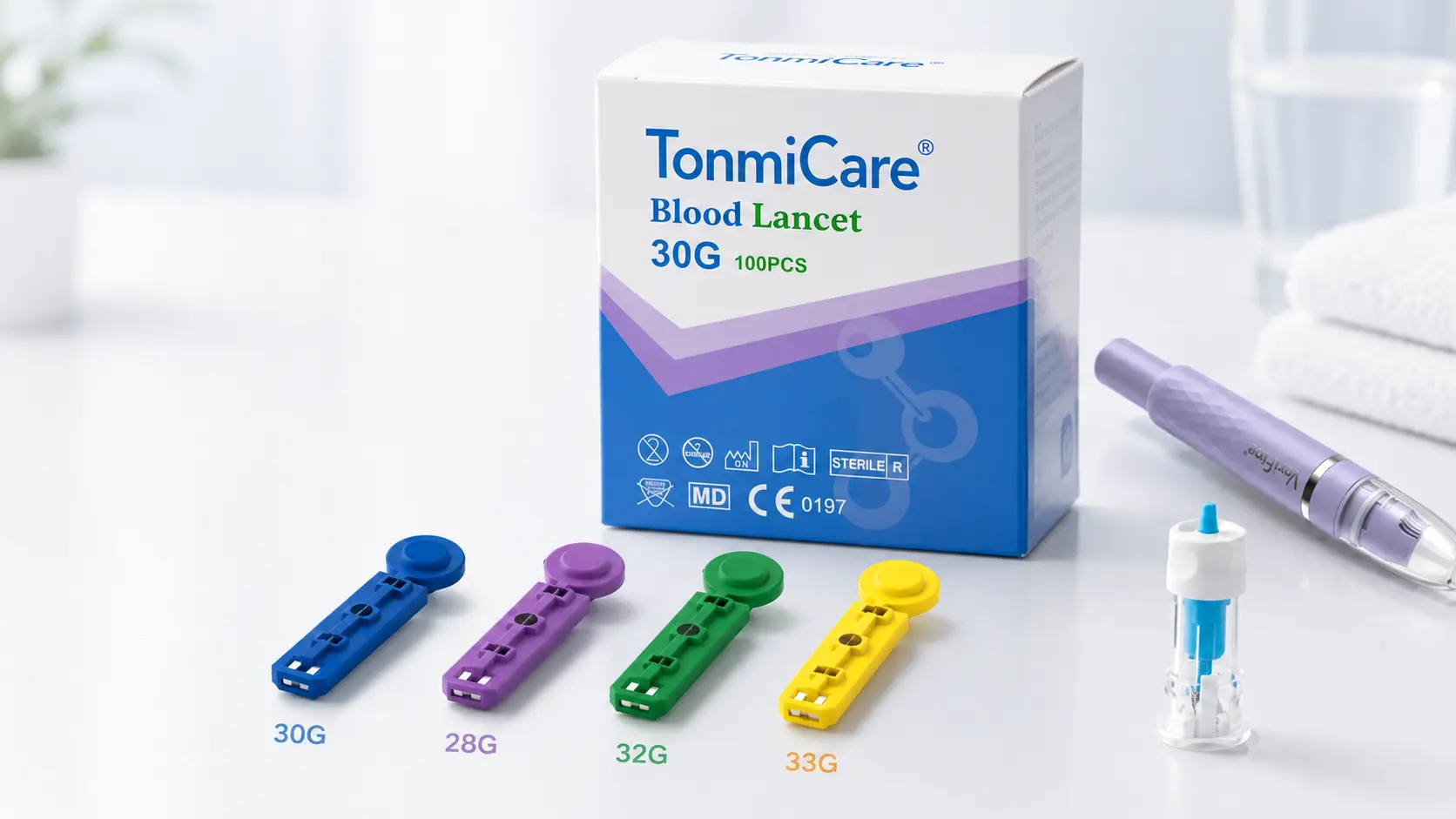
Do not use cap color, body color or a product photograph as compatibility evidence. Color schemes are not standardized across all manufacturers and may represent gauge, depth, product family or branding—or have no technical meaning outside that supplier’s system.
5. A Lancing Device Compatibility Workflow
A pharmacy or distributor considering an alternative lancet should build a documented fit decision. “Looks the same” and “works with most devices” are not enough.
- Identify the exact lancing device. Record manufacturer, model name, model number and current instructions for use.
- Classify the lancet interface. Determine whether it uses a standard twist-top form, a named proprietary lancet, a drum or another cartridge system.
- Obtain the proposed lancet identity. Record legal manufacturer, brand, REF, gauge, dimensions, protective-cap design and sterile package.
- Request written compatibility support. Use a supplier compatibility statement, device instructions or model-level technical record—not an unsupported marketplace listing.
- Evaluate insertion and retention. Confirm that the lancet seats fully, the cap closes, the device cocks and releases normally, and ejection or removal follows the instructions.
- Verify performance in the intended workflow. Confirm sample adequacy, depth-setting behavior and safe post-use handling under an approved evaluation protocol.
- Control substitutions. Approve one REF-to-device mapping and require written notice before a change to dimensions, molding, tip, cap, packaging or manufacturing site.
A compatibility evaluation should use an approved protocol and the responsible clinical, laboratory, infection-control and procurement teams as appropriate. It is not permission to test unapproved combinations casually on patients.
6. Standard Lancets vs Safety Lancets
“Standard lancet” and “safety lancet” describe different workflows. A standard disposable lancet is commonly loaded into a reusable lancing device assigned to one person. A single-use safety lancet integrates the penetrating element, activation mechanism and post-use sharps protection into one disposable device.
| Feature | Standard lancet + reusable device | Single-use safety lancet |
|---|---|---|
| Typical workflow | Personal self-monitoring with a device assigned to one person | Assisted monitoring, screening or professional settings when supported by intended use |
| Depth | Often adjusted on the reusable device | Usually fixed by exact safety-lancet SKU |
| Compatibility | Must fit the reusable lancing device | Self-contained; confirm intended use, gauge, fixed depth and activation method |
| Reuse control | Lancet is discarded; reusable base remains assigned to one person | Auto-disabling or irreversible mechanism prevents another use |
| Sharps exposure | Used lancet removal and disposal require controlled handling | Integral feature should cover or retract the sharp after activation |
| RFQ fields | Device list, fit, gauge, sterile package and removal method | Gauge, depth, activation, retraction, sample claim and intended setting |
Under current U.S. device regulation, these distinctions are not merely marketing categories. The current blood-lancet regulation separately describes single-use devices with an integral sharps injury-prevention feature, single-use devices without that feature, and multiple-use-capable devices intended for one patient.[3]
7. Lancet Selection for Clinics and Assisted Blood Glucose Monitoring
Healthcare facilities should not take a personal self-testing workflow and apply it unchanged to multiple patients. CDC states that fingerstick devices should never be used for more than one person. For assisted blood glucose monitoring, CDC recommends single-use, auto-disabling fingerstick devices and selection of single-use lancets that permanently retract after puncture.[4]
FDA’s blood-lancet labeling guidance likewise recommends that multiple-use-capable devices be labeled for single-patient use and not be used for assisted blood draws at healthcare sites. It recommends single-use disposable lancets for assisted blood draws and clear instructions for disposal and any self-disabling feature.[5]
OSHA’s interpretation of the Bloodborne Pathogens Standard states that employers must provide safety-engineered lancets for employees performing finger-prick blood sampling unless a safer device is contraindicated in a particular medical situation. OSHA distinguishes this occupational use from an individual performing personal self-testing.[6]
Facility selection fields
- intended use includes the planned healthcare setting;
- single-use and auto-disabling mechanism is clear;
- sharp retracts or is otherwise protected irreversibly after activation;
- gauge and fixed penetration depth match the test and patient population under facility review;
- activation method supports the intended workflow and personal protective equipment;
- instructions address use, hand hygiene, skin preparation and safe disposal;
- the used device fits the point-of-use sharps container without forcing or hand entry.
For disposal planning, use Tonmit’s sharps container selection guide to compare opening, capacity, placement and changeout. CDC recommends disposing of used lancets at the point of use in an approved sharps container.[4]
8. FDA Status, Labeling and Quality Evidence
Blood lancets are regulated under 21 CFR 878.4850. As of the current rule, single-use blood lancets with an integral sharps injury-prevention feature, single-use lancets without that feature, and multiple-use-capable lancets for single-patient use are Class II devices subject to special controls. A multiple-use blood lancet intended for multiple patients is Class III and subject to premarket approval requirements.[3]
| Regulatory category | Example FDA product code | Key buyer question |
|---|---|---|
| Single use with integral sharps injury-prevention feature | FMK[8] | Does the exact safety lancet irreversibly disable after use, and is the quoted model mapped to the applicable 510(k)? |
| Single use without integral sharps injury-prevention feature | QRK[7] | Is the product intended, labeled and controlled for single use, with safe handling and disposal instructions? |
| Multiple-use capable for single patient only | QRL[9] | Is the reusable base restricted to one patient, and are cleaning, disinfection and compatible blade instructions validated? |
FDA’s classification database identifies QRK devices as Class II under 21 CFR 878.4850 and subject to 510(k) review.[7] The exact product code and clearance pathway depend on device design and intended use, so buyers should not transfer a record from one lancet family to another.
Request a SKU-level identity file that includes, as applicable:
- legal manufacturer, manufacturing site, brand owner, labeler, importer and distributor roles;
- manufacturer REF and supplier item number;
- intended use, care environment and single-patient or single-use restrictions;
- gauge, outside diameter where controlled, penetration depth and activation design;
- compatible lancing-device models or confirmation that the product is self-contained;
- applicable FDA product code, 510(k), device listing and UDI/GUDID record where required;
- current label, instructions for use and sterile-barrier configuration;
- biocompatibility, sterilization, package integrity, shelf-life and mechanical performance evidence appropriate to the exact device;
- complaint, nonconformance, field-action, traceability and change-notification procedures.
A registration number, an FDA logo in a brochure or the phrase “FDA certified” is not a substitute for this mapping. Use the regulatory term supported by the exact public record and controlled device file.
9. Packaging, Shelf Life and Bulk Supply Planning
Gauge and fit bring the product into the evaluation; packaging and supply controls determine whether it can be distributed reliably. Tonmit’s wholesale diabetes care supplies program includes blood glucose monitoring and accessory categories, but availability, specifications and U.S. warehouse support should be confirmed for each quoted SKU and transaction.
| Supply field | Why it matters | Required RFQ detail |
|---|---|---|
| Sterile barrier | Protects the skin-penetrating component until use | Individual protective format, sterilization method, integrity evidence and opening instructions |
| Pack hierarchy | Affects dispensing, case pricing, freight and replenishment | Units per retail pack, packs per case, units per case and pallet data |
| Lot and expiry | Supports receiving, traceability and stock rotation | Lot format, labeled shelf life and minimum remaining shelf life at shipment |
| Model identity | Prevents gauge-only or color-only substitution | REF, barcode/UDI where applicable, label revision and compatibility statement |
| Warehouse status | Availability changes by SKU, lot and order | Exact REF, available quantity, lot, expiration, processing time and destination-based delivery estimate |
| Change control | Small dimensional changes may affect fit or activation | Advance notice for material, molding, tip, cap, sterile barrier, site, label or device-list changes |
For broader program planning, link lancets to the meter, strips, control solution, lancing devices and disposal pathway instead of buying them as isolated consumables. Tonmit’s blood glucose monitoring supplies page can be used to organize the product list, while exact system compatibility remains a model-level approval.
10. Lancet Selection Matrix by Use Environment
| Use environment | Likely product route | Priority checks |
|---|---|---|
| Personal self-monitoring with an existing pen-style device | Fresh compatible standard lancet for each test; reusable device remains assigned to one person | Exact device model, compatible lancet family, gauge, depth setting and user instructions |
| Personal system using a drum or cartridge | Manufacturer-specified drum or cartridge | System name, cartridge generation, gauge, loading, advancement and disposal |
| Assisted blood glucose monitoring in a clinic or long-term-care setting | Single-use auto-disabling safety lancet with intended use supporting the setting | Fixed gauge/depth, activation, irreversible retraction, PPE workflow and point-of-use disposal |
| Pharmacy retail replacement | Exact compatible refill or documented alternative | Named device list, package identity, consumer labeling and no unsupported equivalence claim |
| Distributor private-label program | Controlled standard or safety-lancet family | Regulatory roles, 510(k) mapping, labeler/UDI analysis, compatibility evidence, MOQ and change control |
No row assigns 28G, 30G or 33G automatically. Gauge selection still depends on the approved device, depth, sample requirement, intended population and product evidence. The matrix chooses the product architecture first, then the exact specification.
11. Lancet and Lancing Device RFQ Checklist
Use the following fields to make competing quotations comparable:
| Category | Required information | Buyer status |
|---|---|---|
| Use case | Personal self-monitoring, assisted monitoring, screening or other defined setting | Required |
| Product type | Standard lancet, proprietary refill, drum/cartridge or single-use safety lancet | No automatic substitution |
| Specification | Gauge, metric diameter if controlled, penetration depth, activation method and sample claim | Exact REF |
| Compatibility | Named lancing-device models and supporting document, or confirmation of self-contained design | Written evidence |
| Safety | Single use, single patient, auto-disabling, retraction and post-use disposal statements | Match care setting |
| Regulatory | Legal manufacturer, product code, 510(k), listing, label, IFU and UDI where applicable | SKU mapping |
| Quality | Sterilization, sterile barrier, biocompatibility, mechanical performance, shelf life and complaint process | Controlled evidence |
| Commercial | MOQ, units per pack and case, carton/pallet data, artwork, lead time and price basis | Comparable quote |
| Fulfillment | Current U.S. inventory by REF, lot, expiry, quantity, processing window and destination | Transaction-specific |
| Lifecycle | Lot traceability, complaint exchange, field-action roles and advance change notification | Contract control |
Tonmit is the company and website operator; TonmiCare is the product brand used for applicable product programs. A TonmiCare package or private-label request must still be tied to the legal manufacturer, exact device family, regulatory record, controlled artwork and defined quality responsibilities.
Questions from users and healthcare buyers
12. Frequently Asked Questions
What do lancet gauge numbers mean?
Gauge describes the relative diameter of the penetrating element. Within common lancet labeling, a higher gauge number generally means a thinner lancet, so 33G is finer than 30G and 28G. Gauge does not describe penetration depth, device compatibility or sample volume by itself.
What is the difference between 28G, 30G and 33G lancets?
28G is the thickest and 33G the finest of the three, with 30G between them. The practical result depends on the complete device, including depth, tip design, skin and required sample. Compare the exact compatible system rather than assigning a universal “best” gauge.
Is a higher-gauge lancet thinner?
Generally, yes. The gauge numbering convention is inverse. If a metric outside diameter is needed for approval, verify it on the exact manufacturer specification instead of relying only on a rounded online conversion chart.
Are 33G lancets always less painful than 30G or 28G?
No universal guarantee is supported. A clinical study comparing 28G, 30G and 33G lancets did not find a significant aggregate gauge effect on pain; depth and device design also influenced outcomes. Individual experience and product design vary.
Is lancet gauge the same as penetration depth?
No. Gauge describes relative diameter. Depth describes penetration into the skin. Reusable lancing devices may provide adjustable depth, while many safety lancets use a fixed depth tied to the exact SKU.
Are blood glucose lancets universal?
No. Some standard twist-top lancets have documented broad compatibility, but proprietary devices, drums and cartridges require their specified lancet family. Confirm the exact device model and a current compatibility statement or instructions for use.
Can generic lancets replace branded lancets?
Only when the proposed product has documented fit for the exact lancing device and the buyer has approved its performance, labeling, sterile barrier and regulatory identity. A matching gauge or similar appearance is not sufficient evidence of interchangeability.
What is the difference between a standard lancet and a safety lancet?
A standard lancet is commonly installed in a reusable lancing device assigned to one person. A safety lancet is normally a self-contained, single-use device with an integral mechanism that disables the device and protects or retracts the sharp after activation.
Can a lancing device be used for more than one patient?
CDC states that fingerstick devices should never be used for more than one person. Reusable pen-style devices should remain assigned to one patient. Assisted monitoring should use single-use, auto-disabling fingerstick devices.
Which lancets should clinics use for assisted blood glucose monitoring?
CDC recommends single-use, auto-disabling devices and lancets that permanently retract after puncture for assisted monitoring. The facility should also confirm intended use, gauge, fixed depth, activation, labeling, regulatory record, PPE workflow and disposal.
Does the meter’s blood sample requirement affect lancet selection?
Yes. The required sample is specific to the meter or test system. Gauge alone does not prove that the device will reliably obtain that volume. Review the meter instructions and evaluate the complete approved lancing configuration.
How should used lancets be disposed of?
CDC recommends disposing of used lancets at the point of use in an approved sharps container. Follow the device instructions, facility policy and applicable state and local requirements; do not place exposed used lancets in ordinary trash.
Can lancet color identify the gauge or compatible device?
Not reliably. Color meanings vary by manufacturer and product family. Use the label, REF, gauge, depth and compatibility documentation. Do not approve or substitute a lancet by cap or body color.
What documents should a distributor request before bulk ordering?
Request the legal manufacturer, exact REF, intended use, gauge, depth, compatibility evidence, label and IFU, product code and applicable FDA record, sterile-barrier and shelf-life evidence, pack hierarchy, lot controls, change notification, current inventory and complaint procedures.
13. Limitations and Conclusion
A chart of lancet gauge sizes can explain that 33G is finer than 30G and 28G, but it cannot select a product on its own. Evidence from comparative lancing research shows that depth and device mechanics can influence blood volume and discomfort alongside gauge. The practical decision must connect gauge to the exact device, penetration depth, test-system sample requirement, user or patient population, care setting and product instructions.
For personal self-monitoring, approve the exact lancet family against the assigned lancing device. For clinics and other assisted-monitoring settings, follow CDC, FDA and OSHA guidance on single-use safety-engineered devices and point-of-use sharps disposal. For procurement, lock the manufacturer REF, compatibility evidence, sterile package, label, regulatory mapping, case quantity, shelf life and change-control terms before comparing price.
That is the useful answer to “Which lancet gauge is best?”: the best choice is not a number in isolation. It is the thinnest, deepest or most safety-engineered configuration that is appropriate for the intended workflow, demonstrably compatible, capable of obtaining the required sample and supported by complete SKU-level evidence.
Wholesale & documentation support
Request Lancet & Lancing Device Selection Support
Send Tonmit the intended care setting, lancing-device models, preferred gauge and depth, test-system sample requirement, pack quantity, annual demand, target market and required documentation. We can organize comparable product options and identify unresolved compatibility or regulatory fields before sample approval.
Include the exact lancing-device manufacturer and model. “Universal lancet, 30G” is not enough information to verify compatibility.
References
- Mianowska B, Mlynarski W, Szadkowska I, Szadkowska A. Evaluation of Three Lancing Devices: What Do Blood Volume and Lancing Pain Depend On? Journal of Diabetes Science and Technology. 2021;15(5):1076–1083. doi:10.1177/1932296820949930.
- Roche Diabetes Care. Accu-Chek FastClix Lancets—Product Specifications and Compatibility. Accessed July 28, 2026.
- Electronic Code of Federal Regulations. 21 CFR 878.4850—Blood Lancets. Current electronic edition accessed July 28, 2026.
- Centers for Disease Control and Prevention. Considerations for Blood Glucose Monitoring and Insulin Administration. Updated August 7, 2024; accessed July 28, 2026.
- U.S. Food and Drug Administration. Blood Lancet Labeling—Guidance for Industry and FDA Staff. November 29, 2010.
- Occupational Safety and Health Administration. OSHA’s Position on Lancets or Lancing Devices Without Safety-Engineered Features. Standard Interpretation, September 9, 2008.
- U.S. Food and Drug Administration. Product Classification: Single-Use Blood Lancet Without an Integral Sharps Injury-Prevention Feature—Product Code QRK. Accessed July 28, 2026.
- U.S. Food and Drug Administration. Product Classification: Single-Use Blood Lancet With an Integral Sharps Injury-Prevention Feature—Product Code FMK. Accessed July 28, 2026.
- U.S. Food and Drug Administration. Product Classification: Multiple-Use Blood Lancet for Single-Patient Use Only—Product Code QRL. Accessed July 28, 2026.